Labor will not support Adani’s proposed $16 billion Carmichael coalmine
 Not up to me to support $16 billion Adani coalmine: Shorten Opposition Leader Bill Shorten says it’s not up to him to support Adani’s proposed $16 billion Carmichael coalmine. SBS News, 1 June 16 Opposition Leader Bill Shorten has refused to throw his support behind the controversial Adani coalmine and says federal Labor would not spend any public money to help the massive project.
Mr Shorten said the future of the $16 billion Adani project in Queensland’s Galilee Basin was in the hands of investors.
“When you ask if I support it, it’s not up to me to support a particular business enterprise. Whether or not the Adani coalmine goes ahead will be up to the investors of Adani,” he told ABC radio in Brisbane.
“We won’t be expending any commonwealth resources on the Adani mine.”……
Labor on Wednesday pledged $100 million to help get community renewable energy projects off the ground…….http://www.sbs.com.au/news/article/2016/06/01/not-me-support-16-billion-adani-coalmine-shorten
Australian Conservation Foundation’s environment election scorecard
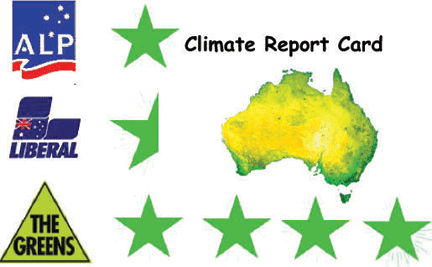 Environment scorecard rates Coalition’s policies ‘woefully inadequate’, Guardian, Gareth Hutchens, 31 May 2016 The Australian Conservation Foundation’s assessment of the parties’ policies awards the Coalition 11 points out of 100, Labor 53 and the Greens 77
The Australian Conservation Foundation has described the Coalition’s environmental policies as “woefully inadequate” in its traditional election scorecard.
It gave the Coalition 11 points out of a possible 100, Labor 53 and the Greens 77.
The ACF’s chief executive, Kelly O’Shanassy, said: “The politicians who want to lead the country must have real plans to protect people, rivers, reefs, forests and wildlife for the future.”
“The Coalition’s 11 out of 100 on the environment is woefully inadequate. If they are not prepared to lead on climate and nature, they are not fit to lead the country.
“It’s not as if conservatives can’t be good conservationists – Liberal cabinet minister Garfield Barwick was ACF’s first president; Robert Menzies signed the first Antarctic Treaty; Malcolm Fraser made Kakadu a national park; John Howard established the national greenhouse inventory and the national water initiative,” she said.
The scores were calculated by measuring the parties’ policies on clean energy, pollution reduction, and environmental protection, and comparing them with the 40 tests set out in ACF’s national agenda for 2016.
Those tests include setting stronger pollution targets to help limit global warming to less than 1.5C above pre-industrial temperatures; stopping uranium mining and export; delivering on the Murray-Darling Basin Plan; and shifting to 100% renewable energy by 2050.
The ACF decides how many marks to award for each party policy on the basis of how completely it fulfils the ACF’s tests. Where a policy unwinds existing environmental protection, the ACF awards negative marks.
An ACF spokesman said the organisation had been in contact with all three major parties this year to tell them how their policies would likely rate in its election scorecard with its policies as they stand…….
A recent poll showed climate change is one of the top four issues for voters at this election. http://www.theguardian.com/australia-news/2016/may/31/environment-scorecard-rates-coalitions-policies-woefully-inadequate
Transition to renewable energy favoured by most voters
Most voters support transition to 100% renewable energy, says Australia Institute
Polling indicates 71% would be more likely to vote for a party that supported distributed small-scale solar and storage, Guardian, http://www.theguardian.com/sustainable-business/2016/may/31/most-voters-support-transition-to-100-renewable-energy-says-australia-institute
Max Opray, 31 May 16, Battery storage technology has the potential to reshape not just the energy and transport sectors but also the upcoming Australian federal election, according to a new report.
The Australia Institute report Securing Renewables: How Batteries Solve the Problem of Clean Electricity includes polling indicating that 71% of Australians would be more likely to vote for a party that supported distributed small-scale solar and storage.
Based on a national opinion poll of 1,412 people undertaken between February and March 2016, the study also found 63% of respondents would be more likely to support a party that aims to transition to 100% renewable energy by 2030 and that 45% would be more likely to support a party that attempts to accelerate the uptake of electric vehicles.
“The combination of batteries paired with variable renewable energy such as solar and wind can now provide security of electricity supply, with zero emissions,” says the author of the report, Australia Institute strategist Dan Cass.
The report found that one in four Australians wish to create and store power in order to unplug from the grid and that 80% of the 1.5m Australian households to have already invested in rooftop solar are considering the purchase of batteries.
It also noted that the predicted boom in electric cars could see households using such vehicles when parked and plugged in as storage providers for the wider energy network.
Jobs in plenty in the renewabl energy industry
The Community Power Agency – which specialises in supporting community groups to set up a  community owned renewable energy (CORE) project – is directly working with the 70 community energy groups across Australia.
Looking towards the election, the Community Power Agency is calling on all political parties to put in place robust policy to support the growth of community energy innovation in Australia.
“In terms of the focus for the election… the ALP and the Greens have both come out with excellent renewable energy policy and have been talking about it quite a lot. They could be talking about it more. But certainly the ALP has committed $28.7 million to support community energy projects across Australia and they have also committed to a 50 per cent renewables target by 2030, so there is some good policy basis there, we are yet to see any kind of announcement on this type of thing from the Coalition which is very disappointing.
Renewable Energy is a Jobs Rich Industry http://probonoaustralia.com.au/news/2016/05/renewable-energy-jobs-rich-industry/ A Not for Profit organisation dedicated to growing the community energy sector in Australia has claimed renewable energy is a jobs rich industry.

The Community Power Agency said Australian regions and towns can maximise employment in renewable energy with community-owned projects.
It comes after a new global report released by the International Renewable Energy Agency (IRENA) showed that renewable energy jobs were on the rise, with community-owned projects to benefit most.
More than 8.1 million people around the world are now employed in renewable energy, up 5 per cent on last year.
Nicky Ison Community Power Agency director said renewable energy was a jobs-rich industry and when such projects were community-owned that created even more employment.
“The research from the US – because there are a lot more community energy programs in the US than here – shows that if you have a community ownership stake in a larger renewables project, like owning a couple of wind turbines in a larger wind farm, the economic benefit to that local community in terms of jobs, investment, money circulating in the local economy, the economic benefit is 1.5 to 3.5 times greater,” Ison told Pro Bono Australia News. Continue reading
Greens energy plan to generate $53 billion of investment in Queensland
 Greens announce $53b clean energy plan http://www.sbs.com.au/news/article/2016/05/29/greens-announce-53b-clean-energy-plan The Greens have announced a clean energy plan for Queensland which it says will generate $53 billion of investment in projects over 15 years. “This would be delivered through a combination of direct government investment and ownership, and reverse auctions which provide bankable incentives for private sector investment.”
Queensland Greens Senator Larissa Waters said delivering a clean-energy economy would also safeguard Great Barrier Reef tourism jobs and agricultural jobs that were threatened by coal mining and coal seam gas.
“The old parties are leaving Queensland at risk of missing out on the job-rich clean energy revolution,” she said.
Major political parties downplay environment as election approaches
Parties yet to turn on the green light http://www.heraldsun.com.au/news/breaking-news/parties-yet-to-turn-on-the-green-light/news-story/33847ddc845b64eaffc5a62566d89188 May 28, 2016 One of the key issues missing from the election campaign so far is the environment.The economy, health and education have been the focus of the first three weeks of the campaign.
However, the environment has proven to be a well-trodden battleground in federal elections over the past two decades.
Tony Abbott’s crusade against Labor’s carbon tax helped propel him into office in 2013, despite Kevin Rudd’s best efforts to bring forward the start of the emissions trading scheme.
In 2010, both major parties made announcements on climate change, the health of the Murray-Darling system, marine parks, Queensland’s controversial wild rivers laws and forestry.
In 2007, Rudd’s promise to ratify the Kyoto protocol and take strong action on climate change helped convince thousands of voters to unseat the Howard coalition government.
John Howard himself kicked around the idea of an emissions trading scheme, having realised tackling issues such as water and climate were not only good for the environment but made economic and electoral sense.
Turnbull was rolled by his own party in 2009 over his support for Labor’s ETS and has been forced to embrace Abbott’s direct action plan, despite evidence of its ineffectiveness and voter confusion over what he really believes. Shorten says separate emissions trading schemes for the electricity sector and industry, coupled with a target of 50 per cent renewable energy by 2030, is the way to go.
For both major parties, there are votes to be won in talking up the benefits of jobs and economic growth from renewable energy, clean technology, greener farming practices and ensuring the long-term health of the Great Barrier Reef.
There are big electoral benefits for strong environmental policy.
Younger voters, especially, rate climate and the environment among their top concerns and if Labor or the coalition are to woo them away from the Greens they will need to come out early with some impressive policy.
A policy misstep by Labor could cost the party valuable Greens preferences.
We can ask every candidate about climate policy, and not vote for the polluters
 Our democracy has been bought. To win on climate, we have to take it back, Guardian, 26 May 16 Christine Milne “…… In an era of partisanship, these vested interests are bipartisan in providing lucrative post-politics careers. Tony Abbott made this blatantly clear when he said recently he hoped the mining industry would demonstrate their gratitude to Ian Macfarlane in his years of retirement for his magnificent achievement in scrapping the mining tax.
APPEA, the voice of the oil and gas industry, has already appointed former Labor energy minister Martin Ferguson as chair of its advisory board. Interestingly, Ian Macfarlane introduced the generous frontier tax arrangements and royalty payments for oil exploration that Martin Ferguson extended such that BP will be able to claim 150% of drilling costs in the Great Australian Bight. That’s bipartisanship for you.
The fossil fuel industry currently donates millions of dollars to both major parties, and in return secures billions in tax breaks and subsidies – not to mention preferential treatment when applying for mining and gas lease and oil drilling approvals and favourable decisions under the Environment Protection and Biodiversity Conservation Act.
If donations aren’t enough, then hostile advertising is held over prime ministers as a threat. This tactic worked for them in destroying the mining tax and the carbon price and they are banking on it working again in 2016.
But how do they get away with it given the level of community concern about global warming? The concern that continues to grow in the wake of the terrifying fires, extreme droughts, and devastating storm surges people are living through.
How did the fossil fuel industry get away with all their subsidies intact in this year’s budget when hospitals and schools are defunded? This includes keeping their lucrative fuel tax rebate, which is worth $2bn a year while single parents and community legal centres are done over. Why didn’t Labor raise the roof about this and why didn’t they reject utterly the LNP’s billion dollar Arena cut?
Because it is not just the Liberal party that is captured by dirty money. Labor, Liberals and National parties have proven that they are utterly captured by this pervasive and polluting industry, that is rapidly condemning our planet to burn. And they are getting away with it because politicians on both sides of the aisle – with the exception the Greens – are unwilling to stand up to the big miners.
There is an unspoken bipartisan agreement supported by the mainstream media that the continuation of the coal, gas and oil industries is a given and will not be debated. The approval of Adani’s Carmichael mega coal mine still stands……
We can make a choice to stay lukewarm and lose any possibility of keeping warming below dangerous levels or we can ask every candidate for a yes or no answer and not vote for anyone who props up the big polluters and lets dangerous climate change runaway on their watch. It’s the only way to start reforming a broken system. http://www.theguardian.com/commentisfree/2016/may/26/our-democracy-has-been-bought-to-win-on-climate-we-have-to-take-it-back
Turnbull govt’s election gamble: ignoring climate change at their political peril?
have Hunt’s strategies worked on the Australian electorate? Not according to a recent ReachTEL poll of 2,400 respondents on May 9, which revealed that 56% believed the government needed to do more to tackle global warming.
64% said they would be more likely to vote for a party that has a plan to source 100% of Australia’s electricity from renewable sources like wind, solar and hydro in the next 20 years.
 Prime Minister Malcolm Turnbull seems to have switched off his personal barometer on climate as an issue that is too politically fraught.
The Greens, for their part, are making many more inroads into this election than the last. They certainly have thestrongest climate policy, with a renewable energy target of 90% by 2030. The ReachTEL poll referred to earlier shows the Greens have four times the primary vote than the National Party.
The Greens know that for under 30 voters they are already matching the primary vote of the major parties, and that a core platform of strong action against global warming is a big part of this support. Whether the major parties can ignore this support that springs from climate will be one of the biggest gambles of this election.
Why has climate change disappeared from the Australian election radar? http://www.sbs.com.au/news/article/2016/05/23/comment-why-has-climate-change-disappeared-australian-election-radar Two weeks into a protracted election campaign, it is looking ever-more likely that climate change is to be placed way down the order of business – at least for the major parties, writes David Holmes. Source: The Conversation 23 MAY 2016 DAVID HOLMES, MONASH UNIVERSITY
The contest over climate change that characterised the previous three elections seems to have disappeared off the political radar despite the issue being more urgent than ever. Since the Paris climate summit, global average temperatures continue to break month-on-month records.
Just a few weeks after the summit, the North Pole was briefly not even able to reach freezing point – in the middle of winter. And just this month, Cape Grim surpassed a 400 ppm baseline minimum.
Then there is the truly frightening climate spiral developed by Ed Hawkins from the University of Reading. It shows what an El Niño amplified global temperature has climbed to. The spiral assumes a tight-knit but ever-expanding ball until April 2015, when the spiral line starts to separate dramatically from the ball. This year it careers dangerously close to the 1.5℃ threshold.
The diminishing political and media spiral on climate
While global temperatures may be spiralling out of control, the opposite appears to be happening with the climate issue attention cycle in Australia. Continue reading
Australia’s political leaders ignoring climate change, in lead-up to election
 Climate policy silence: Can’t our leaders handle the heat?, ABC, 19 May 16 By Greg Jericho We’re way past the point of pretending the world isn’t warming, so the question really should be why the major parties are so silent on their climate policies during an election campaign, writes Greg Jericho.
One aspect of having an election during winter is that even though temperature records are being broken, climate change is largely out of voters’ minds.
While there is fierce debate over housing affordability, jobs and industrial relations, the debate on climate change has largely been put to the side by Labor and only used by the Government as a fear tactic to cover their own policy failure.
On Monday, NASA announced that April this year was the hottest April on record, marking the seventh month in a row the monthly record had been broken, and the third month in a row of the record being broken by a record amount…….
Since 1880 the record average temperatures for January-April has been set 17 times (including 1880). The average increase in the record has been .07C, and there has never been an increase in the record of more than 0.2C. And yet in the first four months of this year the average temperature was 0.38C above the previous best – an increase 5.3 times greater than the average increase:…..
The temperature in April also meant that the previous 12 months was the warmest 12 month period on record – beating the previous best which was set in March, which beat the previous best which was set in February, which beat the previous best which was set in January, which beat the…
……On the Friday after the budget the Department of Environment released the latest quarterly update on our nation greenhouse gas emissions.
It showed that for the sixth quarter in a row, annual electricity emissions had risen. Continue reading
Great Barrier Reef should be a central election issue – Tim Flannery
Saving Great Barrier Reef from climate change should be central election issue, says Tim Flannery http://www.theguardian.com/environment/2016/may/17/saving-great-barrier-reef-climate-change-should-be-central-election-issue-says-tim-flannery
Scientist says lack of attention to climate change is ‘staggering’ given it is Australia’s last chance ‘to close down coal-fired power stations and save the reef’, Guardian, Calla Wahlquist, 17 May 16, Tim Flannery says preserving the Great Barrier Reef from coral bleaching linked to climate change should be a central issue in the federal election campaign.
Flannery, a scientist and member of the Climate Council, said the lack of attention paid to climate change so far in the eight-week campaign was “staggering”.
“This needs to be the reef election,” he told Guardian Australia. “This is the last moment I think that we can realistically expect that we can enact some policies … to close down coal-fired power stations and save the reef.
“Other issues are still going to be there in another four years. This one won’t.”
A study in April found that almost 93% of the Great Barrier Reef had been affected by global bleaching, part of a global coral bleaching event that scientists say was caused partly by El Niño and partly by background global warming.
The aerial survey, conducted by James Cook University, found the bleaching was most severe in reefs north of Port Douglas, where about 81% of reefs were assessed as having severe bleaching. Prof Terry Hughes, head of the National Coal Bleaching Taskforce, told Guardian Australia last month that the mortality rate in coral reefs in that area was already at more than 50%.
Hughes said it was five times worse than the last two bleaching events, in 1998 and 2002, when 40% of the reef escaped bleaching.
Coral bleaching has also been recorded in Western Australia’s Kimberley region, where between 60-90% of some reefs are reported to be bleached. Continue reading
Australian environment groups unite to oppose govt plans to cut their charitable status
 Federal election 2016: climate survey fires up green council of war Graham Lloyd THE AUSTRALIAN MAY 17, 2016 Peak environment groups have prepared a co-ordinated election blueprint on climate change, the Great Barrier Reef and fossil fuels, staring down threats to cut the charitable status of organisations that play politics.
The groups, including Greenpeace, WWF, the Australian Conservation Foundation and the Wilderness Society, have spent the past fortnight planning a strategy against the background of a parliamentary report that set out a road map to punish critics of the government and resource industry.
Established by Environment Minister Greg Hunt, it recommended groups be required to spend 25 per cent of fundraising on tree planting and land repair or lose tax-deductible status. It also said organisations should be made liable for illegal actions of members, supporters or volunteers.
The lower house committee recommendations were not supported by Labor members and the report included a dissenting statement from Liberal member Jason Wood. Mr Wood listed potential casualties, including Beyond Zero Emissions, Great Barrier Reef Foundation, Environment Victoria, Friends of the Earth, Greenpeace Australia, Australian Youth Climate Coalition, The Wilderness Society, EDOs of Australia, Australian Orangutan Project and Environmental Justice Australia.
Wilderness Society national campaign manager Lyndon Schneiders said: “They are also saying to a bunch of rednecks that they will deal with environment groups’ campaigns against controversial oil and gas projects.”
Former Greens leader Bob Brown said making groups responsible for the actions of members and volunteers “would be right at home in Vladimir Putin’s Russia”. Climate Change organisation 350.org said the recommendations were anti-democratic and “an unnecessary witch-hunt”.
The Wilderness Society said it made more sense to spend money lobbying to stop trees being cut down that to replant them……http://www.theaustralian.com.au/federal-election-2016/federal-election-2016-climate-survey-fires-up-green-council-of-war/news-story/b8af615de95a65ca71c609ae8990700b
Australia’s coming election: climate change policy to be a vote changer
Election 2016: Climate change policy a vote winner for majority of Australians http://www.smh.com.au/federal-politics/federal-election-2016/election-2016-climate-change-policy-a-vote-winner-for-majority-of-australians-20160513-gouwbf.html May 15, 2016 Fergus Hunter Breaking news reporter Strong climate change policy is a vote-changing matter for a majority of Australians, a new poll shows, establishing the issue as an important battleground one week into the election campaign.
According to the ReachTEL survey of 2400 people, conducted for a coalition of environmental groups, 64 per cent of respondents said they would be more likely to vote for a party seeking 100 per cent renewable energy in 20 years and 48 per cent said they would be more likely to support a party reducing Australia’s net carbon emissions to zero by 2050.
The figures contrast with the Turnbull government’s avoidance of the topic. The Prime Minister did not mention climate change in his speech when kicking off the election campaign.
The Coalition’s policy is a 26-28 per cent cut on 2005 emission levels by 2030 through its multi-billion dollar emissions reduction fund and 23 per cent clean energy production by 2020.
Recently unveiled is Labor’s proposed 45 per cent cut on 2005 levels through emissions trading and restrictions on land clearing.
The Greens want a 63-82 per cent equivalent cut to emissions and 90 per cent renewable energy by 2030.
“The Prime Minister has spoken about the need to transition the economy from one dependent on mining. It is clear from this poll that an increasing number of Australians support that goal on climate change grounds,” Lyndon Schneiders, national director of the Wilderness Society, said.
“It is also clear that the vast majority of Australians recognise that we need new and powerful laws to manage that transition and to protect the places we love from the impacts of climate change.”
The poll also found:
- 56.1 per cent of people would be more likely to support a party phasing out coal-fired power, compared to 27.2 per cent unchanged and 16.6 per cent who would be less supportive.
- 66.9 per cent would be more likely to vote for a party that strengthens environmental laws protecting sites like the Great Barrier Reef, while 23.1 per cent are unaffected and 10 per cent would be less likely to support them.
- 61.9 per cent of people agree that the burning of fossil fuels causes global warming and is destroying the Great Barrier Reef, while 23.2 per cent disagree and 14.9 per cent don’t know.
A squad of environment groups, including the Australian Youth Climate Coalition, the Australian Conservation Foundation, GetUp! and Environment Victoria, are using the election to target 25 marginal seats with a doorknocking and publicity campaign on climate policy.
AYCC national director Kirsty Albion said the organisation is encouraging young people at universities and schools to enrol to vote “so that politicians start taking our future seriously and act on global warming”.
ABC on election issues: climate way down, nuclear waste import doesn’t get a mention
Election 2016: Where the parties stand on the big issues, ABC 15 May 16
“……Environment
The environment has been one of the key battlegrounds in the past two elections, with Tony Abbott’s attack on Julia Gillard’s carbon tax at the heart of his election pitch in 2013.
Despite Malcolm Turnbull previous preference for an emissions trading scheme, which saw him rolled as leader in 2009, since becoming prime minister he has maintained the Government’s direct action policy.
The carbon tax that was designed to address climate change was seen as a key reason for the downfall of the Rudd/Gillard/Rudd government, and consequently, neither party wants to impose a fixed price on carbon.
Both sides of politics have come up with different ways of attempting to reduce emissions while protecting the public and big international companies from feeling too much financial pain.
Climate change
- Both parties agree climate change is a threat and have committed to cutting Australia’s emissions by 5 per cent on 2005 levels by 2020. But from here they differ.
- The Coalition’s goal is to cut by 26–28 per cent on 2005 levels by 2030. Labor wants to cut emissions by 45 per cent on 2005 levels by 2030 and achieve net zero emissions by 2050.
- Their strategies to address climate change also differ. The Coalition opted for a “direct action” approach in which $2.55 billion in taxes is paid to companies to undertake projects which will reduce greenhouse gas emissions.
- Labor wants to introduce two emissions trading schemes — one for electricity generators and one for big industry. Labor says neither is expected to have a large impact on consumer prices.
Renewable energy
- The Coalition introduced the mandatory renewable energy target, which was then raised by Labor under Kevin Rudd.
- The Government and Labor agreed to scale back the target last year, but the Opposition has announced it would seek to increase it again if elected.
- The Coalition has promised more than 20 per cent of electricity will come from renewable sources by 2020. Labor is aiming for 50 per cent renewable energy by 2030. Continue reading
How will the environment factor in the Federal Election campaign?
Transition from dirty to clean energy a priority election issue http://www.themercury.com.au/news/opinion/talking-point-transition-from-dirty-to-clean-energy-a-priority-election-issue/news-story/1f6ea59d019243b1ff199e731677a018
Paul Sinclair is campaign director for the Australian Conservation Foundation. May 11, 2016 How will the environment factor in the Federal Election campaign?
If last week’s Budget was anything to go by, the Turnbull Government still favours the interests of polluters over the community.
Malcolm Turnbull’s first Budget follows the environmental neglect of his predecessor.
In fact, under the Turnbull Government, spending on the environment is forecast to fall by 17 per cent by 2019-2020.
Despite talking up the need to shift to a diversified economy, policy commitment supporting a transition away from coal and stimulating renewables or helping workers transition to a more energy-efficient future was absent from the Budget.
This is a great pity because we know the PM understands the science of climate change, and elsewhere political leaders are connecting the dots.
In the past weeks Labor and Green party leaders have released climate policies that are miles ahead of where we were 12 months ago. Continue reading
Australian Greens plan to subsidise households’ solar batteries
Greens to hand households 50% battery cost https://au.news.yahoo.com/thewest/a/31522244/greens-to-hand-households-50-battery-cost/ Elise Scott – AAP on May 5, 2016 The Australian Greens would spend billions handing back half the cost of battery storage to households to encourage the uptake of renewable energy.
The five-year program would be funded by savings through slashing fossil-fuel tax breaks.
The $2.9 billion plan would allow individuals to claim a 50 per cent refundable tax credit on battery storage for their homes, up to $5000 in the first year.The credit would taper off to $1500 by 2021 which the Greens say reflects the projected decline in battery storage costs.
The minor party will on Thursday reveal the policy, which also includes a grant scheme for low income households.”Our battery storage plan will help people power up their home and power down their bills,” Greens leader Richard Di Natale said.
Business would be able claim depreciation on the battery storage asset over an accelerated period of three years.
Batteries enable simpler storage of renewable energy, which otherwise needs to be consumed as it is generated. New technologies are emerging, however battery storage remains relatively expensive for households and business.
Parliamentary Budget Office costings obtained by the Greens showed $2.85 billion would be needed over the forward estimates for the household policy.
The business incentives would cost an additional $38 million. The Greens said it would be funded through by savings, including $2.75 billion from removing accelerated depreciation from fossil fuel intensive industries.
1 This month

of the week – Australians for War Powers Reform (AWPR)
To see nuclear-related stories in greater depth and intensity
 Antinuclear