Senate Committe calls for delay in CSIRO job cuts, until after the federal election
 CSIRO job cuts should be delayed until after federal election, Senate Committee says Job cuts at the CSIRO should be delayed until after the federal election, a Senate Select Committee has recommended. ABC News 3 May 16
In a revision of the original plan to shed 350 positions, the CSIRO wants to cut 275 jobs and set up a new climate research centre in Hobart, creating 40 positions.
A Senate Committee has recommended the Government direct the organisation to stop its proposed restructure in light of an anticipated election in July. It also recommended a suitable independent agency investigate the economic value of CSIRO climate measurement and research.
The Oceans and Atmosphere division was the hardest hit under the plan, facing a loss of 75 positions.Losses elsewhere included 35 from Minerals, about 70 from land and Water, about 30 from Agriculture, 45 from manufacturing and about 20 from Food and Nutrition.
Greens senator Peter Whish-Wilson said in a statement it was clear the value of CSIRO’s climate scientists had been underrated. “What is clear from this entire debacle is that both the Australian Government and the CSIRO management has at no stage placed any value on the work being done by the CSIRO climate scientists,” he said.
“The report makes clear recommendations to halt the restructure process until the election is over. Both the board and the Government have the ability to do this right now.”……..http://www.abc.net.au/news/2016-05-03/csiro-job-cuts-should-be-delayed-senate-committee/7380754
Australian Greens unveil 7 point plan for the nation getting off coal and gas
 Greens climate policy calls for immediate ban on new gas, coal projects http://reneweconomy.com.au/2016/greens-60604 By Sophie Vorrath on 28 April 2016 The Australian Greens have unveiled a seven-point policy plan to wean the Australian economy and electricity network off coal, including an immediate ban on all new coal and gas projects, a tax on coal exports and a carbon price.
Following on the heels of federal Labor’s Climate Change Action Plan, the Greens’ 7-point plan – released on Thursday – aims to put an “urgent brake” on Australia’s fossil fuel emissions, while also investing in large-scale clean energy.
And it follows the ALP in calling for the reinstatement of a carbon price – although Greens Leader Richard di Natale has already ridiculed Labor’s proposed version, which he told the National Press Club on Wednesday equated to a carbon price of 3c a tonne.
The Coalition, meanwhile, is busy disparaging both, with environment minister Greg Hunt dusting off the party’s tried and tested mantra on ABC Radio National on Thursday, that “the overarching point here is that this is an electricity tax.”
The Greens plan, which would raise revenue by placing a levy on coal exports and “ending tax-free fuel” for mining companies, includes a $1 billion Clean Energy Transition Fund to help workers exit the coal industry.
It would also invest in the health of the Great Barrier Reef, which is already feeling the effects of global warming, with as much as 90 per cent of its coral affected by bleaching. Continue reading
6 reasons why Australia’s Liberal Coalition government’s climate scare campaign is wrong
 Labor, and those in the Coalition who understand that climate change is a thing, are actually converging in their ideas about what policies Australia should adopt. They are moving towards sectoral, and maybe intensity-based, trading schemes and towards using a suite of policies (energy efficiency, vehicle standards, regulations) to get to our targets. And every interest group with a stake in this argument – business, environment groups, investors – are desperately willing the major parties to find some kind of consensus. The Business Council of Australia said Labor’s policy could be a “platform for bipartisanship”. They are right.
And the barren, stupid climate wars and dumb fact-free scare campaigns are a guaranteed recipe for a terrible economic and environmental failure.
 Why Coalition climate scare campaign is not credible and makes no sense, http://www.theguardian.com/australia-news/2016/apr/27/why-coalition-climate-scare-campaign-is-not-credible-and-makes-no-sense Guardian, Lenore Taylor
Malcolm Turnbull is attempting to discredit Labor’s new emissions plan. Here are six reasons the government’s campaign is wrong
1. The prime minister says that by promising to cut emissions by 45% by 2030, rather than 26% to 28% (as the government has pledged) Labor is “doubling the burden” on Australians. But modelling commissioned by the Coalition from leading economist and former Reserve Bank board member Warwick McKibbinshowed that a 45% cut would shave between 0.5% and 0.7% from gross domestic product (GDP) by 2030, whereas a 26% cut would shave between 0.2 and 0.3%. In other words the difference in the economic cost of the Coalition’s target and Labor’s target is about 0.3% of GDP in 2030. That’s 0.3% of an estimated GDP of over $3.5 trillion. It’s not hard to work out that is not doubling an economic burden. Continue reading
Just where does South Australia’s Senator Nick Xenophon stand on nuclear waste importing?
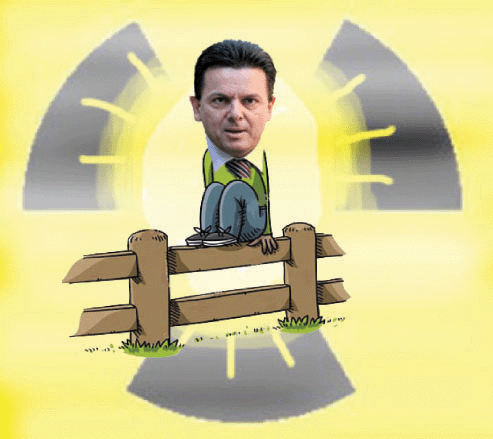
Nuclear caution vital, Port Lincoln Times, 18 Apr 16 ROAD funding, nuclear waste and drilling in the Great Australian Bight are among the issues on the agenda for recently announced candidate for Grey, Andrea Broadfoot.
Ms Broadfoot was last week announced as the Nick Xenophon Team’s candidate for the seat of Grey and said she hoped to make the safe Liberal seat marginal to attract the resources the region needed.
“We’re very committed in the community about getting out and talking to people and finding out what their issues are.”
Speaking in Port Lincoln on Thursday, Senator Nick Xenophon said Ms Broadfoot would give current member for Grey, Liberal Rowan Ramsey, a “run for his money”…….
Ms Broadfoot said the potential for a nuclear waste storage facility at one of three sites in South Australia was another issue she was concerned about.
She said the region needed to look at the long term impact on the perception of the region rather than the short term monetary gains that may be made.
“We need to be really cautious and careful about the decisions we make,” Ms Broadfoot said……..
She said the community was divided on the issue, with even the former Liberal member for Grey Barry Wakelin publicly coming out and saying Kimba was not the place for nuclear waste.
Mr Xenophon said it did not make sense to have a nuclear waste storage facility in a premium agriculture region……http://www.portlincolntimes.com.au/story/3855319/nuclear-caution-vital/?cs=1500
Australia’s government completely beholden to fossil fuel industries

 The links between big polluters and politicians , The Saturday Paper, BILL MCKIBBEN, 16 Apr 16 “…….Despite the crisis unfolding around it, the current Australian government seems determined to ignore the role it has to play in preventing the planet from cooking.
Six months ago, Australia agreed to the Paris deal. Yet, since then, Australia has reapproved one of the world’s largest coalmines, opened a new research centre for the fossil fuel industry, cut funding for renewable energy, cut funding for climate research. The bewildering list goes on and on…..
Australia’s political system is …….becoming more and more American with each new donation. Until recently you had a prime minister who, between mouthfuls of onion, told the world that coal was good for humanity.
Granted, Malcolm Turnbull is no Tony Abbott. But Turnbull is also friendly with the fossil fuel industry. Just this week in Perth, he attended a dinner with the CEOs of Shell, Chevron and Woodside. Blocked by radical conservatives and wined and dined by the fossil fuel industry, Australia is now left adrift with a laughable climate strategy.
As the planet burns, Australia continues to dig up more fossil fuels. But it’s no surprise when you look at the amount of cash changing hands between your politicians and the big polluters.
In fact, for every $1 the fossil fuel industry has donated to Australia’s major political parties since your most recent federal election, they will be handsomely rewarded with $2000 worth of handouts in the upcoming federal budget. We have a similar crisis in the US. The more donations the industry gives to congress, the more they get back in subsidies. Recent research shows members of the US house of representatives who voted in favour of the Keystone Pipeline got 13 times more in donations from Big Oil than those who voted against. All up, five key refinery companies spent $58.8 million lobbying.
Like the US, the companies that donate most in Australia are those that have the most to lose from your government taking action on climate. They’re companies such as Australia’s biggest carbon polluter, AGL; or Origin, whose existence depends on throwing a wrecking ball through the solar and wind sector; and Chevron, from the same family of companies as Exxon, which knew about the climate damage we were setting ourselves up for yet pushed its dangerous product onto the world.
And then there’s the revolving door between your government and the mining industry. One of your chief negotiators on the Kyoto Protocol left public service to become the head of the Australian Coal Association. Australia’s former climate change minister is now an adviser to AGL and Santos. The deputy prime minister to John Howard left parliament to sit on the board of Whitehaven Coal. Heck, one of your richest coal barons is a sitting parliamentarian. And this is just the tip of the melting iceberg: it doesn’t consider the many staffers and unelected individuals who walk back and forth between parliament and the fossil fuel industry. This is why Prime Minister Turnbull has no climate plan. His government is full of climate deniers and fossil fuel fanatics whose political life depends upon blocking climate action. …..
Parliamentarians such as Cory Bernardi, who has spent his time in Canberra questioning the weather bureau and running “grassroots” campaigns to axe the carbon price. Or Angus Taylor, who describes human-induced climate change as “religion” devoid of facts. People such as former oil and gas executive, now senator, Gary Gray, who helped found one of the world’s most notorious climate denialist think tanks…….
The incoming federal election means politicians currently have their ear to the ground. Right now is a perfect opportunity to begin calling for an end to polluter handouts and donations – and real action on climate change.
It will take a movement to break the link between Australia’s politicians and the big polluters. But the foundations for a pollution-free politics, here in Australia and around the world, are building by the day. https://www.thesaturdaypaper.com.au/opinion/topic/2016/04/16/the-links-between-big-polluters-and-politicians/14607288003136
Election: Liberal and Labor prefer to ignore Climate Change
Climate change has dropped off the political radar (and this is a big problem) ABC THE DRUM, 14 APR 16 By Mike Steketee The aversion to talking about climate change during the election campaign reflects a wider problem: our concern for this issue has fallen even while it has become larger and more urgent, writes Mike Steketee.
How much of an issue will climate change be in this year’s election?
Not a major one, if Malcolm Turnbull gets his way. He has saddled himself with Tony Abbott’s policy as one of the costs of appeasing the conservatives in his ranks.
And while Bill Shorten will be arguing he has a superior policy – but also risking a fear campaign over re-introducing a carbon tax – Labor, too, believes it has bigger fish to fry, such as pushing forward its credentials on education and health. Continue reading
Voters in key Liberal Coalition electorates strongly support renewable energy
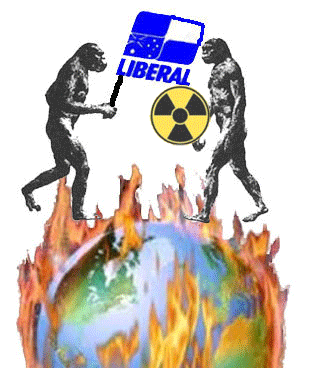 Strong Renewable Energy Support In Key LNP
  Electorates http://www.energymatters.com.au/renewable-news/renewables-australia-lnp-em5288/
January 12, 2016 The passion for renewables in Australia isn’t waning, but support for coal appears to be – particularly when it comes to new mines. This is a continuing trend among voters of all political leanings.
72-77% of voters recently polled in conservative electorates support Australia becoming a 100% renewable energy powered nation by 2030.
A ReachTEL-conducted survey of thousands of residents across the federal electorates of New England, Page, Warringah and Dickson in December revealed just 14% to 18% opposed a renewables powered Australia.
The polling of these voters also indicated a global moratorium on new coal mines had strong support; at 50 – 57%.
It will come as no surprise that Labor and Greens voters indicated even stronger support.
“Renewable energy is popular across the political spectrum. Part of Tony Abbott’s undoing was that he placed himself at odds with the electorate on this issue,” said Ben Oquist, Executive Director of The Australia Institute said.“These results show politicians of any hue who undermine support for a 100% renewable future risk an electoral backlash.”
Mr. Oquist also stated construction of new mines in a struggling market is “a recipe for economic disaster.”
“China recently announced a 3 year moratorium on new coal mines. Malcolm Turnbull can and should show the same commitment to deliver on commitments made at the Paris climate meeting in December,” he said.
The chances of a moratorium? Late last year, Federal Energy Minister Josh Frydenberg claimed there was a “strong moral case” for coal. Also in October, the Federal Government granted Adani re-approval to build the massive and very controversial Carmichael coal mine
Back in 2014, the Institute for Energy Economics and Financial Analysis (IEEFA) issued a wake-up call to investors, stating the global coal industry’s economic models were flawed. IEEFA said major coal projects with a reliance on export markets such as India constituted a huge financial risk.
The Australia Institute is actively campaigning against new coal mines in Australia and says a local moratorium will send the strongest political signal that the reign of coal is over.
1 This month

of the week – Australians for War Powers Reform (AWPR)
To see nuclear-related stories in greater depth and intensity
 Antinuclear