Matt Canavan hijacks native title fight on Adani
 “The system, the native title system,” Tony McAvoy, SC, Australia’s first Indigenous silk said, “coerces Aboriginal people into an agreement. It’s going to happen anyway. If we don’t agree, the native title tribunal will let it go through, and we will lose our land and won’t be compensated either. That’s the position we’re in.”
It’s a big case, not only for the W&J people, but for an entire, overheating planet.
 The Saturday Paper Mike Seccombe , 15 Feb 19,
 Just before 1pm on Tuesday, most media attention in Parliament House was focused on the government’s historic embarrassment on medical evacuations of asylum seekers. So, relatively few were there to witness another embarrassment, in the senate courtyard.
Its purpose was to promulgate the line that the traditional custodians overwhelmingly support the giant coalmine. To that end, Canavan, along with his National Party colleagues Michelle Landry and George Christensen, had invited a member of the W&J people to spruik the benefits of the mine. Continue reading
Global events, as well as Australian politics, may spell doom for Australia’s coal industry
Australia’s coal future under threat as more changes hit fossil fuels globally, ABC
Key points:
- Germany wants to exit coal power by 2038, which could have implications for Australian coal producers
- Renewables last year overtook coal as the key source of energy in the European nation
- Environmental groups are pushing candidates to outline their position on climate change ahead of the upcoming federal election
In Germany, Chancellor Angela Merkel confirmed the country would exit coal power by 2038.
In New South Wales, a court knocked back an application for a new coal mine on the grounds it would increase greenhouse gas emissions at a time when they need to be cut.
Neither will immediately derail the freight train that made Australia $66 billion in export earnings last year, overtaking iron ore as our most valuable traded commodity, but both decisions are a snapshot of large and incremental changes in policy and legislation that are hitting the coal sector.
“We want to be out of coal in 2038,” Chancellor Merkel told students in Tokyo last week, after a government-appointed commission released its 20-year plan to completely shut the coal-fired power plants that currently provide almost half the country’s electricity……….
Politics may dictate a shift
Australia is months away from a federal election where senior Liberal Party figures — including Treasurer Josh Frydenberg and former prime minister Tony Abbott — are being threatened by independents who support a rapid shift away from greenhouse-gas-producing fossil fuels like coal.
Even people who cannot vote, but feel passionately about the impact of climate change, are entering the debate.
School student Maiysha Moin helped found “Climate Voices” to amplify the concerns that prompted a strike by thousands of students last year.
“We want the voices of young people to be heard,” she said.
“Right now we see a lot of politicians don’t represent our vision for the future, especially on climate change, and what we want to do is endorse leaders and candidates who will represent what we believe in and our values.”
The new group is vetting the climate change credentials of potential candidates, giving them stamps of approval and offering campaign support in key marginal seats.
“What we need right now is visionary leadership,” she said.
“We need our politicians to be brave, step up, take action and listen to what the people have to say instead of standing around and hoping that climate change is going to go away — that’s not going to happen.” https://www.abc.net.au/news/2019-02-15/australias-coal-future-under-threat-amid-global-changes/10812758
Adani ramps up propaganda war, intimidation of activists
New South Wales Labor announces plan for 500,000 households to get rooftop solar
Labor announces plan for 500,000 households to get rooftop solar, https://www.smh.com.au/national/nsw/labor-announces-plan-for-500-000-households-to-get-rooftop-solar-20190209-p50wrl.html, By Laura Chung,February 9, 2019 NSW Labor has announced it will support a program to help 500,000 households to install rooftop solar, reducing electricity bills in the next 10 years.
Under Labor’s Solar Homes policy, owner-occupied households in NSW with a combined income of $180,000 or less would be eligible for a rebate, to be capped at $2200 per household.
Shadow Minister for Energy and Climate Change, Adam Searle, said the policy could add solar to an additional million homes over the next decade, and could save the average household anywhere between $600 and $1000 a year on electricity bills.
“This is a bold program to push NSW to the front of the energy revolution,” he said. “This will significantly cut electricity bills and carbon emissions.”
“We will have much more to say about energy and tackling climate change.”
The program would be phased in during the 2019-2020 financial year. The policy announcement comes ahead of the launch of Labor’s campaign bus, which will travel around the state from Sunday.
The Smart Energy Council said Labor’s policy addressed two of NSW residents’ main concerns: the cost of living and climate change.
It shows “a strong commitment towards climate change” and is a “sign of confidence in renewable energy, a critical part of NSW’s future,” a spokesman said.
The council said it would like to see a stronger commitment from both the NSW Government and the Opposition to supporting families’ purchases of household solar batteries, which would provide people “with a greater sense of control of power and how they use power.”
In a statement, deputy leader of NSW Liberals Dominic Perrottet said Labor “cannot be trusted” to deliver more affordable, reliable and clean energy, “with a history of energy cost blowouts and blunders”.
The NSW Coalition government “is getting on with the job of taking pressure off electricity prices, while maintaining energy security,” Mr Perrottet said.
Morrison government not recognising the climate impacts already hitting Australia
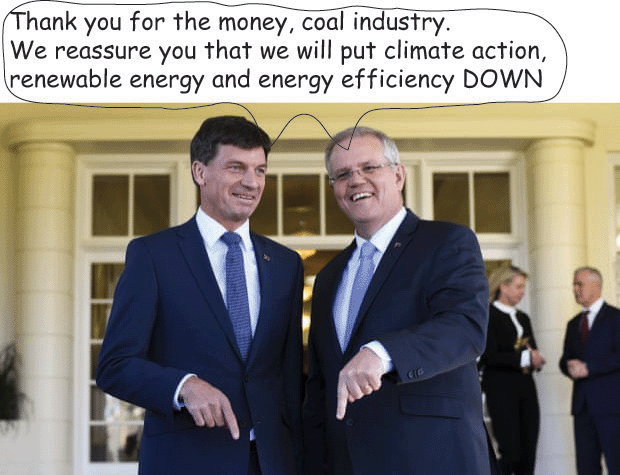 Governments not keeping pace with climate change impacts: scientist, Brisbane Times, By Tony Moore, February 5, 2019 — One of Australia’s leading scientists has warned the Queensland and federal governments that they are not keeping pace with the impacts of climate change. Governments not keeping pace with climate change impacts: scientist, Brisbane Times, By Tony Moore, February 5, 2019 — One of Australia’s leading scientists has warned the Queensland and federal governments that they are not keeping pace with the impacts of climate change.
Queensland’s recent extreme weather – bushfires, heatwaves, coral bleaching, drought, Cyclone Penny, Townsville’s floods – showed the state was clearly experiencing climate change, Professor Ian Lowe said. “What I think is a reason for concern is that the science in the 1980s was saying that – if the [1980] climate models were right – by about 2030 there would be observable changes in climate that would be impossible to ignore,” Professor Lowe said. “Now I think you could say that, if anything, the science of the time was being unreasonably cautious,” he said. I think you would have to be in deep denial not to accept that there are unmistakeable signs of climate change.” Professor Lowe is a member of the Queensland government’s senior climate change body, the Queensland Climate Advisory Council. It is chaired by Queensland Environment Minister Leeanne Enoch, while Queensland Premier Annastacia Palaszczuk, Deputy Premier Jackie Trad, Natural Resources and Mines Minister Anthony Lynham and Queensland’s chief scientist are members. It has met only three times since 2017. ……. Professor Lowe listed coral bleaching, Townsville’s flooding, the Australia-wide heatwaves in January 2019, the unseasonal Queensland bushfires from October to December and the recent fires in Tasmania as examples of extreme weather, triggered by the changing climate. Professor Lowe said the Queensland government was not “keeping pace” with measures to adapt to a changing climate, despite a string of reports since 2015. “As I said before, there isn’t yet the sense of urgency that there should be, either in adaptation, or in mitigation,” he said. He said the federal government was “in complete denial” over the impacts of climate change. Prime Minister Scott Morrison, in Townsville on Tuesday, declined to say whether the torrential rain, described as a one-in-100-year event, was a demonstration of climate change……. https://www.brisbanetimes.com.au/environment/climate-change/governments-not-keeping-pace-with-climate-change-impacts-scientist-20190205-p50vun.html |
Keeping South Australia nuclear-dump-free – a priority for Candace Champion, Greens candidate for Grey electorate
Greens announce new candidate for Grey electorate, Transcontinental, Amy Green 6 Feb 19 Port Augusta woman Candace Champion has joined the race for the seat of Grey at the next federal election.
Running as a candidate for The Greens, Candace is described as a passionate and driven young Aboriginal woman who can bring diversity to Australian parliament.
Brought up in a close-knit family, Candace has many fond memories of her childhood growing up on the Eyre Peninsula – especially participating in local sports. ……
While her family has been a large source of inspiration throughout her life, her faith is also something that has had a big influence on who she is today.
Candace’s father was a minister and later on her mother followed suit.
“The church is and has always been a second home for me. Friday night Youth Group and Sunday Church hold special memories,” she said.
She is now an active member of the Uniting Church in Australia and the Uniting Aboriginal and Islanders Christian Congress.
Candace said she was inspired to run for government after witnessing the many issues her family, friends, country, communities and church continue to face. ……
She is deeply committed to child safety and keeping families together, a treaty with First Australians, and the protection of Australia’s beautiful country and waters.
“By running for the seat of Grey I hope to achieve real advocacy, I will advocate for equality, justice and change. I hope to create positive change in all areas of government and society,” Candace said……
Candace is also passionate about cleaning up politics – where corporate donations should be banned and making SA a no nuclear waste dump. …… https://www.transcontinental.com.au/story/5886273/candace-throws-her-hat-to-contest-the-seat-of-grey/?fbclid=IwAR0TR2ZpvxAPD1T647q1lPdqF30cV6h6aE38D
Bill Shorten’s climate change policy isn’t ‘ambitious enough’ – Zali Steggall
Independent challenging Tony Abbott says Shorten’s climate change policy isn’t ‘ambitious enough’ The high-profile independent taking on Tony Abbott in Warringah at the coming federal election says Labor’s climate change policy needs to be more ambitious and include an explicit commitment to block the Adani coalmine.In an interview with Guardian Australia’s political podcast, Zali Steggall said the current policy outlined by Bill Shorten was on the right track, but she challenged the opposition to go further. “I don’t think it’s ambitious enough.”
Steggall said Labor, given the potential for a change of government later in the year, needed to include a commitment to block the controversial Queensland coal project. “Our financial institutions aren’t prepared to lend or invest in coal projects, why should the Australia people’s money be invested?”
She said Labor, if it wins this year’s federal contest, needed to use whatever regulatory powers it had available to it to stop the project. “We need an orderly retirement of coal, I don’t think we should be entering new projects,” Steggall said.
“The attention should be with renewables, technology, clean transport, clean energy – not projects like Adani.”
Steggall, a barrister, and former Olympic ski champion, is one of a group of small l liberal independents taking on government frontbenchersin the federal election contest expected in May, and has put Abbott and the Coalition’s record on climate change front and centre of her campaign in the Sydney seat.
The environment movement, and activist groups like GetUp, also want Labor to strengthen its position on the Adani project, an idea Shorten countenanced seriously last year, before stepping back.
Private polling conducted for the environment movement and for the major parties suggests community concern about climate change is currently sitting at levels not seen since the federal election cycle in 2007……. https://www.theguardian.com/australia-news/2019/feb/06/zali-steggall-says-labor-needs-to-commit-to-stopping-adani-coalmine
|
|
Australian Labor Party’s policy platform – on nuclear waste, and opposition to nuclear industry development
 From Robyn Wood, 4 Feb 19– The ALP policy platform has just been published.
Former fire chief lashes out at government inaction over climate change
‘Astounded’: former fire chief unloads on politicians over climate change inaction, The Age, By Nicole Hasham, 4 February 2019, Decorated Australian firefighter Greg Mullins says climate change is contributing to bushfires so 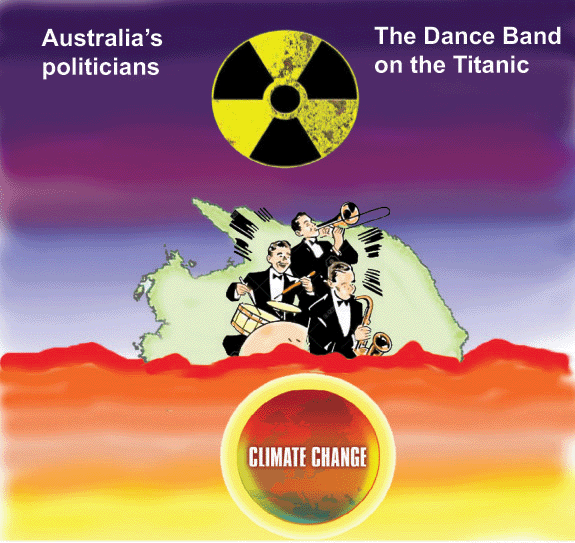 horrendous that homes and lives cannot be protected, and the federal government will not acknowledge the link because it has failed on emissions reduction policy.
The extraordinary comments by Mr Mullins, a former NSW Fire and Rescue Commissioner, coincides with the Tuesday launch of the group Bushfire Survivors for Climate Action, which will lobby the major parties to drastically reduce fossil fuel use and cut greenhouse gas emissions.
Prime Minister Scott Morrison and Opposition Leader Bill Shorten both visited Tasmania on Monday, where catastrophic bushfires had reportedly destroyed eight homes and burnt 190,000 hectares of land as of Monday afternoon. Their visit came on the 10th anniversary of the Victorian Black Saturday bushfires.
The major parties’ pledges on climate change are expected to be a frontline issue at the upcoming federal election, as the public reels from record-high summer temperatures, extreme weather and a long, unforgiving bushfire season.
Fires are a natural phenomenon in the Australian bush, but experts say climate change effects such as heatwaves and changed rainfall patterns mean bushfires are becoming more frequent and extreme.
Mr Mullins said fire seasons “are longer, more severe, and we are getting fires that are much harder to put out”.
“What that means … is there is simply not enough firefighters and fire trucks to do the job, to protect every structure and protect people’s lives,” he said.
“It’s extremely inconvenient for any government that does not have a cogent answer for what they’ll do about climate change, to see the effects of climate change putting more and more people and homes at risk.”
Mr Mullins has 50 years of fire fighting experience, including 39 years with Fire and Rescue NSW and as a volunteer in his youth and in retirement. He has been awarded the prestigious Australian Fire Service Medal and is an officer of the Order of Australia. He is a member of the Climate Council and welcomed the formation of Bushfire Survivors for Climate Action.
Mr Mullins sought to raise the climate change alarm in public comments in 2006 following fires in the Blue Mountains, but says the then-NSW Labor government told him to “pull your head in”.
“They didn’t want public servants coming out saying [the climate change driver] was pretty obvious to us,” he said.
“I feel quite passionately that the word needs to get out about how much the bushfire threat has worsened. I’ve watched it change, and I’ve watched our politicians sit on their hands, from both major parties. I don’t think either of them really have answers or are doing enough.”
NSW Labor has been contacted for comment.
……….A Labor government would reduce carbon emissions by 45 per cent by 2030, based on 2005 levels. The government has pledged to reduce emissions by 26 per cent over the same period, however, the OECD says Australia will miss that target under current policy settings.
GetUp! and the Climate Media Centre are supporting the Bushfire Survivors for Climate Actiongroup.
Black Saturday survivor Ali Griffin lost her home near Yarra Glen during the tragedy, and said: “I don’t want this to happen to anyone else”.
“We know the threat of devastating bushfires is getting worse every year we keep burning coal and heating our planet,” she said.
“Enough is enough, we are sick of the lack of progress on this issue – any politician without a serious plan to tackle climate damage is not fit to hold office.” https://www.theage.com.au/politics/federal/astounded-former-fire-chief-unloads-on-politicians-over-climate-change-inaction-20190204-p50vl0.html
Murray-Darling report shows public authorities must take climate change risk seriously
The Conversation, Graduate Fellow, Steyer-Taylor Center for Energy Policy and Finance, Stanford University, February 4, 2019 The tragic recent events on the Darling River, and the political and policy furore around them, have again highlighted the severe financial and environmental consequences of mismanaging climate risks. The Murray-Darling Royal Commission demonstrates how closely boards of public sector corporate bodies can be scrutinised for their management of these risks.
Public authorities must follow private companies and factor climate risk into their board decision-making. Royal Commissioner Brett Walker has delivered a damning indictment of the Murray Darling Basin Authority’s management of climate-related risks. His report argues that the authority’s senior management and board were “negligent” and fell short of acting with “reasonable care, skill and diligence”. For its part, the authority “rejects the assertion” that it “acted improperly or unlawfully in any way”.
The Royal Commission has also drawn attention to the potentially significant legal and reputational consequences for directors and organisations whose climate risk management is deemed to have fallen short of a rising bar.
It’s the public sector’s turn
Until recently, scrutiny of how effectively large and influential organisations are responding to climate risks has focused mostly on the private sector.
In Australia it is widely acknowledged among legal experts that private company directors’ duty of “due care and diligence” requires them to consider foreseeable climate risks that intersect with the interests of the company. Indeed, Australia’s companies regulator, ASIC, has called for directors to take a “probative and proactive” approach to these risks.
The recent focus on management of the Murray-Darling Basin again highlights the crucial role public sector corporations (or “public authorities” as we call them) also play in our overall responses to climate change – and the consequences when things go wrong……….https://theconversation.com/murray-darling-report-shows-public-authorities-must-take-climate-change-risk-seriously-110990
Mark Butler ALP Shadow Minister rules out nuclear power
MARK BUTLER MP
SHADOW MINISTER FOR CLIMATE CHANGE AND ENERGY
MEMBER FOR PORT ADELAIDE
E&OE TRANSCRIPT
RADIO INTERVIEW
RN BREAKFAST
TUESDAY, 22 JANUARY 2019
SUBJECT/S: Labor’s $1 billion National Hydrogen Plan, climate change, nuclear power, Liberals plan for new coal.
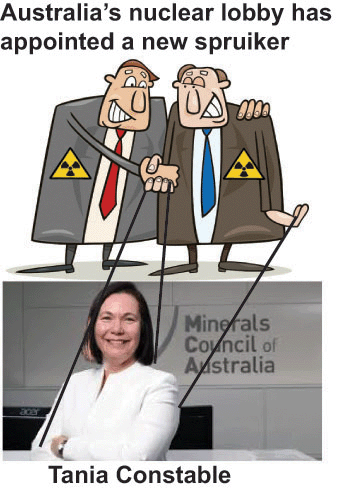 KELLY: You’re listening to RN Breakfast; our guest is the Shadow Climate and Energy Minister, Mark Butler. Mark Butler, Tanya Constable who is the Chief Executive of the Minerals Council of Australia is today proposing in news.compapers that nuclear energy be allowed to be developed as a zero emissions fuel. She says Australia will only be catching up with the rest of the world, there are new technologies in this area ready to be deployable, they produce zero emissions and thirty other countries around the world use them. Is Labor prepared to exercise or even consider that option?
BUTLER: No, this is not a technology that has any opportunity for Australia. There are legal barriers to it, which we reindorsed at our National Conference just before Christmas as Labor Party policy. Where nuclear power is being explored, new nuclear power plants around the developed world in particular, for example the UK, it is extraordinarily expensive power as well. Rather than focus on these sorts of technologies that really are of no practical use to Australia, we want to focus on renewable energy which is going to bring down emissions, bring down power prices, and power thousands and thousands of jobs.
Climate change is back as a big issue in Australian federal politics
Climate change is a burning issue (again) in voters’ minds, Guardian, Katharine Murphy @murpharoo, 2 Feb 19, The Coalition has no choice but to try and fix the self-created disaster that is its climate policy. his piece of backroom intelligence shouldn’t come as a surprise, given the summer we are all still enduring. Record high temperatures, the hottest January on record; storms; floods in some places, droughts in others; mass fish kills in ailing rivers.Climate change is back as a vote-changing issue – top of mind for many Australian voters. Private polling conducted for the environment movement and for the major parties suggests community concern about climate change is currently sitting at levels not seen since the federal election cycle in 2007.
If you can remember the events of 2007, you’ll recall that John Howard was forced into a significant about-face on the issue. Within sight of the election that swept Kevin Rudd into power, Howard signed the Liberal party up to emissions trading, a “world’s best-practice” cap and trade scheme, and declared Australia must prepare for a “low-carbon future”.
he research doing the rounds as the major parties bed down their war rooms for the May contest puts climate change in the top-two issues of concern nationally. Women, particularly, are alarmed by the ongoing policy inaction, and that’s bad for the Liberals because the party’s standing among women is already depressed courtesy of the unhinged shenanigans of the past 12 months.
But there’s some nuance in the research. In marginal seats in outer suburban areas – the seats that often determine the outcome of federal elections – cost of living pressures still rank higher than climate change. But people insist that climate is registering in the top-three concerns in several outer suburban seats, where the issue is normally dormant.
The political consequence of all this is pretty obvious. The strength of community concern about climate change leaves the Morrison government vulnerable. The Coalition’s policy record on climate change is appalling. There is no other word for it. Absolutely, indefensibly, appalling…….
Independents such as Zali Steggall and Oliver Yates are thumping the government on climate change, both as a thing in itself and as a proxy for dysfunction within the Liberal party which is imposing costs on the citizenry……… https://www.theguardian.com/australia-news/2019/feb/02/climate-change-a-burning-issue-again-in-voters-minds
Mark Parnell calls on South Australian government to stop its plans to diminish environmental department
 Mark Parnell MLC, 2 Feb 19, The Marshall Liberal Government is planning more cuts to staff and programs in the SA Department of Environment and Water and will transform the Department into an “economic development agency”.
This is outrageous! This Government’s wilful abandonment of the environment will send species extinct and further degrade struggling eco-systems.
The hypocrisy of the Liberals knows no bounds. In opposition, they criticised Labor’s annual budget cuts to the environment, but as soon as they were elected they did the same, with 100 jobs axed last year and more to come. And now they’re going one step further!
The clear message is that if the environment doesn’t make money for someone, it’s not worth protecting. Heaven help our endangered wildlife. If creatures like the Glossy Black Cockatoo or Yellow-footed Rock Wallaby don’t start earning their keep, the Government has made it clear that they are a lower priority. This is not a good time to be a Hooded Plover or an Orange-bellied Parrot in South Australia.
The Marshall Liberal Government’s honeymoon period is now well and truly over. The Government has shown its true anti-environment colours. Any notion that they might care about species, eco-systems, sustainability and the climate, has all but disappeared. Now, they have left us in no doubt that, in their eyes, only those parts of the environment that make money deserve protection.
The Greens are calling on the Liberals to stop the cuts and retain a Department that is focussed on protecting our environment and waterways. They need to stand up for South Australia’s environment and River Murray. The Government should heed the warning of the Royal Commissioner into the management of the River Murray that kow-towing to economic interests upstream only results in further degradation of the environment.
Declaring war on the environment pits this government against everyone who cares about our natural heritage. We must protect the environment for its own sake as well as for future generations.
Our environment and all the species that depend upon it for their survival, deserve better. South Australians deserve better!
Let the Marshall Liberal Government know that you expect the Environment Minister to stand up for South Australia’s environment at all times – not just when there is an economic advantage. Sign our petition and share your concern with family and friends.
South Australian government changing Environment Dept, and cutting its budget
REVEALED: Staff, budget cuts as Environment Dept becomes “new agency” , In Daily, Tom Richardson@tomrichardson, 1 Feb 19, The state’s Department of Environment and Water will become primarily an “economic development agency” that will be forced to operate with “less staff and smaller budgets” under a major restructure announced to staff yesterday.
The timing of the shift is ironic, with today’s release of a scathing Royal Commission report into the management of the River Murray, itself critical of Environment and Water Minister David Speirs.
Chief executive John Schutz – who replaced former boss Sandy Pitcher, one of four top bureaucrats axed by the incoming Marshall Government last March – yesterday wrote to staff telling them they would be “transitioning to a new agency”……….
“We balance environmental protection with economic development – this means we contribute to our state’s economy by driving sustainable economic development, and unlocking the potential of our natural and heritage resources.” …..
The department will be split into five divisions – Boards and Councils; Strategy, Science and Corporate Services; National Parks and Wildlife; Water and River Murray; and Sustainable Economic Development. https://indaily.com.au/news/2019/01/31/revealed-staff-budget-cuts-as-environment-dept-becomes-new-agency/
Australian government fudging the facts to make its climate policy look good
 Australia is counting on cooking the books to meet its climate targets , The Convesation, Senior Industry Fellow, RMIT University, January 31, 2019 A new OECD report has warned that Australia risks falling short of its 2030 emissions target unless it implements “a major effort to move to a low-carbon model”.
This view is consistent both with official government projections released late last year, and independent analysis of Australia’s emissions trajectory. Yet the government still insists we are on track, with Prime Minister Scott Morrison claiming as recently as November that the 2030 target will be reached “in a canter”.
The government is indeed poised to deliver on the “letter of the law” of its Paris commitment if two things play out. First, if it claims credit from overdelivering on Australia’s 2010 and 2020 commitments. And second, if the “low demand” scenario is the one that eventuates.
How would this scenario actually eventuate?
Let’s leave aside the technical question of whether it’s legitimate to count past performance towards future emissions targets, and focus for now on how the low-demand economic scenario might become reality.
The government’s report contains no discussion on the basis of the “low demand” scenario. But history suggests the annual baseline estimates of 2030 emissions have overestimated future emissions, with revisions downwards over time. For example, the 2018 projection for 2030 emissions is 28% lower than the 2012 projection for the same date (see figure 2 here).
In the real world, meanwhile, change is evident. Households and businesses are installing solar panels, not least to guard against high power bills. Businesses are signing power purchase agreements with renewable energy suppliers for much the same reason. State and local governments are pursuing increasingly ambitious clean energy and climate policies. Some energy-intensive industries may be driven offshore by our high gas prices.
Other studies also support the idea that Australia may indeed outperform its baseline emission scenario. ANU researchers recently predicted that “emissions in the electricity sector will decline by more than 26% in 2020-21, and will meet Australia’s entire Paris target of 26% reduction across all sectors of the economy (not just “electricity’s fair share”) in 2024-25”.
The government’s baseline electricity scenario uses the Australian Electricity Market Operator’s “neutral” scenario. But AEMO’s “weak” scenario would see 2030 demand in the National Electricity Market 18% lower than the neutral scenario (see figure 13 here).
Of course, many of these changes are happening in spite of the government’s policy settings, rather than because of them. Still, a win’s a win!
Emissions in context
This is partly because of the plan to use prior credit for previous emissions targets to help get us across the line for 2030. This may be allowed under the international rules. But we would be leveraging extremely weak earlier commitments.
For example, Australia’s 2010 Kyoto Protocol target of an 8% increase in emissions was laughably weak in comparison with the developed world average target of a 5% cut. Our 2020 5% reduction target is also well below the aspirations of most other countries. What’s more, several major nations have declared that they will exclude past “overachievements” from their 2020 commitments.
The government has obfuscated the issue further by deliberately conflating our electricity emission reductions target, which will be easily met, with our overall economy-wide target, which presents a much tougher challenge.
There’s more. Australia’s Paris pledge to reduce emissions from 2005 levels by 26-28% between 2021 and 2030 is inconsistent with our global responsibilities and with climate science. The target was agreed to by the then prime minister Tony Abbott in 2015 as the minimum needed to look credible. But as the Climate Change Authority pointed out, a 2030 target of 40-60% below 2000 levels is more scientifically responsible. https://theconversation.com/australia-is-counting-on-cooking-the-books-to-meet-its-climate-targets-110768
1 This month

of the week – Australians for War Powers Reform (AWPR)
To see nuclear-related stories in greater depth and intensity
 Antinuclear