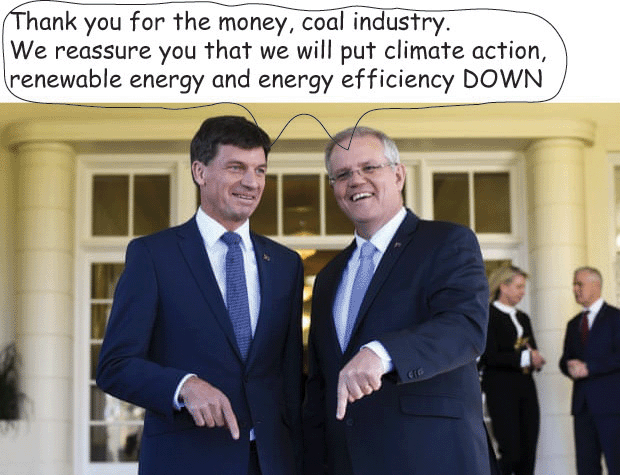
Angus Taylor prepares to underwrite coal-fired power By Phillip Coorey, Fin Rev, 01 Feb 2019 Energy Minster Angus Taylor has all but confirmed the Morrison government is prepared to underwrite new coal-fired power stations, at the same time moderate Liberal MPs are urging the government to adopt a policy on climate change.Mr Taylor released a list 66 potential power generation projects seeking taxpayer support after the government called for expressions of interests to provide “reliable” or “fair dinkum” power.
Of the projects submitted, 10 rely on coal…….
The coal proponents are looking for an indemnity against future climate policy or a guarantee from the government it will act as a buyer of last resort.
Climate key in Olympian’s bid for NSW seat, SBS News 28 Jan 19, Climate change will be one of Olympian Zali Steggall’s main policies as she contests Tony Abbott’s Sydney seat of Warringah in the federal election.The barrister and former world champion skier on Sunday launched her campaign to run as an independent in the upcoming election in a seat she described as socially progressive and caring.
The 1998 Winter Olympics bronze medallist said Sydney’s northern beaches need a voice from “the sensible centre”……..Ms Steggall will make climate change policy a key issue, one which Mr Abbott dismissed saying locals cared about a northern beaches tunnel, lowered living costs, border security and power prices……https://www.sbs.com.au/news/climate-key-in-olympian-s-bid-for-nsw-seat
NUCLEAR POWER STATIONS ARE NOT APPROPRIATE FOR AUSTRALIA – AND PROBABLY NEVER WILL BE by Climate Council / 23 January 2019
Periodically, as with the changing of the seasons, various individuals appear in the media extolling the virtues of nuclear energy, promising a panacea of clean and reliable electricity to solve Australia’s energy crisis. But the truth is far less rosy.
…….steps involved in producing nuclear power (from mining, to construction, decommissioning and waste management) result in greenhouse gas pollution. Greenhouse gas pollution associated with nuclear power could be similar to a gas power station, with estimates ranging from 80 – 437 kg/MWh.
But nuclear energy is not “renewable”. Uranium is a finite resource just like coal or gas……
Nuclear energy doesn’t make sense in Australia
…..there are a number of reasons why nuclear power is not appropriate for Australia.
Nuclear power stations are highly controversial, can’t be built under existing law in any Australian state or territory, are a more expensive source of power than renewable energy, and present significant challenges in terms of the storage and transport of nuclear waste, and use of water.
Australia is one of the sunniest and windiest countries in the world, with enough renewable energy resources to power our country 500 times over. When compared with low risk, clean, reliable and affordable renewable energy and storage technology in Australia, nuclear power makes no sense.
Nuclear power stations are expensive
Nuclear power stations are extremely expensive to build. For example, the Hinkley nuclear power station under construction in the UK will cost 20 billion pounds (AU$36 billion). Nuclear cannot compete on a cost basis with wind and solar, which are the cheapest forms of new generation. The cost of energy from the Hinkley Power station is significantly higher than large-scale solar, wind and offshore wind energy in the UK.
On average, nuclear power stations take a decade to build
The Hinkley power station will take nine years to build. The global average is 9.4 years. This would be even longer in Australia given there is currently no nuclear industry here. It is not unusual for nuclear power stations to take over a decade between the start of approvals and coming online. For comparison, wind and solar farms take just one to three years.
Australia cannot wait this long to replace our ageing fleet of coal power stations, which are already struggling to cope with extreme heat.
Nuclear power stations are inflexible and ill-suited to a modern grid
Nuclear power stations are inflexible – that is, they cannot quickly increase or decrease the amount of electricity they produce.
Nuclear power generation is not well suited to modern, fast and flexible electricity grids with large amounts of wind and solar generation. Unlike inflexible nuclear, fast response technologies such as batteries, pumped hydro and solar thermal can be turned on and off, or ramped up and down to balance electricity supply and demand.
Nuclear power stations require massive quantities of water to operate. In a dry continent like Australia, prone to hot summers and drought conditions which are only likely to get more severe as climate change worsens, it would be reckless to rely on a water-hungry power source like nuclear.
The bottom line is this: it makes no sense to build nuclear power stations in Australia.
(at left Kado Muir) It’s time to stop radioactive racism
Globally the nuclear industry is in decline and has been for a long time. The price of uranium was briefly inflated along with false dreams of a nuclear renaissance, in reality the industry is waning. The Fukushima disaster reminded both communities and financial institutions that nuclear power is far too risky for life on this planet.
In Western Australia we have a very aggressive uranium exploration program, sponsored by the State Government, yet deeply opposed by the people. We have a strong history of resistance against uranium mines and a proud history of stopping these mines. In the 1970′s my elders fought against uranium mining at Yeelirrie. In the 1980′s people from the Western Desert marched down St Georges Terrace in the thousands against uranium mining on their lands and we are proud to say we’ve never had a uranium mine in WA. We are going to keep it that way.
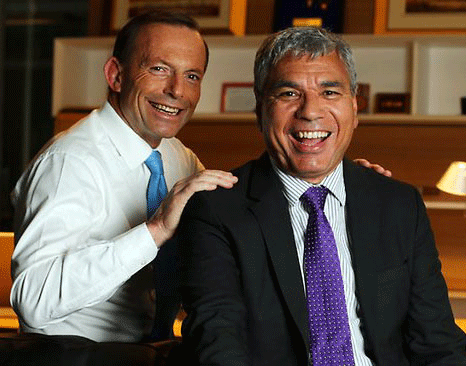
Warren Mundine wrote to the Financial Review promoting the nuclear industry. He wants uranium mining, he wants nuclear power and he wants the international community to dispose of its nuclear waste here, all on our lands. Mr Mundine does not speak for us here in Western Australia and has no right to talk about what should or should not happen on our country.
Some of the communities who are being barraged by these wanna be miners have generations of knowledge about uranium ‘poison’. We know better than most, the dangers of uranium. We also have generations worth of experience in dealing with mining companies , of witnessing their broken promises and the deep enduring failures of government to protect our country and people.
We don’t need someone from the East Coast, from Canberra or Canada to tell us what we should or shouldn’t do. Uranium stays in the ground. We have a saying, “Wanti* Uranium, leave it in the ground!” (*leave it)
The nuclear industry across Australia takes it’s toll on Aboriginal communities; from the nuclear weapons testing in Maralinga and Monte Bello island, from the trial mines in Wiluna, Yeelirrie and Manyingee in WA, to the abandoned mines in the NT & Queensland at Rum Jungle and Alligator River and Mary Kathleen, the existing mines at Ranger and Beverley and Roxby Downs in SA. The defeated proposed waste dump in South Australia now proposed for Muckaty Station in the NT. This industry preys on remote Aboriginal communities keeping everything out of sight and out of mind.
Across Australia there has never been a uranium mine that has not leaked radioactive mine waste into the environment, this industry has been tried and consistently failed.
The risk to our lands, to life itself far outweigh the measly rewards, the few jobs on offer, the State government royalties. It is not worth the long term damage to our country and to our water.
These mines will only last for 10 years or 20 years but as custodians we have thousands of years of waste. Long after this State government is a memory, long after the mining companies have gone broke we will be living with the radioactive legacy of their greedy short term ambitions. I and the people of West Australian Nuclear Free Alliance will not sell future generations short.
Kado Muir is the Chairperson of the West Australia Nuclear Free Alliance, he is a Ngalia man and a custodian for Yeelirrie – one of the uranium deposits under exploration by BHP Billiton.
Guardian, Paul Karp , 22 Jan 19 Indigenous leader and former Labor boss to be parachuted in as a Liberal in the NSW electorate held by retiring MP Ann Sudmalis
Indigenous leader Warren Mundine will be parachuted in to contest the marginal seat of Gilmore under a Scott Morrison-endorsed plan being considered by the New South Wales Liberal party executive.
On Tuesday the state executive voted to block the preselection of real-estate agent Grant Schultz, who had been picked by local members to contest the seat held by the retiring MP Ann Sudmalis.
Schultz reacted angrily to the decision and vowed to run in the seat as an independent……
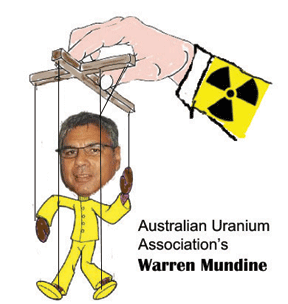
Warren Mundine, a member and former National President of the ALP, and co-convener of the Australian Uranium Association’s Indigenous Dialogue Group, has been promoting the nuclear industry recently. Unfortunately he turns a blind eye to the industry’s crude racism, a problem that ought to be core business for the Indigenous Dialogue Group.
Mundine could have mentioned the legacy of uranium mining in the Wiluna region of WA; to pick one of many examples. Uranium exploration in the region in the 1980s left a legacy of pollution and contamination. Greatly elevated radiation levels have been recorded despite the area being ‘cleaned’ a decade ago. Even after the ‘clean up’, the site was left with rusting drums containing uranium ore. A sign reading “Danger − low level radiation ore exposed” was found lying face down in bushes.
In August 2000, coordinator of the Wiluna-based Marruwayura Aboriginal Corporation Steve Syred said that until 1993, 100−150 people were living three kilometres from the spot where high radiation levels were recorded. Syred told the Kalgoorlie Miner that the Aboriginal community had unsuccessfully resisted uranium exploration in the area in the early 1980s. Since then many people had lived in the area while the Ngangganawili Aboriginal Corporation was based near the contaminated site. Elders still hunted in the area.
Another example ignored by Mundine was in late March when the NSW government passed legislation that excluded uranium from provisions of the NSW Aboriginal Land Rights Act 1983 thus stripping Aboriginal Land Councils of any say in uranium mining.
Yet another example ignored by Mundine was the 2011 amendments to the S.A. Roxby Downs Indenture Act 1982. This is the legislation that governs operations at the Olympic Dam uranium and copper mine and retains exemptions from the S.A. Aboriginal Heritage Act. Traditional Owners were not even consulted in the amendments or exemptions. The S.A. government’s spokesperson in Parliament said: “BHP were satisfied with the current arrangements and insisted on the continuation of these arrangements, and the government did not consult further than that.”
That disgraceful performance illustrates a broader pattern. Aboriginal land rights and heritage protections are feeble at the best of times. But the legal rights and protections are repeatedly stripped away whenever they get in the way of nuclear or mining interests. The Olympic Dam mine is largely exempt from the S.A. Aboriginal Heritage Act and any uranium mines in NSW are to be exempt from provisions of the NSW Aboriginal Land Rights Act. Likewise, sub-section 40(6) of the Commonwealth’s Aboriginal Land Rights Act exempts the Ranger uranium mine in the N.T. from the Act.
Mundine claims that Australia has “a legal framework to negotiate equitably with the traditional owners on whose land many uranium deposits are found”. That claim is disingenuous.
Native Title rights were extinguished with the stroke of a pen by the Howard government to seize land for a radioactive waste dump in South Australia. Aboriginal heritage laws and Aboriginal land rights are being trashed with the current push to dump in the Northern Territory. Federal Resources Minister Martin Ferguson’s National Radioactive Waste Management Act overrides the Aboriginal Heritage Act, sidesteps the Aboriginal Land Rights Act, and allows for the imposition of a dump on Aboriginal land even in the absence of any consultation with or consent from Traditional Owners.
David Ross, Director of the Central Land Council, noted in a March 14 media release: “This legislation is shameful, it subverts processes under the [Aboriginal] Land Rights Act and is clearly designed to reach the outcome of a dump being located on Aboriginal land in the Northern Territory, whether that’s the best place for it or not. This legislation preserves the Muckaty nomination without acknowledging the dissent and conflict amongst the broader traditional owner group about the process and the so-called agreement. The passage of this legislation will further inflame the tensions and divisions amongst families in Tennant Creek, and cause great stress to many people in that region.”
A small number of Traditional Owners support the N.T. dump proposal. However most are opposed and the Northern Territory Government supports that opposition, key trade unions including the Australia Council of Trade Unions, church groups, medical and health organisations, and environmental groups. If push comes to shove, there will be a blockade at the site to prevent construction of the dump.
A pro bono legal team is assisting Traditional Owners with their legal challenge against the nomination of the Muckaty site. At a Federal Court hearing on March 27, a Commonwealth lawyer argued that the government’s legislation allows the nomination of a dump site to stand even if the evidence regarding traditional ownership is false.
These patterns are evident in other countries. North American Indigenous activist Winona LaDuke from the Anishinabe Nation told the Indigenous World Uranium Summit in 2006: “The greatest minds in the nuclear establishment have been searching for an answer to the radioactive waste problem for fifty years, and they’ve finally got one: haul it down a dirt road and dump it on an Indian reservation”.
Here in Australia the situation is scarcely any better than it was in the 1950s when the British were exploding nuclear bombs on Aboriginal land. Which brings us to another of Mundine’s blind spots. He could have mentioned the latest ‘clean up’ of the Maralinga nuclear test site, which was done on the cheap. Nuclear engineer and whistleblower Alan Parkinson said of the ‘clean-up’: “What was done at Maralinga was a cheap and nasty solution that wouldn’t be adopted on white-fellas land.”
Mundine’s claim to support Aboriginal empowerment is contradicted by his consistent failure to speak out when mining and nuclear interests and governments that support those interests disempower Aboriginal people.
LIFT URANIUM MINING BAN, Pauline Hanson’s ONE NATION, 23 Jan 19,NSW One Nation will end the uranium mining ban which has been in place since 1986.
Across our western border, South Australia has been able to reap the benefits of this billion dollar national industry….. There are too many government regulations holding back the NSW economy, with the uranium mining ban one of the dumbest.
With power prices skyrocketing, the mining sector has called for the nuclear option with hopes a high-level review could end a ban on the prohibited energy source.
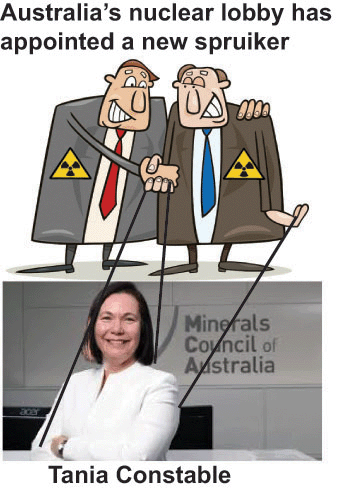
The Minerals Council of Australia has seized on the upcoming review of environmental protection laws under which nuclear power is banned.
Chief executive Tania Constable said removing the four words — “a nuclear power plant” — in one section of the law would allow the industry to be considered for development.
Federal Environment Minister Melissa Price said while the extent of the review had not yet been determined it must examine the full operation of the laws.
“The review will involve extensive consultation and will consider all ideas put forward by industry, environment and community groups to improve and strengthen national environmental law,” she said.
Ms Price said under law the review of the Environment Protection and Biodiversity Conservation Act had to be completed by October.
But Opposition leader Bill Shorten ruled out any changes under a Labor government.
“Labor has no plans to build nuclear power plants, full stop. We will deliver more renewables and cheaper power for Australians, and we will do it without building nuclear power plants in our cities and towns,” he said.
Ms Constable said that along with upgrades to existing coal-fired generators, nuclear power was a “commonsense approach” to lowering power prices and also reducing emissions.
In December, Labor signed off on its new national platform which states “Labor will … prohibit the establishment of nuclear power plants and all other stages of the nuclear fuel cycle”.
About 30 countries rely on nuclear power, with France generating nearly 75 per cent of its electricity that way.
The World Nuclear Association lists Hungary, Slovakia and Ukraine as generating more than half from nuclear, while Belgium, Sweden, Slovenia, Bulgaria, Switzerland, Finland and the Czech Republic use it for more than one-third of their power.
Prime Minister Scott Morrison said he was open to changing the law but wanted to be sure of the economic case.
“I’m not too much into an ideological debate about from what source it comes, I just want to make sure it turns up and that it brings power prices down,” he said. “The only work I have seen on that … is that (lower prices) is only achieved with very significant government subsidies.”
Susan Craig Fight To Stop Nuclear Waste Dump In Flinders Ranges SA, 18 Jan 19,
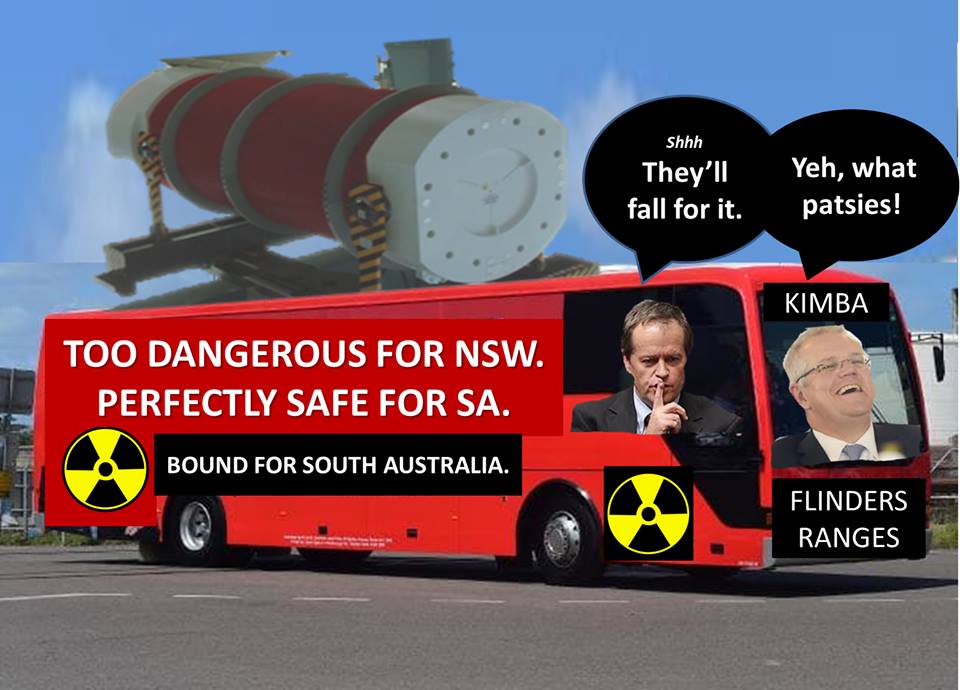
Federal Labor tell us the nuclear waste is TOO DANGEROUS for Lucas Heights, NSW, “we’ve got to get it out of there because it’s too dangerous to have it in densely populated metropolitan Sydney.
Federal Liberal tell us it’s PERFECTLY SAFE. It’s confounding that a post code can change the risk level of nuclear waste!
Both Scott and Bill are on the same bus. They refuse to make this an election issue. South Australians need to get on our own bus and demand that this issue be brought out into the open.
The current plan for a nuclear waste dump for South Australia is dangerous. Intermediate level nuclear waste is 100% fatal, after exposure life expectancy is around 4 – 6 weeks, it’s radioactive for 10,000 years and it will be stored above ground in a tin shed. It’s time for a cohesive, intelligent worlds best practice plan be developed to keep all Australian’s and our environment safe, now and into the future.
Labor will strengthen the law to protect Australia’s Environment and Heritage – TONY BURKE
Environmental wins at the National Labor Conference, Independent Australia By Stephen Williams | 13 January 2019Stephen Williams questions national co-convenor Felicity Wade of the Labor Environment Action Network (LEAN) about new Labor policy.
“………Our goal was to ensure climate action was no longer an issue to be used tactically, becoming instead an article of faith. We believe a deep-rooted response to the environmental challenges of the 21st Century is essential to the long-term survival of a modern social-democratic party.
At the 2015 Labor National Conference, LEAN won the commitments to 50% renewable energy and 45% emission reductions by 2030. But it was just a few days ago, at the 2018 National Conference, that our real goal was won. Watching the debate on the floor, there was confidence and enthusiasm. Labor not only believes climate change is real, but that it is core business.
Party heavyweights lined up to affirm their commitment to turning around the “climate emergency”, as one of the motions described it. The continued challenge of the proposed Adani coal mine in Queensland is still outstanding. LEAN believes that while Labor will continue to support existing coal operations for some time, allowing a new, huge coal basin to be opened up is both risky and undermines perceptions of our commitment to climate change.
LEAN’s next task is to rebuild commitment to the natural environment in the same way. On issues of the natural environment, it is more about remembering something lost, rather than embracing something new. Visionary environmental policy has a Labor history and this week’s commitment to a new environment Act and an independent Environment Protection Authority are the first steps in reclaiming this.
The current environmental legislation, the Environment Protection and Biodiversity Conservation Act 1999 (Cth) (EPBC), is from the Howard era. It is primarily a tool to facilitate development, not to protect the environment. What’s more, it annoys business, and costs money by creating delays and confusion, little of which translates into good environmental outcomes. The only proactive aspects of the Act create lists of environmental threats with no power to protect anything or make a difference to real-world outcomes.
Since the EPBC Act was legislated in 1999, the number of threatened species and ecosystems has increased by 30%, with three animals going extinct. About 7.4 million hectares of threatened-species habitat (more than the size of Tasmania) has been cleared. Only 0.3% (21 of 6,100 developments assessed by the Act) have been rejected for unacceptable risks to the environment.
Australia has the highest rate of mammal extinctions in the world and is the only developed nation in the world’s top ten land-clearers. About 3,000 Australians die each year due to air pollution, plastics clog our waterways, while the community’s efforts to recycle are not matched by government-led national responses to ensure the waste is re-used.
We need more power at the federal level to stem these losses. ……..
When asked by our campaigners how they felt about climate change policy, the message they sent back to the party was unequivocal: 370 local ALP branches endorsed our call for 50% renewables by 2030 and credible emission-reduction targets.
Peta Credlin’s preselection could be the spark that blows up the Liberal party, Guardian, Oliver Yates , 9 Jan 19, Credlin has put short term political interests, and the interests of the coal industry, before the future of our country What better example is there that the Liberal party must split than the proposed nomination of Peta Credlin for the seat of Mallee.If, as Credlin says, “climate change remains Malcolm Turnbull’s kryptonite”, then her preselection could just be the Liberal party’s dynamite. The split already exists, but for now, it’s being held together with sticky tape and string. And Credlin’s preselection could well be the spark that lights the fuse, and blows the whole thing up.
The Liberal party is suffering an existential crisis. And no other issue defines this crisis like the looming threat to our safety and security caused by inaction on climate change. Credlin understands this and has used her position as a climate change-denying, hard-right mouthpiece of the Murdoch empire to advance her own political interests, and the interests of the coal industry.
She’s consistently claimed climate change is a political hoax, and used her position in the media to undermine a sitting prime ministerand any energy policy supported by the Coalition party room that does not involve more coal and the end of renewables.
She doesn’t represent real liberal views, and if she appeals to what’s left of the “base”, then many people who used to vote Liberal will keep moving for the exits.
Inspired by Donald Trump, Credlin has argued Australia should tear up the Paris agreement, tear up any sensible national energy guarantee. Credlin has demanded taxpayers’ money go to the Adani coalmine and be used to build new coal-fired power stations. It’s madness.
Australians don’t want this. We would prefer a Great Barrier Reef, renewable energy and a future we can survive and thrive in.
These views are so ignorant – their political manifestation through Tony Abbott, Craig Kelly and their ilk – that it presents a grave economic and security threat to Australia’s future. And it could be the final death knell to the Liberal party.
Credlin’s demonstrated lack of understanding of the serious climate emergency we face, or even the basic economics of power production costs are breathtaking. She promotes the view that climate change is some leftwing conspiracy and that the science is rubbish.
These views need to be called for what they are: dangerous.
In her media roles, Credlin has even attacked the scientific foundation for energy and climate policy. From the desk at Sky, she announced her displeasure that former prime minister Malcolm Turnbull asked chief scientist Alan Finkel for real consideration of the climate change transition and energy policy. Instead she demanded a manufactured report devoid of reality………
Australians know it’s getting hotter every summer and see the increases in extreme weather. Report after report, overflowing with scientific evidence, traditionally a solid foundation for investment and public policy making, has been abandoned by the federal Liberal party. We understand how this will threaten our families, economy and security, and we must act to provide people with a real liberal alternative.
Credlin, Abbott and the rest of the hard-right’s “commitment to coal” is entirely political. The calculation they’ve made is that their short-term political interests, and the interests of the coal industry, are more important than the future of our country, our people and holistically the environment we all share.
It is essential now that real liberals stand against this reckless game of Russian roulette the hard right are playing with our future. If not, they too will adorn the walls as climate change deniers, who, despite all the evidence, refused to act.
Woomera not in contention for nuclear storage facility, The Transcontinental, Marco Balsamo, 3 Jan 19
The Department of Industry, Innovation and Science (DIIS) has dismissed any possibility of reconsidering the Woomera Protected Area (WPA) as a site for the national radioactive waste management facility.
With ongoing operations at the site conducted by the Department of Defence, DIIS described a nuclear waste facility as an “incompatible land use”.
Commonwealth Scientific and Industrial Research Organisation (CSIRO) stores 10,000 drums of low and intermediate level waste in a hangar at Evetts Field, 1.3 kilometres from the Woomera Range head.
Defence also stores 35 cubic metres of intermediate level waste in a bunker 5km down range.
However, a DIIS spokesperson said the 122,000-square kilometre military testing range was not suitable…….
Two sites in Kimba and one near Hawker have been nominated to host the potential facility, but the selection process has been delayed, as the Federal Court is set to hear the Barngarla Determination Aboriginal Corporation v District Council of Kimba case this month. …..
Traditional owners lodged an Australian Human Rights Commission (AHRC) complaint in December 2018, alleging a fundamentally flawed process in the consideration of the site near Hawker.
Twenty years on, only the names have changed, The Age 1 January 2019 The annual release of the federal Cabinet papers is usually a chance to reflect on issues long since settled. … the release today by the National Archives of Australia of the papers from John Howard’s cabinet deliberations of 1996 and 1997.
A string of issues that demanded the attention of Mr Howard and his senior ministers are still with us. And still causing trouble for the government.
The most obvious is climate change and finding a way to reduce Australia’s greenhouse gas emissions.
The Cabinet papers reveal how the Howard government clearly rejected the advice of its most senior ministries that the most effective and efficient method to deal with the issue was via a price signal with an emissions trading scheme.
It would take a decade for Mr Howard to change his mind, taking a trading scheme – along with the Labor Party – to the 2007 election.
Howard government told without a carbon price, emissions would rise, The Age, By Shane Wright, 1 January 2019The Howard government was urged more than 20 years ago to consider an emissions trading scheme, while its signature plans to deal with Australia’s greenhouse gas emissions were considered by its own departments to be merely aimed at deflecting global criticism.
As the Morrison government continues to fight a debilitating internal battle over how to deal with climate change, previously secret papers from the 1990s reveal a suite of major government departments said the most effective and efficient way to deal with greenhouse gases was to impose a carbon price.
Cabinet papers from 1996 and 1997 released on Tuesday by the National Archives reveal the beginnings of the Howard government’s drawn-out response to the threat posed by rising greenhouse gas emissions and the way some of those issues are still playing out in the Morrison government.
Ahead of the expected adoption of the Kyoto Protocol in December 1997, there were deep concerns within the government about how it may affect Australia with its large coal exports, heavy dependence on coal-fired power stations and increasing LNG production.
Government departments headed by Prime Minister and Cabinet, Treasury and Foreign Affairs fleshed out the details of a series of proposals backed by the government in September 1997 in a bid to deal with Australia’s emissions.
The co-ordinating document produced by the departments, which were aiming to finalise a package discussed at cabinet earlier in the month, made clear the bureaucracy did not believe the government’s plans would go nearly far enough in cutting emissions but may be sufficient to deflect international criticism.
“None of the packages presented here would achieve the stabilisation of emissions at 1990 levels,” they said.
“Rather, they are aimed at deflecting criticism that Australia is not fully committed to reducing its emissions.”
The departments costed a series of proposals which would ultimately become part of the government’s official response to climate change…….
But the departments, which acknowledged the government’s opposition to a price signal, said these would ultimately be expensive initiatives which would not deliver a real impact on the nation’s overall emissions profile.
“The most effective way to reduce emissions would be to combine significant price signals (either general or sectoral increases in taxes on greenhouse producing activities), information so firms and individuals can reduce greenhouse production, opportunities to invest in carbon sinks and some degree of compulsion to address areas where markets cannot be made to work effectively,” they said…….
While a small number of Coalition MPs have backed subsidies for new coal-fired power stations, the cabinet documents from 1997 canvassed ways to use emission standards to effectively end brown coal-fired stations and encourage more gas into the system.
Labor has pledged to try to revive the energy guarantee and while it has ruled out a carbon tax it is considering an “emissions-trading type scheme” for high-polluting industries which are likely to be in the manufacturing and liquefied and natural gas sectors.
The days roll on and 2018 is about to be in the past tense.
As ever the year saw highs, lows and flatlines. It also saw sustained and successful resistance to the nuclear industry in Australia.
This note is a snapshot, not a definitive list, but I wanted to capture some of our collective efforts and achievements so in a quiet moment we can reflect and recharge – and know that we are making a real difference.
Thanks and solidarity to all – and best wishes for a good break and time with people and in places that freshen the spirit. I look forward to working with you all in season 2019.
Uranium: Less is being ripped and shipped
Kakadu: the clean-up of the Ranger site is underway – Mirarr native title of the region was formally recognised – Rio Tinto have accepted their responsibility to clean up – there was a calendar and a series of events around the country to mark twenty years since the Jabiluka blockade
uranium remains stalled and actively contested in WA: 2018 saw a decade since then Premier Barnett announced a fast tracked uranium sector that would be “iron ore on steroids” – there are no mines but there is a major legal challenge to the Yeelirrie project, procedural challenge to Mulga Rock and community resistance to the four proposed projects with actions at AgMs, project critiques, Walkatjurra Walkabout and more
Qld Labor reaffirmed its opposition to uranium mining at its state conference
Radioactive waste: Under pressure and delayed
the federal plan for a national waste facility in regional SA is highly contested, behind schedule and increasingly uncertain
the issue was pushed ahead of the state election and SA Labor has subsequently adopted a good policy position
there is growing civil society awareness and engagement with the issue – especially through our trade union partners
the Barngarla people were formally awarded native title over the Kimba sites in June and have taken legal action over deficiencies in the Feds consultation processes
Adnyamathanha resistance to the proposed Flinders Ranges site is strong and they have lodged a complaint on the plan with the Australian Human Rights Commission
community resistance at both sites is sustained and strong with high levels of engagement and regular actions, events and media profile
Federal Labor policy has a long way to go but at its national conference in December Labor moved from a policy position dominated by sites and place to one of standards and process
Standing Strong – the story of the successful community fight against the earlier plan for an international radioactive waste dump in SA was launched and learned from
there was early and strong opposition to chatter around other potential radioactive waste sites – especially at Brewarrina (NSW) and Leonora (WA)
Nuclear weapons: the cold war is reheating and support for a weapons ban grows
ICAN – the International Campaign to Abolish Nuclear Weapons – has continued to build on its 2017 Nobel Peace Prize profile
there was sustained outreach and awareness initiatives, including a bike ride from Melbourne to Canberra
there is growing international support for the Treaty on the Prohibition of Nuclear Weapons with more nations signing and ratifying the ban
federal Labor committed to sign and ratify the ban treaty at its national conference in Adelaide in December – a major step forward
the Peace Boat visited Australian waters and cities in January/February and the Black Mist, Burnt Country Maralinga exhibition continued touring
Broader nuclear free efforts
ANFA – the Australian Nuclear Free Alliance – had a good gathering in the Adelaide Hills in October and there was clear recognition of the role of First Nation people in the atomic resistance with awards to crew in WA, Aunty Sue in SA and Jeffrey Lee gaining the German based Nuclear Free Future award in the global Resistance category
anniversaries were marked with actions, events and reflection – including Fukushima, Chernobyl, Hiroshima and Maralinga
people engaged in state and federal processes including Senate Estimates, Senate Inquiries into radioactive waste siting and mine rehabilitation, ARPANSA Codes of Practice and more
folks engaged with ALP state and federal conferences, the ACTU Congress, many union forums, SoS, the Sustainable Living Festival and more
we remained connected and updated via the efforts of Christina Macpherson, Maelor at ACF, Jim Green at WISE, KA at CCWA and Walkatjurra, WGAR news, 3CR’s Radioactive Show, Understory and more
Looking ahead to 2019 – Another big year ahead folks – and one where we consolidate, defend and grow
Challengesinclude:
the forever struggle of resourcing and capacity
pro-nuke voices pushing small modular reactors (SMRs) and seeking to overturn the ban on domestic nuclear power
Mineral Council of Australia and others seeking the removal of uranium mining as a ‘trigger’ action in the federal EPBC Act
We need to:
better braid the uranium story and struggle into the wider dirty energy-fracking- fossil fuel narrative
keep Rio Tinto and the regulators focussed and genuine re the best possible rehab outcomes at Ranger and keep the door shut to the uranium sector in WA
support affected communities facing radioactive waste dump plans and push federal Labor to adopt a different approach
pressure and support federal Labor to follow through on its commitment to sign and ratify the nuclear weapons ban
make Australian uranium companies operating overseas – often in jurisdictions with low governance – accountable for their impacts






 Antinuclear