Why Labor is taking the right course on nuclear disarmament

|
Labor sets the right course on nuclear disarmament, https://www.smh.com.au/politics/federal/labor-sets-the-right-course-on-nuclear-disarmament-20181224-p50o22.html, By Gem Romuld, 27 December 2018 On the final afternoon of the recent 48th Labor national conference, Anthony Albanese took to the podium to announce that a future Labor government will sign and ratify the UN Treaty on the Prohibition of Nuclear Weapons. He declared that “people who change the world are ones that are ambitious”, after three days of intense negotiations on nuclear policy among senior Labor parliamentarians.The Coalition government has not only refused to join the treaty, but boycotted the negotiating conference and opposed the process leading up to it. While claiming to wholeheartedly seek a world free of nuclear weapons, foreign affairs ministers Julie Bishop and Marise Payne have failed to act. Their preferred path is one that doesn’t challenge the nuclear-armed states, especially our powerful ally, and protects the status quo.
After words of caution from Senator Penny Wong and MP Richard Marles in October, supporters of the nuclear ban treaty within Labor had to move a mountain to get the leadership on side. Even with former foreign minister Gareth Evans warning against the treaty, out of deference to the United States, on the eve of the resolution the supportive majority won out. With 78 per cent of the federal caucus signed up to support the ban, 83 per cent of Labor voters on side, and two dozen unions adding their voice, Labor has a clear mandate. Soon after the resolution passed unanimously, commentators rushed to dismiss the resolution as aspirational, ineffective and conditional upon whether nuclear-armed states join the treaty. This is not true; there are no binding caveats to the resolution. Labor must only “take account of” various factors ahead of signing and ratifying. Conservatives within Labor tried to attach binding preconditions, but their attempts failed. As for whether the resolution is aspirational, in fact it is binding. Therefore, it is no longer a matter of whether a Labor government will join the TPNW – only when. A recently published paper by Harvard Law School’s International Human Rights Clinic is clear that Australia joining the ban treaty would advance its stated goal of supporting nuclear disarmament without creating insurmountable legal obstacles to ongoing military relations with the United States. Australia signed up to the landmines and cluster munitions treaties when the United States did not, and still has not, signed on. The alliance relationship doesn’t bind us to include weapons of mass destruction in our defence policies. Further, the ANZUS Treaty contains no obligation to accept the policy of nuclear deterrence. The threat posed by nuclear weapons is real and urgent. More than ever, our security depends on an effective rules-based international order and strong multilateral institutions. No nuclear-armed states have yet joined the treaty, but this will change. No treaty, whether on disarmament or human rights or climate change, has ever enjoyed universal support at the outset. Support is always built up over time. Monumental strides forward in human history rarely begin with all parties coming together to agree on a common course of action. The majority of the world’s nations negotiated the TPNW based on their firm belief that it would have a profound impact on the behaviour of nuclear-armed states and their allies, even if its provisions would not, at the outset, be binding on those states. Treaties prohibiting other inhumane, indiscriminate weapons demonstrate this process; for example, the landmine ban treaty is widely regarded as a success, with massive reductions in use and production worldwide. Within the nuclear weapon ban treaty’s first year of existence, money is moving. The Norwegian sovereign wealth fund and the largest Dutch pension fund have decided to exclude nuclear-weapon-producing companies from their investment portfolios, citing the treaty as their reason. The Australian Medical Association and the Australian Red Cross have urged the Australian government to sign and ratify the treaty as a humanitarian imperative. Cities within countries opposed to the treaty are also joining the call for national action, including Los Angeles, Toronto, Manchester, Melbourne and Sydney. The ban treaty is a powerful new tool for advocacy, and nuclear disarmament is back on the political agenda. Since the treaty opened for signature in September 2017, 69 states have signed on and 19 have ratified. The 50th nation to deposit its instrument of ratification will enable the treaty to enter into force and become permanent international law. With dozens of nations currently undergoing domestic processes to sign and ratify, entry- into-force is expected by 2020. It is beyond time for Australia to quit our role as nuclear enabler for the United States. The nuclear weapon ban treaty presents us with a persistent question; will we join the global majority and contribute to the consensus against these WMDs, or remain implicated in the nuclear threat? Labor’s commitment clears a pathway forward for the next Government. Gem Romuld is the Australian director of the International Campaign to Abolish Nuclear |
|
Labor is right to support a nuclear ban treaty
The cold war is back. Labor is right to support a nuclear ban treaty https://www.theguardian.com/commentisfree/2018/dec/28/the-cold-war-is-back-labor-is-right-to-support-a-nuclear-ban-treatyLabor’s pledge to commit to nuclear disarmament puts the alternative party of government on the right side of history.
The gulf between the shenanigans of way too many politicians, and the growing urgency of grave and looming threats has rarely seemed wider. Action on crucial issues languishes while parliamentarians make naked grabs for power, acting in the interests only of themselves. Poor personal behaviour seems endemic. On the two unprecedented dangers looming over all humanity – nuclear war and climate disruption – Australia has been not just missing in action, but actively on the wrong side of history, part of the problem rather than the solution.
The government’s own figures demonstrate that our country, awash with renewable sun and wind, is way off track to meet even a third of its greenhouse gas emissions reduction target by 2030 – itself nowhere near enough.
Not only is nuclear disarmament stalled, but one by one, the agreements that reduced and constrained nuclear weapons, hard-won fruit of the end of the first cold war, are being trashed. All the nuclear-armed states are investing massively not simply in keeping their weapons indefinitely, but developing new ones that are more accurate, more deadly and more “usable”. The cold war is back, and irresponsible and explicit threats to use nuclear weapons have proliferated. Any positive effect that Australia might have on reducing nuclear weapons dangers from the supposed influence afforded us by our uncritical obsequiousness to the US is nowhere in sight. Our government has been incapable of asserting any independence even from the current most extreme, dysfunctional and unfit US administration. The US has recently renounced its previous commitments under the nuclear non-proliferation treaty (NPT); we have said nothing.
The one bright light in this gathering gloom is the 2017 UN treaty on the prohibition of nuclear weapons. For its role in helping to bring this historic treaty into being, the International Campaign to Abolish Nuclear Weapons (Ican) was awarded the Nobel peace prize for 2017 – the first to an entity born in Australia. This treaty provides the first comprehensive and categorical prohibition of nuclear weapons. It sets zero nuclear weapons as the clear and consistent standard for all countries and will help drive elimination of these worst weapons of mass destruction, just as the treaties banning biological and chemical weapons, landmines and cluster munitions have played a decisive role in progressing the elimination of those other indiscriminate and inhumane weapons. The treaty lays out a clear pathway for all states, with and without nuclear weapons, to fulfil their binding legal obligation to accomplish nuclear disarmament. It is currently the only such pathway.
Regrettably, the Australian government was the most active “weasel” in opposing the treaty’s development at every step and was one of the first to say it would not sign, even though we have signed every other treaty banning an unacceptable weapon.
Hence the Labor party’s commitment at its recent national conference in Adelaide that “Labor in government will sign and ratify the Ban Treaty” is an important and welcome step. It is a clear commitment, allowing no room for weaselling.
The considerations articulated alongside this commitment are fairly straightforward and consistent with the commitment. First, recognition of the need for “an effective verification and enforcement architecture” for nuclear disarmament. The treaty itself embodies this. Governments joining the treaty must designate a competent international authority “to negotiate and verify the irreversible elimination of nuclear weapons” and nuclear weapons programmes, “including the elimination or irreversible conversion of all nuclear-weapons-related facilities”. Australia should also push for the same standard for any nuclear disarmament that happens outside the treaty.
Second, the Labor resolution prioritises “the interaction of the Ban Treaty with the longstanding Nuclear Non-Proliferation Treaty”. The treaty has been carefully crafted to be entirely compatible with the NPT and explicitly reaffirms that the NPT “serves as a cornerstone of the nuclear disarmament and non-proliferation regime”, and that its full and effective implementation “has a vital role to play in promoting international peace and security”. All the governments supporting the treaty support the NPT, and the NPT itself enshrines a commitment for all its members to “pursue negotiations in good faith on effective measures relating to cessation of the nuclear arms race at an early date and to nuclear disarmament”. The UN secretary general, Antonio Guterres, and the International Committee of the Red Cross are among those who have affirmed that the treaty and the NPT are entirely consistent, complementary and mutually reinforcing. Even opponents of the treaty recognise that prohibition is an essential part of achieving and sustaining a world free of nuclear weapons.
Third, the Labor resolution refers to “Work to achieve universal support for the Ban Treaty.” This too is mirrored in one of the commitments governments take on in joining the treaty, to encourage other states to join, “with the goal of universal adherence of all States to the Treaty.”
An Australian government joining the treaty would enjoy wide popular support in doing so – an Ipsos poll last month found that 79% of Australians (and 83% of Labor voters) support, and less than 8% oppose, Australia joining the treaty.
Australia would also stop sticking out like a sore thumb among our southeast Asian and Pacific Island neighbours and be able to work more effectively with them. Brunei, Cook Islands, Fiji, Indonesia, Kiribati, Laos, New Zealand, Malaysia, Myanmar, Palau, Philippines, Samoa, Thailand, Timor-Leste, Tuvalu, Vanuatu and Vietnam have already signed the treaty.
Most importantly, joining the treaty and renouncing nuclear weapons would mean that Australia would become part of the solution rather than the problem of the acute existential peril that hangs over all of us while nuclear weapons exist, ready to be launched within minutes. Time is not on our side. Of course this crucial humanitarian issue should be above party politics. The commitment from the alternative party of government to join the treaty and get on the right side of history when Labor next forms government is to be warmly welcomed. It is to be hoped that the 78% of federal parliamentary Labor members who have put on record their support for Australia joining the treaty by signing Ican’s parliamentary pledge will help ensure Labor keeps this landmark promise.
• Dr Tilman Ruff is co-founder of the International Campaign to Abolish Nuclear Weapons (Ican) and Nobel peace prize winner (2017)
Australian government promoting Australia’s secret weapons deals to Saudi Arabia and UAE for murderous war in Yemen
|
Documents reveal Australia’s secret arms deals with nations fighting Yemen’s bloody war, ABC News
Internal Defence Department documents obtained under Freedom of Information (FOI) and from parliamentary hearings reveal since the beginning of 2016, Canberra has granted at least 37 export permits for military-related items to the United Arab Emirates, and 20 to Saudi Arabia. They are the two countries leading a coalition fighting a war against Houthi rebels in the Middle East’s poorest nation, Yemen. The four-year war in Yemen has killed tens of thousands and an air-and-sea embargo has led to more than 85,000 Yemeni children under five dying from hunger, according to one children’s agency. Australia’s burgeoning exports to the UAE and Saudi Arabia may be connected to a plan announced by then-Prime Minister Malcolm Turnbull in January to drastically increase defence sales over the next decade. Australia will spend $200 million between now and 2028 in order to make Australia the 10th-largest arms exporter in the world. It is currently the 20th largest. The strategy states the Middle East is a “priority market” for defence exports. The Government has tried to keep details of the exports secret, but New South Wales lawyer and human rights activist Kellie Tranter has spent a year trying to shed light on the sales. Continue reading |
Australian Labor Party’s very limited support for the United Nations nuclear ban treaty
 Bill Shorten wins cautious agreement on foreign aid, recognising Palestine and nuclear ban treaty, SMH, By Michael Koziol
18 December 2018 A federal Labor government will pursue the recognition of Palestine, a treaty banning nuclear weapons and an increase to foreign aid – but final decisions will be left for cabinet under an agreement struck between the party’s factions.Three controversial issues in the foreign relations portfolio were settled in backroom deals on Tuesday morning to ensure there were no contentious votes and Labor leader Bill Shorten ended the party’s national conference on a united note.The changes to Labor’s platform urge the next Labor government to recognise Palestine as a sovereign state as an “important priority”, but leaves the final decision to cabinet acting on expert advice.Labor has also given in-principle agreement to the United Nations nuclear ban treaty – but only after taking account of whether nuclear-armed states had signed up (so far none have) and whether they were abiding by the treaty’s terms…….
Senator Wong and defence spokesman Richard Marles led the negotiations, while the Left’s Anthony Albanese was heavily involved in the nuclear talks ……..
The controversial nuclear treaty bans states from using, producing or stockpiling nuclear weapons, and prohibits them from assisting any other state to engage in such activities.
Mr Marles – who has criticised the treaty as “the non-nuclear world thumbing its nose at the nuclear world” – said it was “no secret” some in Labor were sceptical about the treaty and its impact on Australia’s alliance with the US.
A Labor government would need to be “certain” the treaty would not endanger that alliance, Mr Marles told the conference, and it was essential there was a realistic pathway for nuclear powers to sign up.
As recently as October, Senator Wong said there was “no realistic prospect” of any nuclear states signing the treaty, let alone ratifying it, and it would have “no effect” without their endorsement……https://www.smh.com.au/politics/federal/bill-shorten-wins-cautious-agreement-on-foreign-aid-recognising-palestine-and-nuclear-ban-treaty-20181218-p50mw8.html
Division within the Liberal Coalition over climate change
 Coalition’s divide exposed at COAG energy meeting in Adelaide, ABC, By Casey Briggs 19 Dec 18, A meeting of Australia’s energy ministers had ended bitterly divided, with the country’s biggest Liberal-run state accusing the Commonwealth of blocking discussion on climate change. Coalition’s divide exposed at COAG energy meeting in Adelaide, ABC, By Casey Briggs 19 Dec 18, A meeting of Australia’s energy ministers had ended bitterly divided, with the country’s biggest Liberal-run state accusing the Commonwealth of blocking discussion on climate change.
|
|
|
Labor has-been Gareth Evans still pro nuclear, sabotaging the UN Nuclear Ban Treaty
That treaty is now considered a huge success with 164 state parties. Evans was wrong then and he is wrong again now on the nuclear weapon ban treaty.”Labor set for nuclear showdown as Gareth Evans warns of risk to US alliance, Guardian, Paul Karp
The former foreign affairs minister made the comments to Guardian Australia on the sidelines of Labor’s national conference, intervening in a dispute over how to translate in-principle support for disarmament into practical action.
The showdown set for Tuesday pits the Labor frontbencher Anthony Albanese against the party’s foreign affairs spokeswoman, Penny Wong, two traditional Labor left allies divided by conditions to be put on joining the treaty.
Guardian Australia understands that Albanese has registered an amendment proposing to sign and ratify the nuclear weapons ban treaty immediately to send a strong signal in favour of disarmament and noting that Australia can seek changes after it joins. Continue reading
Australia’s Liberal National govt will use tax-payer funds to promote new and existing coal mines
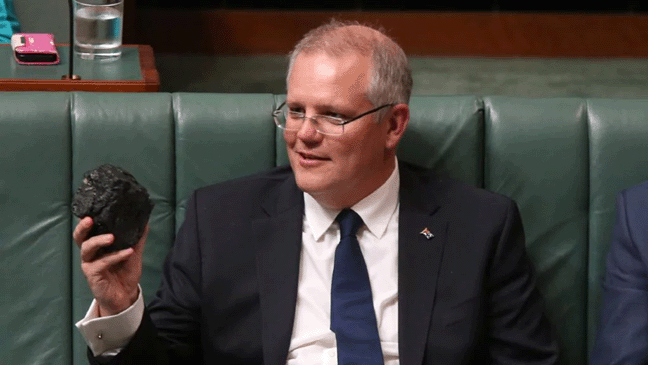
Coalition signals it will provide taxpayer support for new and existing coal plants. https://www.theguardian.com/environment/2018/dec/13/coalition-signals-it-will-provide-taxpayer-support-for-new-and-existing-coal-plants Katharine Murphy Political editor@murpharoo 13 Dec 2018
Morrison government specifies generation projects will need to be coal, gas, batteries or pumped hydro to be eligible for underwriting The Morrison government has sent a clear signal that it is prepared to provide taxpayer support for both new and existing coal plants, opening registrations of interest in its controversial new power generation underwriting program.
With the government accelerating to cover off major announcements before the Christmas break, the energy minister, Angus Taylor, will on Thursday use an event at a hydro power station in Tasmania to outline the terms of the new program and urge proponents to get their bids in over the summer break – before 23 January.
As well as finalising the criteria for the underwriting program, and calling for expressions of interest, the government is also expected to outline its response to the Ruddock review into religious freedom, and unveil its decision on Australian diplomatic facilities in Israel, before the end of the week.
Taylor will confirm on Thursday that the underwriting program – which has been criticised by business groupsand energy stakeholders – will potentially fund generation projects including new builds and brownfield projects, like upgrades or life extensions of existing coal generators.
Taxpayer support will be made available to projects through a range of financing options such as underwriting floor prices, underwriting cap prices, grants and loans – although the finalised program guidelines makes it clear that the amount of support available under each phase of the program, and the extent of taxpayer liability, will be capped.
The government has not published an upper limit on the size of eligible projects but the minimum eligible project size will be 30MW
The criteria makes it clear that the program is technology neutral but it also specifies that generation projects will need to be coal, gas, batteries or pumped hydro to be eligible for the government underwriting.
The document calling for expressions of interest does not supply any specific guidance on the emissions intensity of the projects. It says only that projects delivering an electricity product at a lower emissions intensity “will be deemed higher merit.”
It also makes clear the program will also be open to foreign investors in the event the proposal can clear Foreign Investment Review Board processes.
As to timing, the document suggests phase one is anticipated to commence in the first quarter of 2019 – which puts some of the decision making pre-election in the event the government goes to the polls in April.
Labor and the Greens are opposed to any taxpayer support for coal projects, and will continue efforts once parliament resumes next year to try and frustrate the Coalition’s program, potentially by attempting to amend the government’s “big stick” divestiture bill, which stalled in the final sitting week, to include a prohibition on power companies receiving commonwealth support.
As well as the underwriting, Taylor has also flagged the possible indemnification of projects from the future risk of a carbon price.
There is speculation around the energy sector that the government underwriting proposal could facilitate an extension of the Vales Point power station near Lake Macquarie in New South Wales. It is owned by Trevor St Baker, who was vocal during a stakeholder session last month convened to discuss the underwriting program.
Ahead of Thursday’s announcement, Taylor said: “This program will drive down electricity prices for householders by increasing competition and increasing supply in the market.”
He said the objective was to produce a pipeline of projects “that will allow us to bring targeted generation into the system in the right place at the right time”.
Scott Morrison and the Business Council are pushing coal – but on what evidence?
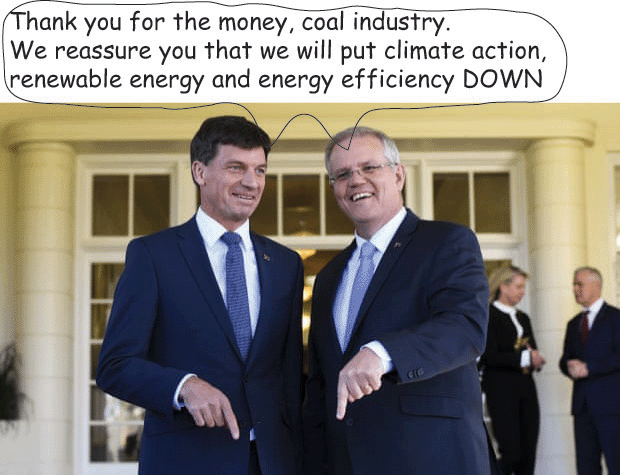 Guardian, 14 Dec 18
 Despite plummeting costs of renewables the government and the BCA insist that emissions reduction would be ‘economy wrecking’
Fresh from losing the economic fight about company tax cuts, the Coalition government is doubling down on an economic fight about renewable energy. And yet again, as they march into battle they have the Business Council of Australia as their key source of economic and political advice. What could go wrong?
The cost of renewable energy has fallen dramatically in the past 10 years and will continue to fall for years to come. By some accounts, new renewables with storage are already cheaper than coal fired power stations. Some argue that they aren’t quite there yet. But no one argues that in 30 years’ time a new coal-fired power station that has to buy coal will be able to compete with a solar farm that gets its sunshine for free.
Betting on the future cost of renewables is like catching a falling knife, but if there is one thing that unites the Coalition and the BCA it’s that they aren’t averse to self-inflicted wounds. At precisely the time when the costs of renewables and storage are plummeting and the world is meeting in Poland to discuss reductions in fossil fuel use, the Liberal government and the peak body for the biggest businesses in Australia are united in arguing that a 45% emissions reduction target by 2030 would be – in the words of BCA chief executive Jennifer Westacott – “economy wrecking”.
As with the failed campaign for company tax cuts, the nation’s prime minister is getting his talking points from the nation’s biggest lobbyists. In parliament last week Scott Morrison declared “a 45% target is economy wrecking”, adding to a scare-campaign designed to convince the Australian public that they have to choose between the environment they want for their kids and the jobs they want for them. It is sickening.
Not even the BCA’s own members believe the rhetoric of their peak body. Both Commonwealth Bank and Citi have renewable energy targets of 100% – Citi by 2020. Other BCA members like the CSIRO have put out a transition road map which includes 90% electricity generation from solar PV and wind by 2050 while maintaining reliability in the grid…………https://www.theguardian.com/commentisfree/2018/dec/13/scott-morrison-and-the-business-council-are-pushing-coal-but-on-what-evidence
Promoting coal at UN Climate Summit, did Patrick Suckling speak officially for Australia?
 Climate Mobilisation Australia, 11 Dec 18, The Australian Ambassador for the Environment, Patrick Suckling, appeared on a panel for a US government side-event pushing clean coal technologies as climate solutions. The session on Monday 10 December was called: “U.S. Innovative Technologies Spur Economic Dynamism – Promoting innovative approaches”.
One must ask was Ambassador Suckling’s presence sanctioned at Ministerial level? His attendance on the panel is hardly good diplomacy for Australia, even given the Liberal Government support for coal and weak climate targets and climate policy.
After about 9 minutes the first speaker was disrupted and youth and civil society delegates unfurled a banner and made their own testimonies on the disruptive and dangerous nature of coal for health and climate.
They chanted “Keep it in the ground” and “Shame on you”, before leaving the session. After they left, there were very few people to listen to the myths being spouted of clean coal.
Watch the Facebook Livestream video of young delegates taking over the side event about 9 minutes in and making their own testimony on the fossil fuel industry.
The Australia Institute Director of Climate & Energy Program Richie Merzian was there to document the session in the tweets below.
“How could this be good for Australia? The Ambassador finding himself in the middle of the largest cultural battle at #COP24” remarks Richie Merzian…… https://www.facebook.com/groups/859848424161990/
Australia’s Liberal Coalition govt cosying up to coal megaminer Adani
 Adani met with environment department 40 times in six months
Coalition ‘holding Adani’s hand’ through mine approvals, Greens senator says, Guardian, Lisa Cox and Ben Smee, Tue 11 Dec 2018
The environment minister, Melissa Price, and energy minister, Angus Taylor, met the company once each in Canberra. The meetings occurred between 7 May and 7 November this year and were tabled by the department in response to questions on notice from the Greens senator Larissa Waters.
Waters had asked at an estimates hearing in October if the department, minister or assistant minister had “met with Adani representatives or lobbyists in the past six months”.
She said on Tuesday the number of meetings suggested the department was “holding Adani’s hand through the approvals process”.
The number of meetings was evidence of the “cosy relationship” Adani had with the federal government, Waters said.
“The environment department is supposed to be a regulator and protector of our environment yet it’s holding Adani’s hand through the approvals process to get this mega coalmine off the ground.
“It shouldn’t be facilitating the development of a new dirty coalmine, it should be standing up for the best interests of our people and planet.”
The company announced late last month it would self-finance its controversial coalmine but it still requires approvals from state and federal governments for its groundwater-dependent ecosystem management plan and its management plan for the black-throated finch before significant work can start at the site.
The Queensland government is also under renewed pressure to rule out two potential subsidies to Adani.
The Mackay Conservation group released polling of marginal central Queensland electorates on Tuesday that showed 60% of people oppose any form of government subsidy. Only 22% supported subsidies, and 18% were unsure.
An Australia Institute report has found a potential royalties deferment deal would effectively be a low-interest loan to Adani, worth up to $385m.
The report also looked at $100m in road upgrades being considered by the Queensland government. It analysed approval plans for the Carmichael mine and found Adani’s vehicles “would be nearly all of the traffic on the road”.
Researcher Tom Swann, the author of the report, said: “The Queensland government has said repeatedly that it will not provide taxpayer funds to Adani, but Queenslanders are on the hook for hundreds of millions of dollars because of these deals.”
The state government’s public statements on Adani have been sceptical in recent weeks since the announcement it would self-fund a slimmed down version of Carmichael.
The premier, Annastacia Palaszczuk, said last month, “We will believe it when we see it”.
The royalties deal, which has not yet been signed, was premised as support for the “first mover” in a coal basin………. https://www.theguardian.com/environment/2018/dec/11/adani-met-with-environment-department-40-times-in-six-months
Australia’s dirty tricks in Poland: getting away with no reduction in greenhouse emissions
|
‘Fake action’: Australia’s secret path to hitting Paris climate goals, Brisbane Times, By Peter Hannam,– 10 December 2018 Australia could use a little-known loophole to help meet up to half its Paris climate commitments in a move that analysts warn could undermine the global accord. Neither Environment Minister Melissa Price nor Labor will rule out counting Australia’s expected credits from beating its 2020 goal under the soon-to-be-superseded Kyoto Protocol against its 2030 Paris pledge. The analysts say such a move by Australia would encourage other nations to follow suit. One ex-member of Australia’s negotiating team said the government had considered using the credits for some time even though it went against the spirit of the Paris accord signed in 2015. While not formally on the agenda at the current climate talks in Poland, the issue of Kyoto credits is expected to be discussed in coming days. Continue reading |
It’s time: why Labor must join the global push to outlaw nuclear weapons
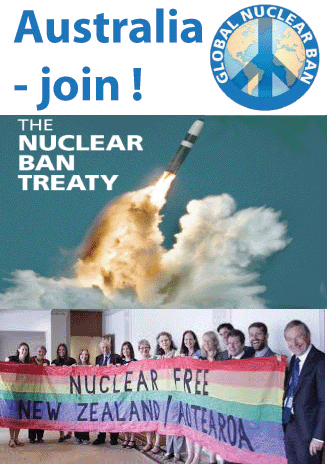 https://www.smh.com.au/politics/federal/it-s-time-why-labor-must-join-the-global-push-to-outlaw-nuclear-weapons-20181206-p50kpx.htmlBy Robert Tickner, 10 December 2018 The key political players and decision makers of the Australian Labor Party are about to gather in Adelaide for their 48th national conference from next Sunday. They will consider Labor’s stand on a humanitarian issue that has been the focus of the party’s ideals and aspirations for decades. Will it back a new global move to outlaw nuclear weapons?
Support for signing and ratifying the United Nations Treaty on the Prohibition of Nuclear Weapons has already been endorsed by 78 per cent of members of the parliamentary Labor Party. They include national president Wayne Swan, deputy leader Tanya Plibersek, shadow treasurer Chris Bowen, Tony Burke, Mark Dreyfus, Mike Kelly, Joel Fitzgibbon, Linda Burney, Catherine King, Brendan O’Connor, Anthony Albanese and Patrick Dodson. More than 20 leading trade unions have joined the ACTU in this cause. Continue reading
Students lead anti-Adani protests, vow to remove Liberal Party from power
Stop Adani protesters gather in cities, take aim at Scott Morrison’s activism comments, ABC News, 9 Dec 18 By Kevin Nguyen Student activists who felt the Prime Minister was condescending last week over climate issues have vowed to remove the Liberal Party from power — and keep it out — as long as it maintains its current policies.
Key points:
- A national survey showed a majority of respondents supported student protests on climate change
- Rallies took place in Sydney, Melbourne, Brisbane and Cairns
- Junior activists said the Prime Minister’s comments compelled them to march
Thousands of protesters gathered in capital cities on the east coast on Saturday in a coordinated march against Indian energy giant Adani’s Carmichael mine and rail project.
At the end of last month, Adani announced the scaled-back $2 billion controversial coal mine in the Galilee Basin would go ahead and would be 100 per cent self-financed, with work starting before Christmas.
While the attendees at the rally were diverse, it was school-aged students who were leading the crowds.
“It’s awful to see our leader feels like we shouldn’t have opinions and we shouldn’t care and they shouldn’t listen to us,” 14-year-old Jean Hinchliffe said in response to Mr Morrison’s calls last week for “less activism in schools”.
“It’s just atrocious. As students we are very informed and very educated and that’s why we’re taking action.
“We’re fighting for our own futures.”………
PM’s comments galvanised students
Like Jean, many young students who appeared at the rallies on Saturday were part of the thousands of Australian students who defied Scott Morrison’s call to stay in school.
While school-aged students will not be eligible to vote in next year’s federal and state elections, they are becoming the face of the Stop Adani and climate strike movements determined to make it a persistent election issue.
Daisy Jeffrey, 16, from Conservatorium High School in Sydney, said she was interested in a future in politics and Mr Morrison’s comments had galvanised her, and dozens of her peers, to take to the streets.
“It wasn’t disheartening, it made us more angry and more determined to go out on the streets,” Daisy said.
In addition to Sydney, rallies were held in Brisbane, Melbourne and Cairns.
n Melbourne, hundreds of people sat down in the middle of the busy Flinders Street intersection, blocking traffic in a bid to draw attention to their cause………https://www.abc.net.au/news/2018-12-08/adani-student-protesters-vow-to-keep-liberals-out-of-power/10597022
No Australian policy on climate change as Melissa Price, Minister For Coal, heads off to U.N. climate talks
No climate consensus at ministers meeting https://au.news.yahoo.com/no-climate-consensus-ministers-meeting-033707782–spt.html, Angus Livingston, , Australian Associated Press, 7 December 2018
Australia’s state environment ministers are refusing to agree to a joint statement on climate change until the federal minister comes up with a plan to tackle it.
Melissa Price met with her state counterparts in Canberra on Friday and asked them to endorse a statement for her to take to a climate meeting in Katowice, Poland, on Saturday.
They refused because the government has no plan to tackle the problem.
“What I had suggested was that we had an agreed statement that we would all work together to determine an action plan with respect to climate, with respect to things that we can do individually and collectively,” Ms Price told reporters on Friday.
“Sadly that was not agreed. There was not an agreement on the words that I proposed, and no one proposed alternative words.”
The Labor governments of Queensland, Victoria, Western Australia, the Northern Territory and the ACT released a joint statement condemning the lack of action.
“The science is frightening, unequivocal and clear – we are running out of time,” the statement said.
“Yet the response of successive Liberal prime ministers has been one of delusion and deliberate inaction.
“It is unacceptable that any action on climate change has again been left off the agenda at today’s meeting.”
The states demanded a boost to Australia’s overall output of renewable energy, stronger energy efficiency targets, and action on emissions across all sectors.
“It is time for the federal government to stop ‘noting’ the science around the impacts of climate change, and actually step up and take action,” Queensland Environment Minister Leeanne Enoch said.
“It is unacceptable that there has been no progress on climate change by the federal government.”
Ms Enoch said she asked Ms Price to come back to the next meeting with an action plan of how to respond to the Intergovernmental Panel on Climate Change report’s findings about the dangers of 1.5 degree global warming.
“Unfortunately, the federal environment minister would not agree to undertake that important work,” she said.
The fightback against Adani and Aurizon steps up
Margaret Gleeson, December 6, 2018, Issue 1206, www.greenleft.org.au/content/fight-back-against-adani-and-aurizon-steps
“A reported 20,000 students, many of them with their parents and grandparents in tow, took to the streets with a powerful message to Adani and policymakers: ignore us at your peril.
This was followed by a sit-in at Parliament House in Canberra on December 5.
Another round of #StopAdani rallies has been called in Brisbane, Cairns, Melbourne and Sydney on December 8. …
Adani has jumped the gun and started work illegally. Its use of groundwater is also the subject of a federal investigation. …
“The Supreme Court must decide if Aurizon, an enormously powerful and well connected corporation, should have the power to deny a small community group the right to inform Australians how to help to prevent this climate crisis.
“Obviously the people who make up FLAC have a direct interest in the outcome, but should this corporation succeed in gagging free speech to this degree, we will all be the worse for it.
“Finally, Aurizon’s action is based on the assumption that if FLAC stops training concerned citizens on how to take non-violent, safe, direct action, people will stop taking action. Unfortunately what may well happen is that people continue to act to prevent a climate catastrophe, but do so without the training, discipline or principles of non-violence.” … ‘
ReadMuchMuchMore of Margaret Gleeson‘s comprehensive article at the #GreenLeft Source: www.greenleft.org.au/content/fight-back-against-adani-and-aurizon-steps
1 This month

of the week – Australians for War Powers Reform (AWPR)
To see nuclear-related stories in greater depth and intensity
 Antinuclear