Which South Australian parties have the guts to say NO to the Federal nuclear waste dump plan? – theme for March 18
 Is there some reason why the greedy nuclear lobby, the secretive agency ANSTO, and the weak Australian government all seem to think that it’s OK to transport nuclear reactor trash for thousands of km across the land, and dump it on agricultural land in South Australia?
Is it because they’ve decided that South Australia is already radioactively trashed, because the Australian government allowed the British to test 12 major nuclear weapons and hundreds of “minor” ones on Maralinga, S.A.?
It is some sort of weird payback because this State never had convicts dumped on them – so the dominant Eastern States want to put the South Australians in their place?
South Australia is a beautiful place. It has never generated nuclear trash. Let the nuclear trash be kept, (as international conventions and best practice dictate) near to the point of production – AT LUCAS HEIGHTS in Sydney. And then let Australia come to its senses and stop making the foul stuff.
This is NOT a “Kimba” issue, not just a regional issue, – it’s certainly a STATE issue, and a NATIONAL issue.
Aware citizens in Australia are waiting to see if the South Australian Labor Party, Liberal Party, SA Best Party have the guts to join the Greens in saying NO to the Federal nuclear waste dump plan.
South Australia election: Greens OPPOSE, SA Best nearly oppose, nuclear waste dump in SA: Labor and Liberal vacillate
 “SA Best is pleased to provide the following response to … :
level radioactive waste storage and disposal facility
Yes
Refer to SA-BEST environment policy.
11c. Actively support the state Nuclear Waste Storage Facility (Prohibition) Act 2000.
Commit to further strengthen this legislation by removing the modified section
level radioactive waste storage and disposal facility
Yes
Commit to further strengthen this legislation by removing the modified section
 Note: The Liberal response (as published) does not provide an answer to Q 11b:
“The Greens have made the following commitments in response to … :
 11a Categorically rule out the creation of an international high and/or intermediate
level radioactive waste storage and disposal facility
Yes
Commit to further strengthen this legislation by removing the modified section
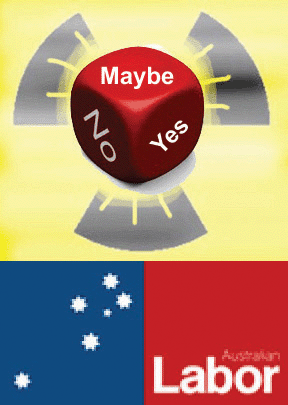 Labor: “Thanks for opportunity to outline our position. A detailed response to your questions is attached:
level radioactive waste storage and disposal facility more https://www.ourfuturesa.org.au/scorecard

Nuclear Waste issue highlighted in Port Augusta ahead of state election
 Mara Bonacci, 5 March 2018 On Saturday 3rd March, members of Adelaide-based group Don’t Dump on SA joined Adnyamathanha and Barngarla people and members of the Flinders Local Action Group (FLAG) on the Princes Highway in Port Augusta to highlight concerns over the Federal government’s plan to site a radioactive waste facility in South Australia.
The lively and colourful event involved a giant inflatable radioactive waste barrel, music, free cuppas and a lime green three-headed kangaroo. It received a positive response and lots of encouragement from locals and passing traffic.
Locals who stopped for a chat were given showbag-style information packs and encouraged to send a submission to the federal Senate Inquiry into the selection process for a national radioactive waste management facility in South Australia. An online submission template can be found athttps://nowastedump.good.do/wastedumpsenateinquiry/submission/.
Barngarla woman Linda Dare said “We’re here today to tell people that we don’t want a radioactive waste facility in South Australia. We want people to support us in the fight to stop it”.
FLAG member and Hawker GP, Dr Susi Andersson, said “The federal government is treating this as an issue for the local people only, but many people visit and care about the Flinders Ranges and don’t want a dump there. I feel the broader community need to know about and discuss this issue”.
In response to earlier federal moves to dump radioactive waste in SA our Parliament passed the Nuclear Waste Facility (Prohibition) Act 2000. The objects of this Act are “to protect the health, safety and welfare of the people of South Australia and to protect the environment in which they live by prohibiting the establishment of certain nuclear waste storage facilities in this state.”
In the lead up to the state election on 17 March, people concerned about the imposition of a nuclear waste facility in SA are being encouraged to vote for parties who will defend this legislation. Information can be found at https://www.ourfuturesa.org.au/scorecard.
Xenophon’s SA Best – interesting on renewables, (but what about the planned nuclear waste dump?)
my personal prediction is that this will result in around 90 per cent renewables [in South Australia] by 2030. This is a prediction, not a target.
SA can lead the nation not just on energy generation, but all the manufacturing, construction and jobs that could go with this in areas such as PV panels, components, smart energy, CST mirrors, etc.
 What’s Best for South Australia’s energy policy http://reneweconomy.com.au/whats-best-for-south-australias-energy-policy-28835/, By Graham Davies on 28 February 2018
At a recent energy event in Adelaide where I presented for Nick Xenophon’s SA-BEST, it was encouraging that the Greens, SA-BEST, Labor and Liberal all stated that renewables was the future.
However, the Liberal Party is going to be hamstrung by Turnbull/Abbott and the National Energy Guarantee (a thought bubble to appease the Abbott ilk, masquerading as policy); inaction on climate; and offering a $1 billion loan to Adani. Continue reading
Queensland premier backs renewables over Adani
Queensland’s premier has talked up gas and renewable energy when asked about the Adani coal mine, on her first day back from a trade mission to the United States.
Federal Labor Leader Bill Shorten this week cast further doubt on Adani’s ability to raise funding for the project and whether a future Labor government would support the project.
Annastacia Palaszczuk on Friday said she hadn’t spoken to Mr Shorten since returning from the US, but reiterated the $16.5 billion mine had to stand up by itself without taxpayer money.
“There are other resource industries investing in Queensland, the gas industry is investing in Queensland, we have $20 billion worth of renewable energy on our books,” Ms Palaszczuk told reporters in Brisbane
“I hope a lot of resource company’s projects go ahead, but money talks, and the money is talking by investing in renewables.”
Ms Palaszczuk deflected questions about the proposed coal mine in Queensland’s Galilee Basin, instead pointing to interest from US investors in her government’s 50 per cent renewable energy target.
The premier said she had also met with the CEOs of a number of gas companies in the US as part of her government’s push to use gas as a transition fuel between coal and renewables.
Shorten slip-slidin’ on Adani
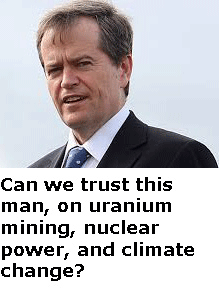 David Speers, The Opposition Leader has issued a statement that stopped short of promising to review the mine’s approval, but didn’t rule it out either. In other words, Labor’s position is as clear as mud. (subscribers only)
http://www.heraldsun.com.au/news/opinion/david-speers-cash-just-a-distraction-while-shorten-slipslidin-on-adani/news-story/0a61be3ee5fa0280feb69177b3153ed2
Labor can’t have it both ways on Adani Courier Mail editorial
On the issue of Adani’s proposed $16.5 billion Carmichael mine in Queensland’s Galilee Basin, the Labor Party, at both a federal and state level, reeks right now. They need to stop walking the middle road and come up with clear policy.(subscribers only)
http://www.couriermail.com.au/news/opinion/editorial-labor-cant-keep-on-middle-road-on-adani-mine/news-story/8fde752b52ce78e1158a83f6451fff3c
South Australia Liberal Party – confused policy on nuclear waste dumping
From the Liberals current policy website: 
NUCLEAR INDUSTRY – OUR POSITION
South Australia and the Nuclear Industry
The Liberal Party has always been willing to fully and openly investigate the pros and cons of the nuclear fuel cycle to grow our economy and build our State. https://www.stevenmarshall.com.au/nuclear_industry
From ABC news
SA power cuts: Nuclear energy should be considered as solution, state Liberals say, By Daniel Keane,
today he said that did not mean he or his party were against the production of high-level nuclear waste in South Australia, via nuclear energy generation.
“We’ve never ruled out the nuclear opportunity for energy. We made it very clear that we were not in the slightest bit interested in continuing to pour money into the hopeless case which was a nuclear repository in South Australia,” he said.
“The royal commissioner ruled out nuclear energy in South Australia but there will be a time when it may become viable, and desperate times call for desperate solutions, and we are in a desperate situation.”
Mr Marshall denied the policy was hypocritical, but did not offer an explanation as to what would become of the highly radioactive spent fuel rods if a nuclear reactor was built in South Australia. http://www.abc.net.au/news/2017-02-09/sa-power-cuts-could-be-solved-by-nuclear-energy-say-liberals/8256814
Nick Xenophon’s SA BEST party promises community electricity co-op.
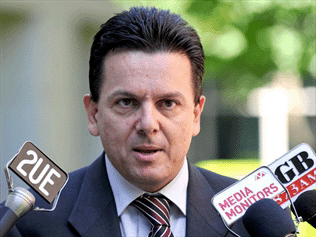 Xenophon’s SA BEST unveils community electricity co-op plan http://reneweconomy.com.au/xenophons-sa-best-unveils-community-electricity-co-op-plan-11721/ By Sophie Vorrath on 27 February 2018
Nick Xenophon’s SA BEST party has waded into the South Australia energy war, with an election promise to cut power prices by as much as 20 per cent, by setting up a community electricity co-op.
Billed as an “exciting plan to lower power prices using the co-operative model of community electricity trusts,” the policy was unveiled on Tuesday ahead of the March 17 state election.
It follows a battery of energy policy promises from Jay Weatherill’s Labor Party, including plans to boost the state renewables target to 75 per cent, to introduce an energy storage target, and to adopt nation-leading electric vehicle incentives.
The SA Liberal Party has been less ambitious, but in October last year promised $100 million in grants to help homes to buy and install battery storage.
The SA BEST policy proposal gives form to one of Xenophon’s most favoured campaign slogans, which promised to give power back to the South Australian people.
To be named the Community Electricity Trust of SA (cETSA), the co-operative retailer would be made up of 50,000 lower-income households and up to 5000 small businesses, and power prices for those members would come down by 20 per cent.
The retailer would also be able to tender to develop 150MW of new renewable energy generation.
“The co-operative (energy) model has an internationally proven track record for delivering services,” said Business Council of Cooperatives and Mutuals CEO Melina Morrison.
“(It) is already being deployed in countries around the world, including the USA, Germany and Denmark,” she said.
“Nick Xenophon has been a long-time champion of co-operative and mutual enterprises – the Business Council of Co-operatives and Mutuals is confident this won’t be the last creative solution to SA’s problems using the co-op and mutual model from SA BEST.”
This article was originally published on RenewEconomy’s sister site, One Step Off The Grid, which focuses on customer experience with distributed generation. To sign up to One Step’s free weekly newsletter, please click here.
Climate change denialists: is Australia’s new Deputy PM one of those?
Is Australia’s new Deputy PM another anti-wind climate denier? REneweconomy, By Sophie Vorrath on 27 February 2018
So Barnaby Joyce has gone; resigned from the position of Leader of the National Party and deputy prime minister of Australia, taking with him his climate scepticism, general dislike of renewables, and love of all things coal.
But is his replacement – Michael McCormack – any different? Quite possibly not. Here’s what we know, so far:
The Coalition’s minister for veterans affairs, and the newly installed minister for infrastructure and transport, McCormack joined parliament as a Nationals MP in 2010, after being elected to the House of Representatives for Riverina, in New South Wales.
He is the first Nationals leader since 1990 not to have worked as a farmer, although he is the son of a farmer.
McCormack started his working life in the media, rising from cadet journalist at the local Wagga paper the Daily Advertiser, to the position of editor.
He has some shady opinions on climate change.
In his first speech to parliament in 2010, McCormack he referred to climate science as “the nonsense we hear so often spoken by so many who base their views on mere assumptions of what might or might not happen.”
And he said: “When it does not rain for years on end, it does not mean it will not rain again. It does not mean we all need to listen to a government grant-seeking academic sprouting doom and gloom about climate changing irreversibly.”
He also referred repeatedly to that old Dorothea Mackellar poem – “I love a sunburnt country” – that some people seem to believe is a legitimate counter argument to decades of scientific research.
In 2012, he made an impassioned speech against the Labor government’s Carbon Pricing scheme:……..
is McCormack still a climate denier and wind farm hater? The answer is… we don’t know yet if he has evolved any.
Greens MP Adam Bandt tried to ask the new Deputy Prime Minister about his position on climate change during Parliament’s Question Time, but got shut down by the House Speaker:
“The member for Melbourne has been in the House long enough to know that he needs to ask ministers about issues for which they are responsible, not about first speeches, not about any other speeches. The member for Melbourne can resume his seat. The Deputy Prime Minister, as far as I am aware with the tabling of the new ministerial responsibilities, is still the Minister for Veterans Affairs and he is the Minister for Infrastructure and Transport, and that question in no way goes to his responsibilities. We will go to the next question.”
That’s a stunning statement – to suggest that ministries of infrastructure and transport “in no way” are linked to climate change.
RE has emailed and phoned McCormack’s office to ask if he still holds any or all of the above views. Or if he had changed them like he did on his strident attack on homosexuality that he later apologised for. We will keep you posted. http://reneweconomy.com.au/is-australias-new-deputy-pm-another-anti-wind-climate-denier-56686/
A Labor government could revoke Adani’s licence for coal mine expansion
Adani mine licence could be revoked under Labor government, Geoff Cousins says Bill Shorten told him, ABC News 27 Feb 8
Businessman and environmentalist Geoff Cousins says Opposition Leader Bill Shorten told him that if Labor wins government it could revoke the Adani mine licence.
Mr Cousins, former president of the Australian Conservation Foundation, told 7.30 that Mr Shorten made the statement to him privately last month.
“The key statement was that, ‘When we are in government, if the evidence is as compelling as we presently believe it to be regarding the approval of the Adani mine, we will revoke the licence, as allowed in the act. That’s a clear policy’,” Mr Cousins said.
“He told me he intended to speak to his colleagues.”
He said the conversation took place when Mr Shorten asked him for advice about the environmental impact of the Adani mine in Queensland’s Galilee Basin.
Mr Cousins said he spent two days in north Queensland with Mr Shorten — at the Labor leader’s request — to discuss the matter.
“He said he wanted to learn as much as he could first hand about the mine and the impacts on the reef and climate change issues and so on,” Mr Cousins said.
“He said the reason he wanted to get that first-hand knowledge was because he was planning a firmer policy position on Adani.”
According to Mr Cousins, at the end of the two days Mr Shorten told him he would discuss the policy with his colleagues.
Mr Cousins said he was speaking out publicly to “increase the pressure” on Labor to make a decision.
“It’s pretty clear there is some kind of resistance in his party to him leading on this issue,” he said………
The Adani mine has been a major headache for Mr Shorten and the Labor Party.
In rural Queensland the party faces a very real electoral threat from One Nation and wants to be seen as offering jobs and economic growth.
But at the same time it is trying to appeal to voters in the inner-Melbourne electorate of Batman, which could fall to the Greens in a by-election in just over a fortnight. http://www.abc.net.au/news/2018-02-27/geoff-cousins-accuses-bill-shorten-of-reneging-on-adani-deal/9490238
Australia’s Department of Home Affairs – too much power to Peter Dutton?
 Politicising Intelligence: Dutton, Pezzullo and the Department of Home Affairs, Independent Australia , Dr Binoy Kampmark discusses the “unsettling” power overreach of the newly devised super ministry, the Department of Home Affairs, overseen by Peter Dutton and Michael Pezzullo.
BE WARY of the police state operative, the desk job authoritarian — be especially wary of the political figures endorsing such characters, those supposed saviours from inflated threats and cardboard demons.
This is the dilemma Australian bureaucrats face across a range of departments in Canberra, notably those cannibalised in the creation of the Department of Home Affairs, the remodelled variant of the Immigration and Border Protection portfolio. Those affected by the process hail from the Attorney-General’s Department, Infrastructure and Regional Development and Prime Minister and Cabinet.
The Saturday Paper‘s Karen Middleton revealed something that was as surprising as the next sunrise. ASIO officials are said to have been tetchy about the whole business of centralised power — a point that seemed to eek its way in a secret speech delivered by the former Australian Attorney-General, George Brandis. Brandis, according to Middleton, claimed the creation of the department to be “unsettling” for the agency, though expressed confidence that the changes would be implemented without too much fuss……..
Pezzullo and Dutton harbour a confused view about the protection of liberty. To ensure its strength, a degree of state confusion and muddling is necessary. But security assumes the force of a sledgehammer, centralised and directed against citizen and enemy alike. ……..https://independentaustralia.net/politics/politics-display/politicising-intelligence-dutton-pezzullo-and-the-department-of-home-affairs,11243
Senator Cory Bernardi promises $445 billion for South Australia, if it hosts international nuclear waste dump

Cory Bernardi says a nuclear power dump could make us the ‘Saudi Arabia of the south’, news.com.au 26 Feb 18 CORY Bernardi is pushing to reignite a controversial development in South Australia, saying it could make the state the “Saudi Arabia of the south”.
LEADER of the Australian Conservatives party Cori Bernardi is pushing for a nuclear waste dump in South Australia, which he says will transform the state into the economic “Saudi Arabia of the south”.
Speaking at the party’s election launch in South Australia on Sunday, founder and federal Senator Cory Bernardi said he wanted to reopen the debate on an outback nuclear dump.
He called for changes to the law to allow for “all forms of energy production”, including nuclear power, urging authorities to “complete a full rigorous analysis” of the idea.
According to The Advertiser, he claimed the dump would generate up to $6.7 billion in gross state product, allow for $3 billion in annual taxes to be scrapped, and see the state reaping in $445 billion over the next century.
“Imagine that legacy for our children … to draw on in developing this state,” he said. “We would be an economic powerhouse. We would be the strongest state in the Commonwealth.”
Upper House candidate Robert Brokenshire said the party is “committed to looking at all types of energy production including nuclear energy to find the cheapest and most reliable form of energy”.
Labor Premier Jay Weatherill was quick to rule out the suggestion.
“That’s dead,” he said on Sunday. “Labor Party policy has been opposed to a nuclear waste facility in the past and there’s no prospect of changing that in the future.”
Mr Weatherill did not rule out pursuing a High Court case against the Turnbull government if a national nuclear waste dump was to be approved in South Australia, The Australian reported last month.
……..Earlier this month, the Australian Conservatives announced it will field 33 Lower House and two Upper House candidates at the state election on March 17. http://www.news.com.au/technology/environment/cory-bernardi-says-a-nuclear-power-dump-could-make-us-the-saudi-arabia-of-the-south/news-story/eb3f1ada5ed978646f53a2911f0e1c3d
South Australia: Senator Cory Bernardi ridicules Elon Musk, as he launches Australian Conservatives pro nuclear election Campaign
SA election: Australian Conservatives launch nuclear dump idea and ridicule Elon Musk, By Daniel Keane , ABC News 25 Feb 18
Labor wavers back and forth on the Adani coal mine question.
Labor’s fence-sitting on Adani has become a double backflip, Guardian, 24 Feb 18
The backflip is standard operating procedure in professional politics, we all know that, but the double backflip is a somewhat rarer event.
Yet under the cover of yet another seismic convulsion inside the Turnbull government, Bill Shorten looks to be lining up for the dubious double on the controversial Adani coal mine. After signalling quite clearly in late January that Labor would toughen its position on the project, the Labor leader has cooled off noticeably on that notion over the past week or so.
Just before David Feeney announced he would resign from parliament because he couldn’t prove he was eligible to sit in the lower house, triggering a byelection in his lower house seat of Batman, Shorten used an appearance at the National Press Club to telegraph a shift on the mine.
Climate groups had been active with Shorten over the summer break, trying to persuade him to adopt a legal option of stopping the mine. The Labor leader changed the working formulation on the project in late January, and backed in the putative shift in the weeks immediately following, suddenly revving up the negative environmental impacts of the project.
a few things will matter to Labor at the next federal election. One will be having a climate policy that appeals to progressive as well as traditional voters. Another will be having a leader who isn’t perceived by voters as a flip-flopper, or a climate warrior of convenience.
While Labor can’t and shouldn’t forget blue collar workers and succumb entirely to the post materialist sensibilities of its inner urban constituency, toughening its line on Adani represented an opportunity for Labor to try to unify the progressive left, which has engaged in poisonous recriminations as a consequence of the toxic climate wars which have divided Australian politics for more than a decade……..https://www.theguardian.com/australia-news/2018/feb/24/labors-fence-sitting-on-adani-has-become-a-double-backflip
Premier Jay Weatherill says that South Australia’s election will be a referendum on renewables
 Weatherill: Why state election will be referendum on renewables, REneweconomy, By Giles Parkinson on 22 February 2018
South Australia Premier Jay Weatherill might not be able to see much daylight between his Labor Party and the rival Liberals and SA Best, but he’s certainly making sure there is a big difference between his energy policy and those of the Opposition and the upstart party of Nick Xenophon.
Over the past few weeks, before and since the start of the official election campaign, Weatherill has been trotting out almost daily announcements about significant new investments and new targets for renewable energy and energy storage in the state.
It was capped this week with his world-leading 75 per cent renewables target by 2025, the Australia-first “renewable storage” target of 750MW, Australia’s first battery manufacturing plant, to be built by Germany’s sonnen, and any number of individual renewable and storage projects.
There is good reason for this. Renewable energy, according to the polls, is a lot more popular than the Labor government, struggling under the burden of 16 years in power and about an even bet with the Liberals, with Xenophon the wild-card.
…….Weatherill insists the pursuit of renewable energy has been a success. The Australian Energy Market Operator, having “dropped the ball” is now managing the system properly (new CEO Audrey Zibelman has been a “breath of fresh air”, he says), and renewables have not been the cause of any outages.
“What we have demonstrated is that despite having 48.9 per cent renewable energy, we haven’t had any reliability issues that caused outages because of the size of our renewable energy,” Weatherill says
The blackouts in September 2016, and in February last year, were caused by major weather events and failures in the National Energy Market, the latter when “perfectly good supply” (a major unit at the Pelican Point gas generator) was not switched on because of “the way the market works.”
That prompted the SA government to intervene, building its own emergency back-up, and launching a series of initiatives that has seen the world’s biggest lithium-ion battery built by Tesla, and the world’s biggest solar tower with molten salt storage due in 2020.
This has been accompanied by a series of investments and studies in battery storage, pumped hydro and hydrogen energy projects, along with virtual power plants and micro-grids.
And the Tesla big battery, next to the Hornsdale wind farm, is already having an impact, particularly in markets that provide network services known as FCAS (Frequency Control and Ancillary Services).
“The Tesla big battery is already smashing the FCAS market, and we will get fantastic benefits from not being ripped of by the existing generators for those FCAS services,” Weatherill says.
………Labor’s 75 per cent renewable energy target compares to the Liberals pledge to can any state-based initiative, even though both have programs to encourage battery storage in households.
Xenophon’s SA Best is only now starting to roll out its policy proposals, which include creating a new “not-for-profit” retailer, and a tender for 150MW of “dispatchable” renewables.
Weatherill is hopeful Labor can continue without having to strike a deal with Xenophon’s SA Best, but says he is confident, if he must, in being able to convince Xenophon to come on board with Labor’s energy policy, notwithstanding Xenophon’s support of anti-wind campaigns in the past.
“I think I can persuade Nick that this is an appropriate future for South Australia,” he says. “I hope to get there on my lonesome without a coalition. If we do (need to strike a deal), I won’t be compromised on this, because it is critical for the future of the state.”…….http://reneweconomy.com.au/weatherill-why-state-election-will-be-referendum-on-renewables-47132/
1 This month
17 October, Free Public Talk on Nuclear Issues in South Australia
David Noonan will speak on public interest concerns over the new Roxby Downs Indenture Act 2026 on BHP copper-uranium mining and ore processing in SA, and on how AUKUS may face SA with a High-Level nuclear waste agenda.
Dr Jim Green will discuss international developments in the field of nuclear power including ‘small modular reactors’ and Generation 4 ‘advanced’ nuclear reactor concepts.


Help Aunty Sue Protect Her Land and Sacred Sites From Destructive Rocket Testing.
.

Australians deserve the truth
about
AUKUS – https://aukuspublicinquiry.com/

PETITION – To: Prime Minister Anthony Albanese and the Australian Labor Government

of the week – Australians for War Powers Reform (AWPR)
To see nuclear-related stories in greater depth and intensity

