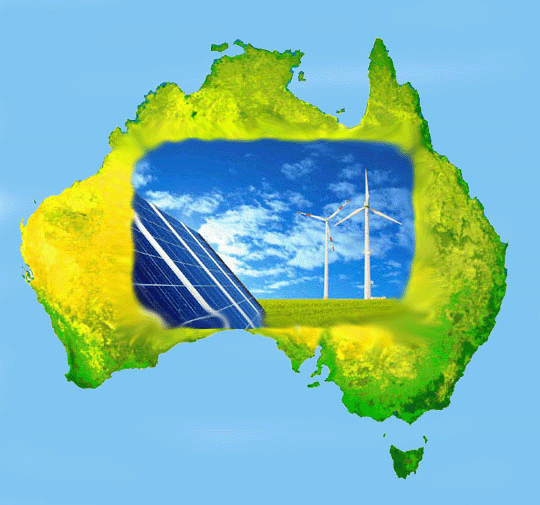
One year on from the state-wide blackout in South Australia that sparked the Coalition’s extraordinary jihad against wind and solar, it is clear that the answer to the trumped up energy crisis is exactly what the Coalition doesn’t want it to be: yet more wind and solar.
The message coming from the market operator, from the networks, from the CSIRO, from industry, and from the energy sector itself is that the best way to address the anticipated shortage of electricity, the soaring cost of gas, surging retail prices and cutting emissions is the same: more wind and solar.
The response of deputy prime minister Barnaby Joyce? He decided to compare Liddell and Bayswater with old cars and embraced the idea that Liddell was just like an old FJ Holden. Continue reading →
Bill Shorten visits South Korea to address nuclear tensions
Australian opposition leader calls on China and Russia to put pressure on the North Korean regime over missile tests, Guardian, Amy Remeikis, 24 Sept 17, Australia’s opposition leader, Bill Shorten, will meet with South Korea’s prime minister as part of a bid to reassure the region that Australia’s position on North Korea will not change, even if there is a change in government.
Shorten and his foreign affairs spokeswoman, Penny Wong, have left for a four-day trip to South Korea and Japan, with meetings scheduled with Lee Nak-yeon, the former UN secretary general Ban Ki-Moon, the commander of the US Forces in Korea, Gen Vincent Brooks, and Japan’s foreign minister, Taro Kono.
The trip comes just days after the Australian foreign minister, Julie Bishop, used her address to the United Nations general assembly to condemn North Korea’s ongoing nuclear and missile provocations, and to call on the rogue nation’s allies China and Russia to continue applying pressure.
On his way to the political hotspot, Shorten said North Korea was one area where Labor and the Coalition were in lockstep.
“South Korea and Japan are critical to the economic and national security of our region,” he said.
The Turnbull government’s $5 billion Northern Australian Infrastructure Facility has never received a proposal to help fund a coal-fired power station since it was created two years ago.
While senior minister, including Prime Minister Malcolm Turnbull, continue to link the NAIF to funding a next-generation coal plant, it is understood the NAIF board has not assessed any proposal for a high-efficiency low emissions or a carbon capture and storage coal project.
When contacted by AFR Weekend, NAIF chief executive Laurie Walker would not comment on specific proposals, but confirmed the board was on track to announce the first round of funding from the project later this month.
The project would then be put to Deputy Prime Minister Barnaby Joyce, who has taken over the portfolio after resources minister Matt Canavan stood aside following doubts over his citizenship.
Ms Walker said the NAIF board was now looking at 10 projects in due diligence, up from five projects a few months ago, based on 161 inquiries, and was on track to make a decision by the end of the month.
“We are still on target for our first investment decision. The decision hasn’t yet been made but we’re on track,” she said. Once a decision by the NAIF board has been sent to the minister he has 21 days to decide whether to veto – a period which can be extended to 60 days.
Other as yet undisclosed projects which have made it to the NAIF short-list include renewables, resources, transport and tourism, Ms Walker said.
Despite the lack of coal projects which have applied for NAIF funding, the infrastructure funding body – established by former treasurer Joe Hockey after the 2015 budget – is constantly linked by senior ministers as a potential funding source for next-generation coal projects.
Mr Turnbull, on a three-day trip to Queensland marginal seats this week, specifically highlighted the NAIF as a way to get new coal projects across the line.
Once a decision by the NAIF board has been sent to the minister he has 21 days to decide whether to veto – a period which can be extended to 60 days.
Other as yet undisclosed projects which have made it to the NAIF short-list include renewables, resources, transport and tourism, Ms Walker said.
Despite the lack of coal projects which have applied for NAIF funding, the infrastructure funding body – established by former treasurer Joe Hockey after the 2015 budget – is constantly linked by senior ministers as a potential funding source for next-generation coal projects.
Mr Turnbull, on a three-day trip to Queensland marginal seats this week, specifically highlighted the NAIF as a way to get new coal projects across the line.
The Queensland Liberal National Party has vowed to back a HELE coal project in the state if it wins the next election, which is due to be held later this year or early next year. But it says it wants it to be mostly privately funded.
Green Energy Markets director Tristan Edis said the concept of using taxpayer funding for a coal-fired power station in Queensland – which could cost between $2 billion and $5 billion – was not justified.
“It doesn’t make environmental or economic sense, but it makes perfect political sense [for the LNP],” he said.
Labor vowed to ban ‘trans-shipping’ in reef waters after UN’s scientific body raised concerns about proposal in 2014, Guardian, Joshua Robertson, 23 Sept 17, The Queensland Labor government has flagged breaking a 2015 election promise by allowing the loading of coal ships at sea in the Great Barrier Reef marine park.
Labor vowed to ban so-called “trans-shipping” in reef waters after the United Nations’ peak scientific body raised concerns about a proposal off Hay Point near Mackay in 2014.
The prime minister says with electricity demand flat and even falling in Australia, he doesn’t see there being a commercial demand for expensive nuclear power. Roje Adaimy, 21 Sept 17, Malcolm Turnbull doesn’t see there being the commercial demand for nuclear power in Australia to warrant pushing its development.
The prime minister says that while the country has among the biggest uranium reserves in the world, building nuclear power stations takes a very long time.
China has a number of plants under construction but there is no “cookie cutter” design to help efficiently roll out the technology.
There also needed to be bipartisanship, which right now “is not even remotely there”, he told a ‘politics in the pub’ event on Queensland’s Sunshine Coast.
“The projects take so long to build that they would be very likely to span the lifetime of several governments,” Mr Turnbull said on Thursday night. “They’re all bespoke, so it takes a very long time to construct them and very expensive.”
On top of that, demand for electricity in Australia was flat or declining. “I don’t see there being the commercial demand for nuclear power,” he said. “That’s putting my businessman’s hat on rather than my politicians’ hat on.”
It comes just a few weeks after the Minerals Council released a paper setting out the case for nuclear power.
Nuclear power has relatively strong support among coalition MPs, but it remains a political hot potato and has been repeatedly ruled out by governments because of its cost.
Coalition MPs giggle, cackle, smirk and laugh in Parliament over climate change,Independent Australia , Simon BlackMany of our current crop of conservative politicians laugh like naughty children whenever climate change is brought up. This can’t be how the world ends
NERO NEVER FIDDLED while Rome burned.
It is a popular myth, but it’s simply not true — there were no fiddles back in Roman times.
Nero is, however, reported to have sung a song about the sacking of Troy while watching as 70 per cent of Rome was swallowed by flames in a single blistering gulp.
Some of our current crop of politicians have gone one better — they now laugh like small children whenever climate change is brought up.
Whish-Wilson told the floor and later posted on social media, that it was “the angriest I have ever been in the Senate” as he watched members of the house openly mock climate scientists.
Liberal Senator James McGrath stood to read what appeared to be his party’s talking points in a deadpan monotone stopping a number of times to smirk and chuckle.
Leader of the Australian Conservatives Party, Cory Bernardi, rose to make a point of order, informing the house that it was, in fact, he who had been raucously laughing.
Presumably, he was concerned the people who voted him in would be upset if he wasn’t earning his base pay of $199,040 a year by chuckling his way through Senate motions.
Nice work if you can get it.
It’s part of a trend in Australian politics for conservatives to openly mock, laugh and ridicule climate change, even as the Great Barrier Reef bleaches and dies, even as we notch up record hot year after record hot year, even as natural disasters such as Hurricanes Harvey and Irma increase in frequency and intensity worldwide.
When asked about climate change in June this year by a Liberal colleague, Australian Environment Minister Josh Frydenberg had a good laugh.
How Malcolm Turnbull has trashed the Liberal Party record and betrayed our oceans, SMH, Tim Winton , 17 Sept 17 “……
Australians have always loved the ocean, but now, more importantly, we understand how vital the sea’s health is to the future of our island home…….
In 2012, after an exhaustive scientific process and wide community consultation, Tony Burke declared a system of marine national parks, one of the biggest and best in the world, the most significant conservation gain in Australian history.
That took courage. Because it put science before politics, prudence ahead of expediency. And it was popular. But as soon as he came to power in 2013 Tony Abbott announced an immediate moratorium on these parks and instigated a review. The purpose was purely political. To delay implementation, corrode consensus and deny the science. A move straight out of the culture warrior’s playbook.
After decades of forward-thinking leaders, the nation had fallen into the hands of a man whose loyalties were only to the past. It was a low moment. But Abbott’s reign was as brief as it was fruitless. It was a relief to see him replaced in 2015 by a man who’d actually done things, who believed in the future. Malcolm Turnbull did not scorn science. He seemed to understand the value and fragility of our natural estate. So there was new hope the marine parks review would now be expedited and redirected towards real conservation outcomes. With coral reefs bleaching and miners pressing for even more coal ports and seabed to drill, the need for protection had only grown more urgent.
Well, that moment of promise is long gone. Turnbull’s period in office has basically been a hostage drama. The bargain he made with powerbrokers rendered him captive to the party’s most illiberal wing, and if his performance on climate, energy and marriage equality aren’t evidence enough, last month’s announcement that marine parks would be slashed beyond all recognition puts it beyond dispute.
……The draft management plans recently released for consultation by Josh Frydenberg don’t just signify the gutting of the national system, they represent the largest removal of protection for Australian wildlife in our history. What the government is proposing is a nihilistic act of vandalism. Forty million hectares of sanctuary will be ripped from the estate. That’s like revoking every second national park on land. Under its new plan, 38 out of 44 marine parks will be open to trawling, gillnetting and longlining, 33 will be open to mining, and 42 exposed to the construction of pipelines. In total defiance of the scientific advice upon which the original system was designed, 16 marine parks will now have no sanctuary zones at all.
Coalition’s pro-coal policy likely a vote loser; optional voting in plebiscite helps Yes, The Conversation, Recently the Coalition and its media supporters have condemned the SA and Victorian Labor governments for allowing coal-fired power plants to close. The Coalition is trying to extend the life of the Liddell power plant in NSW, and is considering building a new coal-fired power plant. This is an attempt to portray Labor as the party of intermittent, unreliable and costly power.
The Coalition has been in office for four years. In July 2014, they repealed the carbon price that Labor had introduced. Many people would now ask why energy prices have kept increasing in the three years since this repeal. In a mid-August Essential poll, 59% thought they were paying a lot more for electricity and gas than two or three years ago.
In February, 45% in an Essential poll said that recent blackouts were mainly due to failures of the energy market, 19% blamed privatisation and just 16% blamed renewables.
In mid-August an Essential poll gave the Coalition a net -34 rating on providing affordable and reliable energy, their worst score from a list of 12 issues. In last week’s Essential, 49% blamed private power companies most for rising energy prices, 22% blamed the Turnbull government, 9% environmentalists and 5% renewable energy companies.
People who blame private power companies are more likely to trust Labor than the Coalition to get tough, given the Coalition’s pro-business reputation……. [lots of figures given here]
As a result of the Coalition’s pro-coal policy, some Abbott supporters could return, possibly boosting the Coalition’s primary vote at the expense of One Nation and Others. However, respondent allocated preferences are currently more friendly to the Coalition than the previous election method, and this could change. The Coalition risks losing more centrist voters to Labor.
In some parts of the country, such as NSW’s Hunter Valley, coal is important to the local economy, and the Coalition is likely to benefit. In most of the country, being pro-coal is likely to hinder the Coalition.
SA has been the state most subject to attacks from the pro-coal lobby. It has a Labor government that is over 15 years old, and this would be expected to be a drag on Federal Labor in that state. We would expect the SA swing to Labor to be the lowest of any state.
Instead, the Poll Bludger’s BludgerTrack currently gives Labor their second largest swing in SA. Labor leads in SA by 58.4-41.6, a 6.1 point swing to Labor since the 2016 election. The SA sample sizes used in BludgerTrack are small, so this result is much more error-prone than the national BludgerTrack figure (53.7-46.3 to Labor, a 4.1 point swing), but this is still a large swing to Labor in a state that should have the lowest swing.
“The Liberal National Party (‘LNP’) Welfare Card programme is really a LNP rort for the benefit of the Liberal and National Parties and their members, donors and supporters.
“Indue Pty Ltd, the corporation awarded the contract to manage the Welfare Card programme
and to operate its underlying systems, is a corporation owned by Liberal and National Party members
and that donates to various Liberal and National Party branches around Australia.
“The former chairman of Indue is none other than former LNP MP Larry Anthony who is the son of former Liberal Country Party Deputy Prime Minister Doug Anthony.
“Anthony now holds his shares in Indue in his corporate family trust managed by Illalangi Pty Ltd.
“Other companies now owned by Larry Anthony, or by the corporate trustee of his family trust, Illalangi Pty Ltd, work under ‘sub’ contracts for Indue itself and make their profits from dealings with Indue
in the course of Indue performing its contracts with the LNP Government.
“These corporations are SAS Consulting Group Pty Ltd
– a political lobbying group that counts Indue as a client
– and Unidap Solutions Pty Ltd – a digital IT services corporation that provides Indue,
as well as the current LNP Government directly, with various IT services.
“Larry Anthony is also current president of the National Party of Australia, that is, the ‘N’ in ‘LNP’. … “
As the federal government considers a clean energy target, one of its MPs is looking to nuclear power as a long-term solution. Nuclear technology sits hand in hand with concerns about North Korea but one federal MP believes there’s also room for it in the energy debate.
Assistant minister Jane Prentice on Thursday again flagged support for nuclear power as a long-term solution.
“It is clean and I think there are opportunities,” she told reporters in Canberra.
“I think the new nuclear technology is much safer than the old one and I think it should be on the discussion paper if we’re serious about long-term clean energy.”
The government is weighing up a clean energy target, the only recommendation it is yet to address from Chief Scientist Alan Finkel’s review of the national electricity market.
“Of course, our problem at the moment is short-term power and making it affordable, making it sustainable and reliable,” Ms Prentice said.
“I always believe that you need a longer term strategy as well.”
By Giles Parkinson on 12 September 2017 As the federal Coalition continues to push the case for an ageing, unreliable, and slow moving coal generator to maintain energy security in the 2020s, the Australian Energy Market Operator has underlined its advice to the government last week: it wasn’t a push for more baseload.
“We need flexible capacity that can be switched on and off, and we need to transition to a new generation of Australia’s principal energy market institutions, and the newly-formed Energy Security Board.
“Our advice was fairly pragmatic,” Zibelman said. “We are concerned that on a 45°C day if we lose a generator (which AEMO has said is quite likely) we want reserves in the system to be able to respond.
“In our report we identified the fact that with amount of variability (from solar and wind energy and electricity usage) is changing rapidly, we need resources that can change rapidly.
“That may be different to traditional baseload resources, which do not move a lot. It doesn’t mean baseload is bad, it’s just that we need a different portfolio. (Baseload) may not be able respond in the time period we need it to respond.”
Sound like Liddell? Not really. The plant owner AGL Energy has made it clear that Liddell is old, increasingly unreliable, expensive to maintain, prone to unexpected outages and can’t be relied upon at times of peak demand, particularly as temperatures rise.
Zibelman’s comments, like the two AEMO reports it released last week, contrast starkly with the Coalition government’s contention that AEMO had insisted that rapid action was needed, and that that rapid action must mean that Liddell’s life span must be extended.
Zibelman made it absolutely clear that her preference was for fast, flexible technologies, both in supply and demand, and bother in front and behind the meter. Importantly, it had to be technology that the market operator could rely upon.
“The system is changing,” Zibelman said. “That’s not a bad thing. What we need to do is to start saying we have to think about next the generation of technologies, the next generation of markets and how to take advantage of it.”
Earlier, she noted: “The power system works best when we can operate it in accordance with the law of physics. (That means) we need to make sure we have sufficient tools to respond in a real time system.”
She noted that a focus was needed on system services such as inertia, voltage and frequency, which came as “ancillary services” to thermal generators, but now had to be sought elsewhere. This was not a reason not to evolve, just a reason to focus on how to set a market to encourage these technologies and capacities.
“Our advice was pretty straight forward,” she said: “As system has a higher level of (renewable) penetration, issues like frequency, violate and inertia needs to be addressed – not because it a bad thing, but because it was bundled previously with the big generators ….
“It’s not just having enough of these resources, it’s about having enough of these resources at the time and the place you need them. At all times AEMO needs the ability to turn something on and something off to maintain system balance,” Zibelman said.
She spoke of demand management, one of her favourite topics and preferred mechanisms in the US, but said it had been communicated badly and misunderstood – particularly the idea that the market operator would turn off the lights or the air-conditioning.
“What we are talking bout is being able to use rotating mass, use battery storage, electric vehicles, and create a more integrated system.”
She said it was clear that the Australian market was heading towards 30-40 per cent “distributed generation”, which means mostly solar and storage behind the meter. These technologies can and needed to be harnessed to ensure that they contribute to grid security.
Asked specifically about Liddell, Zibelman said choosing that as a preference would require an analysis to determine its level of dispatchability and its flexibility, and its ability to deal with reliability concerns.
“What do we want to do is to make sure we are riding the technology innovation curve in the right way…. it all has to fit. We’re thinking about what do we need, what do we have, and then what are the right mechanisms to get the best outcomes that are economically sound.”
She said it was clear that the Australian market was heading towards 30-40 per cent “distributed generation”, which means mostly solar and storage behind the meter. These technologies can and needed to be harnessed to ensure that they contribute to grid security.
Asked specifically about Liddell, Zibelman said choosing that as a preference would require an analysis to determine its level of dispatchability and its flexibility, and its ability to deal with reliability concerns.
“What do we want to do is to make sure we are riding the technology innovation curve in the right way…. it all has to fit. We’re thinking about what do we need, what do we have, and then what are the right mechanisms to get the best outcomes that are economically sound.”
Nationals demand “coal target” as energy politics spirals into loony fog, REneweconomy By Giles Parkinson on 11 September 2017 It barely seems believable, but the politics of energy has just gotten worse. A week that began with a bizarre push to extend the life of a decrepit, 50-year-old power plant in the hope of keeping the lights on, finished with the Nationals demanding that no further subsidies be given to renewable energy.
Instead, they said, they should be given to last century’s technology: coal. At their annual conference on the weekend, the National voted, in effect, for a coal energy target. It wants the federal government to give out loans to support the coal industry.
Former resources minister, and Joyce’s ex chief of staff Matt Canavan, joined in, describing renewables as a “short term sugar hit” for jobs….
One sane voice at The Australian is Alan Kohler, who points out that despite the bluster of the Nationals and the conservatives within the Liberal Party, everybody knows coal-fired power stations must close if Australia is to meet the 2 degree commitment that everybody agreed to in 2015.
“The task of leadership is to prepare for that, not yearn for coal,” he writes.
“The Australian Energy Market Operator has made it clear the closures can be handled through demand management and some NEM redesign, with even more renewables and batteries, which is what’s happening anyway because that’s what businesses and investors want to invest in.
“There won’t be any new coal power stations, and the lives of existing ones won’t be extended unless the government, bizarrely and unnecessarily, pays for it.







 Antinuclear