 Federal Labor backtracking on support of Adani’s planned Carmichael coal mine, ABC News, 1 May 17 By political reporter Dan Conifer, Federal Labor is stepping back from its support of Adani’s proposed multi-billion-dollar Queensland coal project.
The Indian company is still to decide whether to proceed with its Carmichael mine in the Galilee Basin.
Earlier this month, Federal Opposition Leader Bill Shorten backed the project.
“I support the Adani coal mine so long as it stacks up. I hope it stacks up,” Mr Shorten said.
But Labor’s energy and environment spokesman Mark Butler today warned the development could hurt other coalmining areas……..
Westpac rules out lending to project
Westpac last week released a climate change policy stating it would only lend to projects involving higher-quality coal. The decision effectively ruled out financing the Adani development and any other ventures using coal from the Galilee Basin.
Mr Butler said the bank’s move was further proof “the economics of this project don’t stack up”.
“The demand for thermal coal exports around the world is in rapid decline,” he said.
“I think instead we should be thinking about other economic development and job opportunities for North Queensland.”
He said the Carmichael project would need a “miracle” to proceed.
Adani is seeking a $900 million taxpayer-subsidised loan for a rail line to the Abbot Point coal port.
According to Forbes’ rich list, group chairman Gautam Adani and his family are worth more than $8 billion.http://www.abc.net.au/news/2017-04-30/federal-labor-backtracks-on-support-of-adani-coal-mine/8483932
May 1, 2017
Posted by Christina Macpherson |
AUSTRALIA - NATIONAL, climate change - global warming, politics |
Leave a comment
Westpac’s anti-coal stance exposes a Coalition out of sync with business and public on climate http://www.theage.com.au/federal-politics/political-opinion/westpacs-anticoal-stance-exposes-a-coalition-out-of-sync-with-business-and-public-on-climate-20170428-gvuw4m.html Mark Kenny, Obviously Westpac’s public ‘un-friending’ of new coal – for which you can read Adani’s Carmichael coal mine in the Galiliee Basin – is a body blow for a project whose backers are thinning by the day.
Westpac is the last of the big four Australian banks to bin Adani’s publicly toxic prospectus.
All are unmoved by the lure of ongoing coal profits, especially if it comes with ties to a venture that has become a byword for climate change denial.
Adani will continue to seek other financiers – including extraordinarily, the Australian taxpayer from whom it is telling Indian backers, it remains eligible for a $1 billion loan. This is despite the Northern Australia Infrastructure Fund rules, which appear to render it ineligible.
With or without that welfare, the business case for new coal generally and the Adani mine in particular, looks to be ebbing. Fast.
Westpac’s decision is an environmental declaration of intent. But it is a coldly commercial one also that recognises what the Australian government defiantly rejects: coal’s day has passed.
Resources and Northern Australia Minister Matt Canavan hit out strongly at the bank, suggesting it had succumbed to the inner-city politics of Sydney rather than the employment needs of the sunshine state. Remarkably, Canavan – cabinet minister – even advocated a boycott, counselling potential customers to back a bank that backs Queensland’s interests.
Doubtless there would be many Queenslanders upset by the Adani venture, not least the thousands already employed around the Great Barrier Reef.
Besides, Westpac is hardly going out on a limb. Try going to the AGL website. One of the nation’s biggest energy companies has announced a new campaign to end its association with coal entirely: “The reasons for getting out of coal are all around us” its homepage proclaims.
Privately, Malcolm Turnbull must surely be hoping the Adani thing just goes away. The PM may be a progressive rationalist at heart but in his head there are other realities to balance. Party room realities like Tony Abbott, Peter Dutton, and the Nationals, whose head-in-the-sand record on climate change has left farmers so exposed that even the National Farmers Federation now proposes a carbon price.
Paul Keating once described Turnbull as a cherry on a compost heap. The trouble with compost heaps is they tend to be stationary. This issue is anything but, and if you want proof, just follow the money.
May 1, 2017
Posted by Christina Macpherson |
AUSTRALIA - NATIONAL, business, climate change - global warming, politics |
Leave a comment
 Greens delight in inserting more wind turbines into Barnaby’s seat, REneweconomy,
By Giles Parkinson on 28 April 2017 It is one of the great ironies of Australia’s latest renewable energy boom that the New England electorate of deputy prime minister Barnaby Joyce – one of the most ardent and
misinformed opponents of renewables in the current government – should be one of the country’s key renewable energy hubs.
And The Greens, the most ardent supporters of a very rapid transition to 100 per cent renewable energy (a goal that the CSIRO and the networks agree is quite attainable), delight in pointing this out.
This week, Shane Rattenbury, the ACT minister for climate change and the only Green to hold such a portfolio, and NSW Greens energy and resources spokesman Jeremy Buckingham went to Joyce’s seat to inspect the early construction work on the new Sapphire wind farm, a 100MW facility that is being built thanks to a contract signed by the ACT as part of its program to secure wind and solar for the equivalent of 100 per cent of its electricity needs by 2020.
They took particular delight in mocking Joyce’s description of a transition to renewables as “crazy”, while at the same time playing host to some of the biggest wind and solar projects in the state. Apart from Sapphire, New England also plays host to the White Rock wind farm and the new solar farm that is being built nearby, and other projects in the pipeline………
Rattenbury, who is also leader of the ACT Greens and now responsible for ensuring that the contracts with the 10 wind and solar farms in NSW, Victoria and South Australia are delivered, and that the state meets its 100 per cent target, says Sapphire will create 200 local jobs and generate up to $10 million in economic benefits within the local New England economy.
“It’s disappointing that the Deputy Prime Minister Barnaby Joyce describes the ACT’s 100% renewable electricity target as ‘crazy’, while his electorate reaps the benefits of a clean energy future,” he said.
“The fact is, the contracts are in place, the projects are getting built and the ACT target will be met on time, at prices that aren’t exposed to the fluctuations of coal and gas.”
Indeed, the ACT may be a net beneficiary. It has locked much of its renewable energy generation at prices around $80/MWh, while wholesale prices across the nation have soared well beyond that. When the prices do jump above the fixed price negotiated by the ACT, the ACT consumers receive the difference……..http://reneweconomy.com.au/greens-delight-in-inserting-more-wind-turbines-into-barnabys-seat-48035/
May 1, 2017
Posted by Christina Macpherson |
AUSTRALIA - NATIONAL, politics |
Leave a comment
Turnbull wants to subsidise coal AND gas transport, REneweconomy, By Sophie Vorrath on 27 April 2017 Prime minister Malcolm Turnbull has again declared his support for all things fossil fuel, after suggesting his government could use public money to sponsor both new coal and gas production facilities in Australia, via the Northern Australia Infrastructure Fund.
In his latest concession to the nation’s powerful fossil fuel lobby, Turnbull told Brisbane Radio that the fund could be used both to subsidise gas pipelines in northern Australia and to underwrite the plans of Indian coal giant Adani to build a rail line from its proposed Carmichael mine………
Activist group GetUp said Turnbull’s plan to use public monies to underwrite gas pipelines was “another white elephant”.
“Not content with handing over a billion dollars to prop up Adani’s doomed coal project, Turnbull now wants to spend public money on an expensive and unviable gas pipeline as well.” said GetUp’s Miriam Lyons.
“Spending public money on white elephants in waiting is a betrayal of everyday Australians who pay their taxes to fund public services and public-interest infrastructure.
“As with Adani’s doomed Carmichael project, a gas pipeline from the Northern Territory to Queensland doesn’t stack up economically,” Lyons said.
“It will also do nothing to stop price-gouging by greedy gas generators who have a stranglehold on the market for supplying power to meet demand spikes caused by heatwaves and cold snaps.
“The best thing we can do to break the power of greedy gas companies is to back the competition: cleaner, cheaper, fracking-free energy from solar and storage, as well as energy efficiency,” she said. http://reneweconomy.com.au/turnbull-wants-to-subsidise-coal-and-gas-transport-61896/
April 28, 2017
Posted by Christina Macpherson |
AUSTRALIA - NATIONAL, climate change - global warming, politics |
Leave a comment
More hydro power on federal agenda, Herald Sun, Katina Curtis, Australian Associated Press, April 20, 2017 Malcolm Turnbull is boosting his renewable energy credentials by providing federal funding for another study into expanding Australia’s hydro storage, this time in Tasmania.
It comes as Labor accuses the prime minister of giving gas companies a wet lettuce leaf flogging in his bid to persuade them to increase domestic supply.
Mr Turnbull also confirmed on Thursday his government is looking at building a multi-billion dollar pipeline to bring gas from Western Australia to the east coast – an idea climate experts dismiss as ridiculous and expensive…….
However, energy expert Andrew Stock, from the Climate Council, dismissed it as an idea that would lock in high power prices.
“LNG export pricing out of the west coast plus transportation through a multi-billion dollar pipeline doesn’t make for cheap gas,” he told reporters in Canberra.
Mr Stock was launching a new Climate Council report warning switching from coal to gas power will do nothing to lower electricity bills and will be nearly as polluting. http://www.heraldsun.com.au/news/breaking-news/more-hydro-power-on-federal-agenda/news-story/4b0b27dfd550e150108b8662f68f550e
April 22, 2017
Posted by Christina Macpherson |
AUSTRALIA - NATIONAL, energy, politics |
Leave a comment
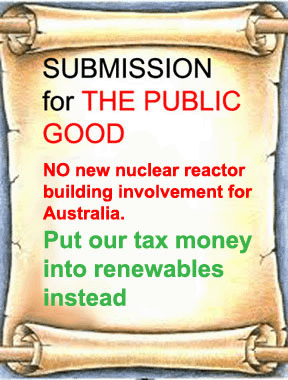
 Submissions received until 28 April by Parliamentary Committee
Right now a Parliamentary Committee is considering Australia’s further involvement in the ‘Charter’ or Framework Agreement for International Collaboration on Research and Development of Generation IV Nuclear Energy Systems. The Committee consists of 9 Liberal MPs, 6 Labor, and one Green.
Australia secretly signed the ‘Charter’ on 22 nd June 2016 – signed by  Dr Adi Patterson COE of the Australia Nuclear Science and Technology Organisation. (pending this JSCOT review). ANSTO is to be the implementing agent.
The An international collection of 14 countries: Argentina, Brazil, Canada, France, Japan, South Korea, South Africa, the UK and the USA ( original charter members 2005) Switzerland, Euratom, China, Russia and Australia (signed later) . The World Nuclear Association describes the collection as countries for whom nuclear energy is significant now or seen as vital in the future.

When the Australian government quietly signed up to the GIF, it made no commitment to any particular action towards developing new nuclear reactors. Other countries, including Japan, Canada, France, South Korea, have committed to working on particular types ofGeneration IV reactors Australia might be expected to not only fully sign up as a member of the Charter, but perhaps also to provide funding and resources to develop one or more types.

Involvement of various countries in developing particular types of new nuclear reactor

April 17, 2017
Posted by Christina Macpherson |
ACTION, AUSTRALIA - NATIONAL, politics, secrets and lies |
Leave a comment
 Loaning $900m for Adani’s central Queensland coal railway too risky, environmental lawyers say The World Today By Katherine Gregory 12 Apr 17
“………’If we stop this project, it will be worse for the environment’
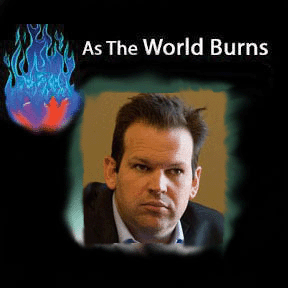
The Minister for Northern Australia and Queensland senator Matt Canavan said the letter sent to NAIF’s directors was a bullying tactic.
“These guys are bullies trying to stop jobs being created in north Queensland. Their stated aim is against coal and development. Against coal, and coal is the second largest exporter in Queensland,” Senator Canavan said.
He said the Queensland Supreme Court has already dismissed environmentalists’ arguments that the mine should not go ahead because of climate change.
“If we don‘t supply India with coal, other countries will,” Senator Canavan said.
“So from global climate change perspective to argue that this mine in and of itself will warm the planet and cause global warming disasters is wrong and misguided.
“There are other parts of the world India will get its coal from and it will. The Indian resources minister has said that to me specifically.
“If anything, if we stop this project, it will be worse for the environment, because the coal that is there in the Galilee Basin is higher quality, much higher quality than what exists in India.”
Senator Canavan said Adani’s rail line would open up opportunities for other mines and create more jobs for regional Queensland.
But shadow resources and northern Australia minister Jason Clare said federal Labor does not support using taxpayer money to fund the rail line.
“What are the rules that this Northern Australia Infrastructure Facility have to comply with when they decide when they’re going to tip taxpayer money into private projects?” Mr Clare said.
“And one of the rules here is that they can only provide funding if the project is unlikely to go ahead without it. And Adani has said this funding isn’t critical.
“So on that basis it doesn’t meet the requirements of the fund.” say http://www.abc.net.au/news/2017-04-12/adani-queensland-coal-mine-railway-$900m-loan-too-risky/8439582
April 14, 2017
Posted by Christina Macpherson |
AUSTRALIA - NATIONAL, politics |
Leave a comment
“His idea of protecting the Reef is giving a coal billionaire a billion dollars to build a coal mine right on the Reef’s doorstep.
Turnbull slammed for “sucking up” to Adani, as business pushes 50-year life for coal plants, REneweconomy, By Sophie Vorrath on 11 April 2017 Prime Minister Malcolm Turnbull has come under renewed criticism from Australian environmental groups after meeting with senior executives from Indian coal mining giant Adani Group as part of his three-day state visit to India.
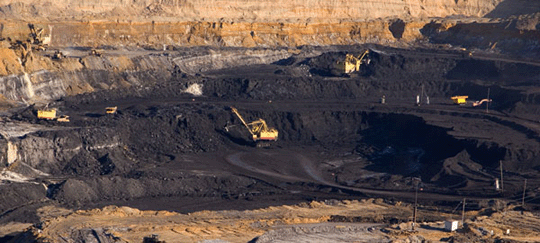
The meeting with Adani chair Gautam Adani and other company executives in New Delhi on Monday coincides with deliberations on company’s final investment decision on the $21-billion Carmichael coal mine in Queensland’s Galilee basin, which is set to be Australia’s largest coal mine, if built. Continue reading →
April 12, 2017
Posted by Christina Macpherson |
AUSTRALIA - NATIONAL, climate change - global warming, politics |
Leave a comment
Senate inquiry sparks ideological fight over Australia’s energy supply and climate change, ABC News, By political reporter Angelique Donnellan, 10 Apr 17, A Senate inquiry report into Australia’s electricity supplies has descended into a slanging match between members, prompting questions about its value for taxpayers.
The Select Committee into the Resilience of Australia’s Electricity Infrastructure in a Warming World heard from 60 witnesses in Adelaide, Canberra and Melbourne, including major energy generators, retailers and industry regulators.
But in the committee’s draft report released today, Federal Greens senator and chairwoman Sarah Hanson-Young took aim at the Coalition and its policies.
“The introduction of a market-based carbon trading scheme would effectively end the decades-long subsidy that coal has received in the electricity generation market,” she said.
“Yet like the proverbial ostrich, the Coalition Government has buried its collective head in the coalmine and refuses to address in any meaningful way the crisis facing the nation.”
The committee had seven other members, including three Labor senators, two Liberal, One Nation and Nick Xenophon.
All dissented to Senator Hanson-Young’s draft report, with Coalition senators calling it biased, false, misleading and dismissive of coal as a generator for electricity…….
Senator Hanson-Young questioned the use of gas as a transition fuel and the need for more gas mining.
“The misplaced notion that coal seam gas could provide a solution to the gas shortage on Australia’s east coast displays a profound ignorance of how the market works,” she said.
“Any unconventional gas will surely find its way onto the export market.”http://www.abc.net.au/news/2017-04-10/coalition-senators-take-aim-at-senates-draft-electricity-report/8431790
April 12, 2017
Posted by Christina Macpherson |
AUSTRALIA - NATIONAL, climate change - global warming, politics |
Leave a comment
The motion taken by the Young Nats brings them into line with the National Farmers’ Federation, the Business Council of Australia, the Australian Industry Group and much of the energy sector, including the electricity transmission and distribution businesses
Young Nationals reject federal party policy to back emissions trading, The Age, Heath Aston , 10 Apr 17, The Young Nationals have split with the senior ranks of the party, voting to support the introduction of a carbon trading scheme. Continue reading →
April 12, 2017
Posted by Christina Macpherson |
AUSTRALIA - NATIONAL, climate change - global warming, politics |
Leave a comment

The contents of the Coalition’s dissenting report, however, are quite extraordinary, and highlight the difficulties that prime minister Malcolm Turnbull would have if he ever chose to implement sensible energy policies, or sought to implement the inevitable conclusions of the Finkel Review.
In essence, the Coalition’s report was a collection of renewable energy myths that might have been collected from far-right anti-wind and climate denying websites
Coalition says wind turbines increase emissions, more coal needed, REneweconomy, By Giles Parkinson on 11 April 2017 Coalition Senators say that wind turbines are likely to cause greenhouse gas emissions to increase, and insist that the best thing that Australia can do to combat climate change is to export more thermal coal.
The extraordinary conclusions – from Senators Chris Back and Jonathon Duniam – were included in the dissenting report to the Senate inquiry into the resilience of electricity infrastructure in a warming world. They also insist that coal and gas would remain the dominant sources for electricity around the world for “many generations to come.”
“Energy generated by wind turbines do not reduce greenhouse gas emissions within the electricity sector by the amount claimed. In fact, there is some evidence that the addition of wind energy onto the grid actually increases carbon emissions,” the Coalition Senators wrote.
It was one of four dissenting views on the report prepared by the Greens chair Sarah Hanson-Young, highlighting the impossible nature of Australia’s energy politics, and the apparent refusal of any parties to agree on anything, including facts.
One Nation’s Malcolm Roberts issued a dissenting report which simply claimed that there was no such thing as a warming world. Continue reading →
April 12, 2017
Posted by Christina Macpherson |
AUSTRALIA - NATIONAL, politics |
Leave a comment
The Indian company has applied for a $900 million concessional loan from the government’s Northern Australia infrastructure fund to help build a rail line connecting the central Queensland mine and the Abbot Point port.
“If you want to have a good commercial operation in Australia, I am not convinced the taxpayer of Australia should underwrite the risk of the project through a billion dollar loan,” Opposition Leader Bill Shorten told reporters in Brisbane.
Mr Shorten said other mining companies are not getting billion dollar railways built for them.
“We have to make sure it stacks up,” Mr Shorten said.
The company’s Carmichael coal mine project in Queensland was approved in December but has faced serious opposition from environmental and indigenous groups.
Senior executives of Adani, including founder and chairman Gautam Adani met with Prime Minister Malcolm Turnbull in India on Monday.
Mr Adani requested an early resolution of native title issues surrounding the mine, which was hit by a Federal Court ruling that invalidated deals with traditional owners across Australia.
Legislation dealing with the problem is before the Senate and Mr Turnbull is understood to have assured the company the issue would be fixed.
Mr Shorten said Attorney General George Brandis was to blame for the confusion over native title.
Anything he touches turns to “custard”, the Labor leader said.
“In an incompetent government, he is the gold medal of incompetence,” he said.
April 12, 2017
Posted by Christina Macpherson |
AUSTRALIA - NATIONAL, politics |
Leave a comment
Adani to press Turnbull on $900m boost during visit , THE AUSTRALIAN, DAVID CROWE, Political correspondent, Canberra, @CroweDM, 10 Apr 17, Malcolm Turnbull will be asked to seal a $900 million deal to clear the way for the mammoth Adani coal mine in central Queensland during his visit to India that also seeks to inject momentum into a trade deal between two countries.
The Prime Minister arrived in New Delhi last night for a three-day state visit that will include talks with his Indian counterpart Narendra Modi, meetings with business leaders and a focus on the country’s demand for energy.
The $21 billion coal project towers over other items on the agenda, with Adani pushing for action within months on financing agreements and regulatory hurdles. Its Carmichael mine is being opposed by green groups in the courts and on the ground.
“We’ll certainly be talking about the importance of energy exports to India,” Mr Turnbull said before flying to New Delhi from Port Moresby, where he concluded a two-day visit yesterday morning. “India has a massive program of expanding electrification across the country and Australian coal has a very big role to play in that.”
Adani founder Gautam Adani told Indian media last month the company was eligible for $900m from the Turnbull government’s Northern Australia Infrastructure Fund to build the rail line from the mine to the company’s port at Abbot Point.
The backing from the fund, which uses federal guarantees to finance commercial projects, will help Adani limit its equity contribution to the rail project to about $800m of a total investment of about $2.5bn in the next two years, with the rest coming from debt and the NAIF.
Queensland Premier Annastacia Palaszczuk met Mr Adani in Mumbai last month and announced most approvals had been concluded for the project. At the same function, Mr Adani said he expected final approval from the federal government by May.
Mr Turnbull is expected to see Mr Adani during the visit after meeting him at least twice, in November 2015 and December 2016, when the billionaire pushed for more help to get the mine open.
After the 2015 meeting, Mr Adani said he had pressed Mr Turnbull to legislate to stop environmental groups delaying the project in the courts. The Abbott government’s attempt to amend the Environmental Protection and Biodiversity Conservation Act to stop “vigilante” activists was stymied in the Senate a month before Mr Turnbull became Prime Minister.
Writing in The Australian today, Mr Turnbull emphasises the opportunities for Australia as the Indian economy grows, increasing demand for Australia….. http://www.theaustralian.com.au/national-affairs/foreign-affairs/adani-to-press-turnbull-on-900m-boost-during-visit/news-story/6beae575a49aacfad4d51eca3dfe0846
April 10, 2017
Posted by Christina Macpherson |
AUSTRALIA - NATIONAL, climate change - global warming, politics, politics international |
Leave a comment