Australia’s democracy trashed, as Labor government + Liberal opposition join forces to push AUKUS bills through
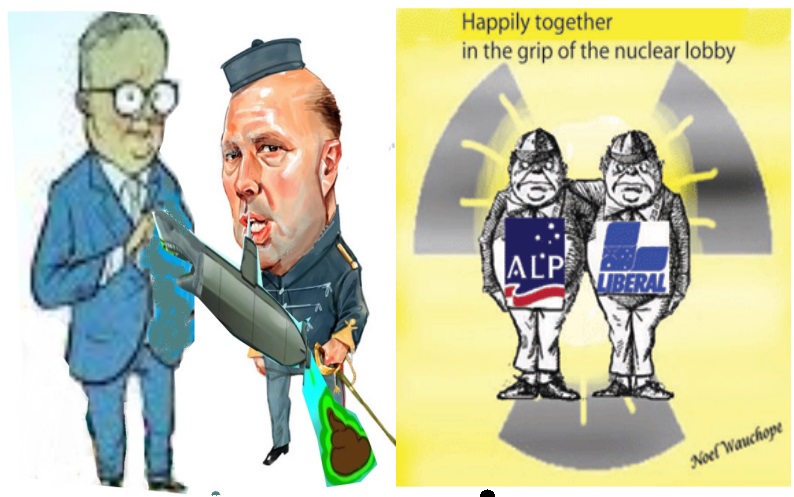

15 Oct 24, On Thurs 10th the ALP Gov & Coalition jointly forced a Senate vote on two AUKUS Bills without allowing any debate and jointly voted down all proposed amendments (see below) – see the vote at Senate Hansard extract at p.28-29 of this doc https://parlinfo.aph.gov.au/parlInfo/download/chamber/hansards/28068/toc_pdf/Senate_2024_10_10.pdf;fileType=application%2Fpdf
16 x Senators voted No:
Allman-Payne, P. J. Cox, D. Faruqi, M. Hanson-Young, S. C. Hodgins-May, S. Lambie, J. McKim, N. J. (Teller) Payman, F. Pocock, B. Pocock, D. W. Roberts, M. I. Shoebridge, D. Steele-John, J. A. Thorpe, L. A. Tyrrell, T. M. Waters, L. J.
36 x Labor & Liberal & National Senators voted Yes to AUKUS Bills.
see Australian Greens Senator David Shoebridge Media Release on 11th Oct 2024 on nuclear waste aspects:
Albanese and Dutton team up on toxic AUKUS nuclear waste deal | Australian Greens
All proposed Amendments to the AUKUS Bills were voted down by the ALP & the Coalition.
a set of Amendments by Greens Senator Shoebridge, a set by Ind Senator Thorpe, a set by Ind Senator Pocock, and a set by Senator Lambie, were voted down as four groups of amendments – see a Senate Hansard extract from p.40 to p.58 of doc: https://parlinfo.aph.gov.au/parlInfo/download/chamber/hansards/28068/toc_pdf/Senate_2024_10_10.pdf;fileType=application%2Fpdf
Premier vows to hold vote on Coalition nuclear power plan ahead of federal election

Queensland state law forbids the construction and operation of nuclear reactors and other facilities under the Nuclear Facilities Prohibition Act.
LNP leader David Crisafulli, who is on track to lead the opposition to power, stands firmly against the proposal.
Fraser Barton, Oct 15, 2024, https://reneweconomy.com.au/premier-vows-to-hold-vote-on-coalition-nuclear-power-plan-ahead-of-federal-election/
Queenslanders will be asked to vote in a plebiscite on nuclear energy at the next federal election if Labor Premier Steven Miles is re-elected.
The premier believes a separate vote on Opposition Leader Peter Dutton’s nuclear proposals can be held at the same time as the federal poll.
“I’ve said I’ll comply with the law,” the premier told reporters alongside Prime Minister Anthony Albanese on Monday.
“The law bans nuclear in Queensland but also requires the minister to hold a plebiscite as soon as they reasonably believe that the Australian government intends to build a nuclear reactor.
“Peter Dutton said the first step to get nuclear reactors in Queensland is to elect David Crisafulli – they were his words – and that means that the first step to blocking Peter Dutton’s plan for nuclear reactors is to elect me in October.”
Albanese labelled the federal coalition’s nuclear energy goals a “fantasy”.
“They don’t have a proper plan here, and it’s no wonder that they should be held to account for it,” he said.
Dutton has promised to build seven nuclear plants across Australia if the coalition wins next year’s federal election.
Dutton has previously vowed to override states who refuse to adopt the energy plan.
But Queensland state law forbids the construction and operation of nuclear reactors and other facilities under the Nuclear Facilities Prohibition Act.
LNP leader David Crisafulli, who is on track to lead the opposition to power, stands firmly against the proposal.
Political analyst John Mickel said Labor would use nuclear’s high costs and dependency on water to woo regional voters, if the plebiscite goes ahead.
“What Labor would be trying to do there is bring that issue to the fore,” he told AAP.
Plans to build nuclear plants could cost up to $600 billion and the coalition said nuclear reactors could be online by 2037.
Queensland premier will hold plebiscite on nuclear power if he wins state election
Exclusive: Steven Miles says law requires a referendum be called if the commonwealth is likely to build a ‘prohibited nuclear facility’ in the state
Andrew Messenger and Graham Readfearn, Mon 14 Oct 2024
Steven Miles will hold a state plebiscite on Peter Dutton’s nuclear power plans if he wins the 26 October poll, a move that could polarise the electorate in the Coalition’s strongest state at the next federal election.
The Queensland premier said he had received legal advice on the nuclear issue and raised the possibility of initiating a plebiscite on the same day as the federal election.
“Depending on how things play out, you could even hold that plebiscite on the same day as the federal election, to save people going to the polls twice,” Miles said in an exclusive interview with Guardian Australia.
The federal opposition leader, Peter Dutton, will take a plan for seven Commonwealth-owned nuclear power stations to the next election. That includes two in Queensland, replacing existing coal plants at Callide and Tarong.
But an obscure provision in Queensland’s 17-year-old Nuclear Facilities Prohibition Act 2007 may stand in the way. The act bans granting a grid connection, development application or generating authority to any nuclear facility.
It also requires the minister call a plebiscite if “satisfied the government of the commonwealth has taken, or is likely to, take any step supporting or allowing the construction of a prohibited nuclear facility in Queensland”.
The state opposition leader, David Crisafulli, has repeatedly ruled out changes to the law, most recently at a joint press conference with Dutton this month……………………………………………………………………………………. more https://www.theguardian.com/australia-news/2024/oct/14/queensland-premier-will-hold-plebiscite-on-nuclear-power-if-he-wins-state-election
Two Peter Dutton policies may swing Teals to Labor in a minority government
Michael West Media by Michael Pascoe | Oct 14, 2024
The scenario: a minority government after the next election, as various polls forecast.
The question: in a close-run thing, to whom would the “Teals” give the keys to the Lodge?
The hypothesis: there are two Dutton policies that should force the genuine independents to select Albanese as Prime Minister.
The perversity: neither of those policies could be expected to appeal much to voters who weren’t already in the LNP camp.
May election likely
Slipping by without much attention last week was the government changing Budget Night to March 25, effectively confirming the early May election that has always been most likely. So seven months to win any hearts and minds that are not already committed.
The makeup of the crossbench will be different. Not all the community independents – to give Teals their official name – from the Class of ’22 may be returned (for starters, vale the scratched seat of North Sydney and, therefore, Kylea Tink) and there could be newbies. From here, though, it still looks likely that Teals will have the final say on who forms government. More on that later.
Enter stage right the two key LNP policies that should make it impossible for Teals to give Dutton the nod: nuclear power and housing.
The key common issues of the Teal wave in 2022 were climate, integrity, gender, and not being Scott Morrison, all based on a pledge of listening to and reflecting their communities’ concerns.
The nuclear “concept” of a plan
Dutton’s “concept of a plan” to build multiple nuclear reactors somewhere between a distant tomorrow and eternity – an excuse for extending fossil fuel burning and reducing investment in renewables – won’t and can’t wash with any Teal genuinely concerned about climate policy.
Enter stage right the two key LNP policies that should make it impossible for Teals to give Dutton the nod: nuclear power and housing.
The key common issues of the Teal wave in 2022 were climate, integrity, gender, and not being Scott Morrison, all based on a pledge of listening to and reflecting their communities’ concerns.
As Phil Coorey reported in the AFR ($):
“If they’re not going to release the detail, we’ll do it for them,” a government member said, speaking on condition of anonymity.
“The terms of reference include an examination of how soon a nuclear power plant could be operational; the cost of building and maintaining them, the storage and transportation of fuel and waste; the feasibility of using existing coal-fired power station sites and their power lines; federal, state, territory and local government legal and policy frameworks; and the impact of power prices.”
Generally forgotten is that we had a parliamentary inquiry into nuclear power only five years ago, chaired by the LNP’s Ted O’Brien, now the shadow energy spokesman tasked with selling Dutton’s nuclear gambit.
With the Coalition dominating that inquiry, the most O’Brien could come up with was that “nuclear energy should be on the table for consideration as part of our future energy mix”, not that we should go for it.
Then, like now, O’Brien was hoping small modular reactors might become a thing and other new large reactor technologies could be the economical go.
Generally forgotten is that we had a parliamentary inquiry into nuclear power only five years ago, chaired by the LNP’s Ted O’Brien, now the shadow energy spokesman tasked with selling Dutton’s nuclear gambit.
With the Coalition dominating that inquiry, the most O’Brien could come up with was that “nuclear energy should be on the table for consideration as part of our future energy mix”, not that we should go for it.
Then, like now, O’Brien was hoping small modular reactors might become a thing and other new large reactor technologies could be the economical go.
The only certainty about the LNP’s energy/climate policy is that it would delay efforts to reduce Australia’s carbon emissions. With climate denial strong in the party, the procrastinator’s golden rule rules: Put off to tomorrow what you don’t have to do today because you might get away with not doing it tomorrow.
There is no way Teals, in conscience, could choose such a policy. Climate 2000’s Simon Holmes à Court doesn’t call the Teals’ shots, but they couldn’t expect his support if they went with the deniers and sceptics………………………………………………………………………………………………..
The minority government scenario?
The post-election negotiations will test the integrity of cross-bench members. The Teals of Liberal heritage – most obviously Allegra Spender in Wentworth and Kate Chaney in Curtin – might have to hold their noses to appoint a Labor government, but they would forfeit all personal credibility if they empowered fraudulent nuclear and housing policies.
The others – Monique Ryan, Zali Steggall, Helen Haines, Zoe Daniel, Sophie Scamps and, possibly post-May, Nicolette Boele in Bradfield – have their own professed standards to live up to. If they do, they won’t be empowering a minority LNP government.
We may also assume that Bob Katter, Rebekha Sharkie ($) and Andrew Gee (if he is returned in Calare after quitting the Nationals over the Voice referendum) go LNP, while the Greens and Andrew Wilkie prefer Labor.
The self-declared opposite of a Teal, the former Liberal Dai Le ($) in the former Labor seat of Fowler, has never pledged herself on climate or anything else for that matter, winning by being an involved local and not the parachuted-in Labor candidate, Kristina Keneally.
Her gaffe in ignorantly suggesting the Lucas Heights research facility could generate electricity indicates she would not have a problem with the Dutton nuclear fantasy – unless the parliamentary inquiry convinces her otherwise. https://michaelwest.com.au/peter-duttons-policies-may-swing-teals-to-labor-in-election/
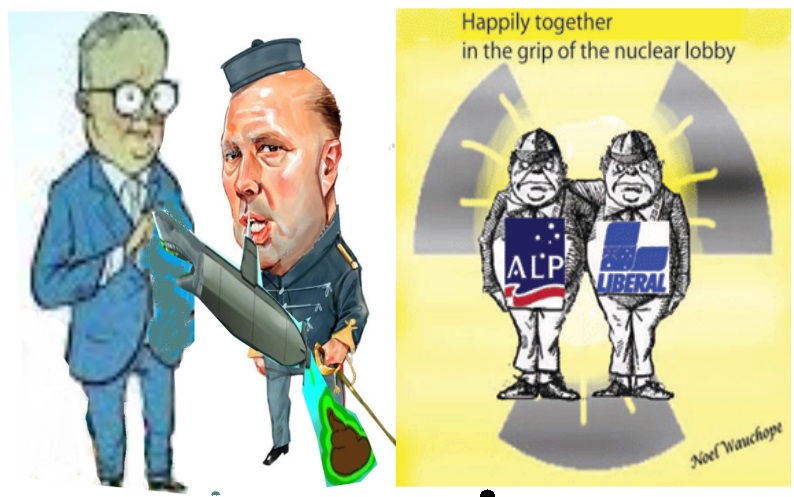
Albanese and Dutton team up on toxic AUKUS nuclear waste deal
The Bill immediately creates two nuclear dump ‘zones’, one off the coast of Perth and the other at Port Adelaide, without any community consultation or local support.
The Albanese Government today teamed up with Peter Dutton’s Coalition to push through a controversial AUKUS Bill that will allow the dumping of high-level naval nuclear waste anywhere in Australia.
The Albanese Government, in alliance with the Coalition, rammed the Australian Naval Nuclear Power Safety Bill through the Senate today without debate.
The Bill also created a new naval nuclear regulator as part of the AUKUS agreement with the UK and US on nuclear submarines. It initially allowed for all UK and US nuclear submarine waste to be dumped in Australia until the Albanese Government sheepishly amended it, due to growing public opposition, to prevent the dumping of UK or US ‘spent nuclear fuel’.
However, the amendments still allow the dumping of US and UK intermediate-level waste and other high-level nuclear waste from their nuclear submarines. The Greens moved amendments this afternoon that explicitly prevented this, and the major parties voted against these amendments and others.
The Bill immediately creates two nuclear dump ‘zones’, one off the coast of Perth and the other at Port Adelaide, without any community consultation or local support.
The Bill also allows nuclear dump zones to be declared anywhere in Australia that the Defence Minister chooses with the flick of their pen, again without any consent from local communities or First Nations traditional owners.
Senator David Shoebridge, Greens Spokesperson for Defence, said: “Albanese and Dutton have teamed up today to push this AUKUS nuclear waste legislation through the Senate without debate.”
“Today’s actions see both Labor and the Coalition joining hands to ram through legislation that will let the UK and US dump their naval nuclear waste in Australia.”
“The Albanese Labor Government initially tried to sneak through a law that would allow the UK and US to dump all types of nuclear waste in Australia. The Greens called the Government out on this, and then people around Australia pushed back.
“Even with last-minute Labor amendments, this legislation still allows the dumping of US and UK nuclear waste in Australia. Labor’s amendments only prohibit the US and UK dumping ‘spent nuclear fuel’ from their submarines in Australia, but do not prohibit any other highly irradiated UK and US nuclear waste.
“This legislation green-lights dumping of all Australian naval nuclear waste anywhere in Australia. To be clear, exposure to even intermediate-level waste is lethal to humans, and the risk lasts for hundreds of years.
“Everyone can see AUKUS is sinking, the question is now becoming how much environmental and financial damage it will do before it hits rock bottom,” Senator Shoebridge said.
John Hewson – The opposition leader’s nuclear bullshit
But the basic question that never seems to be asked is whether the electricity sector is being run in the interests of electricity consumers or the nuclear industry. This needs to be asked in the Australian context, in relation to Dutton’s persistence with his nuclear option against the massive and still-mounting global evidence of its cost and time delay disadvantages, and the hollowness of his commitments to cheaper electricity.
https://www.thesaturdaypaper.com.au/comment/topic/2024/10/12/the-opposition-leaders-nuclear-bullsh, 12 Oct 24, John Hewson is a professor at the ANU Crawford School of Public Policy and former Liberal opposition leader.
In a full mimicry of Donald Trump, Opposition Leader Peter Dutton’s reality is how he claims it to be, in complete disregard for the facts. So it is with his stance on nuclear energy. He simply asserts his nuclear power will deliver cheaper electricity to Australian households, and that nuclear is the only pathway to net zero by 2050. In a speech to the Committee for Economic Development of Australia last month he delivered his rationale: line after line of bullshit.
Dutton builds much of his case for nuclear on what he claims are the very cheap electricity prices in the Canadian province of Ontario, where nuclear accounts for about half of the energy mix. However, he ignores the fact the domestic supplier, Ontario Power Generation, is effectively a basket case, with a very sorry financial history that has been catalogued by the Ontario Clean Air Alliance.
In 1998, seven of public utility Ontario Hydro’s nuclear reactors were unexpectedly forced to shut down due to safety concerns. All of these reactors were inoperable for more than five years – two were still inactive as late as 2017, according to the Ontario Clean Air Alliance.
By the following year, Ontario Hydro was effectively bankrupt, and split into five companies. The nuclear stations went to OPG, while some $20 billion of the stranded nuclear debt was transferred to the Ontario Financial Corporation, with the paydown lasting for more than a decade.
The province had to boost its dirty coal plants’ output by 120 per cent to keep the lights on – an outcome that would be most pleasing to Dutton’s important donors.
OPG’s electricity prices rose about 60 per cent between 2002 and 2016, in order to pay for nuclear power – including restarting the five reactors that had been shut down. In September 2016, OPG told the Ontario Energy Board it needed to increase its nuclear power prices by more than 10 per cent a year for the next decade. The premier of Ontario later directed OPG to take on billions of dollars of additional debt to ensure electricity price increases over subsequent years would not exceed the rate of inflation.
It is worth noting that in the start-up phase, the relatively new Darlington Nuclear Generating Station on the north shore of Lake Ontario has suffered from technical problems, even with proven technology, which have delayed it becoming fully operational. It should be clear there are very few givens in adopting these technologies, as evidenced with most projects across the globe, whereas Dutton is inclined to assume otherwise.
Dutton and O’Brien have attempted to create the impression that Australia is being left behind in a world rushing to adopt and expand nuclear power. This is in doubt, but it is certainly true that there is a major push to decommission existing nuclear power plants.
It is also important to learn from the cost blowouts of the Darlington project. The project was initiated in 1973 but not started until roughly a decade later. Ontario Hydro estimated a cost of C$7.4 billion when construction began (though earlier projections were lower). Costs more than doubled from here, an important element of which was the interest cost on the project debt over and above the expanding costs from delays in construction scheduling and in the build itself, which is often ignored in discussions. Other reasons for the cost blowout included the need to meet regulatory changes and updates to Ontario Hydro’s financial policies, as well as necessary design tweaks during construction. All of which seem to be characteristic of nuclear projects.
The overruns prompted more questions about whether OPG would go bankrupt again if the Darlington rebuild continued to go over budget and demand for electricity continued to fall. Why weren’t costs cut, or the Darlington rebuild cancelled, and, importantly, why didn’t they start buying more cheap water power from neighbouring Quebec, using existing transmission lines?
But the basic question that never seems to be asked is whether the electricity sector is being run in the interests of electricity consumers or the nuclear industry. This needs to be asked in the Australian context, in relation to Dutton’s persistence with his nuclear option against the massive and still-mounting global evidence of its cost and time delay disadvantages, and the hollowness of his commitments to cheaper electricity.
It is also worth noting that Canada established Atomic Energy of Canada Limited (AECL), a Crown corporation, not as a generator but as the primary research and development agency in the field of nuclear energy. As such, it is responsible for design, engineering, marketing and servicing of the country’s CANDU reactors, and aims to make CANDU “the long-term competitive electricity supply system”. This is a for-profit operation. Does the Coalition aim to replicate this sort of entity?
Peter Dutton and his shadow energy minister, Ted O’Brien, have sought to challenge the authority of CSIRO’s GenCost report on these cost disadvantages. A United States study has suggested the CSIRO estimates were conservative, putting the cost at $12,351 a kilowatt, compared with GenCost’s $8446/kW. Similarly, a recent report on the ABC’s Four Corners reviewing the US experience with the Plant Vogtle project in Georgia – which is also often cited by the Dutton team, in support of their policy proposal, as delivering cheaper electricity – revealed consumer dissatisfaction as electricity prices have risen sharply. And Bill Gates’s new Kemmerer project in Wyoming has encountered troubles.
While there are many gaps still in Dutton’s advocacy for us to adopt nuclear energy, one of the most important is his vagueness about the technology to be adopted – he has vacillated from the demonstrated, expensive large reactors to the commercially as yet unproven small modular reactors (SMRs). He would have us believe that by the time we need to build these, the proven technologies will be available. This delay may prevent him from supplying adequate cost estimates before the next election. It’s notable that the only SMR project to receive approval by the US Nuclear Regulatory Commission was abandoned recently because of rising costs, even after the Department of Energy had pledged some US$500 million in grants.
Although we probably have the world’s largest deposits of uranium, we don’t have an enrichment industry. This also raises another serious question for the opposition to answer: where will the fuel for the reactors come from? Are they advocating that we also launch a nuclear enrichment industry? Is this also part of their AUKUS dream?
There are also important issues to be addressed in relation to the disposal of the waste from the reactors. The United Kingdom is currently demonstrating just how significant a challenge this can become.
Labor announces surprise parliamentary inquiry into nuclear power, raising hopes of an ‘adult conversation’

ABC, By chief digital political correspondent Jacob Greber, 10 Oct 24
In short:
Labor has launched a parliamentary inquiry into nuclear power, which it hopes will expose shortcomings in the opposition’s plans.
But the Coalition says it is ready to “come to the party” and profile arguments in favour of nuclear.
What’s next?
Labor, the Coalition and crossbench will nominate members of the committee, due to report back no later than April 30.
An energy expert has welcomed Labor’s decision to establish a parliamentary inquiry into nuclear power, saying open consideration of the technology is better than the federal government’s current position of seeking to “pooh-pooh the whole thing”.
Labor surprised the Coalition by announcing on Thursday that it will report no later than April 30 on the deployment of nuclear power, including small modular reactors.
Tony Wood, an energy specialist at the Grattan Institute, said “anything that begins to open up an adult conversation about nuclear power is a good thing”.
“In some ways, it’s better than what the government was doing, which is pooh-pooh the whole thing.”
The government-dominated House of Representatives committee will look at deployment time frames, uranium transport, supply, storage and enrichment capability, water impacts, and costs and consequences for electricity affordability.
Labor hopes the inquiry — which the ABC understands was initiated by backbenchers led by Hunter Valley MP Dan Repacholi — will fill the information void left by the Coalition’s repeated delays in releasing its planned nuclear policy or economic modelling.
Voters have ‘many questions’, Labor MP says
Mr Repacholi said voters in his electorate and around the nation have “many questions” about the opposition’s plan to build several nuclear power stations.
“Whether they support or oppose the scheme, the questions raised by Australians show they want more details,” he said.
“Right now, the information Australians need to fully understand the proposal is simply not there…………………………. more https://www.abc.net.au/news/2024-10-10/labor-announces-nuclear-power-inquiry/104456124
Labor springs surprise nuclear power committee to call Coalition bluff on energy policy.
https://reneweconomy.com.au/labor-springs-surprise-nuclear-power-committee-to-call-coalition-bluff-on-energy-policy/ 10 Oct 24
The Labor government has sprung a surprise on the last sitting of the winter parliament by establishing a parliamentary select committee to inquire into the viability of nuclear power.
The committee is not designed to support any shift in Labor government policy, but more to call out the Coalition bluff, and fill in the the lack of details, and costings, of its own nuclear power plans.
The committee has been proposed and will be chaired by Labor’s Dan Repacholi, the MP for the Hunter region which is host to one of seven sites identified by Opposition leader Peter Dutton and energy spokesman Ted O’Brien for their nuclear power plants.
The committee is expected to report by April 30, but given that the next federal election is now almost certain to be held in May next year, it can also issue an interim report.
Its term of reference are focused on the unknown and contested parts of the Coalition’s nuclear policy, including the costs and timeframes of both large scale and small modular reactors, its potential share of the country’s energy mix, water and waste issues, enrichment capabilities, and state and federal regulations.
The committee will have a majority four members appointed by the government, two from the opposition and one cross-bencher. O’Brien sought to make it three government and 3 opposition, but the motion failed.
The decision to create the committee comes just weeks after Dutton failed to outline details of his nuclear power plans at a CEDA event where he was expected to do just that. His claims that nuclear will deliver cheaper prices to consumers, and that the first reactor can deliver power by 2035, have been rejected by virtually everyone in the energy industry.
Federal energy and climate minister Chris Bowen told parliament on Thursday that nuclear is clearly the most expensive form of energy.
Bowen said O’Brien had refused an invitation to debate the issue on ABC’s Q&A program. I said yes, he said no,” Bowen said.
“Report after report shows that the Oppositions plan will push prices up. Professor Rod Sims said maybe $200 a year. Dr Dylan McConnell said $400 or $500 a year. Dr Roger Dargerville said $1,000 a year. And of course, we’ve also seen the report from IEEFA which said $665 a year on average.”
Repacholi told the house earlier on Thursday that he had been “out and about in the Hunter electorate” listening to people about the opposition’s proposed nuclear scheme.
“One thing that has been absolutely clear is that people have many questions. Whether they support or oppose the scheme, the questions raised by Australians show that they want more detail. Right now, the information Australians need to fully understand the proposal is simply not there.”
In a shock move early this morning, leader of the House Tony Burke moved a motion to establish the inquiry which would report back by April 30, 2025, but it can issue an interim report.
Dutton’s nuclear remarks spark calls for clarity on Queensland LNP’s energy plan
Dave Copeman, 4 October 2024, https://www.queenslandconservation.org.au/duttons_nuclear_remarks_lnps_energy_plan?fbclid=IwY2xjawFvCu5leHRuA2FlbQIxMQABHWQFoEI2cqiTljqKHWH3tgX_Vn0_sbMmzV_mCAb1RfmcOcv0tqp3xtDDFw_aem_A3vBJVajSTGpG64uEbkoLg
As Queenslanders await clarity on the LNP’s energy plan, Peter Dutton has today raised the prospect of convincing a future LNP government to change its mind on nuclear power.
While David Crisafulli has rejected nuclear energy, it’s becoming apparent that the clear alternative currently being proposed to the Queensland Energy and Jobs Plan is from Peter Dutton.
Crisafulli has yet to present a detailed and transparent energy plan for Queensland, and his reluctance to outline a clear roadmap raises questions about the future of the state’s energy strategy, including the Queensland Energy and Jobs Plan.
The Queensland Conservation Council is calling for transparency from David Crisafulli regarding the LNP’s energy plans. Queenslanders deserve clarity on how the party intends to meet the state’s energy needs and emission reduction targets.
Queensland Conservation Council Director Dave Copeman said:
Peter Dutton’s comments today make it clear that he is prepared to convince any future LNP Queensland government to reconsider its stance on nuclear power.
While David Crisafulli has rejected nuclear, it’s clear that right now, Peter Dutton’s nuclear agenda is the main alternative being put forward to the Queensland Energy and Jobs Plan.
The Queensland Conservation Council is calling for transparency from David Crisafulli regarding the LNP’s energy plans. Queenslanders deserve clarity on how the party intends to meet the state’s energy needs and emission reduction targets.
Queensland Conservation Council Director Dave Copeman said:
Peter Dutton’s comments today make it clear that he is prepared to convince any future LNP Queensland government to reconsider its stance on nuclear power.
While David Crisafulli has rejected nuclear, it’s clear that right now, Peter Dutton’s nuclear agenda is the main alternative being put forward to the Queensland Energy and Jobs Plan.
Every day that David Crisafulli doesn’t outline his energy plan, the questions around Queensland’s energy future will only grow louder. Queenslanders need to know what the LNP’s strategy is, especially with the growing focus on nuclear from the federal Coalition. We know David Crisafulli doesn’t support Pioneer Burdekin Pumped Hydro, but we don’t have clarity on what he would suggest in its place.
The best way for David Crisafulli to confirm his opposition to nuclear power is to build on the strong pipeline of renewable energy projects Queensland already has and outline a clear plan for closing coal-fired power stations with renewable energy backed by storage.
Renewable energy is already helping to drive down power bills and create jobs, and it’s vital we have energy policy certainty to support this growing sector. The longer we wait for clarity, the more uncertain the future becomes to meet our emission reduction targets and avoid the worst impacts of climate change.
At last, Dutton spells out his nuclear power play – 12 more years of coal (if it lasts)
Opposition leader Peter Dutton has revealed the Coalition’s nuclear energy plan relies on many of Australia’s coal-fired power stations running for at least another 12 years – far beyond the time frame officials expect the ageing facilities to last.
The claim has set off a new round of speculation over the Coalition’s plans – the viability of which has already been widely questioned by energy analysts.
Dutton offered up limited detail in a speech on Monday. He also revealed the plan relies on ramping up Australia’s gas production.
It seems increasingly clear the Coalition’s nuclear policy would prolong Australia’s reliance on coal, at a time when the world is rapidly moving to cleaner sources of power.
The Coalition wants to build nuclear reactors on the sites of closed coal plants. It says the first reactors could come online by the mid-2030s. However, independent analysis shows the earliest they could be built is the 2040s.
Now it appears the Coalition’s plan involves relying on coal to provide electricity while nuclear reactors are being built. On Monday, Dutton suggested coal-fired electricity would be available into the 2030s and ‘40s.
But this is an overly optimistic reading of coal’s trajectory. The Australian Energy Market Operator says 90% of coal-fired power in the National Electricity Market will close by 2035.
All this suggests the Coalition plans to extend the life of existing coal plants. But this is likely to cost money. Australia’s coal-fired power stations are old and unreliable – that’s why their owners want to shut them down. To keep plants open means potentially operating them at a loss, while having to invest in repairs and upgrades.
This is why coal plant owners sought, and received, payments from state governments to delay exits when the renewables rollout began falling behind schedule.
So who would wear the cost of delaying coal’s retirement? It might be energy consumers if state governments decide to recoup the costs via electricity bills. Or it could be taxpayers, through higher taxes, reduced services or increased government borrowing. In other words, we will all have to pay, just from different parts of our personal budgets.
Labor’s energy plan also relies on continued use of coal. Dutton pointed to moves by the New South Wales and Victorian governments to extend the life of coal assets in those states. For example, the NSW Labor government struck a deal with Origin to keep the Eraring coal station open for an extra two years, to 2027.
However, this is a temporary measure to keep the electricity system reliable because the renewables build is behind schedule. It is not a defining feature of the plan.
Dutton claims Labor’s renewable energy transition will require a massive upgrade to transmission infrastructure. The transmission network largely involves high-voltage lines and towers, and transformers.
He claims the Coalition can circumvent this cost by building nuclear power plants on seven sites of old coal-fired power stations, and thus use existing transmission infrastructure.
Labor’s shift to renewable energy does require new transmission infrastructure, to get electricity from far-flung wind and solar farms to towns and cities. It’s also true that building nuclear power stations at the site of former coal plants would, in theory, make use of existing transmission lines, although the owners of some of these sites have firmly declined the opportunity.
But even if the Coalition’s nuclear plan became a reality, new transmission infrastructure would be needed.
Australia’s electricity demand is set to surge in coming decades as we move to electrify our homes, transport and heavy industry. This will require upgrades to transmission infrastructure, because it will have to carry more electricity. Many areas of the network are already at capacity.
So in reality, both Labor’s and the Coalition’s policies are likely to require substantial spending on transmission.
Both Labor and the Coalition acknowledge a big role for gas in their respective plans.
Climate Change and Energy Minister Chris Bowen says gas, along with storage, is needed to help back up to the grid, when solar and wind farms are not producing electricity.
Dutton spoke of plans “to ramp up domestic gas production” in the short term, “to get power prices down and restore stability to our grid” – presumably until nuclear comes online.
But the issue isn’t a lack of gas. It’s that the gas is in the wrong places. There’s a gas shortage because southern reserves are declining and all the gas production is in the north of the continent.
An increased role for gas means getting someone to pay for new infrastructure, such as pipelines or LNG terminals. That will make for expensive gas, and expensive gas means expensive electricity.
It’s now three months since the Coalition released its nuclear strategy. Detail was thin then – and Monday’s speech shed little light.
Many unanswered questions remain – chief among them, costings of the nuclear plan, and how much of that will be born by government. CSIRO says a nuclear reactor would cost at least A$8.6 billion.
We also don’t know how the Coalition would acquire the sites, or get around nuclear bans in Queensland, NSW and Victoria.
We still don’t know how the Coalition plans to keep the lights on in the coming decade, as coal exits.
And crucially, we don’t know what it will cost households and businesses. It is unlikely to be cheap.
Dutton at odds with Queensland LNP over nuclear plans

Federal Liberal leader joined the state’s election campaign on Friday as David Crisafulli reiterated his objection to nuclear sites at Tarong and Callide
Andrew Messenger, Fri 4 Oct 2024, https://www.theguardian.com/australia-news/2024/oct/04/queensland-election-liberal-national-party-nuclear-plan-peter-dutton?fbclid=IwY2xjawFsifVleHRuA2FlbQIxMQABHatRzSolvCpDyme9yMGAFlBbI6wl6H_xHENLi2ILNvm4yPKbJbAux77dWQ_aem_EASDYfMnhAhutdbQArg8oA
The federal opposition leader, Peter Dutton, has dismissed the Queensland LNP’s rejection of his nuclear power plan as just a “difference of opinion” between friends as he joined the state’s election campaign on Friday.
At their first joint press conference since the controversial plan was announced, Queensland LNP leader David Crisafulli reiterated his defiance of Dutton’s plan for two nuclear plants in Queensland. Crisafulli said he would oppose them if elected at the 26 October poll.
It was their first joint appearance since June, when the federal leader announced plans for seven nuclear sites across Australia.
“Friends can have differences of opinion, that’s healthy,” Crisafulli said. Dutton agreed.
Dutton said he would have a “respectful” conversation with Crisafulli if he was elected.
“We can have that conversation,” Dutton said.
“The first step is to get David elected as premier. When the prime minister stops running scared, he’ll hold an election, and I intend to be prime minister after the next election, and we can have that conversation.
“In the end, we want the same thing, and that is cheaper electricity for Queenslanders.”
Crisafulli said he would not change his mind.
He has repeatedly ruled out repealing the state’s nuclear ban under any circumstances.
Dutton has previously suggested overriding state legislation.
“Commonwealth laws override state laws even to the level of the inconsistency. So support or opposition at a state level won’t stop us rolling out our new energy system,” he said in June.
Labor has repeatedly accused Crisafulli of secretly supporting the nuclear plan.
“He’ll have to roll over when it comes to nuclear power, because his entire state party, all of those state LNP MPs in the federal party, all of those state LNP senators in the federal Senate and all of his grassroots members, they want nuclear power, and he’ll have to roll over,” the deputy premier, Cameron Dick, said.
The LNP is widely tipped to win the election.
The prime minister, Anthony Albanese, is yet to appear alongside the premier, Steven Miles, on the campaign trail.
The associate director of research at the ANU’s initiative on zero carbon energy for the Asia Pacific Institute, Emma Aisbett, said having major policy differences between federal and state governments raised investment risk.
“It means that investors in energy will face higher policy uncertainty, which is also known as political risk,” she said. “It has a particularly strong depressing effect on investment for long-lived assets, which have high upfront costs, and both nuclear and renewables, either PV or wind, really fit into that category.”
She said having a dispute between governments could bring back the “energy wars”.
“What that does is slow and delay the net zero transition, and we do not have decades more to waste, slowing and delaying the transition away from fossil based energy.”
after newsletter promotion
“He’ll have to roll over when it comes to nuclear power, because his entire state party, all of those state LNP MPs in the federal party, all of those state LNP senators in the federal Senate and all of his grassroots members, they want nuclear power, and he’ll have to roll over,” the deputy premier, Cameron Dick, said.
The LNP is widely tipped to win the election.
The prime minister, Anthony Albanese, is yet to appear alongside the premier, Steven Miles, on the campaign trail.
The associate director of research at the ANU’s initiative on zero carbon energy for the Asia Pacific Institute, Emma Aisbett, said having major policy differences between federal and state governments raised investment risk.
“It means that investors in energy will face higher policy uncertainty, which is also known as political risk,” she said.
“It has a particularly strong depressing effect on investment for long-lived assets, which have high upfront costs, and both nuclear and renewables, either PV or wind, really fit into that category.”
She said having a dispute between governments could bring back the “energy wars”.
“What that does is slow and delay the net zero transition, and we do not have decades more to waste, slowing and delaying the transition away from fossil based energy.”
If Peter Dutton has a better understanding of the cost of building nuclear, then let’s see it
Johanna Bowyer & Tristan Edis, l Oct 4, 2024, https://reneweconomy.com.au/if-peter-dutton-has-a-better-understanding-of-the-cost-of-building-nuclear-then-lets-see-it/
Two weeks ago, the Institute for Energy Economics and Financial Analysis released a report analysing how much electricity prices and Australian household energy bills would need to rise to make nuclear power plants financially viable.
The report found that household energy bills across the four states analysed would rise by an average of $665 a year relative to existing prices.
Federal opposition energy spokesperson Ted O’Brien claimed the report’s analysis was based on a “cherry-picked” sample of nuclear power projects. Opposition treasury spokesperson Angus Taylor described the analysis as “nonsense.”
The leader of the opposition Peter Dutton had the opportunity to provide a detailed response to our research in a speech he gave on nuclear power several days later. Yet his speech contained no alternative economic analysis or costing to support the opposition’s claims our research is incorrect.
Our analysis was informed by the actual construction costs of all nuclear power projects that have been committed to construction in the past 20 years across the European Union and North America.
In addition, we also considered two projects that had reached the tender contract pricing stage. A sample of six projects may appear small but the lack of a significant number of projects committed to construction is a warning bell in itself.
The limit of 20 years was chosen because projects from any earlier would have employed reactor technologies that lacked critical safety features now deemed essential by EU and US regulators.
The EU and North America were chosen for the following reasons:
– Those regions have relatively similar labour market conditions to Australia, particularly wages and rights to collectively bargain and strike;
– Similar systems of government – liberal democracies with a free press;
– The reactor technologies they certify as safe are likely to be the only technologies Australia will be willing to adopt, and;
– Regulatory structures that ensure transparent and reliable cost data such as investor disclosure or competition law requirements.
It is important to note that within our sample, we included the agreed price Korea Hydro & Nuclear Power Company has bid to build two reactors in Dukovany in Czechia.
History suggests that a tender bid price is highly likely to be an underestimate of the actual construction cost of a nuclear reactor. Nonetheless, we included this project in the study as the Korean APR reactor technology is mentioned as an option in the Coalition’s nuclear policy statements.
Our report explains in further detail that Korea’s experience in building reactors in its own country is highly unlikely to be replicable in Australia. This is because the scale of their nuclear reactor build program is vastly larger than the Coalition’s plans.
Instead, the Dukovany project is a better representation of the costs the Koreans might be able to achieve outside their home base, in a developed, democratic nation.
O’Brien also cited the exclusion Japanese projects from our sample. The only two projects to have been committed to construction in Japan in the past 20 years were halted by regulatory authorities due to safety concerns. We would also note that investigations following the Fukushima Reactor explosion in 2011 uncovered serious problems with the rigour and independence of Japan’s nuclear regulatory safety regime.
The fact that the Japanese regulator had a tendency to overlook or ignore safety issues puts into serious question the applicability of Japanese nuclear construction experience as one Australia would wish to replicate.
It is more than decade since the Fukushima accident prompted the suspension of Japan’s reactor operations pending safety reviews. Since that safety review, only 12 reactors have restarted operations, with 21 units remaining mothballed and a further 21 reactors decommissioned.
China, Russia and the Middle East are often cited by nuclear power lobbyists as better representing reactor construction costs than the EU or North America. However, conditions in these markets vary significantly from Australia, such as:
– Vastly lower wages for construction workers;
– Outlawing of collective bargaining and strikes;
– Severe penalties including jail terms for people peacefully protesting or publicly criticising government authorities;
– The use of nuclear reactor technologies not certified as safe by EU or North American nuclear regulatory authorities, and;
– Reliance on Russian suppliers that are subject to trade sanctions in Australia.
Our research is detailed and extensively referenced, with the methods laid out transparently for others to review. If the federal Coalition has a better understanding of the cost of a nuclear build in Australia than the real-world experience of the EU and North America, we look forward to seeing their analysis.
In the absence of that, expect household power bills to rise by about $665 a year if and when nuclear power plants are built in Australia.
Johanna Bowyer is the Lead Analyst in the Australian Electricity Program at the Institute of Energy Economics and Financial Analysis, Tristan Edis is Director of Analysis and Advisory at Green Energy Markets. They are co-authors of the report, Nuclear in Australia would increase household power bills.
‘Cheaper with nuclear’: What will Dutton’s nuclear plan really cost?

The Age, Mike Foley, September 27, 2024
Opposition Leader Peter Dutton is refusing to release the costings of his nuclear energy policy, despite claiming a national fleet of reactors would slash power bills.
But enough work has been done by independent agencies to give us some idea of the potential price tag.
What Dutton said
“We can have cheaper, cleaner and consistent energy if we adopt nuclear power,” Dutton said last week, adding that nuclear plants did not require the thousands of kilometres of transmission lines that link renewables to the grid, and took up less space than wind and solar farms.
A Coalition government would build seven nuclear plants on the sites of existing coal plants, including two small modular reactors and five large-scale plants, and plans to have the first operating by 2037.
Dutton says residents of Ontario, Canada enjoy cheaper power prices – 18¢ a kilowatt-hour (kWh) – courtesy of the province’s eight nuclear reactors generating about 60 per cent of the electricity supply.
He told Nine’s Today program on September 20 that Ontarians were “paying one-third the cost of electricity that we are here”. In July, he said they were “paying about a quarter of the price for electricity that we are here in Australia”.
These claims are overstated.
Power prices
Victoria pays about 28¢ a kWh, NSW 33¢ and Queensland 30¢. So rather than prices being three to four times higher, they are a bit less than twice the 18¢ figure. South Australians pay more than the other states at 45¢, but still less than Dutton’s claim.
However, this comparison is questionable because Australian prices include a range of costs that Ontarians must pay on top of their kWh charge. Network charges – the cost of building, running and maintaining power poles and wires across the grid – are listed separately on Ontario’s bills and can run into hundreds of dollars a year.
Construction costs
The CSIRO’s latest energy cost report card estimated a large-scale nuclear reactor in Australia would cost $16 billion, based on the low-cost construction of plants in South Korea, and take nearly two decades to build. It calculated that cost could fall to about $8 billion per reactor as efficiencies of scale were achieved after at least five and possibly 10 reactors were built.
Britain’s Hinkley Point C plant, which was announced in 2007 with an estimated $18 billion price tag, is set to be completed 13 years late at a cost of $90 billion.
If a Dutton government built reactors in Australia, that cost would have to be repaid, which could come via consumers’ electricity bills……………………………………………………………. more https://www.theage.com.au/politics/federal/cheaper-with-nuclear-what-will-dutton-s-nuclear-plan-really-cost-20240920-p5kc8z.html
Memo to Dutton: It’s the final quarter, you’d better start kicking

David Crowe, Chief political correspondent, September 26, 2024
The game plan that turned Anthony Albanese from an opposition leader to a prime minister is known by a simple phrase he used for three years before he gained the top job. “I said that we had a plan: kick with the wind in the fourth quarter, outline our policies close to the election,” he said in the weeks after Labor took power.
Albanese tends not to use the phrase these days. No prime minister can tell voters they will only bother with big policies when the election comes. That is true even if it is a plain fact that Labor is working on new measures for the campaign ahead – and that changes to negative gearing may end up in the surprise package.
Peter Dutton, by contrast, lives the Albanese motto every single day. The opposition leader is holding back on every policy that would normally shape an Australian election: on the economy, the cost of living, housing and defence.
Even the glaring exception to that statement – his proposal for seven nuclear power stations – confirms the flimsiness of the Liberal policy platform. Dutton and his energy spokesman, Ted O’Brien, are incredibly coy about how this policy might work. What would it cost? How long would it take? What replaces our ageing coal-fired power stations while we wait for nuclear?
“We will release our costings in due course – at a time of our choosing,” Dutton said in a speech to a business audience on Monday. Sure, it is common for opposition leaders to reveal their full costings shortly before the election. But they tend to put their big-picture policies on the agenda well before that final stage.
Dutton is running out of time. He is acting as if the last phase of this term of parliament is still months away. In fact, the final quarter is already upon us. It started last month, assuming the election is as late as May. And Dutton is yet to prove he can kick when it counts.
Liberals make a fair point about how to judge their policies: they may not have that many, but the ones they have are big and bold. This is absolutely true of the nuclear policy. No matter how many voters were alarmed at the Labor plans for negative gearing in 2019, the prospect of a nuclear accident may frighten a few more. It is a big idea and a huge political risk.
Dutton has leapt ahead of Albanese on a few fronts. He called in May last year for a ban on advertising sports betting during game broadcasts – an idea on which federal cabinet is yet to decide. He backed an age ban on social media earlier this year, months before Labor, thanks to early work by Coalition communications spokesman David Coleman…………………………………………………………………………..
Nothing ventured, nothing gained. Dutton has the wind behind him in the opinion polls but looks reluctant to risk this good fortune by telling Australians what he would do with power. ……………………………………….
There is very little pressure on Dutton to move any faster because he has a disciplined frontbench and party room that waits for him to make the big calls on policy timing, as well as a supportive conservative media that tells him he is outsmarting Albanese at every turn. He avoids press conferences in Parliament House, so the press gallery gets relatively few opportunities to question him. He has a narrow list of preferred TV and radio spots. The media strategy spares him any exposure to long interviews that might test him on what he would do if he was running the country.
………………….. This is not proof that voters are buying what Dutton is selling, they say. After all, nobody is sure what he is selling just yet.
The Labor tacticians could be totally wrong, but the Liberals are certainly taking their time. If Dutton wants to kick with the wind in the final quarter, he will need to run a little faster. https://www.smh.com.au/politics/federal/memo-to-dutton-it-s-the-final-quarter-you-d-better-start-kicking-20240926-p5kdn5.html?fbclid=IwY2xjawFi2ChleHRuA2FlbQIxMQABHeggdYlx-0-WJO5vDD_9NYYsmgvm4WRwBII811EpOipDFB_gAdNsefsDnA_aem_h6jj8XixlRUr13A9QS0T-Q
Stuck on repeat: why Peter Dutton’s ‘greatest hits’ on nuclear power are worse than a broken record.
Guardian, Graham Readfearn, 26 Sept 24
So far there are no costings and no details on what type of reactors there would be, their size or who would build them.
Usually you need a few genuine releases under your belt before you start putting out “greatest hits” albums, but when it comes to spruiking nuclear this hasn’t stopped Peter Dutton.
This week, the opposition leader gave a speech that some hoped – perhaps naively – would add some more detail to the Coalition’s scant policy proposal to build nuclear reactors at seven sites around Australia.
But instead, Dutton delivered a familiar run-down of “greatest hits”; nuclear will mean cheap power, everyone else is going nuclear (so why shouldn’t we?), and renewables are unreliable (did you know, for example, and I bet you didn’t, that “solar panels don’t work at night” or that “turbines don’t turn on their own”?).
Perhaps Dutton is banking on the illusory truth effect where, regardless of the truthfulness of a statement, the more people hear it the more they’re inclined to accept it.
So far there are no costings, no details on what type of reactors or how large they will be, or who will build them. We do know Dutton wants to fund them through the taxpayer.
But let’s run through the track listing.
Renewables-only redux
Take, for example, Dutton’s claim in his speech, at the Centre for Economic Development Australia in Sydney, that Labor is pursuing a “renewables-only” policy for the electricity grid – a phrase he repeated seven times.
Just as it has been for many months, the “renewables-only” claim is false.
While it’s true Labor does want the electricity grid dominated by solar and wind, backed up by storage such as batteries and pumped hydro, the current plan also includes gas-fired power that would act as back-up if solar or wind levels dropped too low…………………………………………………………………………………………………………………………….
28,000km – again
Also getting another go on the turntable was Dutton’s claim the government’s plan would require “28,000km of new transmission lines”.
The actual figure, according to AEMO, is 10,000km – or about a third of Dutton’s claim.
Only under a scenario where Australia gets very aggressive on green energy exports, such as hydrogen, does AEMO think you might need another 10,000km or more of transmission lines.
This has been pointed out before, but, like a broken record, Dutton continues to repeat it.
The nuclear train?
In a statement that will surprise nobody, Dutton said even if the various state and federal bans on nuclear power generation were lifted “we can’t switch nuclear power on tomorrow”.
“But what we can do is ensure that Australia doesn’t miss the nuclear train,” he said.
An independent report on the status of that global “nuclear train” was published last week.
The 500-page World Nuclear Industry Status report said in 2023 a record US$623bn was invested into non-hydro renewable energy, which was “27 times the reported global investment decisions for the construction of nuclear power plants”.
As of July, the report said there were 59 reactors under construction, 10 fewer than a decade ago, with almost half being built in China. Some 23 of those reactors were behind schedule………………………… more https://www.theguardian.com/environment/commentisfree/2024/sep/26/stuck-on-repeat-why-peter-dutton-greatest-hits-on-nuclear-power-are-worse-than-a-broken-record
1 This month

of the week – Australians for War Powers Reform (AWPR)
To see nuclear-related stories in greater depth and intensity
 Antinuclear