Geordan Graetz, pro nuclear spruiker is a ‘Community Engagement Advisor” to South Australians
Tim Bickmore, Nuclear Citizens Jury Watch South Australia, 20 Oct 16
 A player in this scene currently flying under the radar is Geordan Graetz, DPC Community Engagement Advisor.
In the past he has published opinions not only about Fukushima, but also regarding indigenous people & uranium mining: “Representatives of the Martu and Adnyamathanha communities in Western Australia and South Australia respectively have expressed confidence in the companies that have approached them with plans to develop deposits on their lands (Graetz and Manning 2011)” p3, IAIA, 2012.
As recently as 2014 he published material orientated toward removing indigenous people as an impediment to the expansion of uranium mining, albeit it thru application of inclusion under the auspices of international human rights conventions. [Journal of Cleaner production xxx 2014 1-9]
He appears to be an advocate of a ‘Nuclear Renaissance’ – or rather identifies indigenous peoples as a potential roadblock for such.
The NFCRC Final Report cites him & co-author Manning Ch6 Land Rights Section p130 notes ref 8 & again ref 11 (3 mentions).
His partner in a number of publications, Haydn Manning, is a well known pro-nuke spruiker.
There is a linkage between Graetz & the farcical Schools Nuclear Lockdown … probably instigated under his &/or Manning’s social engagement strategy…. more to come.
Hard for South Australia’s Nuclear Citizens’ Jury to reach a consensus about importing radioactive trash
 Tim Bickmore Nuclear Citizens Jury Watch South Australia, 20 Oct 16 My gut feeling is that whilst there is a high apathy coefficient within the wider community, the Nuclear Citizens’ Jury (CJ) make-up does display the polarity that is also evident in the public sphere & which, at least in general expressions, appears to be mostly against the proposal.
At this stage of proceedings, I find it hard to see a consensus being reached.
I also think that South Australian Premier Jay Weatherill is aware of this: hence whilst previously he would have crowed about a ‘positive’ or even ‘maybe’ outcome, now the game plan diversifies. e.g. last night I had a South Australian Govt sponsored survey cold call regarding the Nuclear Fuel Chain Royal Commission (NFCRC) – but was excluded coz they had already reached my ‘age bracket quota’.
I wondered if that ‘quota’ was valid – are they now targeting younger folk under some misguided notion that this cohort would be more amenable to the idea? – and the quota, did that include the already received on-line & Nuclear Roadshow data? I also did not get to hear the questions – which are usually loaded in these types of things.
Also in the mix is the Senate Parliamentary Joint Committee, & my feeling there is that, too, is not a bed of roses for Jay Weatherill.
I am still crossing my fingers that the CJ will return RED coz AMBER allows Jay a small window to change legislation – tho methinks he would need a lot more oomph other than just a CJ-AMBER outcome to really justify doing that.
If no CJ consensus is reached, does that mean an open verdict? If no verdict is reached then “as you were” [=NO] seems the logical outcome. ra ra https://www.facebook.com/groups/1172938779440750/
Could the nuclear waste issue be the finish for South Australia’s Premier Jay Weatherill?
 Power to the people may mean pulling plug on Jay Premier Jay Weatherill must pull off complex balancing act on SA’s energy infrastructure Daniel Wills, The Advertiser,October 14, 2016 PREMIER Jay Weatherill is strangely now both a hero and villain of the environmental movement.
Jobs have long been the biggest issue in SA politics, and will undeniably dominate the campaign in 18 months’ time. It’s a sign of how desperate the situation in SA has become that beating Tasmania back into last place on the unemployment ladder is now a cause for muted celebration.
We also wait to see what future, if any, Whyalla has and the full impact of Holden’s closure.
But leaping up into the top strata of vote-changing issues, which includes the State Government’s overhaul of the health system, are two divisive topics that evoke powerful emotions……….
An Advertiser-Galaxy poll on the blackout published on Monday showed only 16 per cent of people supported dialling back renewables in favour of coal and gas generation……..Voters seem to want something existing technologies don’t offer – carbon-free renewable energy that is cheap and reliable……..
In two Saturdays’ time, Mr Weatherill will head to a Labor Party state convention where the prospect of the state taking high-level nuclear waste for cash will be a flashpoint.
Already, Labor MP Steph Key is speaking out against any change to the party platform. Stakeholders such as SA Unions are expressing grave doubts about the business model…….
The numerical dominance of Labor’s Right faction, plus hesitant support in elements of Mr Weatherill’s Left, makes it likely his nuclear position will survive………
The same people cheering speech lines about wind farms may roll their eyes at nuclear. And vice-versa. This is the core and complex balancing act Mr Weatherill must pull off in the bid for a fifth term – holding a coalition of diverse and often opposed interests to win the day.
It’s not about being all things to all people. It’s about being just enough to just enough.http://www.adelaidenow.com.au/news/opinion/daniel-wills-premier-jay-weatherill-must-pull-off-complex-balancing-act-on-sas-energy-infrastructure/news-story/69403007930c182f4d0f679491a3eee9
Western Australia’s uranium mining lobby rushing to get approvals before WA election
 WA uranium mines: Race for environmental ticks in Goldfields before WA election, conservationists say http://www.abc.net.au/news/2016-10-14/wa-uranium-mine-approvals-race-ahead-of-wa-election-cc-says/7931254 By David Weber, 14 Oct 16, Proponents of uranium mines in Western Australia are racing to gain environmental approvals ahead of the state election, in case Labor wins, according to the Conservation Council.
Three projects in the Goldfields are at various stages of assessment.
They include Vimy Resources’ proposed mine at Mulga Rock, Toro Energy’s proposal to mine near Wiluna, and Cameco’s nearby Yeelirrie project.
The Council’s anti-nuclear campaigner, Mia Pepper, said companies were seeking security for the projects. “Certainly we are getting the sense that [for] the three uranium projects that’re under assessment … they’re clearly seeking some level of approval before the state election,” she said.
The Environmental Protection Authority (EPA) has recommended conditional approval for Toro Energy’s proposal, 30 kilometres south of Wiluna.
Cameco’s project at Yeelirrie, 70 kilometres south-west of the town, was knocked back after the EPA said there was too much risk to the subterranean fauna. However the EPA in August recommended the green light for Vimy’s project at Mulga Rock, 260 kilometres north-east of Kalgoorlie, and preliminary site works have been given the go-ahead.
Approvals could lead to ‘pressure’ on Labor Ms Pepper has met the EPA appeals convenor expressing concern about Mulga Rock. She said if a project cleared certain hurdles, it would be harder to wind it back. “An environmental approval is just one layer of approval that a uranium project requires,” she said.
“[It] is a long way from final approval, so it doesn’t lock in Labor to any of these projects, but … there would be seen to be that kind of pressure.
“It’s a political issue, it’s a very contentious issue and certainly the companies are doing everything they can.”
Even after a positive EPA assessment, uranium projects still required state and federal ministerial backing as well as other approvals and licences.
Cameco’s open cut mine at Kintyre, 270 kilometres north-east of Newman, has gone as far as gaining conditional approval from the Federal Government last year. Labor’s stated policy suggests mines that have been granted final state approval for construction will be permitted to operate and export in the same manner as other mining ventures.
Greens calling for inquiry into miners not cleaning up their toxic messes
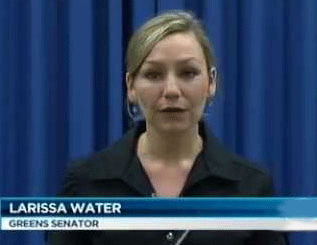 Miners must be forced to clean up their messes http://www.smh.com.au/comment/miners-must-be-forced-to-clean-up-their-messes-20161011-grzjx1.html
Larissa Waters, 13 Oct 16 Some people may be surprised to hear a Greens Senator say this, but here goes. Coal has been a key part of the Queensland economy for many years. Yes, the number of jobs provided by coal has always been overblown (more people work at McDonalds than in coal mining); it makes up less than 0.5 per cent of all jobs in Australia. On the other hand, for places like Clermont and Collinsville, coal has provided a sense of identity as well as stable employment.
All of that is changing, and we need our governments to catch up. The urgent threat of global warming, combined with the world-wide transition to clean energy, have pushed thermal coal into “structural decline”.
Globally the transition away from coal power is already underway. In Queensland, that transition is already hitting home along with the end of the mining boom, with thousands of jobs lost in coal mines, and more job losses to come. In September, it was reported that Hazelwood, Australia’s dirtiest coal power station, will close in 2017. Our job as leaders is to make sure there is a just transition away from coal which looks after workers and communities.
Clean energy will play a huge part in Queensland’s future. Last month, Queensland secured 1100 mostly regional jobs from five large-scale solar projects funded by the Australian Renewable Energy Agency. To create more jobs and to stop dangerous global warming, the Greens want to see 100 per cent clean energy as quickly as possible, with at least 90 per cent by 2030, and a $1 billion Clean Energy Transition Fund to make sure no one is left behind.
Coal communities should be supported to plan their own future, with government investment to help them create jobs. Part of that just transition must be secure jobs in mine rehabilitation, especially for older workers who may have trouble retraining or relocating. Alongside thousands of new regional jobs in clean energy, mine rehabilitation can provide employment in the same communities and regions most affected by the coal downturn.
Queenslanders are being ripped off. Again and again, big mining companies like Rio, BHP, Peabody and Glencore are simply taking their profits and walking away without securing those much-needed jobs in rehabilitation. Continue reading
Witnesses recommended for the next Citizens’ Jury on Nuclear Waste Importing, South Australia
 This is a full list of witnesses chosen by the Nuclear Citizens’ Jury on October 9th and invited to be witnesses for the next Nuclear Citizens’ Jury on 29 October.
Here I have endeavoured to shed light on the likely evidence of each, according to the following code :
GREEN = Anti-nuclear waste dumping , Yellow – doubtful on waste importing. ORANGE=Neutral – Uncertain, about waste dumping, BLACK = I don’t know, PINK = probably pro waste dumping , RED = Pro nuclear waste dumping
- I ran into a spot of bother with the many Aboriginals recommended. As far as I can tell, they are all opposed to importing nuclear waste, except Parry Agius . Some of the most prominent Aboriginal persons are: Kevin Buzzacott, Karina Lester, Rose Lester, Vivienne McKenzie, Enice Marsh.
- Some pro nuclear people might be opposed to the dump plan, so I put those in pink.
 Nuclear Citizens Jury Two: Witness work
WITNESSES CHOSEN BY JURY AND INVITED FOR THE 29th
No List Ref Name Votes Theme
1 123 Richard Dennis 96 Economics
2 121 Professor Richard Blandy 54 Economics
3 128 Professor Barbara Pocock 45 Economics
4 179 Professor Brian Cox 45 Safety
5 166 Hon Nick Xenophon 44 Trust
6 56 Paddy Crumlin 34 Safety
7 1 Timo Aikas 34 Safety
8 4 Professor Rodney Ewing 31 Safety
9 168 Dr Karl Kruszelnicki 30 Safety
10 116 Dr Simon Longstaff 29 Trust
11 5 Robert J Halstead 27 Safety
12 19 Dr Jim Green 25 Safety
13 9 Dr Carl Magnus‐Larsson 25 Safety
14 162 Ian Hore‐Lacy 22 Economics
15 49 Professor Tilman Ruff, AM 22 Safety
16 53 Frank Boulton 21 Safety
17 188 Someone from the Attorney Generals Department to provide advice on the legislation that will be required to be developed/changed. DemocracyCo seeking advice on who. Trust
18 124 Assoc. Professor Mark Diesendorf 20 Economics
19 7 Dr Andrew Herczeg 20 Safety
20 42 Dr Ian Fairlie 19 Safety
21 137 Hon Mark Parnell, MLC 18 Economics
22 39 Dr Margaret Beavis 18 Safety
23 119 Assoc. Professor Haydon Manning 17 Trust
24 122 John Carlson AM 16 Economics
25 200 Dr Benito Cao 16 Economics
26 18 Professor David Giles 16 Safety
27 115 Steven McIntosh 16 Trust
28 2 Dr Ian Chessell 14 Safety
29 34 Professor Sandy Steacy 14 Safety
30 69 Gill McFadyen 11 Consent
31 74 Dave Sweeney 10 Consent
32 104 Bob Watts 9 Consent
33 76 Ross Womersley 8 Consent
34 72 Dr Gerald Ouzounian 7 Consent
35 73 Dan Spencer 6 Consent
36 126 Tim Johnson 7 Economics Invited to provide info on the Royal Commission economic modelling after 20+ requests on Information Gap Cards Dotmocracy Results ‐ 25 plus a few extras to allow for availability Top 6 from Consent ‐ as Gill is unavailable.
Nuclear Citizens Jury Two: Witness work
ABORIGINAL WITNESSES ALREADY INVITED ON THE 29TH Continue reading
Canberra’s renewable energy leadership at risk, as Federal govt demonises renewables.
The solar industry already employs more people than coal-fired generation across the country. In 2014 the solar industry employed more than 13,000 people and even with the uncertainty and watering down of the renewable energy target this is likely to have grown. By comparison, according to the 2011 census 8,000 people worked in fossil fuel electricity generation.
A clean energy transition is already happening, but it is at risk, Guardian, Alexander White, 11 Oct 16 The transition to a low carbon economy is already happening, but is at risk when residents of Australia’s capital go to the polls in local elections.
The transition to a low carbon economy is already happening … in theAustralian Capital Territory, where the local Labor government has legislated for a 100% renewable energy target by the year 2020.
But this major achievement is at risk on Saturday when residents of Canberra go to the polls for territory elections. Continue reading
Should Australia follow Canada – let the states lead on climate?
 Canada lets the states lead on climate, should Australia do the same? The Conversation,October 11, 2016 Canadian Prime Minister Justin Trudeau showed Australia a thing or two when he announced a new climate change plan last week – and not just because it was delivered impeccably in two languages. Trudeau has decided to leave climate policy to the provinces, while forcing them to act.
Is this state-based approach a model for Australia? Continue reading
‘reckless’ and ‘indefensible’ Carmichael coal mine approved by Queensland govt
 Queensland fast tracks ‘reckless’ and ‘indefensible’ Carmichael coal mine, Independent Australia Renew Economy 11 October 2016 Minus financial backing, reneging on the Paris Agreement and even ignoring Adani’s own loss of interest in the project, the Queensland Government is fast tracking the Carmichael coal mine, writesRenewEconomy‘s Sophie Vorrath.
IN A MOVE that has been labelled “indefensible” and “reckless” by green groups, the Queensland Government has declared the massive Carmichael coal mine and port proposed for the State’s Galilee Basin as “critical infrastructure”, in an effort to fast-track its development.
State development minister Anthony Lynhamsaid on Monday that the Labor PalaszczukGovernment had invoked special powers to help progress Adani’s $21 billion project, reinstating and expanding its “prescribed project” status to include its water infrastructure…….
while governments of all colours appear to be rolling out the red carpet for the coal project, there are other hurdles it has yet to clear – not least of all economic ones – as coal looks more and more like a high-risk investment.
As John Quiggan wrote last month, a long list of banks and other funding sources have announced they won’t touch the project, or have pulled out of existing finance arrangements.
The list includes the Commonwealth Bank of Australia (formerly a big lender to Adani), NAB, the Queensland Treasury and global banks including Standard Chartered (another former big lender), Citigroup, JP Morgan Chase, Goldman Sachs, Deutsche Bank, Royal Bank of Scotland, HSBC and Barclays, as well as BNP Paribas, Credit Agricole and Societe Generale. The U.S. and Korean Export-Import banks and the State Bank of India have been touted as possible sources, but appear to have backed away.
Even Adani Group, the Indian conglomerate behind the project, has appeared to lose interest in its coal plans. And just this week, the energy minister for India – the main market for the coal that would be dug up at Carmichael – called on the country’s power generators to cease coal imports if the nation was to come good on its “One Nation, One Grid, One Price” energy goal…..https://independentaustralia.net/politics/politics-display/queensland-fast-tracks-reckless-and-indefensible-carmichael-coal-mine,9578
South Australian Parliamentary Joint Committee on Findings of the Nuclear Fuel Chain Royal Commission
Wednesday 12 October, Constitution Room, Parliament House Members of the public wishing to attend should report to reception in Centre Hall of Parliament House and they will be escorted to the meeting room.
9am – 10am
Dr Carl-Magnus Larsson – Chief Executive Officer, Australian Radiation Protection and Nuclear Safety Agency (ARPANSA)
10am-11am
Kerry Colbong – Chief Executive, Aboriginal Lands Trust
TERMS OF REFERENCE
A Joint Committee of the South Australian Parliament has been established to consider the findings of the Nuclear Fuel Cycle Royal Commission, focusing on the issues associated with the establishment of a nuclear waste storage facility, and to provide advice, and report on, any South Australian Government legislative, regulatory or institutional arrangements, and any other matter that the Committee sees fit. Submissions and expressions of interest to give oral evidence were invited before 1 July 2016.
Turnbull government has misused clean energy funds
 Unlawful reallocation of clean energy investment by the Coalition, Independent Australia, 8 October 2016, John Ward discusses the Turnbull Government’s misuse of Clean Energy Finance Corporation funds.
THERE IS NOW clear evidence of misleading and deceptive conduct by members of the Coalition Government.
This crookedness needs to be exposed.
The sectional interests of our government ministers’ corporate donors are taking precedence over the national interest and the sustainability of financing for the renewable energy industry.
In 2015, then treasurer Joe Hockey and finance minister Mathias Cormann directed theClean Energy Finance Corporation (CEFC) to exclude investments in household and small-scale solar from the $10 billion fund in the future. The draft investment mandate called for ‘mature and established clean energy technologies … including wind technology and household small-scale solar’ to be excluded from the Corporation’s activities.
Interestingly, the authority to make such changes can only come from the Parliament, not the executive. The Executive Council cannot change an act of parliament. The Parliament also authorises the government to spend public money — not the other way around.
Any change, such as the revocation of a part and/or a new investment mandate to the Clean Energy Finance Corporation Act 2012, may only be modified by amendments made, requested or agreed to by the senate. Stephen Keim SC has provided advice to environmental groups about the government’s ability to direct the CEFC. He said the government had the power to put in place an investment mandate but it had to “tread a fairly thin line”.
During 1998, American Petroleum Institute (API), the USA’s largest oil trade association (member companies include BP, Chevron, Conoco Phillips, Exxon-Mobil and Shell) planned a “roadmap” for a climate of deception, including a plan to have “average citizens” believe that the realities of climate science were vague and uncertain.
Australians have been subject to fraudulent and misleading representations regarding climate change over the past ten years by the people we elected.
The direct effect of the CEFC responsible ministers acting as de facto or shadow directors of the CEFC has been to create the perception that Australian policy support for clean energy is uncertain or diminished.
These are the same negative outcomes envisaged by the American Petroleum Institute’s (API) 1998 campaign.
A third entity involved in this deception is lobby group the Institute of Public Affairs (IPA). The IPA was founded by a conglomerate of like-minded groups at the same time as the Liberal Party formed in 1943-44, after the break-up of the United Australia Party. The policy agenda of the Institute of Public Affairs (IPA) has been linked directly to Coalition policy ever since…….
Prime Minister Turnbull, Deputy Prime Minister Joyce, Former Prime Minister Abbott, Ministers Pyne, Hockey, Cormann and Hunt are attempting to falsely convince the public that the Cabinet can re-purpose and re-direct legislation without going back through the Parliament. These changes to the CEFC Act 2012 are still to be legislated. ……..
Let’s consider the limits the Clean Energy Finance Corporation Act 2012 imposes on the responsible ministers’ mandate.
Section 65 states:
The responsible Ministers must not give a direction under subsection 64(1):
(a) that has the purpose, or has or is likely to have the effect, of directly or indirectly requiring the Board to, or not to, make a particular investment; or
(b) that is inconsistent with this Act (including the object of this Act).
The object of Act is to facilitate increased flows of finance into the clean energy sector.
Joe Hockey and Mathias Cormann attempted to skirt around the law. If this gross ideological interference had not happened, the growth and jobs in the clean energy industry might have delivered some real balance to the downturns in other parts of the economy.
The Coalition Government is in contempt of Parliament. Its ministers have betrayed our trust. The Caolition and the IPA are still using the same script and still following the API’s line of climate deception.
There are strong connections between the API and the IPA’s disinformation and the Coalition’s campaign aims.
The links are there. The wrongs have been done. Let’s promote public debate on this matter. https://independentaustralia.net/politics/politics-display/unlawful-reallocation-of-clean-energy-investment-by-the-coalition,9567#.V_loHsmJvtk.twitter
Aboriginal Treaty movement gets boost from Yolngu man Yingiya Mark Guyula’s elecion victory
 We Need To Talk Much Less About Andrew Bolt And Much More About Treaty Liam McLoughlin @situtheatre
https://newmatilda.com/2016/10/08/we-need-to-talk-much-less-about-andrew-bolt-and-much-more-about-treaty/
“A Yolngu man’s extraordinary win at the Northern Territory election is a significant milestone for the Treaty movement.
Yet all the media can talk about is the ‘Indigenous’ Andrew Bolt.
“In recent weeks it was declared that Yolngu man Yingiya Mark Guyula had won a stunning victory
over Labor’s Lynne Walker at the Northern Territory election, running proudly on a Treaty platform. …
“Held by the ALP since 1980, the seat was categorised as “Very Safe Labor” with a margin of 13.7 per cent.
While Labor’s Lynne Walker won the majority non-Indigenous mining town of Nhulunbuy,
Guyula won the vote in every single Yolngu community and was declared the overall winner by eight votes. … “
Citizens’ Jury members not allowed to change the wording of their set question.
9 Oct 16 Tim Bickmore Some of the Jury Members requested that the form of the question be changed to adjust the term ‘circumstances’ into better context ie the question should be along the lines of …. whether or not to pursue the HLW dump, & if so, under what circumstances…..
They were informed that there would be no change to the question. This calls into question any claims that the Jury is in Charge of the process.
The set question is “Under what circumstances, if any, could South Australia pursue the opportunity to store and dispose of nuclear waste from other countries?”
Monitoring South Australia’s Nuclear Citizens’ Jury
I have not been watching today’s Citizens’ Jury Two Livestreaming and Video. However, these sessions are available for viewing. I saw at the agenda – See the agenda here – that the gathering was to be opened by Premier Jay Weatherill, and Kevin Scarce, former chief of the Nuclear Fuel Chain Royal Commission.
Unlike may other critics of the nuclear industry, I have some faith in the process. I did think that DemocracyCo ran the first Citizens’ Jury meetings well, and the jury members asked intelligent questions. The problems were:
- The whole premise was not really a jury situation in any sense. The jury were told that they were not to make a decision (the essential brief of any real jury). They were told to produce a ‘Summary of the Nuclear Fuel cycle Royal Commission’s Report.
- The witnesses were not always well informed, and some were both ignorant and biased. They were chosen at an early stage by the jury members, who clearly did not then have access to impartial and well informed experts.
- Members of the Nuclear Fuel Chain Royal Commission were far too prominently present and vocal. Greg War and Chad Jacobi made sure to dazzle all with their pro nuclear knowledge, whenever it looked as if criticism of the nuclear industry was coming up.
This new Citizens’ Jury has been given a loaded question to consider:
“Under what circumstances, if any, could South Australia pursue the opportunity to store and dispose of nuclear waste from other countries?”
So – much as I admire DemocracyCo’s the group management efforts, and real attempts at fairness, I am not optimistic about the outcome of this Citizens’ Jury 2. I think it will boil down to another delaying tactic by the Weatherill government, to keep the State guessing – while behind the scenes, the nuclear lobby gets on with its preparations for nuclear waste importing to south Australia.
1 This month
17 October, Free Public Talk on Nuclear Issues in South Australia
David Noonan will speak on public interest concerns over the new Roxby Downs Indenture Act 2026 on BHP copper-uranium mining and ore processing in SA, and on how AUKUS may face SA with a High-Level nuclear waste agenda.
Dr Jim Green will discuss international developments in the field of nuclear power including ‘small modular reactors’ and Generation 4 ‘advanced’ nuclear reactor concepts.


Help Aunty Sue Protect Her Land and Sacred Sites From Destructive Rocket Testing.
.

Australians deserve the truth
about
AUKUS – https://aukuspublicinquiry.com/

PETITION – To: Prime Minister Anthony Albanese and the Australian Labor Government

of the week – Australians for War Powers Reform (AWPR)
To see nuclear-related stories in greater depth and intensity


Citizens are also more likely to respond favourably to the government’s proposals when they are given special treatment in this way. I doubt that the citizens jury have heard presentations from the Australia Institute, Mark Parnell (Greens MLC) or Ian Lowe, or images and stories of accidents happenning monthly around the world.
The cooperation of the Murdoch press in this one-newspaper town makes it also very difficult for citizens to remain untouched by a sense of momentum and support that doesn’t actually exist. Governments are becoming masters of “consultation”, which are basically exercises to keep the masses busy while they get on with the planning and the deals in the background.