Craig Wilkins, Conservation Council of South Australia, at parliamentary Nuclear Inquiry
Citizens Jury Panel 1: Craig Wilkins
 TRANSCRIPT OF EVIDENCE TO SOUTH AUSTRALIAN PARLIAMENTARY
  COMMITTEE, 15 July 16
 South Australian Labor’s push for nuclear waste importing is unravelling already
The case presented by the nuclear dumpsters is dissolving. Outspoken opposition from traditional owners is exposing, as a racist charade, the government’s attempts to manufacture “consent”.
The people of the upper Spencer Gulf cities will not be reconciled to having trainloads of lethal wastes rumbling past their doors for the next century. And the economic case for the dump scheme would merit an “F” in any respectable business course.
 Nuclear waste dump case unravels, World News Report, 13 July 16 , Green Left By Renfrey Clarke Armed with the findings of the Nuclear Fuel Cycle Royal Commission, South Australian Labor Premier Jay Weatherill is pressing ahead with plans to import as much as a third of the world’s high-level nuclear reactor waste and store it in the state’s outback.
There are compelling reasons to reject it. The project, it now emerges, could go ahead only over resistance from Indigenous traditional landowners, some of whom took part in the Lizard Bites Back convergence in early July.
There are serious environmental dangers in unloading the wastes, maintaining them above ground for decades while they cool and transporting them for final burial. Tens of thousands of people would be at risk.
Several devastating critiques have also shown that the economic case for the scheme is largely guesswork. Conceivably, the project would run at a loss — while burdening South Australians with the costs and dangers of tending to the world’s greatest single radiation hazard, effectively forever…….
Consultation?
Another element of the pro-nuclear “educational process” is to be the work of a “Nuclear Consultation and Response Agency” that will visit “all major regional centres, more than 50 remote towns and all Aboriginal communities” in a “dedicated program to ensure all South Australians can have their say about the state’s future involvement in the nuclear industry”.
There is no guarantee, however, that the massaging will work. For all the loot promised by the Advertiser, public opinion for and against the waste dump plan seems evenly split and active resistance is growing.
In mid-May Indigenous, health, union, faith and conservation groups joined in setting up a No Dump Alliance. On June 25, some 80 protestors heckled Weatherill as he arrived to address the opening session of his first “citizens’ jury”.
A 200-strong July protest at Roxby Downs, Lizard Bites Back, also condemned the government’s plan for a nuclear waste dump on Indigenous land. Spokesperson Nectaria Calan said the convergence was focused on the connections between uranium mining and nuclear waste. “A responsible approach to managing nuclear waste would begin with stopping its production”, she said.
The case presented by the nuclear dumpsters is dissolving. Outspoken opposition from traditional owners is exposing, as a racist charade, the government’s attempts to manufacture “consent”.
The people of the upper Spencer Gulf cities will not be reconciled to having trainloads of lethal wastes rumbling past their doors for the next century. And the economic case for the dump scheme would merit an “F” in any respectable business course. https://world.einnews.com/article/334731841/OM4SBscz5Dp42697
Big Business and right-wing Labor are backing nuclear waste project, despite its dodgy economics
 Nuclear waste dump case unravels, World News Report, 13 July 16 , Green Left By Renfrey Clarke “……….Business backing The waste dump project may not have good arguments, but it certainly has powerful friends. “We’re absolute advocates,” Nigel McBride, CEO of the industry and commerce peak body Business SA told the Independent Dailyon June 17. “We’re now absolutely saying this is not only feasible but absolutely viable.
“I can tell you Business SA is overtly advocating for a high-level nuclear waste facility in SA, subject to an educational process that will get social consent.”
If this typifies the business skills of South Australia’s moneyed elite, then the state’s economic woes are no mystery.
The Weatherill government has made no formal commitment to the waste dump project, and will not do so before a process of “consultation” with South Australians ends in November.
But few people take the premier’s claim of open-mindedness seriously. Influential figures within the state Labor Party’s dominant right faction are on record as enthusiasts for the waste scheme and big business is cracking the whip.
Weatherill made his views clear when he defied the anti-nuclear thrust of federal Labor policy to set up the royal commission and named the conservative-technocratic retired rear-admiral and former state governor Kevin Scarce as commissioner.
More recently, the government has funded two “citizens’ juries” to hear the testimony of (mainly) pro-nuclear figures and to deliver reports that can be claimed as indicating popular agreement to the nuclear-waste plans……..https://world.einnews.com/article/334731841/OM4SBscz5Dp42697
South Australian Premier Jay Weatherill’s deception about the Nuclear Citizens’ Jury
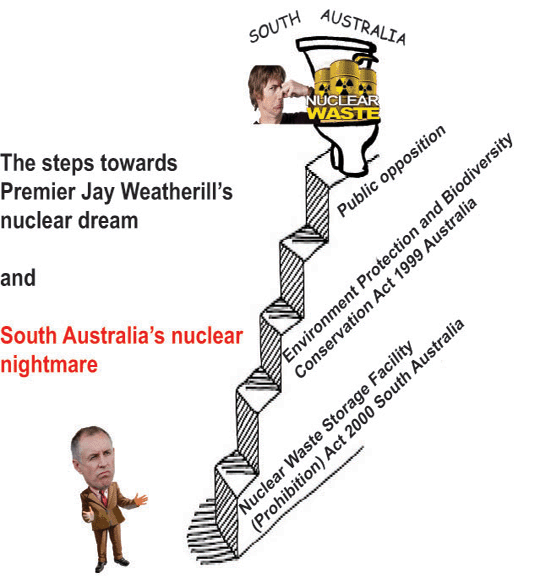
The Citizens’ Jury has delivered exactly what Jay Weatherill wanted- a summary of the Royal  Commission recommendations, with enough uncertainty to justify the nuclear lobby’s next step.
(I’m correcting a previous version of this post, here) The South Australian government already rushed through legislation that overturned South Australia’s legislation against spending money on nuclear industry development, (making this retrospective of course – to cover the $millions already spent)
The next step is to overturn the whole Act, or at least those parts of it which prohibit importing a nd storing foreign wastes.
Weatherill is quoted in THE AUSTRALIAN today as saying ”
“they (the Citizens’ Jury) are asking us to also change the legislation to undertake that work”.
That is a lie. The jury was merely repeating what the Nuclear Royal Commission said. The jury kept to their brief – no decisions or recommendations – just regurgitate what the Commission said.
Election result: no action on climate change
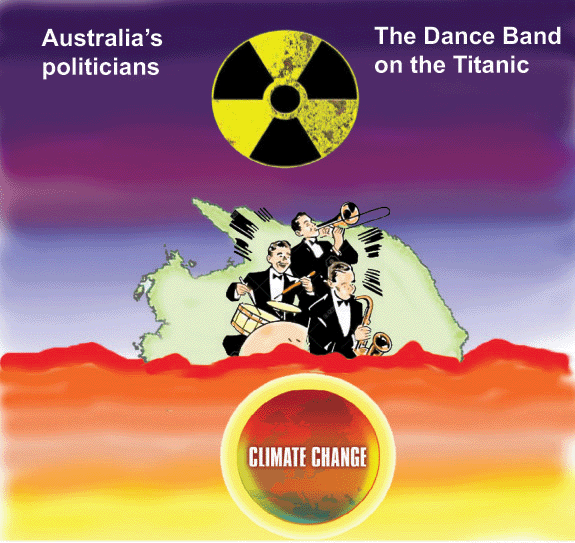 Australians still waiting for climate leadership
  http://www.canberratimes.com.au/comment/australians-still-waiting-for-climate-leadership-20160708-gq1w48.html Geoff Cousins, 10 July 16
Judging from the federal election you wouldn’t know that the public call for leadership on climate change is the highest it has been for a decade in Australia.
In the past 12 months we’ve seen large sections of the Great Barrier Reef turn ghostly white from coral bleaching and sections of Tasmania’s ancient World Heritage forests reduced to cinders in unseasonal fires. The images of Australian suburban homes and swimming pools teetering on the brink of collapse into the ocean off Sydney are burned vividly into the Australian public psyche as a prescient reminder of what’s at stake with more extreme and frequent storm surges predicted under global warming.
The next Federal Parliament must deliver genuine leadership to cut pollution and limit global warming to get in line with the concerns of voters across Australia.
The ALP stepped up early in the election campaign with strong renewable energy policies and Bill Shorten often spoke of his party’s plan to take “real action on climate change” in his pre-election pitches.
Strong policies on tackling carbon pollution from the Greens were announced early in the campaign, and other parties increased their environmental positions as the campaign wore on.
Disappointingly, the Coalition remain without a credible plan to cut pollution or support clean energy, and announcements for smart cities and reef protection were largely funded out of existing clean energy budgets. Continue reading
Important questions for the South Australian Nuclear Citizens’ Jury
 Dan Monceaux, 11 July 16
1) Jury should ask for access to all submissions made to the Parliamentary Committee currently considering responses to the NFCRC’s Final Report.
2) Jury should realise that future consideration is for a multi-lateral nuclear fuel centre, which could involve enrichment, reprocessing, fuel fabrication etc. Waste storage is an entry point: see “Nuclear Fuel Leasing” in the NFCRC’s Report for details.
3) Jury should ask: What is the defence sector’s interest in the nuclear fuel cycle? If defence wants it, how important is the economic case for further processing? Could these proceed without a commercial proposition?
4) Jury should consider the USA’s Energy Employees Occupational Illness Compensation Program and discuss why this was not considered in the NFCRC’s Final Report. it was submitted to the Commission as evidence.
5) Jury should consider the USA’s Radiation Exposure Compensation Act and discuss why this was not considered in the NFCRC’s Final Report. it was submitted to the Commission as evidence.
6) The jury should ask the question: what evidence did the Commission receive and choose NOT to include in its Final Report? Particularly on the topic of safety.
Citizens jury concerned about economics of nuclear waste dump plan
 Citizens’ jury questions economics of SA nuclear dump THE AUSTRALIAN JULY 11, 2016 Rebecca Puddy The bid to establish a nuclear waste storage facility in South Australia has suffered a further setback, after an independent “citizens’ jury” raised concerns about the economic viability of the project.
A citizens’ jury of 50 people met over two weekends to discuss the nuclear royal commission report, handing a nine-page summary to Premier Jay Weatherill last night.
But after hearing from experts, the jury questioned the economic underpinnings of the commission’s findings.
“There were varying views between expert witnesses on the economic viability of this project and therefore questions remain relating to the economic modelling by the royal commission report to feel comfortable progressing to further involvement,” the jury report said.>Mr Weatherill accepted the report from the jury, describing it as “commonsense”.
But he confirmed there was extra work to be done on the estimated size of the economic benefit. “They want some more work on the assumptions so they can be clear on what the benefits are and those assumptions are really what is the actual price an overseas country is prepared to pay for storing their waste in our country and that will only be known if we undertake that work,” Mr Weatherill said.
“That will require expenditure and they are asking us to also change the legislation to undertake that work, so it’s a commonsense recommendation and one we will work on.” Another 350 people will meet in October in another citizens’ jury to look at feedback from the statewide consultations………The South Australian Labor government’s examination into the merits of engaging in the nuclear fuel cycle has so far cost the state’s taxpayers $11.8 million.
This is despite Labor’s national platform, updated last year, strongly opposing establishment of nuclear power plants and any stages of the nuclear fuel cycle, other than uranium mining, in Australia. The platform states strong opposition to the importation and storage of nuclear waste from overseas.
In his opening speech to the citizens’ jury, Mr Weatherill said the group was not meant to arrive at a decision but “to actually arrive at a decision about whether the government can make a decision”……..Varying expert views on the economic benefits of storing nuclear waste have already prompted the government to review work already undertaken by its $7.2 million royal commission.
Opposition spokesman Rob Lucas questioned the value of the citizens’ jury to government. “If that is all there is it has been a massive waste of money which hasn’t clarified anything or progressed the debate at all.”
Mr Weatherill has committed to providing a response to the royal commission by the end of the year. The report royal commission’s recommended pursuing a waste dump. http://www.theaustralian.com.au/national-affairs/state-politics/citizens-jury-questions-economics-of-sa-nuclear-dump/news-story/07e997242e2cb7e71daa0dd45d866a51
Citizens’ jury questions safety concerns surrounding dump proposal
Nuclear royal commission: Citizens’ jury questions safety concerns surrounding dump proposal, ABC News, By Daniel Keane, 10 July 16 A grassroots report into a proposal to build a high-level nuclear waste dump in South Australia has identified safety as a major concern.
The report by a citizens’ jury of 50 randomly selected South Australians also found “significant additional research” is required before residents can make an “informed decision”.
The report, presented to Premier Jay Weatherill on Sunday afternoon, followed four days of intense discussions and meetings with experts both for and against the proposal.
Timeline: SA’s nuclear dump debate Plans for a national nuclear waste dump have been on the agenda for decades, and for much of that time SA’s outback has been touted as a possible site.
“The jurors recognise there are potential economic benefits, but there are also substantial risks to consider,” the report stated. “There is a degree of uncertainty around both the benefits and risks associated with establishing such a facility…….
Nuclear radiation a concern to people, environment Continue reading
South Australia Nuclear Citizens Jury afternoon session 9 July
 In this session, facilitator (probably Emily Jenke from DemocracyCo) was asking the jury to discuss and develop a consensus on the wording of their reports on several topics.
I hope that there will be a transcript of this – (a) because I missed quite a lot and (b) because the to and fro of questions between jurors is hard to follow in an attempted transcript such as I’m doing.
In fact, I learned only some of the discussion on subjects of Education, Community Consent and Trust, and Safety.
Parts that I found particularly significant –
- On Economics – how much investment does the State of South Australia have to put into development of nuclear waste importing facilities? Some jurors felt that there was not enough economic modelling. on education: when will a yes or no answer be acceptable?
- on Trust : it was stressed that this is important because the current South Australian legislation prohibits import and storage of foreign nuclear waste. We need to decide if South Australia, as producer of uranium, has a moral and ethical obligation to take back wastes. Apparently Haydn Manning in a previous hearing has suggested that there is this obligation. However, one juror stated that this was not the finding of the old Ranger Inquiry. International standards state that the society that generates the waste (i.e in nuclear reactors) has that obligation, (not the society that provides the uranium). The Royal Commission Report also states this.
- on Safety – a comprehensive report was given on this, outlining many questions. Here one juror complained that the risks had been emphasised, rather than safety. He referred the jurors back to then evidence given the previous week on radiation risks. At this point my live-stream reception cut out – just as it was getting interesting, seeing that last week’s Citizens’ jury speakers produced a whole lot of trivial nonsense on this topic.
South Australian Greens leader shows up folly of Jay Weatherill’s nuclear waste boondoggle
| Throwing good money after bad – How the nuclear waste dump folly could wreck the State Budget | ||||
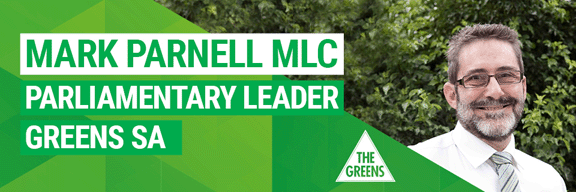
The additional $3.6m allocated in the SA State Budget to advance the case for an international nuclear waste dump means that $13m will have been spent on this deeply flawed proposal by the end of the year, according to Greens SA Parliamentary Leader, Mark Parnell MLC.
“If the Government decides at the end of this year to proceed further with the nuclear waste dump, then this amount must be budgeted for. There will be no revenue, only costs. “On the other hand, if the Government abandons this nuclear waste dump folly now, then we can cut our losses and re-allocate that money to genuinely benefit South Australians rather than impose a toxic legacy for countless future generations”, said Mr Parnell. Here are some better uses to which $600m could be spent: · Finish electrification of the Gawler line and new tram lines to make AdeLink a reality · Better cycling infrastructure · Solar panels on all public housing · Better rural health services and mental health services · Reducing payroll tax for wages paid to apprentices and trainees |
||||
Nuclear Citizens’ Jury – dubious process, and very dubious purpose
It’s not a proper “Jury”, with a purpose to arrive at a yes or no verdict. It is a campaign ruse by the Weatherill government to get these “ordinary people” to develop a readable, understandable, summary of the RC’s 320 pages of recommendations. Apparently the RC personnel are not able to do this themselves.
Two rays of light in all this. First, the jury members are already asking intelligent questions. Secondly, DemocracyCo’s personnel are making every effort to run these hearings fairly, and transparently.
The South Australian nuclear lobby may be in for some surprises.
Nuclear Citizens Jury in action: the purpose and the process, Online Opinion,
By Noel Wauchope – , 5 July 2016 On June 25 and 26, the South Australian government held the first of three citizens juries, dedicated to discussing the recommendations of the recent Nuclear Fuel Cycle Royal Commission. The sessions are being run by the South Australian company DemocracyCo.From the start, there are problems with the purpose of this Citizens’ Jury. Premier Weatherill did not really help to clarify this, in his opening speech, as he explained its purpose:
|
Josh Frydenberg, Energy and Resources Minister attacks environmental groups
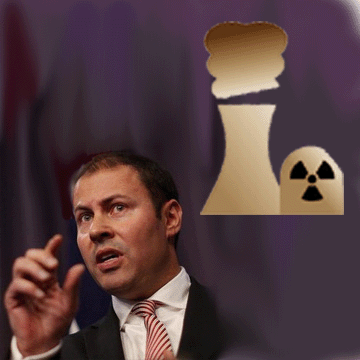 Federal election 2016: Frydenberg slams activist ‘bias’ The Australian, 5 July 16 Liberal frontbencher Josh Frydenberg has attacked the Australian Conservation Foundation and Environment Victoria for campaigning against him in his electorate despite their claims to being independent and non-partisan.
Deposed Tasmanian Liberal Andrew Nikolic is also locked in a war of words with activist group GetUp! over its activities in his seat, where 80 volunteers and 10 paid staff led a $300,000 campaign against the former government whip.
Mr Frydenberg, the Energy and Resources Minister, said the ACF and Environment Victoria had used billboards, trucks and pamphlets to campaign against the Coalition in his inner-Melbourne seat of Kooyong.
“These organisations such as the ACF and Environment Victoria claim to be non-partisan and independent but they clearly acted in this campaign in a way that is hostile to the Coalition,’’ he said.
The ACF hired a truck to drive through the electorate throughout the campaign with a banner attached attacking Mr Frydenberg for refusing to sign up to its environment pledge……..
ACF spokesman Josh Meadows said the banner and flyers were not partisan. “We weren’t saying vote for this person; what were saying was this person pledged commitment and this person didn’t,’’ he said.
Mr Frydenberg said Environment Victoria also launched a partisan attack, placing a billboard at a prominent intersection in the electorate saying: “We booked this ad to talk about the Liberals’ plan to cut climate pollution … they still don’t have one.”
Environment Victoria chief executive Mark Wakeham said: “We are non-partisan, but under the Coalition CO2 emissions have been rising and it’s important that people know that.”…….
In the Adelaide seat of Mayo, GetUp! ran a campaign advocating voting for the Nick Xenophon Team candidate Rebekha Sharkie over Liberal Jamie Briggs. The group says it chooses the recipients of its favours on their stands on renewable energy, marriage equality and education and health. http://www.theaustralian.com.au/federal-election-2016/federal-election-2016-frydenberg-slams-activist-bias/news-story/8c940ff1f471180836bcef01a7813fc9
Teach climate denial in schools – the Hanson plan !
 Federal election 2016: Potential One Nation senator wants climate scepticism taught in schools, SMH July 5, 2016 Nicole Hasham The One Nation candidate with a strong chance of joining Pauline Hanson in the Senate, Malcolm Roberts, wants climate scepticism taught in schools and says the CSIRO and United Nations’ peak climate body endorse corruption.
As Australians adjust to One Nation’s return as a political force, attention has turned to the party’s far-right agenda, which extends well beyond controversial views on immigration and Islam.
Ms Hanson is confident of securing a second Senate spot out of Queensland, which would see Mr Roberts take a seat in the red chamber. She claims her party is in the running for six Senate position
The One Nation website touts Mr Roberts as a family man and former coal mine manager who is “passionate about climate change data and facts”.
He “has earned the respect of informed people around the world for his investigation of claimed global warming and climate change where he … exposed the corruption,” the website states.
……..Mr Roberts’ views appear to be driving One Nation’s extreme climate policy agenda, which includes pushing for a royal commission into climate science and abolition of the Renewable Energy Target.It also wants the teaching of climate science in schools to be based on “the scientific method of scepticism”.
One Nation wants the Bureau of Meteorology reviewed, including “public justification of persistent upward adjustments to historical climate records” and a review of the CSIRO to determine whether funding has influenced its climate claims.
Mr Roberts is listed as a project leader for the Galileo Movement, a prominent climate-sceptic group that boasts broadcaster Alan Jones as its patron.
In a paper published in 2013, Mr Roberts claimed CSIRO scientists were “deeply enmeshed in producing corrupt UN IPCC reports”, in reference to the United Nation’s Intergovernmental Panel on Climate Change, which he also described as “corrupt”.
He claimed IPCC papers “contradict empirical scientific evidence and provide no logical scientific reasoning for their core claim that human CO2 caused, causes or will cause global warming”.
The federal election cleaned out a number of parliamentarians seen as roadblocks to the environment cause, such as WA climate-sceptic MP Dennis Jensen and Bass MP Andrew Nikolic, who wanted environment groups stripped of their charity tax status.
It also put in serious doubt the political futures of others including anti-wind farm crossbench senators Bob Day, David Leyonhjelm and John Madigan.
However One Nation’s new power in the Senate would pose a fresh challenge to those seeking stronger climate action in the next Parliament.
On Monday Ms Hanson said she was “definitely not sold on” climate change…….. Comment has been sought from Mr Roberts. http://www.smh.com.au/federal-politics/federal-election-2016/federal-election-2016-potential-one-nation-senator-wants-climate-scepticism-taught-in-schools-20160705-gpytok.html#ixzz4DapAkA8C
Attempts to dump nuclear waste on South Australia 1998-2004
 The Kungkas wrote in an open letter: “People said that you can’t win against the Government. Just a few women. We just kept talking and telling them to get their ears out of their pockets and listen. We never said we were going to give up. Government has big money to buy their way out but we never gave up.”
Radioactive waste and the nuclear war on Australia’s Aboriginal people, Ecologist Jim Green 1st July 2016 “………Dumping on South Australia, 1998-2004
This isn’t the first time that Aboriginal people in South Australia have faced the imposition of a national nuclear waste dump. In 1998, the federal government announced its intention to build a dump near the rocket and missile testing range at Woomera.
The proposed dump generated such controversy in South Australia that the federal government hired a public relations company. Correspondence between the company and the government was released under Freedom of Information laws. Continue reading
Indigenous elder Dr Jillian Marsh – Greens candidate for Grey, South Australia
 Nuclear personal and political for Dr Jillian Marsh http://www.portpirierecorder.com.au/story/3987452/nuclear-issue-personal-and-political-for-marsh/ Politicians more often than not stick religiously to the party line when it comes to key policy issues.
But for The Greens’ candidate for Grey, Dr Jillian Marsh, the issue of a proposed nuclear industry in South Australia is not just political – it is personal, too. Dr Marsh is a traditional owner and elder of the Adnyamathanha people.
She endorses The Greens’ nuclear and uranium policy which outlines a future without uranium or nuclear energy production. But she said that her Aboriginal heritage motivated her to take the role as candidate for Grey and fight against the proposed nuclear dump.
“I know this is something I have as an obligation as an Adnyamathanha traditional owner,” Dr Marsh said. “I am required to step up to the mark … to take this on board for the sake of future generations.”
One of the proposed sites for a low to intermediate-level nuclear waste dump at The Wallerberdina station, near Barndioota in the Flinders Ranges, sits on Adnyamathanha land.
Dr Marsh was involved in anti-nuclear protest marches through Port Pirie and Port Augusta recently.She felt the the responsibility as a traditional owner and elder of the Adnyamathanha people to speak out about the federal and state government plans.
“Traditional owners, the Aboriginal people, have really had a gutful of this type of approach to community consultation,” she said. “They are always facing the prospect of their culture and country being damaged, destroyed, abused once again.”
Dr Marsh said that the consultation processes and uncertainty put a lot of pressure on aboriginal communities. “It creates a lot of ill-feeling in the community,” she said. “This type of uncertainty and angst is one of the things contributing to the shorter lifespans faced by our people.”
The translation of Adnyamathanha is “people of the rock” or “people of the rocky country” and Dr Marsh said this sacred cultural connection is under threat. “Our connection to the land is constantly being ransacked by ill-informed policies,” she said.
1 This month
7 April – WEBINAR – Australia and the Doomsday Clock – Preventing nuclear war through NoFirstUse and other policies
Online | Tuesday April 7, 4:00-5:30pm, Australian Eastern Time / 8:00-9:30am Central Europe Time
– Access the registration link
15 April – Zoom –Nuclear Power is Not the Solution
Apr 15, 2026 01:00 AM in Canberra, Melbourne, Sydney

Join the International Physicians for the Prevention of Nuclear War (IPPNW) on Tuesday, April 14th for a timely webinar exploring the risks associated with nuclear power and challenging the myth that it offers a simple, safe, carbon-free solution to the climate crisis

21 April Webinar: No Nuclear Weapons in Australia
Start: 2026-04-21 18:00:00 UTC Canberra, Melbourne, Sydney (GMT+10:00)
End: 2026-04-21 19:30:00 UTC Canberra, Melbourne, Sydney (GMT+10:00)
Event Type: Virtual
A virtual link will be communicated before the event.
Host Contact Info: australia@icanw.org

of the week – Australians for War Powers Reform (AWPR)
To see nuclear-related stories in greater depth and intensity
 Antinuclear