Is Australina government secretly planning nuclear submarines?
 Dick Smith questions submarine project, says plans are ‘ludicrous’ and ‘we’re being conned’ 891 ABC Adelaide, 14 Sept 16
French company DCNS won the $50 billion contract to build Australia’s next fleet of 12 submarines in Adelaide, which will replace the current Collins Class fleet. The company won the contract to build a modified version of its nuclear submarine, called the Shortfin Barracuda.
The Australian Government stipulated that the winning contract would need to use conventional power, ruling out larger, nuclear-powered submarines. The lead up to the submarine contract has involved election promises, business and political campaigns and lots of speculation.
Mr Smith said the re-designed version of the submarine would have to be converted to a diesel engine.
But he told 891 ABC Adelaide that was a ludicrous plan and he believed it would never happen.
“So the plan is for us to buy a nuclear submarine design and then convert it to a piston submarine,” he said. “Now no-one has ever done that in the world and in fact when I talk to submarine experts they say it is so ridiculous, so we’re being conned.”
Mr Smith said if the Government’s real agenda was to use nuclear technology, it should be up front about it……….
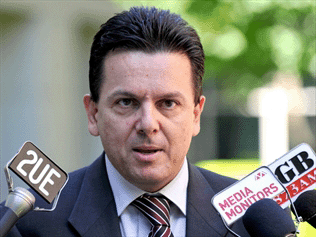
More details on subs project needed: Xenophon South Australia Senator Nick Xenophon said more detail about the submarines project was needed…..Senator Xenophon said he was concerned about the lack of certainty surrounding the project. http://www.abc.net.au/news/2016-09-13/dick-smith-questions-submarines-project-over-nuclear-power/7837946
Discord in nuclear submarine lobby
Businessmen lobby for nuclear subs, news.com.au SEPTEMBER 13, 2016 Australian Associated Press A group of Australian businessmen is lobbying for Australia’s next fleet of submarines to be nuclear-powered and supplied by another country, warning the current deal to build the vessels in Australia will “condemn our sailors to their graves”.
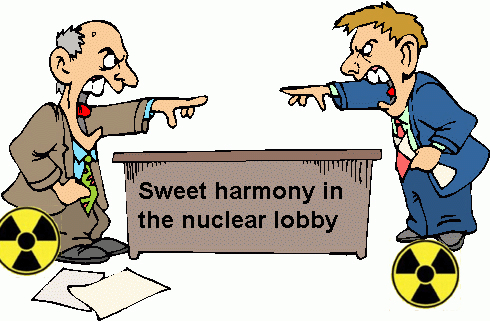
The group says it can’t understand the federal government’s decision to award a multi-billion deal to French supplier DCNS, which will be required to deliver 12 diesel-powered submarines for which there are no drawings and no plans…….
The businessmen, including Dick Smith, Gary Johnston of Jaycar Electronics and ad man John Singleton took out a full-page advertisement in The Australian slamming the move to go with French producer DCNS, suggesting buying off-the-shelf nuclear subs would be a better option……
It also questioned the economics of the decision, saying it would be cheaper to subsidise car industry jobs, if creating jobs was the desired outcome.
Mr Johnston said DCNS was being asked to build a diesel-powered version of what is essentially a nuclear-powered sub.
“They haven’t got a drawing, they haven’t got a plan. Their current nuclear submarine, the Barracuda, is sitting on a slipway…..http://www.news.com.au/national/breaking-news/sa-premier-hits-back-at-sub-criticism/news-story/b8dd63476f1a4552c6685d3533163cd1
Turnbull govt slashes half-a-billion dollars from the Australian Renewable Energy Agency,but doesn’t actually kill it
 Australian Renewable Energy Agency saved but with reduced funding – experts react, The Conversation, September 13, 2016 The Australian Renewable Energy Agency (ARENA) has been granted a funding lifeline of A$800 million over the next five years, after the federal government and opposition came to an agreement that will save the agency.
ARENA had faced being wound down as a result of the government’s earlier proposal to strip A$1.3 billion from the agency. This was part of a wider package of measures designed to save the federal budget more than A$6 billion.
Renewable energy researchers had reacted with dismay to that proposal. An open letter to the government in defence of the agency attracted 190 signatures.
Below, our experts react to the news.
Nicky Ison, Senior Research Consultant, Institute for Sustainable Futures, University of Technology Sydney
Today the Coalition government and the Labor Party struck a deal to:
- slash half-a-billion dollars from the Australian Renewable Energy Agency; and
- save the Australian Renewable Energy Agency (ARENA).
These statements seem like a contradiction, but both are true. However, it is also true that the need to save ARENA exists because of the Coalition government’s efforts over the past three years to dismantle Australia’s renewable energy policy. If the benchmark is that we keep our existing renewable energy institutions, today was a win. However, if the benchmark is that we have institutions and policies that have sufficient funding and scope to tackle the policy challenges of climate change, our changing energy system and driving innovation, then today was a loss.
Andrew Blakers, Professor of Engineering, Australian National University
The Australian research community is pleased that the government’s proposal to debilitate ARENA by removing A$1.3 billion and ending its granting function will not go ahead. At the same time, we are disappointed that yet again ARENA is subject to huge funding cuts.
The fastest and surest way to reduce greenhouse gas emissions is to accelerate the introduction of renewable energy into the electricity system. ARENA has focused heavily in this area (among others), covering the full gamut from support for early-stage research, through grants to young renewable energy companies, to acceleration of deployment of large-scale solar photovoltaic systems.
ARENA will need to heavily prune its activities to cope with a A$500 million budget cut. We look forward to restoration of ARENA funding, and to a concerted effort at the national level to move rapidly to 50-100% renewable electricity……https://theconversation.com/australian-renewable-energy-agency-saved-but-with-reduced-funding-experts-react-65334
Nick Xenophon Team will block cuts to Australian Renewable Energy Agency: What About Labor?
 Nick Xenophon Team’s decision to block ARENA cuts puts pressure on Labor http://www.abc.net.au/news/2016-09-10/labor-under-pressure-amid-renewable-energy-funding-cuts/7832656 AM By political reporter Naomi Woodley The fate of future funding for the Australian Renewable Energy Agency (ARENA) now rests firmly with the Federal Opposition, after the Nick Xenophon Team (NXT) confirmed it would block the Government’s proposed budget cut.
Key points:
- $1.3bn cut is contained in Government’s omnibus savings bill
- Passing of bill to devastate renewable energy industry, Nick Xenophon says
- Labor caucus expected to consider funding cut on Tuesday
The $1.3 billion cut is contained in the Government’s omnibus savings bill, which is currently before Parliament.
Senator Xenophon said if the bill was passed it would devastate the renewable energy industry in Australia.
The real risk of the Government’s slashing of the renewable energy fund, ARENA, is that we will see a brain drain of our best and brightest leaving this country,” he said.
The Government wants to cut ARENA’s funding as part of plans to set up a Clean Energy Innovation Fund that would hand out loans instead of direct grants.
Senator Xenophon said while his team would not support the funding cut, there was scope to change the way ARENA worked.
“There ought to be a change in the funding mechanism to ensure that if a renewable energy technology has commercial success then the grant ought to be repaid, and there ought to be the ability for ARENA to take an equity in that project so it can reap the benefit of that,” he said.
He will ask Labor to support such an amendment when the bill reaches the Senate.
‘Acid is now on Labor’
The NXT’s decision to block the funding cut puts more pressure on Labor to decide how it will vote. Continue reading
Confusion about the two South Australian nuclear waste dump plans
 Are these 2 proposals really so separate, or is the Federal dump choice of South Australia planned so as to soften up South Australians and Australia at large, to view South Australia as a suitable radioactive trash toilet? South Australian Liberals, and the Federal Liberal and Labor are all staying quiet about the Scarce Nuclear Commission plan – but are they secretly in support of it?
Two nuclear proposals ‘confusing discussion’ about potential waste dumps in South Australia, ABC News 2 Sept 16 By Lauren Waldhuter Two separate proposals for storing nuclear waste in South Australia have caused widespread confusion in communities and the Premier has conceded public consultation was badly timed.
 The State Government has launched a state-wide public consultation program on royal commission recommendations to store the world’s high-grade nuclear waste in SA.
But at the same time the Federal Government hasshort-listed Wallerberdina station, near Hawker in the Flinders Ranges, as a preferred site for Australia’s first storage facility for low-to-intermediate level radioactive waste.
Hawker Community Development Board chairperson Janice McInnis said SA’s public consultation was clouding discussion about the federal plan.
“I’ve had phone calls from friends in Adelaide who said, ‘what’s this about a waste dump at Hawker?’, thinking it was the state one and they hadn’t heard about the federal one at all,” she said.
| March 2015 | Nuclear Fuel Cycle Royal Commission established. |
May 2015 |
Landholder nominations to host Australia’s Radioactive Waste Management Facility close. |
| May 2015 |
Royal commission releases four issues papers. Public consultation period begins. |
November 2015 |
Six sites around Australia identified for further assessment, including three in SA. Consultation period begins. |
| February 2016 |
Royal commission releases tentative findings. It suggests SA builds a dump for the world’s high-level nuclear waste. |
April 2016 |
Federal Government announces Wallerberdina station as its preferred site. |
| May 2016 | Final report released and consultation continues. | Present | Consultation continues until next year. |
Premier Jay Weatherill admitted the timing could have been better.
“Certainly we would’ve preferred if the federal process had have waited until our process had been underway,” he said.
“There’s no doubt there’s been confusion between the federal process and the South Australian Government process.
“We’ve detected that as we’ve gone out and spoken to people.
“I think the Commonwealth support the approach that we’ve taken but we’re going to have to find a way to bring those two decision-making processes together.”……..
Two sets of conversations ‘insulting’ Despite disagreeing with both government plans to pursue a nuclear future for SA, environmental groups agree the issue has become too confusing.
The Conservation Council of SA held an expo in Port Augusta on Friday to highlight concerns about both proposals as well as their differences.
“It’s actually insulting to have two sets of governments having two sets of conversations on two different proposals at the same time,” chief executive Craig Wilkins said.
“No wonder the community is confused. “It’s incredibly important that these two plans are kept separate because the impacts are very, very different.” http://www.abc.net.au/news/2016-09-04/nuclear-proposals-confusing-discussion-in-sa/7812646?pfmredir=sm
Meaningless climate weasel words from Environment Minister Josh Frydenberg
 Gaping chasm between Coalition’s climate mantra and the real debate, Guardian, Lenore Taylor, 3 Sept 16 Like the emperor with no clothes, Josh Frydenberg is continuing the grand parade, insisting that Australia is making a successful transition.
Amost every group with a financial, intellectual or ethical interest in salvaging a workable climate policy is now deep in an urgent debate about how Australia can break a decade of policy paralysis. Everyone except the Turnbull government, that is.
The debate, involving big business, small business, investors, the government’s own independent climate advisers, academics, environmentalists, the welfare lobby and the unions, is predicated on the obvious conclusion that our policy – as it stands – cannot deliver the cuts to greenhouse emissions that are domestically necessary and which Australia has promised internationally.
But like the emperor with no clothes, continuing with the grand parade even after the whole crowd has finally declared him naked, the new environment and energy minister, Josh Frydenberg, still insists Australia is “transitioning successfully with the policies we already have in place”. Continue reading
South Australia’s Premier Weatherill is proud that his nuclear waste import plan is RISKY!
 Voters will reward my courage, Weatherill insists, INDaily, 1 Sept 16 Tom Richardson
 Tom Richardson “……….the Premier believes the South Australian public will reward his own Government at the 2018 election for courting “political risk” with contentious changes to the state’s healthcare system and a royal commission into the nuclear fuel cycle………
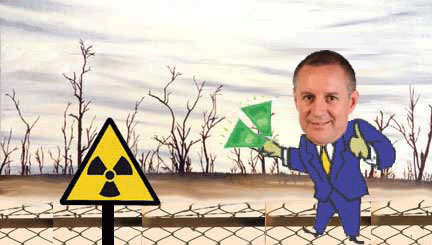
I think ultimately people will give credit to people that are taking on the big decisions,” he insisted.
“There will always be complaints around the edges, but in their heart of hearts they understand somebody’s got to tackle these big questions.”……
On the nuclear issue, acting Liberal leader, Vickie Chapman said: “Weatherill scans the world and tries to find an idea, then thinks, ‘I’ll be bold and brash about this’ – but he’s years late, so it just becomes a sideshow.”……http://indaily.com.au/news/politics/2016/09/01/voters-will-reward-my-courage-weatherill-insists/
Unions ready to oppose South Australian Premier Jay Weatherill on nuclear waste dump plans
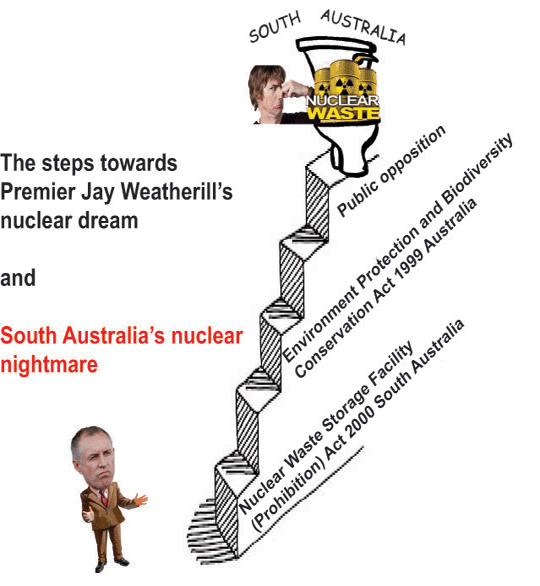 Unions ready to dump on Jay Off the Record: SA’s home of political, business and legal gossip http://www.adelaidenow.com.au/news/opinion/off-the-record-sas-home-of-political-business-and-legal-gossip/news-story/d4d7206f85a8cf5ff5a628158157ef66The Advertiser September 2, 2016 POWERFUL forces within the Labor movement are bracing for an intense union campaign against Premier Jay Weatherill if he goes ahead with plans for a high-level nuclear waste dump.
Off the Record can reveal some are talking about a repeat of the union campaign against Mike Rann, which boiled over in 2010 when he needed a police escort through protesters at Labor’s state conference.
Labor figures have drawn our attention to Maritime Union of Australia state secretary Jamie Newlyn’s public backing of the No Dump Alliance, a broad coalition of environmentalists, indigenous groups and academics.
Newlyn, also SA Unions president, says on the group’s website that the MUA has “a long history of opposing expansion of the nuclear industry including nuclear waste dumps”.
“We fear that the economic assumptions pale in insignificance to the unknown safety and environmental implications of such plans,” says Newlyn.
Wharfies clearly would be required to unload any imported high-level waste, so the union’s support would be critical.
SA Unions vice-president (women) and nurses’ union state secretary Elizabeth Dabars also is backing the anti-dump campaigners, ambiguously declaring her union is pleased “to join the No Dump Alliance to actively participate in community debate on this very important issue for the South Australian community”.
Rann discovered, to his peril, the risks of putting off-side powerful union leaders, such as Australian Workers’ Union state secretary (now president)Wayne Hanson. The AWU, however, is said to be more onside with the dump, because of the potential for jobs and investment.
Perhaps Weatherill will have to worry about his hitherto smooth relations with the union movement being disrupted when he delivers, by the end of the year, the government’s response to the nuclear royal commission.
Australian govt’s cuts to clean energy will mean loss of many CSIRO jobs
 120 CSIRO jobs face the axe if clean energy cuts go through, http://www.canberratimes.com.au/national/public-service/120-csiro-jobs-face-the-axe-if-clean-energy-cuts-go-through-20160831-gr5hxc.html Noel Towell, 31 Aug 16
More than 120 research jobs at the CSIRO face the axe if the Coalition’s proposed cuts to the clean energy research agency are approved by Parliament.
The threatened jobs come on top of scores of university science positions on the chopping block if the Australian Renewable Energy Agency is de-funded as part of the government’s “budget repair” omnibus bill currently before the Parliament.
The new threat to CSIRO research comes less than a month after Science Minister Greg Hunt instructed the organisation to renew its focus on climate science, claiming it would be a “bedrock function” of the agency’s activities.
Fairfax reported on Wednesday that Australia’s leading renewables researchers were warning the nation was heading towards the “clean energy valley of death” if the ARENA cuts are passed. Continue reading
Australian Capital Territory Liberals back ACT govt’s targets of 100 per cent renewables by 2020 and zero net emissions by 2050
 Environmental groups urge ACT to commit to carbon neutrality by 2040, Canberra Times, Christopher Knaus, 1 Sept 16 Environmental groups have urged the ACT government to reach zero net emissions a decade earlier than its current target, while praising the territory’s newly-realised bi-partisanship on climate change.
The ACT government’s targets of 100 per cent renewables by 2020 and zero net emissions by 2050 were backed by the Canberra Liberals at an election forum on Monday night. Liberal leader Jeremy Hanson confirmed his party would continue to pursue Labor’s climate change policies if elected.
The position has drawn praise from the ACT Conservation Council and climate change action group 350.org, which said the approach of the Canberra Liberals “sits in stark contrast to the federal party’s ongoing support for the coal, oil and gas expansion industry and paltry emissions reduction targets”.But both groups have urged the ACT to speed up its transition to a carbon-neutral economy.
Conservation Council ACT executive director Larry O’Loughlin said the ACT should seek to achieve zero net emissions by 2040 to maintain its status as a nation-leading jurisdiction on climate change. Mr O’Loughlin said the government should also set an interim target at some point between 2020 and 2040, to ensure it stays on track to the ultimate goal of carbon neutrality.
He said speeding up the transition to a carbon neutral economy, if adopted across the globe, would help limit global warming to two degrees. The emerging evidence, he said, may even prove that target to be inadequate. “It may be that [2040] is soon unambitious. We might need to do more,” Mr O’Loughlin said.
The Conservation Council has also recently released its election policy document, which sets out the priorities for both major parties ahead of the October election……..
Climate change action group, 350.org, issued a statement on Wednesday congratulating the Canberra Liberals on adopting the existing climate change and renewable energy targets.
350.org Canberra spokesperson Josh Creaser said the ACT had been a leader in fighting climate change, but said more must be done. “Whilst the ACT Liberals have taken an important step by matching the ACT Government’s policies it’s clear that a transition to net zero emissions must happen sooner than 2050,” he said.
“This should also include the ongoing divestment of ACT Government shares in fossil fuel companies.” http://www.canberratimes.com.au/act-news/environmental-groups-urge-act-to-commit-to-carbon-neutrality-by-2040-20160830-gr4i5d.html
Turnbull govt attacks renewable energy, plans to gut Australian Renewable Energy Agency (ARENA)
The sun will set on solar if the Australian Renewable Energy Agency is gutted, The Age, Andrew Blakers and Richard Corkish, 30 Aug 16
The federal government plans to strip the Australian Renewable Energy Agency of most of its funding, as well as its ability to give grants now that Parliament has resumed. Remarkably, the ALP, which established ARENA when in government, may allow this to happen. This is an existential threat to renewable energy research, innovation and education in Australia.
The solar photovoltaic industry is big business. It now makes up a quarter of all new electricity generation capacity installed each year across the world, and it’s growing at 20 to 30 per cent a year. Together, solar and wind energy make up half of all new generation capacity installed globally and all new generation capacity installed in Australia. A renewable energy revolution is in progress, and Australia is at the forefront. Gutting ARENA directly threatens our leadership position.
Our economy has benefited to the tune of billions of dollars in the form of dramatically reduced solar system costs, increased renewable energy business activity, fewer greenhouse gas emissions, royalties, shares and international student fees.
To provide just one example, the Australian-developed PERC solar cell now has annual sales of $9 billion and is forecast to dominate the worldwide solar industry. Further, gains in energy efficiency made possible by this technology are forecast to save our country $750 million in electricity generation costs over the next decade……..
If ARENA is cut, then hundreds of people will lose their jobs within two years. That is the cold reality. This includes researchers, PhD positions and industry leaders. Our brightest minds will be forced to either leave the field, or leave Australia in favour of other parts of the world where solar research is still valued.
In the longer term, Australia’s leadership in solar energy will vanish. As support for research and innovation dwindles, later-stage commercialisation will also start to dry up. This won’t be a temporary loss, but a long-lasting extinction as we lose the research groups that underpin the very education and training of future Australian engineers and scientists.
This would be completely at odds with the federal government’s innovation agenda, as well as its commitment at the UN climate change conference in Paris to double clean energy research and development by 2020…….http://www.theage.com.au/comment/australian-renewable-energy-agency-to-lose-most-of-its-funding-20160829-gr3qme.html
Australian govt’s environment and energy committee chaired by climate sceptic
 Climate sceptic MP appointed chair of environment and energy committee
Liberal Craig Kelly will lead backbench committee that provides advice and feedback on legislation and policies, Guardian, Gabrielle Chan, 29 Aug 16, The climate sceptic Liberal MP Craig Kelly has been appointed chairman of the backbench environment and energy committee, with National party MP Kevin Hogan as secretary.
The committee will provide feedback on legislation and policies relating to the environment and energy, including to the minister, Josh Frydenberg.
Kelly served on the committee during the last parliament and previously invited climate sceptics to “balance” a presentation given by top climate scientists…….https://www.theguardian.com/australia-news/2016/aug/29/climate-sceptic-mp-appointed-chair-of-environment-and-energy-committee
Victorian govt to ban unconventional gas exploration – fracking and CSG extraction
 Victorian unconventional gas exploration ban to end fracking and CSG extraction, ABC News, 30 Aug 16 The Victorian Government is introducing legislation to permanently ban exploration and development of unconventional gas in the state, including coal seam gas and fracking.
Key points:
- Legislation will permanently ban development, production of all unconventional gas in Victoria
- Moratorium on conventional gas extraction to be extended until 2020
- Government says ban will protect Victoria’s agriculture sector
The legislation — the first of its kind in Australia — will be introduced into State Parliament later this year.
Premier Daniel Andrew said the ban would protect the reputation of Victoria’s agriculture sector and alleviate farmers’ concerns about environmental and health risks associated with hydraulic fracturing, known as fracking.
“We’ve listened to the community and we’re making a decision that puts farmers and our clean, green brand first,” he said.
The legislation will also extend the moratorium on conventional onshore gas until 2020, but offshore gas exploration and development will continue.
The Government said the decision, which responds to a parliamentary inquiry, acknowledged the risks involved outweighed any potential benefits……..http://www.abc.net.au/news/2016-08-30/victoria-to-ban-csg-fracking-and-unconventional-gas-exploration/7796944
Liberal Chairman of Coalition’s environment policy committee a proud climate sceptic, suggests nuclear power
Coalition environment committee chairman takes aim at solar subsidies Craig Kelly says he wants wind and solar funding to be redirected to research into ‘technological breakthroughs’ because existing renewables had ‘little effect’, Guardian, Gabrielle Chan, 31 Aug 16, The Liberal chairman of the Coalition’s environment policy committee, Craig Kelly, has questioned solar and wind power subsidies and would like a cost-benefit analysis of future emission reductions policy, due to be reviewed next year.
Kelly was named chairman of the environment and energy committee at the party room meeting on Monday, making him responsible for coordinating backbench feedback to the government on climate and energy policy.
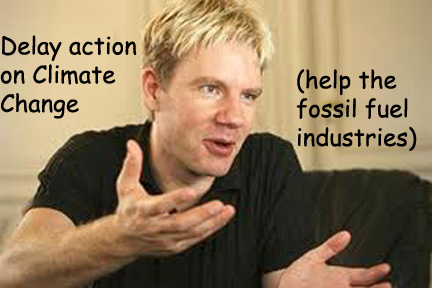 He said he was proud to be a climate sceptic rather than “wallow in groupthink, to be a sheep, or a lemming”. Kelly described himself as in the “Bjorn Lomborg” camp, suggesting wind and solar funding should be channelled into “further research” because those current renewables like wind and solar power had “diminishing returns”………
Kelly said in considering the price of power, the option of nuclear power should be considered……..https://www.theguardian.com/environment/2016/aug/31/coalition-environment-committee-chairman-takes-aim-at-solar-subsidies
Australia trapped in its status as Nuclear Umbrella State
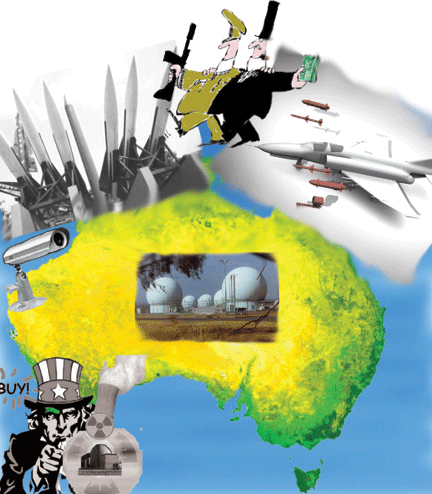 The great nuclear disarmament divide, “……On the one hand, there are umbrella states that are addicted to their nuclear protection, and on the other, there are umbrella states that clearly feel trapped by it, Livemint, 29 Aug 16 W.P.S. Sidhu, Austria, which remained neutral and nuclear weapon-free during the Cold War, has become the leading anti-nuclear crusader in the post-Cold War era. Last year, Austria, along with a group of non-nuclear countries—mostly from the southern hemisphere and Africa, which is entirely covered by nuclear weapon-free zones—proposed several United Nations General Assembly (UNGA) resolutions including on the humanitarian consequences of nuclear weapons. One of the significant Austrian co-sponsored resolutions proposed an open-ended working group (OEWG) to take forward multilateral disarmament negotiations.
Although this resolution was overwhelmingly supported by 138 countries, the five permanent nuclear weapon states of the UN Security Council plus Israel voted against it. While India and Pakistan abstained, North Korea, curiously, supported the resolution. Significantly, 34 states—mostly members of the North Atlantic Treaty Organization (Nato) and those protected by the US nuclear umbrella—also abstained.
Subsequently, while all nine nuclear-armed states (including India) stayed away from the OEWG deliberations in Geneva, the group made substantial progress. By 19 August, the group’s final report had drafted far-reaching recommendations, including a call to initiate negotiations in 2017 on a legal instrument to prohibit nuclear weapons—unlike biological and chemical weapons, nuclear weapons have never been banned. There were indications that this report would be carried by consensus among the states participating in the OEWG. Clearly, a consensus report recommending a treaty to ban nuclear weapons outright would be anathema not only for the nuclear armed states but also the so-called ‘umbrella states’, which depend on the nuclear protection particularly of the US. Thus, the nuclear-armed states sought to influence the OEWG process by proxy.
Enter Australia. In the past, Australia played a leading role in pushing disarmament initiatives, for instance, when it resurrected the Comprehensive Test Ban Treaty in 1996 and co-sponsored an International Commission on Nuclear Non-proliferation and Disarmament in 2008. However, this is at odds with its dependence on nuclear weapons.
As an umbrella state, it depends on the perceived security of US nuclear weapons. In the OEWG, Australia became a proxy of nuclear weapon states and a disarmament spoiler: it called for a vote on the group’s final report even though it was evident that the majority would support the report’s recommendations.
Australia’s objective was two-fold: first, to break the emerging consensus and, second, to close ranks among all the umbrella states. Australia almost succeeded in its second goal. Although 19 Nato states plus Australia and South Korea voted against the report, several other Nato members plus Japan abstai-ned, indicating that not all umbrella states are willing to sustain nuclear weapons and deterrence in perpetuity.
The OEWG process reflects a great disarmament divide not only among the nuclear haves and have-nots, but also among the umbrella states. On the one hand, there are umbrella states that are addicted to their nuclear protection, even though it is not apparent that such security is omnipotent. On the other hand, there are umbrella states that clearly feel trapped by the protection provided, but are unsure how get out of this situation. This debate will now play out on the floor of the UNGA…..http://www.livemint.com/Opinion/4smGv8MNF3hg63Y1WpRzQL/The-great-nuclear-disarmament-divide.html
1 This month
17 October, Free Public Talk on Nuclear Issues in South Australia
David Noonan will speak on public interest concerns over the new Roxby Downs Indenture Act 2026 on BHP copper-uranium mining and ore processing in SA, and on how AUKUS may face SA with a High-Level nuclear waste agenda.
Dr Jim Green will discuss international developments in the field of nuclear power including ‘small modular reactors’ and Generation 4 ‘advanced’ nuclear reactor concepts.


Help Aunty Sue Protect Her Land and Sacred Sites From Destructive Rocket Testing.
.

Australians deserve the truth
about
AUKUS – https://aukuspublicinquiry.com/

PETITION – To: Prime Minister Anthony Albanese and the Australian Labor Government

of the week – Australians for War Powers Reform (AWPR)
To see nuclear-related stories in greater depth and intensity

