Western Australian govt to press on with its changes to Aboriginal heritage legislation
WA government to proceed with controversial changes to Aboriginal heritage legislation, ABC News 19 Feb 16 By Jacob Kagi The West Australian Government intends to proceed with controversial changes to Aboriginal heritage legislation, despite progress on the bill stalling for so long that it dropped off the list Parliament was due to consider.
The Government first introduced legislation to Parliament to amend the Aboriginal Heritage Act in 2014, but there has been no substantial progress on the bill since then.
Because it had been so long since the bill had been debated, it dropped off the Legislative Assembly’s “notice paper”, which is the list of legislation and motions which Parliament is due to consider.
However, that was rectified on Thursday, with the Government passing a motion to restore the bill to the notice paper.
The proposed changes have proven controversial, with concerns that much of the decision-making power would rest of the head of the Department of Aboriginal Affairs, and fears the legislation did not give enough of a role to Indigenous people…….http://www.abc.net.au/news/2016-02-19/wa-government-to-proceed-with-controversial-changes-to-aborigin/7182280
Proposal for nuclear waste dump splits South Australian Kimba community
 Support for proposed nuclear storage facility at Kimba difficult to determine
ABC Rural 18 Feb 16 The South Australian town of Kimba is divided over the benefits or otherwise of a low level nuclear storage facility in the area.
The Federal Government has released a shortlist of six sites nominated to store low-to-intermediate nuclear waste, with three of them located in South Australia.
The three South Australian sites are Cortlinye and Pinkawillinie near Kimba on the Eyre Peninsula, and Barndioota near Hawker, north of Port Augusta.
The prospect of Kimba region being selected has caused deep divisions in the community of Kimba.
The ABC has been told some people are boycotting local businesses in town due to their opposing views  on the issue but the Federal Member for Grey,Rowan Ramsey believes as the debate continues more people are coming around to the idea.
“That’s very concerning, I had not anticipated that people would go to those lengths. All I have ever wanted was a calm rational debate,” Mr Ramsey said…….
Mr Ramsey has been a key player in the debate even offering up his own property as a possible site to host the facility before it was deemed a conflict of interest……
Andrew Baldock and his father Graeme nominated 100 hectares of cropping country at Cortlynie outside Kimba to host the nuclear site……
Melanie Woolford who runs Merinos and prime lambs with her husband, kilometres from the proposed site at Pinkawilinie does not share that view. Ms Woolford is concerned the risk of jeopardising the regions clean, green image does not justify the proposed benefits of having a nuclear waste facility in the region.
“It scares me to think what could happen to our kids or our grandchildren, I think we have a right to say no. “It’s good farming land and I don’t understand why you’d want to put it (a nuclear storage facility) in the middle of farming land,” Ms Woolford said.
“I’ve been here for 13 years and I don’t enjoy coming to Kimba anymore, it’s horrible.” http://www.abc.net.au/news/2016-02-18/nuclear-dump-support-at-kimba-diifficult-to-determine/7181410
Donations to Political parties reap #millions in subsidies to fossil fuel industry
Fossil-fuel industry gets $2,000 in ‘subsidies’ for each $1 in party donations
 Activist group 350.org claims fossil-fuel companies’ $3.7m donations to Liberal, National and Labor parties taints the electoral process, Guardian, Michael Slezak 17 Feb 16 Major political parties have receive $3.7m in donations from fossil-fuel companies since the last election, and will deliver $2,000 in subsidies to the industry for every dollar donated, according to a 350.org report.
“The ongoing failure of our politicians to tackle climate change is directly attributable to the political influence of the fossil-fuel industry,” said Blair Palese, the chief executive of 350.org Australia.
“If we are serious about climate solutions, we must end the cosy relationship between our politicians and the big polluters.” (Below donations by mining industries)

The activist organisation has launched the report alongside a campaign asking individual federal politicians to sign a “pollution-free politics pledge”, where they commit to refuse donations from the fossil-fuel industry.
It has already been signed by all federal Greens politicians, independents Cathy McGowan and Andrew Wilkie, and outgoing Labor MPs Melissa Parke and Kelvin Thomson.
A list of those who have signed is being curated by 350.org. Continue reading
Bill Shorten showing his true pro nuclear colours?
 Bill Shorten flags shift on nuclear waste storage, THE AUSTRALIAN, Michael Owen, Jared Owens, 16 Feb 16 “……..In a big shift from his position a year ago, when he refused to back South Australia’s nuclear royal commission, the Opposition Leader yesterday signalled the possibility of bipartisan support for the inquiry’s proposal that South Australia store some of the world’s high-level nuclear waste.
The radical plan could not proceed without bipartisan support to change commonwealth laws, with federal Labor viewed as the major roadblock.
Visiting a school in Adelaide yesterday, Mr Shorten said federal Labor supported safe storage of low-level domestic nuclear waste and could be persuaded under the right conditions to consider “getting into the international business of storing other people’s nuclear waste”…….
His remarks dismayed some in the ALP, with the party platform “strongly opposed” to storing of imported nuclear waste.
Melissa Parke, the federal MP for Fremantle, said Labor members were “very passionate” about the platform. “Therefore federal Labor’s response to any proposal to store international high-level nuclear waste must be a resounding ‘no’,” she said.
A year ago, Mr Shorten refused to back South Australian Premier Jay Weatherill’s establishment of a royal commission to examine whether the state should increase nuclear fuel cycle activities.
In 2013, he quashed a call by Labor MPs for the party to reopen debate about support for a nuclear industry. Another move last year to change the policy was put on hold until the commission delivered its final report to the Weatherill government. This is due on May 6. http://www.theaustralian.com.au/national-affairs/bill-shorten-flags-shift-on-nuclear-waste-storage/news-story/ef1280d83926b7c7d10692d5910e15a6
Omigawd! A Senior Labor politician who is Not A Fan of Nuclear!
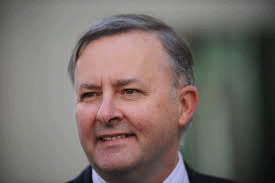 Albanese ‘cautious’ on SA nuclear proposal 9 News 17 Feb 16 Senior Labor figure Anthony Albanese says he is “very cautious” about a proposed high-level nuclear waste dump in South Australia’s outback.
This comes after opposition leader Bill Shorten indicated he was open to a royal commission recommendation that SA earn billions of dollars and create thousands of jobs by storing and disposing nuclear waste.
But Labor’s infrastructure spokesman Mr Albanese appears more wary of the proposal, telling 5AA radio “I would be very cautious about it”.
Mr Albanese also said he was “not a fan” of the nuclear fuel cycle and said renewable energies were more economically viable……… http://www.9news.com.au/national/2016/02/17/10/25/albanese-cautious-on-sa-nuclear-proposal#JtxocOdo0XoCmzd1.99
The Nuclear Commission findings do not bode well for Australia’s renewable energy development
The repeal of the carbon price and the stalling of renewable energy development has put Australia on a path to increase emissions to record levels and will likely not reach a peak before 2030.
The nuclear industry is essentially counting on failure on these tasks, and then having some sort of Marshall plan to allow for the extra expense of nuclear generation.
 Nuclear commission findings spell more trouble for wind and solar in Australia REneweconomy, By Giles Parkinson on 15 February 2016 The South Australian Royal Commission into the nuclear fuel cycle has conceded that nuclear power is not a viable alternative for Australia, but has urged authorities to consider it anyway – in what could have serious implications for the roll out of renewable energy across the country.
The commission delivered the results of its “tentative” findings on Monday, indicating that it supports the establishment of a nuclear waste facility in the state, the storing of spent nuclear fuel and the expansion of uranium mining.
On the subject of nuclear generation, the commission admitted that it wasn’t viable in South Australia in the foreseeable future (2030) – even with a significant carbon price and a sharp reduction in the cost of capital.
It conceded that Australia should only adopt “proven” new nuclear technologies such as “small modular reactors” and next generation “fast reactors” , but that these were some way off, and likely to be very costly.
 But commission chairman Kevin Scarce wants the nuclear generation dream to continue. He admitted that while there were real risks in nuclear generation – and there are “no guarantees on its safety” – he doesn’t “think the positive side of nuclear power is being presented.” Continue reading
Weatherill Democracy in Action – Nuclear Fuel Chain Royal Commission Tentative Findings
Only on the question of the importation, storage and disposal of nuclear waste is the inquiry up-front. This is seen as a definite goer. A big bold tick for the world’s unloved and unwanted nuclear waste. Oh, and by the way, this includes fuel originating from SA’s uranium via “fuel leasing”. The plan is to store the waste for over a decade before it is disposed.
This happens to be just the sort of time delay that would allow the setting up of a plant to produce fresh  uranium fuel from the spent fuel. Another discretely hidden tick, this time for processing.
Dr Dennis Matthews (BSc Hon, PhD), 15 Feb 16 After setting up an inquiry with biased terms of reference, chaired by a person with known sympathies for the nuclear industry, and appointing a committee calculated to support a pro-nuclear agenda, Premier Jay Weatherill now says, with his best poker-face, that this will be a test for democracy.
Well may Jay say that this is a test for democracy, because in setting the test he has bastardised democracy and is now endeavouring to head off any objections. One can almost hear the storm troopers rattling their swords as they look forward to putting down anyone with the temerity to challenge the beloved leader.
The so-called “tentative findings” of Weatherill’s mock democratic consultation are as devious as the man himself.
Weatherill would like us to believe that all he is doing is setting up a nuclear waste industry that will bring untold economic benefits to SA, benefits which the rest of the world seems significantly less eager to embrace, especially those with mature nuclear industries generating this noxious product.
In fact, this travesty of an inquiry is preparing the ground for a full-on nuclear SA with uranium mining, nuclear waste importation, nuclear fuel manufacturing and nuclear power. Continue reading
South Australia is too good to waste.
 Today’s Royal Commission ‘Tentative Findings’ report clearly states that nuclear power will not be economically viable. It also says that uranium conversion, uranium enrichment and nuclear fuel reprocessing are not economically viable. The state’s peak environmental body Conservation Council SA welcomes these findings.
However the report says that South Australia should consider importing international nuclear waste.
“We have had the Royal Commission, now any nuclear waste dump needs South Australia’s permission”, says Conservation SA Chief Executive Craig Wilkins.
“This is a decision for all South Australians. The issue of genuine acceptance and consent is absolutely critical.
“If we pursue a nuclear waste dump path, we are saying “the best we can do is accept the worst the world has got”. I honestly think we can do better than that.”
An opinion poll commissioned by The Advertiser last year found that less than one in six (15.7%) South Australians support a nuclear waste dump in SA.*
“Now comes the hard part. We’ve had a technocratic, distant process so far – now it turns to real people, real places and real values,” says Mr Wilkins.
“The Royal Commission presents an optimistic view of potential profits from offering Australia as the world’s nuclear waste dump. The Commission acknowledges that nuclear waste needs to be isolated from the environment for “many hundreds of thousands of years” yet there is no attempt to cost the management of waste over those timeframes.
“If there’s one thing we know, the nuclear industry is expert at overstating the benefits and radically understating the costs and risks.
“Ultimately, we think it’s essential that all current and future South Australians should have the freedom to choose. Saying yes to nuclear makes that choice forever, there is no going back.”
Greens: Nuclear Royal Commission findings: It’s all about the dump!
 The tentative findings of the Royal Commission into the Nuclear Fuel Cycle, released this morning tell us what we already know, according to Greens SA Parliamentary Leader, Mark Parnell MLC.
As predicted when the Royal Commission was established – this process is all about softening South Australians up to be the World’s nuclear waste dump.
We’ve known for years that the uranium reprocessing market is “uncertain” and that there is “no opportunity for commercial development” [Royal Commission quotes]. We’ve also known for decades that nuclear power for SA is “not commercially viable … in the foreseeable future” [Royal Commission quotes].
“The outcome of the Royal Commission isn’t at all surprising. The Greens knew that the most likely result of this process was to support South Australia becoming the World’s nuclear waste dump.
However, the Royal Commission’s tentative findings on the nuclear waste dump are based on dubious economics, heroic assumptions and a big dose of guess work. The Commission has identified a problem that lasts hundreds of thousands of years and proposed a solution with income that lasts just a few decades, but with costs lasting virtually forever. If anything goes wrong in the future – we’re on our own.
“The Greens are calling on the Weatherill Labor Government to protect our State’s reputation and not leave our descendants to deal with a toxic future as their legacy.
Previous State Labor Premier Mike Rann fought off a Liberal plan for a national nuclear waste dump in South Australia last decade. The current proposals are far more sinister and dangerous because they involve South Australia taking the most dangerous radioactive waste on the planet.
South Australians will now need to ask themselves and their politicians: “Is this the best future that we can aspire to?”
South Australian premier out on a limb, as national Labor dithers about nuclear policy
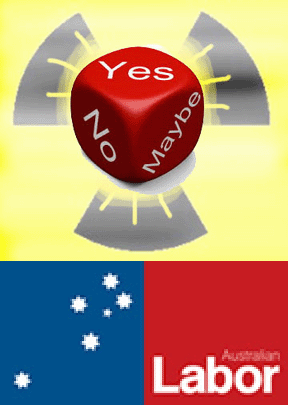 Royal commission tipped to back radioactive dump REBECCA PUDDY, The Australian, Monday 15 February Australia could be a step closer to establishing a nuclear industry today when the interim findings of South Australia’s nuclear royal commission are handed down amid an increasingly favourable political landscape…… it is widely tipped to recommend establishing a high-level radioactive waste dump as a money spinner for the struggling state economy.
The findings are also likely to leave open the option of building a nuclear power reactor in the southern state………..
While Premier Jay Weatherill has committed to responding to the report before the end of the year, his response could be constrained by his party’s national platform. In July it was revealed that Labor had shelved a move to end the party’s opposition to nuclear energy through amending its national platform, which outlines the party’s opposition to nuclear energy.
Labor’s resources spokesman Gary Gray, who was leading the campaign to change Labor’s position, said at the time that the draft proposal to soften the party’s stance on nuclear energy had been set aside while the South Australian Nuclear Fuel Cycle Royal Commission was under way.
The release of the commission’s findings will be accompanied by four technical documents commissioned by Rear Admiral Scarce, which will outline the costs and economic benefits of engaging in the nuclear fuel cycle.
Evidence provided to the commission over the course of its 34 sitting days included a business case that estimated an Australian nuclear reactor would cost between $3 billion and $6bn to build, with operations starting in 2030.
The findings will be released at 11am, with the first of a series of public meetings on the issue scheduled for tonight at the Adelaide Town Hall.
Environmental campaigner David Noonan said anti-nuclear activists would be present at the meeting but would be “deliberately polite”, to ensure the public’s focus stayed on the issue. He said neither of the major parties would advocate for a change in direction with nuclear power or storage until after the federal election, leaving the South Australian Labor government out on a limb.
“There’s a lot of caution there in the political landscape right now,” Mr Noonan said. “Josh Frydenberg will try to get his low-level radioactive waste site over the line before he moves on anything else.”
Tasmanian Greens stick up for civil liberties, and the right to protest
 Protest laws under fire as Greens to attempt to have legislation banished from statute books http://www.themercury.com.au/news/tasmania/protest-laws-under-fire-as-greens-to-attempt-to-have-legislation-banished-from-statute-books/news-story/a7eec43b2cea4197b229e2a28fbc7c35 February 15, 2016 THE Greens will launch a bid to overturn the state’s anti-protest legislation, which they say is being used to stifle the democratic right to protest.
Acknowledging the attempt had little chance of success in the Liberal-dominated State Parliament, Greens leader Cassy O’Connor said the legislation needed to be overturned
Ms O’Connor said the legislation — which carries maximum fines of $10,000 and mandatory jail terms for repeat offenders — was being used against citizens protesting logging operations in the Lapoinya Forest — contrary to government promises about its intent.
“In recent weeks up at Lapoinya up in North West Tasmania, we’ve seen the Government’s draconian anti-protest legislation actually target the very people that Paul Harriss said it wouldn’t — mum and dad protesters.
“This Bill is not only highly political and draconian it is unnecessary — there is already legislation in Tasmania for trespass and public nuisance and we want to see this Bill banished from the statue books. “I believe this law will not remain on the statue books in Tasmania forever. It may be subject to a High Court challenge. It really has no place in a civil and democratic society like ours.”
Tasmanian spokesperson for Civil Liberties Australia. Rajan Venkataraman, said the Bill was a severe infringement on the right to peaceful protest. “The provisions in this Act are quite unique to Tasmania,” he said.
“Around most jurisdictions in Australia and indeed many countries around the world, they have provisions regarding trespass and public nuisance and certainly violent protest … but this kind of Act specifically targets protesters and specifically peaceful protesters. “The offences created by the Act and the penalties imposed are extreme and not in proportion to penalties imposed under other statutes, even for quite serious and violent offences.”
Resources Minister Paul Harriss dismissed opposition to the laws.
“It says a lot about the Greens that at a time when the state is a facing a number of serious challenges, they are most concerned about changing the law to allow their mates to try to stop others from lawfully harvesting a regrowth forest.”
Northern Territory Mine Regulator gives a free pass for uranium mining companies to pollute
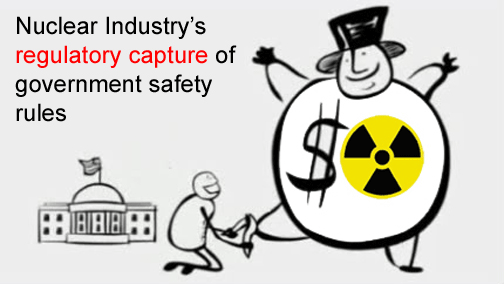 What is a regulator for again? http://linkis.com/greensmps.org.au/1cNkL 12 Feb 2016 The Northern Territory mine regulator is inviting uranium companies to ignore any environmental safeguards with their refusal to prosecute Energy Resources Australia, the Australian Greens said today.
“After more than two years, the NT regulator has given ERA a pass. The Ranger mine leaked nearly 1.5 million litres of radioactive acidic sludge into the plant area, and could have got people killed,” Australian Greens Deputy Leader Senator Scott Ludlam said today.
“Under estimates questioning we were told that the report into the leach tank spill was kept from the public while a decision was made about whether or not to prosecute. It’s hard to envisage a scenario that warranted the application of the full force of the law more than this one.
“The regulator failed to prevent the spill, they took years to deliberate, and came up with nothing. They’ve essentially announced to mining companies in the NT that there are no legal consequences for catastrophic negligence,” Senator Ludlam said.
“We urge the NT government to reverse this decision immediately and force ERA to be accountable.”
No charges over radioactive spill! How nice for ERA!
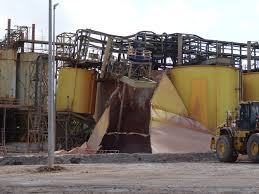 ERA radioactive slurry spill: NT Government won’t lay charges against miner A uranium miner has avoided charges over a 2013 spill of 1,400 cubic metres of radioactive slurry at its Ranger mine in the Northern Territory. ABC News 12 Feb 16
Key Points:
- Report focuses on radioactive spill from 2013 at Ranger Mine near Kakadu NP
- NT Government says not in public interest to lay charges
- Mining company Energy Resources Australia welcomes findings
The spill at the Energy Resources of Australia (ERA) Ranger uranium mine, which is surrounded by Kakadu National Park, saw a holding tank collapse on December 7, 2013. Workers discovered a hole in the side of the tank and were evacuated before the tank burst and the slurry escaped.
ERA said no-one was injured and no uranium leaked off the site into Kakadu.
The NT Government on Friday released the findings of its Completed Investigation Into Failure of Leach Tank 1 Ranger Uranium Mine.
Department of Mines and Energy chief executive, Ron Kelly, explained in the report that he accepted the “admission of fault by ERA to the unauthorised spill as a result of the failure of Leach Tank 1”.
“However I have decided that it is not in the public interest to lay a charge against ERA under Section 33 of the NT Mining Management Act [MMA],” he said……..
EDO blames ‘lack of political will’ for failure to prosecute
Principal lawyer with the non-profit Environmental Defenders Office in the NT, David Morris, said the Government did not need to show that ERA intended for the spill to occur to successfully prosecute the miner.
“The reason they are not bringing this prosecution? I think, lack of political will,” Mr Morris said.
“What this decision does is send a message to the Northern Territory community that we are not going to hold companies to account for a really poor standard of quality control on their mine sites,” Mr Morris said.
He said being forced to shut down the site was not a penalty.
“That is the cost of doing business when you do business poorly.” http://www.abc.net.au/news/2016-02-12/era-avoids-charges-over-radioactive-slurry-spill/7163560
Independent Australia cracks the mystery of “international award” to (Anti) Environment Minister Greg Hunt
 Mystery explained: Hunt’s award handed out by the oil industry, Independent Australia Lachlan Barker 12 February 2016, MANY THIS week, myself definitely included, were gobsmacked by Greg Hunt receiving an award for – get your sick bags ready everyone – “Best Minister in the World“.
When I first saw this, again like so many of you, I thought it was satire, perhaps done by that excellent SBS site The Backburner. I’ve repeatedly been taken in by this site, so plausible are their funny stories and so appalling is our federal government.
But no, when we all got off the floor, the stories were indeed real and Hunt had, indeed, been given this award.
However, I knew there was something rotten here and so I thought I better find out how this bizarre occurrence came about. So I went to the site of the organisation that gave out the award, the World Government Summit. There on the home page is a link to “Partners“, so I clicked on that and discovered that the intriguingly entitled ‘Entrepreneurship Partner’ is the Abraaj Group.
So I clicked on that and we come to the Abraaj page and discover their portfolio. Among them are such heartwarming industries as Chemicals, Metals and Industrials,Pharmaceuticals, Construction and Manufacturing and of course Energy, Mining and Utilities.
[Author lists the companies, with their logos]
One company, Auro Mira Energy is focussed on renewables; they pursue hydro and biomass power generation in India.
However, the rest is largely fossil fuels……..
So there you have it mystery solved, Greg Hunt’s award was sponsored in large part by the energy industry, most prominently oil.
Once I found this out, it kind of made Hunt’s award make sense.
The award was for “Best Minister in the World” and so if you are going to pick a minister who does more than any other to enable the continued and increased use of fossil fuels, then clearly Greg Hunt is your man………
Greg Hunt is the best at enabling ongoing and increasing use of fossil fuels, against all financial and global ecological sense. So they can give him an award, as long as it’s for “Most Destructive Environment Minister the Earth has ever Known”.
Lachlan Barker blogs at cyclonecharlie88.blogspot.com.au. You can follow him on Twitter at@cyclonecharlie8. https://independentaustralia.net/environment/environment-display/mystery-explained-hunts-award-handed-out-by-the-oil-industry,8672
2900 scientists urge Malcolm Turnbull to prevent the drastic cuts to CSIRO’s climate researchers
Australia played a vital role in monitoring and modelling, particularly for the southern hemisphere.
 CSIRO climate cuts ‘devastating’, almost 3000 scientists tell Malcolm Turnbull http://www.smh.com.au/environment/climate-change/csiro-climate-cuts-devastating-almost-3000-scientists-tell-malcolm-turnbull-20160211-gms3ea.html Peter Hannam Environment Editor, Almost 3000 scientists from nearly 60 nations have appealed to Prime Minister Malcolm Turnbull and other Australian leaders to halt the CSIRO’s plans to halve the number of researchers working on climate monitoring and modelling.
In a letter that was also sent to the CSIRO’s board and chief executive Larry Marshall, the 2900 researchers said the decision to cut 100 full-time positions out of about 140 staff from two units of the Oceans and Atmospheric division “alarmed the global research community”.
“The decision to decimate a vibrant and world-leading research program shows a lack of insight, and a misunderstanding of the importance of the depth and significance of Australian contributions to global and regional climate research,” the letter said.
“The capacity of Australia to assess future risks and plan for climate change adaptation crucially depends on maintaining and augmenting this research capacity.”
The letter follows a statement earlier this week by the World Climate Research Program that the proposed axing risked severing “vital linkages with Australian colleagues and to essential southern hemisphere data sources, linkages that connect Australia to the UK, the US, New Zealand, Japan, China and beyond”. Continue reading
1 This month
Chernobyl: The Lost Tapes – A good documentary on Chernobyl on SBS available On Demand for the next 3 weeks– https://www.sbs.com.au/ondemand/tv-program/chernobyl-the-lost-tapes/2352741955560
15 April – Zoom –Nuclear Power is Not the Solution
Apr 15, 2026 01:00 AM in Canberra, Melbourne, Sydney

Join the International Physicians for the Prevention of Nuclear War (IPPNW) on Tuesday, April 14th for a timely webinar exploring the risks associated with nuclear power and challenging the myth that it offers a simple, safe, carbon-free solution to the climate crisis

21 April Webinar: No Nuclear Weapons in Australia
Start: 2026-04-21 18:00:00 UTC Canberra, Melbourne, Sydney (GMT+10:00)
End: 2026-04-21 19:30:00 UTC Canberra, Melbourne, Sydney (GMT+10:00)
Event Type: Virtual
A virtual link will be communicated before the event.
Host Contact Info: australia@icanw.org

of the week – Australians for War Powers Reform (AWPR)
To see nuclear-related stories in greater depth and intensity
 Antinuclear