Australian Greens unveil 7 point plan for the nation getting off coal and gas

 Greens climate policy calls for immediate ban on new gas, coal projects http://reneweconomy.com.au/2016/greens-60604 By Sophie Vorrath on 28 April 2016 The Australian Greens have unveiled a seven-point policy plan to wean the Australian economy and electricity network off coal, including an immediate ban on all new coal and gas projects, a tax on coal exports and a carbon price.
Following on the heels of federal Labor’s Climate Change Action Plan, the Greens’ 7-point plan – released on Thursday – aims to put an “urgent brake” on Australia’s fossil fuel emissions, while also investing in large-scale clean energy.
And it follows the ALP in calling for the reinstatement of a carbon price – although Greens Leader Richard di Natale has already ridiculed Labor’s proposed version, which he told the National Press Club on Wednesday equated to a carbon price of 3c a tonne.
The Coalition, meanwhile, is busy disparaging both, with environment minister Greg Hunt dusting off the party’s tried and tested mantra on ABC Radio National on Thursday, that “the overarching point here is that this is an electricity tax.”
The Greens plan, which would raise revenue by placing a levy on coal exports and “ending tax-free fuel” for mining companies, includes a $1 billion Clean Energy Transition Fund to help workers exit the coal industry.
It would also invest in the health of the Great Barrier Reef, which is already feeling the effects of global warming, with as much as 90 per cent of its coral affected by bleaching. Continue reading
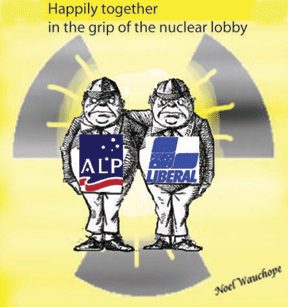
Liberal and Labor will downplay nuclear waste issues, until the election is safely over
 Decision on low-level nuclear waste dump unlikely before year-end and without public support, April 30, 2016, The Advertiser, DANIEL WILLSPARIS, FRANCE, Sunday Mail (SA) A GO-AHEAD for a low-level nuclear waste dump for South Australia will not be granted before the end of the year – and will only proceed if there is public support, Premier Jay Weatherill says.
Speaking to the Sunday Mail during a visit to France to meet the designers of the future submarines, Mr Weatherill said the proposal could only be approved after the final Royal Commission report and the delivery of a State Government response to Parliament.
An array of state laws currently ban both low- and high- level waste facilities, as well as the use of nuclear energy and enrichment of mined uranium……..
“I think it’s a community debate that will begin in earnest after the next federal election,” he said.……http://www.adelaidenow.com.au/news/south-australia/decision-on-lowlevel-nuclear-waste-dump-unlikely-before-yearend-and-without-public-support/news-story/4fb4790f8c5d433ddb509b60bec39cdc
The submarine boondoggle- over $2000 per each Australian
4. BUT WAIT THERE’S MORE So we spend $2,000 each. That just gets us the big lumps of steel. If you actually want to use them, you’re paying more. It could be another $2,000 to $4,000 per Australian….
OPTIONS The great thing about the way the acquisition will work is there should be the opportunity to cut back from 12 when the inevitable delays and cost blowouts happen. From here we can’t save the whole $2000 but maybe we can save some, for better uses.
 Sub standard: why the $2,000 we are each spending on submarines will probably be a terrible waste http://www.news.com.au/technology/innovation/design/sub-standard-why-the-2000-we-are-each-spending-on-submarines-will-probably-be-a-terrible-waste/news-story/6922de6f6a72657c669fdc1a1248916f APRIL 30, 2016, Jason Murphy news.com.au@jasemurphy AUSTRALIA is spending $50 billion to buy submarines. The biggest whack of money we’ve ever spent on a Defence project. It comes out at $2000 per person. And it’s probably a shocking idea. Continue reading
Liberal coalition plans nuclear submarine fleet so that we can fight China
Coalition plans nuclear-powered submarine fleet over long term. Fin Rev, by Aaron Patrick and Phillip Coorey, 1 MAY 16
Some of Australia’s new submarines could be nuclear-powered by the time they enter service, making them much more potent against the huge Chinese navy.
One of the reasons French ship builder Direction des Constructions Navales Services, also known as DCNS, won the $50 billion contract was its ability to switch easily to a nuclear version of the submarines being designed for the Royal Australian Navy.
That is because the Australian diesel-powered Shortfin Barracuda will be a shorter, lighter version of a nuclear submarine already being manufactured by DCNS in Cherbourg on the English Channel.
Cabinet ministers and defence officials have already discussed the possibility of switching from diesel engines to nuclear power part-way through the construction contract, political, government and industry sources say.
The Coalition wants to keep the option open in case public opposition to nuclear power changes in the future. National polls taken from 2006 to 2009 found between 35 and 50 per cent of Australians supported introducing nuclear power, a study by the National Academies Forum showed.
DCNS, which is majority owned by the French government, is expected to start building the Australian submarines in Adelaide next decade. The last one might not be completed until 2050.
The other bidders for the contract, Germany’s Thyssenkrupp Marine Systems and Japan’s Kawasaki Heavy Industries and Mitsubishi Heavy Industries, don’t make nuclear submarines………..
The government, which has been criticised for opting to build the submarines in Australia, said it was not considering switching to a nuclear-powered version………
Another drawback of nuclear reactors is that, unlike diesel motors, they can’t be turned off to make the submarine silent.
Australia’s submarines are unusual. They would be the only conventionally powered ones that used pump jets for propulsion rather than propellers, Stephan Fruehling, a defence expert at the Australian National University’s College of Asia and the Pacific, said.
The Coalition government quietly supports developing a nuclear industry in Australia and on Friday proposed storing radioactive waste on a remote South Australian cattle station.
It has encouraged the South Australian Labor government to push ahead with a debate over storing spent nuclear rods from overseas. Given the submarines will be built in Adelaide and South Australia has some of the largest uranium deposits in the world, the state could one day become the centre of an Australian nuclear industry. http://www.afr.com/business/manufacturing/coalition-plans-nuclearpowered-submarine-fleet-over-long-term-20160429-goieal
New submarines chosen as prelude to nuclear submarines

 Business SA says Future Submarine fleet could include nuclear-powered versions once local atomic industry is established, Adelaide Now April 30, 2016 State political reporter Daniel Wills, Paris, France, Sunday Mail (SA) AUSTRALIA’S future submarine fleet could be transitioned to include a potent mix of both intelligence gathering diesel boats and rapid, fast-moving nuclear-powered vessels once the state develops a sophisticated atomic industry based around storage, Business SA says.
The Federal Government is facing calls from across the strategic policy and business communities, as well as from an outspoken SA Senator, to strongly consider the nuclear option.
Premier Jay Weatherill visited DCNS’ Cherbourg shipyard last on Friday Adelaide time, just hours after SA was chosen as the likely site of a low-level nuclear waste dump and as former governor Kevin Scare puts the finishing touches on a Royal Commission due for release within days.
Business SA chief executive Nigel McBride, who joined the Cherbourg tour to observe the construction of a nuclear Barracuda sub that will become the template for Australia’s diesel fleet, said there was strong national defence reasons for having a mix of the two…..
Mr McBride told the Sunday Mail that building community confidence behind nuclear storage was crucial before the question of expanding the industry into defence capabilities.
“As we’ve gone around Europe and looked at their nuclear cycle, and take into account the likely final recommendations from the Royal Commission in regards to the storage of waste, we will as a nation and state soon come to a decision about if we participate or not,” he said…….
Mr McBride said storage was a “starting point” in a discussion about other applications.
The first future sub is set to hit the water in the early 2030s, about the time when Mr Scarce says the state could have a storage industry up and running if it moved to do so immediately……
“We walked around a facility today which had a significant nuclear threat, nobody even blinked. We walked around and took it for granted that it would be professionally contained,” Mr McBride said……
Senator Day said there was “no escaping” the strategic need for nuclear subs…….
“The winning DCNS bid links SA with a French nation with nuclear subs and nuclear power. This opens up great opportunities for SA to learn how to embrace all facets of the nuclear fuel cycle.”…….
Mr Thomson said diesel subs were valuable in “certain, specific circumstances”.
“But if you had to choose between 12 nuclear or 12 conventional subs, it’s a no-brainer. You’d have the nuclear subs every time…
Australian law currently bars the use of nuclear subs………http://www.adelaidenow.com.au/news/south-australia/business-sa-says-future-submarine-fleet-could-include-nuclearpowered-versions-once-local-atomic-industry-is-established/news-story/9ae30cb1933a6119182944f6dbdcf09c
Nuclear inquiry needed for waste dump sites
 29 Apr 2016 The Australian Greens have called for an independent, deliberative inquiry into long-term stewardship options for spent nuclear fuel, drawing widely on international experience in light of today’s announcement to use Wallerberdina Station near Barndioota in South Australia’s Flinders Ranges as a proposed dump sitefor WA Scott Ludlam said this should start with the question, what is the safest way to isolate long-lived wastes from people and the environment for tens of thousands of years, rather than where should we dump it?
“Existing spent fuel and reprocessing wastes should be properly containerised in 60-year licenced castors, effectively big bomb-proof lead and steel containers, and remain at Lucas Heights under active care and maintenance,” he said.
The Government must also come clean about what kinds of waste they intend to dump.
“While the Government emphasises that this debate is about low-level medical wastes (gloves and discarded diagnostic equipment), the real debate is about where the spent nuclear fuel from the Lucas Heights research reactor ends up,” he said.
Mr Ludlam said today’s announcement was only happening because community action led by Aboriginal leaders managed to defeat the proposal to dump nuclear waste at Muckaty Station in the Northern Territory.
“Unless the Government wants a repeat of that disaster, it needs to listen to local voices now. Minister Josh Freydenberg and his predecessor Ian MacFarlane said they would not proceed without consent. That consent is clearly missing: the community is saying no, and this must be respected,” he said.
“What we needed was a genuinely deliberative investigation into how to isolate this waste for tens of thousands of years; instead we got this attempt to cut corners and dump it off on an unsuspecting community.”
The Greens have committed to support local Aboriginal people who recently led a tour of the region for Australian Greens representatives.
The Greens also call for: Continue reading
Were those French submarines chosen so that t they could later be NUCLEAR submarines?
Why did we agree to pay too much for French submarines? THE AUSTRALIAN
APRIL 29, 2016 Robert Gottliebsen,Business Spectator columnist Melbourne The evidence now mounting shows that the submarine tender is one of the most irregular ever conducted in Australia. Defence officials in the US, Japan and Germany are shocked at what is now being revealed.
Within 24 hours of the tender being announced, both sides are saying different thingsso, as anyone experienced with tenders knows, that means the deal has every prospect of becoming a disaster. (The good, the bad and the ugly of the submarine tender process, Apr 29)
There is mounting evidence that the French do not want to build the first two submarines in Australia. They need to make the first two submarines back home.
In Paris, they were shocked that Prime Minister Malcolm Turnbull was so definitivein his statement that all 12 submarines would be built in Australia.
To understand how this bizarre situation developed and the implications that stem from it, we need to go back to the defence white paper which estimated the cost of the 12 submarines at $50bn (we learned later that this is an inflation-adjusted figure).
At the time, the Japanese were mystified because they knew their tender was less than half that and the German “all local” tender was even lower — probably under $20bn…….
Why would you need 4,000 French workers — three times the number of Australian workers required for the German bid — when 12 submarines are to be built in Australia?
The other strange aspect of the submarine tender is that the submarines are not going to be delivered until 2033 or 2034. The Germans were offering to have submarines available around 2028.
But maybe there was something about doing the deal with the French that has not been disclosed. Perhaps a group of defence officials believe longer term that Australia needs nuclear submarines because of their greater range. Given its 15 years before the first submarine arrives, everyone would have forgotten what Malcolm Turnbull said this week. Indeed, he will have retired.
To build a nuclear submarine in Australia requires a change in the legislation, and a nuclear industry, which we don’t have, although the climate is changing and South Australia looks set to become a nuclear hub.
When the tender was first announced, I noted that there might be a nuclear agenda but at that stage I had no idea of the tendering mess (Australia’s defence options open up, April 27).
If it’s a nuclear submarine that Australia wanted, then it would have only been fair the other tenderers know about it and be given an opportunity to include a nuclear option. http://www.theaustralian.com.au/business/opinion/robert-gottliebsen/why-did-we-agree-to-pay-too-much-for-french-submarines/news-story/9ed179b276d13922c15d767873c6dea2
6 reasons why Australia’s Liberal Coalition government’s climate scare campaign is wrong
 Labor, and those in the Coalition who understand that climate change is a thing, are actually converging in their ideas about what policies Australia should adopt. They are moving towards sectoral, and maybe intensity-based, trading schemes and towards using a suite of policies (energy efficiency, vehicle standards, regulations) to get to our targets. And every interest group with a stake in this argument – business, environment groups, investors – are desperately willing the major parties to find some kind of consensus. The Business Council of Australia said Labor’s policy could be a “platform for bipartisanship”. They are right.
And the barren, stupid climate wars and dumb fact-free scare campaigns are a guaranteed recipe for a terrible economic and environmental failure.
 Why Coalition climate scare campaign is not credible and makes no sense, http://www.theguardian.com/australia-news/2016/apr/27/why-coalition-climate-scare-campaign-is-not-credible-and-makes-no-sense Guardian, Lenore Taylor
Malcolm Turnbull is attempting to discredit Labor’s new emissions plan. Here are six reasons the government’s campaign is wrong
1. The prime minister says that by promising to cut emissions by 45% by 2030, rather than 26% to 28% (as the government has pledged) Labor is “doubling the burden” on Australians. But modelling commissioned by the Coalition from leading economist and former Reserve Bank board member Warwick McKibbinshowed that a 45% cut would shave between 0.5% and 0.7% from gross domestic product (GDP) by 2030, whereas a 26% cut would shave between 0.2 and 0.3%. In other words the difference in the economic cost of the Coalition’s target and Labor’s target is about 0.3% of GDP in 2030. That’s 0.3% of an estimated GDP of over $3.5 trillion. It’s not hard to work out that is not doubling an economic burden. Continue reading
Urgent need to end $7.7 Billion Fossil Fuel Subsidies
 $7.7 Billion Fossil Fuel Subsidies ‘Like Being In Bed With Big Tobacco’ , New Matilda, By Thom Mitchell on April 26, 2016 Calls for an end to fossil fuel subsidies are growing louder in the lead up to Treasurer Scott Morrison’s May 3 budget, with a diverse coalition of advocates demanding an end to the $7.7 billion free ride they claim the fossil fuel industry gets each year.
At a press conference in Canberra this morning academics, religious leaders, renewable energy interests and unionists said it was illogical and counter-productive for the government to continue to subsidise fossil fuels if it’s serious about transitioning to clean energy.
“Continuing to fund polluters when we know the damage being done to the environment is unforgivable intergenerational theft,” said Luke Stickels, from the Australian Education Union.
“It is grossly foolish and unfair. Developing our nation’s future is foremost in the minds of educators in schools across the country, but that future is not secure when the government continues to defy the urgent public desire for strong action on climate change,” he said.
In a letter sent late March, a group of more than 50 civil society groups spelled out the savings they believe could be made if the government winds back subsidies to the industries which are fuelling climate change. They urged the government to:
● End nonagricultural fuel tax credits, boosting the budget by $5.5 billion in 2016/17
● End exploration and prospecting deductions for the mining industry ($650m)
● End statutory effective life caps for the oil and gas sector ($349m)
● End the concessional rate of excise levied on aviation gasoline and aviation turbine fuel ($1.24b)
● Confirm that the Northern Australia Infrastructure Facility will not invest in fossil fuel projects or in infrastructure that primarily assists such projects
This morning, former Anglican Church Bishop George Browning reiterated that the government “must stop handing over billions of our dollars to the fossil fuel industry, whose activities are driving dangerous climate change”.
“Science and Christianity are on the same page in urging human responsibility in the face of escalating climate change,” he said. “The clock is ticking. We cannot sit on our hands any longer.”……..https://newmatilda.com/2016/04/26/govt-urged-to-pull-the-handbreak-on-fossil-fuel-industrys-7-7-billion-free-ride/
Australian govt might have to back down on its cuts to CSIRO climate research
CSIRO eyes alternative plan to climate job cuts as Chairman Thodey faces inquiry, The Age, April 24, 2016 Peter Hannam Environment Editor, The Sydney Morning Herald CSIRO is expected to offer an alternative to deep cuts of its climate science program as soon as this week in a bid to defuse criticism as a Senate committee prepares to widen its inquiry to include chairman David Thodey.
Mr Thodey is scheduled to address the committee in Canberra on Wednesday. Unusually, the chairman has asked the session be held in camera and that he not be joined by CSIRO management, Fairfax Media has been told.
Speculation of a resolution was fanned by Environment Minister Greg Hunt last week breaking his silence on the cuts, which originally targeted as many as 110 of the 140 staff in the key Oceans & Atmosphere division……..
Instead, senior CSIRO staff now expect the agency to pare back the planned cuts and offer a “face-saving” alternative of a special climate unit, possibly headquartered in Hobart……http://www.theage.com.au/environment/climate-change/csiro-eyes-alternative-plan-to-climate-job-cuts-as-chairman-thodey-faces-inquiry-20160424-godtal.html.
Malcolm Turnbull – fine words, but actually retreating on climate action
 ‘Walking in the other direction’: Malcolm Turnbull’s broad retreat on climate, The Age April 22, 2016 Peter Hannam Environment Editor, The Sydney Morning Herald When Prime Minister Malcolm Turnbull rose to address the United Nations Climate Change Conference in Paris late last year, he told the world Australia would meet the challenges of global warming “with confidence and optimism”.
You don’t turn off R&D spending when there’s a revolution under wayAndrew Blakers, Centre for Sustainable Energy Systems, ANU
Australia’s carbon emissions target – slicing 2000 levels by about 19 per cent by 2030 – would halve pollution on a per capita basis, “one of the biggest reductions” of any G20 nation, Turnbull said. The government would also double “clean energy innovation” investment over the next five years, and carve out $1 billion from the existing aid budget to help threatened Pacific neighbours build “climate resilience” and cut emissions……….
The pact, which the government plans to ratify later this year if re-elected, aims to limit global temperature increases to between 1.5 and 2 degrees of pre-industrial levels – even if current national offers fall far short of the greenhouse gas reductions needed.
But in the four months since Turnbull’s speech, climate news from abroad and at home has been anything but positive………..
For policy areas directly under Turnbull’s control, it’s been a dismal few months for climate action, not least CSIRO’s assault on climate science launched on February 4 that will see dozens of leading researchers sacked among as many as 450 jobs to go.
Despite pleas of budget penury, the government somehow managed to find $15.4 million a couple of weeks later for a new Oil, Gas and Energy Resources Growth Centre to, among other things, “foster community support” for non-renewables, including coal and nuclear energy.
It is also forked out $3.3 million to two researchers to examine the effects of wind farms on health. Just four researchers made submissions for the cash, a remarkably small number, according to Sydney University public health expert, Simon Chapman.
Taken for granted
And a fresh concern surfaced this week with 61 leading scientists writing to Turnbull decrying the government’s decision last month to end grants from the Australian Renewable Energy Agency (ARENA).
Set up by the Rudd-Gillard government, the agency still had $1.3 billion in funding to disperse by 2022.
Instead, it will now work with the Clean Energy Finance Corp to offer $100 million in loans annually for 10 years to foster “clean and renewable energy”. ARENA still has $130 million to be allocated, with “high interest” from potential proponents, Hunt says.
The proposed end of ARENA’s grant funding removes “an essential component of technology innovation”, the mostly solar researchers said in the letter obtained by Fairfax Media.
Forty years of such grants over had allowed Australia to contribute “very far above its weight” in renewable energy. By contrast, reliance on equity returns “have rarely been effective” in advancing early-stage research, the scientists said.
Richard Corkish, chief operating officer of UNSW-based Australian Centre for Advanced Photovoltaics, said his facility faced “an existential threat” if the $4 million in annual ARENA funds ended. The school continues to spawn world-leading technology, including new types of solar cells using abundant, non-toxic materials.
“ARENA is our major funding source,” Corkish says.
Andrew Blakers, who led development of the solar PV technology being adopted by the world’s largest producers, said all new electricity investment in Australia over the past five years had been in solar or wind energy.
“This is incredible”, says Blakers, who heads the Centre for Sustainable Energy Systems at the Australian National University. “You don’t turn off R&D spending when there’s a revolution under way.”
………Greens deputy leader Larissa Waters said there’s “an obvious disconnect between the Prime Minster’s rhetoric in Paris last year and his actions in Canberra”.
“Presiding over cuts to CSIRO’s world-leading climate research and gutting renewable technology research is stupid on so many levels.
“The government is tipping new money into fossil fuel research so that the big mining companies profiting off the world’s warming don’t have to pay for research themselves,” Waters says……..http://www.theage.com.au/environment/climate-change/walking-in-the-wrong-direction-malcolm-turnbulls-broad-retreat-on-climate-20160420-goat2p.html
Australia needs action, not just Turnbull’s words, to save the Great Barrier Reef
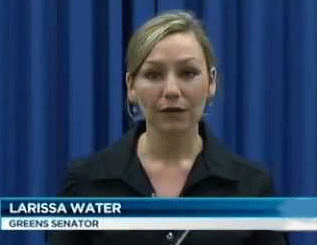 Climate deal won’t stop Great Barrier Reef from getting ‘cooked’, say Greens, Guardian, 23 Apr 16 Australia’s lack of action on pollution reduction targets has made the country a laughing stock on the international stage, according to senator Larissa Waters Australia’s lack of follow-through on climate change will leave the Great Barrier Reef “completely cooked” despite it signing the Paris climate deal, the Greens say…….
“Unfortunately, minister Hunt likes to bandy about some figures but Australia has been a laughing stock on the international stage,” she said.
“Our pollution reduction targets are so far below the science and people know that our policies aren’t even getting us towards those very low targets.”
Senator Waters rejected the government’s commitment of a further $11m on projects to continue improving water quality on the Great Barrier Reeffollowing a study this week showing 93% of the reef was bleached.
She pointed to the Queensland and federal government’s backing of the Adani coal mine, which critics say will further imperil the reef. “We need to really have a change of policy when it comes to approving every coal mine anyone ever thinks of and instead really fund and support the transition and speed it up to clean-energy,” Senator Waters said. http://www.theguardian.com/environment/2016/apr/23/climate-deal-wont-stop-great-barrier-reef-from-getting-cooked-say-greens
ANOTHER Liberal Senator doubts the science of climate change!
 Senator agrees climate science ‘not settled’ http://www.skynews.com.au/news/politics/federal/2016/04/21/senator-agrees-climate-science–not-settled-.html 21 April 2016 Deputy Nationals leader Fiona Nash has supported her coalition colleague Liberal Senator George Brandis’ view that the science on climate change is not settled.
Labor has condemned Senator Brandis after he told parliament he was not ‘at all’ convinced there is a scientific consensus about climate change.
‘It doesn’t seem to me that the science is settled at all,’ Senator Brandis said on Tuesday during debate on the tabling of documents relating to the Commonwealth Scientific and Industrial Research Organisation (CSIRO).
‘The commitment of Senator Brandis to addressing the impacts of climate change is so shallow, he hasn’t made up his mind whether it actually exists yet,’ environment spokesman Mark Butler and shadow attorney-general Mark Dreyfus said in a statement.
Senator Nash told Sky News she agrees there are ‘varying views’ between scientists on climate change..
‘I don’t think it is certainly necessarily settled,’ she said. ‘I think we should be taking every precaution that we ensure the planet is healthy.’
The NSW Senator says she was not sure whether her view on climate science was shared by her cabinet colleagues
‘I think you would have to ask the other cabinet ministers but it’s certainly my view.’
– See more at: http://www.skynews.com.au/news/politics/federal/2016/04/21/senator-agrees-climate-science–not-settled-.html#sthash.4k3e4pDd.dpuf– See more at: http://www.skynews.com.au/news/politics/federal/2016/04/21/senator-agrees-climate-science–not-settled-.html#sthash.4k3e4pDd.dpuf– See more at:http://www.skynews.com.au/news/politics/federal/2016/04/21/senator-agrees-climate-science–not-settled-.html#sthash.4k3e4pDd.dpuf
Australia to sell uranium to Ukraine? – insensitive timing, economic and security folly
For security reasons, Australia has suspended uranium sales to Russia. It seems extraordinary that Australia should now enter into a deal with even more unsafe and unstable Ukraine, in its present war and political crisis.
No doubt the federal parliament’s influential Joint Standing Committee on Treaties (JSCOT) will examine the planned deal, that Julie Bishop signed up to in New York with Ukrainian Energy and Coal Industry Minister Volodymyr Demchyshyn.
JSCOT recently warned against the agreement to sell uranium to India but its recommendations were ignored by the Coalition Government. Here’s hoping that there will be scrutiny on the Ukrainian agreement and that the government will pay attention.

Four big reasons not to sell uranium to Ukraine https://independentaustralia.net/environment/environment-display/fourbig-reasons-not-to-sell-uranium-to-ukraine,8895 Noel Wauchope 18 April 2016 As the 30th anniversary of the Chernobyl disaster approaches, Noel Wauchope outlines just a few compelling reasons why the Coalition Government’s uranium deal with Ukraine may have further disastrous consequences.
WHAT AMAZINGLY insensitive timing! As the anniversary of the Chernobyl nuclear catastrophe approaches, Australia makes a deal (at the Nuclear Security Summit) to sell uranium to Ukraine.
This is such a bad idea for so many reasons — it’s hard to know which to pick first!
Economics: simply because uranium exporting is not really economically worthwhile.
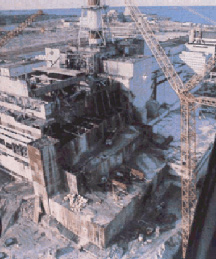 Chernobyl’s plight: because Ukraine’s Chernobyl radioactive disaster is continuing. (We supplied uranium for that other catastrophe — Fukushima.)
Insecurity: Ukraine’s dangerous nuclear industry due to civil war, ageing reactors, risks of smuggling and terrorism.
Political crisis: Ukraine’s notoriously corrupt and unstable political regime.
Let’s check those four reasons.
Economics
The global uranium industry is in a declining state. Price reporting companies describe repeated low and falling uranium prices. Australia’s uranium industry now accounts for 0.2 per cent of national export revenue — and that’s not counting profits that go overseas, due to the high degree of foreign ownership of companies mining uranium in Australia.
Chernobyl’s plight
Just where does South Australia’s Senator Nick Xenophon stand on nuclear waste importing?
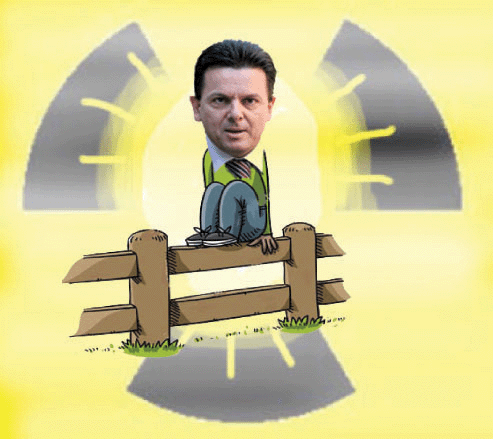
Nuclear caution vital, Port Lincoln Times, 18 Apr 16 ROAD funding, nuclear waste and drilling in the Great Australian Bight are among the issues on the agenda for recently announced candidate for Grey, Andrea Broadfoot.
Ms Broadfoot was last week announced as the Nick Xenophon Team’s candidate for the seat of Grey and said she hoped to make the safe Liberal seat marginal to attract the resources the region needed.
“We’re very committed in the community about getting out and talking to people and finding out what their issues are.”
Speaking in Port Lincoln on Thursday, Senator Nick Xenophon said Ms Broadfoot would give current member for Grey, Liberal Rowan Ramsey, a “run for his money”…….
Ms Broadfoot said the potential for a nuclear waste storage facility at one of three sites in South Australia was another issue she was concerned about.
She said the region needed to look at the long term impact on the perception of the region rather than the short term monetary gains that may be made.
“We need to be really cautious and careful about the decisions we make,” Ms Broadfoot said……..
She said the community was divided on the issue, with even the former Liberal member for Grey Barry Wakelin publicly coming out and saying Kimba was not the place for nuclear waste.
Mr Xenophon said it did not make sense to have a nuclear waste storage facility in a premium agriculture region……http://www.portlincolntimes.com.au/story/3855319/nuclear-caution-vital/?cs=1500
1 This month
17 October, Free Public Talk on Nuclear Issues in South Australia
David Noonan will speak on public interest concerns over the new Roxby Downs Indenture Act 2026 on BHP copper-uranium mining and ore processing in SA, and on how AUKUS may face SA with a High-Level nuclear waste agenda.
Dr Jim Green will discuss international developments in the field of nuclear power including ‘small modular reactors’ and Generation 4 ‘advanced’ nuclear reactor concepts.


Help Aunty Sue Protect Her Land and Sacred Sites From Destructive Rocket Testing.
.

Australians deserve the truth
about
AUKUS – https://aukuspublicinquiry.com/

PETITION – To: Prime Minister Anthony Albanese and the Australian Labor Government

of the week – Australians for War Powers Reform (AWPR)
To see nuclear-related stories in greater depth and intensity

