Family First Senator Bob Day pushing for nuclear submarines for Australia
Poor South Australia! I don’t know what it is about South Australia. Such a beautiful State,with an amazing and interesting history.
And – it’ s the State that can truly boast of success in renewable energy.
 Unfortunately, South Australia is also saddled with that white elephant – the uranium industry.
It is also the hub of pro-nuclear promotion. There are the nuclear propagandists like Barry Brook, the universities infiltrated by pro nuclear proponents like Prof Simons, and the pro nuke business groups – all promoted by BHP. (Below Adelaide pro nuke promoters of nuclear power)

Now we have Senator Bob Day urging the government to develop nuclear submarines, as a recent Family First media release (3/12/14)revealed
89% of Australians support Renewable Energy Target
Almost 90% of Australians support renewable energy target, says poll, Guardian, Lenore Taylor, political editor Tuesday 2 December WWF poll finds overwhelming support for RET, particularly in Victoria, South Australia and Tasmania, as senators consider deal. Almost 89% of Australians want the renewable energy target increased or kept the same, according to new polling designed to shore up Senate opposition to plans by the government and some crossbench senators to wind back the policy.
The polling found support for the policy – which requires that 41,000 gigawatt hours of electricity be sourced from renewables in 2020 – was even higher in Victoria, South Australia and Tasmania, the home states of crossbench senators Ricky Muir, Nick Xenophon and Jacqui Lambie who hold deciding votes on any attempt to push RET change through the Senate.
Commissioned by WWF, the Reachtel polling found a strong majority of voters in the three states thought it was “very important” for the federal government to invest in renewable energy (60% in South Australia and 62.4% in Victoria and Tasmania, compared with 59.8% nationally).
Talks between the Abbott government and the Labor opposition to find a bipartisan agreement on the RET have broken down and a “compromise” plancirculated by Liberal Democrat senator David Leyonhjelm is understood not to have the support of senators Bob Day, John Madigan and Jacqui Lambie.
The government had originally signalled it wanted very deep cuts to the target – and commissioned the businessman and self-professed climate sceptic Dick Warburton to undertake a review, which recommended it be slashed to about 16,000 gigawatt hours……..
The poll found very high support for the RET among swing voters – those considering changing their voting preference from 2013. Some 88% of those voters think the RET should be increased or stay the same and 64% of those considering a change in vote supported an increase to the RET, with only 12% supporting a decrease. And 62% were more likely to vote for a party that supports keeping or increasing the current RET.
“Cutting the RET makes no sense. It will see Australia’s carbon pollution go up, sustainable energy jobs lost and investment shut out. It’s also out of line with public sentiment which is clearly in favour of supporting growth in Australia’s renewable energy sector, including wind and solar,” said WWF spokeswoman Kellie Caught.
Polling has repeatedly found very strong voter support for renewables. Another recent poll by the Australia Institute found 64% of self-identified Liberal voters supported an increased target.
But the current impasse has seen investment dry up, and if it is not resolved, electricity retailers will run out of new renewable energy to buy to meet their legislated requirements – forcing them to pay a “penalty” price.
The Reachtel poll, conducted on 26 November, contacted 5,036 voters around Australia, including 1216 in Victoria, 934 in Tasmania and 873 in South Australia. http://www.theguardian.com/environment/2014/dec/02/almost-90-of-australians-support-renewable-energy-target-says-poll
Julie Bishop toes the Liberal Party line on nuclear power, climate, and renewable energy
View from the Street: Bishop goes nuclear, SMH November 30, 2014 Andrew P Street “………..Atomic! Meanwhile Foreign Minister and probable next Coalition PM Julie Bishop has come out in favour of nuclear energy.
“It’s an obvious conclusion that if you want to bring down your greenhouse gas emissions dramatically you have to embrace a form of low or zero-emissions energy and that’s nuclear, the only known 24/7 baseload power supply with zero emissions,” she said, in a statement that no-one especially asked for and that seems timed principally to give people something to talk about other than the Victorian election.
Now, nuclear power doesn’t emit greenhouse gases. It does, however, produce a lot of waste that’s incredibly radioactive – uranium, plutonium, neptunium, californium – and we have zero idea of how to store it aside from “bury it and walk away”.
Nuclear waste dumps are not unreasonably considered one of those things that absolutely everybody wants nowhere near them, making them a political nightmare.
And while things don’t generally go wrong in nuclear plants, those rare accidents tend to beome major disasters – as Fukushima and Chernobyl discovered to their considerable cost.
However, there’s another more immediate, practical reason why nuclear isn’t a likely alternative for Australia: our energy industry now almost entirely consists of private companies, who are not going to build nuclear reactors.
See, nuclear power plants take a long time to build. Depending on the design, construction takes between four and eight years, followed by six-to-twelve months of testing before it actually starts generating electricity. By comparison, building a wind farm takes six months.
As a result reactors are also extraordinarily expensive and typically take decades to turn a profit. AGL’s shareholders are very unlikely to back the company building something that won’t provide any return until most of them are dead.
So it’s not seriously going to happen in Australia. But there’s another issue in there.
Let’s look at that “baseload power” thing
The question of baseload revolves around the fact that people need power all the time including when there’s no sun or wind. Thanks a bunch, nature.
While this sounds at first blush like an insurmountable issue and is inevitably raised by people condescendingly dismissing renewable energy, it’s not that big an issue – and in fact the problem has already been solved.
Mark Diesendorf and colleagues at the University of NSW did a comprehensive study of Australia’s electricity demand and discovered that “It turns out that wind and solar photovoltaic are only unable to meet electricity demand a few times a year… Since the gaps are few in number and none exceeds two hours in duration, there only needs to be a small amount of generation from the so-called flexible renewables: hydro and biofuelled gas turbines. Concentrated solar thermal is also flexible while it has energy in its thermal storage.”
Then again, Bishop’s staying on message. After all, talking up nuclear energy is a great option if you want to move your political party away from your denialist position on climate change while still supporting the mining industry, doing nothing about reducing emissions, and keeping the conversation away from solar and wind.
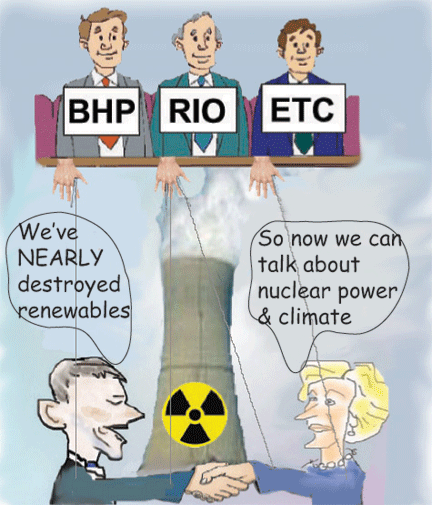
So: expect the Coalition to be banging on about it for the foreseeable.
The cocktail hour: cities in dust
Speaking of Chernobyl, CBS cameraman Danny Cooke posted video he shot of the abandoned city of Pripyat mere days ago.
It’s haunting stuff – especially his sweeping drone shots – and it’s a timely reminder of what nuclear energy can cost. That’s an entire city falling to ruin, right there. http://www.smh.com.au/comment/view-from-the-street/view-from-the-street-bishop-goes-nuclear-20141130-11x4ns.html
Some people welcome Julie Bishop’s nuclear power push. Most want more renewable energy
Julie Bishop’s calls for nuclear power debate welcomed, SMH December 1, 2014 Lisa Cox National political reporter “………Environment Minister Greg Hunt said on Sunday that although nuclear power was not Coalition policy, he was supportive of a debate but any shift would require bipartisan support………
new polling for the clean energy industry showed voters want Australia to adopt more ambitious policies for renewable energy.
A survey of 1442 people commissioned by Solar Citizens, and conducted by the Australian Institute, found 76 per cent of people were either supportive or very supportive of increasing Australia’s renewable energy target, rather than scaling it back.
Thirty-five per cent favoured increasing the target to 50 per cent by 2030, while a further 30 per cent wanted a target greater than 50 per cent by 2030. http://www.smh.com.au/federal-politics/political-news/julie-bishops-calls-for-nuclear-power-debate-welcomed-20141130-11x4pl.html
Julie Bishop goes for nuclear power, as Ziggy Switkowski hedges his bets
But he [Dr Ziggy Switkowski] agreed that if there were improvements in wind and solar technology over the next two decades to make them more reliable around the clock, renewable energy sources could be more viable than nuclear.
Julie Bishop reopens nuclear debate as route to cut carbon dioxide emissions, SMH, November 30, 2014 Latika Bourke Foreign Minister Julie Bishop says nuclear energy remains an option for Australia, describing it as an “obvious direction” as it considers how to cut carbon dioxide emissions after 2020.
Ms Bishop called for a an open discussion about the feasibility of nuclear power, given Australia’s abundance of uranium, but accused Labor of resorting to a scare campaign when the issue was raised during the Howard government years
……….Ms Bishop flies to Lima, Peru, in just over a week to attend the annual United Nations climate conference, where Australia will face pressure to announce its climate targets for beyond 2020 and it’s understood the Prime Minster has personally requested Trade Minister Andrew Robb chaperone Ms Bishop so he can factor in the economic impacts of any new targets Australia considers. Continue reading
The irrationality of Senator David Leyonhjelm’s plan for renewable energy in Australia
 The new conservative plan to shut down renewable energy, REneweconomy, By Giles Parkinson on 26 November 2014 More details have emerged about the plan hatched by a group of conservative cross-bench Senators to dramatically reduce the amount of new renewable energy projects to be built in Australia over the next five years, and to deliver a windfall subsidy to old hydro electric plants.
The plan outlined by libertarian (low taxes, minimal government) Senator David Leyonhjelm essentially delivers on the Coalition plan to limit new build renewables to around 26,000GWh, but has the bizarre inclusion of handing subsidies earmarked for new projects to state-owned hydro plants that were built decades ago.
The renewable energy industry has reacted with horror. The Clean Energy Council said it would result in a transfer of nearly $14 billion of wealth to those plants, remove more than $14 billion from new development, causing new projects to remain at a standstill and put 18,000 jobs at risk. (See its list below)
The proposal was described by The Australia Institute as a “shocker” and by the Australian Wind Alliance as “hair-bained” and “madness”. All agreed it would be worse than even what the controversial Waburton Review proposed. It is truly absurd. But what is really unsettling for the industry – and anyone who cares about the development of renewable energy in Australia – is how similar the policy is to what the ruling Coalition is proposing.
Now, while it seems preposterous that the Coalition would ever allow renewable energy certificates to be pocketed by the hydro operators (over and above the baseline currently in place), nothing can be ruled out from this government.
But it’s really just about mixing numbers to get to the same answer, and right now it seems that that answer is 51,000GWh – what the conservative side says is equivalent to a “real” 20 per cent of the revised demand forecast by 2020. They just propose different routes to get there, although the impact on the renewable energy industry would be equally devastating………………..
the Coalition doesn’t care. It’s mission is quite clearly to reduce the “new build” component of the RET to the 26,000GWh suggested by Warburton and endorsed by Macfarlane, Hunt and Abbott.
If it can do that with support of the cross-benchers, then that is exactly what it will do. Already, the idea has the stated support of John Madigan and Bob Day, Jacquie Lambie seems interested, Nick Xenophon will support anything that kills the wind industry, and even Clive Palmer – as we discussed in our article Can Palmer be tusted to defend the RET” – has made similar noises about pre-existing hydro.
Leyonhjelm’s ridiculous proposal will just be a smoke-screen for what is really on the agenda as confirmed by the support of the Coalition and many of these cross-benchers, including the Motorist Party’s Ricky Muir – of yet another investigation into wind energy and its economic impact.
The CEC described that “farcial” move – approved by the Senate on Monday – as “groundhog day”. It will be the 9th such inquiry – and all have so far supported the case for wind energy.
Here is the CEC’s list of reasons why the Leyonhjelm’s scheme is madness:
- Supporting existing hydro at the expense of new renewable energy. This proposal would provide additional support to existing hydro generation, reducing the amount of new renewable energy generation needed by over 60 per cent, from 25,000 Gigawatt-hours (GWh) to just over 9,000 GWh. This scale of reduction would have a devastating impact on existing market participants, while the flaws in this approach would likely undermine any new investment.
- Transfer of $13.5 billion to existing hydro operations. It would lead to a massive wealth transfer to existing hydro generation, at the expense of new renewable energy, worth more than $900 million per year, or $13.5 billion between now and 2030 when the policy ends. Almost 60 per cent of this would flow directly to Tasmania.
- Loss of broader economic benefits. The benefits of investment in new large-scale renewable energy would be lost. This includes the $14.5 billion of expected investment and thousands of new jobs in rural and regional parts of Australia.
- Loss of carbon abatement benefits. The new investment delivered by the current RET is expected to deliver carbon reductions of 194 megatonnes of carbon by 2030. If the policy was altered as proposed, taxpayers would need to fund additional measures through the Direct Action policy to replace this abatement.
- Higher power prices for consumers. A reduction in new electricity supply and competition in the wholesale electricity market would lead to higher power prices for consumers. The benefit of new renewable energy investment on power prices was demonstrated by the ACIL Allen modelling for the recent Warburton Review, which showed that any scenario which led to less renewable energy also led to higher power prices.
- Hydro power is already supported by the RET. Hydro is already eligible under the RET, where it generates above a pre-determined baseline. This provides an incentive for the maintenance and upgrade of existing hydro generation, and has provided revenue to Australia’s existing hydro power generators over the life of the policy. http://reneweconomy.com.au/2014/the-new-conservative-plan-to-shut-down-renewable-energy-96690
Who got to Jacqui Lambie- to get her to support Abbott’s trashing of renewable energy?
 Christina Macpherson, 26 Nov 14 What has happened to our democracy when a truly not representative person like Jacqui Lambie can get the power to sabotage Australia’s renewable energy programme?
Jacqui Lambie, a failed trier for the Liberal party in Tasmania, was picked up as a member for Clive Palmer’s Palmer United Party, and was elected to the Senate in 2013.
Jacqui Lambie got only 1501 first preference votes
 She got in through (a) her membership of the Clive Palmer push, and (b) on a horde of preferences from other parties, – in the disgusting and undemocratic shemozzle of preference deals.
The PUP’s Jacqui won the seat – just short of the vote of the sex industry’s Eros Foundation. All fine and dandy. The PUP pledged to vote for keeping the Renewable Energy Target.
Now we find Jacqui Lambie potentially in a position of great power – she can do deals with Tiny Abbott – ostensibly to support soldiers’ wages and conditions. All very good. I want the soldiers to have fair wages and conditions too.
But at what price? And – Jacqui’s not over-burdened with ideas of her own – who is putting the pressure on her?
Senator Jacqui Lambie’s turnabout on Renewable Energy
Jacqui Lambie gets on with push for Defence pay rise STEVEN SCOTT THE COURIER-MAIL NOVEMBER 25, JACQUI Lambie has begun negotiating with the government to wind back the Renewable Energy Target and cut funding for the Clean Energy Finance Corporation if it offers some increase in Defence pay.
Within hours of cutting ties with the Palmer United Party, Senator Lambie held talks with Environment Minister Greg Hunt about backing government bills in return for doubling the Defence pay rise to 3 per cent.
Senator Lambie’s willingness to talk – despite vowing to oppose all bills until Defence pay was increased – has given the government hope it could benefit from the collapse of Clive Palmer’s influence in the Senate……
She also voted with the government in support of an inquiry into wind farms that was proposed by Liberal Democrat David Leyonhjelm…..http://www.couriermail.com.au/news/queensland/jacqui-lambie-gets-on-with-push-for-defence-pay-rise/story-fnn8dlfs-1227133566044
Victorian election: Labor will re-introduce emissions reduction target, and promote wind and solar energy
 Victoria election 2014: Labor promises to reintroduce emissions reduction target ABC News, 25 Nov 14 Victoria’s Opposition has promised to reintroduce a state-based emissions reduction target if it is elected on Saturday.
The pledge is part of of the state Labor’s newly-released environmental platform.
The Opposition said it would bring back the target, which was introduced in by Labor in 2006 before being wound back in 2009 after the federal renewable energy target was extended.
The Victorian Coalition Government removed the state’s target of 20 per cent by 2020 from the Climate Change Act in 2012
A report by the Climate Council released earlier this month found that Victoria and New South Wales had the worst approach to renewable energy in the country.
Labor environment spokeswoman Lisa Neville said she wanted Victoria to play a leading role in tackling climate change…….
Ms Neville said Labor would also establish a $20 million fund to encourage investment in renewables.”[The fund] will co-invest with the private sector to drive wind and solar energy, and new technologies,” she said.
“We’ve also said that we’ll use the planning laws to actually encourage and promote renewable energies like wind farms in Victoria.”……..http://www.abc.net.au/news/2014-11-26/victorian-labor-to-reintroduce-renewable-energy-target/5918118
Nuclear power is in Australian govt’s Energy Green Paper, but no real enthusiasm for it
Nuclear power still some way off for Australia Financial Review, 24 Nov 14 JOANNA MATHER “…….Nuclear rated a brief mention in the energy green paper released by the federal government in September. “Nuclear energy remains a serious consideration for future low emissions energy,” the paper says.
But it would be a mistake to view this as a sign of any real appetite within the government to progress the issue, says Ken Baldwin, director of the Energy Change Institute at the Australian National University.
“White papers always list the options available to the country,” he says. “Nuclear is in the mix but that doesn’t mean it is being given particular significance in the white paper.”…..
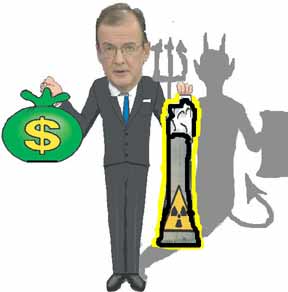 Former Telstra boss Ziggy Switkowski, who headed a review of nuclear’s potential during the Howard years, believes Australia is forfeiting a great opportunity………
Switkowski says falling demand for electricity in Australia and intractably adverse community attitudes “will see the window for nuclear power begin to close”.
At present, legislation prevents the development of an Australian domestic nuclear energy industry. Removing legislative barriers to Australia using nuclear power for electricity, when there is an economic case for its deployment, would include amending the Australian Radiation Protection and Nuclear Safety Act 1998 and the Environment Protection and Biodiversity Conservation Act to allow construction or operation of nuclear fuel plants.
The green paper commits the government to reviewing the regulatory framework that governs nuclear and waste facilities to remove any duplication and streamline regulations…
Cheerful Tony Abbott warns on a hot summer coming (nothing to do with climate change)
 Summer’s hot, get used to it, says Tony Abbott THE AUSTRALIAN AAP NOVEMBER 22, 2014
TONY Abbott today warned of a long, hot summer as he opened a Sydney swimming pool, but steered clear of mentioning climate change.
 “It’s going to be a hot summer,” he said at the Hornsby Aquatic Centre. But the Prime Minister was quick to add: “How many Australian summers are not hot summers?”
His comments came as Sydneysiders braced for high temperatures tomorrow with the city expected to reach 35C and up to 40C forecast in the west…….
Mr Abbott’s comments about the hot summer also came after Foreign Minister Julie Bishop challenged US President Barack Obama over a climate change speech he made on the sidelines of the G20 summit in Brisbane. http://www.theaustralian.com.au/news/nation/summers-hot-get-used-to-it-says-tony-abbott/story-e6frg6nf-1227131724609
Australia’s Future Fund invests in nuclear weapons development and our banks are happy to provide capital as well.

The protesters were drawing attention to the fact that the federal government’s $101 billion Future Fund invests more than $260 million in foreign companies involved in the manufacture of nuclear weapons (and that figure has increased by $33 million since last June)…….. Continue reading
Julie Bishop contradicted by scientists, on her claim about the Great Barrier Reef
Great Barrier Reef will be ‘slaughtered’: scientists dismiss Julie Bishop’s claim reef not at risk November 21, 2014 – 3:59PM Peter Hannam Environment Editor, The Sydney Morning Herald World-leading scientists say the Great Barrier Reef will be “slaughtered” this century as seas warm and become more acidic, dismissing comments by Foreign Affairs Minister Julie Bishop that Australia’s natural icon was not at risk.
Ms Bishop told Sky News on Friday her office had sent the White House a briefing outlining the Australia’s efforts to preserve the reef after US President Barack Obama’s warning in Brisbane last weekend that its “incredible natural glory” was threatened by climate change.
“Of course, the Great Barrier Reef will be conserved for generations to come. And we do not believe that it is in danger,” Ms Bishop said……….
on Brodie, a chief research scientist from James Cook University, said Ms Bishop’s comments contradicted the government’s own report on the state of the reef.
The Great Barrier Reef Outlook Report 2014 “found the reef to be in poor condition and the outlook is for continuing deterioration,” Dr Brodie said. “It’s obviously in danger.”
“Climate change remains the most serious threat to the Great Barrier Reef and is likely to have far-reaching consequences in the decades to come,” the report said. http://www.smh.com.au/environment/climate-change/great-barrier-reef-will-be-slaughtered-scientists-dismiss-julie-bishops-claim-reef-not-at-risk-20141121-11r4a6.html#ixzz3JluffhbH
Tony Abbott and Campbell Newman cannot be trusted about the true economics of coal
Will Abbott and Newman show us their coal portfolios? Will they hold their investments until 2020? olddogthoughts November 16, 2014 Standing up for coal – Abbott and Newman give investment advice November 16, 2014 by: Kaye Lee
Tony Abbott has told a G20 leaders’ discussion on energy he was “standing up for coal” as the Queensland government prepares to unveil new infrastructure spending to help the development of Australia’s largest coal mine.Abbott, who recently said coal was “good for humanity”, also endorsed the mine, proposed by the Indian company Adani, to the meeting.
The Australian government has given all environmental and regulatory clearances for the $7.5 billion coal mining, rail and port project, said Gautam Adani, chairman, Adani Group, in an interview to The Indian Express.
And Campbell Newman is happy to put your money where his mouth is. “We are prepared to invest in core, common-user infrastructure,” Mr Newman said. “The role of government is to make targeted investments to get something going and exit in a few years’ time.”
Despite poor market conditions, high costs and the massive outpouring of concern over the environmental impacts of their projects, Indian companies GVK and Adani remain hell-bent on opening up the Galilee Basin in Queensland. The smallest mine is as large as Australia’s biggest operating coal mine and the largest, twice the size. All of the proposals in the Galilee Basin would produce enough coal to chew up 7% of the world’s remaining carbon budget, drastically reducing our chances of keeping a lid on global warming.
Adani and fellow Indian company GVK are pushing their projects and Adani wants to start construction early next year, but the key problem is access to funds.
Few banks are willing to lend when coal prices are so low and the industry is facing issues with climate change.
There are also issues with both companies………………….. Continue reading
Australia’s deadlock over Renewable Energy Target *RET)
RET fate deadlocked, Stock & Land DANNIKA BONSER 13 Nov, 2014 AUSTRALIA’S future in sustainable energy is on shaky ground as the federal government remains in a stand-off with Labor over proposed cuts to the Renewable Energy Target (RET).
The Abbott government is pushing to slash the RET from 41 terawatt hours per year by 2030 to 26tW hours/year but needs support from Labor or the Palmer United Party to get the change through the Senate.
Labor was willing to bargain the RET down slightly but walked away from talks with cabinet ministers after a compromise could not be reached. Continue reading
1 This month
Chernobyl: The Lost Tapes – A good documentary on Chernobyl on SBS available On Demand for the next 3 weeks– https://www.sbs.com.au/ondemand/tv-program/chernobyl-the-lost-tapes/2352741955560
15 April – Zoom –Nuclear Power is Not the Solution
Apr 15, 2026 01:00 AM in Canberra, Melbourne, Sydney

Join the International Physicians for the Prevention of Nuclear War (IPPNW) on Tuesday, April 14th for a timely webinar exploring the risks associated with nuclear power and challenging the myth that it offers a simple, safe, carbon-free solution to the climate crisis

21 April Webinar: No Nuclear Weapons in Australia
Start: 2026-04-21 18:00:00 UTC Canberra, Melbourne, Sydney (GMT+10:00)
End: 2026-04-21 19:30:00 UTC Canberra, Melbourne, Sydney (GMT+10:00)
Event Type: Virtual
A virtual link will be communicated before the event.
Host Contact Info: australia@icanw.org

of the week – Australians for War Powers Reform (AWPR)
To see nuclear-related stories in greater depth and intensity
 Antinuclear