In Australia Nuclear interests trump aboriginal rights
The nuclear war against Australia’s Aboriginal people, Ecologist Jim Green 14th July 2014 Nuclear war“……….Muckaty Traditional Owners have won a significant battle for country and culture, but the problems and patterns of radioactive racism persist. Racism in the uranium mining industry involves: ignoring the concerns of Traditional Owners; divide-and-rule tactics; radioactive ransom; ‘humbugging’ Traditional Owners (exerting persistent, unwanted pressure); providing Traditional Owners with false information; and threats, including legal threats.
One example concerns the 1982 South Australian Roxby Downs Indenture Act, which sets the legal framework for the operation of BHP Billiton’s Olympic Dam uranium mine in SA.
The Act was amended in 2011 but it retains exemptions from the SA Aboriginal Heritage Act. Traditional Owners were not even consulted. The SA government’s spokesperson in Parliament said:
“BHP were satisfied with the current arrangements and insisted on the continuation of these arrangements, and the government did not consult further than that.”
That disgraceful performance illustrates a broader pattern. Aboriginal land rights and heritage protections are feeble at the best of times. But the legal rights and protections are repeatedly stripped away whenever they get in the way of nuclear or mining interests.
Nuclear interests trump aboriginal rights
Thus the Olympic Dam mine is largely exempt from the SA Aboriginal Heritage Act. Sub-section 40(6) of the Commonwealth’s Aboriginal Land Rights Act exempts the Ranger uranium mine in the NT from the Act and thus removed the right of veto that Mirarr Traditional Owners would otherwise have enjoyed.
New South Wales legislation exempts uranium mines from provisions of the NSW Aboriginal Land Rights Act. The Western Australian government is in the process ofgutting the WA Aboriginal Heritage Act 1972 at the behest of the mining industry.
Native Title rights were extinguished with the stroke of a pen to seize land for a radioactive waste dump in SA, and Aboriginal heritage laws and land rights were repeatedly overridden with the push to dump nuclear waste in the NT.
Most of those laws are supported by the Liberal / National Coalition and Labor. Radioactive racism in Australia enjoys bipartisan support.
Muckaty Traditional Owners have won a famous victory, but the nuclear war against Aboriginal people continues – and it will continue to be resisted, with the Aboriginal-ledAustralian Nuclear Free Alliance playing a leading role Jim Green is the national nuclear campaigner with Friends of the Earth, Australia, and editor of Nuclear Monitor.
Nuclear Monitor has been publishing deeply researched, often strongly critical articles on all aspects of the nuclear cycle since 1978. A must-read for all those who work on this issue! http://www.wiseinternational.org/node/36 http://www.theecologist.org/News/news_analysis/2476704/the_nuclear_war_against_australias_aboriginal_people.html
Regulators to decide on Cameco’s Kintyre uranium mine, but not economically viable now
Cameco: Australia Regulator to Rule on Uranium Mine Within Weeks By Stephen Bell Capiyal Gr. 16 July 14 PERTH-–Canada’s Cameco Corp. (CCJ) expects Australian regulators to decide on its proposed Kintyre uranium mine within weeks, but will likely delay construction after prices of the nuclear fuel slumped to nine-year lows.
Brian Reilly, managing director of Cameco Australia, said Wednesday he expects Western Australia state’s Environmental Protection Authority to release a report into the project soon.
“The EPA is sitting on the report and recommendations–we anticipate seeing that released publicly within the next few weeks,” Mr Reilly told The Wall Street Journal on the sidelines of a uranium conference in Perth.
The regulator will make a recommendation to state and federal ministers, who will then make a final decision on whether the project can go ahead.
Mr. Reilly said Cameco hopes to “be in a position by the end of this year to have this project approved.”
However, Cameco would need uranium prices to recover sharply before starting construction of the mine. It would also look to discover more uranium reserves at the mine site.
In mid-2012, Cameco deferred development of Kintyre due to a collapse in the uranium price in the wake of the Fukushima nuclear accident in Japan. At the time, Cameco said the project likely wouldn’t be viable if uranium prices fell below US$67 a pound.
Spot uranium prices are currently around US$28 a pound because of a slower-than expected restart of Japanese nuclear reactors idled soon after the Fukushima crisis. There has also been a build-up in global uranium inventories as nuclear facilities recycle more fuel……http://english.capital.gr/News.asp?id=2064849
Tony Abbott was elected to destroy action on climate change
History will condemn climate change denialists Robert Manne theguardian.com, Wednesday 16 July 2014
Tony Abbott was elected by the right-wing of his party for a single purpose: to destroy any meaningful action in Australia against the threat of climate change ……..

Climate change denialism soon spread beyond the US, especially to the countries of the English-speaking world. As Australia is a country extremely sensitive to the cultural winds blowing in from the US, reliant on the export and consumption of coal, and where the denialist Murdoch newspapers exercise enormous unhealthy influence, it is hardly surprising that over the past decade climate change denialism quickly sunk deep roots here.
The impact was seen in late 2009 with the coup inside the Liberal party which replaced Malcolm Turnbull, a rational believer in climate science, by a complacent opportunist, Tony Abbott, who regarded and still regards climate science as “crap”. The anti-Turnbull coup represents the most critical moment in the recent history of Australia. Abbott was elected by the right-wing of his party for a single purpose: to destroy any meaningful action in Australia against the threat of climate change. When the carbon tax is repealed, the leaders of the coup and the fossil fuel interests they represent will receive from a dutiful prime minister their anticipated reward.
The right-wing denialists, now dominant within the Coalition, often call themselves conservatives. They are not. At the heart of true conservatism is the belief that each new generation forms the vital bridge between past and future, and is charged with the responsibility of passing the earth and its cultural treasures to their children and grandchildren in sound order. History will condemn the climate change denialists, here and elsewhere, for their contribution to the coming catastrophe that their cupidity, their arrogance, their myopia and their selfishness have bequeathed to the young and the generations still unborn. http://www.theguardian.com/commentisfree/2014/jul/16/history-will-condemn-climate-change-denialists
Former Liberal leader supports Renewable Energy Target
Liberal veteran Hewson backs Renewable Energy Target, Sunshine Coast Daily Daniel Burdon | 11th Jul 2014 A FORMER Liberal Party leader has urged the Abbott government not just to retain the renewable energy target, but increase it to ensure carbon emissions can be curbed.
 But Dr Hewson said the RET, likely the only specific target for reducing Australia’s emissions left once the carbon tax is removed, is doing the job. He said while the RET and other climate change policies could help to reduce emissions, in less than a week, Australia could be without any overarching policy on climate change………http://www.sunshinecoastdaily.com.au/news/former-liberal-party-john-hewson-renewable/2315456/
Radioactive racism, the war to dump nuclear waste on Aboriglnal land in Australia

legal rights and protections are repeatedly stripped away whenever they get in the way of nuclear or mining interests. Thus the Olympic Dam mine is largely exempt from the SA Aboriginal Heritage Act. Sub-section 40(6) of the Commonwealth’s Aboriginal Land Rights Act exempts the Ranger uranium mine in the NT from the Act and thus removed the right of veto that Mirarr Traditional Owners would otherwise have enjoyed. NSW legislationexempts uranium mines from provisions of the NSW Aboriginal Land Rights Act. Native Title rights were extinguished with the stroke of a pen to seize land for a radioactive waste dump in SA, and Aboriginal heritage laws and land rights were repeatedly overridden with the push to dump nuclear waste in the NT
The bipartisan nuclear war against Aboriginal people, Dr Jim Green, Online opinion 11 July 14 The nuclear industry has been responsible for some of the crudest racism in Australia’s history. This radioactive racism dates from the British bomb tests in the 1950s and it has been evident in more recent debates over nuclear waste.
 Since 2006 successive federal governments have been attempting to establish a nuclear waste dump at Muckaty, 110 kms north of Tennant Creek in the Northern Territory. A toxic trade-off of basic services for a radioactive waste dump has been part of this story from the start. The nomination of the Muckaty site was made with the promise of $12 million compensation package comprising roads, houses and scholarships. Muckaty Traditional Owner Kylie Sambo objected to this radioactive ransom: “I think that is a very, very stupid idea for us to sell our land to get better education and scholarships. As an Australian we should be already entitled to that.”
While a small group of Traditional Owners supported the dump, a large majority were opposed and some initiated legal action in the Federal Court challenging the nomination of the Muckaty site by the federal government and the Northern Land Council (NLC). Continue reading
Australia’s fossil fuel front groups “tax deductible gift recipients” !
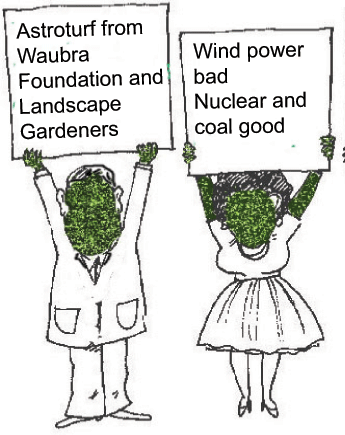 The IPA and Waubra Foundation’s charitable tax status rorts Independent Australia Sandi Keane 8 July 2014 Why do corporate lobby groups like the IPA and fossil fuel front organisations like the Waubra Foundation retain ‘deductible gift recipient’ status, while genuine environmental charities like the Australian Conservation Foundation face having theirs stripped away by the Abbott Government.Sandi Keane investigates.
FOR AN ORGANISATION that has been touting ‘low taxes‘ for sixty years, the Institute of Public Affairs (IPA) sure delivers big on tax benefits to its major donors, especially Big Mining — which is already heavily subsidised by Australia’s taxpayers (note graphic below right).
Some, like Glencore, not only enjoy such subsidies but have no qualms about paying zero tax. These are the true “leaners” we tax-payers have to “lift”, as this article will show……….
Fortunately, Sourcewatch has done significant work into the IPA’s funding and relates the following:
The IPA has heavily relied on funding from a small number of conservative corporations. Those funders disclosed by the IPA to journalists and media organisations include:
- Major mining companies – BHP-Billiton and Western Mining Corporation;
- Pesticides/Genetically modified organisms: Monsanto;
- A range of other companies including communications company Telstra, Clough Engineering, Visy, and News Limited;
- Tobacco companies – Philip Morris (Nahan) and British American Tobacco
- Oil and gas companies: Caltex, Esso Australia (a subsidiary of Exxon) and Shell and Woodside Petroleum; and fifteen major companies in the electricity industry;
- Forestry: Gunns, the largest logging company in Tasmania;
- Murray Irrigation Ltd …
In 2003, the Australian [Howard] Government paid $50,000 to the Institute of Public Affairs to review the accountability of NGOs.

The latest truly breathtaking rort is tax deductibility for donations to fund the new IPA-promoted misinformation manual, Climate Change: The Facts 2014. Like previous books, it attacks climate science, carbon pricing and renewable energy targets……….http://www.independentaustralia.net/environment/environment-display/the-ipa-and-waubra-foundations-charitable-tax-status-rorts,6649
New Senator Ricky Muir out to save Australian Renewable Energy Agency (Arena) from theAbbott axe
 Ricky Muir seeking to save the Australian Renewable Energy Agency Lenore Taylor, political editor theguardian.com, Tuesday 8 July 2014 Senator is seeking to amend the carbon tax repeal bills to stop $435m in funding being stripped from the clean energy body Motoring Enthusiast senator Ricky Muir has emerged as a surprise would-be saviour of the $2bn Australian Renewable Energy Agency (Arena), seeking to amend the carbon tax repeal bills to stop $435m in funding being stripped from the clean energy body and promising to try to stop its abolition.
Muir’s amendment is very similar to one already circulated by the Australian Greens, and seeks to stop immediate funding reductions for Arena, which the government is seeking to abolish with separate legislation to be voted on in September.
The move raises the possibility that the crossbench could frustrate the government’s intention to abolish Arena. Palmer United party senators have already promised to stop the government’s plan to abolish the Clean Energy Finance Corporation and the existing renewable energy target.
But the government is already seeking to effectively close Arena ahead of legislation passing, refusing to reappoint board members as their terms expire. The government wants to return $1.3bn in Arena funding to the budget, and then have the industry department oversee around $900m in funding deals that have already been struck.
Muir’s amendment would stop the immediate $435m funding cut announced by the Coalition last September, but a spokesman for the Victorian senator said it was the first step in an attempt to retain the body.
“Ricky wants to preserve Arena. He is in favour of renewable energy and he thinks it is doing great work,” the spokesman said. Muir’s intervention comes as the Senate prepares to pass the package of bills repealing the carbon tax on Wednesday or Thursday, with the backing of the three Palmer United party senators and others on the new crossbench.
PUP’s Senate leader, Glenn Lazarus, introduced PUP’s only amendment to the main carbon tax repeal bills on Tuesday, reversing the onus of proof so that power retailers must show they have passed on cost savings to households.
As previously reported by Guardian Australia, PUP is also finalising amendments to legislate its dormant ETS, which it has announced will be part of the bill to repeal the climate change authority.
PUP has said its amendments will retain the CCA to advise governments on when a set of conditions are met to activate the Australian ETS. The negotiations are about exactly what actions will be required by trading partners the United States, the European Union, South Korea, Japan and China for the Australian ETS to be enacted.
At times PUP leader Clive Palmer has referred to the other countries having to have an ETS, but another proposal is that they would need to have an “effective” carbon price at a certain level, meaning they might be achieving significant greenhouse gas reductions through different policies.
The uncertainty about the amendment means the Climate Change Authority Repeal Bill will be considered separately to the rest of the carbon tax repeal legislation. It is unclear whether the government is considering the amendment.
Introducing the PUP’s power pricing amendments, Lazarus said the Australian ETS would occur “if the day comes when our American trading partners, the US, China, the EU, Japan and Korea set up an emissions trading scheme.”
Lazarus said the carbon tax repeal was “historic”.
It is understood the PUP senators and independent senator Nick Xenophon and DLP senator John Madigan are still considering how they will vote on the legislation to repeal Arena, but may back the Greens and Muir and refuse to allow its abolition.http://www.theguardian.com/world/2014/jul/08/ricky-muir-seeking-to-save-the-australian-renewable-energy-agency?cmp=wp-plugin
Warren Mundine ‘raises his eyebrows’, but Nova Peris speaks out, on Tony Abbott racist gaffe
 Nova Peris attacks Tony Abbott over ‘unsettled’ land THE AUSTRALIAN JULY 05, 2014 Patricia Karvelas LABOR senator Nova Peris has condemned Tony Abbott for suggesting Australia was unsettled before British occupation.
And Mr Abbott’s chief indigenous adviser [Warren Mundine] admits he “raised his eyebrows” 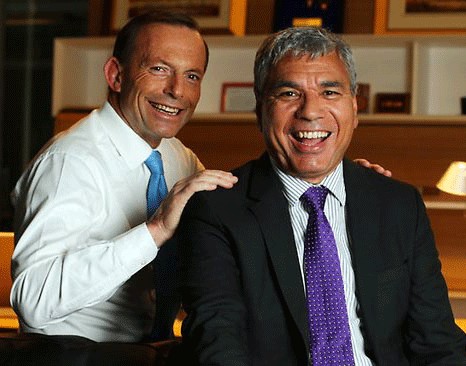 when the Prime Minister said we had all benefited from Britain’s original foreign investment because Australia was “unsettled” before the British arrived.
After delivering the keynote address at the Economic and Social Outlook conference on Thursday night, Mr Abbott was asked about foreign investment, but his answer suggesting people were not in Australia in 1788 sparked a backlash.
Senator Peris said the comments were highly offensive, dismissive of indigenous peoples and simply incorrect.
“British settlement was not foreign investment. It was occupation,’’ she said. “The comments from the Prime Minister have not just offended Aboriginal Australians but many people around the country.” Senator Peris said Mr Abbott’s comments had setback bipartisan efforts to recognise Aboriginal and Torres Strait Islander people in the Constitution……http://www.theaustralian.com.au/national-affairs/policy/nova-peris-attacks-tony-abbott-over-unsettled-land/story-fn9hm1pm-1226978303770
Palmer and Gore have saved Australia’s important renewable energy projects
Australia Institute director says Gore-Palmer ploy reset climate debate http://www.theguardian.com/environment/2014/jul/01/australia-institute-director-says-gore-palmer-ploy-reset-climate-debateFormer Greens staffer Ben Oquist, one of those who brought the two men together, said the move was a step forward The Australia Institute has defended its role in negotiating the Clive Palmer-Al Gore climate announcement because the concessions made by the Palmer United party had “avoided a big step backwards” and reset the climate debate in Australia.
In an email to supporters, the thinktank’s strategic director and former Greens staffer, Ben Oquist, one of a number of people involved in bringing Gore and Palmer together, defended the move as a step forward, despite PUP’s unchanged resolve to repeal Australia’s carbon pricing scheme after the Senate resumes next week.
PUP will now use its balance of power votes in the Senate to retain the Clean Energy Finance Corporation, the Climate Change Authority and the renewable energy target.
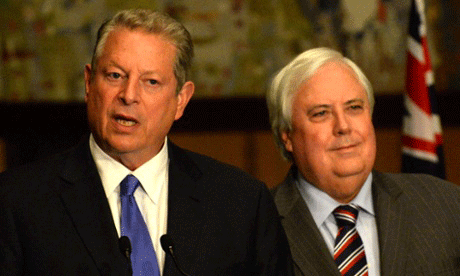
“Six months ago it seemed certain that the Abbott government would succeed in its plan to scrap the RET, the CEFC and the CCA,” Oquist wrote.
“[The institute’s] research has long shown that the RET has been the key mechanism driving investment in clean energy production … It has had more impact than the carbon price at zero cost to the government. Billions of dollars in investment was being put at risk by the Abbott government’s determination to unwind the scheme.
“The Palmer-Gore announcement has reset climate policy and politics. Keeping the CCA, the RET and the CEFC is much more than most expected from PUP. We have avoided a big step backwards … [it] also reframed the debate about carbon pricing – it’s hard to suggest carbon pricing is some form of left-wing, economy-wrecking conspiracy when a billionaire mining magnate supports it.”
Oquist says it “would have been preferable for PUP to have delayed a vote on the carbon price repeal by sending it to a committee. It would have been preferable for them to amend the existing carbon price to move straight to the floating price [due to start next July]. The fact is that the PUP senators and Clive Palmer think that their voters expect them to vote it down, and that’s what they intend to do.”
Government backbenchers have been pushing for the RET to be watered down (it currently requires 41,000 gigawatt hours of power to be sourced from renewables by 2020) on the grounds that it pushes up power prices. Before the PUP announcement senior government sources were suggesting the scheme could be closed to new entrants after the government’s own review of the scheme, chaired by the businessman and self-professed climate sceptic Dick Warburton. More recently backbenchers have been pushing for a less drastic scaling back.
ACIL Allen modelling done for the government’s review shows the current target will increase the average household bill by an average of $54 a year between now and 2020, but will reduce bills by a similar annual amount over the following decade compared with what they would be if the RET were repealed.
The modelling used assumptions highly unfavourable to renewable energy, including that coal and gas prices would remain almost unchanged until 2040.
Separate modelling for the Clean Energy Council by Roam Consulting – with different assumptions about gas prices – found that bills would be $50 higher by 2020 if the RET were repealed, compared with it being retained.
And polling has revealed that Australians overwhelmingly want the renewable energy target to be retained or even increased.
The polling, done for the Climate Institute, shows 72% of Australians want to keep or expand the RET.
The Coalition went to the election promising to keep the RET, which underpins investment in energy sources such as wind and solar, but said it would review the fact that the policy was exceeding its original goal of delivering 20% renewable energy by 2020 because of falling electricity demand.
Warburton, a veteran industrialist and the chairman of the Westfield Retail Trust, described his views on climate science in a 2011 interview on ABC.
“Well, I am a sceptic,” he said. “I’ve never moved away from that. I’ve always believed sceptical. But a sceptic is a different person than a denier. I say the science is not settled. I’m not saying it’s wrong. I’ve never said it’s wrong, but I don’t believe it’s settled.”
Climate change is above party politics. Labor should support Direct Action policy
Labor should compromise on Direct Action: Australia Institute chief The Conversation, 1 July 14, Michelle Grattan, Professorial Fellow at University of Canberra The chief executive of the left-leaning Australia Institute think tank, Richard Denniss, has urged Labor to do a deal to implement elements of the government’s controversial direct action climate program.
With money already appropriated in the budget for the proposed emissions reduction fund, Denniss said it should be used “to buy as much abatement as we can”.
The government has legislation before Parliament to provide for the Clean Energy Regulator to conduct auctions and enter into contracts to pay companies to reduce their emissions. Some $2.55 billion worth of contracts would be funded, although only $1.1 billion would be spent in the forward estimates period.
When the carbon tax is repealed – now considered certain after last week’s announcement by Clive Palmer that PUP senators will vote for ending the tax – Australia would have no primary scheme for combating climate change if direct action is not implemented.
Labor voted against the direct action legislation in the House of Representatives, but shadow treasurer Chris Bowen appeared to leave open its final position at the weekend.
Denniss told The Conversation: “The government is offering to spend a couple of billion on abating emissions. As long as we get good value for it, and we are confident the emissions are abated and administrative costs are not excessively high, I think that would be a good outcome.”
But he said the money should be spent on energy efficiency projects and carbon farming, rather than buying emissions from big polluters, as the administrative costs would be much lower and the measurement of emission reduction much easier…….http://theconversation.com/labor-should-compromise-on-direct-action-australia-institute-chief-28689
Liberals attack environmental charities, (but right wing Institute of Public Affairs is unscathed)
 Activist charities targeted http://www.examiner.com.au/story/2382849/activist-charities-targeted/?cs=95 By MATT MALONEY June 28, 2014,
The Liberal Party’s Federal Council on Friday night unanimously endorsed a policy motion put up by Bass Liberal MHR Andrew Nikolic to remove consumer and competition law exemptions for eco-charities. He argued that environmental groups should be treated the same as corporations under the act, and that tax deductibility for donations and reduced fees for court action should be removed.
He said there were 583 approved environmental groups under the act, and 13 of these were allowed to receive tax-deductible donations. “I am seeking to remove exemptions so environment groups are not above the law,” Mr Nikolic said. “Part of taking this forward now requires ministers in the state and federal government to act together to remove the exemption.”
Mr Nikolic’s motion follows moves by the state government to repeal the Tasmanian forest peace deal and clamp down on forest protesters through tough new laws involving hefty fines and three-month mandatory prison sentences.
Wilderness Society spokesman Vica Bayley said the latest move would not only hit community groups but the industry groups that the government had pledged to protect.“The Liberals have torn down the only collaborative and constructive thing going and replaced it with draconian measures,” Mr Bayley said.
“It’s a backward step and demonstrates that they believe that their policies will fail and the state will descend back into conflict.”
He said amendments to consumer and competition law would increase the level of controversy and contention in forestry in Tasmania as the government would be seen as one that wanted to block dissenting voices.
Abbott now looking sillier on climate policy
 Abbott completely isolated by Palmer’s “inconvenient senate” Clive Palmer’s emissions trading announcement effectively leaves Abbott completely isolated on climate policy , The Guardian, Alex White, 25 June 14 Clive Palmer‘s shock announcement on Wednesday night next to former vice president Al Gore has been very cautiously welcomed by Australia’s environment movement.
Palmer’s announcement effectively leaves Abbott completely isolated on climate policy, both domestically, and as Al Gore’s presence demonstrates, internationally as well. It is remarkable that one of Australia’s largest coal barons has firmly declared his support for renewables, taking action on global warming, and introducing anemissions trading scheme.
Senior leaders of some of the largest environment groups told me that they welcome Palmer’s position on the renewable energy target, the Clean Energy Finance Corporation and the Climate Change Authority, while approaching the details with caution and a large grain of salt. It was labelled as “definitely surprising”, “very smart politically”, “surprising” and “courageous”.
There are no details behind Palmer’s announcement, and it is unclear what approach he will take with his decision to support the abolition of the carbon “tax” and its replacement with an emissions trading scheme. Palmer also stated that he would not support prime minister Abbott’s “direct action” policy, criticising it as a waste of money.
Kelly O’Shanassy, the new CEO of the Australian Conservation Foundation, who is organising the Climate Reality project that Gore is in Australia for, said “keeping the ‘clean three’ of the RET, the CEFC, and the CCA is great news for all Australians. It’s great to see that Clive Palmer has the courage to listen to the voices of Australians when they say they support clean energy and they support cutting pollution.”
Several recent polls showed that a large majority of 72 percent of Australians support keeping or expanding the renewable energy target. Similarly, the polls show that Australians support putting a price on carbon, and just 22 percent support the discredited “direct action” policy.
The Clean Energy Council was effusive in its congratulations. Deputy Chief Executive Kane Thornton described the announcement as “a Titanic boost for the clean energy industry”. Increasing the proportion of Australia’s energy from renewable sources would mean lower costs for consumers and potentially thousands of extra jobs. Kane said in a statement, “what we need is policy stability to unlock these benefits, and the best outcome for the industry is if the policy is left alone to continue working.”
A senior environment campaigner noted to me that “we are approaching Palmer’s announcement with caution, especially on the RET. This is not the first time the Palmer United Party has made an announcement about renewables, only to see it reversed less than 24 hours later.”
What is clear is that Tony Abbott‘s offensive against renewable energy and the Clean Energy Finance Corporation are effectively dead……..
It is clear that Palmer (and Gore) has completely rewritten climate politics in Australia. Why he has done this is not clear, and there are elements of incomprehensibility in what has said.
However, as a political tactic, it could potentially be a master stroke, and consigns Abbott’s almost non-existent climate policy to the dust bin. As Greenpeace’s Pearson quipped, “tonight Al Gore has delivered Tony Abbott an inconvenient senate.” http://www.theguardian.com/environment/southern-crossroads/2014/jun/25/clive-palmer-al-gore-climate-change-renewable-energy-carbon-price
Clive Palmer’s position will prevent Abbott from destroying renewable energy industries
 Ross Garnaut praises Clive Palmer’s decision to block abolition of Renewable Energy Target, ABC News By political correspondent Emma Griffiths and Kerry Brewster 27 Jun 2014, The man who helped design Australia’s current carbon pricing scheme has praised Clive Palmer over his decision to block the abolition of the Renewable Energy Target.
Economist and carbon pricing expert Professor Ross Garnaut says the Palmer United Party’s position to vote to retain the RET and other key climate change bodies will have “important” and positive effects. “We’re in a better position than we were before this news,” he told the ABC’s 7.30 program on Thursday. “We’re in a better position than when we were facing abolition of carbon pricing, major tampering with the Renewable Energy Target, abolition of the Climate Change Authority, abolition of the Clean Energy Finance Corporation. “It may not be the ideal way of doing things, but Mr Palmer’s support for keeping existing arrangements will have important effects.”
On Wednesday, Mr Palmer revealed his party would vote with the Coalition in the Senate to repeal the carbon pricing scheme if lower power prices were locked in, a condition the Government says it is “happy” to enshrine in law.
However PUP will vote to block the Government’s bid to abolish the Clean Energy Finance Corporation, the Renewable Energy Target and the Climate Change Authority. Continue reading
Fact checking shows Tony Abbott overstates savings from axing carbon tax
 Fact check: Tony Abbott overstating household savings from axing the carbon tax ABC News, 27 Jun 2014 Legislation to repeal the carbon tax is headed for the Senate, where crossbench Senators have indicated they will give the support needed for it to pass. The Government claims households will be significantly better off.
At a press conference on June 23, Prime Minister Tony Abbott said: “Every household right around Australia will benefit to the tune of $550 a year. So this is a $550 a year windfall to every household in Australia…”
ABC Fact Check looked at this issue in 2013. Mr Abbott made a similar comment then, but at the same press conference Environment Minister Greg Hunt was more precise about the timing. That fact check found that Mr Abbott was overstating the case, but Mr Hunt reasonably said the legislation would mean “a saving of $550 on average next financial year [2014-15], as opposed to the current situation”.
As Mr Abbott regularly repeats his claim and Senate scrutiny is imminent, ABC Fact Check investigates again………..
The verdict
Based on Treasury modelling, households will be better off by around $550 in 2014-15 if the current legislation is scrapped. However the following year, when the fixed price would move to a floating price, the estimated impact on households drops to $280.
Mr Abbott’s claim is overstated. http://www.abc.net.au/news/2014-06-27/tony-abbott-carbon-tax-savings-overstated-fact-check/5554748
VIDEO: Clive Palmer needs to explain his policy on Emissions Trading
 VIDEO Greens leader says Clive Palmer ‘having it both ways’ on ETS Australian Broadcasting Corporation 7.30 Report
Broadcast: 25/06/2014
Reporter: Sarah Ferguson
Greens leader Christine Milne welcomes Clive Palmer’s opposition to abolishing the renewable energy target and the climate change authority but thinks he may be having it ‘both ways’ on his emissions trading suggestions.
Transcript
SARAH FERGUSON, PRESENTER: No Government minister, unfortunately, was available for interview tonight. Greens leader Christine Milne, however, is in our Canberra studio. …..SARAH FERGUSON: Now, a few weeks ago I think, Clive Palmer was still questioning the science of climate change; now the green miner is putting himself at the vanguard of climate change policy. Can you make any sense of this?
 CHRISTINE MILNE: Well, no, Clive changes his mind from day to day, but I do welcome the fact that he has now said that he will support the Renewable Energy Target, the Clean Energy Finance Corporation, the Climate Change Authority and I hope he also means the Renewable Energy Agency. So I really welcome the fact that they’re now going to support the retention of those institutions set up by the Greens and Labor under the last government. So that’s good. But as to his vague remarks in relation to emissions trading, it certainly looks as if he’s trying to have it both ways……
SARAH FERGUSON: Yes, but not with our major trading partners, not with the US, not with China, not with Japan and not with South Korea, so it is something different.
CHRISTINE MILNE: Well, that’s the problem with Mr Palmer: I’m not sure how much he understands or whether this is a cynical ploy to make it look as if he wants emissions trading whilst actually abolishing the (audio problems) … or whether his amendments would apply to the existing scheme and that’s where he needs to come out and clarify his position. …….
1 This month.
20 September –National Day of Action in Melbourne on the International Day of Peace


Help Aunty Sue Protect Her Land and Sacred Sites From Destructive Rocket Testing.
.

Australians deserve the truth
about
AUKUS – https://aukuspublicinquiry.com/


PETITION – To: Prime Minister Anthony Albanese and the Australian Labor Government

of the week – Australians for War Powers Reform (AWPR)
To see nuclear-related stories in greater depth and intensity
 Antinuclear