Financial modelling – the new style of anti coal activism
Swapping picket lines for pinstripes: Meet the new face of anti-coal activism, SMH June 24, 2014 Jamie Freed and Nassim Khadem
Tim Buckley, a former head of equity research at Citigroup, once spent his days doing financial modelling for conglomerates like Wesfarmers, which has a coalmining business.
When you talk to them privately, they say to do the right thing while the government is doing the wrong thing is actually going to cost our business.
Now he works for the US-based pro-renewable energy group Institute for Energy Economics and Financial Analysis. One of his projects is demonstrating why spending $40 billion on coalmines and infrastructure in Queensland’s Galilee Basin doesn’t make financial sense.
His aim is to convince superannuation funds, lenders and governments that funding infrastructure for the projects would be a bad long-term investment and they should focus on energy sources with more promising futures, such as solar and wind………
‘Evidence’ top miners know
He says BHP Billiton’s decision to stop investing in new coal projects and Rio Tinto’s $US1 billion ($1.05 billion) sale of its Clermont mine in Queensland are evidence that even the top miners recognise the way the world is heading.
He would like to convince the big four banks to stop lending to coalminers, but says that is unlikely under the current government.
“When you talk to them privately, they say to do the right thing while the government is doing the wrong thing is actually going to cost our business,” he says. “They say it will damage their political standing in Canberra.”……..
‘Evidence’ top miners know
He says BHP Billiton’s decision to stop investing in new coal projects and Rio Tinto’s $US1 billion ($1.05 billion) sale of its Clermont mine in Queensland are evidence that even the top miners recognise the way the world is heading.
He would like to convince the big four banks to stop lending to coalminers, but says that is unlikely under the current government.
“When you talk to them privately, they say to do the right thing while the government is doing the wrong thing is actually going to cost our business,” he says. “They say it will damage their political standing in Canberra. : http://www.smh.com.au/business/carbon-economy/swapping-picket-lines-for-pinstripes-meet-the-new-face-of-anticoal-activism-20140624-3aqeu.html#ixzz35ngwl0eW
Over 70% of Australians want to keep the Renewable Energy Target
Majority Of Australians Support Renewable Energy Target http://www.energymatters.com.au/index.php?main_page=news_article&article_id=4359 A survey has found not only do most Australians want to maintain the nation’s Renewable Energy Target, a majority want to see it set higher.
A related report to be released on Monday by the Climate Institute states the number of people supporting an RET of 20 per cent and above has risen to 71 per cent this year. Just 9 per cent want to see the target reduced or abolished altogether.
76 per cent believe state governments should be putting in place incentives for more renewable energy.
On Sunday, the Climate Institute kicked off a last-ditch campaign dubbed Stop The Dinosaurs, urging Parliament to take note of public sentiment and key factsand save not only the Renewable Energy Target, but also carbon laws.
One of the high-profile people supporting the campaign is former Liberal Party leader Dr John Hewson. “From 2010 to 2012, Australians were subject to a historic scare campaign about the impacts of the carbon laws, but it is quite clear now that these laws are not a ‘wrecking ball’ or ‘python squeeze’,” said Dr. Hewson.
“The fact is that since the carbon laws were enacted, Australia’s pollution has been reduced by millions of tonnes and the economy has grown. Average households are not worse off as many feared they could be.” The survey also indicates the Prime Minister’s claimed commitment to battling climate change isn’t believed by many Australians.
“Only 20 per cent trust Tony Abbott when he says he is concerned about addressing climate change, in contrast to 53 per cent who do not, including 37 per cent who strongly distrust the Prime Minister,” states The Climate Institute. 82 per cent of Australians choose solar power in their top three energy sources and 64 per cent choose wind. Coal, recently referred to by the Prime Minister as one of “nature’s gifts“, was even less popular than nuclear.
“It is OK to like dinosaurs, but this year’s Climate of the Nation survey shows that it may well be politically dangerous to be one when it comes to climate change and its solutions,” said John Connor, CEO of The Climate Institute.
The full Climate of the Nation 2014 report will be available at 11am on Monday from the Climate Institute web site.
Australia’s Climate Denialism: the Age of Abbott
 How Rupert Murdoch created the world’s newest climate change villain, Salon Australia was once a leader on climate action. Thanks to American conservative powerhouses, that’s no longer true ALEXANDER WHITE 21 June 14, Australia, the sunburned country, is uniquely vulnerable to the dangers and risks of global warming. Whether it is the severe effects of flooding, unseasonal heat waves, devastating bush fires or decade-long droughts, Australia’s people, economy and natural environment have all keenly felt the impact of extreme weather and climate change.
Australia’s national scientific organizations have been raising the alarm for more than a decade, and the previous government accepted that scientific consensus and enacted a cap-and-trade scheme in 2012. But after a divisive election last year — one that saw native-born Rupert Murdoch exercise his considerable influence in Australian media markets to disastrous effect — the country is now governed by a deeply unpopular Liberal-National government, crafted in the image of the most climate-denying elements of the Tea Party. And its position on climate change has significant impacts on global efforts to reduce carbon emissions: Australia is not only the chair of the G-20 group of nations, but also holds a place on the U.N. Security Council.
The rest of the world saw this ideology on full, embarrassing display with the recent visit by Prime Minister Tony Abbott to Canada and the United States. Continue reading
Senator Nova Peris sticks up for the Aboriginal Land Rights Act
 Land Rights Act not an impediment: Peris Herald Sun 17 June 14, NORTHERN Territory Senator Nova Peris has rejected claims the Aboriginal Land Rights Act is holding indigenous people back. THE NT Minister for Community Services Bess Price said at a development conference in Darwin on Monday the Act has locked Aboriginal land away……..
Senator Peris said there were a number of things preventing Aboriginal economic development, such as a lack of infrastructure. “For someone in Bess Price’s position, when she opens her mouth she does speak for Aboriginal people but what she’s saying is totally untrue,” she told ABC radio, but admitted the approvals process was too slow.
Under the Land Rights Act in the NT, landowners must negotiate with a land council for an Indigenous Land Use Agreement before they can sell or use their land for commercial purposes, and lending institutions prefer longer 99-year leases in order to guarantee funds for people to buy their own homes or launch businesses, which can only be approved by the federal minister.
But land councils do not always act in the interests of traditional owners, said Senator Nigel Scullion.
“Sometimes a land council has a particular agenda and can assist with economic development; other land councils have other agendas and perhaps might not be so helpful because they have some fundamental opposition to independence from particular groups,” he told ABC.
“There’s no doubt that the system needs some adjustment but I don’t agree with Bess that it’s in the actual Land Rights Act. I can’t see any circumstance that the (Act) can’t assist with; it’s supposed to be enabling legislation.”
Both the Northern Land Council and the Central Land Council have indicated that they don’t like 99-year township leases “and they’re actively working against the interests of traditional owners in some cases”, Senator Scullion said.
“It’s my task to make sure that land councils as commonwealth agencies dance to the beat of the traditional owners’ drum, that’s their role……..http://www.heraldsun.com.au/news/breaking-news/land-rights-act-not-an-impediment-peris/story-fni0xqi4-1226957327562
Business Council of Australia pushes for nuclear power and against renewables
Let’s not forget that Tony Shepherd and the Business Council are keen lobbyists for the nuclear industry.  https://antinuclear.net/2011/03/01/business-council-of-australia-joins-nuclear-lobbys-marketing-push/
Business council push to cut renewable energy target, SMH, 12 June 14, “……The Business Council of Australia says the government should scale back the target to a point where renewable energy will account for a ”true” 20 per cent of Australia’s electricity generation by 2020. In a submission to the Abbott government’s review of the target, the council also calls for the scheme to cease in 2030.
The 17-page submission describes the target as ”poor public policy” that is ”no longer relevant to Australia’s circumstances”……The council’s submission contrasts to last month’s submission from the Australian Industry Group, which pressured Prime Minister Tony Abbott to retain the targets and argued that reducing the target would not lead to a fall in power prices. http://www.smh.com.au/federal-politics/political-news/business-council-push-to-cut-renewable-energy-target-20140612-3a0cw.html#ixzz34YLl7VyO
As Tony Abbott aims to kill off Climate Action programs, he praises USA’s new Climate Action
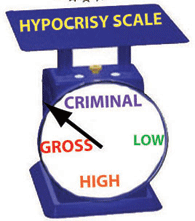
 Australian Prime Minister Praises U.S. Climate Action, While Trying To Kill Similar Program http://thinkprogress.org/climate/2014/06/06/3445853/australian-epa-sensible/ BY ANDREW BREINER ON JUNE 6, 2014 AUSTRALIAN PRIME MINISTER TONY ABBOTT TOLD THE PARLIAMENT THIS WEEK THAT THE NEW U.S. CARBON LIMITS ARE “SENSIBLE,” EVEN THOUGH HIS GOVERNMENT IS TRYING TO END AN AUSTRALIAN LAW THAT ESSENTIALLY USES SIMILAR TACTICS TO CUT EMISSIONS. “THERE IS NO EMISSIONS TRADING SCHEME IN THE UNITED STATES,” HE TOLD PARLIAMENT. BUT THAT’S NOT ENTIRELY TRUE.
While the EPA rule doesn’t set up a federal carbon pricing or emissions trading system, those are available and encouraged options for states, and they’re already being used successfully. The Regional Greenhouse Gas Initiative has been going strong for several years in Northeastern states, making money for state governments while cutting carbon. California’s cap-and-trade system, set up in 2006, will likely also provide a model for states looking to comply with EPA regulations. More states are expected to join or create cap-and-trade systems to meet EPA limits.
Abbott says he likes U.S. climate policy, but his real model seems to be Canada, where oil money has stifled recognition of climate change, climate policy, and activism. In Australia, the law and private spying have been used to make protest harder, and climate denial has become common in Abbot’s government.
It’s unclear at this point whether Abbott will be able to repeal the Clean Energy Future laws that establish a price on carbon and emissions trading program in Australia. But there’s no question that his Liberal Party government has beenhostile to climate action and clean energy, and quite committed to helping the coal industry. Meanwhile, Australia is dealing with significant climate change impacts, including record-breaking heat waves and droughts.
Tony Abbott informs the world that Climate Change will NOT be discussed at the G20
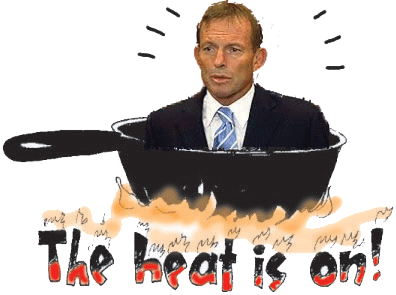 Climate change ‘off G20 agenda’, The Age June 5, 2014 Lisa Cox and Adam Morton Prime Minister Tony Abbott has downplayed the likelihood of climate change being discussed at a G20 leaders’ summit hosted by Australia, suggesting it does not fit the meeting’s economic focus.
Asked about pressure from the US and Europe for climate to be included on the agenda for the November meeting in Brisbane, Mr Abbott said there were other international meetings that were more appropriate for discussing the issue………
His comments followed US and Chinese leaders revealing new plans to tackle climate change.
A top Chinese climate adviser told a Beijing conference that the world’s largest emitter of greenhouse gas would put a cap on emissions for the first time in its next five-year plan, starting in 2016………
US President Barack Obama announced he would regulate to cut emissions from power plants to 30 per cent below 2005 levels by 2030 – considered the most significant step he has taken to tackle global warming.
Also this week, the European Union reported its emissions were 19 per cent lower than in 1990 and South Korea said it would tax coal imports and cut duty on alternative fuels from July.
Australia will become the first country to abolish a carbon pricing scheme if the Abbott government’s repeal legislation is passed by the incoming Senate. In its place it is proposing a ”direct action” scheme, which would involve the government paying some companies to cut emissions………
Greens leader Christine Milne said financing tackling climate change had to be on the G20 agenda. ”Our Prime Minister is so backward he doesn’t seem to understand the connection between climate change and economics.” http://www.theage.com.au/federal-politics/political-news/climate-change-off-g20-agenda-20140604-39jdx.html
Time that Northern Territory’s Chief Minister Adam Giles came clean about nuclear wastes

 GILES NEEDS TO COME CLEAN ON NUCLEAR DUMP STANCE http://territorylabor.com.au/giles-needs-to-come-clean-on-nuclear-dump-stance/ Gerry McCarthy , 4 June 2014 Local Member for Barkly, Gerry McCarthy, today called on the Chief Minister, Adam Giles, to stand alongside Territory Labor and other Territorians who do not want a nuclear waste dump in the Territory.
“Territorians are adamant that they do not want a Nuclear Waste Dump at Muckaty Station,” Mr McCarthy said.
Mr McCarthy said Adam Giles needs to come clean to Territorians about where he stands on the issue.
“It has been alleged that Adam Giles is an ardent supporter of a having nuclear waste facility in the Territory,” Mr McCarthy said.
“By his silence it appears the Chief Minister does support the proposed nuclear waste dump at Muckaty. “Territory Labor and many Territorians are concerned about the risk of potentially dangerous nuclear waste that will be transported on our roads, rail and through our ports to reach the proposed facility.
“The Chief Minister needs to assure Territorians that he will not stand by and let the Federal Government turn the Territory into a nuclear waste dump.”
The Member for Barkly said representatives of traditional owners against a nuclear waste dump at Muckaty were in the High Court in Melbourne currently trying to end the 7 year struggle to establish the first purpose built nuclear waste dump facility in the Territory. The High Court hearings will collect evidence in Tennant Creek and Darwin later this month. Media contact: Cathryn Tilmouth  0427 500 667
Australia’s Panel to Review Renewable Energy target – close ties with polluting industries!
 (VIDEO) Alleged conflict of interest in energy review panel Australian Broadcasting Corporation Lateline Broadcast: 04/06/2014 Reporter: Kerry Brewster The expert panel which is deciding how much renewable energy Australia should produce is defending itself against claims of conflict of interest because an economist on the panel is using work he did for the oil and gas industry to argue the case for scrapping the renewable target.
Transcript
TONY JONES, PRESENTER: The expert panel which is deciding how much renewable energy Australia will continue to produce is defending itself against claims of conflict of interest. Solar advocates say economist Brian Fisher should step down from the Government’s review of the Renewable Energy Target. They say he previously did work for the oil and gas industry and that’s being used to argue the case for scrapping the Renewable Energy Target. This exclusive report from Kerry Brewster.
KERRY BREWSTER, REPORTER: For 14 years, the oil and gas industry has lobbied for the 20 per cent Renewable Energy Target, or RET, to be dumped.
DAVID BYERS, AUST. PETROLEUM PRODUCTION & EXPLORATION ASSN: We would like to see the Renewable Energy Target removed.
KERRY BREWSTER: Now a Government-appointed panel is reviewing the target. And it hasn’t ruled out scrapping it altogether, a move that the renewable energy industry says would halt billions of dollars in new solar and wind projects and potentially bankrupt some large companies……..
KERRY BREWSTER: The modelling used to argue for the target to be scrapped is two-year-old work from BAEconomics, headed by economist Dr Brian Fisher. Dr Fisher is one of the four experts tasked by the Prime Minister to decide the target’s future.
Solar advocates are calling this a serious conflict of interest. They point to the fact the same modelling was rejected by the last RET review conducted 18 months ago by the Climate Change Authority.
JOHN GRIMES, AUSTRALIAN SOLAR COUNCIL: He’s been an active player, providing advice that’s been absolutely one-sided in the past, advice that’s still being used. Brian Fisher should step down from his position on this review committee……..
In the complex world of modelling, Bloomberg New Energy says it’s crucial to reflect not just the cost of renewables, but also the benefits. Its submission includes what it says APPEA’s modelling doesn’t: the ability of solar and wind to drive down the wholesale price of electricity when the sun shines and the wind blows.
KOBAD BHAVNAGRI, BLOOMBERG NEW ENERGY: That’s essential, really. You have to look at both the costs and the benefits of the scheme. Just like when you’re going to buy a house you look at the cost of buying a house versus the benefits of not having to pay rent anymore. It’s quite easy to highlight the costs and completely ignore the benefits.
MILES GEORGE, INFIGEN: In that modelling that was done for APPEA two years ago, there was no attempt to identify or model the wholesale price reduction that’s associated with renewable energy.
KERRY BREWSTER: Wind energy company Infigen says APPEA’s modelling doesn’t stand up to scrutiny……….http://www.abc.net.au/lateline/content/2014/s4018998.htm
Victoria’s anti-wind energy Premier Napthine decides that gas is “renewable” energy
Napthine government wants gas included in renewable energy target June 3, 201 Tom Arup Environment editor, The Age Australia’s renewable energy target would include gas-fired power – derived from fossil fuels – under a controversial proposal by the Victorian government.
The state also suggests the target should also be scaled back to reflect falling demand for power……….
Greens Leader Greg Barber said including gas in the target would be “a huge hit to the earth …….”If Premier Denis Napthine has convinced himself that gas is a renewable energy source, then he is confused,” he said. “Adding gas to the renewable energy target means it is no longer about renewable energy.”
The Victorian opposition said the government should be fighting to maintain the target in current form.
Labor energy spokeswoman Lily D’Ambrosio said: “As it stands, the [target] provides investment in new industries and will create thousands of jobs for Victorians. We wholeheartedly support that – Denis Napthine should too.”……..
The Victorian submission puts it at odds with renewable energy firms and NSW, which supports the target as it stands but wants the timeframe to achieve it pushed out…….
Environment Victoria campaigner Nick Aberle said keeping the target would allow Victoria to tap into billions of dollars of clean energy investment, creating skilled jobs in regional areas. “There is also good evidence that keeping the target will ultimately lead to lower electricity prices for consumers,” Dr Aberle said.
In a separate submission, the City of Melbourne strongly backs the retention of the target as it stands. It says the policy is pushing down wholesale electricity prices, benefiting consumers including manufacturers in the city.
The Melbourne City Council submission also says the advent of renewable energy technology, such as rooftop solar panels, has strengthened the resilience of the energy grid and both put curbs on demand and lowered prices during extreme heatwaves.http://www.theage.com.au/environment/energy-smart/napthine-government-wants-gas-included-in-renewable-energy-target-20140603-39gs0.html
Abbott government cuts Aboriginal funding, and promotes discrimination
Budget cuts stir Aboriginal anger in Australia Ft.com By Jamie Smyth in Sydney, 3 June 14, “……This is our land. They have pulled our houses down and want to replace them with student accommodation and shops,” says the 66-year-old, who has lived for a half century in Redfern, seen by many Aboriginals as their spiritual home in Sydney.
This battle for social housing is just one of the many struggles Aboriginal communities face as they strive to emerge from two centuries of discrimination and grinding poverty.
The Redfern protest – timed to coincide with National Reconciliation Week – is taking place against the backdrop of a A$500m cut in Aboriginal funding programmes in the federal budget, which includes A$160m in health services alone. It also comes as Canberra proposes a watering down of the racial discrimination act, which was introduced in 1975 following a long and bitter political battle.
The government changes are alarming Aboriginal leaders, who were told by Tony Abbott when he was elected in September 2013 he would be a “prime minister for Aboriginal affairs”. Critics say it is a broken promise by Mr Abbott, who has been accused of backtracking on several key election commitments since May’s budget – the toughest in Australia for almost two decades.
“What beggars belief is they are saying they support freedom of speech while at the same time they are taking away money from [Aboriginal] advocacy bodies,” says Thomas Calma, an Aboriginal elder from Darwin and former race discrimination commissioner
The coalition wants to repeal a section of the race discrimination act, which makes it unlawful to “offend, insult or humiliate” another person because of their “race, colour or national or ethnic origin”.
“People do have a right to be bigots,” said George Brandis, Australia’s attorney-general, when he proposed the changes to parliament as a way to bolster free speech.
“With this budget the government is really moving back to the discriminatory policies we saw in the past. It is back to the future in Australia.” http://www.ft.com/intl/cms/s/0/5d031d70-eab5-11e3-80fb-00144feabdc0.html#axzz33hiLRfqj
Our fool of a Prime Minister connects World War 2 ‘s dead soldiers with business investment!
Tony Abbott raises eyebrows after linking WWII D-Day memorial with policies on mining and carbon taxes, Brisbane Times Alexandra Back June 2, 2014 Prime Minister Tony Abbott has courted controversy by linking a commemoration of the 70th anniversary of D-Day to his government’s policies.
On Sunday afternoon the Prime Minister released a video which he began by saying the D-day landings had changed the course of human history. Seconds later Mr Abbott makes an odd segue into a message for overseas investors, that Australia is open for business.
- He goes on to talk about the government’s commitment to repealing the carbon tax and the mining tax, then returns to D-day.
“The United States, Canada and France are long standing friends. We stood together at D-Day, we trade every day and we have always shared a commitment to democracy, to enterprise and to people’s right to be free,” he says in the video.
The conflation of the two messages raised eyebrows on Twitter with Greens leader Christine Milne, political commentator George Megalogenis and comedian Charlie Pickering among those criticising the PM.
Each week Mr Abbott posts a video detailing ”important events for the week”.
On this most recent post, and after Fairfax Media became aware of the video on Sunday night, someone changed the title from ”A message from the PM – 70th Anniversary of the D-day landings” to ”A message from the PM – Visit to France, Canada and United States”.
Unfortunately for the Prime Minister’s office the opening graphic on the video retains the original title. The link to the transcript of the video can no longer be accessed……….
Over 3000 Australians were involved – including 2500 air force personnel who provided air support for the Allied landings. Following the D-day commemorations, I will be travelling to Canada and the United States – and will be joined by Australian business leaders.
”My message to overseas investors is that Australia is open for business.”……..http://www.brisbanetimes.com.au/federal-politics/political-news/tony-abbott-raises-eyebrows-after-linking-wwii-dday-memorial-with-policies-on-mining-and-carbon-taxes-20140602-39cuy.html
New South Wales Premier Baird backs Renewable Energy Target, in defiance of Federal Liberals
 Mike Baird gives backing for renewable energy target, SMH, Peter Hannam ENVIRONMENT EDITOR, THE SYDNEY MORNING HERALD May 29, 2014 The NSW government has broken ranks with conservative counterparts in Canberra and the other states by declaring its strong support for the national renewable energy target.
Unlike other Coalition leaders, including Prime Minister Tony Abbott, Mike Baird makes clear in his government’s submission to the federal RET review that renewable energy benefits consumers, helps energy security by diversifying sources and cuts greenhouse gas emissions.
The NSW submission notes the fixed target – now at 41,000 gigawatt-hours of clean energy sources by 2020 – last year cost households in the state about $40. That sum, though, was offset by the effect renewable energy had on driving down wholesale electricity prices, the report said. ”The RET is good for NSW consumers and households – it ultimately saves money,” said Amy Kean, the state’s renewable energy advocate, who helped prepare the submission
The state also has a lot of jobs and investment at stake – some 8395 megawatts of capacity worth about $13 billion are ”progressing through the planning system”, the report said……….
The submission says projects that have met certain conditions – such as having progressed to a financial close by a particular date – could be given special consideration in any reformed RET, ”given the significant amount of effort that has already been expended in good faith”. Further reviews should also be held only every five years to bolster certainty, the NSW government said.
Analysts such as Hugh Saddler at Pitt & Sherry warn that any tinkering of the target is likely to stall new investments.
”The problem about postponing to an undefined date [is it] makes it uncertain again as to when the investments will be required,” he said. ”Once you get away from a fixed amount of gigawatt-hours in a fixed year, you’re immediately bringing back uncertainty because it depends on demand growth.”
The declaration of support is likely to be welcomed by an industry which has few outspoken supporters in conservative ranks.
Mr Baird’s predecessor, Barry O’Farrell, did not make a submission to the previous RET review less than two years ago, and was no fan of wind farms. http://www.smh.com.au/environment/climate-change/mike-baird-gives-backing-for-renewable-energy-target-20140528-394ri.html#ixzz33Fp4KnBR
New South Wales Greens introduce Bill to promote renewable energy to benefit Hunter Valley
 The Greens say renewable energy bill will benefit the Hunter http://www.abc.net.au/news/2014-05-30/the-greens-say-renewable-energy-bill-will-benefit-the-hunter/5488224 The New South Wales Greens are confident new jobs will be created in the Hunter Valley if state MPs back its legislation to transform the energy sector. The party has seized on the Baird Government’s support for the national renewable energy target with a Bill calling for at least one 500 megawatt coal fired electricity generating unit to be shut down by 2017.
It also wants sensible, science-based wind farm planning guidelines introduced.
Green’s energy spokesman John Kaye says the move away from coal fired base load power will not hurt the Hunter.”There’s a whole lot of studies out there that show pushing up the renewable energy target, moving out of coal into wind, bring three or four times the number of jobs that already exist,” he said. “We can create new jobs, high quality jobs, unionised jobs in the wind industry, in the solar industry that will more than compensate for any loss of jobs in the coal industry.”
Plans for two Upper Hunter wind farms could benefit from the Greens push to make renewable energy a bigger part of the state’s energy mix.Scone’s Kyoto Energy Park is already approved while planning continues on the proposed Liverpool Range Wind Farm.
Mr Kaye says the government should support his party’s legislation. “What the Baird government is going to do to remove the barriers for renewable energy, what they’re going to encourage public and private investment,” he said. “Hopefully Mike Baird is turning a corner, he’s taking his government to new days where some of these Hunter wind farms can go ahead.”
Tony Abbott’s blatant lie to the Aboriginal people on land rights
 PM Abbott’s top 40 broken promises and blatant hypocrisies — so far, Independent Australia Alan Austin 24 May 2014, Alan Austin updates IA’s running tally of hypocrisies and broken promises by Australia’s most mendacious ever prime minister — Tony Abbott…….
35. Aboriginal land rights
At the Garma festival in north-east Arnhem Land last August Abbott promised to
“… do whatever I humanly can in government to bring this [improved land rights for Aboriginal people] about.”
As funding for research and for legal aid for land claims across Australia is critical, all Aboriginal land claimants were looking expectantly at the May budget.
They got nothing..….http://www.independentaustralia.net/politics/politics-display/pm-abbotts-top-40-broken-promises-and-blatant-hypocrisies–so-far,6512#.U4Umyx0K8pE.twitter …@IndependentAus
1 This month
17 October, Free Public Talk on Nuclear Issues in South Australia
David Noonan will speak on public interest concerns over the new Roxby Downs Indenture Act 2026 on BHP copper-uranium mining and ore processing in SA, and on how AUKUS may face SA with a High-Level nuclear waste agenda.
Dr Jim Green will discuss international developments in the field of nuclear power including ‘small modular reactors’ and Generation 4 ‘advanced’ nuclear reactor concepts.


Help Aunty Sue Protect Her Land and Sacred Sites From Destructive Rocket Testing.
.

Australians deserve the truth
about
AUKUS – https://aukuspublicinquiry.com/

PETITION – To: Prime Minister Anthony Albanese and the Australian Labor Government

of the week – Australians for War Powers Reform (AWPR)
To see nuclear-related stories in greater depth and intensity

