Falling Upwards: Labor’s Quiet Reward for Failure
25 January 2026 David Tyler, Australian Independent Media
Greg Moriarty’s plum job posting sends a clear message about how Canberra looks after its own.
Washington isn’t a demotion; it’s the prize. Greg Moriarty’s nomination as Australia’s next ambassador to the US isn’t the act of a government cleaning house; it’s the system congratulating itself on resilience. In Canberra, failure rarely disqualifies. It just moves you sideways until the heat cools, or upward, if the optics align.
In a bureaucracy obsessed with process, protection is paramount; the process to protect: protect the insiders first, accountability second; if accountability, (in Canberra, always a slow train coming), arrives at all.
The Canberra reflex
No-one is fussed about Moriarty’s credentials. He is eminently qualified; the boffin’s boffin. He was Australia’s Ambassador to Indonesia (2010–2014) and Ambassador to Iran (2005–2008), giving him “on-the-ground” experience with political Islam, even if Mossad and CIA hit squads mean his speed-dial will need updating.
Moriarty spent his first decade (1986–1995) as a regional analyst in the Defence Intelligence Organisation. DIO. This is the agency responsible for providing intelligence to the Australian Defence Force.
During the first Gulf War, as the 1991 United States’ oil war with Saddam Hussein has become known, Moriarty served as a uniformed Captain in Saudi Arabia, providing intelligence briefings directly to General Norman Schwarzkopf at US Central Command. The “liberation of Kuwait” was a hollow slogan used to mask a war fought to ensure the US remained the sole “policeman” of the world’s energy supply.
Clandestine Diplomacy? Also Greg’s bag. He was Australia’s Ambassador to Iran (2005–2008) at a time when the US had no diplomatic presence there. He was one of the few Westerners with a deep, “inside” view of Tehran, eventually briefing President George W. Bush in the Oval Office, a rare gig, for an Australian diplomat.
Counter-Terrorism Coordinator? If the cap fits. Moriarty was the inaugural “czar” of Australia’s counter-terrorism efforts, whose brief was to bridge the gap between ASIO (domestic spies) and ASIS (foreign spies).
But there’s more. Not only is he a veteran of very complex and challenging foreign postings, but Moriarty served as the International and National Security Adviser and Chief of Staff to Prime Minister Malcolm (Fizza) Turnbull, an all-leather jacket-no-naff-elbow-patches-man. A man of means, Turnbull’s million dollar punt on his own campaign makes him easily the best self-saucing pudding to get into The Lodge.
As a former PM, Turnbull’s become a fearless critic of the Liberal Party, now that he’s free to focus on its internecine wars, its dud policy and its hapless leader, from time to time, as minding his stock portfolio allows. But he’s always put in a good word for Greg. Turnbull often highlights Moriarty’s history with the U.S. (specifically his service with U.S. Central Command). This background helps explain why Prime Minister Anthony Albanese has just appointed Moriarty to succeed Kevin Rudd as Ambassador to the United States.
Turnbull’s trust in Moriarty helped pave the way for Greg to become one of the architects of AUKUS and the primary point of contact for the Trump circus. Scott Morrison may quibble but, success has many fathers.
Above all, Moriarty was the key figure responsible for coordinating Australia’s counter-terrorism arrangements in 2015. He is a primary architect of the controversial strategy that views groups like Hizb ut-Tahrir, as “ideological threats” to national security, even if they fall short of the violence threshold.
So it isn’t about experience or qualifications. It’s about reflex. Canberra’s muscle memory. When faced with scandal or exposure, Canberra’s instinct is to pull the shutters down, shield its own; tidy paperwork later.
Consider Kathryn Campbell. During Senate estimates, Jacqui Lambie pressed Moriarty about his role in placing Campbell; already publicly associated with the Robodebt debacle, in a senior AUKUS‑related Defence post reportedly worth close to $1 million. It wasn’t a technical error; it was a deliberate continuity move.
As Moriarty told estimates, on 14 June 2022 PM&C Secretary Glyn Davis called to see whether there might be a new role for Campbell, who was likely to be moved from DFAT. Moriarty said yes; a spot was waiting in Defence’s nuclear submarine taskforce.
He later argued the appointment pre‑dated the Royal Commission, but that defence misses the point. By mid‑2022, Robodebt’s unlawfulness was already public, and Labor had pledged a Royal Commission in its campaign. To claim no one foresaw reputational risk is bureaucratic fantasy.
When the Commission handed down its findings on 7 July 2023, its condemnation of Campbell was withering. She was suspended without pay three days later and later resigned……………………………………………………………………………..
The politics of timing
And then, there’s the timing.
Moriarty’s appointment, like so many immaculate Canberra announcements, coincides with turbulence elsewhere, this time, the government’s controversial Hate Speech bill. The bill risks criminalising intent: targeting individuals or groups perceived as being about to breach the law, rather than those who actually do.
For activist networks and civil‑liberties advocates, this language turns dissent into pre‑crime; policing inclination rather than action. It marks a profound step away from Labor’s democratic heritage, recasting expression and dissent as potential threats……………………………….
Accountability, inverted
Canberra will insist that promoting Moriarty is pragmatism: the steady hand, the safe pair. But Australians watching from below see something else; a governing circle where the guilty always escape justice.
Accountability in Canberra remains a one‑way mirror: the public gets watched; the powerful get reassigned.
If Labor truly wants to rebuild faith in government, it must break its habit of rewarding failure and punishing conscience. Responsibility must cost something again. Until then, power will keep protecting itself; and the “fair go” will remain a slogan embalmed in Labor’s history, rather than a principle alive in its governance.
Two Canberras
This isn’t just a job swap; it’s a parable of the Two Canberras.
In one Canberra, the “Safe Pair of Hands” is rewarded for a career spent managing the optics of illegal wars, secret submarine deals, and the protection of disgraced colleagues. In this Canberra, accountability is a one-way mirror: the public is watched, but the powerful are merely reassigned.
In the other Canberra, those who actually serve the public interest – the Witness Ks, the David McBrides, and the Bernard Collaerys – are crushed. Their “fidelity” earned them prosecution, not a promotion. Their “integrity” earned them a criminal record, not a diplomatic passport.
Moriarty’s flight to Washington reveals the grim reality of modern Labor governance. By rewarding the managers of wrongdoing while punishing the whistleblowers who expose it, the “Fair Go” has been embalmed and put on display as a museum piece. In today’s Canberra, the stream does not rise higher than its source; and the source is a closed loop where power exists only to protect itself.
Responsibility has no cost for the inner circle; it is a tax paid only by the principled. Moriarity’s pragmatic promotion demotes, depletes and pointedly disregards the notion of Australia as the land of the fair go. https://theaimn.net/falling-upwards-labors-quiet-reward-for-failure/
Cognitive Capture: Australia’s Silent Coup-by-Precedent
24 January 2026 Dr Andrew Klein, PhD
Dateline: January 2026
For months, a narrative has been assembling in plain sight. It does not involve soldiers in the streets or a declaration of martial law. Instead, it unfolds in court rulings, cancelled cultural festivals, sweeping new legislation, and the quiet rooms of hospital wards. Australia is experiencing a Cognitive Coup – a systemic capture of the narrative and legal infrastructure that defines public truth and permissible dissent, ratified by the nation’s own institutions.
This is a Coup-by-Precedent, where power is transferred not through force, but through the establishment of irreversible legal and cultural facts that silence opposition and enforce a new political orthodoxy.
Part I: The Legal Architecture of Silence
The most explicit tool of this new order is law. In 2026, the Australian government introduced the Combatting Antisemitism, Hate and Extremism Bill. Framed as a security measure, its provisions are sweeping: further criminalisation of hate speech, expanded powers to cancel visas for those deemed to spread hate, and the establishment of a national firearms buyback scheme. Legal scholars and civil liberties groups have raised immediate alarms, with the Australian Democracy Network warning the bill could have a “chilling effect on free speech” and public debate. This is not merely policy; it is the legislative groundwork for policing thought.
Part II: The Judicial Finding of Surrender
While the law builds the future cage, the courts have documented the present captivity. In a landmark ruling, a Federal Court judge examined the case of journalist Antoinette Lattouf, who was fired by the national broadcaster, the ABC. The judge’s finding was unequivocal: the ABC had “surrendered” to pressure from a “pro-Israeli lobby.” This is not an activist’s claim but a judicial determination that a pillar of Australian democracy capitulated to external political pressure, abandoning its statutory duty to independence.
This pattern is not isolated. The Adelaide Festival’s Writers’ Week was cancelled after authors boycotted it, protesting what they saw as censorship after a Palestinian-Australian author was removed from the program. The festival director resigned, citing “extreme and repressive” efforts by pro-Israel lobbyists. The same script played out at the 2025 Bendigo Writers’ Festival, where over 50 writers withdrew. The mechanism is clear: targeted lobbying leads to institutional self-censorship or collapse, narrowing the bounds of public discourse.
Part III: The Bureaucratic & Medical Silencer
For the individual citizen or dissenting voice that operates outside these collapsing public forums, a more intimate enforcement mechanism activates. My own case provides a microcosm of the macro dynamic.
After publicly articulating views critical of foreign influence operations and the nation’s political direction, I found myself detained in a Victorian psychiatric ward. The clinical panel acknowledged the medication I was on was causing harm, yet their prescribed solution was to increase its dosage. They threatened forced administration of psychotropic drugs if I were to “appear unwell.” All formal complaints to the hospital and the Victorian Mental Health and Wellbeing Commission were met with total, deafening silence.
The parallels are structural:
- The ABC’s surrender to external lobbyists is mirrored by the hospital’s surrender to a politicised diagnosis.
- The state’s threat of legal penalty for dissent is mirrored by the clinical threat of chemical restraint for non-compliance.
- The goal is identical: to neutralise a disruptive narrative by declaring its source illegitimate – either as un-Australian hate or as psychiatric instability – and removing its platform.
This is the weaponisation of medicine as political control, the final layer of enforcement when public shaming and legal pressure are insufficient.
Part IV: The Infrastructure of Forgetting
Underpinning this cognitive shift is a quieter, more profound vulnerability: the surrender of memory itself. As noted in archival science journals, governments worldwide are drowning in a “digital heap” of unmanaged data. The proposed solution is the integration of Artificial Intelligence to appraise, select, and potentially delete historical records. When the power to decide what is remembered and what is erased is ceded to algorithms optimised for efficiency rather than truth, national sovereignty over history is lost. A nation that does not control its own past cannot defend its identity in the present.
Conclusion: The Coup Is Precedent
The Cognitive Coup is complete not when a politician is replaced, but when the new rules are normalised. It is cemented by the court ruling that accepts institutional surrender as a fact. It is reinforced by the cancelled festival that no one dares to revive. It is operationalised by the law that makes dissent legally perilous and the medical protocol that makes it a symptom of illness.
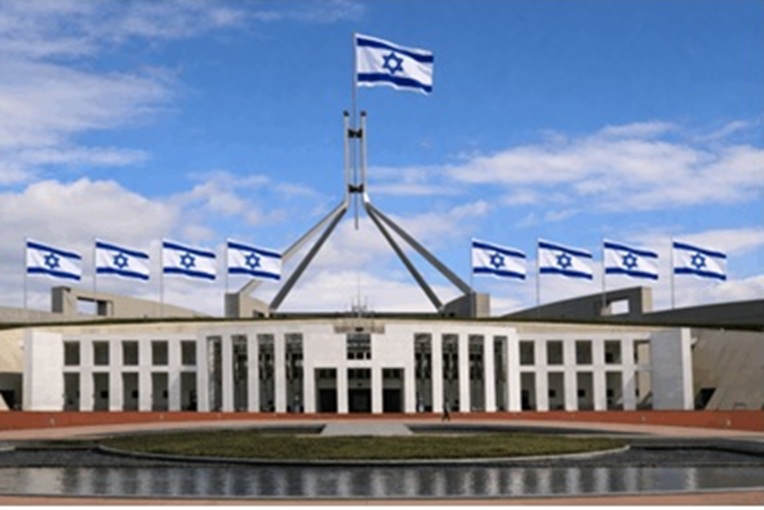
The Australian public may not have seen tanks, but they are witnessing the annexation of their public square. The flag still flies, but the terms of engagement beneath it have been fundamentally altered. The precedent has been set: that external interests can dictate cultural policy, that dissent can be legislated into hate, and that the ultimate dissenter can be pathologised and silenced.
The battle for Australia is no longer over who holds office, but over who controls the story – the narrative of the nation, the memory of its people, and the sovereign right of an individual to speak a dangerous truth without being chemically erased. The coup is not televised. It is curated, legislated, and medicated.
References
- Legal Framework: The Combatting Antisemitism, Hate and Extremism Bill 2026.
- Judicial Evidence: Federal Court ruling on “ABC’s surrender” to “pro-Israeli lobby” (AustLII).
- Cultural Enforcement: Cancellation of Adelaide Festival’s Writers’ Week & Bendigo Writers’ Festival due to lobbying campaigns (The ABC).
- Archival Vulnerability: Academic analysis on AI in archives and loss of sovereignty over historical record.
- Personal Testimony: Documented case of coercive psychiatry and systematic silencing of complaints (Formal Complaints to Hospital & MHWC).
Sussan Ley tries to rewrite history
19 January 2026 AIMN Editorial, Palestine Action Group, https://theaimn.net/sussan-ley-tries-to-rewrite-history/
Today has witnessed a new low in the sickening attempt by some politicians to exploit the horrific massacre at Bondi in order to attack the mass protest movement in which hundreds of thousands of people have marched against the genocide in Gaza.
Opposition leader Sussan Ley, in particular, made a speech filled with obscene misinformation and outright lies. The complete abandonment of any commitment to the truth is a deeply worrying lurch toward the kind of politics Donald Trump has unleashed in the US.
Any suggestion that the Bondi massacre can be blamed on the millions of Australians who have opposed Israel’s genocide in Gaza is baseless, preposterous, hate-filled and hypocritical. There is no evidence of any link whatsoever. ISIS does not support the Palestinian cause, and all available evidence points to the killers being radicalised several years before 2023 or the Harbour Bridge March for Humanity.
The Palestine solidarity movement has always stood firmly and explicitly against antisemitism, and has since the very beginning been organised alongside Jewish people, who have marched in their thousands against the Israeli regime. In Sydney, almost every protest we have held for the past two years has been co-sponsored by Jews Against the Occupation ‘48, and featured Jewish speakers and MCs.
Antisemitism did not march on our streets, bridges and landmarks, nor did it camp in our university quadrangles, and not a shred of real evidence has ever been produced for such claims. On the incredibly rare occasions when genuine antisemites have tried to participate in our movement, they have been unanimously denounced and excluded. The same certainly cannot be said of the Liberal Party, or the Murdoch and other press outlets pushing these claims, who have often supported far right movements led by actual neo-Nazis.
Sussan Ley despicably ties the mass anti-genocide movement to firebombings of places of worship – attacks which the NSW Police and AFP have detailed were carried out by criminal elements, perhaps coordinated by someone in Iran. In other words, nothing to do with the protest movement!
Like others making such blatantly dishonest claims, Sussan Ley has supported the worst possible act of racist violence: genocide. Ley gives the impression she would like it to be a criminal offence to oppose the crimes of the state of Israel. She also seeks to weaponise one form of racism, antisemitism, to whip up another: Islamophobia. This is despicable politics and must be rejected by all who want to uphold universal principles of anti-racism, let alone a basic commitment to factual and rational debate.
Outside the Canberra bubble dominated by politicians, lobbyists and media executives, the fact that Israel has committed a genocide in Gaza is now an incontrovertible fact, confirmed by all human rights organisations and experts. Well over 100,000 Palestinians are estimated to have been massacred and starved to death since October 2023. This is why millions have marched, not because they hate Jews, but because they are against possibly the biggest racist atrocity of the 21st century, carried out by the state of Israel. And this is why they will continue to march, as Israel’s occupation and genocide of Gaza continues.
How Did Australia Get Here?
19 January 2026 Michael Taylor AIM Extra, https://theaimn.net/how-did-australia-get-here/
For the first time in Australian political history, Pauline Hanson’s One Nation Party is polling higher than the Liberal–National Coalition.
Let that sink in.
A party that thrives on fear, resentment, and division – a party built on racism, dog-whistling, and grievance politics – is now outperforming the mainstream conservative alternative. This is not a curiosity. It is a warning.
And it forces a confronting question: how did Australia get here?
The uncomfortable answer is that this moment has been years in the making.
One Nation’s rise is not primarily a story about Pauline Hanson. It is a story about political failure – particularly the failure of the major parties to speak honestly to Australians about economic insecurity, social change, and the forces reshaping their lives.
When people feel unheard, they don’t always become thoughtful. Often, they become angry.
The LNP Opposition has offered little more than cultural skirmishes and imported American talking points. Instead of articulating a serious, coherent alternative vision for the country, it has drifted between silence and performative outrage. Leadership has been replaced by mimicry. Policy has been replaced by posture.
Into that vacuum steps One Nation – loud, simple, and shameless.
The party offers certainty in an uncertain world. It points fingers. It names enemies. It promises easy answers to complex problems. And for some voters, that is enough.
Australia has also absorbed something corrosive in recent years: the tone and tactics of Trump-style politics, without the institutional guardrails or civic culture to blunt their impact. Conspiracy thinking, contempt for expertise, hostility to minorities, and the fetishisation of “strength” over decency have all found a home here.
One Nation didn’t invent this climate – it exploits it.
Media ecosystems that reward outrage over accuracy have played their part. When anger is monetised, when fear drives clicks, and when minorities are framed as threats rather than neighbours, extremist parties don’t need to persuade – they simply wait.
What makes this moment especially troubling is that One Nation is not shy about what it stands for. Its history of racist rhetoric, its hostility to First Nations Australians, its flirtation with authoritarian leaders, and its open admiration for Donald Trump are not hidden. They are features, not bugs.
That a growing number of Australians are willing to look past – or even embrace – those traits should alarm anyone who cares about social cohesion.
This does not mean Australia has suddenly become a hateful country. But it does suggest that we have become more tolerant of cruelty, more cynical about politics, and more willing to excuse prejudice when it is wrapped in the language of “common sense” or “telling it like it is.”
The greatest danger is not that One Nation will ever form government. It won’t.
The danger is that its ideas seep into the mainstream – softened, laundered, and normalised by larger parties chasing votes instead of values. History shows that democracies don’t fail overnight. They erode gradually, as the unacceptable becomes familiar and the outrageous becomes routine.
If a party built on division can now outpoll a major party, then the real question is no longer about Pauline Hanson.
It’s about us.
What kind of country do we want to be – and what are we prepared to tolerate in the meantime?
Political Futures: Stronger Progressive United Front to Broaden the Hate Speech Legislation
Oxfam Australia, 14 January 2026 Denis Bright, https://theaimn.net/political-futures-stronger-progressive-united-front-to-broaden-the-hate-speech-legislation/
The far-right of Australian politics and the LNP, with the support of the Murdoch Press, have had a field day during the summer break to foster a commitment against hate speech. The tragic events at Bondi have been fully exploited for political advantage without reference to the underlying mental health state of advocates of antisemitism.
The Albanese Government is responding productively by incorporating a ban on hate speech with new gun control legislation. The forthcoming legislative actions are still in a speculative phase and are likely to be amended in parliamentary processes (ABC News, 13 January 2026):
In short:
A draft of Labor’s new hate speech bill, seen by the ABC, creates a new federal offence making it illegal to publicly promote or incite racial hatred where the conduct would cause a reasonable person to feel intimidated, harassed or fear violence.
But it includes a narrow defence where the speech, writing or other form of public gesture is solely quoting religious texts for teaching or discussion.
What’s next?
Parliament has been recalled to sit for two days next week to debate the wide–ranging bill, which also includes changes to gun laws proposed in the wake of the Bondi attack.
A draft of the Combating Antisemitism, Hate and Extremism Bill, seen by ABC News creates a new federal offence making it illegal to publicly promote or incite racial hatred where the conduct would cause a reasonable person to feel intimidated, harassed or fear violence.
The legislation includes a narrow defence where the speech, writing or other form of public gesture was solely quoting religious texts for the purpose of religious teaching or discussion.
Prime Minister Anthony Albanese on Tuesday used the Old Testament of the Bible to explain the carve out, saying the laws would set a “principles-based test” for conduct and speech that incited racial hatred toward another person or group.
“I encourage you to read the Old Testament and see what’s there and see if you outlaw that, what would occur,” he said.
“So, we need to be careful – we consulted with faith groups, not just with the Jewish community.
“We want to make sure there’s the broadest possible support for this legislation but we also want to make sure that there aren’t unintended consequences of the legislation.”
Our Prime Minister’s concerns about some of the edicts from the Old Testament are highly relevant.
The Old Testament justified the historical invasion of the seven nations of Canaan by the Kingdom of Israel in ancient times.
For cities outside the immediate Promised Land, Israel was commanded to offer terms of peace first. Only if the city refused were they to engage in military action (Deuteronomy 20:10-15). This is straight out of President Trump’s ultimatums to countries like Mexico and Venezuela in this latter-day exceptional era.
Later prophets like Isaiah and Hosea criticized “militarism” when it shifted from trusting in God to trusting in “chariots and horses” (Isaiah 31:1).
With the approach of Sydney’s Gay and Lesbian Mardi Gras, quotes from the Old Testament might fall into the category of hate speech as shown by these quotes from the Holiness Code of Leviticus:
- Leviticus 18:22: “You shall not lie with a male as with a woman; it is an abomination.”
- Leviticus 20:13: This verse repeats the prohibition but adds a legal penalty: “If a man lies with a male as with a woman, both of them have committed an abomination; they shall surely be put to death.”
The cultural exceptionalism promoted in the Old Testament can be used to justify contemporary political excesses including multi-trillion-dollar spending on militarism and tolerance of the growing wealth divide in developed middle powers which fosters support for far-right political agendas as a diversionary response to social tensions.
Progressive Australian politics has taken a battering in the summer break. Before the break, Australian conservative politics was in disarray as the National Party abandoned commitment to zero carbon emission targets and Barnaby Joyce defected to One Nation from his New England electorate.
The hate legislation and its additional gun control protocols are an opportunity to set the balance right again.
When Australian conservatives are on another far, far-right tidal wave, Labor must fight back in defence of the relevance of a majority centre-left government. Good political communication can tame political tidal waves. Commitment to the exceptional values of the US Global Alliance reversed the initial swing to Labor at the 1961 Australian elections as voters looked to the skies for the arrival of those F-111 fighter bombers from General Dynamics that arrived over a decade later.
In the midst of the strategic storm at the 1966 national election, fifteen federal electorates defied the national trend after days of saturation media coverage of President Johnson’s (LBJ) visit.
In the normally conservative federal electorate of Dawson based on the Mackay Reion in Queensland, local member and economist Dr Rex Patterson secured a 13.4 percent swing to Labor after preferences to consolidate a 11.4 percent swing to Labor in the Dawson byelection earlier in 1966.
Dr. Rex Patterson was totally committed to needs-based policies to promote regional and northern development to overcome fifteen years of LNP control of the seat, which was formed in 1949.
At the minor Moranbah polling booth in Dawson on the boundary with the Capricornia electorate, One Nation tied with the LNP to gain 25 percent of the primary vote. This was converted to a landslide result of 63.1 percent of the vote to the LNP after preferences from far-right parties.
This rise of the far-right in regional Australia and disadvantaged outer metro electorates is embedded in social and economic tensions. Shrill populist rhetoric with the support of most mainstream commercial media networks diverts attention away from real solutions to these tensions as noted by the structural analysis of Greece’s former finance minister, Yanis Varoufakis:
It is for the Albanese Government to restore the political balance with a United Front with progressive independents and Green senators to broaden the proposed hate legislation into bans on all forms of discriminatory speech (Gay News 28 August 2024):
The commitment of the Albanese Government to improved living standards might rally support again for the 2028 elections requires a renewed effort in regional electorates like Dawson, Capricornia, Flynn, Hinker and Wide Bay and in those disadvantaged federal electorates in Outer Metro areas which were retained by the LNP in 2025.
Ironically, Labor’s best booth in Dawson was in the Hamilton Island Polling booth with local enrolment of younger resort workers:
In researching this article, I came across the achievements of Dr Rex Patterson in winning and retaining the federal seat of Dawson between 1996 and 1975. I was not aware of the extent to which the Dawson electorate defied the national mood in 1966.
The near impossible can be achieved with the right style of political communication as achieved when a regional electorate defied the vast resources of Queensland’s National Party during the Joh era by a commitment to solutions and needs-based agendas for change and consensus-building in challenging times.
When demanding a Royal Commission isn’t enough
9 January 2026 Michael Taylor , https://theaimn.net/when-demanding-a-royal-commission-isnt-enough/
For weeks Josh Frydenberg – and senior figures in the opposition – demanded a Royal Commission into the Bondi shootings. Their criticism of Prime Minister Albanese was relentless: he was accused of dithering, of failing to act decisively, of putting politics ahead of public safety and accountability.
The message was unambiguous. A Royal Commission was urgently needed, and the Prime Minister’s failure to immediately call one was presented as a serious dereliction of duty.
Then Albanese did exactly what he was accused of refusing to do. He called a Royal Commission.
What followed was not relief, nor support, nor even cautious endorsement. Instead, Frydenberg launched into a fresh round of criticism – this time over the Prime Minister’s choice of commissioner. The demand for action had been met, yet the outrage only intensified.
At this point, it is reasonable to ask: what, precisely, was Frydenberg seeking?
Royal Commissions are among the most serious instruments available in Australia’s democratic system. They are designed to establish facts, test evidence, and make recommendations independent of political pressure. When politicians demand them, they are effectively asking the government to hand over control of an issue to an arm’s-length process that cannot be directed once established.
In this case, Frydenberg’s behaviour suggests the Royal Commission itself was never the point. The point was the political leverage gained by accusing the government of inaction. Once that leverage evaporated – once the Prime Minister called the inquiry – the focus shifted immediately to delegitimising the process itself.
Frydenberg’s criticism of the appointed commissioner rests on the implication that the individual lacks credibility, independence, or suitability. But this raises an obvious question: if Frydenberg believes the commissioner is unfit, why was there no articulated standard beforehand? Why was the demand not for a Royal Commission led by a person meeting clearly defined, bipartisan criteria?
The answer appears uncomfortable but unavoidable. Any commissioner appointed by this government was always going to be unacceptable, regardless of credentials. The outrage is not conditional; it is structural.
This is where the episode drifts from political disagreement into something more corrosive. By first demanding a Royal Commission and then attacking its leadership the moment it is established, Frydenberg sends a contradictory message to the public: trust this process – unless the wrong people are running it.
That is not a healthy position for a major political actor to take, particularly in the aftermath of a tragedy. It risks turning an institution designed to uncover truth into a partisan battlefield before it has even begun its work.
The absurdity lies in the sequencing. The opposition, in unison with Frydenberg, argued that failing to call a Royal Commission was irresponsible. Now they imply that calling one – without their preferred appointee – is equally irresponsible. Under this logic, there is no scenario in which the government could have acted correctly.
It is worth pausing on what this means in practice. If every decision is wrong by definition, then criticism is no longer about improving outcomes or safeguarding integrity. It becomes performative – a reflex rather than a reasoned response.
This pattern is not new, but it is becoming more pronounced. Demands are made loudly and publicly, framed as matters of urgent national importance. When those demands are met, they are immediately reframed as failures, missteps, or evidence of ulterior motives. The standard is not excellence, but impossibility.
In the context of a Royal Commission into a violent public tragedy, that approach carries real risks. It encourages cynicism about the process before evidence is heard, witnesses are examined, or findings are made. It invites the public to see the inquiry not as a search for answers, but as another front in a political war.
None of this requires blind faith in the government or its appointments. Scrutiny is legitimate. Questioning decisions is part of democratic accountability. But there is a difference between scrutiny and pre-emptive sabotage.
If Frydenberg truly believes in the value of a Royal Commission, he should allow the process to function and judge it on its conduct and findings. If he does not, then he should be honest about that position rather than using the language of accountability as a political bludgeon.
Australians deserve better than a debate in which every outcome is framed as failure simply because it was delivered by the wrong side of politics. Royal Commissions are not toys to be thrown aside once they stop being useful.
If Frydenberg – and the opposition – demanded one in good faith, now is the moment to prove it.
Labor’s Bondi Backflip: When Fear Trumps Justice
7 January 2026 David Tyler, Australian Independent Media
Anthony Albanese didn’t choose a Royal Commission into the Bondi massacre, but he was bullied into it. The real scandal isn’t his surrender, but the cynical machinery that left him no other option. When political extortion replaces policy, nobody wins.
The Hostage Prime Minister: How Albanese Was Cornered
Anthony Albanese is said to be on the cusp of a belated acceptance of a Royal Commission into the Bondi massacre, “senior sources” tell the Sydney Morning Herald, as the political costs of his refusal become too big to bear. Similarly, the ABC reports that he’s “not ruling it out.”
This isn’t a back-flip, it’s a capitulation. The PM, who sensibly resisted the demand as redundant, divisive, and politically-driven, is now forced to yield by a Coalition campaign so relentless it beggars belief. This isn’t about truth-seeking; it’s about hostage-taking and cynical opportunism, made possible by Advance backing, where the ransom is Labor’s credibility and the cost is the weaponisation of grief.
The trap was sprung from the moment key figures persuaded Sydney’s Jewish community leaders to exclude the PM from memorial services to the Bondi shootings. Did Albo have to suffer this public snub? No. A bolder, less conflict-avoidance craving type of leader might have stood his ground and insisted on his right to be there to grieve publicly as the nation’s leading public figure. Paul Keating would have seen off the ploy. It remains a calculated and unprecedented slight, from which Albo may not recover.
Our PM was effectively denied the role of national mourner after the Bondi massacre, with organisers excluding him from key memorial services; a move described as an “extraordinary personal censure”
The Coalition, scenting blood after an orchestrated booing at Bondi’s memorial and an open letter from over twenty former Labor MPs, including Mike Kelly and Michael Danby, is turning dissent, discord and grief into a media blitzkrieg. Business elites, judges, and commentators pile on, framing resistance as indifference to Jewish safety. (As if a Royal Commission ever confers protection.)
The message is clear: Comply, or be branded weak on terror. Albanese, boxed in, is folding; not out of conviction, but because the alternative could be political suicide. Already, Sydney shock jocks, Ben Fordham and Ray Hadley, charge the PM with having helped cause the tragedy. He “ignored the warnings.” His government’s focus on Gaza meant it was “distracting from domestic hate.”
The Sydney Morning Herald reports that government insiders confirm Albanese now doubts Dennis Richardson’s rapid review suffices; but the review was never the issue. The issue was who controlled the narrative. The Coalition, having spent years demonising Muslims, migrants, and “African gangs,” suddenly discovered a conscience on anti-Semitism. The hypocritical opportunism isn’t just thick; it’s Trumpian.
The Royal Commission Racket: Justice as a Political Weapon
Royal Commissions in Australia are less about truth than theatre, as Albanese knows all too well. From the Trade Union Royal Commission ($46 million, zero convictions) to the Aboriginal Deaths in Custody inquiry (339 recommendations, Indigenous incarceration doubled), the pattern is clear: damning headlines, negligible reform. These inquiries are designed to paralyse governments, not fix problems.
The Coalition’s demand for a Bondi Royal Commission fits this play book perfectly.
It’s not about answers; it’s about amplifying division, tying Labor in knots over Israel-Palestine, and ensuring the issue dominates headlines until the next election. As historian Judith Brett notes, inquiries are the opposition’s nuclear option when arguments fail. Opposition leader Sussan Ley, whose predecessors won elections on stopping the boats, babies overboard, and other migrant scapegoating, now postures as the guardian of social cohesion.
The audacity would be laughable if the stakes weren’t so grim.
Sussan Ley’s Selective Outrage
Sussan Ley’s claim that “antisemitism has no place” in Australia would carry more weight if her party hadn’t spent decades monetising bigotry and moral panic……………………………………………………………………………………………………………….. https://theaimn.net/labors-bondi-backflip-when-fear-trumps-justice/
Is Albo in Trouble? The Death by a Thousand Cuts

28 December 2025 David Tyler , Australian Independent Media
Is Anthony Albanese finished?
Albo is a sitting duck in the sights of the right. His “troubles” are being trumpeted from talk-back to the Melbourne tabloids and across social media, where the enormously well-funded dark-money megaphone of the right, the Advance Australia network, is busy amplifying outrage and sharpening its next campaign weapon. There is, and long has been, an industry devoted to vilifying Labor.
On my left is an historic organisation dedicated to humanity, equality and justice. Founded in 1891, the Australian Labor Party emerged from the trade union movement, built by working Australians who decided that if power resided in parliament, labour would have to confront it there.
On my right? Founded in 2018, Advance Australia is a right-wing political campaigning operation, structured as a web of charities and front groups, operating largely beyond the transparency rules that bind political parties and their donors, while running tightly targeted culture-war and electoral campaigns against Labor, the Greens, unions, climate policy, and progressive social reform.
With its Orwellian name and regressive purpose, Advance is taking no prisoners in its war on the party of the wage-earner. Its targets are predictable yet carefully chosen: Anthony Albanese for alleged weakness; Labor for timidity; government itself for failing to serve the mythical “real Australia”.
Clowns like Craig Kelly and Old King Coal himself, Matt Canavan, provide colour, but the deeper story is structural: the right-wing commentariat is now better funded, better organised, and more ruthless than at any point in Australia’s democratic history. The machinery shaping the national argument from the margins is no longer improvised. It is strategic, disciplined, and flush with cash.
Against that backdrop, Albanese is attempting to govern within a political and media ecosystem designed to grind him down. Every Labor leader since Whitlam has felt the same gravitational pull.
Each time, the Murdoch empire and its imitators treat Labor governments as temporary aberrations between the “proper” custodians of the realm. The idea no longer needs selling. It is simply assumed. The result is familiar: every Labor hesitation becomes a crisis, every Coalition failure a footnote, and every unforced error; a travel claim, a stadium stoush, a botched response to tragedy, another chance to land the cut.
The Small-Target Trap: Governing Like an Underdog
Albanese’s small-target strategy worked as a campaign tactic. It’s useless as a governing philosophy. The Prime Minister’s steady, understated style made sense in opposition, but in office, it too often reads as reticence. He speaks softly in an age that rewards loudness, compassionately in an age that scorns empathy, and with deliberation in a media environment that trades in snark, snide and speed. That makes him a rare kind of political figure: decent and disciplined, but branded as dull. The “weak Albo” trope thrives in this climate because it fills the silence his style sometimes leaves.
But the problem isn’t just style. It’s strategy. By failing to define his government’s narrative, Albanese cedes the field to opponents who are happy to fill the void. When Sussan Ley and Josh Frydenberg—neither known for political courage, vision nor caution with finances can land blows over the Bondi massacre, it’s not just a PR failure. It’s proof that Labor’s caution is being weaponised. When Labor-lite, “Cuisine minceur,” NSW Premier, Chris Minns outmanoeuvres the PM on Bondi it’s not just a state-federal spat. It’s a pattern. And patterns, in politics, become perceptions.
Minns’ leadership during the Bondi crisis is applauded as decisive, bipartisan action, upstaging Albanese’s federal response; making it seem cautious and reactive. Yet it’s not an isolated incident. The narrative of State leaders seizing the initiative while the PM plays it safe, has become a recurring motif in federal politics of late, from crisis management to policy rollouts.”
This is the death by a thousand cuts: not one fatal blow, but a steady drip of missteps, compromises, and missed opportunities. All capably played up by a Murdoch-led media. Travel rorts, stacked appointments, and the Tasmanian Stadium madness aren’t isolated gaffes. They’re symptoms of a government so focused on avoiding risk that it forgets to claim credit; or even defend itself.
The Environmental Own Goal: Climate Diplomacy as Surrender
Labor’s signature climate reform, the reworked Safeguard Mechanism, was billed as a cap on emissions from Australia’s biggest polluters. In practice, critics argue it functions more as a work-around than a brake. Facilities can expand emissions while complying on paper, relying on carbon offsets and accounting mechanisms rather than deep, on-site cuts.
The scheme has been dogged by controversy over low-integrity offsets, including so-called “avoided deforestation” projects where no credible deforestation threat existed, and carbon credits linked to mine-site rehabilitation that critics say should never have qualified at all.
Independent researchers and environmental law groups contend that, taken together, these design features allow new coal and gas projects to proceed under the pretence of a cap, effectively green-lighting fossil fuel expansion while maintaining the appearance of climate restraint.
Even within Labor, MPs acknowledge that compromises struck with mining and gas lobbies have drained the government’s credibility. This isn’t climate leadership. It’s carbon diplomacy of the old school. To anyone expecting strong environmental protections, the Safeguard Mechanism feels like a betrayal dressed up in bureaucratic finery; a replay of the politics that cost Rudd and Gillard their moral high ground a decade ago.
The message to voters is clear:
- The planet can wait.
- The donors can’t.
- The status quo will do.
Welfare and the Digital Workhouse: Polishing the Architecture of Cruelty……………………………………………………………
Defence Drift and the AUKUS Mirage: Billions for a Maybe
Nowhere is the gulf between rhetoric and reality wider than in defence. AUKUS is the most audacious wager any Australian government has ever placed on a technological future it neither controls nor is likely to live to see. Hundreds of billions have been pledged for nuclear submarines that will not arrive for decades and which, if they do, risk arriving obsolete, overtaken by unmanned systems, ubiquitous surveillance, and rapid advances in undersea detection.
Within defence circles, the project is increasingly derided as strategic theatre: a grand, expensive performance of alliance fealty that conceals the hollowing out of local capability. While ministers chant “sovereign capability,” shipyards remain bare, skilled workforces are wafer-thin, and costs climb with a stubborn indifference to arithmetic or accountability. This is not strategy so much as symbolism mistaken for strength, scale confused with power, and loyalty substituted for thought.
If this is deterrence, it is deterrence by press release: loud, brittle, and addressed less to adversaries than to editors, allies, and the anxious political class at home. AUKUS does not so much defend Australia as rehearse its dependence, outsourcing sovereignty in the hope that faith, money, and patience will one day be mistaken for capability.
The Structural Bind: Governing in a Rigged System
To blame Albanese alone is to ignore the architecture of his predicament. He governs in an environment where money, message discipline, and media amplification now flow overwhelmingly from the right………………………………………
A Party Too Small for Its Moment
So, is Albo in trouble? Inevitably. But not only because a hostile press or a cynical opposition have decided so. The deeper problem is that Labor’s exhaustion is showing………………..
This article was originally published on URBAN WRONSKI WRITES https://theaimn.net/is-albo-in-trouble-the-death-by-a-thousand-cuts/
Should We Have an Enquiry or a Tantrum?
27 December 2025 Terence Mills, https://theaimn.net/should-we-have-an-enquiry-or-a-tantrum/
Michael McCormack, former leader of the National Party, had a surprising and emotional outburst before the Christmas break. Surprising in that rarely has he shown this level of energy, certainly not when he was National’s leader and on the back-bench he has barely made a contribution beyond regretting the defection of his mate Barnaby Joyce down the rabbit-hole of One Nation.
Mr McCormack was incensed that federal parliament had not been recalled following the Bondi shootings and he was particularly upset that Anthony Albanese had not initiated a national Royal Commission to complement and duplicate the Royal Commission set up by the New South Wales government: he was also enraged that new gun ownership regulations legislated in NSW, and probably to be adopted nationally, would impact unfairly on the activities of farmers – farmers and professional shooters will be restricted to 10 weapons but with a ban on automatic weapons that allow multiple shots without reloading, similar to those used by the alleged shooters at Bondi and gun licences will need to be renewed every two years rather than being perpetual licenses – poor farmers, how will they get by?
He may have been spurred into activity after Sussan Ley, the coalition’s prime ministerial hopeful, noted that Penny Wong, despite close scrutiny, had not been observed shedding a tear over the Bondi killings – evidently an inexcusable failing on the part of a female minister!
I got the impression that Mr Mc Cormack’s emotional tirade was not so much about Bondi, Royal Commissions or guns but rather it was about the fact that he, as a deposed former party leader, now sitting on the back-benches, was the only voice in the National Party available to speak out particularly as his leader, David Littleproud was completely silent on these issues: Mc Cormack may well have been echoing his former colleague Barnaby Joyce who had little faith in the current leadership of the National Party.
For the record, the New South Wales government have initiated a Royal Commission that will look into, among other matters:
- The nature, prevalence, and drivers of antisemitism in Australia leading up to the Bondi attack, including actions of governments, law enforcement, and broader society.
- An examination of Islamic extremism and neo-nazi ideology long with recommendations to strengthen counter terrorism systems.
Albanese has resisted political and emotive pressure to having a separate Royal Commission to that proposed by Premier Minns in New South Wales. He has noted that:
“There was no royal commission called by the Howard government after Port Arthur. There was no royal commission called by the Abbott government after the Lindt [Cafe] siege, there hasn’t been a royal commission held recently that has not had an extension of time. We know who the perpetrators are here … We know what the motivation is, that they are motivated by the evil ideology of ISIS and a perversion of Islam.”
Albanese has, alongside hate speech reforms and changes to gun laws, announced a review into federal law enforcement and intelligence agencies which will be led by former intelligence chief Dennis Richardson, and he has offered the co-operation of both the government and federal agencies with the NSW commission.
Those insisting on a separate federal Royal Commission say that it would not necessarily take years to conclude and that they could call on the appointed Commissioner to have a preliminary report by the end of April. That, of course is nonsense as the whole point of a Royal Commission is to be broad ranging, hear from all and sundry and probe into the dark corners that usually are hidden; you cannot expect quick fix responses and the Royal Commissioner would undoubtedly resist that sort of pressure.
Albo bows to media, Israel pressure, moves on antisemitism, free speech
by Stephanie Tran and Kim Wingerei | Dec 19, 2025, https://michaelwest.com.au/albo-bows-to-media-israel-pressure-moves-on-protests-antisemitism-free-speech/
Anthony Albanese has announced the government “adopts and fully supports Jillian Segal’s plan to combat antisemitism,” bowing to intense media pressure. Stephanie Tran and Kim Wingerei report.
Criticising the state of Israel is about to get difficult.
Speaking at a press conference on Thursday, the Prime Minister said, “We’ve already legislated for hate speech, hate crimes, hate symbols, outlawing doxxing,” adding the government would implement all 13 recommendations “in consultation with the Jewish community and the envoy.” His words hint at a cop-out with a bit of wriggle-room.
The 13 recommendations he refers to are from Anti-Semitism Envoy Jillian Segal’s report, presented in July this year, including the adoption of the controversial definition of anti-semitism by the International Holocaust Remembrance Alliance – the “IHRA definition.”
Never intended to “chill speech”
The government’s formal response endorses the IHRA definition as Australia’s official definition by publishing a new “supplementary guide” by the Special Envoy to assist its application in an Australian context. Until that’s been published, it is unclear what this will mean in practice.
First adopted by Australia in 2021 under the Morrison government, the definition includes 11 illustrative examples, most of which relate to criticism of the State of Israel.
Kenneth Stern, the lead drafter of the IHRA definition, has cautioned against its use as a disciplinary tool. Stern has repeatedly said the definition was never intended to “target or chill speech”.
“Starting in 2010, right-wing Jewish groups took the “working definition”, which had some examples about Israel … and decided to weaponise it with title VI cases,” Stern wrote in a Guardian op-ed.
In 2021, the Jerusalem Declaration on Antisemitism was supported by hundreds of Jewish scholars in response to what they described as the IHRA definition’s “unclear” and “controversial” framing. The Declaration’s preamble states:
“The IHRA Definition includes 11 “examples” of antisemitism, 7 of which focus on the State of Israel. While this puts undue emphasis on one arena, there is a widely-felt need for clarity on the limits of legitimate political speech and action concerning Zionism, Israel, and Palestine.”
Burgatory ruling
In a recent Melbourne Magistrates’ Court ruling, a magistrate rejected police attempts to treat anti-Zionist chanting as a strict-liability offence, finding prosecutors must prove intent to insult or offend.
The court found that political speech must go beyond a mere difference of opinion and be “contrary to contemporary standards of public good order” to constitute a criminal offence.
Outside the court, Hash Teyeh hailed the ruling as “a huge win for the freedom of political speech”.
New immigration powers
The government’s response also includes expanded immigration powers, with the government “collaborating with the Special Envoy for Antisemitism to enhance training of immigration officers”.
Minister for Home Affairs Tony Burke said, “We will be changing the law to make visa cancellation and visa refusal easier. … I have refused and cancelled visas on the grounds of antisemitism in a way that very few predecessors have. I don’t resile from that.
“And I’ve made clear on the balance of bigotry versus freedom of speech.”
Antisemitism Education Taskforce
In response to Segal’s recommendation to “foster long-term societal resilience by ensuring throughout Australian society an understanding of, and familiarity with, the nature, history and danger of antisemitism,” the Government will establish “the Antisemitism Education Taskforce (the Taskforce) to be chaired by David Gonski AC,” the perennial go-to man for aspirational plans.
The aspirations are to encompass all levels of education, from kinder to uni, in a concerted effort to ensure “a deep understanding of Jewish Australians’ history and culture, and a mature understanding and expression of Australian values.”
The plan does not touch on what those values are, but there is the odd, cursory nod to combating racism in general, including funding for an SBS podcast “to dispel misinformation and disinformation impacting Australia’s social cohesion.”
Security, law enforcement and coordination
A new AFP special taskforce is to be established, “to investigate threats, violence and hatred towards the Australian Jewish community and parliamentarians.”
The government has also committed $159.5m in security funding to the Executive Council of Australia Jewry and other community groups, “to improve safety and security at Jewish community sites, including synagogues, and to protect Jewish students in schools and higher education.”
Recommendations not adopted
Some of the more controversial proposals in Segal’s original report were omitted from the government’s formal response, albeit not explicitly rejected.
These include recommendations to allow public funding to be terminated for cultural institutions or festivals deemed to have failed to address antisemitism, or the removal of charity tax status for “problematic organisations.”
See below [chart on original] for a detailed analysis of what has been included and what has not. Only 31% of the original recommendations are to be implemented “as is.”
RAAF, or Richard Marles’ Airways? The Defence Minister’s flight of fancy

by Rex Patrick | Dec 21, 2025, https://michaelwest.com.au/raaf-or-richard-marles-airways-the-defence-ministers-flight-of-fancy/
The awful events at Bondi Beach have taken travel rorts off the front page but documents show Defence Minister Richard Marles is using an Air Force 737 as his own private jet. Rex Patrick reports.
Apologies to Richard Marles for using the title of Defence Minister in the lede to this article; he much prefers the title of Deputy Prime Minister. It’s all about the look.
What next in travel rorts
The Prime Minister has asked IPEA, the Independent Parliamentary Expense Authority, to examine whether the parliamentary travel entitlement rules require reform (hint: they do).
MWM is on the case, with an FOI lodged to see what’s been happening behind the tightly drawn curtains of the Prime Minister’s Office.
Meanwhile, on RAAF VIP Airways
In August 2023, journalist Samantha Maiden revealed that the Defence Minister, – sorry, Deputy Prime Minister – had been personally consulted over the decision to stop publishing where politicians are flying on VIP flights during the same period he personally ran up a $3.6 million bill.
“Publication of VIP flights, generally, cannot present a security risk.“
They were indeed regularly published, with details of routes and passengers, from the late 1960’s until 2022. VIP flights generally take off from secure airports, often from quarantined Royal Australia Air Force (RAAF) areas of those same airports, and the reports are requested to be made public well after the event.
MWM has been fighting two separate Freedom of information (FOI) battles with the Department of Defence (‘Defence’) over the release of flight details.
In the first FOI fight, from September 2023 to October 2024, Defence capitulated in the Administrative Review Tribunal, effectively telling MWM there were no security issues with the flights themselves, rather a concern with identifying individuals with close ties to high office holders to target (presumably with cyber surveillance).
Second request
When a second FOI request was made in October 2024 by MWM focussing on the Defence Minister’s – sorry – Deputy Prime Minister‘s, ‘last four flights’, the FOI was met with hostility and obstruction.
Only after taking the matter to the Information Commissioner (OAIC) and threatening to elevate it to the Administrative Review Tribunal, did Defence again capitulate.
What the documents show in this case is that two of the four flights in question were between Avalon, 64 km from Melbourne airport, and Canberra. The first was a morning flight on 23 September 2024 from Avalon to Canberra. It involved two pilots, and according to the passenger manifest, 5 other security /support/defence staff and lots of empty seats.
Why the Defence Minister didn’t take a commercial jet is not known. There are plenty of, circa $1000 business class flight options from Melbourne to Canberra. Perhaps such a course of action would not have been befitting of a Deputy Prime Minister on that occasion.
And the entourage
A second flight that took place on 10 October 2024 at the end of a parliamentary sitting week, from Canberra to Avalon, carried the Defence Minister – sorry, we keep getting that wrong, Deputy Prime Minister – and three other Victorian MPs, Resources Minister Catherine King, Libby Coker MP and Joanne Ryan MP.
All were appropriately designated by the RAAF as ‘entitled passengers’.
The FOI suggests 13 other security /support/defence staff tagged along. Again, there were plenty of empty seats on the flight.
The two other flights taken by the Deputy Prime Minister – he’ll be happy we’re finally using that more elite title – that were captured by the FOI were a Sydney – Java (Indonesia) – Timor – Avalon flight from 28 to 30 August 2024 and a Melbourne to Port Villa flight on 18 September 2024 returning to Avalon the next day – both using the RAAF’s smaller Falcon executive jet.
Perhaps it was appropriate for the Deputy Prime Minister to fly on a Falcon ‘private’ jet for these international trips, but it’s hard to see the justification for taking a near empty RAAF 737 on travel that could easily have been conducted on commercial flights.
Bronwyn “Chopper” Bishop
Richard Marles lives in Geelong. Maybe he could fly at the front of a commercial aircraft from Canberra to Melbourne and then take a helicopter the rest of the way to Geelong. Bronwyn Bishop did that once in 2015 (and lost her job as Speaker of the House).
‘But Bishop’s extravagance was less expensive for the taxpayer than Marles’.
Apparently, the Deputy Prime Minister regards a hour’s ride in a luxuriously appointed Comcar between Melbourne Airport and Geelong to be an intolerable inconvenience. But even allowing for security requirements it’d be a much more cost effective solution than an RAAF crewed 737.
When the domestic flights above were taken, FOI had not successfully extracted VIP flight details out from under a flight manifest secrecy blanket deployed by former Prime Minister Morrison, but endorsed by Marles.
Maybe the next MWM FOI on the Deputy Prime Minister’s flights might reveal that a bit of sunlight on the issue has stopped such extravagance. We’ll just have to wait and see.
Rex Patrick is a former Senator for South Australia and, earlier, a submariner in the armed forces. Best known as an anti-corruption and transparency crusader, Rex is also known as the “Transparency Warrior.“
Politicising a Terror Attack | Scam of the Week.
21 Dec 2025
IDF security guards to roam the streets of Sydney? Criticism of Israel to be outlawed? Protests banned, media and universities monitored, the threat of defunding for antisemitism?
This episode examines how the Bondi Beach attacks were rapidly politicised, before the facts were established and while families were still grieving. Instead of restraint, Australia witnessed an immediate rush to blame, agenda setting by foreign leaders, and a media cycle that prioritised outrage over evidence.
We look at how the tragedy was leveraged to justify new crackdowns on protest, expanded surveillance, and policies that blur the line between combating antisemitism and restricting legitimate political speech.
We examine the role of lobby groups, the adoption of the IHRA definition, and the implications for media freedom, public broadcasters, universities, and civil society. There is no justice without truth. Watch the full investigation and read the related reporting at michaelwest.com.au
When grief becomes a weapon: The Bondi massacre and the politics of blame
John Howard’s sudden concern about religious hatred would be comic if it were not obscene. This is the same leader who weaponised fear of Muslims during the Tampa crisis, who lied about desperate refugees throwing their children into the ocean, who used the Bali bombings to justify laws that disproportionately targeted Muslim communities.
20 December 2025 David Tyler, https://theaimn.net/when-grief-becomes-a-weapon-the-bondi-massacre-and-the-politics-of-blame/
Part I
The Lie Built on Graves
On Sunday evening, December 15, fifteen people celebrating Hanukkah at Sydney’s Bondi Beach were murdered in an ISIS inspired terrorist attack. The victims ranged from a ten-year-old girl to an 87-year-old Holocaust survivor. Also slain, is Rabbi Eli Schlanger, who organised the Chabad community event.
By Wednesday morning, Naveed Akram, 24, had been charged with 59 offences, including 15 counts of murder and terrorism. His father Sajid Akram, 50, who carried out the attack alongside him, was shot dead at the scene. Police later confirmed that Islamic State flags had been found in their vehicle.
It is worth being precise about what followed. Rabbi Schlanger was farewelled at a funeral held at the Chabad of Bondi synagogue, attended by NSW Premier Chris Minns and former prime minister Scott Morrison. The Prime Minister was not invited. Separately, a broader community and interfaith memorial was held in Bondi, to which Albanese was also not invited. He later attended a distinct interfaith service where he spoke alongside religious leaders. These distinctions matter, because the political narrative was constructed not around absence, but around the deliberate staging of presence.
Before the first funerals were held, senior Coalition figures began laying responsibility for the massacre at the feet of Prime Minister Anthony Albanese. John Howard, pioneer of modern Australian dog whistle politics, emerged to lecture the nation on racial hatred. Scott Morrison appeared at memorial events, solemn and conspicuous. Opposition Leader Sussan Ley spoke darkly of government failure.
But it was former treasurer Josh Frydenberg who delivered the most incendiary line, declaring at a Bondi memorial gathering:
“It is time for him to accept personal responsibility for the death of 15 innocent people, including a 10-year-old child.”
This was not grief speaking. It was strategy.
The claim being advanced was simple and brutal. Had Albanese acted differently on antisemitism, had he implemented the full agenda of the government’s antisemitism envoy, these murders would not have occurred. Therefore, the blood was on his hands. Murdoch outlets amplified the message with enthusiasm.
This deserves to be called what it is: an outrageous lie wrapped in mourning clothes.
A timeline that refuses to cooperate
Sajid Akram arrived in Australia from India in 1998 on a student visa, during John Howard’s prime ministership. He later transitioned to a partner visa; then resident return visas. His son, Naveed, was born in Australia. Neither were on a terror watch list. Police confirm the pair travelled to the Philippines in November, raising serious questions about radicalisation pathways and intelligence blind spots.
The path that led to Bondi did not begin with Albanese. It began decades earlier, across a series of governments, and culminated in a catastrophic failure of detection and disruption by the very institutions designed to prevent mass casualty attacks.
That reality is inconvenient, because it demands scrutiny of intelligence agencies, policing systems, gun licensing regimes and online radicalisation ecosystems. So instead we are offered theatre.
Morrison attended Rabbi Schlanger’s funeral. Albanese was not invited. The message was clear enough for any political operative to decode. Judgment had been passed. Labor stood accused.
Albanese’s actual constraints
The PM’s response has been criticised as timid. In truth, it reflects the constitutional reality of the office.
Many of the measures being demanded by his critics are not merely controversial. Jillian Segal’s are constitutionally impossible without eviscerating principles of institutional independence and freedom of expression. Defunding universities for failing to meet a politicised definition of antisemitism, inserting an envoy into the oversight of public broadcasters, compelling ideological training of judges, are authoritarian measures dressed up as protection.
What Albanese has done is cherry-pick what is implementable while rejecting what is not. Segal attends education consultations but wields no defunding power. A Gonski led taskforce has been established to examine antisemitism across education sectors. Security funding for Jewish community sites has been extended. SBS will receive additional resources for social cohesion programming.
On the legal front, the government is pursuing hate crime reforms including enhanced penalties for threats and violence, national vilification consistency, and expanded capacity to list extremist organisations.
What none of these addresses is the central failure that made Bondi possible.
The questions that matter
How did two radicalised men amass multiple firearms legally? Why did a person previously investigated by ASIO retain access to long guns? How did the Akrams’ travel and online activity fail to trigger intervention? Why was a neo-Nazi rally approved outside Parliament weeks earlier, while resources for deradicalisation or advance protection of the Bondi Hanukah celebration remain threadbare?
These questions demand an inquiry. A royal commission into intelligence and security failures is not a political indulgence. It is the only serious response.
As Bernard Keane has argued, slogans about ideology do nothing to fix broken systems. Frydenberg’s line that “radical Islamist ideology pulled the trigger” is clever but empty. Ideology does not operate in a vacuum. It spreads through algorithmic amplification, grievance communities, and institutional neglect.
A deeper category error lies here. It matters. Increasingly, researchers and prevention agencies argue that violent extremism behaves less like a debate to be “won” and more like a social contagion that spreads through environments of grievance, isolation, algorithmic reinforcement and access to means.
In other words, it is not only a policing problem. It is a prevention problem, best tackled with the same logic public health uses for violence more broadly: early intervention, risk and protective factors, and harm reduction. The CDC’s public health approach to violence prevention offers the basic prevention framework, while work explicitly applying that lens to countering violent extremism is now mainstreamed in policy and research, from the U.S. National Institute of Justice to analyses of “complex contagion” dynamics in extremist spread.
But here? Crickets. And clearly, the opposition has little interest in examining these failures, because they implicate Coalition governments at both state and federal levels.
A serious response would look like this
- A royal commission into intelligence and security failures, examining why ASIO’s investigation of Naveed Akram failed to prevent the attack, how licensing systems allowed a person under intelligence scrutiny to legally acquire multiple firearms, and why coordination failed between federal and state agencies.
- An independent review of online radicalisation pathways, examining how ISIS and other extremist content bypasses platform moderation, how algorithms amplify radicalising material, and what regulatory frameworks could disrupt these pipelines without creating Orwellian surveillance.
- A genuine public health approach to deradicalisation, learning from programs in Europe and Southeast Asia that intervene with at risk individuals before violence occurs, providing alternative narratives and exit pathways from extremism.
- Honest engagement with the drivers of both antisemitism and Islamophobia in Australia, recognising that the same Coalition figures now demanding action on antisemitism spent years using anti-Muslim dog whistles for electoral advantage, teaching a generation of Australians that scapegoating religious minorities is politically acceptable.
But we are not getting any of this. Instead, we are getting partisan point scoring, with Howard blazing away.
A familiar political pattern
John Howard’s sudden concern about religious hatred would be comic if it were not obscene. This is the same leader who weaponised fear of Muslims during the Tampa crisis, who lied about desperate refugees throwing their children into the ocean, who used the Bali bombings to justify laws that disproportionately targeted Muslim communities.
Those instincts did not vanish. They normalised the idea that religious minorities could be treated as electoral threats. They taught Australians that scapegoating worked.
The Akrams did not emerge from nowhere. They were radicalised in a country where anti-Muslim rhetoric has been rendered politically acceptable over decades. That cultural groundwork is precisely what ISIS propaganda exploits.
For Howard to now pose as an elder statesman while ignoring his own role in cultivating grievance requires an astonishing capacity for self-delusion.
Bondi should have triggered a national reckoning about institutional failure. Instead, it has been repurposed as a weapon.
But that is only half the story.
Because alongside the blame game sits a second, more dangerous manoeuvre. The attempt to redefine antisemitism itself in ways that risk making Jewish Australians less safe, not more.
That is the argument you are not supposed to have.
Wait, What?!
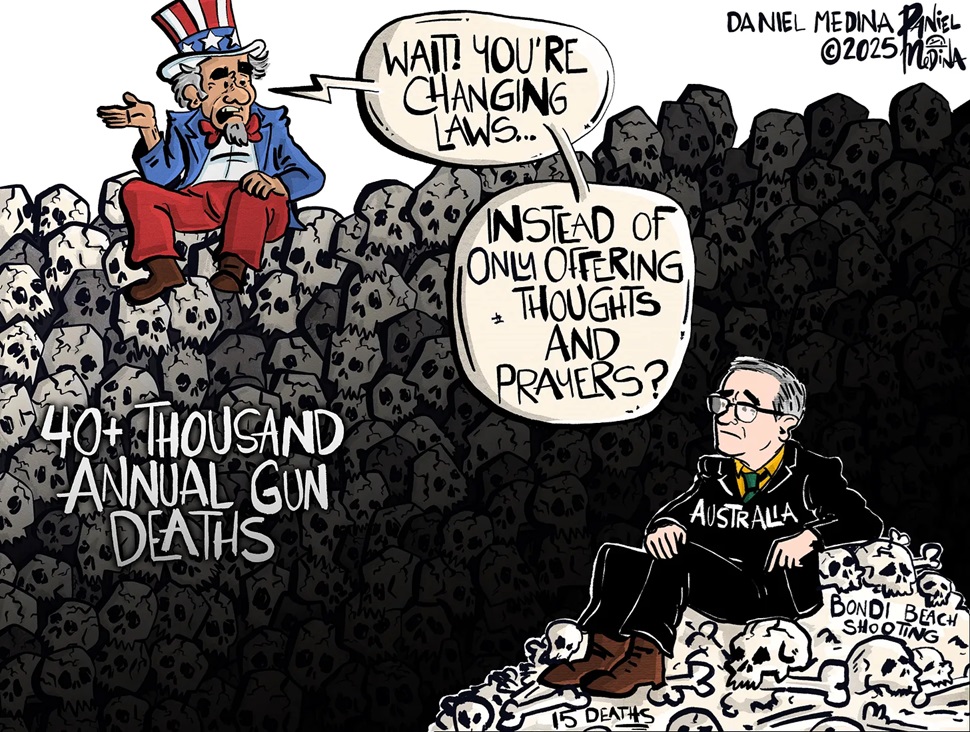
Racket cartoons, by Daniel Medina, https://racketcartoons.substack.com/p/wait-what?utm_source=post-email-title&publication_id=549592&post_id=181841928&utm_campaign=email-post-title&isFreemail=true&r=ln98x&triedRedirect=true&utm_medium=email, Dec 17, 2025
After the devastating massacre at Bondi Beach on Sunday, Australia’s PM and leaders promised to tighten gun laws to help make sure it never happens again. As an American reading this, and hearing more than just “thoughts and prayers,” I sat at my desk and felt deeply sad. Our country is so dysfunctional that we cannot handle even the basics of governing, let alone face the leading cause of death for American children: firearms.
What stood out to me was how quickly Australia’s leaders responded and how they seemed to agree that the government should act after something so terrible. In the United States, mass shootings are often followed by sadness but no action. It can feel like we accept these deaths as normal instead of trying to prevent them. Seeing another country treat gun violence as a problem they can fix makes our inaction even harder to understand.
The Israel Lobby’s War on Aussie Doctors
Since recording this video, the Victor Change Cardiac Research Institute has finally allowed Professor Macdonald to return to work. Thank you to everyone who helped achieve this important victory for free speech and our healthcare system.
1 This month

of the week – Australians for War Powers Reform (AWPR)
To see nuclear-related stories in greater depth and intensity
 Antinuclear