Tony Abbott’s subservience to climate denialists might be his undoing
 The conversation on global warming has been stalled because a shrinking group of denialists fly into a rage when it’s mentioned. It’s like a family with an alcoholic father who flies into a rage every time a subject is mentioned and so everybody avoids the elephant in the room to keep the peace.
For any political leader unwilling to exercise leadership on the issue, trying to respond to climate change leaves them uncertain which way to turn. Continue reading
Tony Abbott prepared to break his pledge on reducing carbon emissions

 Tony Abbott willing to break emissions pledge over funding hole The Age September 2, Jonathan Swan Opposition Leader Tony Abbott has branded the election a referendum on the carbon tax and said it would be “unimaginable” for a defeated Labor Party to stop him repealing the tax.
Mr Abbott also confirmed categorically – for the first time – that he would break the Coalition’s pledge on greenhouse reduction targets if it cost more money than he had budgeted for.
The Opposition Leader spent about 15 minutes of a 20 minute address to the National Press Club hammering Labor on the carbon tax. If elected the Coalition would repeal the tax within its first year in government, Mr Abbott promised………
Mr Abbott confirmed he was prepared to break the Coalition’s pledge to cut Australia’s greenhouse gas emissions by 5 per cent by 2020 (on the levels recorded in 2000). Estimates by Treasury and independent modelling companies suggest that the Coalition’s $3.2 billion Direct Action policy will fall several billion dollars short of reaching the targets.
“The bottom line is we will spend as much as we have budgeted, no more and no less,” Mr Abbott said. : http://www.theage.com.au/federal-politics/federal-election-2013/tony-abbott-willing-to-break-emissions-pledge-over-funding-hole-20130902-2t0fh.html#ixzz2dnJ1CXjy
Democratic Labor Party’s Geraldine Gonsalvez comes out swinging for a nuclear weapons free world
Geraldine Gonsalvez, 2 Sept 13, I am running as a candidate in the electorate of Bruce. As you all know how passionate I am about a peaceful toxic free world free of nuclear weaponsand weapons of mass destruction. You can be rest assured I will be active and vocal if by a miracle I do get elected to federal parliament towards this cause. This is a very busy week for me given my limited resources.
In Northern Territory electorate, Greens, Labor and Coalition candidates all oppose nuclear waste dump
 Solomon candidates against nuclear dump Bigpond News, August 30, 2013 Labor, the coalition and the Australian Greens rarely agree on anything, but the three candidates for Solomon are united in their opposition of a proposed nuclear waste dump in the Northern Territory.
At a community forum hosted by the ABC in Darwin on Friday, the candidates also debated marriage equality, voluntary euthanasia, housing affordability, hospitals, and schools funding.
Country Liberal Party incumbent Natasha Griggs, who holds the seat by a thin 1.7 per cent margin, said she crossed the floor on the nuclear issue to stand up for Territorians.
Greens candidate Todd Williams said: ‘The NT is viewed as easy and open and that can be foisted upon to store nuclear waste … against the wishes of traditional owners.’…….. http://bigpondnews.com/articles/Election-2013/2013/08/30/Solomon_candidates_against_nuclear_dump_901529.html
Newcastle Independent candidate calls for renewable energy in Hunter Valley
Independent calls for renewable energy manufacturing in Hunter Manufacturers Monthly, 30 August, 2013 Matt McDonald The former Kurri Kurri Aluminium Smelter site should be transformed into a hub of renewable energy manufacturing.
As the Maitland mercury reports, this is the opinion of Independent candidate for Newcastle Rod Holding.
Mr Holding believes the smelter site wNDIDATE CALLS FOR ould be a good starting point to his plan to transform other industrial areas in the electorate into renewable energy manufacturing hubs.
“It wouldn’t take a lot of money for the factories to be transformed so they could make generators or turbines,” Mr Holding said.
“There’s no reason why Newcastle can’t start exporting this technology to get away from the global warming fossil fuel disaster that’s ahead of us.”
He said that the plan would create local jobs, boost the regional economy, and also provide the Hunter with an alternative export to coal. Mr Holding said that, if elected, he would probably vote with the Greens in the House of Representatives…. http://www.manmonthly.com.au/news/independent-calls-for-renewable-energy-manufacturi
Greg Hunt (Liberal)’s carbon reduction plan based on dodgy facts
Fact Check, 30 Aug 13,
- “……..The claim: Greg Hunt says CSIRO research shows carbon emissions can be reduced by 20 per cent over 40 years using nature, soils and trees.
- The verdict: Mr Hunt quotes the figure for potential abatement accurately, but he leaves out the uncertainties and practical challenges in a large body of research and articles published by its scientists…..” http://www.abc.net.au/news/2013-08-30/greg-hunt-not-giving-full-story-climate-research/4923258
Abbott’s Direct Action climate plan will cost $35 billion more than budgeted for.
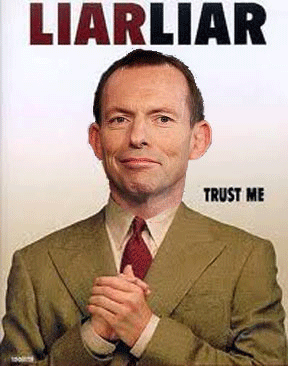 Report casts more doubt on Direct Action HERALD SUN, NICK PERRY AAP AUGUST 30, 2013
AN Abbott government would need to spend around $35 billion more than it has budgeted on its climate change policy to deliver its promised cuts to carbon emissions by 2020.
The findings from energy advisory firm RepuTex raise more doubts about whether the coalition’s Direct Action plan can reduce carbon emissions by five per cent by 2020 given the funding allocated……
Uncertainty over Liberal Coalition’s plans to cut renewable energy incentives
”What we’re heading into is a period of sustained high volatility in the industry. There is a high possibility that, if this is not managed correctly, we will all end up with much higher costs than we could have had.
”You can transform the energy system in a non-disruptive fashion or in a disruptive fashion … But ultimately it is going to be transformed.”
Money trail backs the clean energy revolution, SMH, Ben Cubby, Peter Hannam 31 Aug 13 “…….At present, the Coalition has promised to abolish the carbon price, the Clean Energy Finance Corporation and the Climate Change Authority – which will recommend the greenhouse gas reduction targets that will in turn influence renewable energy growth.
This week it also announced that it would cut funding to the Australian Renewable Energy Agency – an independent group that oversees about $3.2 billion in renewables investment, and which the opposition has previously said would be retained.
The exact nature of the newly pledged cuts remains obscure. ”There will be some savings over the forward estimates – those details will be out with the full costings before the election,” a spokeswoman said. Continue reading
Liberal Coalition flounders, – its Renewable Energy Policy based on bad advice
the Coalition – and in particular its energy spokesman, Ian Macfarlane – needs little encouragement to argue against wind and solar. But such decisions should not be based on false premises.
The dangerous thinking behind Coalition renewable energy policy (excellent charts and graphs) REneweconomy By Giles Parkinson on 29 August 2013 The Coalition’s admission this week that it had thrown the Australian Renewable Energy Agency into the basket of climate change and green energy programs  to be cut if elected should not have taken people by surprise, because they have been hinting at it for a few months.
But it does raise questions about where the Coalition is heading with its energy policies, and why there appears to be such deliberate moves to wind back support mechanisms for wind energy and solar, and other emerging renewable technologies.
Part of the problem may be in the quality of the advice it is receiving. Many in the Coalition defer to the Institute of Public Affairs when asked about climate change and renewables policies. The IPA, of course, is a right-wing think tank  that doesn’t accept the science of climate change, and argues against climate and clean energy policies.
More recently, Greg Hunt has been using the work of Bjorn Lomborg to justify Direct Action. Lomborg, as we discussed in last month’s piece, is known for downplaying the dangers of climate change, for arguing that renewable energy should not be deployed until costs are reduced in research labs, and for suggesting that wacky “geo-engineering” schemes such as cloud whitening should be priorities.
That may explain why the Coalition is now targeting ARENA, whose job it is to help take technologies out of the lab and actually deploy them. The Coalition also intends to shut down the Clean Energy Finance Corp, which plays a similar role, as well as the Climate Change Authority, which conducted last year’s review of the Renewable Energy Target. The Coalition wants the RET to be reviewed yet again, but not by the CCA. The uncertainty is already causing Australia to fall down the ranks of investment attractiveness.
Another document that may be influential in Coalition thinking was circulated in recent months by one of its so-called “star” candidates, Angus Taylor, the anti-wind campaigner who is seeking election in the seat of Hume in NSW. Continue reading
Tasmania’s Labor and Liberal vote down Greens’ plan for moratorium on fracking
 Greens lose vote to introduce a moratorium on fracking MATT SMITH MERCURY AUGUST 29, 2013THE Tasmanian Greens’ push for a moratorium on the mining practice of fracking has been voted down by Labor and the Liberals. Greens MP Tim Morris said his party would continue to work with concerned landowners, businesses and communities to protect the best interests of Tasmania’s environmental and economic future…… HTTP://WWW.THEMERCURY.COM.AU/NEWS/TASMANIA/GREENS-LOSE-VOTE-TO-INTRODUCE-A-MORATORIUM-ON-FRACKING/STORY-FNJ4F7K1-1226706169520
Radio: Adelaide the hub of military industrial intelligence nuclear complex
The issue isn’t nuclear power. The issue is processing uranium for nuclear power that then can be used for defence
You have to understand this in terms of in terms of Adelaide, -it’s a military industrial intelligence complex
Simons is connected to the University College of London but basically he’s a front man for business interests, We can clearly question what he is doing given the fact that he’s getting funding from indirect corporate sources.

 AUDIO: https://radio.adelaide.edu.au/nuclear-power-in-south-australia-a-golden-age/ Nuclear Power in South Australia – a golden age? Radio Adelaide 23 Aug 13 Chris Komorek spoke with Dr David Palmer from Flinders University to explore the changing landscape. Produced by Ian Newton. TRANSCRIPT by Christina Macpherson
Chris Komorek As the uranium debate heats up, so does the destroyed reactor in Fukushima, Japan.The International Energy Policy Institute at the University College London’s Adelaide campus is advocating a ramped up nuclear industry here in South Australia. We’re joined by Dr David Palmer from Flinders University.
Australia’s third force gathers strength: Christine Milne and The Greens
Inside the Greens circus, minus Bob and the freaks CRIKEY GUY RUNDLE | AUG 28, 2013 The Greens are still slightly in awe that they are a real, live party, as the Green tide rolls on….
Gripping the lectern, clad in a jacket as green as a rainforest or a roulette baize, Greens leader Christine Milne is in full flight, but stops for the laugh. Reminds herself, perhaps, to stop for the laugh. “I know, but it’s true …” Then she ploughs on. She looks Margaret Thatcher, she looks like your schoolteacher, she looks like a church lady, most ungreen, her delivery is wooden, reserved, there’s something held back, but she’s wowing the crowd, a couple of hundred Greens, come in from Canberra and the backblocks, all the senators and Adam Bandt people looking at them with “wow, there’s quite a lot of us, we’re kinda of a real party”, and a few enthusiasts/tragics flown in from the event.
Her speech on Saturday at the Greens’ national campaign launch is hard-edged, upfront political, and eschews a lot of the more spiritual themes that former leader Bob Brown might have put in. She announces refugee treatment inquiries, a Clean Air Act, a party whip vote on equal marriage; every time, rolling back Labor’s welfare cuts, bang, bang, bang, and you get a picture of her parliamentary style: no-nonsense and forthright………

Indeed, it’s a new Greens style of sorts, fitting with the fact that they are, in some ways, the new natural party of government, not now, not even soon, but sometime, when more of the world looks like Canberra — if it doesn’t all end up looking like Fallujah — and knowledge production has so infused so much of the overall system that social classes have been substantially transformed. That gives the new Greens not only a seriousness, a demeanour that has no special pleading about it, but also, of all things, a mild born-to-rule mien, a new class sheen. ….
Formidable, and with a party at as good a level of support as it’s ever been, she seems ready for whatever may come on Threatened Species Day, September 7. http://www.crikey.com.au/2013/08/28/rundle-inside-the-greens-circus-minus-bob-and-the-freaks/
Parkes electorate could have bright economic future, with Greens renewable energy plan
Parmeter backs renewable energy Moree Champion 28 Aug 13 GREENS candidate Matt Parmeter visited Moree on Friday as part of his election tour around the whole of Parkes. Mr Parmeter is a civil engineer from Dubbo, he has two children and lives and works all around the area. Whilst in Moree last week, he visited many business houses and greeted locals to tell them about his passions and concerns.
He said his big passion was for renewable energy and told the Moree Champion how excited he was to see the Moree solar farm plans going ahead.
“The Greens have strong policies in place for the electorate to help increase jobs. Jobs develop the economy but the only way to get more jobs is to introduce new industries and I believe renewable energy is that new industry,” he said.
The Greens have been supporting four ideas to help the renewable energy industry grow and develop with one of those being a bank dedicated to renewable energy projects.
“By supporting this bank we can up the capital to see the go-ahead for projects needing large amounts of money to flourish,” Mr Parmeter said….. http://www.moreechampion.com.au/story/1737760/parmeter-backs-renewable-energy/?cs=8
How to destroy renewable energy funding – vote Liberal
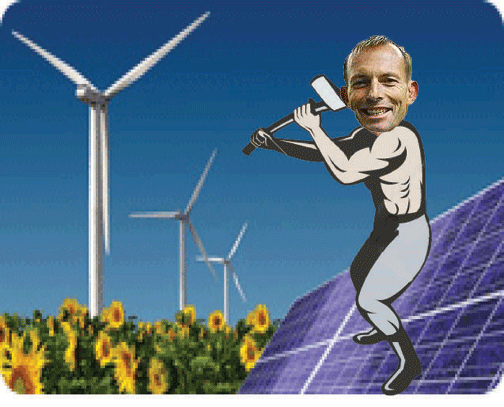 Coalition Intends To Gut Renewable Energy Funding http://www.energymatters.com.au/index.php?main_page=news_article&article_id=3913 29 Aug 13 Among its axing of renewable energy programs, the Coalition has announced it also intends to cut funding to the Australian Renewable Energy Agency (ARENA).
In addition to dismantling the Clean Energy Future package and shutting down the Clean Energy Finance Corporation; ARENA is also in the Coalition’s crosshairs – however at this point in time how much funding will be slashed is unclear.
ARENA was provided approximately $3 billion to invest in renewable energy projects until 2022. Currently, around $2 billion is uncommitted and available for ARENA to invest in qualifying projects.
Dr Geoff Evans, Campaign Manager for 100% Renewable, says Tony Abbott and the Coalition appear to be ignoring community sentiment in relation to renewable energy in Australia.
“Australians overwhelmingly support an increase in renewable energy. We want government to support a transition to clean energy and to be a world leader in investment and jobs in clean energy.”
“But, based on today’s announcement, it seems like Tony Abbott and the Coalition aren’t listening to Australians, and that the incentives and market security essential for investment are under threat.”
ARENA commenced on July 1, 2012 and was established to support innovations to improve the competitiveness of renewables; plus increase the supply of renewable energy in Australia.
Dr. Evans says while the Coalition claims to be the “party of jobs and business”; the announcement to gut ARENA directly contradicts this.
“If the Coalition wants to win next week, they need to ensure they are listening to Australians. And ordinary Aussies are overwhelming saying the same thing: more renewables, not less,” Dr Evans says.
100% Renewable is a community campaign for clean energy. The group is behind initiatives such as Solar Scorecard; which rates how local politicians stand on issues relating to renewable energy. 100% Renewable also leads Solar Citizens; a project bringing together existing and potential solar owners to ensure the rights of solar owners are protected and to help further Australia’s rooftop solar revolution.
Fact Check: Abbott using outdated figure on carbon tax cost to households
Opposition Leader Tony Abbott says households will be hundreds of dollars better off if the Coalition scraps the carbon tax.
“We’ll scrap the carbon tax so your family will be $550 a year better off,” Mr Abbott said at the Liberal Party’s campaign launch on Sunday.
The figure also appears in the Coalition’s formal policy document.
http://www.abc.net.au/news/2013-08-28/abbott-using-outdated-figure-on-carbon-tax-cost/4912726
1 This month
17 October, Free Public Talk on Nuclear Issues in South Australia
David Noonan will speak on public interest concerns over the new Roxby Downs Indenture Act 2026 on BHP copper-uranium mining and ore processing in SA, and on how AUKUS may face SA with a High-Level nuclear waste agenda.
Dr Jim Green will discuss international developments in the field of nuclear power including ‘small modular reactors’ and Generation 4 ‘advanced’ nuclear reactor concepts.


Help Aunty Sue Protect Her Land and Sacred Sites From Destructive Rocket Testing.
.

Australians deserve the truth
about
AUKUS – https://aukuspublicinquiry.com/

PETITION – To: Prime Minister Anthony Albanese and the Australian Labor Government

of the week – Australians for War Powers Reform (AWPR)
To see nuclear-related stories in greater depth and intensity

