Australian govt to expand its nuclear industry at Lucas Heights, Sydney
 Govt to invest $168m in nuclear medicine 9 News Sep 19 2012 The federal government says it will get a $1 billion return from investing $168 million in nuclear medicine and treatment to create jobs, and help half a million Australians and millions of people around the world.
Senator Chris Evans, Minister for Science and Research, has announced the investment plan to construct a nuclear medicine manufacturing plant and a world first Synroc plan will generate 250 jobs.
It will be delivered by scientists at the Australian Nuclear Science and Technology Organisation (ANSTO) at Lucas Heights using the existing low-enriched uranium reactor.
The nuclear medicine manufacturing plant will secure Australia’s ability to produce Molybdenum-99 (Mo-99) which is used for diagnosis of heart disease, cancers, and kidney and gastrointestinal tract
disorders, Senator Evans said…
..Today is an important day for the 550,000 people who require a nuclear medicine procedure in Australia each year, as well as the 45 million people across the globe who will be able to access Australian-produced nuclear medicine,” Senator Evans said.
Australia will earn a return by meeting half the world’s needs for Mo-99, he said…. http://news.ninemsn.com.au/article.aspx?id=8535511
Greens urge PM to raise human rights and nuclear safety on India tour
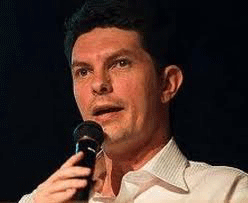
 Senator Scott Ludlam. 16 September 2012. The Australian Greens have urged the Prime Minister to use her impending visit to India to speak out on the ongoing repression of Indian communities opposed to nuclear power.
Massive protests against new reactors in India are adding to the global pressure on the slumping nuclear power industry.
Greens Senator Scott Ludlam said the democratic right to protest was being steamrolled by the Indian police.
“In Koodankulum nuclear reactors are being forced on local residents at gunpoint, and uranium fuel loading is imminent despite 10 safety guidelines having not been met. Brutal repression has been carried out by the police against tens of thousands of peaceful protestors at the reactor. Two people have been shot dead by police, most recently Anthony Samy just five days ago. There have been at least five deaths in the struggles against Koodankulam, Jaitapur (Maharashtra) and Gorakhpur (Haryana) nuclear power plants since 2010.
“In 2011 one of India’s pioneer nuclear scientists and formerly a member of India’s Atomic Energy Commission, Dr MP Parameswaran, said India should suspend its entire nuclear program because of safety risks and the unresolved problem of nuclear waste.
“Earlier this year India was ranked 28th out of 32 countries in terms of the security of their nuclear stockpiles. Making matters worse, the new Nuclear Safety Regulatory Authority (NSRA) has fewer powers and less independence than the previous Atomic Energy Regulatory Board. The NSRA is a puppet body: answerable to a handful of government ministers who can issue orders to the body, and sack its members.”
Senator Ludlam will move a motion for the Senate to call on the Prime Minister to make nuclear safety, nuclear proliferation, and the human right to peaceful protest major issues in her October visit to India.
Media Contact: Giovanni Torre – 0417 174 302
More details:
Nuclear safety in India: http://greensmps.org.au/content/media-releases/indian-nuclear-security-ranked-among-worst-world-will-labor-persist-uranium-s
The anti-nuclear struggle in India: http://greensmps.org.au/content/media-releases/greens-urge-uranium-rethink-anti-nuclear-movement-besieged-india
India and nuclear proliferation: http://greensmps.org.au/content/media-releases/labor-backflip-uranium-sales-india-unethical-illogical-and-probably-illegal
NSW govt pushes ahead in promoting uranium exploration
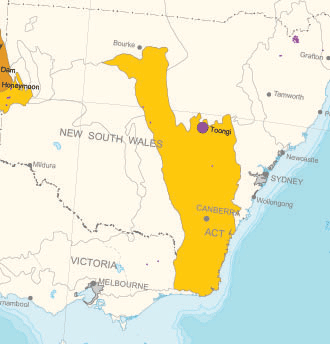
map shows (yellow) area where uranium might be explored for
NSW explores uranium mining, Australian Mining, September, 2012 Vicky Validakis NSW Resources Minister Chris Hartcher announced on Saturday the government was open to expressions of interest from miners wanting to
explore Group 11 minerals, which includes uranium and thorium, The Australian Financial Review reported. ..
… The announcement follows the government’s controversial move to overturn the state’s 26-year ban on uranium exploration.
Legislation overturning the exploration ban passed through the state’s upper house unamended, despite opposition from Greens and Labor MPs, who said the government had no mandate…… Applications will close
on November 13. http://www.miningaustralia.com.au/news/nsw-explores-uranium-mining
Queensland’s LCP govt backflips on its election promise to keep ban on uranium mining
Environmentalists says LNP reneging on uranium ban agreement THE AUSTRALIAN 17 September, 2012 Cole Latimer Green groups say the Queensland Government has backflipped on its promise to ban uranium mining after opening discussions on the metal’s future on Friday.
QLD mines minister Andrew Cripps opened the floor for discussion last week after the Queensland Resources Council and the Australia Uranium Association called on Campbell Newman’s Government to make a decision on uranium’s future…… ACF spokesperson Dave Sweeny said the LNP has previously pledged to keep the uranium ban in place, The
Australian reports .
“We remind the Queensland government and the LNP they went with a clear commitment to the people they had no intention to expand or facilitate the uranium industry in Queensland,” he said.
We will actively take part in this debate highlighting the costs and consequences both here and overseas,” he said.
“Don’t forget Australian uranium was inside Fukushima (nuclear reactors in Japan) when it melted down. “Rocks from Kakadu are now causing radioactive fallout.”
It comes only days after Australian uranium miner Energy Resources of Australia (ERA) was accused of ‘stealthily’ attempting to mine uranium.
Anti nuclear waste candidate elected to Auburn City Council, New South Wales
 Fourth socialist elected to a local council in Australia, Green Left, September 14, 2012 By Peter Boyle, SydneyThe Communist Party of Australia’s (CPA) Tony Oldfield was elected to Auburn Council in the NSW local government elections on September 8. He became the fourth socialist to be elected as a local councillor around the country. The others are Sam Wainwright (Socialist Alliance, Fremantle Council) and Steve Jolly and Anthony Main (Socialist Party, Yarra City Council, Victoria).
Oldfield was elected as part of a local community activist group called “The Battler” . The group has been campaigning to stop the Coalition state government sending radioactive waste from the north shore suburb of Hunters Hill to a storage facility in Lidcombe….. http://www.greenleft.org.au/node/52229
Renewed lobbying for uranium mining in Queensland
 Federal Resources Minister Martin Ferguson, in a speech to the uranium industry in June, called on Queensland to lift the ban. “The Australian Government urges Queensland to take the next step and to also remove its ban on uranium mining
LNP silent on uranium mining front Gympie Times, Daniel Burdon, APN Newsdesk | 13th September 2012 A RENEWED push by the state resources lobby to reopen Queensland to uranium mining has been met with silence by the Newman Government. Continue reading
Importance of keeping Australia’s Renewable Energy Target unchanged
Australia’s Renewable Energy Target – Stability Crucial http://www.energymatters.com.au/index.php?main_page=news_article&article_id=3381 by Energy Matters, 14 Sept 12, Flip flops isn’t just an American term for a popular form of Aussie footwear; it also describes our country’s approach to renewable energy at times – and to our detriment.
The Federal Government’s Climate Change Authority is currently undertaking a review of Australia’s Renewable Energy Target, currently set at 20 per cent of Australia’s energy to be gained from renewable sources by 2020. The Clean Energy Council has called for the Federal Government to ensure the Renewable Energy Target remains unchanged, stating that it was crucial to promoting investment, driving job creation and continuing to push down costs for consumers. “The Renewable Energy Target is the single most important policy measure for the entire Australian renewables sector,” said Clean Energy Council Chief Executive David Green.
“Any changes to the Renewable Energy Target will shatter this stability and remove investor confidence in clean energy, negating the industry’s ability to support Australia’s shift to clean energy sources and to reduce energy costs for consumers in the long-term. The fact a review is even being held is already contributing to uncertainty in the market.”
The CEC believes alterations to policy could damage returns on investments already made and consequently, Australia’s reputation with regard to energy infrastructure investment.
The organisation states the Renewable Energy Target has generated around $18.5 billion of investment and thousands of jobs, seen 1.7 million home solar power and solar hot water systems installed and resulted in the equivalent of more than 2.1 million households being powered by large scale renewables to date.
“To date, it has also been the single largest carbon abatement scheme in Australia and without it Australia would not have achieved its emissions reductions target under the Kyoto Protocol,” says Mr. Green.
Left untouched, current policies would see a further $30 billion in investment and a total reduction of 380 million tonnes in carbon emissions over the life of the scheme.
“The cost of the Renewable Energy Target contributes just 7 per cent to the average Australian electricity bill, and this is forecast to drop to just 4 per cent by 2020 – with even greater potential savings as we all become smarter about how we use our energy.”
Submissions in response to an initial issues paper released by the Climate Change Authority are due today. The Clean Energy Council’s submission can be viewed here .
Darwin City Council worried about Muckaty nuclear waste dump plan
 Darwin council concerned about nuke dump safety http://www.abc.net.au/news/2012-09-12/darwin-council-seeks-safety-assurances-over-nuke-dump/4257828?section=nt Kristy O’Brien The Darwin City Council wants to know what safety systems would be in place for transporting waste from the proposed Muckaty Station nuclear dump near Tennant Creek.
The council has weighed into the debate about Australia’s first nuclear waste dump which is expected to be built at Muckaty Station. Councillors want the Local Government Association of the Northern Territory (LGANT) to seek advice about risk management systems for transporting nuclear waste.
Lord Mayor Katrina Fong Lim says the waste would be taken to Muckaty Station on Northern Territory roads, railways or through the Darwin Port. “It is actually about the risk management of how it could go,” she said.
The council also wants LGANT to press the Federal Government for an inquiry into whether Muckaty Station is an appropriate place to store nuclear waste.
Sneaking nuclear power into NSW the Thorium way?
 Citizens’ jury puts nuclear on the table http://m.smh.com.au/environment/energy-smart/citizens-jury-puts-nuclear-on-the-table-20120910-25ol6.html SMH, SEAN NICHOLLS September 11, 2012 A ”CITIZENS’ JURY” has recommended the government start a discussion about nuclear power stations in NSW as an issue that ”should not be dismissed”.
The jury of about 25 people from Sydney was one of two invited by the Parliament’s public accounts committee to participate in an inquiry into alternative energy. The other was from the New England area.
The juries were chosen by the New Democracy Foundation whose members include the chairman of Infrastructure NSW, Nick Greiner, and the former premier of Western Australia Geoff Gallop. Its founder is the executive director of Transfield Holdings, Luca Belgiorno-Nettis.
The Sydney jury’s report, released yesterday, urges the government to initiate ”informed public discussion” into ”emerging nuclear technologies” such as thorium as an energy source. ”The unanimous view of the jury was that the proposed issue of nuclear power generation should not be dismissed,” the recommendation – one of five – says.

”A minority view (10 per cent) supported starting deployment in the immediate future. While this view was not shared, the jury was in agreement that the topic should be discussed in greater detail withthe Australian public.”
The government is preparing to proclaim legislation that will overturn a 26-year ban on uranium exploration.
The Energy Minister, Chris Hartcher, and the Premier, Barry O’Farrell, have been at pains to deflect opposition claims that this could lead to nuclear power.
Mr Hartcher has previously said the decision was not about providing an alternative energy source to electricity generation. Unlike uranium, there is no ban on exploration or mining of thorium in NSW.
In its report, the New England jury said the community had no confidence in uranium-based power. But it also said the same applied to coal seam gas and neither should be pursued until that improved.
In an awkward recommendation for the government, it says the electricity distribution businesses, or ”poles and wires”, should be kept in public ownership. Mr O’Farrell has ruled out selling the poles and wires this term but has left the door open to taking it to the next election to raise infrastructure funds.
The chairman of the public accounts committee, Jonathan O’Dea, said the reports, which will be included in the committee’s final report, would be discussed on Thursday. A spokeswoman for Mr Hartcher said he would await the final report
before considering any recommendations.
New South Wales’ dud renewable energy plan
O’Farrell’s Renewables Goal ‘Realistic, But Plan Is A Dud‘ http://www.energymatters.com.au/index.php?main_page=news_article&article_id=3373 by Energy Matters, 9 Sept 12, Greens NSW MP John Kaye says a draft Renewable Energy Action Plan for New South Wales fails to call off the O’Farrell government’s war on rooftop solar and wind power.
Dr. Kaye believes the plan, if implemented in its current form, will lock NSW into a coal-fired future with jobs and investment “set to continue to haemorrhage out of the state”.
Unveiled on Friday, the Plan outlines 28 actions the Government says will help NSW meet its 20% renewables by 2020 target. Energy Minister Chris Hartcher says only the best value for money solutions will be adopted; delivering investment and jobs “at no cost to consumers”.
“The goal is realistic but the plan is a dud. Without a commitment to lowering the barriers that are stunting wind and solar investment, cuts to greenhouse gas emissions and the tens of thousands of new jobs will be nothing but a pipedream,” said Dr. Kaye
With regard to small scale solar, the only action listed under the plan is to “Annually request IPART to estimate a benchmark range for a fair price for small-scale generated solar energy.” The benchmark range recommended by IPARTfor 2012/13 is 7.7 – 12.9c per kilowatt hour – and is voluntary.
To support medium-scale solar power, the NSW Government will work with industry identify commercial sites where it will be cost effective and facilitate uptake for commercial buildings through the Renewable Energy Advocate.
“The failure to reverse the O’Farrell government’s policy hostility to wind and solar will turn the promised 6,000 new jobs into nothing more than a fantasy.”
“Parliamentary Secretary Rob Stokes worked hard to produce a new deal for renewables. It’s clear that he was badly undermined by his Minister Chris Hartcher and the fossil fuel lobby who want clean energy technology to remain a boutique industry that does not interfere with their profits.”
The Plan is available here and public comment is invited. Submissions will be accepted until 26 October 2012.
Australia’s Liberal States, especially Queensland, fight renewable energy
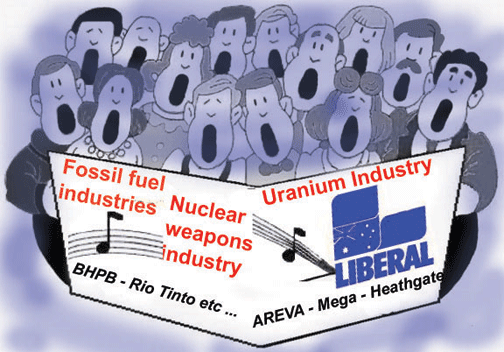 Newman’s antipathy to green energy runs deep.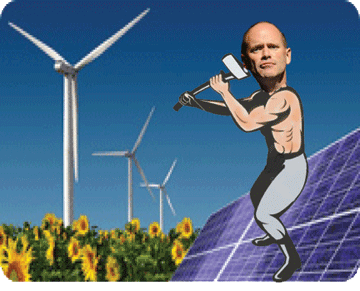
Campbell Newman’s war on green energy REneweconomy By Giles Parkinson 6 September 2012 It looks like the clean energy industry is going to have to go back to basics when dealing with the new conservative government in Queensland – just as it has had to do in Victoria, with that state’s Coalition government. Tomorrow, when the NSW Coalition government releases its renewable energy plan, it will learn if it will have to do the same there.
In Queensland, however, the industry is right back at first base. Not that it ever really left it: it is the one state that has hardly any large-scale renewable generation, apart from a series of biomass plants from sugar cane plantations and a single 12MW wind farm.
Premier Campbell Newman signalled his approach to renewables early in his term when he decided he didn’t want to put any state money into the Solar Dawn consortium, or any other renewable energy project for that matter, and announced he would disband the state’s climate change and renewables program. His approach was that the if federal government had a carbon tax and a renewable energy target, then Canberra should pay for it. It wasn’t the state’s business.
That might sound fine on the stump, or in a sound bite on radio talkback, but it’s actually self-defeating. The law states that each electricity retailer must provide a certain amount of renewable energy to its customers, paid for by renewable energy certificates, and that includes Queensland utilities.
If they don’t build renewable energy in their own state, then that money will simply be spent on projects being built by the southerners – be it in NSW, Victoria or South Australia. Continue reading
Baillieu governs in the interests of the fossil fuel lobby, damaging the wind farm industry
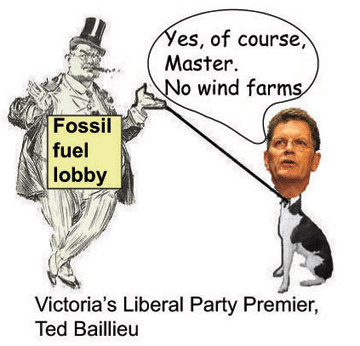 Victorian wind farm laws: a blow to Australia’s clean energy future? , The Conversation, Lisa Caripis Research assistant, Centre for Resources Energy and Environmental Law at University of Melbourne Anne Kallies PhD Scholar at University of Melbourne 4 September 2012,
It’s been just over one year since the Baillieu government introduced the second part of its far-reaching planning law reforms to restrict the development of wind farms in Victoria. The results are an example of how state planning law can be a barrier to achieving national renewable energy goals.
With a majority in both houses of Parliament, the Coalition was able to amend Victoria’s planning framework unhindered to deliver on its 2010 election promise to “restore fairness and certainty to the planning process for wind farms”.
In pursuit of this aim, the planning amendments most notably impose a blanket ban on wind farms in many parts of the state. They effectively give the owners of any dwelling within 2km of a proposed wind farm the power to decide whether or not the development should proceed. A July 2012 amendment clarifies that these changes are targeted at wind farms generating electricity for supply to the grid, not for on-site use.
Economically, reports indicate that the impacts of these changes in terms of lost or stalled wind farm investment and employment have been considerable, in a state that has some of Australia’s best wind resources. While promising to “give the community a greater voice” through these changes, the amendments instead render local, pro-wind initiatives, such as community wind farm projects impossible in many locations .
Not only do the planning law changes have the potential to entrench existing fossil fuel power generation in Victoria, they undermine the Victorian Government’s commitment to the federalRenewable Energy Target (RET).
The RET is designed to ensure that 41,000 GWh – close to 20% – of our electricity comes from large-scale renewable energy by 2020. It implicitly relies on implementation through state and territory planning frameworks, because decisions about what kind of development can take place and where rest with the states. The Climate Change Authority , which reviews the RET, notes
State and territory planning regulations may affect the level of renewable energy generation, its mix, and the geographic distribution of renewable power stations.
This can cause problems when state laws are out of step with national targets, as the electricity market rule-maker pointed out last year . It is of some concern that New South Wales draft guidelines also adopt the 2km consent rule and impose a noise assessment regime stricter than in any other jurisdiction in Australia, the United States or Europe….. http://theconversation.edu.au/victorian-wind-farm-laws-a-blow-to-australias-clean-energy-future-9163
Victoria’s Premier Baillieu – out to destroy renewable energy
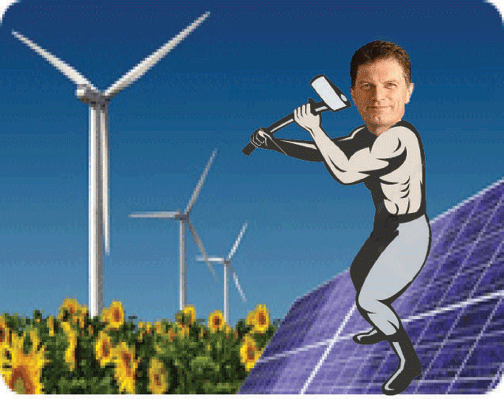 Victorian Solar Incentive Cut – Reactions http://www.energymatters.com.au/index.php?main_page=news_article&article_id=3366 by Energy Matters, 3 Sept 12, The new, “fairer” feed-in tariff for roof-top solar panels in Victoria appears to be anything but – and the race is on for households to secure the higher rate before the deadline hits. The new tariff will be slashed from the current 25c + up to 8c electricity distributor contribution to just 8c per kilowatt hour for households lodging the necessary paperwork after September 30. The rate will be adjusted annually in line with the wholesale electricity rate. According to Melbourne-based Energy Matters, the deadline provides little – and in many cases, no time – for households to acquire a system.
The company is urging those considering solar panels to call Energy Matters on 1300 727 151 as soon as possible to discuss what the change will mean to them, as it will vary according to circumstances. Environment Victoria was particularly scathing of the changes, stating the Baillieu Government has broken a key election promise to provide ‘fair reward’ for solar households.
“Ted Baillieu has dumped his promise to support the Mallee solar farm, he’s made it harder to build a wind farm than a new coal-fired power station, and now he’s slashed household and business solar support. At the same time he’s handing out tens of millions in cash to the big coal companies,” said Victoria McKenzie-McHarg. “It’s fair to ask what this government has against clean energy?” she said. The Clean Energy Council stated the rate was too low. We’re obviously disappointed at this decision to reduce support for solar power, which will make it harder for everyday Victorians to reduce their power bills and put industry jobs under pressure,” said Clean Energy Council Policy Director Russell Marsh. Labor’s energy spokeswoman, Lily D’Ambrosio, slammed the decision.
”The Baillieu government has again shown it just doesn’t care about supporting families who want to reduce their energy costs while also doing their bit for the environment,” Ms. D’Ambrosio said according to a report on The Age web site. Information from Energy Matters’ web site shows a good quality 5kW solar power system installed in Melbourne can slash a household’s electricity costs in the region of $1,920 annually under the higher feed in tariff incentive arrangements; an amount that will be significantly eroded under the new system.
Mad monk Abbott also ignorant – about uranium mining
 Abbott Out Of His Depth On Mining, New Matilda , 27 Aug 2012 Does Tony Abbott understand the Australian mining sector? His inept response to the Olympic Dam announcement showed him mangling the basics of public policy, writes Ian McAuley Last week BHP-Billiton announced that their profit had fallen from $US32 billion in 2010-11 to a mere $US27 billion last year, and that they were shelving their $30 billion Olympic Dam expansion. . Tony Abbott’s commentary on the event exposed him as an Opposition Leader way out of his depth and brought forth confusing statements about the progress of the resource boom.
Abbott’s claim that the carbon tax and the minerals resource rent tax (MRRT) were behind the decision to drop the Olympic Dam expansion was quite at odds with the company’s announcement that the decision was about capital construction costs and “subdued commodity prices”.
The resources at Olympic Dam are uranium, copper and gold, none of which is subject to the MRRT. If anything, global action on climate change should have been expected to boost uranium demand, but the price of uranium oxide has fallen from a peak of $US290/kg in 2007 to around $US110 now, the Fukushima accident and the tumbling price of gas and photovoltaics having dampened any expectation of a price recovery…. http://newmatilda.com/2012/08/27/mining-puts-tony-out-his-depth
Be wary that BHP might push for further environmental concessions for Olympic Dam uranium site
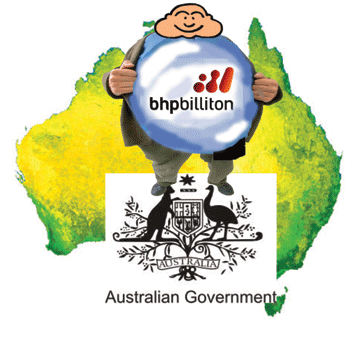 The Guardian Australia 29 Aug 12, “………South Australian Premier Jay Weatherill is also doing his best to sound optimistic in the light of the Olympic Dam decision. Though his predecessor Mike Rann signed a shamefully generous indenture agreement with BHP Billiton in December last year, it wasn’t enough to satisfy international capital. BHP may use the current unsettling situation to press for the bending of the environmental rules to allow for the speedy introduction of the
notorious acid leeching extraction method at the site….
Abbott will step up the anti-union assault even further than Gillard to deliver the conditions transnational investors want.
Lost in all of these events and threatened changes are the wishes and needs of the Australian people. They don’t want a future dependent on exports of uranium to countries like the US where they enable the production of nuclear weapons and depleted uranium shells. They don’t want the wishes of the Aboriginal people ignored or the environment sacrificed to boost the bottom line of transnational corporations.
They don’t want to have to beg profit-bloated transnationals to make a suitable tax contribution out of the fortunes still being made out of resources that rightfully belong to the whole people. They want a sustainable, pro-people economy….
http://www.cpa.org.au/guardian/2012/1562/01-workers-warned.html
1 This month
17 October, Free Public Talk on Nuclear Issues in South Australia
David Noonan will speak on public interest concerns over the new Roxby Downs Indenture Act 2026 on BHP copper-uranium mining and ore processing in SA, and on how AUKUS may face SA with a High-Level nuclear waste agenda.
Dr Jim Green will discuss international developments in the field of nuclear power including ‘small modular reactors’ and Generation 4 ‘advanced’ nuclear reactor concepts.


Help Aunty Sue Protect Her Land and Sacred Sites From Destructive Rocket Testing.
.

Australians deserve the truth
about
AUKUS – https://aukuspublicinquiry.com/

PETITION – To: Prime Minister Anthony Albanese and the Australian Labor Government

of the week – Australians for War Powers Reform (AWPR)
To see nuclear-related stories in greater depth and intensity

