Strong opposition to the Labor-Liberal nuclear waste dump legislation
 Nuclear dump protesters disrupt Parliament ABC News, http://www.abc.net.au/news/2012-03-13/nuclear-dump-protesters-disrupt-parliament/3886614 March 13, 2012 Anti-nuclear protesters have tried to stop debate in Federal Parliament on legislation for Australia’s first national nuclear waste dump.
 The Government’s bill to establish the dump has been passed in the Senate with Opposition support. The Greens and independent senator Nick Xenophon opposed the legislation.
A group in the public gallery disrupted proceedings, calling out for the dump to be stopped. They are concerned it will be built on Aboriginal land at Muckaty Station, near Tennant Creek, in the Northern Territory.
The Government has consistently stated the legislation did not specify a site for the dump. But it has offered to give the Northern Territory $10 million if it accepts the waste dump.
Greens spokesman on nuclear issues Scott Ludlam says he is confident the community will continue to fight any plan to use the Northern Territory site. “That is the unnecessary fight that this Government has picked in a bipartisan consensus with the Opposition who opposed it in the first place,” he said.
“This is the beginning of the campaign to stop Muckaty, not the end.” Mr Ludlam says the Greens will continue to fight the project. “The site is in an earthquake zone, it floods regularly, there are very long transport corridors, there are no jobs being applied and it’s opposed from people on the ground, on the front line from Tennant all the way up to the NT Government and people around the country,” he said.
 Donna Jackson, from the Australian Nuclear Free Alliance, says she is shocked the legislation has been passed while there is still a legal challenge before the courts about the ownership of the Muckaty site. “Look I honestly didn’t think that they would have the gall to pass this legislation given that the court case is still happening,” she said. “I’m not sure if it set a precedent but I’m not aware of any other bills passing while there is still a court case in action.” Jimmy Cocking from the Arid Lands Environment Centre says it is a sad day for the Territory and the country. “If all of a sudden this starts happening and they construct a nuclear waste facility north of Tennant Creek, the transport of this radioactive waste across the country is going to be a subject of concern with local councils across the country,” he said.
Apart from Greens amendment Australia’s Nuclear Waste Bill is bad legislation

 Nuclear waste dump plans pass Senate SBS World News, 13 March 2012 Legislation to establish Australia’s first national nuclear waste dump has passed the Senate, the ABC reports, paving the way for a dump at Muckaty Station in the Northern
Territory.
The Northern Territory government and various local clan groups are opposed to the plan to build a medium-level nuclear waste dump on the aboriginal land north of Tennant Creek….. Anti-nuclear activist Nat Wasley told the Green Left Weekly she welcomed Greens Senator Scott Ludlam’s amendment that international waste cannot be stored at the facility but said the rest of the legislation ‘Is neither new nor good.
It builds on the mistakes of the Howard era and lacks credibility and consent. There are still many hurdles for the government before a dump is up and running, and this proposal will be challenged every step of the way.’…
A dispute over who owns the land in question continues to complicate affairs – a Federal court case is yet to decide if the indigenous group who signed the deal to put Muckaty station in the running to hold the waste are the true owners.
 Resources Minister Martin Ferguson’s reitereated the an earlier pledge not to proceeed until the court case is decided, Fairfax reported. ‘In relation to litigation in the Federal Court concerning the nominated land, the Government will not act on this site until this matter is resolved by the Court’, he said….. Muckaty is the only site nominated under the current proceedings.
http://www.sbs.com.au/news/article/1633901/Nuclear-waste-dump-plans-pass-Senate
In the interests of their fossil fuel backers, Liberal Party attacks wind energy
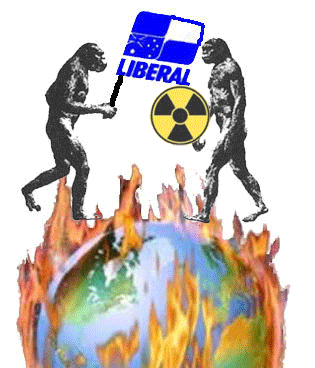 Is Rowan looking after the interests of his constituents, or of the fossil fuel industry? He is correct, as I understand it, in pointing out that there are times when the generated wind power loads the SA grid to its limit, and that there will be a need for more interconnection between SA and the eastern states if wind power is to expand much further. However, the Liberal Party’s systematic attacks on sustainable energy and support for the fossil fuel industry in its campaign to stop the rise in sustainable energy shows a complete abandonment of ethical standards…
More Coalition attacks on wind power and renewables, Independent Australia, 08 Mar 2012 Liberal MP Rowan Ramsay is yet another Coalition MP keen to promote fossil fuels over renewables — especially wind. Environmentalist Dave Clarke responds to a speech Ramsay made recently attacking wind power projects in South Australia. Rowan Ramsey gave a speech in the Australian Parliament in mid-February 2012, which was biased against wind power. In this speech he made a number of claims and inferences that were questionable at best and false at worst. Continue reading
Premier Baillieu out of step with voters, on climate chnage
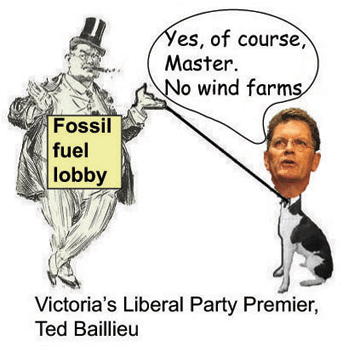 Voters call for action on climate change, The Age, Adam Morton March 9, 2012 AS THE Baillieu government prepares to reveal the future of Victoria’s climate change laws, a poll has found two-thirds of Coalition voters think the state has a responsibility to cut greenhouse gas emissions.
The Essential Media poll of 1009 Victorians, commissioned by conservation group Environment Victoria, found 76 per cent believed the state government should cut emissions and not leave it to the federal government to take action through a carbon tax or other steps.
Among Coalition voters, 66 per cent said the state had a responsibility to cut emissions.
Victorians want the state government to act despite belief in climate
change being split between those who think that it is caused by human
activity (47 per cent) and those who think it is either due to natural
variation or not happening at all (44 per cent).
The poll comes as the state government is due to this month release a
review of the Climate Change Act introduced by the previous Labor government, which includes a target of cutting Victoria’s emissions by 20 per cent this decade.
The Baillieu government has wound back some clean energy programs and fuelled expectations the target could be reduced or scrapped.
Other findings from the poll conducted in December and January were:
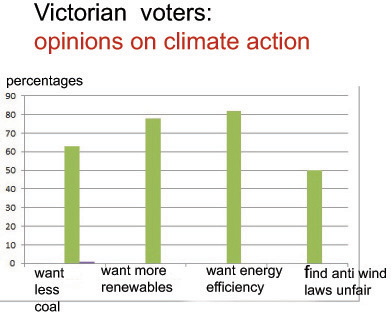
■ Just 22 per cent of voters consider wind farm laws that give households right of veto over turbines within two kilometres of their house fair. Fifty per cent said the laws were not fair. ■ A majority said they wanted fewer coal-fired power plants (63 per cent) and more renewable energy (78 per cent) and energy efficiency (82 per cent). : http://www.theage.com.au/environment/climate-change/voters-call-for-action-on-climate-change-20120308-1un7y.html#ixzz1ofcfEu4I
New South Wales Liberal Premier pleased about Clean Energy Finance Corporation for Sydney
 NSW wins multi-billion dollar clean energy deal http://www.news.com.au/national/nsw-wins-multi-billion-clean-energy-deal-despite-opposition/story-e6frfkw9-1226291960573 By Malcolm Farr, National Political Editor news.com.au, arch 07, 2012
Sydney to host Clean Energy Finance Corporation
Premier O’Farrell happy despite opposition to clean energy fund
“This is good news whichever way you look at it”
NSW Premier Barry O’Farrell is torn between opposing the Federal Government’s carbon pricing and his pride in Sydney’s selection as host of a multi-billion dollar clean energy fund. Continue reading
Call to National Party M.P. to back Clean Energy Finance Corporation
 Stawell Climate Action Group call to build big solar Stawell Times, 09 Mar, 2012 STAWELL – Stawell Climate Action Group, got to work this week building a huge sign spelling out the words ‘big solar’, to show their support for the development of large scale solar power in Australia….They gathered at Central Park, Stawell with overalls, hardhats and tools to
build the big solar sign… .
They are calling on John Forrest to get behind a new $10 billion fund for renewable energy. Continue reading
Australia’s Future Fund, and its investments in nuclear weapons
 A Future Fund with a chequered past. news.com.au 8 March 12, IT is yet to celebrate its sixth birthday, but Australia’s sovereign wealth fund, the Future Fund, has long attracted criticism….. Last year it emerged that the Future Fund had invested heavily in a string of companies that made parts for nuclear weapons. It defended its move on the grounds the investments did not contravene the nuclear non-proliferation treaty……. The Future Fund argues its strategy ensured a strong performance during the darkest days of the global financial crisis.
A spokesman said its focus was “on an appropriate mix of investment opportunities to achieve mandated returns with acceptable but not excessive risk”. http://www.news.com.au/business/a-future-fund-with-a-chequered-past/story-e6frfm1i-1226292987866#ixzz1oYXYgjRb
Australian Labor government will not change its policy of opposition to nuclear power
 Despite pro nuclear Bob Carr joining the Ministry, the Australian Government opposes nuclear power plants. The Prime Minister was quoted in an article in 9 News, Mar 6 2012 By Julian Drape “…….The prime minister was also quizzed on Tuesday about incoming foreign minister Bob Carr’s stated support for nuclear power.
In response she said Labor’s policy was to oppose nuclear power plants in Australia “and it won’t be changing”.
“Our future as a country … is in making the best of our natural assets as well as continuing to use traditional sources of energy.
“We are a country with abundant sunshine. We are a country with a very, very, very long coastline which gives you access to tidal power.” Ms Gillard added that hot rocks energy could also be brought on stream.
Australian Nuclear Science and Technology Organisation (ANSTO) pushing for nuclear power for New South Wales
 A NSW power trip, Climate Spectator, Keith Orchison, 6 Mar 12, “.. the NSW Legislative Assembly public accounts committee, chaired by Sydney North Shore MP Jonathan O’Dea, which has been given the task by the O’Farrell government of examining the economics of power generation.
…One answer, says the Australian Nuclear Science & Technology Organisation in a submission to the parliamentary committee, is to consider diversifying the NSW power system, adding renewables, fossil-fuelled plants with carbon capture and storage and reactors to the mix.
Energy security for NSW, says ANSTO, will be at risk without active consideration of nuclear energy, given that the future cost of carbon isn’t known and wind and what-not is intermittent. Given the availability and price challenges gas generation faces, it suggests the stability of nuclear power pricing should make it attractive…..” http://www.climatespectator.com.au/commentary/nsw-power-trip
Bob Carr and Tony Abbott in perfect harmony
Bob Carr: ‘I agree with Tony Abbott’, Green Left, March 5, 2012 By Peter Robson Prime Minister Julia Gillard anointed former NSW premier Bob Carr as the foreign minister on March 2. It awaits the approval of a joint sitting of NSW parliament but for all intents and purposes, Carr has just been catapulted to the third-highest political post in the land after being out of politics since 2005….. . We found a stand-out post from January 27. Here, Carr commented on the protest against opposition leader Tony Abbott and Gillard on January 26 by members of the Aboriginal Tent Embassy.
Carr said: “I agree with Tony Abbott and think his remarks entirely sensible. The Tent Embassy in Canberra says nothing to anyone and should have been quietly packed up years ago…….Carr also said: “The block-headed demonstration sets back reconciliation and would seal the defeat for Aboriginal recognition in the constitution if a referendum were pending.”
I think the best bit about being an Labor Party intellectual must be having the gall to tell an impoverished, oppressed minority — whose rate of imprisonment exceeds that of the imprisonment of blacks under South African Apartheid — that they are drawing too much attention to their cause. That takes some chutzpah….. In the context of discrimination of the kind his party supports by supporting the NT intervention, and the context of the vast gulf in living conditions and incarceration rates between black and white, such a policy would gut any attempt at “narrowing the gap”. It would, in short, be a policy of assimilation. Aboriginal disadvantage would become simply “disadvantage” — inexplicable, unsolvable, but most of all, no one’s fault.
Carr (bravely, Sir Humphry Appleby might say) started his post with “I agree with Tony Abbott …”. Maybe he should have just left it there. http://www.greenleft.org.au/node/50251
The pro nuclear Thoughts of new Foreign Minister Bob Carr
“Australia has a theological objection to nuclear power. It’s illogical but deeply entrenched. Still polls have been moving and younger people are more open-minded than those who come of age politically in the 1980s. It remains the only serious base-load alternative to incinerating more coal.
One should applaud every move in India and China to try nuclear plants..
 You need two things.
One, a longer term education campaign by a coalition of pro-nuclear industry, science, union and indigenous groups . Second, a Lib-Lab consensus.

A fourth generation reactor, with its high level safety and minimal waste ..” Bob Carr http://bobcarrblog.wordpress.com/2010/12/01/the-nuclear-thing/
“Of course the O’Farrell Government is right to attempt legislation to permit uranium exploration in New South Wales. I said this two months ago. The Federal Government has expanded uranium mining and opened exports to India. South Australia boasts what will become the world’s largest uranium mine“. Bob Carr http://bobcarrblog.wordpress.com/2012/02/15/uranium-mining-in-nsw/
Why Australia should kick pollution politician Martin Ferguson out of the government Ministry
REMOVE MARTIN FERGUSON FROM ENERGY, by Tom Swann (and Swann doesn’t even mention Ferguson’s unswerving loyalty to the nuclear lobby! – C.M.) )
Here’s just a short list of what Fergo gets up to:
– He invited climate skeptics to launch their book at Parliament House;
– He had the AFP and private companies spy on climate volunteers and campaigners, under the pretence of protecting the energy supply–are we being tracked right now?;
– On a 16 person panel designing future energy policy, he chose only one from the renewables industry, and only after pressure;
– He’s infamous for his ‘open door’ to coal and gas lobbyists;
– He advocates massive expansion of coal and gas, and is pushing ahead with the new HRL coal plant despite HRL missing deadlines, community outrage and the PM’s promise for no new coal;
– He has a long history of holding back our struggling renewables industry, from irregular funding to poor program administration;
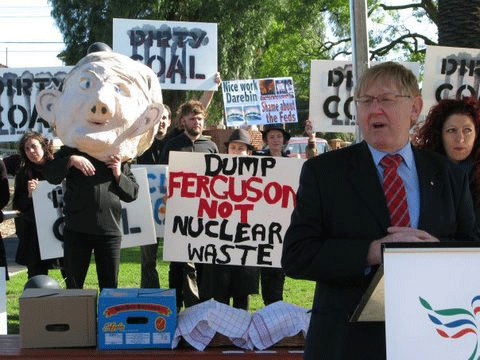
– For example, he is responsible for the poor design and continued delays in the Solar Flagships program, which hasn’t yet issued a single flagship grant;
– Gillard acknowledged he is a liability when she made sure he was not in charge of setting up the new Clean Energy Finance Corporation;
– As Ministerial Chair of the International Energy Agency, he ignores the IEA’s recent push for urgent climate action through strong support for big solar;
– Meanwhile, government reports overlook the projections, from the IEA and elsewhere, of rapidly falling renewables costs, especially in solar, as well as new evidence showing support for renewables can actually cut costs;
– He agitates for nuclear power in Australia, nevermind the cost, emissions impact and health risk (the recent Energy White Paper makes a big deal out nuclear power in Australia even while showing all too clearly how expensive it would be!);
– He wants Australia to become a global nuclear waste dump, and has started by forcing a dump on Muckaty, a remote Aboriginal community that wants nothing to do with it – Senate debate on Muckaty started when everyone was focused on leadership spill!
– As the Minister for Tourism, he’s responsible for hundreds of thousands of jobs provided by the Great Barrier Reef — many times more than in fossil fuels. But the reef is under extreme threat from climate change — and so are those jobs! http://www.communityrun.org/petitions/move-martin-ferguson-out-of-energy
“Stronger Futures” legislation, an indignity to all Australians, not only to Aborigines
They are policies that have been shamelessly trialled on the Aboriginal people of the Northern Territory and that are now to be imposed on other so-called areas of disadvantage across Australia. The degrading trail of internal colonisation continues, discriminating one moment on the basis of race and the next moment on the basis of class.
The ‘Stronger Futures’ legislation might strengthen the futures of the powerful but it is an attempt to weaken the dignity of those who are subjected to its control.
Picking the scab of colonisation, Eureka Street JOHN FALZON MARCH 01, 2012
There’s a deep wound in Australia.
There’s a gash in our story.
It is a wound that is known by different names:
Colonisation.
Dispossession.
Coercion.
Control.
It is still with us. Continue reading
South Australia happy to flog off uranium – but says nuclear power’s no good
Uranium industry in major turnaround, Adelaide Now by: TIM DORNIN AAP February 29, 2012 AUSTRALIA has no need for nuclear power and no licence from society to develop it, South Australian Mineral Resources Minister Tom Koutsantonis says.
The minister says he fully supports uranium mining in SA but not nuclear power. “The truth is, you need a social licence to operate, and there is not a social licence for nuclear power,” Mr Koutsantonis told a uranium
conference.
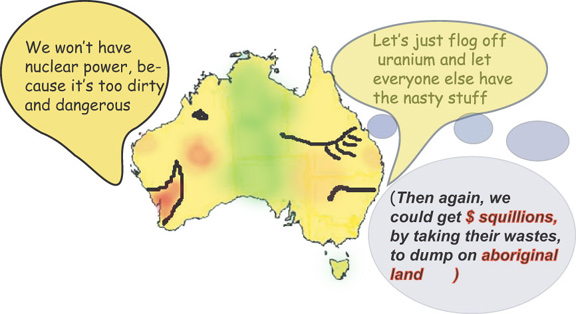
“The Australian public don’t want it. “I don’t think it’s economic, I don’t think it’s viable, and I don’t think it’s politically saleable.”
Historic day as Arkaroola finally gets permanent protection
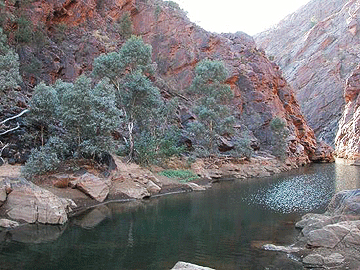 The Upper House of State Parliament has just passed a Bill to permanently protect from mining the iconic mountains of Arkaroola in the State’s far North. The legal protection is the culmination of a long-running community and Greens campaign to ensure this magnificent part of our State is no longer threatened by damaging mining activity.
“This is a wonderful, historic day,” said Greens Parliamentary leader Mark Parnell. “It’s taken a long time, but finally a law has been passed that ensures the permanent protection of the world famous mountains of Arkaroola.
“If a future Government wants to let the miners back in they will have to over-turn this Act of Parliament. I am totally confident that this will never happen. “It is wonderful that all sides of politics have finally accepted what the Greens have been arguing all along: that some places are simply too precious to mine,” he said.
 In passing the Bill, the Greens moved 2 successful amendments to ensure appropriate consultation with the traditional owners from the Adnyamathanha people over the management of the land. “As this is such an important piece of legislation, it is vital we get it right and ensure that all traditional owners have a say in how Arkaroola will be managed,” said Mr Parnell.
“The Greens have been very proud to stand alongside the Sprigg Family, Adnyamathanha Elders and the many passionate environmental and heritage campaigners from across the state and across the world who have fought to protect this precious place.“They can all be very proud of what they have achieved,” he said.
1 This month.
20 September –National Day of Action in Melbourne on the International Day of Peace


Help Aunty Sue Protect Her Land and Sacred Sites From Destructive Rocket Testing.
.

Australians deserve the truth
about
AUKUS – https://aukuspublicinquiry.com/


PETITION – To: Prime Minister Anthony Albanese and the Australian Labor Government

of the week – Australians for War Powers Reform (AWPR)
To see nuclear-related stories in greater depth and intensity
 Antinuclear