Stop renewables and wait for nuclear: Nationals stunning rejection of science and industry
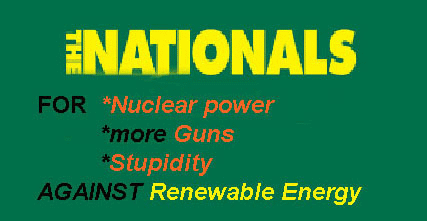
Giles Parkinson 14 August 2023 https://reneweconomy.com.au/stop-renewables-and-wait-for-nuclear-nationals-stunning-rejection-of-science-and-industry/
Nationals leader David Littleproud says he wants to have an “honest” conversation about Australia’s energy transition. Well and good. But maybe Littleproud himself can help that process by not telling outright lies.
On Sunday, Littleproud did us all a favour by spelling out in detail the Nationals energy policy, just in case it wasn’t already obvious: Stop renewables and wait for nuclear.
It has been, he admitted, the party’s policy for at least the last decade, if not longer.
That’s not surprising, given that its the favoured policy and strategy of Big Oil, Big Gas, Big Coal, and the likes of Gina Rinehart to whom the Nationals appear completely beholden. And it wins support at all levels of the Nationals grass roots through a co-ordinated and quite extraordinary campaign of fear and misinformation.
Littleproud’s train crash of an interview on ABC’s Insiders program on Sunday – well, it might have been a train crash if he had been questioned by someone with the wit to hold his talking points up to scrutiny – highlight the tragedy of Australia’s and the world’s current climate policies.
All these policies are focused on net zero by 2050, or 2060 if you happen to be China. As many scientists fear, it’s a target that is used as a prompt by naysers and do-nothings – such as the Nationals and the fossil fuel industries – to put things off for another day.
It is another excuse for delay, delay, and yet more delay – even though the science tells us, quite clearly, and more emphatically given the summer in the northern hemisphere and tumbling heat records – that what matters most is how quickly we act now.
Littleproud is completely unfazed by the science. In fact, it is a stunning rejection of the science. He wants a “pause” to the roll out of wind and solar and transmission links and a stop to the “reckless pursuit” of the government’s 82 per cent renewables targets.
He suggests that wind and solar has its place, but that solar should be built on city rooftops, not on “prime agricultural” farmland, or in remnant forests. We should wait for nuclear, he says, because “we’ve got time” and net zero by 2050 is the government’s “only commitment.”
He wasn’t asked the obvious question about the Nationals acceptance of climate science, the need to act by 2030, the need to try and cap average global warming to 1.5°C, a target that would require net zero to be reached more than a decade earlier.
Littleproud appealed for “honest conversations”, and then said the federal government’s 83 per cent renewables target requires 28,000 kms of new transmission lines.
Let’s be absolutely clear, that is simply not true.
The Australian Energy Market Operator’s Integrated System Plan suggests that up to 10,000kms of new transmission will be needed over the next two decades under its “step change” scenario, which includes the 82 per cent renewable share that is now the federal government’s target.
That renewables target, by the way, is key to reaching Australia’s modest emissions reduction target of 43 per cent below 2005 levels – a year chosen because of its peak land clearing of remnant forests under the Liberal/National Coalition.
Granted, the preparation work for the transmission lines have been poorly handled, by transmission companies, governments and the likes of AEMO, but it should be noted that most of these transmission lines are considered necessary even in the “slow scenario”, where science is completely ignored and coal hangs around a lot longer.
Littleproud’s number of 28,000kms is only mentioned in the “hydrogen superpower” scenario that imagines huge arrays of wind and solar in remote areas that might need to be connected to the grid. It is of course, his sponsors’ worst nightmare – because it means the end of the fossil fuel industry as we know it.
Littleproud then goes on to mention the prospect of nuclear SMRs (small modular reactors), and even something called “micro reactors”, which are little more than an idea, and probably even further down the pipeline than the SMRs, which are themselves at least a decade away, and not likely to be cheap.
The Nationals leader reckons big industry users like smelters might like the idea of micro reactors because they are modular, and about 3-5MW and can be used to power their facilities, and bring down costs.
It’s a ridiculous suggestion. A smelter draws up to about 500MW of load, so it will need around 100 of these things that don’t exist, and as the former head of the US Nuclear Regulatory Commission wrote recently, only ideologues and ‘tech bros” think that nuclear can be cheap. And the Coalition.
The owners of Australia’s smelters, for the record, have already made their views clear. Rio Tinto, for instance, has said that its smelters only have a future beyond the end of the decade if they can convert their power supply to renewables by 2030.
If not, they will not be able to compete with the rest of the world, either on cost, or on emissions. And who is providing the biggest stumbling block to renewables? The Nationals and fossil fuel industry led campaign against wind, solar and transmission.
And therein lies the tragedy, the dishonesty, and the absurdity of the Nationals’ and the Coalition’s stance against green energy.
It will stuff industry in Australia, and the local economy, long before it stuffs the planet and the environment. But by then, they – and the Murdoch media which trumpet their positions, and the mainstream media that refuses to question it – will have found something else to whinge about.
Senate nuclear power report sees no role for nuclear .

A Senate committee released a report into nuclear power last Friday. The majority report, endorsed by Labor and Greens senators, argued against nuclear power and against the repeal of Howard-era legislation banning nuclear power in Australia. A dissenting report by Coalition Senators argued for repeal of the legislation banning nuclear power.
The majority report concludes that repeal of legislation banning nuclear power “would create an unnecessary escalation of risk, particularly given Australia is able to utilise readily available firmed renewable technology to secure a reliable, affordable and clean energy system for Australia’s future”. It gives the following reasons:
1. Nuclear power is the most expensive energy option for Australia whereas firmed renewable energy is the cheapest option. Introducing nuclear power into Australia’s electricity network would “drive up power prices, causing additional economic pain for everyday Australians who are already struggling with the cost of living pressures.”
2. Next generation nuclear technology is unproven and there are no commercially operational ‘small modular reactors’ anywhere in the world. “It is clearly not possible for Australia to develop a nuclear power sector with SMR technology which is not commercially available,” the majority report states.
3. Given the “very considerable” lead time that would be involved in establishing a new nuclear industry in Australia, the contribution of nuclear power to the electricity market would likely be negligible given Australia’s projected 83 per cent uptake of firmed renewables by 2030. “The committee recognises that addressing climate change requires immediate action and pursuing nuclear energy would only be a distraction from Australia’s 2030 target and broader efforts to reach net zero emissions by 2050.”
4. Nuclear power is inflexible. The energy output of nuclear power plants lacks the flexibility required to meet the needs of a modern electricity market. Firmed renewables are much better suited to the load profiles of modern electricity grids which require greater flexibility.
5. Nuclear carries inherent and consequential safety risks. In addition to other risks, establishing a nuclear power industry in Australia “would unnecessarily add to the local and global problem of managing high-level nuclear waste”.
6. Water scarcity — an issue “close to the hearts of many Australians”. Reactors require “significant volumes” of water for cooling and the “necessity of locating nuclear power plants near sea water would likely mean the construction of nuclear reactors near densely populated areas and would create additional environmental and security risks.”
7. Nuclear power would create “potential and unnecessary national security risks” due to “perceived links between civil nuclear industries and nuclear weapons proliferation, as well as opening the possibility of nuclear reactors being the target of hostiles.” Australia continues to be an international advocate of nuclear non-proliferation and the committee supports Australia’s ongoing participation in the Nuclear Non‑Proliferation Treaty, as well as the international and bilateral nuclear safeguard agreements it has ratified.
8. “There is no social license to support the establishment of a civil nuclear industry in Australia. A significant majority of Australians are not comfortable with the prospect of having nuclear power plants, or the radioactive waste they produce, in their backyards. Overwhelmingly, Australians recognise the importance of transitioning to a secure and sustainable energy future, and firmed renewables are the key to achieving that future.”
Gina Rinehart: Australia’s wealthiest person uses Bush Summit speech to push for nuclear power
Rebecca Le May, The West Australian, Mon, 14 August 2023
Gina Rinehart is pushing for Australia to become nuclear-powered instead of upsetting farmers with more “bird-killing wind generators and massive solar panel stretches”.
The multi-billionaire used the final sentence of her keynote speech at The Australian Bush Summit on Monday to call for a national foray into the contentious energy source — easing into the topic with a joke purportedly by nuclear physicist Edward Teller, who helped Robert Oppenheimer produce the first nuclear bomb………… (Subscribers only) more https://thewest.com.au/business/mining/gina-rinehart-australias-wealthiest-person-uses-bush-summit-speech-to-push-for-nuclear-power-c-11581010
Why the nuclear option is clever in opposition but a nightmare in government
The Coalition’s push to include nuclear energy in the nation’s arsenal has nothing to do with solving the climate debate.
InQueensland, August 14, 2023, John McCarthy
If only that was the case.
The first and most reasonable question for them is why is the Coalition is pushing nuclear now and did nothing to progress it when they were in power?
The answer is just as reasonable. It has no hope and it’s not because of its inherent cost and efficiency, which seems to make up a lot of the debate.
An example of how difficult it would be to push forward with nuclear energy was the recent Federal Court decision to overturn the approval of a waste dump for radioactive material in the South Australian town of Kimba, where the issue had split the town.
It took a decade to get to that point and the division in Kimba would be likely to be played out nationally if the Coalition ever got serious about adopting nuclear energy.
……….The reason the Coalition has started pushing nuclear is very much the same reason it won’t succeed. It’s devisive. It would be a nightmare.
You may think that’s a criticism of the Coalition but it isn’t. It’s politics and clever politics, as well.
Nuclear provides an agitation point for the Albanese Government and a pivot on which the Coalition can position themselves as forward-thinking and rational…………………………..
It should also be noted that a nuclear power station in the US was recently completed seven years late and cost $US34 billion ($52.3 billion), about $US21 billion over its initial budget.
While adopting nuclear, the LNP in Queensland has ditched coal. Its support is now whispered rather than championed, as it was in 2019 when it was instrumental in handing Government to Scott Morrison.
………………………………………………… The real issues however are about waste, where a nuclear power station would be sited, how much would it cost and how long would it take to develop and, most importantly, is it safe? All pretty reasonable questions.
Whether they would continue to advocate for nuclear if they returned to Government is a completely different question. It’s reasonable to assume that the issue would be handed to a committee where it would gather dust.
……………………….. The problem is nuclear remains a social and environmental nightmare…….. https://inqld.com.au/opinion/2023/08/14/why-the-nuclear-option-is-clever-in-opposition-but-a-nightmare-in-government/
How will they explain themselves to their grandchildren?

August 11, 2023, by: Mark Buckley https://theaimn.com/how-will-they-explain-t
It is hard to understand the stupidity of Australia’s political leaders when it comes to the climate catastrophe. It is a given that the likes of Barnaby Joyce and Tony Abbott will ignore the facts as they unfold, but even they must have noticed what’s going on.
Maybe the political class don’t watch television, or read newspapers, or have relatives living overseas, but the rest of us do.
Two years ago there were horrific floods in Germany and Belgium, in mid-July 2021, which killed more than 220 people. Damage was widespread and was seen as far away as the Netherlands, Austria and Switzerland. In Europe, in summer.
In Australia we know the lasting devastation of floods, and the impossibility of future proofing. The only solution is to re-build, if re-build you must, on higher ground.
Is a flood more real if it happens in Germany rather than in Lismore, or Shepparton? Are wildfires more devastating when they happen in Canada or Greece? Does total destruction of a town in Hawaii mean more than if it happens in Mallacoota?
Ask Matt Canavan why he chooses to ignore the facts of climate destruction in Australia. What does he think of the lack of sea ice in the Antarctic this year? Some scientists think the rise in sea levels, caused by the undermining of the ice in Antarctica, could range from between 2 metres to 10 metres.
Imagine the harm to our coastal cities if it comes in closer to 10 metres. Well, they won’t be there anymore, so it’s not difficult to imagine the damage. It won’t make it hard to get onto the West Gate Bridge, because the West Gate Bridge will be an abandoned arc of empty roadway, and what would be the use of driving to Geelong, because Geelong won’t be there anymore.
Kardinia Park will be an empty reservoir. But enough imagining, already. For our intellectually challenged leaders, the plight of our civilisation is at stake.
Droughts and bushfires will alternate with flooding rains, as the seasons change. Mass starvation will lead to mass migrations, from those lands most affected, to those less affected.
If you think living in the mountains, far away from the mass populations of cities, will make you safe from the changes in the climate, think again.
Towns in the Andes mountains in Peru have reached 38°C or more, while in Argentina’s capital, Buenos Aires, temperatures above 30°C have been recorded; this month. It is winter there now.
Peter Dutton wants to fix the climate crisis with nuclear power. Does he know how long it takes to arrange for a nuclear power station to be approved, planned and built? Does he not own a clock, or a calendar?
On the government’s side of the ledger, more than 2,000 medical professionals have demanded that the Albanese government withdraw $1.5bn funding for the Middle Arm industrial development, in the Northern Territory.
The funding is a handout to assist the development of the huge Beetaloo Basin gas field. Labor is struggling to disguise the funding. Are votes in the short-term worth wrecking the climate?
We have been told that the earth is reaching, and in some cases, passing through “tipping points” for the climate.
It doesn’t take much imagination to recognise the utter failure of almost every government on earth to react to the crisis.
See the piss-ant state governments as they legislate to criminalise the actions of climate activists. Jailing them won’t achieve anything. It is as effective and as ridiculous as trying to stop the tide.
See how the so-called leaders of governments world-wide baulk at the difficult conversations they need to have with their citizens, to convince them that time has almost run out.
Believe it or not, but the scientists need to change their language, from calm reason to barely suppressed terror. We are facing Armageddon, and politicians are worried that people will either panic, or vote them out of power.
They need to get to the front. Show some leadership. Make change. Don’t worry about plans for fifty years in the future, your rubbish plans for nuclear subs and inland rail.
Worry about the end of civilisation as we know it. Worry about our children and their children. I don’t want my grandchildren starving because we had a leadership which valued the chance of a directorship with a gas company over the survival of humanity.
And the leaders of today need to know there is nowhere to hide if it all turns to manure. They were warned, and there is not a mountain high enough to escape to.
The Coalition’s likely embrace of nuclear energy is high-risk politics
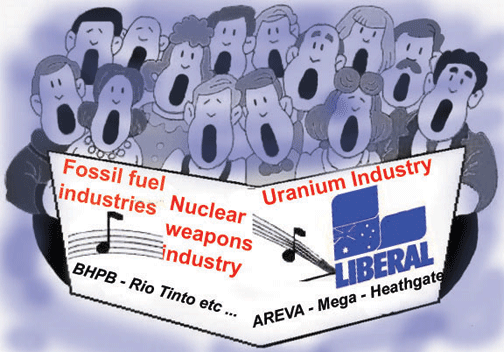
The Conversation. Michelle Grattan, 10 Aug 23
Crazy brave, or just crazy? If, as seems likely, the opposition embraces nuclear power in its 2025 election policy, it will be taking a huge political gamble.
The Coalition might argue this would be the best (or only) way to ensure we achieve net zero by 2050. But “nuclear” is a trigger word in the political debate, and the reactions it triggers are mostly negative.
Opposition Leader Peter Dutton has been open since the election about nuclear energy being on the Coalition’s agenda. It’s a “no surprises” tactic – but one that has allowed the government, especially Climate Change Minister Chris Bowen, to regularly attack and ridicule the idea.
This week opposition climate change and energy spokesman Ted O’Brien was spruiking nuclear power, writing in The Australian about the US state of Wyoming’s plans for a coal-to-nuclear transition.
……………………..O’Brien, a Queensland Liberal, has been a vociferous nuclear advocate; he chaired a parliamentary inquiry under the former government that recommended work to deepen understanding of nuclear technology and a partial lifting of the present moratorium, dating from 1998, on nuclear energy.
Nationals leader David Littleproud has also been central to the push for the Coalition to back nuclear energy.
The Nationals, by their climate scepticism and their deep attachment to coal, held back the Coalition on climate policy for more than a decade. Ahead of the 2022 election they were dragged by Scott Morrison to agree to the 2050 target with a massive financial bribe (some of which they didn’t receive because of the change of government).
Now, in opposition, some of the Nationals’ rump would like the party to ditch the 2050 commitment. The nuclear option would be one means of keeping them in the tent.
The “nuclear” the Coalition is talking about doesn’t involve old-style plants, but “new and emerging technologies” including small modular reactors.
That’s one of the problems for the policy – this is an emerging technology, not a quick fix to Australia’s challenges in transiting from fossil fuels.
That is, however, nothing compared with the challenge of public opinion. Notably, the 2019 parliamentary report was titled Nuclear Energy – Not without your approval.
A 2022 Lowy poll found Australians divided on the issue of nuclear power, although opinion appeared to be softening. Some 52% supported removing the ban, which was a five-point rise from 2021; 45% opposed this – six points down on the year before.
The government would have a ready-made “not in my backyard” campaign to launch against the Coalition’s policy. …………………… https://theconversation.com/grattan-on-friday-the-coalitions-likely-embrace-of-nuclear-energy-is-high-risk-politics-211346
Marcus Strom: AUKUS is a mad, bad and dangerous war policy, Labor Against War
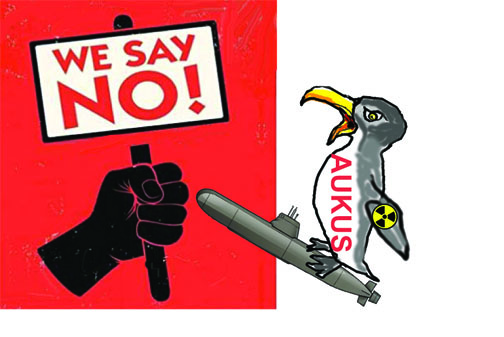
And that’s what Labor Against War is about. We can’t sit silently on this. We only formed only a few months ago. Already, we are working branch by branch, moving motions, winning many, losing some, making alliances with the Maritime Union, the Australian Manufacturing Workers Union, the Electrical Trades Union, the Construction Union. Unions New South Wales has a policy opposed to AUKUS.
By Marcus StromAug 10, 2023 https://johnmenadue.com/marcus-strom-aukus-is-a-mad-bad-and-dangerous-war-policy/
Anthony Albanese likes to think of himself as a Bob Hawke unifying type. But if he keeps dragging us along this war path, he will be remembered as our Tony Blair.
We hear a lot about how AUKUS is going to be about getting the balance right, rebalancing the region as China expands. And yes, China has its interests, and is building a military in the region and that is also to be concerned about. But I wonder about balance. And we’ve just been reminded again the stories from Guam and from Okinawa. There are 343 US bases in East Asia alone. Now, I don’t know how eight nuclear submarines adds to the balance in the region.
AUKUS is a policy of empire. And empire means violence. And I am amazed having worked in Canberra until recently at the blithe, consequence-free approach that our political leaders seem take to this. It’s “just the price of doing business on the world stage” is how it’s presented.
This is not what the Labor Party should be fighting for.
Alongside the obscene violence of joint war games happening in Australia at the moment, we’ve had the AUSMIN meeting between leading Australian ministers and US ministers. I read this in the press yesterday about what AUSMIN means. “Australia is now being asked to pull more of its weight in the alliance, play a bigger role in helping stabilise the regional balance of power and be integrated as a base of operations into US force projections into the region or into US war planning for a possible conflict with China in Asia.”
That’s from the very radical editorial column of the Australian Financial Review. Also from the Australian Financial Review today, “The AUSMIN talks over the weekend continue the trend since the late 1990s of tying Australia more tightly into both American grand strategy and war planning in Asia. The permanent American military presence on Australian soil is now at a scale unprecedented since the Second World War.”
They are preparing us for war.
That is why I could no longer work for this government. Up until February I was press secretary to Ed Husic, and the AUKUS policy is one of the main reasons I resigned from that position.
As I said to somebody coming in, “The secret to never being disillusioned with the Labor Party is never be illusioned with the Labor Party.” But the Labor Party, despite its many flaws, does have a tradition of opposing some unjust wars. This was pointed out by Paul Keating at a recent National Press Club speech he gave.
Labor was against the Vietnam War, eventually; Labor did stand against the second Iraq War. Although Bob Hawke did support the first Iraq war. So there’s a chequered history.
I’m going to talk about Tom Uren. Tom Uren many of you will know was a lone voice to start with against the Vietnam War in the Labor Party.
Keating pointed out that the ALP opposed Vietnam. But that’s not always how it was. Tom Uren points out in an interview he gave in 1996, that he and Jim Cairns, who went on to become treasurer, moved a motion to Labor caucus in 1965 opposing US bombing of North Vietnam. They lost that vote.
The left then of the Labor Party voted against it. But seven years later Gough Whitlam on a wave of anti-war sentiment took power and one of the first acts was to bring the remaining Australian troops home from Vietnam.
So we can fight back and we can make change. While Tom Uren started as a lone voice, on AUKUS in the Labor Party, I can say we are not alone. Already people like Paul Keating, Bob Carr, Carmen Lawrence, Doug Cameron, Peter Garrett are speaking out against the insanity of this policy.
War is a deadly business. It can’t be treated as a gambit against wedge politics from the opposition, but that is how it’s being treated.
The war in Iraq killed hundreds of thousands of people, left millions displaced, sparked regional destabilisation, engendered the ISIS calamity. A war with China would make Iraq look like a tea party; it would threaten nuclear catastrophe. This is what we’re facing with AUKUS.
It is also a threat to Australian sovereignty. AUSMIN and the military interoperability it is producing, means that there will be US soldiers enmeshed with Australian forces on a continual basis.
And this Australian government, this Labor government, is now allowing the rotation of B-52s through the Tindal base in the Northern Territory. Now, those planes carry nuclear weapons. They neither confirm nor deny. Australia’s quite relaxed at that policy. But we know that makes Australia a nuclear target.
It makes Australia not just a target and a victim, but an aggressor in the region; a host to war machines that could slaughter millions of people. We have to say, “No” to that.
I’m reminded of something Henry Kissinger said, “Being an enemy of the United States is very dangerous. Being a friend is fatal.”
Simon Crean was Labor leader when the Iraq war happened, and he bravely stood against the war drums. When Simon Crean died recently, Prime Minister Anthony Albanese said, “History has vindicated Simon’s judgment, but at the time his stance was deeply counter to the prevailing political and media climate.”
We are again looking for such courage in a Labor leader.
Instead, we have meekly inherited a Scott Morrison policy. When I speak at Labor Party meetings I say, “If we’d lost the last election, and Scott Morrison was pursuing this policy, you’d all be up in arms. You’d all be screaming about the injustice of it, the war mongering of it. Just because our guy’s doing it doesn’t mean you should shut up.”
And that’s what Labor Against War is about. We can’t sit silently on this. We only formed only a few months ago. Already, we are working branch by branch, moving motions, winning many, losing some, making alliances with the Maritime Union, the Australian Manufacturing Workers Union, the Electrical Trades Union, the Construction Union. Unions New South Wales has a policy opposed to AUKUS.
The South Coast Labor Council, which is facing having a nuclear submarine base in Port Kembla, has stood up and said, “No”.
Branch by branch anti-war activists are passing resolutions. We’ve now going into National Conference. We are hoping we can force at least a bit of a debate onto that conference. To not even discuss this would be an absolute travesty of Labor Party democracy.
We’re not expecting to win at the first hurdle, but neither did Tom Uren. This is a long campaign to win the Labor Party from being a war party to being a peace party.
Assurances count for nothing. The danger we face in a multi-decade, multibillion-dollar program is we don’t know who will be prime minister in ten years, five years. We don’t know who’s going to be in the White House at the end of next year. And yet we are going to be lumbered with a nuclear alliance with two fading Anglo powers on the other side of the world.
AUKUS is a mad, bad and dangerous war policy. And to borrow from the French, we don’t just think this, we know this. As an aside, I was absolutely gobsmacked by the chutzpah of Macron speaking in the Pacific, complaining about the ‘new imperialism’ recently.
Anthony Albanese likes to think of himself as a Bob Hawke unifying type. But if he keeps dragging us along this war path, he will be remembered as our Tony Blair.
Believe it or not, the ALP is meant to be a democratic socialist party. Read it, it’s in the rules.
It’s meant to fight for a better world. But we should no longer be satisfied for fighting for Chifley’s Light on the Hill. This is a labour of Sisyphus, a goal that we never reach. It is time to bring the light down into the shadows, to enlighten the world, to bring hope to today, not tomorrow.
Capitalism is a war system. We have to oppose capitalism to stop war.
Hope is rising. We will make a difference. Use that anger that you felt to really get active. We are rebuilding a peace movement, an anti-war movement.
I look here today; we need to double, triple our numbers. At our last Labor Against War meeting in Sydney, we had somebody there in their 80s telling us about how they fought against the Vietnam War. And there were people in the room in their school uniforms. Now that is a sign for hope that we can raise our voices fight a really bad policy.
And we have to win this because the alternative is cataclysmic.
These are extracts from a speech by Marcus Strom at a public meeting organised by IPAN at the ANU, Canberra, 1 August 2023
Yes in my backyard: Nationals happy to go nuclear

SMH, yMike Foley and James Massola, August 10, 2023
Nationals leader David Littleproud has declared he is open to having a nuclear power plant in his Queensland electorate, as the Coalition pushes a new plan to convert Australia’s existing fleet of coal plants to the controversial source of electricity generation.
Coalition energy spokesman Ted O’Brien said on Wednesday nuclear energy was a crucial emissions-reduction technology. He called for a national discussion about ending Australia’s moratorium, and argued that existing coal plants could be supplanted with the developing nuclear technology of small modular reactors.
Federal parliament banned nuclear power in 1998, and the moratorium has remained in place with bipartisan support.
“I would support a process to explore small-scale modular reactor technology in my electorate with appropriate consultation and education of the community if a moratorium was removed,” Littleproud said.
The Maranoa MP, whose electorate sprawls across western Queensland, was joined by two Nationals colleagues in supporting nuclear in their patch.
Michelle Landry, who represents Capricornia in Queensland, said she would support a coal-to-nuclear transition in her electorate at a “coal-fired power station that is no longer being used”.
Former leader Barnaby Joyce, whose electorate of New England in northern NSW does not have coal plants, emphatically backed developing the technology in his electorate.
O’Brien, however, would not be drawn on his position on a nuclear power plant in his Sunshine Coast electorate of Fairfax. He said a selection of nuclear locations could be addressed if the moratorium was lifted.
“If we end up with a clean energy policy that includes zero-emissions nuclear energy, a cheap NIMBY [not-in-my-backyard] campaign will inevitably come and we’ll deal with those sort of childish debates then,” O’Brien said.
O’Brien said small modular reactors would be key to a nuclear energy policy………………………
CSIRO and the Australian Energy Market Operator’s GenCost report into the cost of electricity generation based on technology type found that an energy grid running on 90 per cent renewables, including transmission lines and back-up battery or gas power, would cost between $70 to $100 a megawatt hour in 2030.
Small modular reactors would cost between $200 and $350 a megawatt hour, were that technology available by 2030.
Former chief scientist of Australia Alan Finkel, writing in the Financial Review this week, said it was unlikely small modular reactors could be deployed before 2040 in Australia, which meant “we must continue our investment in renewables”.
Climate Change and Energy Minister Chris Bowen has rejected the deployment of nuclear power and on Wednesday reiterated the Albanese government’s goal to cut power bills by supplying 82 per cent of electricity through renewable energy by 2030.
“We look forward to the costings and the locations of the nuclear power stations when [O’Brien] releases them. I’ve been a bit confused about why a party claiming to be economically rational would propose the most expensive form of energy as a way to reduce prices,” Bowen told parliament.
On Wednesday, Bowen announced energy rule changes to force companies building transmission lines to engage in earlier and more frequent “genuine” community consultation. The move is designed to reduce community opposition, which is now the main obstacle to the government’s goal to decarbonise the electricity grid.
Opposition Leader Peter Dutton has backed the coal-to-nuclear plan and Canning MP Andrew Hastie said small modular reactors should be considered as replacement for coal plants given “we already have four to five small modular reactors on order” to power Australia’s next generation of nuclear submarines.
When asked if he backed nuclear in his northern NSW electorate, Joyce said: “Not only would I be happy to have a small modular reactor in New England, but I suggested the policy to accompany it.”…………………………………….https://www.smh.com.au/politics/federal/yes-in-my-backyard-nationals-happy-to-go-nuclear-20230809-p5dv43.html
Coalition’s aim for nuclear energy criticised by the Australian government.
A radical proposal to change Australia forever has been criticised by the Australian government amid the nation’s energy crisis.
news.com.au Alex Blair 10 Aug 23
The Coalition is reportedly considering a “coal-to-nuclear transition” as part of its 2025 energy policy.
The strategy aims to secure long-term baseload power, reduce emissions, and lower electricity prices, with plans to tap into Australia’s abundant uranium reserves.
Australian regions the party believes are vulnerable to the shift from coal to renewables, including the Hunter Valley and Queensland, have reportedly been floated as potential candidates for the development of small modular reactors.
Opposition energy and climate change spokesman Ted O’Brien emphasises that local community input is crucial and that a “social license” should be obtained before any major infrastructure project is undertaken………………………………………………………………
However, Labor party representatives say the Coalition’s plan is riddled with holes. A spokesperson for Climate Change minister Chris Bowen said the Coalition had previously voiced support for a nuclear Australia but is yet to provide rock solid details to the public.
“They’re yet to come up with a plan with where the reactors can go and how much they will cost,” the spokesperson told news.com.au.
“Even if we started today, having nuclear power ready within 10 years is being generous. They’re very much against renewables, where we are backing it. Labor has implemented the $20b rewiring the nation policy, which has produced an actual change for the future.
There are credible reports that nuclear is the most expensive source of energy in the world, so they really need to show people the plan.”
The spokesperson noted the Coalition has long had a stance against Labor’s renewable energy plan, which aims to provide Australia with 82 per cent of its energy by 2030.
Last year, renewables accounted for roughly 36 per cent of Australia’s energy, with coal generation falling from 59.1 per cent in 2021 to 54.6 per cent in 2022……………………………..
Bowen said Australia needs more investments in order to reach its net-zero goals, calling for more industry figureheads to get behind the clean energy scheme.
“Sector by sector plans are important for Australia because each sector is so different,” he said.
“I’ve been struck by the level of support and engagement from Australian businesses — big and small, and from international investors.” https://www.news.com.au/national/politics/show-people-the-plan-coalition-criticised-over-calls-to-transition-australia-to-nuclear-energy/news-story/48e3f1e14e9e72275ab1d2df91992d0a
Parramatta Labor Party’s FEC unanimous anti-AUKUS motion
Antonina Gentile 4 Aug 23
The ALP’s FEC of the entire Parramatta electorate tonight voted unanimously against aukus. This makes it the second FEC in NSW, the other being Sydney. Thus noone can try to attack the campaign as an inner urban phenomenon anymore.
This will certainly give AA and the Executive something to lose some sleep over. They are confident that they will win the National Conference vote, but they have a widespread party membership in movement and these are far less pleased than they thought.
If the “aukestra” outside Conference is impressive, parliamentary delegates will now more than ever need to take note and, if lobbied by their constituencies and organisations such as those on this list, some could start finding their tongues…
The right’s nuclear stupidity is enough to make us cough up Phlegm Orville

From National Times Facebook page 2 Sept
The right’s nuclear stupidity is enough to make us cough up Phlegm Orville ( Bernard Keane and Crikey )
President Macron has reversed France’s original plan to reduce its nuclear energy from 70% to 50%, indeed as part of a nuclear renaissance, France will build six new large reactors and shortly commence testing on a nuclear power plant in Phlegm Orville, which is set to open early next year.
Er, what? Phlegm Orville in France? Sounds like a haute cuisine serving of mucus. Presumably the IPA scribe misheard when Dutton referred to Flamanville Nuclear Power Plant (thank God he didn’t refer to Finland’s Olkiluoto). Or perhaps they couldn’t believe Dutton was seriously invoking Flamanville as an advertisement for the wisdom of nuclear power.
Crikey first mentioned the new reactor being built at Flamanville in 2009, when it was due to open in 2013 and was already one-third over budget. By 2016 it was 200% over budget and scheduled to start in 2018. By 2018, the builder EDF discovered serious construction problems that delayed the start until 2020, and blew the budget out again. In 2020, the French government labelled Flamanville a “mess”. Early in 2022, when it was going to open at the end of the year, there was another delay and the budget rose to €12.7 billion (A$21.3 billion). At the end of last year, there was another delay into 2024 and the budget went over €13 billion.
So, all up, a decade overdue, and a final cost triple the initial estimate — if it starts next year. And it’s what Dutton thinks is an advertisement for nuclear power. Perhaps he should have mentioned Olkiluoto instead. It finally commenced in April this year… 14 years overdue.
Such criticisms, however, are now airily dismissed by nuclear power advocates. The future is small modular reactors (SMRs), which take much less time to build and are far cheaper — even if there are none actually operating outside Russia or China yet. “A single SMR can power some 300,000 homes. A microreactor could power a regional hospital, a factory, a mining site or a military base,” Dutton told the IPA.
At the same time as Dutton is spruiking SMRs, the Financial Review is as well. It’s run a three-part series on plans in Canada, Japan and the United Kingdom for SMRs (as one AFR reader acerbically noted, the keyword is “plans”).
The AFR also editorialised about the glories of SMRs. Conveniently absent, however, was the fact that even the new wonder technology needs massive taxpayer subsidies. The SMR that gets advocates most excited is the small prototype that US firm NuScale received regulatory approval to build in Idaho earlier this year — celebrated as a major milestone for the technology. Except it won’t commence operation until 2030 at the earliest and has already received US$1.4 billion in subsidies. That hasn’t stopped the proposed facility’s cost per MW-hour already increasing by more than 50% — three times the current cost of large-scale nuclear power in the US.
Why has the cost gone up for this SMR? Because, erm… cough cough… there’s been a massive blowout in the construction cost: 75%, to more than US$9 billion. Sure, it’s not a Phlegm Orville 300% blowout, but it is only a small reactor. And who will insure SMRs? In the United States, the government provides that insurance, with nuclear power plant owners paying hundreds of millions of dollars a year in premiums, further adding to the cost.
Another issue not mentioned by either the AFR or Dutton — both of whom like to whine about too much government spending — is what to do with the waste produced by SMRs. See, while they may be small, SMRs produce much more waste per unit of energy produced — and waste with higher radioactivity levels — than normal reactors. Good luck finding somewhere to store that for 10,000 years. You can bet no company will be doing that — it will fall to taxpayers, yet again.
So, apart from taking a long time to build, blowing out costs, requiring a massive infrastructure solution in terms of waste disposal and requiring colossal taxpayer support, the SMRs championed by Dutton and the AFR are completely different to traditional nuclear power.
What’s driving all this? Why does the right think SMRs are the solution? The delays that are typical of nuclear power, and which would be typical of SMRs as well, aren’t the problem — they’re the point. Switching focus to nuclear power and away from renewables and storage would delay decarbonisation and give fossil fuel industries extra years — indeed, extra decades — to keep operating while a nuclear “solution” was prepared. Like carbon capture, like gas, it’s another scam used by fossil fuel interests to try to delay meaningful climate action.
It’s enough to make you cough your lungs out.
If Albanese’s such a buddy of Biden’s, why is Assange still in jail?

An initial refusal from Biden is only an invitation to ask a second time, in a firmer voice
Bob Carr Bob Carr was NSW’s longest-serving premier and is a former Australian foreign affairs minister. 27 jul 23, https://www.theage.com.au/politics/federal/if-albanese-s-such-a-buddy-of-biden-s-why-is-assange-still-in-jail-20230721-p5dqci.html
Julian Assange is in his fourth year in Britain’s Belmarsh prison. If the current appeal fails, he will be shackled and driven off in a prison van and flown across the Atlantic on a CIA aircraft for a long trial. He faces likely life imprisonment in a federal jail, perhaps in Oklahoma.
In 2021, then opposition leader Anthony Albanese said, “Enough is enough. I don’t have sympathy for many of his actions, but essentially, I can’t see what is served by keeping him incarcerated.”
As prime minister, Albanese said he had already made his position clear to the Biden administration. “We are working through diplomatic channels,” he said, “but we’re making very clear what our position is on Mr Assange’s case.”
So we can assume that at one of his seven meetings with US President Joe Biden he has raised Assange, even on the fringes of the Quad or at one of two NATO summits. Or perhaps in San Diego when they launched AUKUS, under which Australia will make the largest transfer of wealth ever made outside this country. This $368 billion is a whopping subsidy to American naval shipyards and to the troubled, chronically tardy British naval builder BAE Systems.
But it clinches Australia’s reputation as a deliriously loyal, entirely gullible US ally. It gives President Biden the justification for telling Republicans or Clinton loyalists in his own party that he had no alternative but to end the pursuit of Assange. “Those Aussies insisted on it. They’re doing us all these favours … we can’t say no.”
In addition to the grandiose AUKUS deal, Biden could list other decisions by the Albanese government that render Australia a military stronghold to help US regional dominance while materially weakening our own security.

Candid words, but they aren’t mine. They belong to Sam Roggeveen of the Lowy Institute in this month’s edition of Australian Foreign Affairs. In a seminally important piece of analysis, Roggeveen nominated Australia’s decision to fully service six American B52 bombers at RAAF Tindal, in the Northern Territory, as belonging on that list. It is assumed these are aimed at China’s nuclear infrastructure such as missile silos. “It is hard to overstate the sensitivity involved in threatening another nation’s nuclear forces,” Roggeveen writes.
In his article, he reminds us we’ve also agreed to host four US nuclear subs on our west coast at something to be called “Submarine Rotational Force-West”. Their mission would be destroying Chinese warships or enforcing a blockade of Chinese ports.
The east coast submarine base, planned most likely for Port Kembla, will also directly support US military operations. It’s another nuclear target. As Roggeveen says, all these locations raise Australia’s profile in the eyes of the Chinese military planners designing their response in the event of war with the US.
In this context, I can’t believe the US president is not on the point of agreeing to the prime minister’s request to drop charges against Assange.
Apart from the titanic strategic favours, two killer facts help our case. One, former US president Barack Obama commuted the sentence of Chelsea Manning, who had supplied Assange with the information he published. The Yank is free, the Aussie still pursued.
Two, the crimes Manning and Assange exposed involved US troops on a helicopter gunning down unarmed civilians in Baghdad. They are directly comparable to the alleged Australian battlefield murders in Afghanistan we are currently prosecuting.
An initial refusal from Biden is only an invitation to ask a second time, in a firmer voice.
It’s possible to imagine an Australian PM – Fraser, Hawke, Keating, Howard or Rudd – being appropriately forceful with a US president. There would be an inflection point in their exchange – prime minister to president – when the glint-eyed Australian says, “Mr President, it’s gone on too long. Both sides of our politics are united. Your old boss commuted Chelsea Manning, an American, in the same case.”
A pause. A beat. Then the killer summation. “Mr President, I speak for Australia.”
Surely this counts.
I don’t believe the president can shake his head and say, “nope”, given all we have gifted – the potent symbolism of B52s, nuclear subs and bases on the east and west coast. It would look like we have sunk into the role of US territory, as much a dependency as Guam or Puerto Rico.
US counter-intelligence conceded during court proceedings there is no evidence of a life being lost because of Assange’s revelations. Our Defence Department reached the same view.
If Assange walks out the gates of Belmarsh into the arms of his wife and children it will show we are worth a crumb or two off the table of the imperium. If it’s a van to the airport, then making ourselves a more likely target has conferred no standing at all. We are a client state, almost officially.
AUKUS nuclear dump deal decades in the making by nuclear evangelists with prescience.
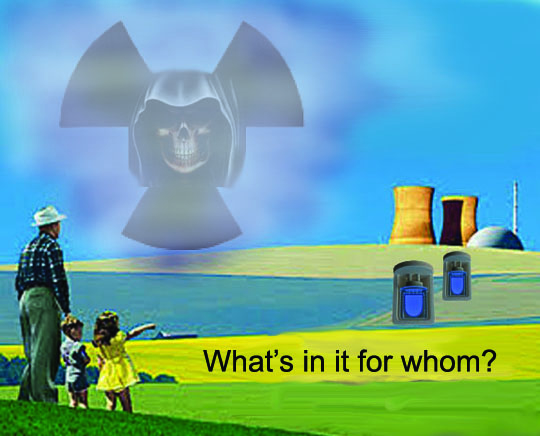
David Hardaker 26 July 23 https://www.msn.com/en-au/news/australia/aukus-nuclear-dump-deal-decades-in-the-making-by-players-with-prescience/ar-AA1elV6p
he story of the long, slow journey to a nuclear waste dump being built in Australia as required by the AUKUS agreement is probably best told through one Jim Voss, a nuclear evangelist from America who has been part of the Australian scene for at least a quarter of a century.
Part of a push which began in 1997, he’s one of a handful of international figures who’ve never gone away. Now, arguably, that push has won the day courtesy of a secret deal struck by the Australian government.
Voss’ most recent appearance was at a parliamentary committee hearing into nuclear legislation on May 15. Courtesy of the government’s AUKUS agreement he was now, finally, able to make a link between the benefits of small modular nuclear reactors — the sort sold by his company — and the nuclear-powered submarines Australia has committed to.
It all went to show, as Voss put it, that “a nuclear culture will be essential for this nation in the future”.
Voss could afford to be just a little triumphant that Canberra day. The inspirational words “If at first you don’t succeed then try, try and try again” could well have been written just for him.
Apart from sheer doggedness, the Voss story tells us much about the close connections between the military and commercial worlds when it comes to nuclear energy, as well as the powerful roles played by the UK and the US governments in seeking a solution for a terrible problem they share: how to permanently store nuclear waste. Australia, it emerges, has been a long-term target.
It was only when Scott Morrison came along — later backed by Prime Minister Anthony Albanese — that all that work paid off, with the bonus that it was all done in secret.
Pangea 1997
Voss first came to public attention in Australia courtesy of a Four Corners investigation in the late 1990s. Voss was then general manager of a company called Pangea which was attempting to realise the idea of building a nuclear waste dump in Australia, catering to an international need for a permanent solution for disposing of radioactive waste. The company considered that outback parts of Western Australia met the checklist for safety, remoteness and geological stability.
Voss was joined by a Pangea scientist, Charles McCombie, who would also go on to become a mainstay of international efforts to have a nuclear waste dump built in Australia.
Other now-familiar connections emerged at this time. Pangea, backed by a multimillion-dollar marketing and lobbying budget, brought on board then-rising star of conservative political polling, Mark Textor. Textor was soon to establish the powerful Crosby-Textor (ClT) group with then Liberal Party director, Lynton Crosby. Textor was reportedly paid some $250,000 for his work. (As we revealed in May, ClT’s American arm acts as a lobbyist for the giant US defence company General Dynamic, which builds the US Navy’s nuclear-powered submarines and is set to play a key role in the AUKUS program. It already hosts a growing Australian workforce at its Connecticut shipyards.)
In America, Pangea had signed up a former US nuclear submarine commander, Ralph Stoll, who helped lobby members of the US Congress to back Pangea’s plans for an Australian dump. Not that the US needed much persuading. Back in 1999, Four Corners reported that Pangea’s case found favour with US security and defence officials when it shifted its focus from a commercial venture to play to America’s strategic preoccupation with growing stockpiles of nuclear warheads.
Former US defence official Jan Lodal who had been responsible for running nuclear policy for the Pentagon put it this way:
There are thousands and thousands of tonnes of [nuclear waste] and thousands of tonnes more coming online each year, so to speak, as well as many thousands of tonnes that are derivative from former nuclear weapons programs. And these have to be stored safely and securely for thousands of years, and the world simply doesn’t have a solution to this. And as long as this waste is stored in an imperfect fashion, in which it is now — virtually everywhere — it represents something of a threat.
The Pangea company drew on American expertise but it was essentially a front for the UK government. It was 80% owned by British Nuclear Fuels Limited (BNFL), which in turn was wholly owned by the British government. BNFL and the UK had the same problem as the US: it held the largest stockpile of high-level radioactive waste in the world (after America) kept in canisters cooling beneath the water at its Sellafield facility in the north of England.


CrikeyFollow
AUKUS nuclear dump deal decades in the making by players with prescience
Story by David Hardaker • Yesterday 8:01 pm

(IMAGE: GETTY IMAGES)© Provided by Crikey
The story of the long, slow journey to a nuclear waste dump being built in Australia as required by the AUKUS agreement is probably best told through one Jim Voss, a nuclear evangelist from America who has been part of the Australian scene for at least a quarter of a century.
Part of a push which began in 1997, he’s one of a handful of international figures who’ve never gone away. Now, arguably, that push has won the day courtesy of a secret deal struck by the Australian government.
Why Seniors with private health cover are losing money
Voss’ most recent appearance was at a parliamentary committee hearing into nuclear legislation on May 15. Courtesy of the government’s AUKUS agreement he was now, finally, able to make a link between the benefits of small modular nuclear reactors — the sort sold by his company — and the nuclear-powered submarines Australia has committed to.
It all went to show, as Voss put it, that “a nuclear culture will be essential for this nation in the future”.
Voss could afford to be just a little triumphant that Canberra day. The inspirational words “If at first you don’t succeed then try, try and try again” could well have been written just for him.
Apart from sheer doggedness, the Voss story tells us much about the close connections between the military and commercial worlds when it comes to nuclear energy, as well as the powerful roles played by the UK and the US governments in seeking a solution for a terrible problem they share: how to permanently store nuclear waste. Australia, it emerges, has been a long-term target.
It was only when Scott Morrison came along — later backed by Prime Minister Anthony Albanese — that all that work paid off, with the bonus that it was all done in secret.
Pangea 1997
Voss first came to public attention in Australia courtesy of a Four Corners investigation in the late 1990s. Voss was then general manager of a company called Pangea which was attempting to realise the idea of building a nuclear waste dump in Australia, catering to an international need for a permanent solution for disposing of radioactive waste. The company considered that outback parts of Western Australia met the checklist for safety, remoteness and geological stability.
Voss was joined by a Pangea scientist, Charles McCombie, who would also go on to become a mainstay of international efforts to have a nuclear waste dump built in Australia.
Other now-familiar connections emerged at this time. Pangea, backed by a multimillion-dollar marketing and lobbying budget, brought on board then-rising star of conservative political polling, Mark Textor. Textor was soon to establish the powerful Crosby-Textor (ClT) group with then Liberal Party director, Lynton Crosby. Textor was reportedly paid some $250,000 for his work. (As we revealed in May, ClT’s American arm acts as a lobbyist for the giant US defence company General Dynamic, which builds the US Navy’s nuclear-powered submarines and is set to play a key role in the AUKUS program. It already hosts a growing Australian workforce at its Connecticut shipyards.)
In America, Pangea had signed up a former US nuclear submarine commander, Ralph Stoll, who helped lobby members of the US Congress to back Pangea’s plans for an Australian dump. Not that the US needed much persuading. Back in 1999, Four Corners reported that Pangea’s case found favour with US security and defence officials when it shifted its focus from a commercial venture to play to America’s strategic preoccupation with growing stockpiles of nuclear warheads.
Former US defence official Jan Lodal who had been responsible for running nuclear policy for the Pentagon put it this way:
There are thousands and thousands of tonnes of [nuclear waste] and thousands of tonnes more coming online each year, so to speak, as well as many thousands of tonnes that are derivative from former nuclear weapons programs. And these have to be stored safely and securely for thousands of years, and the world simply doesn’t have a solution to this. And as long as this waste is stored in an imperfect fashion, in which it is now — virtually everywhere — it represents something of a threat.
The Pangea company drew on American expertise but it was essentially a front for the UK government. It was 80% owned by British Nuclear Fuels Limited (BNFL), which in turn was wholly owned by the British government. BNFL and the UK had the same problem as the US: it held the largest stockpile of high-level radioactive waste in the world (after America) kept in canisters cooling beneath the water at its Sellafield facility in the north of England.
Pangea collapses but the dream lives on
Pangea’s best laid, secret plans came unstuck when the British arm of Friends of the Earth came into possession of a corporate Pangea video which the company had produced for the launch of its Australian venture.
The leaking of the video triggered a federal parliamentary backlash, including from the Howard government’s resources minister Senator Nick Minchin, who denounced the idea of Australia being an international waste dump.
Yet Pangea left a legacy to be reckoned with. It had hit on messaging designed to allay community concerns about safety. One line distilled its argument to house the world’s nuclear waste in remote Australia: “There’s no safer place in the world to make the world a safer place.”
Some influential political voices warned this would not be the end of the matter. Australian Democrats senator Meg Lees told Parliament: “Let us look a couple of years down the track. Knowing the pressure that is coming from Britain, combined with pressure from state governments such as Western Australia, I think we may then have a whole different ball game.”
Then federal MP and former WA Labor premier Dr Carmen Lawrence said: “[Pangea] are serious; they are well-funded. They’re people who’ve worked around the mining industry for a very long time. And I think it would be foolish of anybody — government or people such as me opposed to what they’re proposing — to underestimate their long-term commitment to this proposal.”
Speaking to Four Corners from his office in Seattle, Pangea’s chairman (the late) David Pentz had the most prophetic of words:
The idea of an international repository and the benefits it will bring the world is real. We think we have begun to see how we could put the genie back into the bottle, and you know ideas of this size don’t go away.
Never say never
The big idea never went away. Nor did Jim Voss. Among his voluminous collection of writings and presentations, he has covered some eye-catching topics.
He was joint author of the tantalisingly titled “From subs to mines: what would it take for Australia to develop a nuclear-powered submarine capability?” Written in 2013 — a full decade ago — the paper uncannily anticipated the future.
It canvassed issues relating to “procuring, leasing or assembling a complete military off-the-shelf (MOTS) nuclear-powered submarine in Australia”. This happens to be exactly the AUKUS approach which would see the US provide three of its used nuclear submarines to the Australian Navy to bridge Australia’s capability gap.
The paper continued: “This scenario would likely require Australia to develop a nuclear-powered submarine operations, maintenance, refuelling, waste management and possibly decommissioning capability, without presenting Australia with the considerable upfront challenges of developing a nuclear reactor and fuel enrichment supply chain.”
It also raised the possibility that “procurement, leasing or development of nuclear-powered submarine capabilities in Australia” would potentially open the way to “expansion into other aspects of the high-value nuclear energy supply chain, and provide opportunities for increased nuclear power plant deployment capabilities in the future, for instance, with small modular reactors (SMRs)”.
Voss’s Pangea colleague McCombie also stayed close to the action. As Pangea dissolved, McCombie became part of another international not-for-profit organisation called Arius (Association for Regional and International Underground Storage).
2015, and South Australia calls
The big idea of Australia as the site of an international radioactive waste dump came roaring back into contention in 2015. The South Australian government established the Nuclear Fuel Cycle Royal Commission, chaired not by a judicial figure, as custom has it, but by a retired rear admiral of the Australian Navy, Kevin Scarce, the former governor of South Australia.
A wait worth the while
More than 20 years on and with Australia part of the nuclear submarine club with the US and the UK, Voss is back in town, having taken on the reins of the Melbourne office of the exquisitely named and American-headquartered Ultra Safe Nuclear corporation.
Ultra Safe Nuclear is in the business of selling small modular nuclear reactors. Voss shifted into the managing director’s role in late 2020, about nine months before Morrison announced the AUKUS deal. Given his writings of 2013 which explored the business consequences of Australia acquiring nuclear subs, it appears to be a case of a destiny fulfilled. So how does he feel now about Australia’s nuclear embrace and its pledge to — finally — build a nuclear waste facility?
As a seasoned pro, Voss knows better than to be triumphant. This is not a win for him. It is more an opportunity for Australia:
Australia crossed the Rubicon of needing long-term deep disposal in 1958 [when the Lucas Heights nuclear reactor was established]. Starting at that point, Australia is generating long-lived alpha-bearing waste, in other words, waste with plutonium contaminant in it.”
The waste from Lucas Heights is generally regarded as much lower level than the high-grade waste from nuclear submarines, though Voss says it will also require “a deep disposal solution”. He maintains both can be dealt with by a technique called “very deep borehole disposal”. This is three- to five-kilometres deep at a location where the geography and the physics allowed it to be “absolutely secure for the aeons”.
But what about the 100-tonne spent nuclear reactor of a nuclear sub?
“You’re not putting the entire reactor down,” he says. “You’re putting the most highly radioactive alpha-bearing parts of the reactor down such a hole. So the deep borehole solution is quite amenable to the most highly active waste from a fleet of submarines.”
Australia’s eight submarines would need around six boreholes, he suggests, each costing around $200 million to construct. A snip at $1.2 billion.
But what if the deal to bury Australia’s AUKUS waste is just the start? After all, the cost of a nuclear dump is directly related to the amount of material to be buried. He says:
I would say that I do not personally believe that any part of AUKUS is the thin end of the wedge to an international repository. Two reasons. One is I’ve never heard anybody in any corner suggest that linkage. The second is there is a tried and true premise that a country that generates highly active waste is responsible for its management.
But with the UK and the US still seeking a permanent solution for highly active waste, does he agree it’s not a big step to take the waste of the AUKUS allies? “It would not be a huge leap,” he says. “But again, I cannot see the tea leaves politically lining up to support that path.”
Asked to reflect now on warnings from politicians and others 25 years ago that ultimately Australia may host international nuclear waste, Voss agrees that in some respects those words were prophetic: “Yes, I completely agree. With the problems we face today we are always searching for solutions. And sometimes older solutions have a place where they didn’t 25 years ago.
“But I want to emphasise that nobody that I am aware of in Australia, or frankly in the world, is working on an international disposal solution for all parties for highly active waste.”
Voss says Pangea’s failure was due not to government but to the fact that the social licence or community acceptance to operate a nuclear waste facility was lacking. For the record, he has not seen Textor since Pangea days.
The post AUKUS nuclear dump deal decades in the making by players with prescience appeared first on Crikey.
Dutton’s Nuclear Folly: Small Modular Reactors a political mirage

by Rex Patrick | Jul 23, 2023 https://michaelwest.com.au/duttons-nuclear-folly-small-modular-reactors-a-political-mirage/
As Peter Dutton talks up nuclear power, it is not surprising to see Andrew Liveris shifting his pitch from a ‘gas led recovery’ to a call for Small Modular Reactors (SMRs) to be considered for the 2032 Brisbane Olympics. Dutton is engaged in politics, Liveris in fantasy. Rex Patrick reports on the nuclear distraction.
What’s a Small Modular Reactor?
Small modular reactors (SMRs) are nuclear powered reactors with an electrical power output of less than 300 megawatts (MW).
There’s potential for these reactors to be mass produced and deployed at significantly lower costs to traditional nuclear reactors to replace coal and gas fired power plants with low carbon, base-load, synchronous power generation.
But for a sunburnt country with an abundance of space, they will never compete with solar and wind, supplemented by base-load technologies such as batteries, hydro, pumped-hydro and molten salt.
A Liveris’ Fantasy
Liveris’s 2032 suggestion was beyond belief.
Russia has packaged two low powered nuclear ice breaker reactors in a floating barge to claim a first SMR. China has a demonstration SMR in Shidaowan. Apart from that, they don’t exist.
The US is aiming to have its first SMR generating power in 2029. Its proponent, NuScale Power, has assigned a memorandum of understanding with Polish mining firm, KGHM, to deploy a plant to support its copper and silver production in Poland.
While there are over 70 SMR designs being developed across 18 countries, few are even close to being commercially mass produced.
Australia has had some involvement in SMRs through ANSTO, the operator of the Australia’s only 20 MW nuclear reactor used for nuclear medicine, research, scientific and industrial purposes.
Since late 2020 ANSTO has been participating in a three year International Atomic Energy Agency’s co-ordinated research project on the economic appraisal of SMRs. It has assembled a team of its own and other Australian experts to analyse the economics of the technology.
They have also supported a University of Queensland PhD candidate to model the deployment of SMRs across the Australian National Energy Market. The student is due to conclude his PhD work in a few month’s time.
Eight days after Minister Chris Bowen was sworn in he sought an ANSTO briefing on SMRs.
The Politics of Dutton
While ANSTO has been at work, CSIRO has also been working with the Australian Energy Market Operator to work out the Levelised Cost Of Electricity (LCOE) for each technology.
For 2030, wind and solar are sitting on or around $50/MWh while SMRs are somewhere between $150 and $300/MWh
For 2050, wind and solar are sitting on or below $50/MWh while SMRs are somewhere between $125 and $150/MWh.
Peter Dutton is not one to let facts get in the way of a political position.
Turnbull foiled, Teals fuelled
Across 2017 and 2018 Prime Minister Malcolm Turnbull was working up a National Energy Guarantee (NEG) policy to deliver energy to Australia which balanced out cost, reliability and emissions cleanliness. It was policy designed by engineers and economists.
Dutton moved to exploit deep seated division in the Liberal National Party (LNP).
He wasn’t interested in climate change. He wasn’t interested in good policy. He was interested in himself. He used NEG to challenge Turnbull’s leadership and, while he failed, he managed to kill off the policy. A second challenge saw Scott Morrison sworn is as Prime Minister and the NEG abandoned.
Dutton was the person responsible for a moment in time that created opportunity for the Teals, who went on to displace a number of LNP members in the 2022 election.
A lack of vision
Dutton promoting nuclear will appeal to the LNP base. To the informed, he won’t appeal to those concerned about cost of living and, yet again, he’s certainly not offering leadership and vision.
Yes, there is a case for a mix of wind, solar and nuclear (in place of gas and coal), but it is not a case that’s filled with vision. A better future for Australia is one that seeks to capitalise on abundant space and renewables; a mix of wind, solar, batteries, hydro, pumped-hydro, batteries, molten-salt and other technologies.
That’s what Malcolm Turnbull was trying to do with NEG and Snowy Hydro 2.0. Sadly, Snowy Hydro 2.0 is a project that’s turning out to be a good idea poorly executed.
Originally envisaged to cost $2b, new estimates have its final costs sitting at $10b. A value for money re-assessment must occur, with one alternate pumped-hydro solution being Tasmanian with a second cable being funded to clean electrons across the Bass Strait?
Fusion power
Solutions are available as we wait for fusion energy to arrive.
Fusion received international attention in late 2022 when a US based group made more energy that was put into a fusion reaction, showing proof of concept.
It’ a long way off, a source that won’t be fielded until beyond 2050, but something we should be aiming for.
Wasted opportunity
We don’t pass our planet on to our children and grandchildren; it’s actually on loan from them. It should be treated accordingly.
We should cast our mind forward to 2070, when the world has fully embraced base-load renewables and fusion.
A young man named Dutton will be asking himself ‘what exactly was my great-grandfather thinking”, as he grapples with the still controversial and unsolved problem of dealing with high level nuclear waste from AUKUS submarines and a foray into SMRs.
The answer to the young man’s question will be, “folly”.
Prime Minister Albanese must abandon South Australian nuclear waste dump
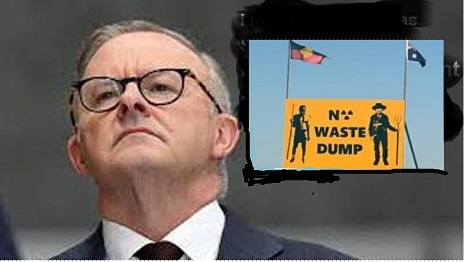
Friends of the Earth Australia ‒ 18 July 2023
The Federal Court has today quashed the declaration of a proposed nuclear waste dump site near Kimba in SA, citing ‘pre-judgement’ and ‘apprehended bias’. The court case was initiated by Barngarla Traditional Owners, who are unanimous in their opposition to the proposed nuclear dump.
Dr. Jim Green, national nuclear campaigner with Friends of the Earth Australia, said:
“Today’s decision is an incredible victory for Barngarla Traditional Owners. Now Prime Minister Albanese must kill the nuclear dump plan stone dead.
“It is an outrage that the Albanese government has been attempting to impose a national nuclear waste dump on Barngarla country despite the unanimous opposition of the Traditional Owners.
“It is deeply hypocritical that the Albanese government has been championing a Voice to Parliament at the same time as it ignores and overrides the unanimous voice of the Barngarla Traditional Owners.”
Jane Stinson, Chair of the SA Parliament’s Environment, Resources and Development Committee, said last year: “In this day and age, when we’re talking about Voice, Treaty and Truth, we can’t just turn around and say, ‘Oh, well, those are our values but in this particular instance, we’re going to ignore the voice of Aboriginal people’. I think that’s just preposterous and it’s inconsistent with what most South Australians would think.”
Susan Close, now Deputy Premier of South Australia, said in 2019 that it was a “dreadful process from start to finish” that led to the nomination of the proposed Kimba dump site and that SA Labor is “utterly opposed” to the “appalling” process which led to Kimba being targeted.
Susan Close noted in 2020 statement, titled ‘Kimba site selection process flawed, waste dump plans must be scrapped’, that SA Labor “has committed to traditional owners having a right of veto over any nuclear waste sites, yet the federal government has shown no respect to the local Aboriginal people.”
Dr. Green continued:
“It is appalling that the Albanese government has been willing to violate the United Nations Declaration on the Rights of Indigenous Peoples while at the same time professing to support the Declaration.”
The UN Declaration on the Rights of Indigenous Peoples states that: “States shall take effective measures to ensure that no storage or disposal of hazardous materials shall take place in the lands or territories of indigenous peoples without their free, prior and informed consent.”
Dr. Green concluded:
“To date, the issue has been managed by federal resources minister Madeleine King. There appears to have been little or no input from caucus, Cabinet or the Prime Minister’s Office.
“Prime Minister Anthony Albanese needs to take control and declare that the rights of Barngarla Traditional Owners will be respected, today’s Federal Court decision will not be challenged, and the government will now abandon the plan to impose a nuclear waste dump on Barngarla country.
“Federal Labor should adopt SA Labor’s policy giving traditional owners a right of veto over proposed nuclear waste dump sites. That would give traditional owners across the country some confidence that their voices will be heard as the government progresses plans to store and dispose of waste arising from nuclear-powered submarines in the coming decades.”
Contact: Jim Green 0417 318 368
Background: ‘Labor must hear Indigenous voice against Kimba nuclear site’, inDaily, July 17.
1 This month

of the week – Australians for War Powers Reform (AWPR)
To see nuclear-related stories in greater depth and intensity
 Antinuclear