Don’t ask the government about the next war
By Alison Broinowski, Feb 22, 2023 https://johnmenadue.com/dont-ask-the-government-about-the-next-war/
This is war protest month, with more to follow. Will efforts against the Iraq war, that failed twenty years ago this week, succeed in heading off the next one?
On Sunday 19 February thousands protested at the Lincoln Memorial in Washington, DC against US militarism, proxy warfare, and the threat of nuclear conflict. The ANSWER Coalition plans a March on 18 March, marking the 20th anniversary of the Iraq invasion. They will demand ‘Negotiations not Escalation’ in Ukraine, and an end to US militarism abroad.
In London a rally organised by Stop the War UK and others on 25 February will call for immediate talks to end the war in Ukraine. They oppose the Russian invasion, as well as NATO’s role in Ukraine, and nuclear war. No2Nato
In Australia, the ABC broke its discreet silence on 20 February with a two-part series of interviews by John Lyons with four non-ASPI defence experts, all of whom agreed that for Australia to join in an American war with China would be disastrous. Part 1 and part 2
And this week Greenleft publicised anti-AUKUS events in six Australian cities on 24 February. Protesters will gather outside the electorate offices of Penny Wong in Adelaide, Jim Chalmers in Brisbane, Richard Marles in Melbourne and Geelong, Pat Conroy in Newcastle, and Anthony Albanese in Sydney. Take action against AUKUS, militarisation on Feb 24
This belated upsurge of anti-war protest takes its cue from 15 February 2003, when 30 million people around the world marched in opposition to the prospect of war in Iraq. Many had never joined a mass demonstration before. They were ignored, and the US-led invasion went ahead on 20 March.
The protestors knew they were lied to by political leaders who claimed Saddam Hussein had weapons of mass destruction, chemical, biological and nuclear. The covert purpose of invading Iraq was to gain control of its oil, and assert US dominance over seven Middle East states: Iran, Iraq, Lebanon, Libya, Somalia, Sudan, and Syria.
The war began, and spread to Libya, Yemen, Somalia, and Syria, provoking retaliation from al-Qaeda and its Islamic State successors. All of the invaded countries, including Afghanistan and Iraq, remain blighted. Millions are dead or displaced. To achieve this, the world’s nations, led by the US, spent sums surpassing $2tn on weapons of war in the past year.
On 5 February 2003, the Australian Senate voted against the Iraq war. In the House of Representatives, ALP leader Simon Crean spoke fervently against Australian participation. Soon after, ignoring both Houses, Prime Minister Howard sent elements of the ADF to join the SAS who had already been dispatched in secret.
Crean’s successors, now in government, might reflect on his remarks, selected here.
Two weeks ago, prime minister, you committed Australia’s young men and women to a war not yet declared, knowing all along that you couldn’t pull them out.
You committed them without the mandate of the Australian people, the Australian parliament or the United Nations. You committed them solely on the say so of George W Bush. You haven’t consulted the Australian people. You haven’t consulted your party. But you have consulted President Bush.
You said you were sending these troops because it was in the national interest. I want to know, prime minister, which nation?
You said yesterday that you are going to Washington to inform George Bush of the views of the Australian people. Well let me tell you what those views are. The Australian people don’t want peace at any cost, but they don’t your war at any price.
The US alliance has endured for over 50 years. It has always had bipartisan support. But it does not mean that we have to agree with every policy position of every US administration.
The prime minister must stop treating the Australian people like mugs…Only Labor governments have been prepared to tell our allies no when it’s been in our national interests.
Eight months after the invasion of Iraq, the Sydney Morning Herald published an open letter to President George W Bush. It was signed by 41 ALP MPs and Senators, and was headed, ‘Mr Bush, here is why we opposed the Iraq war’.
The writers stressed the dangerous precedent the Iraq war was setting, and described it as a mistake. They wrote: ‘The ALP firmly believes that international conflict should, wherever possible, be dealt with peacefully and through international co-operation under the auspices of the United Nations. When all attempts for a peaceful resolution have been exhausted, United Nations sanction is vital if force is to be used.’
The signatories included parliamentarians Anthony Albanese and Penny Wong, then in Opposition.
As Foreign Minister, Penny Wong has recently abandoned peaceful resolution of conflict, and doesn’t mention UN Security Council resolutions authorising war. She has joined Defence Minister Richard Marles in lockstep with the US in a predictable slide into war over Taiwan or the South China Sea.
Three American generals have recently anticipated war with China in the next two to five years. If the US preference for proxy wars – as in Ukraine – is an example, Australia and Japan could be the proxy fighters against China, with similar prospects.
No Australian leader has supported the UN Secretary-General’s appeals to member states to stop inflaming worse wars. Instead, they are spending more extravagant sums on new weapons systems which will be provocative, and if they are ever delivered, probably outdated and unfit for purpose. The remaining option is nuclear: and Australia refuses to ratify the Treaty for the Prohibition of Nuclear Weapons which ICAN initiated.
This month, Senator Wong re-stated the government’s commitment to the status quo on how Australia goes to war. She told Parliament on 9 February that it will not change, just as Marles did in September 2022.
She compounded that with a self-contradictory statement about US nuclear weapons ‘stationed’ in Australia. Backing Defence Department Secretary Greg Moriarty, Senator Wong claimed that Australia adheres to the South Pacific Nuclear Free Zone Treaty, and yet supports the ‘stationing’ of US B-52 and B-2 bombers in Australia without knowing if they are nuclear armed or not.
This, we now learn, has been going on quietly since at least 2005 (“‘Don’t ask, don’t tell’ Top End nuke policy”, Australian, 16 February 2023: 2). As Crean said, the prime minister must top treating Australians like mugs.
Avalon Militarism
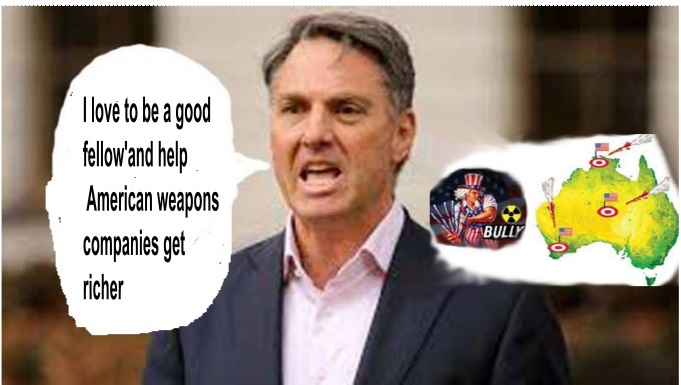
With this military bonanza unfolding on February 28, the Australian Defence Minister, Richard “Call me Deputy Prime Minister” Marles, has tooted his justifications for more hardware, more military merchandise and more engagement with the defence industry.
His address to the Avalon 2023 Defence and Industry Dinner revealed a boyish credulity typical in so many who lead that portfolio. The boys-with-toys credo becomes all seducing. Air forces, he noted, “are the coolest part of any military.” Trying to amuse, he called Top Gun Maverick “an important and insightful documentary.”
https://theaimn.com/avalon-militarism/, February 28, 2023, Dr Binoy Kampmark
The global pandemic was not completely catastrophic in its effects. It led to the cancellation, and postponement, of wasteful projects and events. It spared public money. But as the pandemic slides into the shadow of policymaking, bad habits have returned. The profligates are here to stay.
One such habit is the Avalon air show, a celebration of aeronautical militarism in the southern hemisphere best done without. In 2021, the organisers announced with regret that the event would be cancelled due to COVID-19 restrictions and uncertainty. Last October, however, organisers promised a return to form in 2023. Those with tickets “can look forward to a whole new program with jaw-dropping aerial displays, a refreshed food and beverage offering, and live entertainment.”
Also known as the Australian International Airshow and Aerospace and Defence Exposition, Avalon2023 promises to “showcase” much in the “dynamic world of aviation, aerospace and space, new materials, fuels and ways of flying.”
The program features both a specialist dimension and complimentary conferences “open to any accredited Trade Visitor.” The specialist aspect will feature presentations from, among others, the Royal Australian Air Force, Australian International Aerospace Congress, Australian Association for Unscrewed Systems (AAUS), Australian Industry Defence Network (AIDN), and the Australian Airports Association.
With this military bonanza unfolding on February 28, the Australian Defence Minister, Richard “Call me Deputy Prime Minister” Marles, has tooted his justifications for more hardware, more military merchandise and more engagement with the defence industry. His address to the Avalon 2023 Defence and Industry Dinner revealed a boyish credulity typical in so many who lead that portfolio. The boys-with-toys credo becomes all seducing. Air forces, he noted, “are the coolest part of any military.” Trying to amuse, he called Top Gun Maverick “an important and insightful documentary.”
With that treacly tribute out of the way, Marles could get down to the business of frightening Australians and delighting the military industrial mandarins. Australia faced “the most challenging and complex set of strategic circumstances we’ve seen since the Second World War.” The “global rules-based order” had been placed “under immense pressure”, largely due to the Russian invasion of Ukraine. “The post-Cold War era – a period of democratic expansion and unprecedented integration of global trade and investment – is now over.”
The scriptwriter had evidently gone to sleep in drafting such words. The post-Cold War era was streaked by brutal invasions and interventions (Iraq and Libya, to name but two instances), supposedly by the rules-abiding types in Washington, London and Canberra. The Russian invasion did feature the imposition of will by a larger state on a smaller neighbour using “power and might”, but the US-led invasion that kicked the hornet’s nest of sectarian violence in 2003 came from the same stable of thought.
The speech then follows a familiar pattern. First, call out the Russians. Then highlight the Oriental Armed Scourge to the North. “In the Indo-Pacific, China is driving the largest conventional military build-up we’ve seen anywhere in the world since the Second World War. And much of this build-up is opaque.”
Australia’s security, assured by its remote location and geography, could no longer be taken seriously. “Today we face a range of threats – including longer-range missiles and hypersonics and cyber-attacks – which render our geographic advantages far less relevant.”
The enemy could do damage from afar, causing harm “without ever having to enter our territorial waters or our air space.” It was therefore important to place Australian defence upon the footing of “being able to hold any potential adversaries at risk much further from our shores.”
This was a rather devious way of laying the ground for more cash and larger budgets, ignoring the clear point that Australia has no truly mortal enemies, but wishes to make them as Washington’s obedient deputy.
One particular product is meant to take centre stage. The Australian Defence Force is lagging in the department of murderous drone technology. One promises to be unveiled at Avalon. As reported by the national broadcaster, “The unscrewed air system has been developed by BAE Systems Australia and is designed to be stored in shipping containers.” The device is allegedly capable of carrying a lethal payload in excess of 100 kilograms.
Australia’s Chief of Air Force, Air Marshal Robert Chipman, has made no secret of his desire for low-cost killer drones. “We’ve seen a proliferation of low-cost drones and loitering munitions delivering both ISR [intelligence, surveillance and reconnaissance] and fires to great effect,” he told a Melbourne audience filled with foreign air force chiefs and senior officials, “they don’t replace the roles of contemporary combat aircraft, but they might serve as a useful complement.”
With that in mind, the RAAF was “considering the potential of low-cost drones that bring mass to our air combat system, and we’re considering what new measures are necessary to defend against them.” Such views thrilled the war mongering offices at The Australian, which expressed satisfaction that Australian military policy was finally “moving in the right direction.”
Chapman has been particularly busy in the leadup to the Avalon airshow, walking the tightrope of defence propaganda. Self-praise and capability must be balanced against a fear of achievement on the part of an adversary.
In an interview with the Australian Financial Review last week, the Air Marshal revealed that the RAAF had also joined the hysteria about targeting high altitude surveillance balloons. He also defended the merits of the F-35 fighter jet, praising their pilots as having “retained an edge over drones or other unscrewed platforms despite advances in technology.”
China, however, was causing jitters in the area of hypersonic missiles, capable of delivering a warhead at five times the speed of sound with extreme manoeuvrability. “I think China is in front when it comes to hypersonics […] and that is something we are actively working to address.” Thank goodness, then, for the Avalon Air Show, even if the organisers were not sagacious enough to invite both Chinese and Russian manufacturers.
Marrickville Peace Group (MPG) calls for keeping Australia’s nuclear bans, and particularly emphasises the nuclear waste problem

In brief , the pro nuclear power lobby presents a trouble free new generation front which assumes
just as trouble free social licence. This presentation flies in the face of proven historical fact.
Submission No. 21. to Senate Inquiry This submission argues that the current climate crisis creates an urgent need forAustralia to source its energy from renewable and not nuclear technology. Nuclear energy supply is
deeply flawed when examined wholistically. The safe long term disposal of nuclear waste (HLW)
issue is one to which no country in the world has a satisfactory answer to. It is an issue that will not
go away. The lack of wholistic social licence for nuclear waste disposal renders Australia in an
untenable position both internally and externally/internationally.
I write as a member of Marrickville Peace Group (MPG), situated in the Inner West of Sydney,
Federal Electorate of Grayndler. MPG learns with alarm of the attempt by the LNP to repeat a
pattern, not unknown of the LNP , of setting aside good legislation in order to return Australia to less
enlightened times. MPG objects most strenuously to the move to expand the viability of its current
nuclear technology to cater to the nuclear power industry. . The Private Senators Bill: Environment
and Other Legislation Amendment (Removing Nuclear Energy Prohibitions) Bill 2022) was put
forward by 9 Coalition Senators who have been incentivized by the government signing on to buy
nuclear-powered submarines (according to Senator Matt Canavan.). This promotion of things
nuclear to collateral expansion is arguably one of the more pernicious aspects of the AUKUS deal.
The world is in the grip of a climate crisis, the result of using carbon rich fossil fuels, once though to
be a great boon, as a source of energy. Gradually, since 1896 in fact, when scientist Svante Arrenius
first predicted the greenhouse effect, the world has come to know that climate change is real. Thus
the way we have sourced our energy has brought us to an environmental crisis. The irony is that
nuclear is proposed as counter to the environmental crisis brought about by fossil fuels, when the
disposal of High Level Waste (HLW) is itself a harbinger of deadly waste disposal issues. There is no
proven solution for managing high-level nuclear waste produced in power reactors. No operating
deep underground repository for high-level nuclear waste exists. MPG maintains that the
introduction of nuclear energy into its power mix is a case of replacing one environmental crisis with
another. (Don’t Nuke the Climate Submission Guide)………………………………………………………
The proposal to introduce nuclear power is a long term (and a very costly) project : the average time
to establish a nuclear power station, from planning to operational stage, is between fifteen and
twenty years.. It is not without good reasons that there is an increasing call for the power future to
be renewable and not nuclear.
There is more to the objection to nuclear power than simply the establishment timeframe. | Don’t
nuke the Climate! )
The Glasgow Statement (COP26 2021, signed by 479 international organisations , lists a cluster of
many defective factors associated with nuclear based on the latest Intergovernmental Panel on
Climate Change (IPCC) report. The primary summary statement “We need an urgent global shift to
clean and renewable energy and national governments need to actively facilitate and manage the
transition from reliance on fossil fuels and nuclear to renewable energy”.
A summary of criticisms of the nuclear power option include:
- The nuclear industry has a history of displacing, disrupting and damaging the health and
rights of workers and communities: - It diverts resources away from renewable energy technology;
- Nuclear is slow, expensive and dangerous.
- It is not carbon neutral-almost every stage of the nuclear chain requires additional nonnuclear
energy inputs. And - It poses unique security and waste management risks.
- Nuclear power is unsustainable . Nuclear power relies on uranium mining. Like coal mining
this causes adverse environmental impacts and puts workers and communities at risk. It is a
thirsty industry that consumes large volumes of precious water, from uranium mining and
processing through to reactor cooling. Nuclear power plants are vulnerable to threats that
are being exacerbated by climate impacts, including dwindling and warming water sources,
sea-level rise, drought, jelly-fish swarms and increasing storm severity - It is expensive. Nuclear power is now one of the most capital intensive and expensive ways
to produce electricity and costs continue to rise. (including establishment and decommission
expenses). - Climate threats :Nuclear power plants are vulnerable to threats which are being exacerbated
by climate change. These include dwindling and warming water sources, sea-level rise, storm
damage, drought, and jelly-fish swarms. Nuclear engineer David Lochbaum states: “You
need to solve global warming for nuclear plants to survive “ - Nuclear is increasingly vulnerable security risks. – witness current events at the Zaporizhzhia
power plant in Ukraine.
In Australia, the saga of nuclear waste disposal is long and unsatisfactory. It is characterized by a
high level of dysfunctionality……………………………………………….
THE REALITY OF EXTERNAL INTERESTS was dramatically revealed in the late 90’s when a closely
guarded secret in the form of a consortium Pangea Resources (80% owned by British Nuclear Fuels
Limited (BNFL) had been conducting research and discussions about establishing an international
high-level nuclear waste repository in Australia. A corporate video was leaked to Friends of the Earth
(UK) in the late 1990s. Until this video was leaked, Australians had no idea that we were being
targeted as the world’s nuclear dump. ……………………………………………..
The Friends of the Earth Australia site reveals also there is a list of very prominent politicians / expoliticians
supporting the development of a high level nuclear waste dump in Australia to take waste
from overseas include: Liberal Senator Judith Troeth called for Australia to build nuclear power
reactors and for the high-level waste to be dumped at Muckaty in the NT; former Prime Minister
Bob Hawke ;former foreign minister Alexander Downer; former foreign minister Gareth Evans .
Liberal/National Coalition Senators refused to support a Senate motion opposing an international
nuclear dump in May 2006. In 2005 Martin Ferguson responded to Bob Hawke’s call for Australia to
establish a high level waste dump by saying: “In scientific terms Bob Hawke is right. Australia
internationally could be regarded as a good place to actually bury it deep in the ground”.
THE WAY THINGS ARE SEEN – WHAT TO BELIEVE ?
The Minerals Council (TMC) is clearly supportive of the return to nuclear proposal : Removing the
Prohibition on Nuclear Power.
What is interesting is the selectivity of the MC’s arguments, which are summarised below :
Nuclear energy is zero emissions baseload energy. Fact check : nuclear reactors do not produce air
pollution or carbon dioxide while operating BUT : When it comes to nuclear, uranium extraction,
transport and processing produces emissions. The long and complex construction process of nuclear
power plants also releases CO2, as does the demolition of decommissioned sites.
Nuclear power is affordable ; Fact check The cost of wind and solar PV has decreased by 70-90 %
while nuclear costs have increased by 33%. (Don’t Nuke the Climate Submission guide. Op.cit.)
Nuclear power is safe, Fact check : For whom is it safe ? Of all the claims of the Nuclear lobby, this
surely is the hardest to sell .
Furthermore some aspects of this claim e.g. The risk of accidents in nuclear power plants is low and
declining. The consequences of an accident or terrorist attack are minimal. It is remarkable that the
Intergovernmental Panel on Climate Change (IPCC) says exactly the opposite: “Nuclear power plants
have been described as pre-deployed terrorist targets and pose a major security threat.”
Further, in referring to the “well publicized accidents” the Minerals Council deftly highlights “no
radiation fatalities” of two of the three. In the public mind it surely would loom large that there re
huge consequences to nuclear accidents, of which, as of 2014, there have been over 100 serious
nuclear accidents..the definition of which is : “an event that has led to significant consequences to
people, the environment or the facility. Examples include lethal effects to individuals, large
radioactivity release to the environment, reactor core melt.
TMC has a sales pitch which minimizes to the point of denial.
Nuclear power produces low waste : Fact check :This is a strangely deceptive claim. The “low” refers
merely to volume, NOT TO TOXICITY. The half Life of Plutonium is 24,000 years and of Uranium 238
is 4.5 billion years As argued above in some detail, Nuclear power produces High Level Waste (HLW)
which the world simply does not know, in real terms, how to deal with. Australia has no facility for
HLW. Reprocessing is in line to become a congested international waiting line. Given the possibility
of a wrong turn politically, Australia is a prime target for HLW dumping. The Removing Nuclear
Energy Prohibition Bill is an invitation to the world to focus on Australia as a nuclear waste dump…………
In brief , the pro nuclear power lobby presents a trouble free new generation front which assumes
just as trouble free social licence. This presentation flies in the face of proven historical fact.
The Independent Peaceful Australian Network (IPAN) rejects proposed changes to laws prohibiting nuclear power.

Recommendation 1
Reject the proposed amendments to bills
The Senate Standing Committees on Environment and Communications maintain the status quo in relation to
the Australian Radiation Protection and Nuclear Safety Act 1998 and the Environment Protection and
Biodiversity Conservation Act 1999.
Recommendation 2
Threat priorities
The Australian Government should prioritise as a matter of urgency:
(a) The two existential threats of climate change and nuclear war, and we support joining the Treaty on
the Prohibition of Nuclear Weapons. Prioritising climate change would necessitate a re-orientation of
the role of the Australian Defence Force (ADF).
Recommendation 3
Nuclear energy
The Australian Government should legislate the use of warships or submarines that only use a non-nuclear
energy source.
Submission No.17. The Independent Peaceful Australian Network (IPAN) Public Submission to the Inquiry into Environment andOther Legislation Amendment (Removing Nuclear Energy Prohibitions) Bill 2022
About IPAN
IPAN is a national umbrella organisation of community, peace, faith and environmental groups and trade
unions around Australia with an interest in peace and security. IPAN aims to build public dialogue and pressure
for change to a truly independent foreign policy for Australia – one in which our government plays a positive
role in solving international conflicts peacefully.
The announcement of the Inquiry into Environment and Other Legislation Amendment (Removing Nuclear
Energy Prohibitions) Bill 2022 comes at a very critical time for our country.
IPAN feels very strongly about providing a contribution to this inquiry and seeks to make comments on the
proposal to both amend the Australian Radiation Protection and Nuclear Safety Act 1998 to remove the
prohibition on the construction or operation of certain nuclear installations; and to amend the Environment
Protection and Biodiversity Conservation Act 1999 to remove the prohibition on the Minister for Environment
and Water declaring, approving or considering actions relating to the construction or operation of certain
nuclear installations. These Acts currently expressly prohibit the approval, licensing, construction, or operation
of a nuclear fuel fabrication plant; a nuclear power plant; an enrichment plant; or a reprocessing facility.
Australia currently faces rapidly changing strategic circumstances, global instability and planetary threats to
human security. This set of interlinking challenges, among others, requires an urgent and holistic response
from the Australian government.
Recognising the circumstances outlined above, in 2020 IPAN initiated its own national public inquiry to ‘Explore
the Case for an Independent and Peaceful Australia’ (the People’s Inquiry) so as to determine a path that would
lead Australia towards a genuinely independent, peaceful and secure defence and foreign policy.
IPAN led ‘People’s Inquiry: Exploring the Case for an Independent and Peaceful Australia’
The People’s Inquiry comprehensively questioned the foundations and assumptions underpinning the
cornerstone of Australia’s security – the Australia-US Alliance – across several impact areas: military and
defence, foreign policy, First Nations peoples, politics, society, workers, economy, and the environment.
The People’s Inquiry received 283 submissions from individuals and organisations across the country. An
interim report was released in October 2021 and the full report was released on 22 November 2022.
IPAN’s submission to this current inquiry draws, in part, on the findings and recommendations of the People’s
Inquiry, specifically those related to the area of impact on First Nation’s people, military and defence, foreign
policy and the environment. In particular, some submissions focused directly on issues surrounding nuclear
energy including concerns around storage of nuclear waste and consultation around land use (IPAN 2022a.
pp.21,23).
For a full copy of the Inquiry Report go to https://independentpeacefulaustralia.com.au/
Introduction
IPAN’S interest in matters related to nuclear energy, nuclear installations and nuclear weapons
IPAN has had a longstanding concern about nuclear issues, as a network of organisations and individuals
motivated by the desire to see peaceful resolutions to international conflicts and greatly concerned that our
world never sees a nuclear bomb dropped again – in particular such as the two bombs dropped on Hiroshima
and Nagasaki in 1945, leading to the immediate and subsequent deaths of over two hundred thousand people.
To this end, IPAN (and many member organisations and individual members) has been a very strong supporter
of the international Campaign to Abolish Nuclear Weapons (ICAN) regarding the adoption of a UN treaty to
prohibit nuclear weapons – i.e. the Treaty on the Prohibition of Nuclear Weapons (TPNW).
IPAN has been heartened by the positive steps that have been taken by the new Federal government, in
attending the first Meeting of States Parties to the TPNW in Vienna in June and ending Australia’s opposition tothe treaty by abstaining on a resolution at the UN First Committee after the previous government’s practice of voting ‘No’
Proposed Amendments to Federal Legislation
IPAN is concerned about the proposals in the bill to amend the Australian Radiation Protection and Nuclear
Safety Act 1998 to remove the prohibition on the construction or operation of certain nuclear installations;
and in the Environment Protection and Biodiversity Conservation Act 1999 to remove the prohibition on the
Minister for Environment and Water declaring, approving or considering actions relating to the construction or
operation of certain nuclear installations.
IPAN’ broad concerns with the use of nuclear power
First and foremost, IPAN believes that radiation is dangerous to people and the environment and that it is
critical to reduce human exposure to it. In addition, IPAN believes that the adoption of nuclear power in
Australia would increase electricity costs, slow the transition to a low-carbon economy and introduce the
potential for catastrophic accidents.
IPAN is also concerned about the water resources required for the production of nuclear energy, with huge
volumes required for the production of nuclear energy. We are also concerned about the contentious issue of
where to store nuclear waste, given the associated long-term risks of storage.
This submission therefore makes a number of key points in relation to the proposed amendments to the two
acts – which if adopted would remove the blanket prohibition on the construction or operation of certain
nuclear facilities. IPAN believes that the current blanket prohibition acts as a very important safeguard against
the risks and dangers associated with the nuclear industry – and that to remove this blanket prohibition would
be to the detriment of the Australian community, the environment and the Australian ecosystem.
Factors for the Senate Standing Committees on Environment and Communications to consider in its
decision regarding the proposed amendments
1 The dangers of radiation and risks of human exposure …………………………………………………….
2. Lack of compliance in the uranium mining industry.…………………………………………………….
3 The links between nuclear technology and military nuclear technology’
IPAN is in particular concerned with the links between civil nuclear technology and military nuclear technology.
The ACF have highlighted that uranium is a “dual use fuel and nuclear is a dual use technology – it can power a reactor or a weapon” and they have described how the current conflict in Ukraine has seen “the weaponization of nuclear facilities and the threat of an uncontrolled radiation release”, even if the Russian army does not use its nuclear weapons (ACF 2022a, p.1 cited in IPAN, 2022, p. 71).
The development of nuclear energy could be seen as a slippery slope to the eventual development of nuclearpowered weapons and even nuclear weapons themselves. It is important to recognise that nuclear power
programs have provided cover for numerous weapons programs over many years. An expansion of nuclear
power would simply worsen the situation……………………
Nuclear reactors are pre-deployed military or terrorist targets. The current situation in Ukraine illustrates the
risks:…………………………..
The current ban on nuclear energy in Australia provides a very important safeguard to avoid any chance of the
eventual development of nuclear-powered weapons and even nuclear weapons themselves. We must continue
this ban…………………………………………………………
4 The Costs of Nuclear Power
As pointed out in the second reading speech (by Senator Matt Canavan) of the ‘Environment and Other
Legislation Amendment (Removing Nuclear Energy Prohibitions) Bill 2022 Wednesday, 28 September 2022, the building of a nuclear plant requires high capital costs and long construction times. While the Senator also
argues that nuclear plants have relatively low operating costs – other factors must be considered, such as the
cost of rehabilitation of mines and the cost of storage of nuclear waste, as well as the many risks involved………………………………………………
5. The Costs of nuclear energy vs renewable energy sources
IPAN believes that it is important to address a number of the claims made by Senator Canavan in the Second
reading Speech (Australian Parliament 2022), for example where he asserted that “The relative costs of nuclear
compare well to renewable energy. Between 1965 and 2018 the world spent $2 trillion on nuclear compared to $2.3 trillion for solar and wind, yet nuclear today produces around double the electricity than that of solar and
wind.” He also added that costs may reduce soon.
As figures from Lazard Asset Investment (2021) in their annual Levelized Cost of Energy, Levelized Cost of
Storage, and Levelized Cost of Hydrogen Report showed, the cost of nuclear energy is far greater than that of
renewables, as per the following table. [ on original]
The costs of renewable technologies continue to decline globally, albeit at a slowing pace, reflecting reductions
in capital costs, increased competition as the sector continues to mature and continued improvements in scale
and technology. “Since 2010, the cost of energy has dropped by 82% for photovoltaic solar, by 47% for
concentrated solar energy (CSP), by 39% for onshore wind and by 29% for wind offshore.”
Unlike the costs of wind and solar, the cost of nuclear power has actually risen over time, since 2008, the
“projected cost of new nuclear power has risen by fourfold…and it is still rising”.
These figures are backed up by recent research from CSIRO and the national energy market operator (the
Australia Energy Market Operator (AEMO), with the 2022 CSIRO-AEMO GenCost report also showing that
nuclear power is simply not competitive with renewables, with 2030 cost estimates for Australia as follows
- A$136-326/MWh for Nuclear (small modular):
- A$61-82/MWh for 90 percent wind and solar PV with integration costs (transmission, storage and
synchronous condensers) necessary to allow these variable renewables to provide 90 percent of electricity in
the National Electricity Market. (CSIOR/AEMO, 2022).
IPAN believes that there is simply no economic case for nuclear power in Australia.
Senator Canavan also referred to the trials of Small Modular Reactors that are happening in a range of
countries currently and that “if they become a commercial prospect, their modular nature may deliver
substantial cost savings through mass production”.
The ACF/ICAN have made the very clear point that SMRs however are unproven and do not actually make
electricity in the real world, and further to this, the US Academy of Science in 2018 stated that “several
hundred billion dollars of direct and indirect subsidies would be needed to support their development and
deployment over the next several decades” (cited in ACF/ICAN 2022)……………………………………………………
6 Environmental Impacts
Urgent and Effective Action required.
The chaotic climate events that have punished Australia in recent years demand urgent and effective action.That urgency disqualifies the most expensive and slowest response (as outlined immediately above). In thisway, expense is not simply a consideration for investors. In addition, the imperative to better manage climate change is a strong argument against nuclear power
Storage of Nuclear Waste
IPAN is concerned that despite years of debate and attempted negotiations around the storage of nuclear
waste, it is now 2023 and there is still no agreement on a proven solution to manage or isolate and dispose of
high-level radioactive waste that has been produced in power reactors. Currently there is not one single
operating deep underground repository for high-level nuclear waste across the world……………………………
………………………………………
Another very significant factor is the extreme reluctance on the part of communities earmarked as a site or
potential site for nuclear waste. There are clear issues of racism in the choice of nuclear waste dump sites.
A pertinent point is made by Native American activist, Winona LaDuke,
The greatest minds in the nuclear establishment have been searching for an answer to the radioactive
waste problem for fifty years, and they’ve finally got one: haul it down a dirt road and dump it on an
Indian reservation.
Three years of electricity in a reactor leaves a legacy of 100,000 years of waste – a massive inter-generational
burden, which represents a “Poor risk to return ratio” and damage to the environment for hundreds of
thousands of years……………………………………………….
Water resources required
There are also significant issues around the water resources required for the production of nuclear energy, with
a huge volume of precious and at times scarce water resources required on an ongoing basis for the production
of nuclear energy. As an example from Australia, the Mulga Rock uranium project (200 kms east of Kalgoorlie – near the Queen Victoria nature reserve in the Great Victoria Desert), one of four proposed uranium
mines given approval by WA’s former Liberal-National government Environmental approvals, would see the
“extraction of 15 million litres of water per day, would create 32 million tonnes of tailings, threatens vulnerable species including the Sandhill Dunnart” (ACF/ICAN 2022)…………………………………………………….
Australia’s current independent stance in banning nuclear energy
AS rightly pointed out, by Senator Canavan in the Second Reading Speech, Australia is “the only developed
country, only G20 country in the world that actually bans nuclear energy (which has been in effect since the 10
December 1999 decision of Federal Parliament Australia is also one of only three countries within the 20
richest nations in the world to not have nuclear energy………………….. this must be a cause of celebration, not derision. IPAN feels that it is disingenuous of Senator Canavan to refer to Australia’s “status as a nuclear outcast”. While Senator Canavan highlights the fact
that “Australia has the largest reserves of uranium in the world” – this is not a reason to develop nuclear
energy, for all of the reasons that IPAN is highlighting in this submission.
Decisions about investing in nuclear energy
IPAN has concerns about Senator Canavan’s assertion that “The potential for high costs is not a reason to ban
anyone building a power station” and that “Decisions about the relative profitability of different investments
should be left to the businesses making those decisions”. This is not how public policy works. There are a rangeof processes and provisions that must be worked through with any public policy decision, with environmental impact assessments being one such example. Decisions such as these cannot happen in a void or be left purelyto the market (usually subsidised, in the case of nuclear power).
It also seems rather bewildering that the Senator also makes the seemingly very obvious comment that
“Our environmental laws should focus on protecting Australia’s natural environment.”. The proposal to amend
the two Acts in question represents precisely the kind of scenario where environmental laws should come in to
play – to assess any negative impacts on the natural environment that would result from future use of nuclearenergy.
Previous Inquiries regarding nuclear energy in Australia
A number of recent and very recent inquiries are very relevant to the issues being examined in this current
inquiry. It is fair to say each of the three inquiries listed did not come out favourably for the nuclear industry.
- 2019: Inquiry into the prerequisites for nuclear energy in Australia https://www.aph.gov.au/nuclearpower
- 2016: SA Nuclear Fuel Cycle RC http://nuclearrc.sa.gov.au/
- 2006: Uranium Mining Processing and Nuclear Energy Review (UMPNER)
https://catalogue.nla.gov.au/Record/3960972
The 2006 UMPNER was particularly comprehensive and very well resourced and contained a relatively high
proportion of people who were pro-nuclear – yet it concluded with a resounding, reluctant ‘no’.
10 Impact on First Nations peoples
First Nations’ peoples and their lands are especially impacted by the nuclear industry, both historically (sincethe UK nuclear bomb tests of the 1950s in outback South Australia) and presently.
11 Human rights issues
……………………………… There are clearly human rights implications whenever there is a proposal for the introduction or use of a substance or material that has the potential for catastrophic accidents and where there are inherent risks and challenges, such as those associated with the use of nuclear energy and high-level nuclear waste management. The exclusion of First Nations Peoples from their traditional lands used as the waste repository site represents a major denial of the human rights of those First Nations People.
12 Why Australia should sign and ratify the Treaty on the Prohibition of Nuclear Weapons (TPNW)…………………………………………………………………………………..
Recommendations
IPAN submits the following recommendations to the Senate Standing Committees on Environment and Environment and Communications:
Recommendation 1
Reject the proposed amendments to bills
The Senate Standing Committees on Environment and Communications maintain the status quo in relation to
the Australian Radiation Protection and Nuclear Safety Act 1998 and the Environment Protection and
Biodiversity Conservation Act 1999.
Recommendation 2
Threat priorities
The Australian Government should prioritise as a matter of urgency:
(a) The two existential threats of climate change and nuclear war, and we support joining the Treaty on
the Prohibition of Nuclear Weapons. Prioritising climate change would necessitate a re-orientation of
the role of the Australian Defence Force (ADF).
Recommendation 3
Nuclear energy
The Australian Government should legislate the use of warships or submarines that only use a non-nuclear
energy source.
Australia’s top 11 Environmental Organisations – Submission to Senate – Nuclear power has no role to play in Australia’s energy future.
Submission No. 14 Combined Environmental Organisations: Friends of the Earth Australia, Australian Conservation Foundation, Greenpeace Australia Pacific, Wilderness Society, Conservation Council of WA, Conservation SA, Nature Conservation Council (NSW), Environment Victoria, Queensland Conservation Council, Environment Centre NT and Environs Kimberley (PDF 1470 KB)
EXECUTIVE SUMMARY
Our groups maintain that federal and state legal prohibitions against the construction of nuclear power reactors have served Australia well. We strongly support the retention of these prudent, long-standing protections.
Proponents of the Environment and Other Legislation Amendment (Removing Nuclear Energy Prohibitions) Bill 2022 (The Bill) are seeking to remove these prohibitions, claiming this is needed to address climate change. However nuclear power is – at best ‒ a distraction to effective climate action.
It is important to note that promoters of nuclear power in Australia are not suggesting we build the nuclear technology that currently exists in the commercial world. The reactors that exist today are increasingly seen as a high cost and high-risk way to make electricity. They are also directly linked to high-level radioactive waste and nuclear security, weapons and terrorism concerns.
Nuclear promoters are staking their hopes – and Australia’s energy future – on technology which is uncertain and unproven. At the time of the 2021 Glasgow COP26, the UN Secretary General’s Special Advisor on Climate Change Selwin Hart stated that nations seeking to base their climate response on technologies that have not yet been developed are “reckless and irresponsible.”1
The good news about the renewed nuclear discussion is that it highlights that business as usual with fossil fuels is not an option. The bad news is the very real risk of delay, distraction and a failure to advance a just energy transition.
In response to the 2019 federal inquiry by the Standing Committee on Environment and Energy into the pre-requisites for nuclear power, over 60 Australian organisations representing millions of Australians, and including trade unions, Indigenous, environment, health, faith and peace groups, signed a joint statement opposing nuclear power:
“Our nation faces urgent energy challenges. Against a backdrop of increasing climate impacts and scientific evidence the need for a clean and renewable energy transition is clear and irrefutable. All levels of government need to actively facilitate and manage Australia’s accelerated transition from reliance on fossil fuels to low carbon electricity generation.
The transition to clean, safe, renewable energy should also re-power the national economy. The development and commercialisation of manufacturing, infrastructure and new energy thinking is already generating employment and opportunity. This should be grown to provide skilled and sustainable jobs and economic activity, particularly in regional Australia.
There should be no debate about the need for this energy transition, or that it is already occurring. However, choices and decisions are needed to make sure that the transition best meets the interests of workers, affected communities and the broader Australian society.
Against this context the federal government has initiated an Inquiry into whether domestic nuclear power has a role in this necessary energy transition. Our organisations, representing a diverse cross section of the Australian community, strongly maintain that nuclear power has no role to play in Australia’s energy future.
Nuclear power is a dangerous distraction from real movement on the pressing energy decisions and climate actions we need. We maintain this for a range of factors, including:
Waste: Nuclear reactors produce long-lived radioactive wastes that pose a direct human and environmental threat for many thousands of years and impose a profound inter-generational burden. Radioactive waste management is costly, complex, contested and unresolved, globally and in the current Australian context. Nuclear power cannot be considered a clean source of energy given its intractable legacy of nuclear waste.
Water: Nuclear power is a thirsty industry that consumes large volumes of water, from uranium mining and processing through to reactor cooling. Australia is a dry nation where water is an important resource and supply is often uncertain.
Time: Nuclear power is a slow response to a pressing problem. Nuclear reactors are slow to build and license. Globally, reactors routinely take ten years or more to construct and time over-runs are common. Construction and commercialisation of nuclear reactors in Australia would be further delayed by the lack of nuclear engineers, a specialised workforce, and a licensing, regulatory and insurance framework.
Cost: Nuclear power is highly capital intensive and a very expensive way to produce electricity. The 2016 South Australian Nuclear Fuel Cycle Royal Commission concluded nuclear power was not economically viable. The controversial Hinkley reactors being constructed in the UK will cost more than $35 billion and lock in high cost power for consumers for decades. Cost estimates of other reactors under construction in Europe and the US range from $17 billion upwards and all are many billions of dollars over-budget and many years behind schedule. Renewable energy is simply the cheapest form of new generation electricity as the CSIRO and the Australian Energy Market Operator concluded in their December 2018 report.
Security: Nuclear power plants have been described as pre-deployed terrorist targets and pose a major security threat. This in turn would likely see an increase in policing and security operations and costs and a commensurate impact on civil liberties and public access to information. Other nations in our region may view Australian nuclear aspirations with suspicion and concern given that many aspects of the technology and knowledge base are the same as those required for nuclear weapons. On many levels nuclear is a power source that undermines confidence.
Inflexible or unproven: Existing nuclear reactors are highly centralised and inflexible generators of electricity. They lack capacity to respond to changes in demand and usage, are slow to deploy and not well suited to modern energy grids or markets. Small Modular Reactors (SMRs) are not in commercial production or use and remain unproven and uncertain. This is no basis for a national energy policy.
Safety: All human made systems fail. When nuclear power fails it does so on a massive scale. The human, environmental and economic costs of nuclear accidents like Chernobyl and Fukushima have been massive and continue. Decommissioning and cleaning up old reactors and nuclear sites, even in the absence of any accidents, is technically challenging and very costly.
Unlawful and unpopular: Nuclear power and nuclear reactors are prohibited under existing federal, state and territory laws. The nuclear sector is highly contested and does not enjoy broad political, stakeholder or community support. A 2015 IPSOS poll found that support among Australians for solar power (78‒87%) and wind power (72%) is far higher than support for coal (23%) and nuclear (26%).
Disproportionate impacts: The nuclear industry has a history of adverse impacts on Aboriginal communities, lands and waters. This began in the 1950s with British atomic testing and continues today with uranium mining and proposed nuclear waste dumps. These problems would be magnified if Australia ever advanced domestic nuclear power.
Better alternatives: If Australia’s energy future was solely a choice between coal and nuclear then a nuclear debate would be needed. But it is not. Our nation has extensive renewable energy options and resources and Australians have shown clear support for increased use of renewable and genuinely clean energy sources.
The path ahead: Australia can do better than fuel higher carbon emissions and unnecessary radioactive risk. We need to embrace the fastest growing global energy sector and become a driver of clean energy thinking and technology and a world leader in renewable energy technology.
We can grow the jobs of the future here today. This will provide a just transition for energy sector workers, their families and communities and the certainty to ensure vibrant regional economies and secure sustainable and skilled jobs into the future.
Renewable energy is affordable, low risk, clean and popular. Nuclear is simply not. Our shared energy future is renewable, not radioactive.”……………………………………………………………………
Australia cannot afford to lose more time on energy ‘culture-wars’ or on the false promise of unproven and non-commercial technology.
The former Chair of the US Nuclear Regulatory Commission, Professor Allison Macfarlane, provided a further reality check in 2021 stating, “when it comes to averting the imminent effects of climate change, even the cutting edge of nuclear technology will prove to be too little, too late.”9
Wishful thinking is no substitute for real world evidence and action, or for effective climate action.
Renewable energy exists in the real world and this is the crucial decade when real climate action is urgently needed to make the required transition to a low carbon future.
It is our considered view that the pursuit of nuclear power would delay and undermine efforts to reduce Australia’s greenhouse emissions and address the challenges and opportunities of climate change.
Our shared energy future is renewable, not radioactive.
Recommendation:
Our groups call on the Committee to support effective climate action by recommending against the proposed Bill and reaffirming support for the existing and prudent federal nuclear prohibitions.
{This lengthy submission goes on to provide more detail on the topics mentioned above, and on economics, small nuclear reactors and other “advanced nuclear technologies, waste problems, security and weapons prolifertaio risks. ] more https://www.aph.gov.au/Parliamentary_Business/Committees/Senate/Environment_and_Communications/Nuclearprohibitions/Submissions
Friends of the Earth Adelaide – Submission to Senate – nuclear power an unrealistic distraction
Submission no 9 to the Senate’s Environment and Communications Legislation Committee
We are responding to the Environment and Communications Legislation Committee’s inquiry
into the “Environment and Other Legislation Amendment (Removing Nuclear Energy
Prohibitions) Bill 2022”.
The purpose of the Bill is to remove Australia’s ban on nuclear power. Although superficially
such an amendment might seem innocuous, because it would not in itself lead automatically or
inevitably to the construction of nuclear power plants, in fact it would be pernicious for the
following reasons:
1) It would divert attention from the immediate need for an urgent response to climate change.
Even if a decision was made today to introduce nuclear energy to Australia, not a single kilowatthour
of electricity would be generated from nuclear reactors for over a decade. But the climate
cannot wait that long. Fortunately, there are proven and realistic alternatives that can be acquired
much sooner and much more cheaply, especially in a country as rich in renewable energy
potential as Australia.
2) It would mislead the public into thinking that nuclear energy might be a realistic alternative for
Australia. Viewed objectively, both the historical record and the current status of nuclear power
demonstrate that nuclear energy is neither reliable, cost effective, nor fit for purpose in the
Australian context. If there is any argument for the use of nuclear power, it only applies to
countries which already have nuclear power plants and which need to make a decision about
whether or not to continue operating existing plants. In that case, given that the upfront cost of
existing plants has already been sunk, there may be an argument for continuing their operation
while shifting to a 100% renewables-based zero emissions energy system. However, constructing
new plants just diverts investment from cleaner and more cost-effective alternatives.
Some people who promote nuclear power are sincere, but misinformed or deluded. Others are
quite cynical. There are those who recognise that by promoting nuclear power they can serve
their own interests by delaying the energy transformation and prolonging an energy system which
is based on large-scale centralised generation and the use of fossil fuels. Then there are those who
promote nuclear energy to give them a point of strategic difference with their political opponents.
They are looking for another angle on the climate wars that have blighted the energy policy
landscape for over a decade.
Australia cannot afford to give credence to naïve or cynical arguments in favour of nuclear
power. We must rapidly shift from an energy system based on fossil fuels to a system based on
renewable energy backed by various forms of storage (e.g. batteries and pumped hydro). This
requires governments, industry and the general public to be highly focused on real solutions. The
last thing we need is for vested interests and nuclear true believers to muddy the waters with
fanciful talk of nuclear power.
The best way to send a clear message to industry and the community that Australia’s future lies in
renewable not nuclear energy is to maintain the ban on nuclear power.
See the notes and references listed below for background and supporting argument.
Philip White
Friends of the Earth Adelaide
adelaide.office@foe.org.au
Notes and References
- Nuclear energy is too expensive and will come too late………………………….
- Nuclear energy is a barrier to renewable energy……………….
- There are realistic alternatives………………..
- A few persistent myths
4.1 Baseload Power
‘Baseload power’ is an outdated notion promulgated by nuclear and fossil fuel apologists in order
to mislead policy makers and the general public………….. 4.2 Lessons of the war in Ukraine………… 4.3 All the other problems with nuclear energy still apply..Nuclear energy generates waste that must be isolated for millennia………… more https://www.aph.gov.au/Parliamentary_Business/Committees/Senate/Environment_and_Communications/Nuclearprohibitions/Submissions
Electrical Trades Union of Australia Submission to Senate : Nuclear power a dangerous and costly distraction.
Submission no. 3.
I write on behalf of the Electrical Trades Union of Australia with reference to the Environment and Communications Legislation Committee inquiry into the Environment and Other Legislation Amendment (Removing Nuclear Energy Prohibitions) Bill 2022.
The ETU has a long history of opposing the nuclear industry that began when returning servicemen who were ETU members shared their experiences of the atrocities of World War II and through the democratic processes of our Union voted to adopt the Unions policy of opposition to this industry. That policy has been revisited many times since, as the Union kept abreast of developments in the nuclear industry as well as learned of the far-reaching impacts of the many catastrophic nuclear incidents that have occurred since and the worrying issues of waste management and the connection to weapons industries.
I enclose our September 2019
I enclose our September 2019 submission to a previous federal inquiry into the prerequisites for nuclear energy. All the matters contained in that submission continue to be relevant today. Since our submission, many risk factors such as the high cost and slow build times, the insurance risk and the intractability of waste management have only increased.
This inquiry is a dangerous and expensive distraction from the real effort needed to rapidly decarbonise the Australian economy in a manner that delivers secure jobs, social justice, cheaper energy and lower emissions.
The Australian people neither need, nor want a nuclear future.
See ETU 2018 Submission Electrical trades Union of Australia dispels the hype about Generation IV Nuclear Reactors https://antinuclear.net/2015/09/21/electrical-trades-union-of-australia-dispels-the-hype-about-generation-iv-nuclear-reactors/
Noel Wauchope. Submission to Senate calls for retaining Australia’s nuclear bans.
Submission no. 102 to Senate Standing Committees on Environment and Communications. Regarding Environment and Other Legislation Amendment (Removing Nuclear Energy Prohibitions) Bill 2022 – Noel Wauchope
Australia’s prohibition of the nuclear industry has served us well. We are among the majority of nations that are not burdened with the costs, the toxic wastes, the safety and security problems, and the weapons proliferation risks that burden the minority, the 32 countries that do have nuclear power. Australia is lucky in that regard.
But we’re unlucky in that Australia is the continent most at risk from global heating. We’re experiencing right now the weather extremes that herald rapid climate change. So, the time for Australia to act – is NOW. In 20 or 30 years – it will be too late. But 20 or 30 years is the (optimistic) time frame for getting nuclear reactors operating – whether they be large or small reactors. That is, of course, assuming that nuclear reactors would really be effective in cutting greenhouse emissions, – a questionable assumption, anyway.
The push in Australia is for small nuclear reactors (SMRs) . We must remember that with small nuclear reactors, there needs to be a number of them, to produce anything like the amount of energy that a large nuclear reactor produces. So for Australia the small nuclear reactor plan would mean an absurdly large number of these SMRs to be brought into operation very quickly, across the nation, to have any effect on reducing greenhouse gases.
We also need to remember that these SMRs are still only in the design phase – not operating on any land in the world. Is Australia to be the guinea pig for trying out an expensive experiment?
In the meantime Australia is a leader in adopting renewable energy technologies, both large scale and small. Wind and solar power are here NOW – faster and ever cheaper to install, with constantly improving battery systems for back-up.
My worry is that Australia’s resources,human, financial and physical, could be redirected away from critically needed energy conservation and renewable systems, towards an expensive and untested nuclear power system.
This distraction from practical and clean technologies would also bring the problems of long-lasting radioactive waste, and of nuclear facilities as a target for terrorism.
The experience of other countries should provide a salutary lesson for Australians. France – the much touted nuclear power champion, had a very worrying time in recent summers – nuclear reactors cutting back due to heat problems and water shortage. France is still struggling in their winter, and now has to import electricity. If France’s nuclear fleet can’t cope with summer heat, what hope has Australia got?
All the nuclear countries are struggling with the problem of disposal of nuclear wastes. Finland’s much vaunted underground disposal facility, (at enormous cost) will barely have enough space for Finland’s own nuclear wastes, let alone anyone else’s. Small nuclear reactors do produce a smaller percentage of wastes, but so highly toxic that they form a big problem, too
While most big nuclear reactors world-wide are placed near the coast, vulnerable to sea-level rise, that doesn’t make small nuclear reactors safer. The safety plans for small nuclear reactors are quite confusing. For example, there’s a strong suggestion that they should be placed underground – a supposedly safer and more secure location. But what if there’s a flood?
If Australia maintains its nuclear prohibitions, our direction towards a clean energy future is clear. Removal of these bans would bring not only a plethora of pro-nuclear promotional advertising, but the beginning of a costly experiment in an old technology, nuclear power, whose time is over – the SMR drive is its last gasp. All this at a time when Australia desperately needs to take clean energy actions – to both reduce the rate global warming and adapt to the impacts of climate change. https://www.aph.gov.au/Parliamentary_Business/Committees/Senate/Environment_and_Communications/Nuclearprohibitions/Submissions
Submissions to Senate Committee on move to remove Australia’s bans on the nuclear industry – now published
Submissions to Committee examining Environment and Other Legislation Amendment (Removing Nuclear Energy Prohibitions) Bill 2022

The table below looks bizarre. Sorry – Luddite me.
Until very recently , only 38 submissions had been published – the vast majority being straight from the nuclear lobby., Now suddenly, that’s jumped to 144. I plan to examine them all. But in the meantime – so many submissions from individuals have appeared. So – for now, I’v had to put them in the “Neutral” box . Until I have tim eto plough through them all.
Until very recently , only 38 submissions had been published – the vast majority being straight from the nuclear lobby., Now suddenly, that’s jumped to 144. I plan to examine them all. But in the meantime – so many submissions from individuals have appeared. So – for now, I’v had to put them in the “Neutral” box . Until I have tim eto plough through them all.
Pro- nuclear ——————–Anti Nuclear————-Neutral or I don’t know
| 1 Terrestrial Energy Inc (PDF 203 KB) 2 RePlanet Australia (PDF 8399 KB) 4 Australian Nuclear Association (PDF 186 KB) 5 entX Limited (PDF 98 KB) 6 Women in Nuclear Australia (PDF 113 KB) 7 Ultra Safe Nuclear Australia Pty Ltd (PDF 2606 KB) 8 StarCore Nuclear (PDF 184 KB) 10 JDC Electrical and Communication (PDF 5212 KB) 11 Nuclear For Climate Australia (PDF 1362 KB) 18 SMR Nuclear Technology PTY LTD (PDF 319 KB) 19 Australian Nuclear Science and Technology Organisation (PDF 201 KB) 20 Fusion Party (PDF 224 KB) 24 Minerals Council of Australia (PDF 632 KB) Attachment 1 (PDF 3158 KB) 25 Australian Workers’ Union (PDF 334 KB) 26 Institute of Public Affairs (PDF 1579 KB) 27 Silex Systems Limited (PDF 9259 KB) 30 Australian Resources Development Pty Ltd (PDF 79 KB) (PDF 632 KB) 32 Adj. Prof. Stephen Wilson (PDF 442 KB) 33 Innovative Process Upgrade Technologies (PDF 162 KB) 34 Dr James Taylor, Mr Bill Bourke, Mr Craig Brooking, Mr Rafe Champion, Mr Howard Dewhirst, Mr Paul Goard, Mr Peter J F Harris, Mr John McBratney, Dr Paul McFadyen, Dr John McLean, Dr Alan Moran, Dr John L Nicol, Emeritus Professor Cliff Ollier and Dr Peter Ridd (PDF 158 KB) Attachment 1 (PDF 3022 KB) Attachment 2 (PDF 803 KB) 37 Dr Adrian Paterson (PDF 620 KB) 38 South Australian Chamber of Mines & Energy (PDF 136 KB) | 3 Electrical Trades Union (PDF 501 KB) 9 Friends of the Earth Adelaide (PDF 196 KB) 12 Environment House (PDF 37 KB) 14 Friends of the Earth Australia, Australian Conservation Foundation, Greenpeace Australia Pacific, Wilderness Society, Conservation Council of WA, Conservation SA, Nature Conservation Council (NSW), Environment Victoria, Queensland Conservation Council, Environment Centre NT and Environs Kimberley (PDF 1470 KB) 17Independent and Peaceful Australia Network (PDF 469 KB) 21 Marrickville Peace Group (PDF 181 KB) 23 Voice for Walcha (PDF 140 KB) 28 Medical Association for Prevention of War (PDF 1011 KB) 31 Top End Peace Alliance (PDF 108 KB) 102 Ms Noel Wauchope (PDF 123 KB) | 13 The Australian Academy of Science (PDF 143 KB) 16 Ms Helen Cook, GNE Advisory (PDF 110 KB) 22 Dr Sundance Bilson-Thompson (PDF 50 KB) 29 Australian Citizens Party (PDF 406 KB 35 Mr Alan Lawrenson (PDF 650 KB) ) 36 Department of Climate Change, Energy, the Environment and Water (PDF 2565 KB) 39 Responsible Energy Development for New England (PDF 54 KB) 41 Ms Mary Szental (PDF 34 KB) 42 Mr John Lewis (PDF 35 KB) 43 Mr Darryl Nelson (PDF 19 KB 44 Mr Barrie Hill (PDF 253 KB) 45 Ms Marie-Louise Drew (PDF 54 KB) 46 Mr Benjamin Cronshaw (PDF 99 KB) 47 Mr Neville Rutter (PDF 41 KB) 48 Mr Andrew Williams (PDF 58 KB) 49 Dr Craig Cooper (PDF 161 KB) 50 Mr Raymond Ongley (PDF 20 KB) 51Mr Jim Bain (PDF 60 KB) 52 Mr Randall Starling (PDF 2132 KB) 53 Ms Susanne Godden (PDF 80 KB) 54 Mrs Janet Pukallus (PDF 87 KB) 55 Name Withheld (PDF 38 KB) 56 Ms Deborah Pergolotti (PDF 45 KB) 57 Name Withheld (PDF 17 KB) 58 Name Withheld (PDF 57 KB) 59 Mr William Morrison (PDF 34 KB) 60 Mr Peter Johnson (PDF 33 KB) 62 Mr Michael Mardel (PDF 22 KB) 63 Mr John Wood (PDF 3246 KB) 64 Mr Graeme Batterbury (PDF 94 KB) 65 Ms Jessica Wysser (PDF 87 KB) 69 Mr Walter A Starck (PDF 72 KB) 70 Ms Judy Schneider (PDF 67 KB) 73 Mr Quentin Dresser (PDF 36 KB) 77 Mr Barry Murphy (PDF 54 KB) 78 Jean M. Christie (PDF 40 KB) 79 Mr Keith Derek Kerr (PDF 115 KB) 80 Ms Michele Kwok (PDF 72 KB) 81 Mr Don Higson (PDF 95 KB) 82 Mr Kenneth Martin (PDF 34 KB) 83 Name Withheld (PDF 154 KB) 84 Mr Thomas W. Adams (PDF 28 KB) 85 Mr John Zink (PDF 81 KB) 86 Mr Gregory O’Brien (PDF 27 KB) 87 Mr Peter Briggs (PDF 27 KB) 88 Mr Murray Morris (PDF 30 KB) 89 Mr Adam Medica (PDF 31 KB) 90 Mr John Jenkins (PDF 60 KB) 93 Ms Suzann Vasanji (PDF 48 KB) 94 Ms Jan Wu (PDF 38 KB) 95 Mr Patrick Geeves (PDF 56 KB) 96 Mr George Papadopoulos (PDF 55 KB) 97 Mr Wayne Crawford (PDF 96 KB) 98 Mr Hugh Drum (PDF 37 KB) 99 Virgil Smith (PDF 37 KB) 101 Mr Peter Lane (PDF 80 KB) 103 Ms Helen Bradbury (PDF 27 KB) 104 Mr Robert Heron (PDF 77 KB) 104.1 Supplementary to submission 104 (PDF 77 KB) 105 Ms Beth White (PDF 235 KB) 107 Mr John Newlands (PDF 43 KB) 108 Mr Alexander Joseph Walsh (PDF 48 KB) 110 Mr Robert Pritchard (PDF 43 KB) 111 Mrs Kay Christensen (PDF 40 KB) 112 Mr Peter Hickson (PDF 41 KB) 113 Name Withheld (PDF 47 KB) 114 Mr Justin Tutty (PDF 59 KB) 115 Name Withheld (PDF 43 KB) 116 Name Withheld (PDF 13 KB) 117 Mr Dennis Pukallus (PDF 58 KB) 118 Name Withheld (PDF 17 KB) 119 Dr Christopher Kaalund (PDF 21 KB) 120 Mr Matthew Tomblin (PDF 45 KB) 121 Name Withheld (PDF 30 KB) 122 Mr Timothy Clifford (PDF 35 KB) 123 Mr Louis Rozman (PDF 196 KB) 124 Mr Ian Levy (PDF 202 KB) 125 Name Withheld (PDF 27 KB) 126 Professor Chilla Bulbeck (PDF 56 KB) 127 Professor George Burns (PDF 93 KB) 128 Professor James Doery (PDF 37 KB) 129 Ms Robyn Sullivan (PDF 68 KB) 130 Ms Donna Brooker (PDF 59 KB) 131 Mr Nunzio Grimaldi (PDF 40 KB) 132 Mr Paul Chamberlain (PDF 50 KB) 133 Mr Logan Smith (PDF 43 KB) 134 Ms Monica Leggett (PDF 38 KB) 135 Name Withheld (PDF 140 KB) 136 Ms Grusha Leeman (PDF 57 KB) 137 Hazel Kleinau (PDF 133 KB) 138 Mr Desmond Whyte (PDF 47 KB) 140 Mr Steven Eley (PDF 77 KB) 141 Mr Timothy Nott (PDF 72 KB) 142 Name Withheld (PDF 96 KB) 143 Mr Marc Centner (PDF 92 KB) 144 Name Withheld (PDF 1736 KB) |
Irresponsible Politics: Australia’s B-52 Nuclear Weapons Problem, and weasel words from Foreign Minister Penny Wong.

an irritated Wong deferred the issue in its entirety to Washington’s judgment, accepting the principle of “warhead ambiguity”.
This stubbornly irresponsible approach by the Australian government and its public servants means that the Australian public, at no point, can know whether US aircraft or delivery systems will have nuclear weapons, even if they transit through airspace or are based, for however long, on Australian soil. As Australian Greens Senator and Foreign Affairs spokesperson Jordon Steele John described it, “Australians have resisted the nuclearization of our military for decades and now the Albanese government is letting the Americans do it for us.”
February 17, 2023, Dr Binoy Kampmark, https://theaimn.com/irresponsible-politics-australias-b-52-nuclear-weapons-problem/
It is not farfetched to make the point that delivery systems capable of deploying nuclear weapons will lead to them carrying those very same weapons. Whatever the promises made by governments that such delivery systems will not carry such loads, stifling secrecy over such arrangements can only stir doubt.
That is the problem facing the AUKUS alliance which makes Australia a central point of reference for Washington and its broader ambitions in curbing China. The alliance is increasingly being characterised by a nuclear tone. First came the promise to furnish Australia with nuclear powered submarines, absent nuclear weapons. Then came the announcement to deploy six B-52 bombers to the Northern Territory’s Tindal airbase, south of Darwin.
Australia, in being turned into a US garrison state, is very likely going to be a site where nuclear weapons are hosted, though pedants and legal quibblers will dispute what, exactly, constitutes such hosting. Whether this is done so transiently, or whether this will be an ongoing understanding, is impossible to say. Any such arrangement is bound to make a nonsense of the South Pacific Nuclear-free Zone Treaty, otherwise known as the Treaty of Rarotonga, to which Australia is a party
The Albanese government is doing little to clarify the matter, and, in so doing, drawing even more attention to itself. In Senate estimates hearings held on February 15, the Greens pressed for clarification on the issue of nuclear weapons on Australian soil. Senator David Shoebridge asked whether Canberra was complying with the Treaty of Rarotonga, and whether visiting B-52s could carry nuclear weapons.
The latter question was almost a moot point, given that all B-52Hs are nuclear capable. The only issue is the type of nuclear enabled weapon they might carry. The nuclear gravity bomb days of the aircraft are over, but they are more than capable of being armed with nuclear-tipped cruise missiles.
In his response, Department of Defence Secretary Greg Moriarty manufactured a state of compliance with international obligations. The circle could thereby be squared. “I think more generally, it is clear stationing of nuclear weapons in Australia is prohibited by the South pacific nuclear free zone treaty, to which Australia is fully committed.”
The same, however, could not be said about visiting “foreign aircraft to Australian airfields or transit of Australia’s airspace, including in the context of our training and exercise programs, and the Australia and the Australian force posture cooperation with the United States.”
Disconcertingly, Moriarty went on to acknowledge that the practice of carrying nuclear weapons on US aircraft, if it had been going on, was entirely consistent with Australia’s own commitments to both the Treaty of Rarotonga and the Nuclear Non-Proliferation Treaty. “US bomber aircraft have been visiting Australia since the early 1980s and have conducted training in Australia since 2005. Successive Australian governments have understood and respected the longstanding US policy of neither confirming nor denying the presence of nuclear weapons on particular platforms.”
Moriarty went on to acknowledge that, “Australia will continue to fully comply with our international obligations, and the United States understands and fully respects Australia’s international obligations with respect to nuclear weapons.”
Shoebridge, less than content with the secretary’s response, shot back with another question: “So, Mr. Moriarty, do I understand from that answer that defence does not believe that there is a restraint under Australia’s current treaty obligations [permitting] nuclear armed B-52 bombers to be present in Australia, provided it’s not a permanent presence?”
Moriarty never got a chance to respond. Left with an opportunity to correct the outlandishly servile, not to mention opaque nature of US-Australian security relations, Foreign Minister Penny Wong became stroppy. The tradition of Master Washington and Servant Canberra would not be bucked. “I’m the minister, and I’m responding.”
In responding, thereby channelling the self-interested voice of the US imperium, an irritated Wong deferred the issue in its entirety to Washington’s judgment, accepting the principle of “warhead ambiguity”. “It is part of ensuring we maintain that interoperability that goes to us making Australia safe. We have tried to be helpful in indicating our commitment to the South Pacific nuclear free zone treaty. We are fully committed to that. And we’ve given you the answer that the secretary has given you.”
It was, the Senator continued to elaborate, beneath the minister to “engage in any more hypotheticals” – what Shoebridge was wishing to do, she accused, was “drum up concern, and I don’t think it’s responsible.” What, then, was the appropriate response in the world according to Wong? “The responsible way of handling this is to recognise that the US has a ‘neither confirm nor deny position’ which we understand and respect.”
This stubbornly irresponsible approach by the Australian government and its public servants means that the Australian public, at no point, can know whether US aircraft or delivery systems will have nuclear weapons, even if they transit through airspace or are based, for however long, on Australian soil. As Australian Greens Senator and Foreign Affairs spokesperson Jordon Steele John described it, “Australians have resisted the nuclearization of our military for decades and now the Albanese government is letting the Americans do it for us.”
This ingloriously subservient status to Washington has been laid bare yet again, and along with that, the increasingly likely prospect of being targeted in any future conflict that involves the United States. Hardly a responsible state of affairs, and one on the verge of being treasonous.
Distinct lack of enthusiasm for nuclear power!
“I don’t think the community has any real desire to have nuclear power, I just don’t think it is going to happen.”
Nuclear power debate looms
13/02/2023 https://borderwatch.com.au/news/2023/02/13/nuclear-power-debate-looms/
Barker MP Tony Pasin said he was in support of the investigation to understand current, viable options.
Mr Pasin said nuclear energy was a “mature, proven technology that has the possibility to provide reliable, emissions-free, base-load electricity and it is high time we had an informed debate on its benefits.
“We need to look into what are the viable options right now, and what are the most viable options for affordable, stable electricity.”
He add: “We should do the due diligence that is necessary to decide what is the best option going forward. All I want to do is ensure that whatever decision we make for the long-term future of our economy and generations is that the decision is grounded in science.”
Limestone Coast Protection Alliance chairman Angus Ralton said instead of nuclear power, wind farms and solar would be more efficient.
“Nuclear can take around 10 years to build a reactor. Even small ones take a long time and we don’t have the framework to be allowed to build them,” Mr Ralton said.
“The reactors are also notorious for blowing out, whereas with wind and solar it can take one-to-three years for a large-scale project to be rolled out.”
He said other issues, such as costs to build nuclear and waste disposal, should also be considered.
“Building nuclear power is hideously expensive and I don’t see the point in exploring something new when we already have wind and solar power here,” Mr Ralton said.
“I don’t think the community has any real desire to have nuclear power, I just don’t think it is going to happen.”
Aukus fallout: as US-China tensions grow, Australians reveal mixed feelings about nuclear submarine pact
- Surveys reveal concerns that Aukus won’t make Australia safer, while fears grow of ‘secretive policymaking and little government accountability’
- Some observers have also questioned the high cost of Aukus to taxpayers, suggesting there are other, less expensive ways to ‘deter China’
Su-Lin Tan in Singapore, 12 Feb, 2023
s Australia becoming “more dependent” on the United States following the signing of the Aukus pact, or will the alliance make the country a safer place?
The results of different surveys about the trilateral partnership have revealed a complex set of sentiments among Australians about the country’s current geopolitical climate, as US-China tensions grow………… [Subscribers only] more https://www.scmp.com/week-asia/politics/article/3209821/aukus-fallout-us-china-tensions-grow-australians-reveal-mixed-feelings-about-nuclear-submarine-pact?module=perpetual_scroll_0&pgtype=article&campaign=3209821
Penny Wong overruled department by sending observer to anti-nuclear treaty meeting
The Labor party committed to sign and ratify the treaty after considering a range of factors that appear to be high hurdles to pass.
FOI documents reveal officials were nervous that going to Vienna gathering would be a sign of Australia wanted to join the treaty
Penny Wong overruled her department and insisted on sending an observer to the first meeting of countries that support a landmark United Nations treaty banning nuclear weapons, new documents reveal.
A trove of documents obtained by Guardian Australia under freedom of information laws shows nervous officials warned the foreign minister of “significant” risks if Australia went to the gathering in Vienna shortly after last year’s election.
Those risks included that “Australia’s attendance could be misinterpreted as a first step” in actually joining the Treaty on the Prohibition of Nuclear Weapons (TPNW), which is opposed by the United States and other nuclear weapons states.
Despite Anthony Albanese championing the treaty prior to forming government, the Department of Foreign Affairs and Trade also issued a general warning that joining the agreement “could carry risks for our strategic interests”.
The relatively new treaty imposes a blanket ban on developing, testing, stockpiling, using or threatening to use nuclear weapons – or helping other countries to carry out such activities.
It now has 92 signatories, 68 of which have formally ratified it, and is strongly backed by neighbours such as Indonesia and New Zealand.
Australia has not yet taken steps to join the treaty, and continues to consider its position. The Labor party committed to sign and ratify the treaty after considering a range of factors that appear to be high hurdles to pass.
Defence Minister insists nuclear submarine deal will not damage Australia’s sovereignty

By Richard Wood • Senior Journalist 9 News, Feb 9, 2023
Defence Minister Richard Marles is hitting back at claims the AUKUS military alliance will undermine the future of Australia’s military sovereignty.
In a speech to Parliament today, he will seek to ease worries that the defence pact between Australia, Britain and the US poses any risk.
Former prime ministers Paul Keating and Malcolm Turnbull have critcised AUKUS, saying it makes Australia too dependent on the US…………
Marles’ speech to MPs comes ahead of next month’s announcement about the type of nuclear-propelled submarine technology Australia will obtain. https://www.9news.com.au/national/aukus-submarine-pact-will-not-compromise-australian-sovereignty-defence-minister-says/906cf0bc-0c2f-426b-9720-0acaae9ad5c8
‘Save the only planet we have’: Tony Abbott joins climate-sceptic think tank
EMMA ELSWORTHY, FEB 07, 2023 https://www.theguardian.com/australia-news/2023/feb/07/former-australian-pm-tony-abbott-joins-board-climate-sceptic-thinktank-global-warming-policy-foundation
The former Australian PM says he has joined the Global Warming Policy Foundation, a UK think tank founded by a ‘climate denier-in-chief’.
Former prime minister Tony Abbott, who once compared taking action on climate change with killing goats “to appease volcano gods”, has joined the board of a UK climate-sceptic think tank founded by a politician dubbed “the climate denier-in-chief”.
Abbott said he was pleased to join the Global Warming Policy Foundation (GWPF), which “consistently injected a note of realism into the climate debate”, despite the charity spearheading the backlash against the UK government’s net-zero goal.
“All of us want to save the only planet we have, but this should not be by means which impoverish poorer people in richer countries and hold poorer countries back,” Abbott said of his appointment.
“Right now, in countries like Australia, the impact of climate policy is to make electricity less affordable and less reliable rather than perceptibly to cool the planet.
“We need more genuine science and less groupthink in this debate. That’s where the GWPF has been a commendably consistent if lonely voice.”
The GWPF was founded in 2009 by Thatcher-era chancellor Nigel Lawson, who reportedly resigned from the House of Lords last month. Described by UK Green Party co-leader Adrian Ramsay as the “climate denier-in-chief”, Lawson claimed that “global warming is not a problem” in a 2021 article written for The Spectator during the COP26 in Glasgow.
The foundation’s director, Benny Peiser, also made headlines for spurious statements, including that he found it “extraordinary that anyone should think there is a climate crisis” and that climate “alarmism” was driven by “scientists’ computer modelling rather than observational evidence”.
Despite Lawson’s apparent departure from politics, his foundation continues to cause a headache for UK Prime Minister Rishi Sunak. There has been outrage after a UK register of interests disclosure revealed Conservative MP Steve Baker accepted a £10,000 (A$17,464) donation from the chair of GWPF’s Net Zero Watch.
The campaign arm has urged the UK government to recommit to fossil fuels, commission a fleet of coal-fired power plants, and wind down wind and solar completely, while its alleged breaches of charity law were the subject of a complaint from three British MPs in October.
This isn’t Abbott’s first brush with the foundation. In 2017 he delivered an eyebrow-raising annual lecture that suggested climate change was “probably doing good; or at least, more good than harm”.
Abbott also claimed that photos from his electorate showed the sea level hadn’t risen. (The Bureau of Meteorology found last year that the rates of sea level rise to the north and south-east of Australia have been “significantly higher” than the global average for the past 30 years.)
“Contrary to the breathless assertions that climate change is behind every weather event, in Australia the floods are not bigger, the bushfires are not worse, the droughts are not deeper or longer, and the cyclones are not more severe than they were in the 1800s,” Abbott said at the time.
In an echo of Lawson’s claim that rising temperatures are “no bad thing: many more people die each year from cold-related illnesses than from heat-related ones”, Abbott suggested in 2017 that sweltering heatwaves are good, actually.
“There’s the evidence that higher concentrations of carbon dioxide (which is a plant food after all) are actually greening the planet and helping to lift agricultural yields,” he said. “In most countries, far more people die in cold snaps than in heatwaves, so a gradual lift in global temperatures, especially if it’s accompanied by more prosperity and more capacity to adapt to change, might even be beneficial.”
Heat is the biggest natural killer in Australia (and in the US) and has been for the past 200 years, with fatalities outstripping all other natural killers including bushfires, cyclones and floods. Research has found there were 36,000 deaths associated with heat in Australia between 2006 and 2017.
1 This month

of the week – Australians for War Powers Reform (AWPR)
To see nuclear-related stories in greater depth and intensity
 Antinuclear