Greens Senator Barbara Pocock calls on the Federal Government to suspend work on South Australian nuclear waste site
Call to suspend work on SA nuclear waste site InDaily , Stephanie Richards, 20 Sept22, The Barngarla Determination Aboriginal Corporation in December applied for judicial review in an attempt to thwart construction of the controversial radioactive waste storage facility at Napandee near Kimba on the Eyre Peninsula, arguing they weren’t properly consulted before the site was selected.
Despite the active legal challenge, the Federal Court was told in June that the government had already approved plans to begin earthworks.
That prompted South Australian Greens Senator Barbara Pocock to last week write to federal Resources Minister Madeleine King asking her to commit to suspending all preparatory work and construction at the site pending the outcome of the court proceedings.
“The Barngarla people are unanimously opposed to the waste dump,” she wrote in the letter, seen by InDaily.
“The site is an important part of their culture and heritage, yet they were not consulted on the proposal.
“In light of the Barngarla opposition and lack of consultation, I write to ask that you commit to suspending all preparatory work and construction in relation to building the waste dump at Napandee, pending the outcome of the current judicial review and court proceedings underway.”
……………………….new information released by the federal government reveals it is spending three times more than Barngarla Traditional Owners fighting the project in the Federal Court.
In response to a question on notice lodged by Pocock, the government stated that between December and July, it had spent $343,457.44 on legal fees.
That compares to the approximate $124,000 spent by the Barngarla Determination Aboriginal Corporation over the same period.
The Native Title group estimates that the total cost incurred by the federal government would run into the millions.
Pocock said the disparity between the spending was “disproportionate and just unfair”.
“This is a David and Goliath case,” she said.“The spend so far shows that the government is doing all in their power to minimise the voices and traditional rights of the Barngarla people.”…………….
The Napandee site was selected by the former Morrison Government in November last year, with then Resources Minister Keith Pitt saying the government had secured “majority support” from the local community after more than “six years of consultation”.
But Barngarla Traditional Owners opposed the project and argued they were not included in the consultation.
South Australian Labor has long called for Barngarla people to have the right to veto the project, with Premier Peter Malinauskas telling ABC Radio Adelaide this morning that the state government had expressed its views to the federal government…………..
PM grills Peter Dutton on location of power plants amid Coalition’s nuclear push
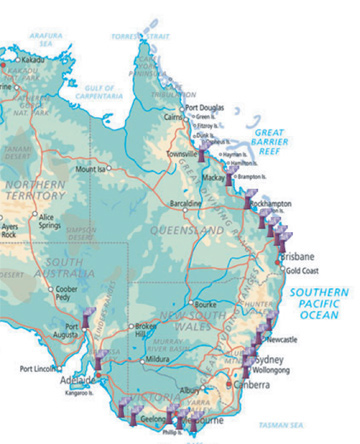
Albanese said after “22 failed plans” the Coalition now wants “to go towards nuclear energy”………………. we know they have to be near urban areas and water.”
the shadow climate change minister, Chris Bowen, ruled out consideration of nuclear power because he said “it is by far the most expensive form of energy”.
Guardian, Paul Karp, @Paul_Karp,Wed 7 Sep 2022
Peter Dutton has doubled down on Liberal support for nuclear power, pre-empting a review of its energy policy by arguing nuclear will be needed to support renewables.
Dutton told the Minerals Council on Wednesday that Australia needs a “frank debate” about nuclear energy, suggesting that it has a “wonderful opportunity to add value” to its uranium resources.
The comments sparked a demand from the prime minister, Anthony Albanese, in question time for the Liberals to nominate “where the plants are going to be”.
The Coalition didn’t do much on nuclear energy while in office. Why are they talking about it now?Read more
On Wednesday Dutton confirmed that he appointed Ted O’Brien as shadow energy minister in part because a committee inquiry he chaired in 2019 recommended the partial lifting of the moratorium on nuclear energy to allow for “new and emerging nuclear technologies”.
Dutton suggested nuclear energy could also help Australia “power up irrigation and open up thousands of square kilometres of export opportunities” before concluding the government should “at least allow” the community to have a debate about it.
In August the shadow climate change minister, Chris Bowen, ruled out consideration of nuclear power because he said “it is by far the most expensive form of energy”.
“I mean, this is economic illiteracy from an opposition searching for relevance,” he told ABC News Breakfast.
“[Nuclear] is slow to deploy. It couldn’t be deployed in Australia until 2030.
“The CSIRO has made it very, very clear renewables are the cheapest form of energy. Nuclear is the most expensive. Why with rising energy prices you would put in the most expensive form of energy available is beyond me.”
Albanese replied that the government stands by the modelling supporting the claim, and that Labor’s policy was based on the systems plan of the Australian Energy Market Operator, which identified it would “promote investment in renewables which is the cheapest form of energy”.
Albanese said after “22 failed plans” the Coalition now wants “to go towards nuclear energy”.
“And they can say, if you like, where the plants are going to be. I’ll look forward to their review, letting us know … [because] we know they have to be near urban areas and water.”
While Labor raised the spectre of campaigning on the location of putative nuclear power plants, Dutton accused the government of asking Australians to sign up to an Indigenous voice to parliament “sight unseen”.
“We have no idea what it means for the mining sector,” Dutton told the Minerals Council earlier.
“We don’t know whether a voice that doesn’t represent the elders that you negotiate with or that your agreement is with in a particular location, now, they might be usurped and [the voice will] exercise a veto, right? That would damage your employees, that would damage your business.”
Earlier, Dutton said it was an “inconvenient truth” for climate activists that “decarbonisation will require more mining”, due to critical minerals’ importance in renewable energy, batteries and electric vehicles.
“I take some delight knowing it must keep them up at night.”
Dutton said the Liberals don’t support “locking in” the 43% emissions reduction target in legislation because the “inflexible position” might disadvantage Australia if competitors did not meet their targets and it would make it “harder if not impossible” for government agencies to fund resources projects……………………… https://www.theguardian.com/australia-news/2022/sep/07/pm-grills-peter-dutton-on-location-of-power-plants-amid-coalitions-nuclear-push
Topics
AI Group Unveiled: a propaganda service for Defence, big business and the Coalition
Michael West Media, by Michael West | Jul 22, 2020 ,
Is AI Group just a front for big business and foreign weapons manufacturers? Michael West reports on the rise of government and business propaganda outfits who are suddenly mute when the subject turns to the delicate matter of who funds them.
“Given the tone of the questions and misspelling of Willox you can list it as “no response”,” sniffed Tony the PR man for AI Group.
“Dang!” we muttered … “Willox, Willox, Willox. No “c”!”
And two “ns” in Innes too! This was indeed a grave error, a double-banger, getting the name of a PR guy wrong in an email to a PR guy. Unforgivable!
Albeit unsurprising. Lobbyists are famously taciturn when it comes to the subject of their own affairs, even as their views are plastered weekly across national media.
Our questions were about who funded them and how much of their hefty $72 million in annual revenue comes from big business, multinational weapons makers and the Government itself.
These questions are important because AI Group and other lobbyists such as the Australia Strategic Policy Institute (ASPI) are sermonising constantly about the way governments and everybody else should be conducting their affairs.
ASPI too is largely funded by foreign defence contractors and the Federal Government. It was little surprise therefore that, hard of the heels of Prime Minister Scott Morrison’s urgent yet vague warning earlier this month that Australia was the victim of menacing cyber attacks, it was ASPI which promptly named China as the culprit and affirmed the urgent nature of the unnamed threats.
Looking at the 2019 financial statements for AI Group, which you will not find on its website, the “peak employer organisation” made $14.3 million from Federal Government contracts last year, which rather helps explain why it is rare to see any criticism of government policy, other than a spot of whining at decisions which do not favour big business enough.
It is by no means alone in this. The Big Four consulting firms Deloitte, EY, PwC and KPMG are in the same boat, reeling in some $700 million in fees annually by consulting to the Government.
On top of its taxpayer take, AI made $38 million from “consulting, management services and training businesses”. So, not only is AI a lobby group but it is also is running businesses for profit, even a law firm while it pays no income tax.
This self-appointed not-for-profit (NFP) is sitting on cash and liquid assets of $76 million and it notched up income of $72 million last year. What did it spend it all this money on?
Some $55 million went on employees. The next biggest item was “Communications” at $5.6 million. They do do a lot of communicating and when it comes to having their voice heard in mainstream media, AI – and particularly its chief executive – Willox are slick operators, perhaps the best in the business lobby.
But unlike the Business Council of Australia, the Minerals Council, and think tanks such as the Sydney Institute and the Institute for Public Affairs (IPA), they actually get large government consulting deals as well as running profitable businesses.
In this, they are similar to the NSW Business Chamber, which boasts revenues of $237 million a year, also runs a law firm and vocation businesses and is even a registered charity…………………………………………..
 |
‘Reject the deadly logic of nuclear deterrence’
So, who is on board? More than 100 federal MPs and another 150 in state and territory parliaments, the Australian Greens, Labor and most other cross-benchers, including most of the new independents.
Two dozen unions, including the Australian Council of Trade Unions, more than 60 faith-based organizations, including the Australian Catholic Bishops Conference, the Australian Medical Association, dozens of civil society organisations and three quarters of the general public.
Fifty five former Australian Ambassadors and High Commissioners signed an open letter urging PM Albanese to fulfill Labor’s commitment.
Gem Romuld, August 21, 2022, Gem Romuld, the Australian Director at International Campaign to Abolish Nuclear Weapons, Australia, delivered this speech to the Sydney Hiroshima Day rally on August 8.
I want to acknowledge that First Nations people suffer the worst of nuclear technologies, not just nuclear weapons’ testing but all aspects of the nuclear chain, including uranium mining and radioactive waste dumping.
These struggles are ongoing today with threats of uranium mining at Mulga Rock in Western Australia, a radioactive waste dump planned for Barngarla land at Kimba, South Australia and the ongoing un-remedied impacts of 12 major nuclear explosions at Monte Bello in WA, Emu Field and Maralinga in SA, followed by hundreds of radioactive experiments — “the minor trials” —at Maralinga.
Today is a really important marker in time, one that we are keeping alive by gathering here.
What happened in Hiroshima and Nagasaki is why the vast majority of sensible people totally abhor nuclear weapons and want to see every last one decommissioned and dismantled.
Five years ago, the treaty banning nuclear weapons was created and last year it entered into force. It is something that experts, governments, diplomats and, even some activists, said could and would not happen.
But with strategy and persistence it did. Now, it has permanently altered the international legal architecture on nuclear weapons: it has raised the bar and all nations are measured against this powerful new standard.
Right now, the Treaty on the Prohibition of Nuclear Weapons has 86 signatories and 66 states parties, with those numbers going out of date regularly as more nations sign on.
Every new signature and ratification is a rejection of the deadly logic of nuclear deterrence and a bold expression of the alternative — human security without nuclear weapons.
The first meeting of states parties in Vienna in June was a big success that culminated in a Declaration and Action Plan, including 50 Points outlining practical ways members of the TPNW can “facilitate effective and timely implementation” of the Treaty articles and the Vienna Declaration commitments.
The second meeting of states parties will be in November-December 2023 at the United Nations in New York City. It will come around quickly. We need Australia to be at that meeting at least as a signatory, if not a state party.
Why is this treaty important?
It’s the first treaty to make illegal everything to do with nuclear weapons.
It completes the triad of bans on the three weapons of mass destruction: nuclear weapons; biological weapons and chemical weapons.
It is a powerful instrument of international law, as well as humanitarian law: it not only prohibits, but it also compels states’ parties to seek nuclear justice by assisting victims and remediating environments impacted by nuclear weapons.
In force as of January last year it is the ultimate test for all nations, including Australia. You are either against nuclear weapons or complicit with them.
Any nations that profess commitment to nuclear disarmament and nonproliferation but haven’t yet joined this treaty are exposed for their double-speak.
Under the previous federal government, prospects for this treaty were dire.
But Prime Minister Anthony Albanese and the Labor Party have committed to sign and ratify the Treaty on the Prohibition of Nuclear Weapons since 2018. Further, three quarters of all Labor MPs have personally pledged their commitment.
We all know that MPs make and break promises. But this is one we won’t let them break, will we?
Our efforts right now are critically important. We cannot for a minute drop the expectation that the government will do what it has promised. We have to be involved and keep up the pressure with MPs, councils, superannuation funds, unions and civil society organisations.
Like most meaningful change, it will take time and be hard won but we are well and truly on the way.
So, who is on board? More than 100 federal MPs and another 150 in state and territory parliaments, the Australian Greens, Labor and most other cross-benchers, including most of the new independents.
Two dozen unions, including the Australian Council of Trade Unions, more than 60 faith-based organizations, including the Australian Catholic Bishops Conference, the Australian Medical Association, dozens of civil society organisations and three quarters of the general public.
Fifty five former Australian Ambassadors and High Commissioners signed an open letter urging PM Albanese to fulfill Labor’s commitment.
We have all the right ingredients: the moment is ripe. We can get Australia to join the nuclear weapon ban treaty in this term of government.
Doing that will help other nuclear endorsing states resist the pressure of the nuclear-armed bullies. Slowly, they will be isolated and, eventually, one of them will begin the process of disarming.
Nuclear power – never a realistic option for Australia.
Peter Dutton wants Australia to consider nuclear power. SBS News 13 Aug 22,

“…………………………………………. In one of his most significant policy moves as Opposition Leader, Peter Dutton has been agitating for a public discussion over nuclear power……… He announced the Coalition would be formally reviewing Australia’s potential to adopt “next-generation nuclear technologies”.
………………………….. Worldwide, there are mixed feelings on how much reliance should be placed on nuclear energy………………….
Could Australia have its own nuclear industry?
Climate Energy Finance director Tim Buckley said building a homegrown nuclear power industry would never be a realistic option for a country like Australia.
He said it was extremely costly to build, required expertise Australia doesn’t have, and the public would never be comfortable with the storage of radioactive waste.
“It would be very charitable to think that Australia could have a nuclear power plant operational in the next 10 or even 20 years,” he said.
“I would absolutely bet against that probability. And the only way you could do it is with $20 billion or $30 billion of government funding underwriting the project.”………………………………………….
Energy finance analyst Bruce Robertson said investing in conventional nuclear would be a waste of money for Australia.
“We’ve got no expertise in the construction of nuclear power plants, we’ve got no expertise in their operation.
“We don’t have lots of nuclear engineers – they don’t exist in Australia. So if we wanted to build a nuclear industry here, it’s going to take a very large upfront cost.”
Could Australia build a nuclear reactor?
Australia currently has only one nuclear reactor, which is a government-run facility at Lucas Heights in Sydney. That reactor doesn’t produce electricity – rather, it is mostly used to generate chemical elements used in medicine.
While Lucas Heights produces a comparatively tiny amount of nuclear waste, there has been fierce debate within Australia over where it should be stored. Mr Buckley said this would only intensify with commercial-scale nuclear energy.
“Nuclear is a very, very divisive topic in the energy space,” he said.
“It is clearly zero emissions – but it generates toxic waste, and there is no solution for that. There are a lot safer and cheaper alternatives.”……………………………..
Nuclear fusion

………………….. Dr Adi Paterson is the former chief executive of the Australian Nuclear Science and Technology Organisation – one of Australia’s largest publicly-funded research bodies. Now he is working with an Australian start-up called HB11, which aims to commercialise nuclear fusion technology.
While nuclear fusion is incredibly promising, it has also proved to be technically frustrating. Researchers are still struggling to create conditions in which nuclear fusion produces more electricity than it requires to run……………..
The world’s largest nuclear fusion reactor is currently under construction in southern France, at a cost upwards of $21 billion.
Some 35 countries, including Australia, have been involved in the construction of the ITER reactor, one of the most ambitious energy projects in the world. Plagued by construction delays, it is now expected to start powering up in 2025.
Mr Buckley said nuclear fusion could be useful in the long term, but would not be ready soon enough to solve the immediate problems caused by global warming.
“When I was in nappies 55 years ago, nuclear fusion was a decade away from commercialisation,” said Mr Buckley.
“And now – 55 years later – it’s still just a decade or two away from commercialisation.”
Nuclear bomb tests at Maralinga triggered Hedley Marston to study fallout over Australia
ABC Radio Adelaide / By Daniel Keane 10 Aug 22,
Hedley Marston could be charming, genial and witty but he was not above fulmination, especially where fulminations of a different kind were concerned.
In the mid-1950s, the CSIRO biochemist emerged as arguably the most significant contemporary critic of Britain’s nuclear weapons testing program, which was launched on Australia’s Montebello Islands almost 70 years ago in October 1952.
Despite the imminent anniversary Marston remains an obscure figure, but his biographer Roger Cross believes that should change.
“He appears to be totally unknown to the Australian public and, of course, to South Australians — he was a South Australian after all,” Dr Cross said.
Marston’s reservations about the nuclear program were far from spontaneous; indeed, his strongest concerns weren’t voiced until several years after the first test, when he recorded a radioactive plume passing over Adelaide.
The source of that plume was Operation Buffalo, a series of four nuclear blasts in 1956, and Marston was especially outraged by the fact that the general population was not warned.
“Sooner or later the public will demand a commission of enquiry on the ‘fall out’ in Australia,” he wrote to nuclear physicist and weapons advocate Sir Mark Oliphant.
“When this happens some of the boys will qualify for the hangman’s noose.”
What made Marston’s fury difficult to dismiss, especially for those inclined to deride opposition to nuclear testing as the exclusive preserve of ‘commies’ and ‘conchies’, was the fact that he was no peacenik.
Detractors might have damned him as an arriviste, but never as an activist: his cordial relations with Oliphant and other scientific grandees demonstrate that Marston was, in many respects, an establishment man.
Dr Cross has described Marston’s elegant prose as “Churchillian”, and the adjective is apposite in other ways.
While the roguish Marston might not have gone as far as the British wartime leader’s assertion that, during conflict, truth is so precious “that she should always be attended by a bodyguard of lies”, he had, in a 1947 letter to the editor, publicly defended scientific secrecy:
Under present conditions of fear and mistrust among nations it is obvious that military technology must be kept secret; and to achieve this end it should be conducted in special military laboratories where strictest security measures may be observed.”
But by late 1956, Marston’s alarm at radioactive fallout across parts of Australia was such that he was privately demanding greater disclosures to the general public.
Much of his ire was aimed at the Atomic Weapons Tests Safety Committee — a body established before the Maralinga tests, but after blasts had already occurred at Emu Fields* and the Montebello Islands.
“He was the only senior Australian scientist to express concerns and, because of his character, the concerns that he expressed were very forthright,” said Dr Cross, whose biography of Marston, aptly entitled Fallout, inspired the documentary Silent Storm.
“When the safety committee after each explosion said there was absolutely no effect on Australians, he believed that they were lying.”
‘If the wind changes, we need to go’
The experiments that led Marston, whose reputation largely rested on his expertise in sheep nutrition, to reach this conclusion were two-fold.
In the more protracted one, he analysed the presence of radioactive iodine-131 — a common component of nuclear fallout — in the thyroids of sheep.
“One group he kept penned up under cover eating dried hay, which had been cut some time before. The other group, he put outside eating the grass,” Dr Cross said.
“He tested the thyroids in each group – the ones on the hay only had background amounts of iodine-131.
“But the ones in the fields had a tremendously high concentration of this radioactive isotope, both north and south of the city.”
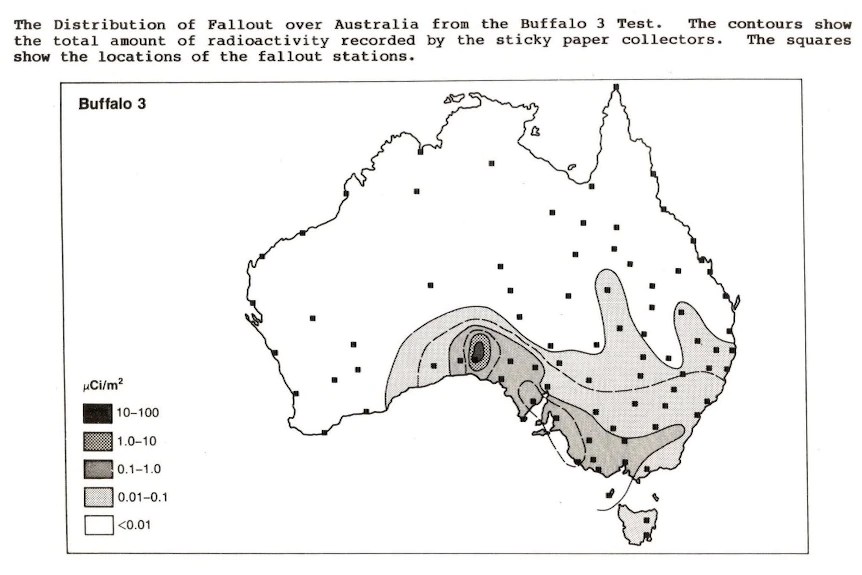
A fallout map from the 1985 royal commission, which stated that while fallout at Maralinga Village from the October 11, 1956, test was “considered to be ‘negligible from a biological point of view’ it does suggest difficulties with the forecast prior to the test”.(Royal Commission into British Nuclear Tests in Australia)
For the other experiment, Marston conducted air monitoring in Adelaide.
He was especially alarmed by what he found for the period following the Maralinga test of October 11, 1956.
“There was a wind shear and at least part, maybe the major part, of that cloud, blew in a south-easterly direction and that took it towards Adelaide and the country towns in between,” Dr Cross said.
“The safety committee — who must have known of the wind shear — had done nothing about warning Adelaide people perhaps to stay indoors.”……………………………………………………
Despite Marston’s reservations, the nuclear program carried on regardless.
Less than a year after the Operation Buffalo tests, Maralinga was hosting Operation Antler.
In September 1957, newspapers around Australia reported on an upcoming “second test” that would, weather permitting, proceed as part of a “spring series”.
If it hadn’t been for the presence of the words “atomic” and “radioactive”, a reader might easily have inferred that what was being described was as commonplace as a game of cricket.
|
Bob Carr puts Peter Dutton on the spot -calls for detail on Dutton’s plans for nuclear power in Australia
Bob Carr on the Opposition flagging nuclear, https://www.2gb.com/podcast/bob-carr-on-the-opposition-flagging-nuclear/ 9 August 22,
Michael speaks with Bob Carr, Former Premier of NSW & Former Australian Foreign Minister, who over the years has been a proponent of nuclear power, though becoming more circumspect with time.
Mr Carr writes, “Any opposition leader is under pressure to espouse fresh ideas and launch out in new directions. In this spirit Peter Dutton says the Coalition is open to nuclear power. He signalled an internal party review but took the opportunity to rehearse the somewhat dusty arguments about nuclear being cheap and reliable.”
“But Dutton in the next three months has the chance to prove this time Australian conservatives are serious. He can pitch it direct to 4.5 million voters in the November 26 Victorian elections. He can show this is more than a lazy “thought experiment” and invest it with hard-edge credibility.”
The National Party’s false claim about nuclear power

Barnaby Joyce’s meltdown over nuclear energy claim , ABC, Jacob Shteyman August 5, 2022,
With Australia’s future energy needs dominating parliament, Nationals MP Barnaby Joyce has claimed we are the only OECD country that does not produce nuclear power.
The claim is false. Eighteen of the 38 OECD countries do not produce nuclear power.
Mr Joyce made the claim during a debate on Labor’s Climate Change Bill 2022 on August 3. In outlining his support for nuclear power, the shadow minister for veterans’ affairs asked: “Why is it that every OECD country produces nuclear power except us? Are we the wise ones and they’re all stupid?” (video mark 19:25).
Mr Joyce has been a supporter of nuclear power for a number of years while the coalition has looked into its implementation at several points in recent decades.
Opposition Leader Peter Dutton announced on August 2 that the coalition would begin an internal process to examine the potential for nuclear power in Australia.
AAP FactCheck contacted Mr Joyce on the source of his claim but received no reply at the time of publication.
The OECD, which is made up of 38 countries, was established in 1961 as a forum for governments to “seek solutions to common economic and social problems”.
The OECD Nuclear Energy Agency publishes an annual report showing nuclear energy generation by each member nation. The 2021 report (table 1.1, page 14) shows 18 of the 38 do not produce nuclear power.
They are Italy, Turkey, Poland, Ireland, Norway, Israel, Austria, Chile, Colombia, Denmark, Estonia, Greece, Iceland, Latvia, Luxembourg, Portugal, New Zealand and Australia.
ANU nuclear expert Tony Irwin confirmed to AAP FactCheck in an email that Australia is not the only OECD nation to generate nuclear power.
A similar claim was made by Liberal MP Stuart Robert in an interview on ABC’s Afternoon Briefing on August 2. While responding to a question about the affordability of nuclear energy, he said: “I think we’re one of only, in fact we’re the only non-top 20 OECD country that doesn’t use nuclear power as part of its power mix” (video mark 9min).
A spokesman for Mr Robert clarified to AAP FactCheck that he meant to say Australia is the only top 20 OECD country without nuclear power.
Either way his claim is false……………………………..
The most recent World Nuclear Industry Status Report, published last year, found global nuclear energy production is on the decline, despite a significant increase in China.
In 2019 AAP FactCheck debunked a similar claim by coalition MP Keith Pitt that Australia is the only OECD country not utilising nuclear energy.
Jenny Ware -A Liberal MP happily in the grip of the nuclear lobby

Some of the more inane comments promoting nuclear power for Australia have lately been voiced by Liberal MP Jenny Ware . She’s enthusiastically advocating nuclear to solve Australia’s electricity crunch prices. (a. Nuclear would not be operative for decades. b. Nuclear is the most costly source)
And she wants the Lucas Heights research reactor to provide electricity. Does she not know that there’s a bit of a difference between a research reactor and a commercial nuclear power plant? (There are a few other problems, too, but nuclear lobby mouthpieces don’t usually stretch to considering them.
from The Daily Telegraph – Nuclear the best medicine for power prices, says new MP Newly elected member for Hughes Jenny Ware has declared Australia has to start talking about adding nuclear into the mix, otherwise we won’t be able to keep the lights on.
James Morrow in The Chronicle writes Hughes MP Jenny Ware wants Lucas Heights nuclear reactor to help power Australia
Labor should halt plans to dump nuclear waste on South Australia – Greens Senator Barbara Pocock.
29 July 2022
Greens Senator for SA Barbara Pocock has called on the Albanese Labor Government to abandon plans to dump nuclear waste on South Australia, after it was revealed the environmental impact statement won’t consider shipping and transport routes for the toxic waste.
The latest concerns have arisen while the Traditional Owners of the selected waste dump site at Kimba on SA’s Eyre Peninsula were visiting parliament this week. The Barngarla people were not consulted before the site was selected and are in the midst of a Federal Court battle opposing the dumping of waste on their traditional lands. They were in Canberra asking the new Minister to listen to them and halt the plans of the Morrison Government.
Senator Pocock said:
“The Albanese Labor Government should stop the pursuit of the Morrison Government’s plans to dump on SA.
“If this dump goes ahead, radioactive waste will be transported through South Australia’s regional roads, streets and waters for decades to come, yet these towns and cities – and most South Australians – have never consulted.
“Now it’s also clear the new government has no plans to consider the environmental impact of the shipping and transport of the waste throughout our state. This is unacceptable.
“This week I met with the Barngarla People who were again in Canberra pleading for the government of the day to listen to them.
“The Labor Party continues to talk about giving First Nations People a voice to the parliament yet is failing to listen to their voices right now, on a current issue. The Prime Minister is addressing the Garma Festival on implementing the Statement from the Heart this weekend. His words will be hollow if his government does not listen to the voice of the Barngala people and instead pursues the radioactive waste dump rejected by Traditional Owners.
“The Greens will fight to ensure that all South Australians have a say about this dump and we will keep listening to the voice of the Barngarla people who, to a person, oppose this dump.”
Government to rewrite climate bill to win over Greens
The Age, By Mike Foley, July 25, 2022 , The Albanese government is promising to rewrite its signature climate reforms to secure support from the Greens including a change to make clear its target of 43 per cent emissions reduction by 2030 is a minimum that could be upgraded over time.
Labor’s concession on the eve of the first parliamentary session is a crucial bargaining play as the new government seeks support for its first major bill.
While the government previously stated that its 43 per cent target would not put a limit on its climate action, Greens leader Adam Bandt is concerned the original draft did not spell that out and could have acted as a cap on emissions’ reduction.
Labor has agreed to make clear in the bill that 43 per cent is a minimum only, but has stopped short of some of the Greens’ biggest demands, such as phasing out coal and gas exports, and it remains to be seen if this rewrite of the bill is enough to lure the minor party across the line.
Bandt told The Age and The Sydney Morning Herald the changes would be a starting point for negotiations.
“The Greens are pleased the government has listened to some of our concerns about the bill, and we are continuing negotiations about remaining issues, including the opening of new coal and gas mines,” he said.
The Greens want to set a target to cut emissions by 75 per cent by 2030 and hit net zero by 2035. Bandt has called Labor’s target “weak”.
A draft of the climate change bill obtained by The Sydney Morning Herald and The Age earlier this month revealed the proposed legislation was largely symbolic because it would only enshrine an emissions target and oblige the federal government to make an annual progress report to parliament.
Responding to the earlier draft, Bandt had demanded the Labor government “Dutton-proof” the targets against any future government’s plans to wind them back, calling for commitments to raise the ambitions to be written into the laws……………………………..
Labor’s bill is expected to come before the lower house on Wednesday where Labor has enough votes to pass it on its own. The bill is set to reach the Senate by September and because the Coalition has vowed to vote against the draft laws, Labor will need all 12 votes from the Greens plus one crossbencher, which will most likely come from ACT independent David Pocock who is open to Labor’s proposal.
Another change proposed by Labor would also insert the new emissions target into the objectives and functions of key agencies such as CSIRO, the Clean Energy Finance Corporation, Infrastructure Australia and the Australian Renewable Energy Agency.
Even if the Greens and the Coalition decide to block Labor’s bill, Labor can deliver its key measures to cut carbon emissions without new legislation by increasing renewable energy projects and capping industrial pollution.
The bill does not contain specific mechanisms to ratchet up emissions reductions, such as the use of existing safeguards mechanism to force tougher carbon pollution caps on the 215 biggest industrial polluters in the country…………….. https://www.theage.com.au/politics/federal/government-to-rewrite-climate-bill-to-win-over-greens-20220725-p5b4fn.html
Nonsense to say ‘Australia needs nuclear submarines to defend itself’: Australian scholar

Global Times 24 July 22,
After the Albanese government took office in Australia, there have been discussions about a possible reset of China-Australia ties. Global Times (GT) reporter Yan Yuzhu talked to Professor David Goodman (Goodman), director of the China Studies Centre at the University of Sydney, about his opinions on the reason why there has been hostility in Australia toward China and possible changes in the new government regarding the China policies……………………………..
Goodman:
I think this government is definitely more inclined to deal with sensible diplomacy with China than standing up in public and telling China why it is wrong. That’s a good thing, because talk is always preferable to war.
Penny Wong is a great foreign minister, as she is listening to people and doing things. She has put a whole new working party in place to see how we can more positively deal with our foreign policy. …………………..
A lot of nonsense is talked such as “Australia needs to have nuclear submarines to defend itself.” It doesn’t work, and there are many opinion influencers who agree with me that this is really not healthy.
Of course, we don’t want to be attacked by anyone, but when you think about what it would take China to physically attack Australia, including logistic and military challenges, it will be clear that China will not do so.
But a lot of the defense officials in the past government in Australia are thinking about what we would do as Australians if China “invaded” Taiwan. How crazy. Even people who are anti-China in the UK and the US have said that kind of argument is rubbish, because it is.
What I’d like to see in the bilateral relationship is that the trade ties could ease. The previous government made some statements and criticism about Chinese trade practices which led to bad trade relations between the two countries. I’d like to see them eased. And in my opinion, China has some severe economic problems ahead. It would be in China’s interests to solve them. ………………………………
About Australia’s hostility toward China, one of the reasons is that politicians outside China prefer a threat to exist so that they can use it to mobilize support for themselves. As a result, both China and Russia become the new fashionable threats.
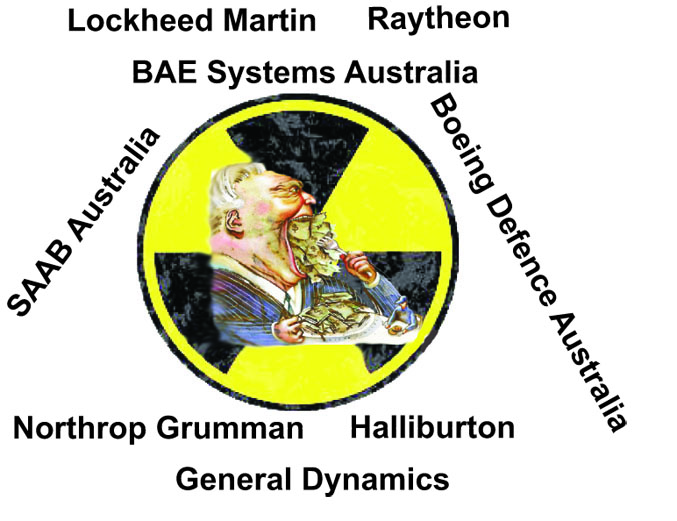
Besides, it is because of the US and European defense industries who fund one of Australia’s leading think tank that leads the charge against China.
Arms makers of course want there to be a China threat because they can sell more. It’s a logic of capitalism I’m afraid.
As to Australia’s stance toward the US, there is a debate going on in Australia as I mentioned before. I don’t know who the majority supports, but there is a sizable body of opinion that doesn’t think that America is the answer to all our problems. There’s also a lot of discussion in Australia about foreign interference and involvement in the local property market. https://www.globaltimes.cn/page/202207/1271242.shtml
Australian local governments vote to retain prohibitions on nuclear power
Local government talks nuclear, Cosmos 15 July 22
Energy shortages across the world have shone a harsh spotlight on the way forward for energy production, and renewed the nuclear power debate in Australia. But what stance are our local government representatives taking on this divisive issue?
What do our grass-roots leaders think about nuclear power?
……. A motion to call on the federal government to remove restrictions to progressing nuclear energy in Australia has recently been defeated by a narrow margin at the National General Assembly in Canberra.
But the heated debate included a claim from one councillor he wouldn’t mind if it was in his own backyard.
Delegates from Australia’s 537 councils took part in the June 19-22 conference, billed by its organisers the Australian Local Government Association (ALGA) as “the largest most influential local government conference in Australia”.
Motion number 52, submitted by Gunnedah Shire Council in north-west New South Wales, called on the federal government to “remove restrictions preventing the development of nuclear energy as a viable option in the production of base-load electricity following the decommissioning of coal-fired power stations throughout Australia”.
Gunnedah Mayor Jamie Chaffey told delegates……………. Nuclear power production has developed exponentially since its early days and is now considered to be safe and reeliable with nations such as Germany [ really?] and France leading the way.
The plea brought an emotional response from Inner West (Sydney) Councillor Mark Drury, who quoted the 2021-22 CSIRO GenCost report.
“Let’s not go through this again, delegates,” Drury said.
“Let us not repeat the mistakes of the last 10 years. Let us not sing from the Mineral Council songsheet. Let us move on.
“Interestingly, the restriction Gunnedah wants to remove is the 1999 [Prime Minister John] Howard ban on ministers considering nuclear power. Since 1999, no Liberal prime minister has changed that. I know Albo [Prime Minister Anthony Albanese] won’t.
“Why? Because nuclear power is expensive. It is really, really expensive.”
Gladstone Mayor Matt Burnett said even people who supported nuclear energy had told him they did not want it in their own backyards.
He quoted the 2018 CSIRO GenCost report that stated by 2050, nuclear energy would cost $16,000 per kilowatt to produce, while solar energy would cost $600 per kilowatt.
“The same report identified it would take 9.4 years before we saw a nuclear generation plant in this country,” Burnett said. “In context, in the Gladstone region, with our beautiful deepwater harbour and our industrial port, the Gladstone Port Corporation estimates we’ve got upwards of 2,500 wind towers coming into the Gladstone Port over the next 10 years.”…………..
The motion was defeated 109 to 93 votes.
The construction and operation of nuclear power stations was prohibited in Australia in 1998. https://cosmosmagazine.com/technology/nuclear-power-local-government-australia/
Liberals to seek ‘social licence’ for nuclear power
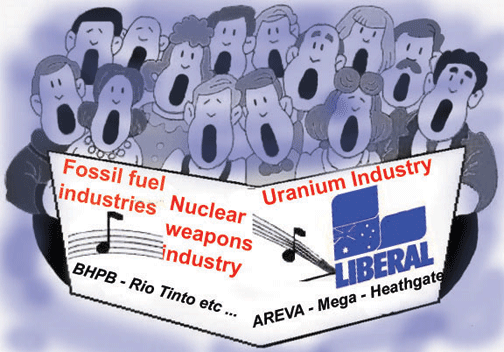
AFR 15 July 22, As Liberal leader Peter Dutton and Nationals leader David Littleproud backed an examination of nuclear power, new shadow energy minister Ted O’Brien said while his immediate focus was the gas and energy crisis, his longer-term mission would be to build support for nuclear energy.
Labor must reverse Morrison’s submarine bungle to protect nation
https://independentaustralia.net/politics/politics-display/labor-must-reverse-morrisons-submarine-bungle-to-serve-nation,16546 By Alan Austin | 11 July 2022,

There is a niche in the global submarine industry that Australia is well-placed to occupy, reports Alan Austin.
IT WOULD BE a bold move which only a visionary and courageous government could accomplish. Australia has the chance now to reimagine its status as a global naval manufacturer and exporter. The challenge is to build a smaller, faster, stealthier, stronger submarine than its rivals, which requires fewer crew and is cheaper to build and operate.
This can be achieved with a scaled-down version of one of the best submarines ever designed: the Collins class. Where was this built? In South Australia in the 1990s.
This “daughter-of-Collins”, as former Prime Minister Paul Keating dubbed it, offers multiple gains. It will replace the current ageing Collins class more quickly than other options, it will give Australia’s navy boats fit for purpose, it will generate export income and build a springboard for expansion into other high-tech manufacturing. It’s a win-win.
Australia lost its car manufacturing industry during the disastrous Tony Abbott period. Australia’s military procurement suffered badly throughout the later Coalition years due to ineptitude, lack of enterprise and corruption. New submarine construction will restore Australia’s heavy industry capability and recover – eventually – the treasure lost with all those Coalition failures.
The boat for middle-power countries
None of the submarines considered by the previous incompetent Coalition Government is right for Australia.
These were:
- Japan’s Soryu class diesel-electric, 84 meters long, speed of 20 knots submerged, 65 crew. The Abbott Government announced in 2014 that it was buying these but did not proceed;
- France’s Barracuda class nuclear attack submarine, 99.5 meters, speed of 25 knots, 60 crew. The Turnbull Government contracted to buy twelve in 2015. The Morrison Government welched on that deal in 2021, costing Australia its international reputation as an honourable trading partner, compromising Australia’s medium-term security, and losing taxpayers around five billion borrowed dollars with nothing to show for it;
- American Virginia class nuclear-powered fast-attack submarine, 115 metres, speed of 25 knots, 135 crew. Designed in the 1990s, first delivered in 2008;
- Britain’s Astute class, nuclear-powered attack submarine, 97 metres, speed of 30 knots, 98 crew. Designed in the 1990s, first launched in 2007.
Other options include Sweden’s Blekinge class diesel-electric, 66 metres; Germany’s U-36, diesel-electric, 57 meters; and India’s Kalvari class diesel-electric, 67.5 metres.
These compare with the current Australian Collins class, which is 77 metres, speed of 20 knots, crew 42, including six officers.
Assessing Australia’s needs
The new Australian sub should be around 60 metres, diesel-electric, speed 30 knots and operable with a crew of four officers and 25 sailors. This is based on the following needs:
- Given regional stability is steadily improving, Australia can ensure its defence with smarter decisions, more advanced technology, better regional collaboration and much lower expenditure;
- Australia’s immediate neighbours are Papua New Guinea, Timor-Leste, New Zealand, Indonesia and Malaysia. Nuclear submarines are not needed to patrol these waters and cannot access New Zealand ports under laws unlikely to change. Malaysia and Indonesia also have serious misgivings;
- The concept that Australia, population 26 million, could deploy nuclear attack class vessels in the South China Sea or beyond to engage militarily with China, population 1,439 million, is ludicrous. This seems to be the underpinning of the previous Government’s failed endeavours.
- The risk of China attacking Taiwan is limited. Even if it does, Australia has no treaties with Taiwan, and will not be involved;
- The risk of buying American nuclear submarines is that they will be operated and controlled by Americans and effectively just add to the U.S. fleet.
Historical precedent
Building the six Collins class submarines in Australia was an extraordinarily ambitious project. The challenge was to build faster, stealthier and more lethal boats than its successful predecessor, the Oberon class.
Prime Minister Bob Hawke delegated this task to Treasurer Paul Keating and Defence Minister Kim Beasley.
Keating recalled recently that “Kim always had the admiral’s hat on. I had the money and the guns”.
Construction began in 1990 and encountered multiple engineering problems, all of which were eventually overcome. The first boat was delivered in 1996, the sixth in 2003. These will now serve until the mid-2030s.
Military analysts Asianometry recently assessed them as:
‘… very capable, up to par with anything the United States has to offer … The Collins was a triumph.’
Australia can do this
ASC, the government-owned shipbuilders based in Osborne, South Australia, built the Collins vessels and has continual experience maintaining them. It has also successfully delivered three Hobart class destroyers and other vessels.
Home-built submarines superior to Collins are now possible because of advances since the 1990s in metallurgy, engine design, sonar technology and batteries. Weapons systems are also more compact.
Importantly, Australia is one of two major lithium mining countries. Lithium-ion batteries have double the storage capacity of lead-acid batteries. Australia becoming the world’s leading lithium battery producer will be a highly-profitable spin-off.
Can new Defence Minister Richard Marles pull this off? As Deputy PM, he had the choice of portfolios and chose defence. He has put his hand up. Let’s see what he delivers when he dons his admiral’s hat.
South Australia’s enthusiasm
The project has passionate support from the State Government.
Welcoming new Defence Minister Richard Marles to South Australia last week, Premier Peter Malinauskas said:
What the Deputy Prime Minister has been able to see firsthand today is the extraordinary capability that South Australia offers when it comes to shipbuilding. This has been something that is now in our blood here in South Australia. We are the home of the Collins-class submarine. We built the AWDs. We now see firsthand the work in terms of the delivery of the Hunter class.
What should we call this new class of submarines built in Australia? One option is to honour the last of the Coalition defence ministers, whose incompetence has inadvertently gifted the new Government with this shot at greatness.
So why not the Boofhead class? Or in honour of Keating, who remains an inspirational visionary in this area, maybe the Scumbag class?
Perhaps, to recognise the recent historic change of government, the Toto class? Or if the incoming Government succeeds with this ambitious project, as it should, then why not simply the Albo class?
1 This month


Help Aunty Sue Protect Her Land and Sacred Sites From Destructive Rocket Testing.
.

Australians deserve the truth
about
AUKUS – https://aukuspublicinquiry.com/

PETITION – To: Prime Minister Anthony Albanese and the Australian Labor Government

of the week – Australians for War Powers Reform (AWPR)
To see nuclear-related stories in greater depth and intensity

