The Federal government is pulling a nuclear waste confidence trick on South Australia.
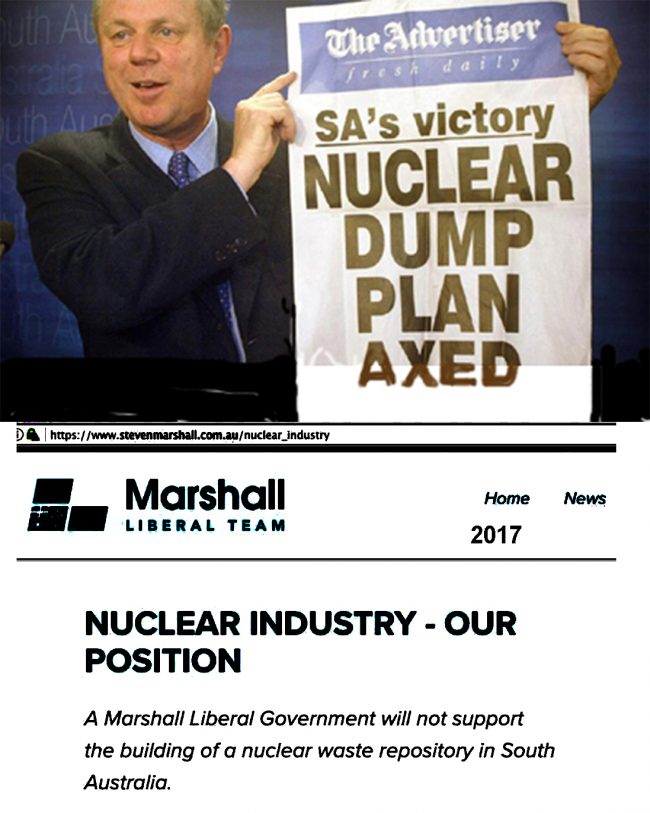
Well, that’s a relief to South Australians.
But aw shucks, that was 2017. Is Premier Marshall now going to do a backflip, and let the Federal government send ANSTO’s radioactive trash to a small rural community in South Australia?
On Monday 21 June at 12.20 pm, the Australian Senate will debate, and may vote on, the revised National Radioactive Waste Management Amendment (Site Specification, Community Fund and Other Measures) Bill 2020 .
South Australia has clear laws prohibiting the establishment of a nuclear waste dump in that State. Nuclear Waste Storage Facility (Prohibition) Act 2000
There is a strange and hypocritical silence from the State’s Liberal leaders, and Labor Opposition. Only the Greens have spoken out against this Federal plan to establish a nuclear waste dump in a rural area.
Why the silence from the rest? It could be because they sort of support the plan, even though it contravenes the State’s law. Or, just as likely, they know that even if this Bill is passed, it’s not really going anywhere, anyway.
The idea of toting ANSTO’s ”intermediate level” nuclear waste from temporary storage at Lucas Heights, to way across the continent to another temporary storage in some little rural agricultural area in South Australia, is fraught with problems, and unanswered questions.
If this Bill becomes law, three previously short-listed locations Lyndhurst in New South Wales, Napandee near Kimba, and Wallerberdina in the Flinders Ranges are nominated as suitable sites, and Minister Keith Pitt will be required to formally declare a site. Correction. I am informed that the New South Wales site is not included, and that Federal Labor have put up an amendment to remove that Wallerberdina site in theFlinders Ranges.
From then on, the rot will really set in, and I don’t like Minister Pitt’s chances of imposing a facility on any of these communities. For a start, the Wallerberdina site has already been rejected. via a community ballot, and that location was scrapped by the previous Minister Matt Canavan.
The obvious target is the Kimba site, where in a fairly restricted vote, a community vote did favour this ”interim” waste dump, accompanied as it was by financial incentives for the town.. But there is strong opposition from the Barngarla people, traditional owners who were excluded from the vote. There are also farmers most unhappy with the choice of this agricultural area: they have formed a group – No Radioactive Waste on Agricultural Land in Kimba or SA.
The newly amended Bill opens the matter up for legal challenge, which is sure to come about. There are serious objections to the plan, not least of which is the problem of transport, involving numerous communities whose residents are likely to object to having radioactive waste transported through their area. There certainly is the question of placing nuclear waste in an agricultural area. Nuclear enthusiasts claim that this is acceptable overseas. They cite France ignoring the protest continuing in the village of Bure where the French government has tried to set up a waste facility.
There are serious doubts on the soundness of the proposal, especially as it relates to the Napandee site . Is it geologically suitable, seismically safe?Meanwhile the interim storage at Lucas Heights has room for years more storage, and has the staff, the security, and the expertise to safely manage the wastes on site.
Above all – the Napandee site has been promoted to the local community, with enthusiastic information from ANSTO and Industry Department experts, and promises of economic benefits. What has not been provided, but in fact, actively discouraged, is the other side of the story. Kimba residents have not had access to the misgivings of other experts about this proposal – economic disadvantages, environmental considerations, water problems, and the long-term probability for the community to be stuck with stranded wastes
NSW Productivity Commission Has “Lost The Plot” On Nuclear Power,
NSW Productivity Commission Has “Lost The Plot” On Nuclear Power, Solar Quotes, June 3, 2021 by Michael Bloch The Electrical Trades Union has weighed in on the New South Wales Productivity Commission’s recommendation to lift the ban on nuclear electricity generation for small modular reactors.
The recommendation was one of many contained in the Commission’s 371-page “Rebooting the economy” whitepaper released last week.
……….. Small modular reactors operating as terrestrial power stations are vaporware at this point; they do not exist. The Commission notes a U.S. company expects to have its first small modular reactor operating by 2026. “Expecting” gives wiggle room for that to not happen and it’s not unreasonable to assume it won’t given the challenges the SMR technology faces, including the renewables juggernaut.
ETU: Nuclear Power “Not The Answer”
With renewables and storage rapidly evolving and their cost continuing to plummet, it sounds a bit nutty to be even considering SMRs – and the Electrical Trades Union agrees.
“The Productivity Commission has lost the plot if it thinks small modular reactors, a technology that has been ‘just around the corner’ since the 1970’s but still doesn’t exist, is the answer to NSW’s productivity growth,” said ETU National and NSW Secretary, Allen Hicks. “Even if someone finally manages to build one that works, the electricity price forecast for their output is six times more expensive than renewables.”
The Commission notes low-cost renewables pose an additional risk to the economics of large reactors, but doesn’t seem to tweak to the fact they pose the same threat to SMRs…..
Mr. Hicks’ advice:
“Boosting the economy, providing more jobs, and dealing with climate change are big problems, but nuclear power is not the answer.”
But something that wins the trifecta are renewables such as wind and solar power along with supporting technologies.
The 70,000-member strong Electrical Trades Union says it has a long history of opposing uranium mining and the nuclear power industry, and has had a ban on members working in both sectors since 1945. You can learn more about the ETU’s stance on its “No Future For Nuclear” website. Mr. Hicks’ advice:
“Boosting the economy, providing more jobs, and dealing with climate change are big problems, but nuclear power is not the answer.”
But something that wins the trifecta are renewables such as wind and solar power along with supporting technologies. https://www.solarquotes.com.au/blog/productivity-commission-nuclear-mb2021/
Labor consults traditional owners about the Kimba nuclear waste dump Bill, considers supporting the Bill.

Nuclear waste facility in SA may be a step closer, after Labor consults traditional owners
ABC, By political reporter Matthew Doran, 15 June 21, ”………………with the federal opposition preparing to negotiate with the government on legislation that would allow construction to begin.
Key points:
- Labor says the government has agreed to amendments allowing legal challenges against the location
- The federal government has proposed to build the dump at Kimba in South Australia…..
Nuclear waste facility in SA may be a step closer, after Labor consults traditional owners
ABC, By political reporter Matthew Doran, 15 June 21, ”………………with the federal opposition preparing to negotiate with the government on legislation that would allow construction to begin.
Key points:
- Labor says the government has agreed to amendments allowing legal challenges against the location
- The federal government has proposed to build the dump at Kimba in South Australia…..
The federal government has proposed the dump be built near Kimba, on South Australia’s Eyre Peninsula, after a shortlist of locations was whittled down and a community vote was held.
But legislation to give the project the tick of approval stalled in the Senate, with Labor concerned the bill did not allow legal challenges against the choice of location……..
On Tuesday, Labor’s Caucus agreed to let Shadow Resources Minister Madeleine King negotiate on the bill after the Coalition suggested it would present amendments to Parliament allowing for judicial review.
“We said we would not support passage of this legislation unless the traditional owners were comfortable with it,” Ms King said………
Ms King said the opposition would wait to see the details of the amendments before making its final decision.
She was praised by Shadow Indigenous Australians Minister Linda Burney for her consultation with the community.
Representatives of the Barngarla Determination Aboriginal Corporation (BDAC) travelled to Canberra to seek extra assurances from the federal government about the amendments.
“We welcome the engagement Labor to date and the engagement from the crossbench,” a spokesperson said.
We also acknowledge the commitment from Labor to ensure that nothing occurs without our support.
“We are unable to comment further at this stage as we are too busy dealing with this.”……..
The amendments are yet to be introduced to Parliament, and the timeframe for construction is not clear.
Legal challenges have scuttled previous attempts to construct a nuclear waste dump, including at Mukaty Station in the Northern Territory.
Nuclear waste facility in SA may be a step closer, after Labor consults traditional owners
Resources Minister Pitt changes nuclear waste Bill in the effort to gain Labor’s support.

Nuclear waste storage facility legislation changed in bid to gain Labor support, secure Kimba site” – The Advertiser 14th June 2021.
“A nuclear waste storage facility in regional South Australia is one step closer, [really?] with the Federal Government making changes in a fresh bid to get the controversial plan through parliament.
Napandee Farm near Kimba on the Eyre Peninsula was named as the preferred site in February 2020 but draft laws to establish the facility have been stalled in parliament for months .
The federal Opposition won’t back the bill in its current form because naming the site in legislation, rather than declaring it by a ministerial decision, prevents a possible future legal challenge to the location.The federal government is now proposing changes that would reinsert the possibility for a judicial review, in a bid to win Labor’s support and get the laws through the Senate.
Under the changes, a site would no longer be specified but three previously short-listed locations – Lyndhurst in New South Wales, Napandee near Kimba, and Wallerberdina in the Flinders Ranges – would be included in the bill and the minister would then be required to declare the site…….
Opposition leader Anthony Albanese’s frontbench is due to consider the amendments on Monday night and the bill may go before the Senate in the next two weeks.
Indigenous associations, including the Barngarla Determination Aboriginal Corporation, have been opposed to the site because traditional land owners who did not live in the area were excluded from a 2019 ballot to gauge community support for the site.
Kimba Mayor Dean Johnson said the community just wanted a decision.“We just look forward to a resolution so our community can move forward,” Mr Johnson said. He welcomed changes to the draft laws if it would secure Labor’s support, and said the minister should declare the site “as soon as possible”…
Australian Conservation Foundation Nuclear Free Campaigner David Sweeney said Mr Pitt had “finally accepted the reality” the proposal did not have support and needed to be revised.
“The return of legal review is important but it is extraordinary that the Minister ever thought its removal was reasonable,” Mr Sweeney said.“A day in court is a fundamental right and to seek to remove this was deeply flawed – as is the government’s wider plan.”…….
Mr Sweeney said there was no compelling case to move intermediate level waste from ANSTO’s site to Kimba, and it had been opposed by the traditional owners.He added the reintroduction of Wallerberdina, which was ruled out in 2019, showed the government was “making policy on the run”.

Most South Australians “don’t want the country’s nuclear waste dump in our backyard,” Senator Hanson Young said.She also raised concerns the amendments opened the door to the minister selecting the Flinders Ranges site.Greens senator Sarah Hanson Young said it appeared the Federal Government and Labor had done a deal to pass the bill.
“We will use all mechanisms available in the Senate over the next two weeks to stop this bill passing, and I suspect our fellow crossbenchers will do the same,” she said.”
Change in Resource Minister Keith Pitt’s strategy: what’s next for his Kimba nuclear dump project?

On Tuesday 15th June, Resources Minister Keith Pitt is introducing a revision to the the National Radioactive Waste Management Amendment (Site Specification, Community Fund and Other Measures) Bill 2020.
The purpose of the original Bill was to make sure that a site near Kimba, South Australia, would become the dump for nuclear waste from ANSTO’s nuclear reactor in Sydney. AND that there could not be any court action taken against it. That site would be ”set in stone”
Mr Pitt has chickened out a bit, seeing that the Senate was likely to reject that Bill. Hence the change – this new amendment The amendment restores the three shortlisted South Australian sites (Lyndhurst, Napandee, and Wallerberdina) as being open for consideration. (This is despite Wallerberdina (the Flinders Ranges site) having been ruled out of consideration in December 2019 by former Minister Canavan. )
”The Bill No longer specifies a site” – listed in supplementary explanatory memorandum https://www.aph.gov.au/Parliamentary_Business/Bills_Legislation/Bills_Search_Results/Result?bId=r6500&fbclid=IwAR2F-HOZX_TNR1r_kYXbB8sM3R-UwZNZRQ7X1hU34z9MTnLot3aRJcEFKVs
‘‘New section 34A ensures that the payment of the Community Fund is linked to a site declaration, rather than to a site specified in legislation” This would appear to cast some doubt on the ambitions of the Kimba District Council etc?
How does this amendment affect the chances of the Bill being passed in the Senate?
Well, Federal Labor being traditionally wishy washy on nuclear issues, this change might be enough to win the support of Labor, and thefore be passed.
Once the Bill is passed, what then?
Minister Pitt can then exercise his power to formally declare the site at Napandee, Kimba, as the site for the radioactive waste facility.
What then?
Well, various possibilities.
Concerned citizens in the the local Kimba community could seek some government grant to pay for their own independent assessment and review .
The plan still requires, and might not qualify for, a licence from ARPANSA, to ensure that the site meets the requirements, geological etc, for interim storage of nuclear wastes, and more permanent storage of low level radioactive wastes.
The Barngarla people, and perhaps others, will file a legal challenge to the site selection.
Australia’s News Corpse, Nine media, and Resources Minister Keith Pitt have been duped by the Minerals Council of Australia.
Australia’s major media organisations, News Corp and Nine Entertainment, have been duped by the mining lobby’s false claims about its contribution to Australia. The industry peak body, Minerals Council of Australia, has failed to include in its analysis the more than $72 billion in GST rebates the industry has received between 2010 and 2018, and an estimated $80.6 billion over the past 10 years.
The Australian, the Australian Financial Review, and the Minister for Resources Keith Pitt have consistently repeated the misleading claims provided to them by the mining lobby via the firm the MCA hired to conduct its reports, Deloitte Access Economics.
Deloitte found that the minerals industry had contributed more than $238 billion in company tax and royalty payments since 2010, with $132 billion from company tax alone.
However, the report avoids mentioning that the mining industry, as an exporting industry, receives a huge GST rebate every year…………. https://www.michaelwest.com.au/murdoch-media-nine-entertainment-mining-lobby-busted-for-record-bullartistry-go-into-hiding/
Dr Jim Green gives an update on the Australian government’s new strategy to get a nuclear waste dump at Kimba, South Australia.
Dr Jim Green, Friends of the Earth, 12 June 21, After being deadlocked in the Senate for exactly twelve months Resource Minister Pitt is introducing a revised radwaste amendment next Tuesday morning (June 15) that seeks to negate key objections to the federal governments approach to the siting of a national radioactive waste facility near Kimba in regional SA.
The changes mean that the Minister – rather than the Parliament – will choose a site and that choice will then be subject to legal review through Administrative Decisions (Judicial Review) Act 1979 (ADJR) processes.
In some ways this is a positive campaign outcome – the federal agenda has been effectively stalled since Feb 2020 and the Minster has had to abandon his push to remove the right of legal recourse, an important reaffirmation of a (limited) check and balance. However, it does mean that the federal effort and momentum to advance the facility will soon significantly escalate.
The amendment restores the three shortlisted SA sites (Lyndhurst, Napandee, and Wallerberdina) as being open for consideration. This is despite Wallerberdina (the Flinders Ranges site) having been ruled out of consideration in December 2019 by former Minister Canavan.
The last listed supplementary explanatory memorandum on the right hand side of the below link outlines the main changes to the revised amendment.
https://www.aph.gov.au/Parliamentary_Business/Bills_Legislation/Bills_Search_Results/Result?bId=r6500
<https://www.aph.gov.au/Parliamentary_Business/Bills_Legislation/Bills_Search_Results/Result?bId=r6500>
I have not had formal confirmation but it is likely that this revised approach will satisfy federal Labor and that the Bill will be passed. After this it is expected that Minister Pitt will move to formally declare the Napandee site, near Kimba.
Once this happens it is expected the Barngarla lawyers (the Adelaide based firm Norman Waterhouse) will file a challenge to the site selection. This development will require a re-calibration – but not a fundamental change – of our strategy and an increased public face to the campaign for responsible radioactive waste management.
Murdoch’s NewsCorpse trying hard to get the Australian Government to privatise the Australian Broadcasting Corporation (ABC)
Privatising the ABC: What’s the Scam? https://www.michaelwest.com.au/privatising-the-abc-whats-the-scam/Michael West | Jun 11, 2021 | What’s the scam?
Murdoch’s maddies at Sky News and The Australian have been banging on, more shrilly than ever, about privatising the ABC. What’s the scam?
The scam is they have no idea what they are talking about. Nor apparently do they want to know what they are talking about. The latest set of ABC financial statements show an enterprise which costs $1bn to fund each year and ABC itself recorded income of just $65m last year.
In the event of a sale therefore, the buyer would have to come up with a cool $900 odd million to fund the ABC. A privatised ABC would then burst into the advertising market and crush the commercial networks which are already financially stressed. It would cost thousands of jobs and send the networks bust. They can ill afford to lose $100m in ad revenue to the ABC, let alone $900m.
The only positive outcome would be that Sky News’ own tiny ad revenue would also be walloped.
New South Wales Deputy Premier in the grip of the nuclear lobby

NSW Deputy Premier says nuclear power is the future as ban remains Radio 2 GB, 04/06/2021, BEN FORDHAM NSW Deputy Premier John Barilaro says nuclear power is the way forward.However, it is currently illegal in Australia along with the mining of uranium in states like NSW.Mr Barilaro told Ben Fordham he’s looking at reintroducing a bill to lift the ban on mining uranium.“If you really want clean, green energy … to run an average home for 75 years it takes 150 tonnes of coal, to do it with uranium you’re talking about 2kg.“We would be ripe as a nation if we lift the ban today to absolutely embrace it.” https://www.2gb.com/nsw-deputy-premier-says-nuclear-power-is-the-future-as-ban-remains/
Nuclear trash – a tale of two Sydney suburbs

Radioactive trash – a tale of two Sydney suburbs, https://johnmenadue.com/radioactive-trash-a-tale-of-two-sydney-suburbs/ By Noel Wauchope, May 26, 2021
Australia is relatively clear of nuclear reprocessing waste problems. But the Sydney suburbs of Hunters Hill and Barden Ridge have radioactive wastes from uranium processing which have been sitting there for decades. A bill is now before the Senate addressing the issue.
Australia does have radioactive waste problems in the lingering concerns over historic atomic bomb test sites in South Australia., and in both the functioning and the closed uranium mines. But there is only one uranium-processing facility producing radioactive wastes, the Opal nuclear research reactor at Lucas Heights in Sydney.
Now, Federal and State governments are making decisions on the disposal of these wastes. But there is still uncertainty and lack of public information on just how [or whether] these decisions will be carried out. For example, there’s no detail on transport routes, dates etc.
There are significant differences between the situations of the two suburbs. Perhaps the most significant one is that at Barden Ridge, the nearby Opal nuclear research reactor will be continuing to produce nuclear wastes for the foreseeable future, whereas the Hunters Hill wastes are set for final and permanent removal. Hunters Hill residents have been worried about this for over a century. For Barden Ridge, it has been been recognised as a problem for a much shorter time.
2021 looks like being a watershed year for both.
Hunters Hill.
n 1911, radium was a valuable commodity, and was processed was processed at Hunters Hill, Some 2,000 tonnes of uranium ore were transported from Radium Hill in South Australia, to extract the radium. Several tonnes of uranium oxide were left, and also thorium 230, which itself decays to form more radium and is therefore dangerous for thousands of years. The project closed in 1915. From then on, it was a saga of mistakes and failed attempts to clean up this remaining debris. There was a tin smelter there until 1964.
Then the Australian Atomic Energy Commission (AAEC, now ANSTO) decided it was safe for housing. In the following years, residents and others became concerned about the uranium tailings spread over 6 housing blocks, in Nelson’s Parade, with the risk to health. They were met with cover-ups and obfuscation from the government. Health tests were kept secret, radiation hotspots were found, and cancers and deaths were claimed to be linked to this, and legal cases ensued.
Government plans to solve the problem included dumping the wastes at sea. This was resisted by environmentalists. The next plan was to dump it in Western NSW. This was strongly opposed by Aborigines from the area’s Bakandii tribe. When several Nelson Parade residents fell ill in the 1970s, the NSW government purchased several houses and demolished them, but failed to remediate the site.
in 1981 The then NSW Premier, Mr Wran asked South Australia to take 5,000 tonnes of contaminated soil. A NSW Upper House Inquiry in 2008 led to the government attempting to plan for the clean-up of 2,000 tonnes of radioactive waste. The Australian Radiation Protection and Nuclear Safety Agency said radioactive waste from Hunters Hill wasn’t permitted to be stored at ANSTO’s Lucas Heights interim waste storage facility.
In 2012, most of the contaminated earth was reclassified as ”restricted solid waste”. Two Sydney suburbs were mooted as destinations for the wastes – Kemps Creek and Lidcombe. This was resisted by the local residents. Then in 2019, the New South Wales government proposed to store the contaminated soil on site in an ”encapsulated” form. This was vigorously rejected by the Hunters Hill residents.
Now, in 2021, beginning in July, New South Wales Property and Housing Minister Melinda Pavey announced that the radioactive material will beexcavated and and be shipped to Idaho ,USA. The contaminated soil is to be sealed in bags, loaded into shipping containers and taken to a secure facility in the Eastern Sydney suburb of Matraville before shipping them overseas in scheduled consignments. ANSTO would oversee the process with up to 1800 tonnes to be transported to Idaho in an18-month-long mission.
Barden Ridge.
The radioactive waste problem of formerly Lucas Heights has a more recent history, with the original HIFAR nuclear research reactor starting operations in 1958. Lucas Heights was then a remote bushland site well outside the suburban area of Sydney. Nuclear development was meshed in secrecy, and controlled by influential experts Philip Baxter, and Ernest Titterton., without much understanding by the parliament or the public. It was the time of British atomic weapons tests in Australia, and heightened fears about the cold war. Little attention was paid to the subject of radioactive wastes.
In later years, as Sydney grew, Lucas Heights did become more of a suburb. And the Three Mile Island 1979 and Chernobyl 1986 nuclear accidents aroused a general awareness of nuclear risks. Radioactive wastes from Fisherman’s Bend in Victoria was brought to Lucas Heights in 1990. By now, public concern was raised. When Lucas Heights agreed to take the waste from St Mary’s Defence Base NSW (1991) the Sutherland Shire Council won a court case against ANSTO to stop Lucas Heights taking waste from other entities.
In 1992, local residents voted to rename the suburb of Lucas Heights, and in 1996 it officially became Barden Ridge. It is widely accepted that this was done to increase the real estate value of the area, as it would no longer be instantly associated with the HIFAR nuclear reactor.
Barden Ridge has a conservative community, historically voting Liberal, that accepts the reality of ANSTO and the now Opal nuclear reactor, with the jobs that come with it. Still, the presence of nuclear wastes is an issue. The Sutherland Shire Council in 2013 said that they liked having the nuclear reactor, but not the radioactive wastes. Local people and Council were relieved to learn, in 1997, of the federal government’s plan to set up a waste facility in another State. Sutherland Shire Council rejoiced in 2014, when the federal government announced plans for a nuclear waste facility in the Northern Territory.
Which brings us to the Australian Government’s Bill about radioactive waste, now before the Australian Senate, the National Radioactive Waste Management Amendment (Site Specification, Community Fund and Other Measures) Bill 2020. This Bill specifies Napandee, a farm near Kimba, South Australia, as the nation’s nuclear waste dump. Resources Minister Keith Pitt has recently announced more grants to the local community .Yet there is significant local opposition to the plan, from Aborigines and farmers. If this Bill is passed, there can be no judicial review of the decision. So, Barden Ridge residents will get their solution. Or maybe not.
The Hunters Hill solution is an unusual one, and quite a precedent. There could still be some opposition to the planned process. The Barden Ridge one is also fraught with problems, as nuclear waste will continue to be produced by the nearby nuclear reactor. The Senate might not pass this Bill, leaving the Resources Minister with the option of declaring the Napandee site, which would then open the matter up for court action.
It’s again ‘wait and see’ time for two worried communities.
Time to question the authorities on the nuclear waste dump mess, the incompetence of ANSTO, and the ?inactive role of Kimba nuclear waste staff .
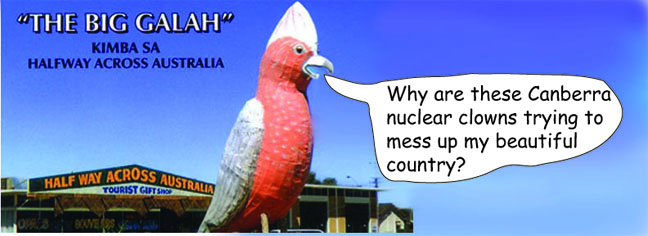
The decision in South Australia authorising the full disclosure of government papers was made on the application of Rex Patrick by the South Australian Civil and Administrative Tribunal by its president who is a Supreme Court judge and not by the Supreme Court as I wrongly stated.
The practical outcome of the decision is that interested parties should now ask various federal and state governments and district councils for full disclosure of all papers relating to the nuclear waste facility at Kimba .
It has been suggested that the federal government is proceeding with the facility and related aspects WITHOUT AUTHORITY in the hope that the composition of the Senate will change in its favour after the federal election but this seems to me a forlorn expectation particularly if the preceding state election in South Australia were to see a change in government to the Labor Party.
However the actions and conduct of the federal government as to the facility are still badly prepared by persons who are ignorant and inexperienced in this area – this is the view of many overseas experts who consider that Australia does not know or understand what is involved with regard to nuclear waste engineering .
The incompetency of ANSTO is best exemplified by lengthy and now somewhat outdated development of the SYNROC process and the continued technical difficulties and breakdowns with the nuclear medicine facility at Lucas Heights
Interested parties should also be questioning what work is actually being done by the government’s personnel located at Kimba since there appears to be no new outcomes through their presence
Australia’s mining lobby exaggerates by $45 billion the taxes and royalties they pay
Mining lobby exaggerates taxes and royalties paid by $45 billion, Michaelo West Media, by Callum Foote | May 21, 2021,
The mining industry has exaggerated its contribution in taxes and royalties to Australian governments by an estimated $45 billion over the past 10 years. Callum Foote reports on the findings of an independent research project by Michael West Media.
The mining lobby and its “independent experts” from Deloitte Access Economics have routinely overcooked the contribution that mining companies make to Australia.
Michael West Media was commissioned to undertake an investigation into Australia’s mining royalty regime by the Neroli Colvin Foundation.
The report, A Fair Share?, found the mining lobby exaggerated by 19% its contribution to Australian government revenues through royalties and taxes for the period where government data has been made available, or an estimated $45 billion over the past decade.
The mining industry sold $2.1 trillion worth of Australian resources overseas in the past decade but Australian governments received less than a 10% return. The actual rate – 9.1% – covers royalty payments and taxes paid. If we consider only royalties, then the rate drops to 5.6% of the value of exported resources.
The mining industry regularly combines royalties and taxes but this is misleading when talking about its contribution to Australia.
Less than 10% of $2.1 trillion worth of Australian resources is perhaps not the “staggering” contribution as described by Resources Minister Keith Pitt earlier this week on the release of the latest Minerals Council report.
This is particularly the case given that the large mining houses are owned by foreign shareholders, so are the largest beneficiaries of Australia’s mineral wealth.
Michael West Media has found that, on average, mining companies make a 1654% revenue mark-up on Australian commodities………..
In Australia, all mineral commodities below the earth are owned by the Australian people. It is up to State and Federal governments to sell these commodities to mining companies that wish to extract and process them for selling. In accounting terms, royalties are deemed to be a “cost of goods sold”.
Just as a baker must buy raw flour from a mill and process it into bread to sell, royalties are the payment made by miners to the Australian people for the raw commodities that they then sell internationally.
Deloitte’s most recent report is more accurate than previous estimates of mining taxes and royalty payments. Michael West Media had contacted the firm for comment before it published this report because it was found that royalty and taxation figures were previously exaggerated by 33%, or $78 billion, for the period between 2010 and 2017………
The total export value of Australian commodities over the period, which is indicative of the revenue these companies have made from selling Australian resources overseas, is $2.1 trillion. This means that only 9.1% of the export revenue made by these companies has been paid to state and federal governments. ……………. https://www.michaelwest.com.au/mining-lobby-exaggerates-taxes-and-royalties-paid-45-billion/
Senator Rex Patrick challenges Scott Morrison’s special arrangement to protect his government from public scrutiny
Senator challenges cabinet secrecy, The Saturday Paper 33 May 21, Scott Morrison is using a special arrangement to keep the workings of his government secret, but independent senator Rex Patrick has launched a challenge to its legality. By Karen Middleton. Karen Middleton is The Saturday Paper’s chief political correspondent.
A special policy committee the prime minister uses to keep the workings of his government secret is being called into legal question as part of a challenge to the confidential status of national cabinet.
Independent senator Rex Patrick launched the challenge after the Department of the Prime Minister and Cabinet refused two freedom of information requests for access to national cabinet documents.
Appearing before the Administrative Appeals Tribunal (AAT) this week, the Commonwealth argued that national cabinet’s workings must be secret because it is an offshoot of federal cabinet, which is governed by a confidentiality convention.
It argued that deciding how cabinet committees are formed and who joins them is in the prime minister’s “gift” alone.
The national cabinet arrangement relies on the controversial cabinet office policy committee that Morrison created upon becoming prime minister. He is its only permanent member. The one-man construct allows the prime minister to declare almost any gathering he attends to be a cabinet committee meeting, protecting it from public scrutiny.
When the tribunal’s Justice Richard White queried the mechanism purporting to give national cabinet confidential status, the government could provide no information.
“Is there anything else that tells me anything about the cabinet office policy committee?” Justice White asked counsel for the Commonwealth, Andrew Berger, QC, on Wednesday. “I’m not sure there is, Your Honour,” Berger replied.
Last year, Labor’s senate leader, Penny Wong, condemned the one-man committee as “an abuse” of process used to “cover up blatant political decision-making”.
Senator Patrick’s AAT challenge could also have implications for accessing information from other designated cabinet subcommittees and groups advising them.
The one-man construct allows the prime minister to declare almost any gathering he attends to be a cabinet committee meeting, protecting it from public scrutiny…………..
…………………………. After the hearing, Rex Patrick described national cabinet as “a last-minute idea dealt with at short notice, without its implementation or consequences being properly considered”.
“That’s apparent when looking back at the various media statements, the cobbling together of a new cabinet handbook and the evidence before the AAT,” he told The Saturday Paper.
Patrick said the legislated right to access information on intergovernmental communication had existed in Australia for almost 40 years, “subject only to a test of public harm”.
“Last year, Prime Minister Morrison took that right away,” he said. “He did not ask the parliament to change the law.”
Patrick said he was in a fight for transparency and responsible government. “And I’m in a fight to stop a prime minister unilaterally taking away a right that was given to me and all Australians, by the parliament.”
Whether Justice White agrees will be clear soon. He reserved his judgement and promised a quick decision.
This article was first published in the print edition of The Saturday Paper on May 22, 2021 as “Cabinet of one”. https://www.thesaturdaypaper.com.au/news/politics/2021/05/22/senator-challenges-cabinet-secrecy/162160560011709
Questions that must be asked of Resource Minister Pitt, about the new money for Kimba, designated as Australia’s nuclear waste dump.

The contentious Waste Management Amendment (Site Specification, Community Fund and Other Measures) Bill 2020 has been listed in the Senate’s order of business for Tuesday 11 May 2021 as number 11 in the government business—orders of the day
The senator representing the responsible minister for the bill is Senator the Hon. Zed Seselja as Minister for International Development and the Pacific.
It is now important that people who care about the Kimba community,about South Australia, about Australia should contact politicians, especially Keith Pitt, Rowan Ramsey, and also Kimba Mayor Dean Johnson, and ask them these vital questions about the money that the Federal government plans to shower on Kimba.
Member for Grey, Rowan Ramsey MP, said the new nvestment highlighted the government’s commitment to
Kimba. Applications for projects will be open later in 2021 and will be assessed by Business Grants Hub in consultation with the Kimba community.
Pitt and Ramsay should be asked with regard to the latest grant:
1. How will it “drive further economic and socialimprovements across the Kimba community?
2. What is the economic success of Kimba?
3. What is the disruption which this has caused for the people in the area by the progress of the facility when
no effort has been made by Pitt and Ramsay to enable those objecting to the facility the opportunity to have an
independent assessment of the safety and economic consequences of the facility’s establishment?
4. Will the services and infrastructure under the new round of funding include payment for an independent assessment sought by the the many persons objecting to the facility proposals.?
5. Would the funding for this payment be made automatically by Pitt without the intended application process?
6. Does Pitt accept that a major part of the disruption to the people in the area has been caused by his government
failing in providing them with a safety case and enabling an independent assessment as demanded by them since the initial proposals for a facility?
7.Surely he would acknowledge that “this funding will be invested into therefore the disruption which this has
caused for the people who live in the area” by paying for an independent assessment as sought by them?
8. How does Ramsay expect that this funding will “include projects which will grow employment in the community”
when there is a justified fear and concern among many in the community that the facility’s presence will destroy the region’s economy“?
9. Is this “a warm welcome”?
10. How can Johnson justify this as “a win for Kimba businesses and residents” when there is the strong
likelihood based on overseas experience that the local economy will be destroyed through the presence and operations of the facility?
11. What are the important health care initiatives, tourism funding and economic diversification projects referred to in the media release as they presumably should have been normal funding obligations of the federal and state
governments?
Minister Keith Pitt – desperate times, desperate measures – to get Kimba nuclear waste dump
 | |||
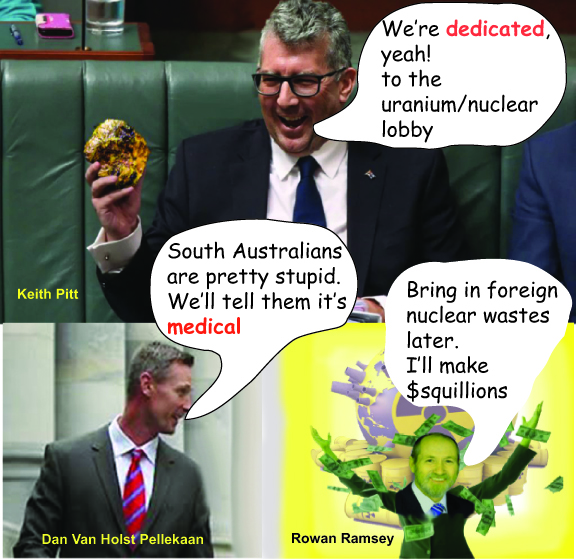
Kazzi Jai No nuclear waste dump anywhere in South Australia, 9 May 21
DESPERATE TIMES CALL FOR DESPERATE MEASURES!!….”Kimba community to receive $2 million funding boost8 May 2021Joint media release with Rowan Ramsay MP, Member for Grey
The Kimba community will benefit from an additional $2 million investment in services and infrastructure under a new round of the Community Benefit Program announced by the Coalition Government.”So….this PRESS RELEASE by Minister Pitt was released YESTERDAY SATURDAY 8TH MAY 2021. Interesting timing given that the Senate reconvenes THIS COMING TUESDAY 11TH MAY 2021!
More money to build public toilets?….Can’t have TOO MANY toilets!!….Or what OTHER Community Benefits projects would they be considering…..given that the GRANT money is not to be used for COMPETITIVE ADVANCEMENT or PERSONAL GAIN. Not looking at anyone specific there – maybe a certain MAYOR, and a certain other person EMPLOYED directly by the department from last Grant Round!!What really intrigues me is that Kimba Council released a public document 30th April 2021 regarding their ANNUAL BUSINESS PLAN AND BUDGET 2021-22 PUBLIC CONSULTATION DRAFT….and in it stated, under Non-Financial Performance Measures – 2021-22 (page 10)…
“Lobby Australian Radioactive Waste Agency and the Minister for resources, Water & Northern Australia for grant funding promised as part of stage 2 of the establishment of the Nuclear Waste Facility. (Strategy3.1)“Feedback due 17th May 2021.So…..this announcement throws up a number of questions. Firstly, “lobby” is a term used to “try to influence the decision-making of a government or opposition representative in the exercise of their official functions”. Does this mean that the Kimba Council had no idea that the money was to be released as part of the continued Stage 2 – which Hawker now is no longer a part of?
Remember Matt Canavan (the previous minister) only announced the so called “New Community Benefit Program 2019-22” JUST MOMENTS BEFORE THE KIMBA AND HAWKER BALLOTS STARTED – on October 8th 2019!! So it isn’t an annual anticipated thing!!….especially when they named the Community Benefit Program 2019 – 22!! Of course Matt Canavan then jumped ship and resigned his ministry on 3rd February 2020.
Is it AGAIN to sway people in Kimba that they are “special”? Remember that $2 million is chicken feed in the grand scheme of things – even the total which would be now $6 million is chicken feed given what they intend doing – making the CURRENT EXPORT PRODUCING AGRICULTURAL LAND OF KIMBA A NUCLEAR WASTELAND….which is over 1700 KMS AWAY from the industrial producer of this nuclear waste – Lucas Heights!!Or is it a way of convincing people that sellout RAMSEY is worth re-electing in this coming Election Year for the Federal Government? (The latest that a Federal Election can be held will be next year May 2022.)
1 This month

of the week – Australians for War Powers Reform (AWPR)
To see nuclear-related stories in greater depth and intensity
 Antinuclear