When demanding a Royal Commission isn’t enough
9 January 2026 Michael Taylor , https://theaimn.net/when-demanding-a-royal-commission-isnt-enough/
For weeks Josh Frydenberg – and senior figures in the opposition – demanded a Royal Commission into the Bondi shootings. Their criticism of Prime Minister Albanese was relentless: he was accused of dithering, of failing to act decisively, of putting politics ahead of public safety and accountability.
The message was unambiguous. A Royal Commission was urgently needed, and the Prime Minister’s failure to immediately call one was presented as a serious dereliction of duty.
Then Albanese did exactly what he was accused of refusing to do. He called a Royal Commission.
What followed was not relief, nor support, nor even cautious endorsement. Instead, Frydenberg launched into a fresh round of criticism – this time over the Prime Minister’s choice of commissioner. The demand for action had been met, yet the outrage only intensified.
At this point, it is reasonable to ask: what, precisely, was Frydenberg seeking?
Royal Commissions are among the most serious instruments available in Australia’s democratic system. They are designed to establish facts, test evidence, and make recommendations independent of political pressure. When politicians demand them, they are effectively asking the government to hand over control of an issue to an arm’s-length process that cannot be directed once established.
In this case, Frydenberg’s behaviour suggests the Royal Commission itself was never the point. The point was the political leverage gained by accusing the government of inaction. Once that leverage evaporated – once the Prime Minister called the inquiry – the focus shifted immediately to delegitimising the process itself.
Frydenberg’s criticism of the appointed commissioner rests on the implication that the individual lacks credibility, independence, or suitability. But this raises an obvious question: if Frydenberg believes the commissioner is unfit, why was there no articulated standard beforehand? Why was the demand not for a Royal Commission led by a person meeting clearly defined, bipartisan criteria?
The answer appears uncomfortable but unavoidable. Any commissioner appointed by this government was always going to be unacceptable, regardless of credentials. The outrage is not conditional; it is structural.
This is where the episode drifts from political disagreement into something more corrosive. By first demanding a Royal Commission and then attacking its leadership the moment it is established, Frydenberg sends a contradictory message to the public: trust this process – unless the wrong people are running it.
That is not a healthy position for a major political actor to take, particularly in the aftermath of a tragedy. It risks turning an institution designed to uncover truth into a partisan battlefield before it has even begun its work.
The absurdity lies in the sequencing. The opposition, in unison with Frydenberg, argued that failing to call a Royal Commission was irresponsible. Now they imply that calling one – without their preferred appointee – is equally irresponsible. Under this logic, there is no scenario in which the government could have acted correctly.
It is worth pausing on what this means in practice. If every decision is wrong by definition, then criticism is no longer about improving outcomes or safeguarding integrity. It becomes performative – a reflex rather than a reasoned response.
This pattern is not new, but it is becoming more pronounced. Demands are made loudly and publicly, framed as matters of urgent national importance. When those demands are met, they are immediately reframed as failures, missteps, or evidence of ulterior motives. The standard is not excellence, but impossibility.
In the context of a Royal Commission into a violent public tragedy, that approach carries real risks. It encourages cynicism about the process before evidence is heard, witnesses are examined, or findings are made. It invites the public to see the inquiry not as a search for answers, but as another front in a political war.
None of this requires blind faith in the government or its appointments. Scrutiny is legitimate. Questioning decisions is part of democratic accountability. But there is a difference between scrutiny and pre-emptive sabotage.
If Frydenberg truly believes in the value of a Royal Commission, he should allow the process to function and judge it on its conduct and findings. If he does not, then he should be honest about that position rather than using the language of accountability as a political bludgeon.
Australians deserve better than a debate in which every outcome is framed as failure simply because it was delivered by the wrong side of politics. Royal Commissions are not toys to be thrown aside once they stop being useful.
If Frydenberg – and the opposition – demanded one in good faith, now is the moment to prove it.
Labor’s Bondi Backflip: When Fear Trumps Justice
7 January 2026 David Tyler, Australian Independent Media
Anthony Albanese didn’t choose a Royal Commission into the Bondi massacre, but he was bullied into it. The real scandal isn’t his surrender, but the cynical machinery that left him no other option. When political extortion replaces policy, nobody wins.
The Hostage Prime Minister: How Albanese Was Cornered
Anthony Albanese is said to be on the cusp of a belated acceptance of a Royal Commission into the Bondi massacre, “senior sources” tell the Sydney Morning Herald, as the political costs of his refusal become too big to bear. Similarly, the ABC reports that he’s “not ruling it out.”
This isn’t a back-flip, it’s a capitulation. The PM, who sensibly resisted the demand as redundant, divisive, and politically-driven, is now forced to yield by a Coalition campaign so relentless it beggars belief. This isn’t about truth-seeking; it’s about hostage-taking and cynical opportunism, made possible by Advance backing, where the ransom is Labor’s credibility and the cost is the weaponisation of grief.
The trap was sprung from the moment key figures persuaded Sydney’s Jewish community leaders to exclude the PM from memorial services to the Bondi shootings. Did Albo have to suffer this public snub? No. A bolder, less conflict-avoidance craving type of leader might have stood his ground and insisted on his right to be there to grieve publicly as the nation’s leading public figure. Paul Keating would have seen off the ploy. It remains a calculated and unprecedented slight, from which Albo may not recover.
Our PM was effectively denied the role of national mourner after the Bondi massacre, with organisers excluding him from key memorial services; a move described as an “extraordinary personal censure”
The Coalition, scenting blood after an orchestrated booing at Bondi’s memorial and an open letter from over twenty former Labor MPs, including Mike Kelly and Michael Danby, is turning dissent, discord and grief into a media blitzkrieg. Business elites, judges, and commentators pile on, framing resistance as indifference to Jewish safety. (As if a Royal Commission ever confers protection.)
The message is clear: Comply, or be branded weak on terror. Albanese, boxed in, is folding; not out of conviction, but because the alternative could be political suicide. Already, Sydney shock jocks, Ben Fordham and Ray Hadley, charge the PM with having helped cause the tragedy. He “ignored the warnings.” His government’s focus on Gaza meant it was “distracting from domestic hate.”
The Sydney Morning Herald reports that government insiders confirm Albanese now doubts Dennis Richardson’s rapid review suffices; but the review was never the issue. The issue was who controlled the narrative. The Coalition, having spent years demonising Muslims, migrants, and “African gangs,” suddenly discovered a conscience on anti-Semitism. The hypocritical opportunism isn’t just thick; it’s Trumpian.
The Royal Commission Racket: Justice as a Political Weapon
Royal Commissions in Australia are less about truth than theatre, as Albanese knows all too well. From the Trade Union Royal Commission ($46 million, zero convictions) to the Aboriginal Deaths in Custody inquiry (339 recommendations, Indigenous incarceration doubled), the pattern is clear: damning headlines, negligible reform. These inquiries are designed to paralyse governments, not fix problems.
The Coalition’s demand for a Bondi Royal Commission fits this play book perfectly.
It’s not about answers; it’s about amplifying division, tying Labor in knots over Israel-Palestine, and ensuring the issue dominates headlines until the next election. As historian Judith Brett notes, inquiries are the opposition’s nuclear option when arguments fail. Opposition leader Sussan Ley, whose predecessors won elections on stopping the boats, babies overboard, and other migrant scapegoating, now postures as the guardian of social cohesion.
The audacity would be laughable if the stakes weren’t so grim.
Sussan Ley’s Selective Outrage
Sussan Ley’s claim that “antisemitism has no place” in Australia would carry more weight if her party hadn’t spent decades monetising bigotry and moral panic……………………………………………………………………………………………………………….. https://theaimn.net/labors-bondi-backflip-when-fear-trumps-justice/
Is Albo in Trouble? The Death by a Thousand Cuts

28 December 2025 David Tyler , Australian Independent Media
Is Anthony Albanese finished?
Albo is a sitting duck in the sights of the right. His “troubles” are being trumpeted from talk-back to the Melbourne tabloids and across social media, where the enormously well-funded dark-money megaphone of the right, the Advance Australia network, is busy amplifying outrage and sharpening its next campaign weapon. There is, and long has been, an industry devoted to vilifying Labor.
On my left is an historic organisation dedicated to humanity, equality and justice. Founded in 1891, the Australian Labor Party emerged from the trade union movement, built by working Australians who decided that if power resided in parliament, labour would have to confront it there.
On my right? Founded in 2018, Advance Australia is a right-wing political campaigning operation, structured as a web of charities and front groups, operating largely beyond the transparency rules that bind political parties and their donors, while running tightly targeted culture-war and electoral campaigns against Labor, the Greens, unions, climate policy, and progressive social reform.
With its Orwellian name and regressive purpose, Advance is taking no prisoners in its war on the party of the wage-earner. Its targets are predictable yet carefully chosen: Anthony Albanese for alleged weakness; Labor for timidity; government itself for failing to serve the mythical “real Australia”.
Clowns like Craig Kelly and Old King Coal himself, Matt Canavan, provide colour, but the deeper story is structural: the right-wing commentariat is now better funded, better organised, and more ruthless than at any point in Australia’s democratic history. The machinery shaping the national argument from the margins is no longer improvised. It is strategic, disciplined, and flush with cash.
Against that backdrop, Albanese is attempting to govern within a political and media ecosystem designed to grind him down. Every Labor leader since Whitlam has felt the same gravitational pull.
Each time, the Murdoch empire and its imitators treat Labor governments as temporary aberrations between the “proper” custodians of the realm. The idea no longer needs selling. It is simply assumed. The result is familiar: every Labor hesitation becomes a crisis, every Coalition failure a footnote, and every unforced error; a travel claim, a stadium stoush, a botched response to tragedy, another chance to land the cut.
The Small-Target Trap: Governing Like an Underdog
Albanese’s small-target strategy worked as a campaign tactic. It’s useless as a governing philosophy. The Prime Minister’s steady, understated style made sense in opposition, but in office, it too often reads as reticence. He speaks softly in an age that rewards loudness, compassionately in an age that scorns empathy, and with deliberation in a media environment that trades in snark, snide and speed. That makes him a rare kind of political figure: decent and disciplined, but branded as dull. The “weak Albo” trope thrives in this climate because it fills the silence his style sometimes leaves.
But the problem isn’t just style. It’s strategy. By failing to define his government’s narrative, Albanese cedes the field to opponents who are happy to fill the void. When Sussan Ley and Josh Frydenberg—neither known for political courage, vision nor caution with finances can land blows over the Bondi massacre, it’s not just a PR failure. It’s proof that Labor’s caution is being weaponised. When Labor-lite, “Cuisine minceur,” NSW Premier, Chris Minns outmanoeuvres the PM on Bondi it’s not just a state-federal spat. It’s a pattern. And patterns, in politics, become perceptions.
Minns’ leadership during the Bondi crisis is applauded as decisive, bipartisan action, upstaging Albanese’s federal response; making it seem cautious and reactive. Yet it’s not an isolated incident. The narrative of State leaders seizing the initiative while the PM plays it safe, has become a recurring motif in federal politics of late, from crisis management to policy rollouts.”
This is the death by a thousand cuts: not one fatal blow, but a steady drip of missteps, compromises, and missed opportunities. All capably played up by a Murdoch-led media. Travel rorts, stacked appointments, and the Tasmanian Stadium madness aren’t isolated gaffes. They’re symptoms of a government so focused on avoiding risk that it forgets to claim credit; or even defend itself.
The Environmental Own Goal: Climate Diplomacy as Surrender
Labor’s signature climate reform, the reworked Safeguard Mechanism, was billed as a cap on emissions from Australia’s biggest polluters. In practice, critics argue it functions more as a work-around than a brake. Facilities can expand emissions while complying on paper, relying on carbon offsets and accounting mechanisms rather than deep, on-site cuts.
The scheme has been dogged by controversy over low-integrity offsets, including so-called “avoided deforestation” projects where no credible deforestation threat existed, and carbon credits linked to mine-site rehabilitation that critics say should never have qualified at all.
Independent researchers and environmental law groups contend that, taken together, these design features allow new coal and gas projects to proceed under the pretence of a cap, effectively green-lighting fossil fuel expansion while maintaining the appearance of climate restraint.
Even within Labor, MPs acknowledge that compromises struck with mining and gas lobbies have drained the government’s credibility. This isn’t climate leadership. It’s carbon diplomacy of the old school. To anyone expecting strong environmental protections, the Safeguard Mechanism feels like a betrayal dressed up in bureaucratic finery; a replay of the politics that cost Rudd and Gillard their moral high ground a decade ago.
The message to voters is clear:
- The planet can wait.
- The donors can’t.
- The status quo will do.
Welfare and the Digital Workhouse: Polishing the Architecture of Cruelty……………………………………………………………
Defence Drift and the AUKUS Mirage: Billions for a Maybe
Nowhere is the gulf between rhetoric and reality wider than in defence. AUKUS is the most audacious wager any Australian government has ever placed on a technological future it neither controls nor is likely to live to see. Hundreds of billions have been pledged for nuclear submarines that will not arrive for decades and which, if they do, risk arriving obsolete, overtaken by unmanned systems, ubiquitous surveillance, and rapid advances in undersea detection.
Within defence circles, the project is increasingly derided as strategic theatre: a grand, expensive performance of alliance fealty that conceals the hollowing out of local capability. While ministers chant “sovereign capability,” shipyards remain bare, skilled workforces are wafer-thin, and costs climb with a stubborn indifference to arithmetic or accountability. This is not strategy so much as symbolism mistaken for strength, scale confused with power, and loyalty substituted for thought.
If this is deterrence, it is deterrence by press release: loud, brittle, and addressed less to adversaries than to editors, allies, and the anxious political class at home. AUKUS does not so much defend Australia as rehearse its dependence, outsourcing sovereignty in the hope that faith, money, and patience will one day be mistaken for capability.
The Structural Bind: Governing in a Rigged System
To blame Albanese alone is to ignore the architecture of his predicament. He governs in an environment where money, message discipline, and media amplification now flow overwhelmingly from the right………………………………………
A Party Too Small for Its Moment
So, is Albo in trouble? Inevitably. But not only because a hostile press or a cynical opposition have decided so. The deeper problem is that Labor’s exhaustion is showing………………..
This article was originally published on URBAN WRONSKI WRITES https://theaimn.net/is-albo-in-trouble-the-death-by-a-thousand-cuts/
Should We Have an Enquiry or a Tantrum?
27 December 2025 Terence Mills, https://theaimn.net/should-we-have-an-enquiry-or-a-tantrum/
Michael McCormack, former leader of the National Party, had a surprising and emotional outburst before the Christmas break. Surprising in that rarely has he shown this level of energy, certainly not when he was National’s leader and on the back-bench he has barely made a contribution beyond regretting the defection of his mate Barnaby Joyce down the rabbit-hole of One Nation.
Mr McCormack was incensed that federal parliament had not been recalled following the Bondi shootings and he was particularly upset that Anthony Albanese had not initiated a national Royal Commission to complement and duplicate the Royal Commission set up by the New South Wales government: he was also enraged that new gun ownership regulations legislated in NSW, and probably to be adopted nationally, would impact unfairly on the activities of farmers – farmers and professional shooters will be restricted to 10 weapons but with a ban on automatic weapons that allow multiple shots without reloading, similar to those used by the alleged shooters at Bondi and gun licences will need to be renewed every two years rather than being perpetual licenses – poor farmers, how will they get by?
He may have been spurred into activity after Sussan Ley, the coalition’s prime ministerial hopeful, noted that Penny Wong, despite close scrutiny, had not been observed shedding a tear over the Bondi killings – evidently an inexcusable failing on the part of a female minister!
I got the impression that Mr Mc Cormack’s emotional tirade was not so much about Bondi, Royal Commissions or guns but rather it was about the fact that he, as a deposed former party leader, now sitting on the back-benches, was the only voice in the National Party available to speak out particularly as his leader, David Littleproud was completely silent on these issues: Mc Cormack may well have been echoing his former colleague Barnaby Joyce who had little faith in the current leadership of the National Party.
For the record, the New South Wales government have initiated a Royal Commission that will look into, among other matters:
- The nature, prevalence, and drivers of antisemitism in Australia leading up to the Bondi attack, including actions of governments, law enforcement, and broader society.
- An examination of Islamic extremism and neo-nazi ideology long with recommendations to strengthen counter terrorism systems.
Albanese has resisted political and emotive pressure to having a separate Royal Commission to that proposed by Premier Minns in New South Wales. He has noted that:
“There was no royal commission called by the Howard government after Port Arthur. There was no royal commission called by the Abbott government after the Lindt [Cafe] siege, there hasn’t been a royal commission held recently that has not had an extension of time. We know who the perpetrators are here … We know what the motivation is, that they are motivated by the evil ideology of ISIS and a perversion of Islam.”
Albanese has, alongside hate speech reforms and changes to gun laws, announced a review into federal law enforcement and intelligence agencies which will be led by former intelligence chief Dennis Richardson, and he has offered the co-operation of both the government and federal agencies with the NSW commission.
Those insisting on a separate federal Royal Commission say that it would not necessarily take years to conclude and that they could call on the appointed Commissioner to have a preliminary report by the end of April. That, of course is nonsense as the whole point of a Royal Commission is to be broad ranging, hear from all and sundry and probe into the dark corners that usually are hidden; you cannot expect quick fix responses and the Royal Commissioner would undoubtedly resist that sort of pressure.
Albo bows to media, Israel pressure, moves on antisemitism, free speech
by Stephanie Tran and Kim Wingerei | Dec 19, 2025, https://michaelwest.com.au/albo-bows-to-media-israel-pressure-moves-on-protests-antisemitism-free-speech/
Anthony Albanese has announced the government “adopts and fully supports Jillian Segal’s plan to combat antisemitism,” bowing to intense media pressure. Stephanie Tran and Kim Wingerei report.
Criticising the state of Israel is about to get difficult.
Speaking at a press conference on Thursday, the Prime Minister said, “We’ve already legislated for hate speech, hate crimes, hate symbols, outlawing doxxing,” adding the government would implement all 13 recommendations “in consultation with the Jewish community and the envoy.” His words hint at a cop-out with a bit of wriggle-room.
The 13 recommendations he refers to are from Anti-Semitism Envoy Jillian Segal’s report, presented in July this year, including the adoption of the controversial definition of anti-semitism by the International Holocaust Remembrance Alliance – the “IHRA definition.”
Never intended to “chill speech”
The government’s formal response endorses the IHRA definition as Australia’s official definition by publishing a new “supplementary guide” by the Special Envoy to assist its application in an Australian context. Until that’s been published, it is unclear what this will mean in practice.
First adopted by Australia in 2021 under the Morrison government, the definition includes 11 illustrative examples, most of which relate to criticism of the State of Israel.
Kenneth Stern, the lead drafter of the IHRA definition, has cautioned against its use as a disciplinary tool. Stern has repeatedly said the definition was never intended to “target or chill speech”.
“Starting in 2010, right-wing Jewish groups took the “working definition”, which had some examples about Israel … and decided to weaponise it with title VI cases,” Stern wrote in a Guardian op-ed.
In 2021, the Jerusalem Declaration on Antisemitism was supported by hundreds of Jewish scholars in response to what they described as the IHRA definition’s “unclear” and “controversial” framing. The Declaration’s preamble states:
“The IHRA Definition includes 11 “examples” of antisemitism, 7 of which focus on the State of Israel. While this puts undue emphasis on one arena, there is a widely-felt need for clarity on the limits of legitimate political speech and action concerning Zionism, Israel, and Palestine.”
Burgatory ruling
In a recent Melbourne Magistrates’ Court ruling, a magistrate rejected police attempts to treat anti-Zionist chanting as a strict-liability offence, finding prosecutors must prove intent to insult or offend.
The court found that political speech must go beyond a mere difference of opinion and be “contrary to contemporary standards of public good order” to constitute a criminal offence.
Outside the court, Hash Teyeh hailed the ruling as “a huge win for the freedom of political speech”.
New immigration powers
The government’s response also includes expanded immigration powers, with the government “collaborating with the Special Envoy for Antisemitism to enhance training of immigration officers”.
Minister for Home Affairs Tony Burke said, “We will be changing the law to make visa cancellation and visa refusal easier. … I have refused and cancelled visas on the grounds of antisemitism in a way that very few predecessors have. I don’t resile from that.
“And I’ve made clear on the balance of bigotry versus freedom of speech.”
Antisemitism Education Taskforce
In response to Segal’s recommendation to “foster long-term societal resilience by ensuring throughout Australian society an understanding of, and familiarity with, the nature, history and danger of antisemitism,” the Government will establish “the Antisemitism Education Taskforce (the Taskforce) to be chaired by David Gonski AC,” the perennial go-to man for aspirational plans.
The aspirations are to encompass all levels of education, from kinder to uni, in a concerted effort to ensure “a deep understanding of Jewish Australians’ history and culture, and a mature understanding and expression of Australian values.”
The plan does not touch on what those values are, but there is the odd, cursory nod to combating racism in general, including funding for an SBS podcast “to dispel misinformation and disinformation impacting Australia’s social cohesion.”
Security, law enforcement and coordination
A new AFP special taskforce is to be established, “to investigate threats, violence and hatred towards the Australian Jewish community and parliamentarians.”
The government has also committed $159.5m in security funding to the Executive Council of Australia Jewry and other community groups, “to improve safety and security at Jewish community sites, including synagogues, and to protect Jewish students in schools and higher education.”
Recommendations not adopted
Some of the more controversial proposals in Segal’s original report were omitted from the government’s formal response, albeit not explicitly rejected.
These include recommendations to allow public funding to be terminated for cultural institutions or festivals deemed to have failed to address antisemitism, or the removal of charity tax status for “problematic organisations.”
See below [chart on original] for a detailed analysis of what has been included and what has not. Only 31% of the original recommendations are to be implemented “as is.”
RAAF, or Richard Marles’ Airways? The Defence Minister’s flight of fancy

by Rex Patrick | Dec 21, 2025, https://michaelwest.com.au/raaf-or-richard-marles-airways-the-defence-ministers-flight-of-fancy/
The awful events at Bondi Beach have taken travel rorts off the front page but documents show Defence Minister Richard Marles is using an Air Force 737 as his own private jet. Rex Patrick reports.
Apologies to Richard Marles for using the title of Defence Minister in the lede to this article; he much prefers the title of Deputy Prime Minister. It’s all about the look.
What next in travel rorts
The Prime Minister has asked IPEA, the Independent Parliamentary Expense Authority, to examine whether the parliamentary travel entitlement rules require reform (hint: they do).
MWM is on the case, with an FOI lodged to see what’s been happening behind the tightly drawn curtains of the Prime Minister’s Office.
Meanwhile, on RAAF VIP Airways
In August 2023, journalist Samantha Maiden revealed that the Defence Minister, – sorry, Deputy Prime Minister – had been personally consulted over the decision to stop publishing where politicians are flying on VIP flights during the same period he personally ran up a $3.6 million bill.
“Publication of VIP flights, generally, cannot present a security risk.“
They were indeed regularly published, with details of routes and passengers, from the late 1960’s until 2022. VIP flights generally take off from secure airports, often from quarantined Royal Australia Air Force (RAAF) areas of those same airports, and the reports are requested to be made public well after the event.
MWM has been fighting two separate Freedom of information (FOI) battles with the Department of Defence (‘Defence’) over the release of flight details.
In the first FOI fight, from September 2023 to October 2024, Defence capitulated in the Administrative Review Tribunal, effectively telling MWM there were no security issues with the flights themselves, rather a concern with identifying individuals with close ties to high office holders to target (presumably with cyber surveillance).
Second request
When a second FOI request was made in October 2024 by MWM focussing on the Defence Minister’s – sorry – Deputy Prime Minister‘s, ‘last four flights’, the FOI was met with hostility and obstruction.
Only after taking the matter to the Information Commissioner (OAIC) and threatening to elevate it to the Administrative Review Tribunal, did Defence again capitulate.
What the documents show in this case is that two of the four flights in question were between Avalon, 64 km from Melbourne airport, and Canberra. The first was a morning flight on 23 September 2024 from Avalon to Canberra. It involved two pilots, and according to the passenger manifest, 5 other security /support/defence staff and lots of empty seats.
Why the Defence Minister didn’t take a commercial jet is not known. There are plenty of, circa $1000 business class flight options from Melbourne to Canberra. Perhaps such a course of action would not have been befitting of a Deputy Prime Minister on that occasion.
And the entourage
A second flight that took place on 10 October 2024 at the end of a parliamentary sitting week, from Canberra to Avalon, carried the Defence Minister – sorry, we keep getting that wrong, Deputy Prime Minister – and three other Victorian MPs, Resources Minister Catherine King, Libby Coker MP and Joanne Ryan MP.
All were appropriately designated by the RAAF as ‘entitled passengers’.
The FOI suggests 13 other security /support/defence staff tagged along. Again, there were plenty of empty seats on the flight.
The two other flights taken by the Deputy Prime Minister – he’ll be happy we’re finally using that more elite title – that were captured by the FOI were a Sydney – Java (Indonesia) – Timor – Avalon flight from 28 to 30 August 2024 and a Melbourne to Port Villa flight on 18 September 2024 returning to Avalon the next day – both using the RAAF’s smaller Falcon executive jet.
Perhaps it was appropriate for the Deputy Prime Minister to fly on a Falcon ‘private’ jet for these international trips, but it’s hard to see the justification for taking a near empty RAAF 737 on travel that could easily have been conducted on commercial flights.
Bronwyn “Chopper” Bishop
Richard Marles lives in Geelong. Maybe he could fly at the front of a commercial aircraft from Canberra to Melbourne and then take a helicopter the rest of the way to Geelong. Bronwyn Bishop did that once in 2015 (and lost her job as Speaker of the House).
‘But Bishop’s extravagance was less expensive for the taxpayer than Marles’.
Apparently, the Deputy Prime Minister regards a hour’s ride in a luxuriously appointed Comcar between Melbourne Airport and Geelong to be an intolerable inconvenience. But even allowing for security requirements it’d be a much more cost effective solution than an RAAF crewed 737.
When the domestic flights above were taken, FOI had not successfully extracted VIP flight details out from under a flight manifest secrecy blanket deployed by former Prime Minister Morrison, but endorsed by Marles.
Maybe the next MWM FOI on the Deputy Prime Minister’s flights might reveal that a bit of sunlight on the issue has stopped such extravagance. We’ll just have to wait and see.
Rex Patrick is a former Senator for South Australia and, earlier, a submariner in the armed forces. Best known as an anti-corruption and transparency crusader, Rex is also known as the “Transparency Warrior.“
Politicising a Terror Attack | Scam of the Week.
21 Dec 2025
IDF security guards to roam the streets of Sydney? Criticism of Israel to be outlawed? Protests banned, media and universities monitored, the threat of defunding for antisemitism?
This episode examines how the Bondi Beach attacks were rapidly politicised, before the facts were established and while families were still grieving. Instead of restraint, Australia witnessed an immediate rush to blame, agenda setting by foreign leaders, and a media cycle that prioritised outrage over evidence.
We look at how the tragedy was leveraged to justify new crackdowns on protest, expanded surveillance, and policies that blur the line between combating antisemitism and restricting legitimate political speech.
We examine the role of lobby groups, the adoption of the IHRA definition, and the implications for media freedom, public broadcasters, universities, and civil society. There is no justice without truth. Watch the full investigation and read the related reporting at michaelwest.com.au
When grief becomes a weapon: The Bondi massacre and the politics of blame
John Howard’s sudden concern about religious hatred would be comic if it were not obscene. This is the same leader who weaponised fear of Muslims during the Tampa crisis, who lied about desperate refugees throwing their children into the ocean, who used the Bali bombings to justify laws that disproportionately targeted Muslim communities.
20 December 2025 David Tyler, https://theaimn.net/when-grief-becomes-a-weapon-the-bondi-massacre-and-the-politics-of-blame/
Part I
The Lie Built on Graves
On Sunday evening, December 15, fifteen people celebrating Hanukkah at Sydney’s Bondi Beach were murdered in an ISIS inspired terrorist attack. The victims ranged from a ten-year-old girl to an 87-year-old Holocaust survivor. Also slain, is Rabbi Eli Schlanger, who organised the Chabad community event.
By Wednesday morning, Naveed Akram, 24, had been charged with 59 offences, including 15 counts of murder and terrorism. His father Sajid Akram, 50, who carried out the attack alongside him, was shot dead at the scene. Police later confirmed that Islamic State flags had been found in their vehicle.
It is worth being precise about what followed. Rabbi Schlanger was farewelled at a funeral held at the Chabad of Bondi synagogue, attended by NSW Premier Chris Minns and former prime minister Scott Morrison. The Prime Minister was not invited. Separately, a broader community and interfaith memorial was held in Bondi, to which Albanese was also not invited. He later attended a distinct interfaith service where he spoke alongside religious leaders. These distinctions matter, because the political narrative was constructed not around absence, but around the deliberate staging of presence.
Before the first funerals were held, senior Coalition figures began laying responsibility for the massacre at the feet of Prime Minister Anthony Albanese. John Howard, pioneer of modern Australian dog whistle politics, emerged to lecture the nation on racial hatred. Scott Morrison appeared at memorial events, solemn and conspicuous. Opposition Leader Sussan Ley spoke darkly of government failure.
But it was former treasurer Josh Frydenberg who delivered the most incendiary line, declaring at a Bondi memorial gathering:
“It is time for him to accept personal responsibility for the death of 15 innocent people, including a 10-year-old child.”
This was not grief speaking. It was strategy.
The claim being advanced was simple and brutal. Had Albanese acted differently on antisemitism, had he implemented the full agenda of the government’s antisemitism envoy, these murders would not have occurred. Therefore, the blood was on his hands. Murdoch outlets amplified the message with enthusiasm.
This deserves to be called what it is: an outrageous lie wrapped in mourning clothes.
A timeline that refuses to cooperate
Sajid Akram arrived in Australia from India in 1998 on a student visa, during John Howard’s prime ministership. He later transitioned to a partner visa; then resident return visas. His son, Naveed, was born in Australia. Neither were on a terror watch list. Police confirm the pair travelled to the Philippines in November, raising serious questions about radicalisation pathways and intelligence blind spots.
The path that led to Bondi did not begin with Albanese. It began decades earlier, across a series of governments, and culminated in a catastrophic failure of detection and disruption by the very institutions designed to prevent mass casualty attacks.
That reality is inconvenient, because it demands scrutiny of intelligence agencies, policing systems, gun licensing regimes and online radicalisation ecosystems. So instead we are offered theatre.
Morrison attended Rabbi Schlanger’s funeral. Albanese was not invited. The message was clear enough for any political operative to decode. Judgment had been passed. Labor stood accused.
Albanese’s actual constraints
The PM’s response has been criticised as timid. In truth, it reflects the constitutional reality of the office.
Many of the measures being demanded by his critics are not merely controversial. Jillian Segal’s are constitutionally impossible without eviscerating principles of institutional independence and freedom of expression. Defunding universities for failing to meet a politicised definition of antisemitism, inserting an envoy into the oversight of public broadcasters, compelling ideological training of judges, are authoritarian measures dressed up as protection.
What Albanese has done is cherry-pick what is implementable while rejecting what is not. Segal attends education consultations but wields no defunding power. A Gonski led taskforce has been established to examine antisemitism across education sectors. Security funding for Jewish community sites has been extended. SBS will receive additional resources for social cohesion programming.
On the legal front, the government is pursuing hate crime reforms including enhanced penalties for threats and violence, national vilification consistency, and expanded capacity to list extremist organisations.
What none of these addresses is the central failure that made Bondi possible.
The questions that matter
How did two radicalised men amass multiple firearms legally? Why did a person previously investigated by ASIO retain access to long guns? How did the Akrams’ travel and online activity fail to trigger intervention? Why was a neo-Nazi rally approved outside Parliament weeks earlier, while resources for deradicalisation or advance protection of the Bondi Hanukah celebration remain threadbare?
These questions demand an inquiry. A royal commission into intelligence and security failures is not a political indulgence. It is the only serious response.
As Bernard Keane has argued, slogans about ideology do nothing to fix broken systems. Frydenberg’s line that “radical Islamist ideology pulled the trigger” is clever but empty. Ideology does not operate in a vacuum. It spreads through algorithmic amplification, grievance communities, and institutional neglect.
A deeper category error lies here. It matters. Increasingly, researchers and prevention agencies argue that violent extremism behaves less like a debate to be “won” and more like a social contagion that spreads through environments of grievance, isolation, algorithmic reinforcement and access to means.
In other words, it is not only a policing problem. It is a prevention problem, best tackled with the same logic public health uses for violence more broadly: early intervention, risk and protective factors, and harm reduction. The CDC’s public health approach to violence prevention offers the basic prevention framework, while work explicitly applying that lens to countering violent extremism is now mainstreamed in policy and research, from the U.S. National Institute of Justice to analyses of “complex contagion” dynamics in extremist spread.
But here? Crickets. And clearly, the opposition has little interest in examining these failures, because they implicate Coalition governments at both state and federal levels.
A serious response would look like this
- A royal commission into intelligence and security failures, examining why ASIO’s investigation of Naveed Akram failed to prevent the attack, how licensing systems allowed a person under intelligence scrutiny to legally acquire multiple firearms, and why coordination failed between federal and state agencies.
- An independent review of online radicalisation pathways, examining how ISIS and other extremist content bypasses platform moderation, how algorithms amplify radicalising material, and what regulatory frameworks could disrupt these pipelines without creating Orwellian surveillance.
- A genuine public health approach to deradicalisation, learning from programs in Europe and Southeast Asia that intervene with at risk individuals before violence occurs, providing alternative narratives and exit pathways from extremism.
- Honest engagement with the drivers of both antisemitism and Islamophobia in Australia, recognising that the same Coalition figures now demanding action on antisemitism spent years using anti-Muslim dog whistles for electoral advantage, teaching a generation of Australians that scapegoating religious minorities is politically acceptable.
But we are not getting any of this. Instead, we are getting partisan point scoring, with Howard blazing away.
A familiar political pattern
John Howard’s sudden concern about religious hatred would be comic if it were not obscene. This is the same leader who weaponised fear of Muslims during the Tampa crisis, who lied about desperate refugees throwing their children into the ocean, who used the Bali bombings to justify laws that disproportionately targeted Muslim communities.
Those instincts did not vanish. They normalised the idea that religious minorities could be treated as electoral threats. They taught Australians that scapegoating worked.
The Akrams did not emerge from nowhere. They were radicalised in a country where anti-Muslim rhetoric has been rendered politically acceptable over decades. That cultural groundwork is precisely what ISIS propaganda exploits.
For Howard to now pose as an elder statesman while ignoring his own role in cultivating grievance requires an astonishing capacity for self-delusion.
Bondi should have triggered a national reckoning about institutional failure. Instead, it has been repurposed as a weapon.
But that is only half the story.
Because alongside the blame game sits a second, more dangerous manoeuvre. The attempt to redefine antisemitism itself in ways that risk making Jewish Australians less safe, not more.
That is the argument you are not supposed to have.
Wait, What?!
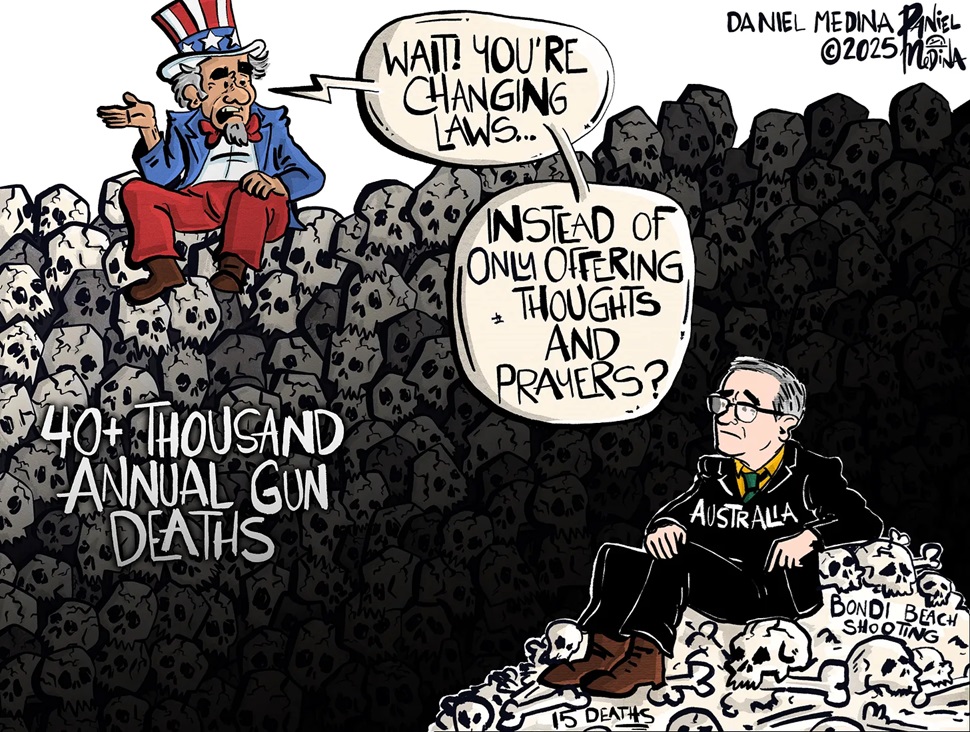
Racket cartoons, by Daniel Medina, https://racketcartoons.substack.com/p/wait-what?utm_source=post-email-title&publication_id=549592&post_id=181841928&utm_campaign=email-post-title&isFreemail=true&r=ln98x&triedRedirect=true&utm_medium=email, Dec 17, 2025
After the devastating massacre at Bondi Beach on Sunday, Australia’s PM and leaders promised to tighten gun laws to help make sure it never happens again. As an American reading this, and hearing more than just “thoughts and prayers,” I sat at my desk and felt deeply sad. Our country is so dysfunctional that we cannot handle even the basics of governing, let alone face the leading cause of death for American children: firearms.
What stood out to me was how quickly Australia’s leaders responded and how they seemed to agree that the government should act after something so terrible. In the United States, mass shootings are often followed by sadness but no action. It can feel like we accept these deaths as normal instead of trying to prevent them. Seeing another country treat gun violence as a problem they can fix makes our inaction even harder to understand.
The Israel Lobby’s War on Aussie Doctors
Since recording this video, the Victor Change Cardiac Research Institute has finally allowed Professor Macdonald to return to work. Thank you to everyone who helped achieve this important victory for free speech and our healthcare system.
The Moral Hazard of Being US Deputy-Sheriff
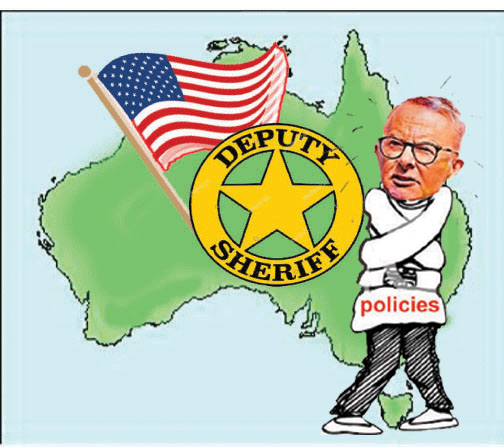
6 December 2025 David Tyler , https://theaimn.net/the-moral-hazard-of-being-us-deputy-sheriff/
In a secure room in Washington last week, Australian officials watched what the world would soon see.
A small Venezuelan fisherman’s tinnie drifts, already incinerated by a first missile. Two survivors cling to a piece of the wreckage. A pause. Then a second flash. A missile is aimed at the living, not the vessel. Eleven men die. US officials insist it was legal. Congress wants answers. The survivors are dead either way. It is an act of primitive, barbaric cruelty. The purpose is to erase witnesses and to send a message of terror as a deterrence.
That second strike; the notorious “double tap” has a long historical precedence. It is now under investigation as a potential war crime, authorised by the same US defence secretary Australia is binding itself to more tightly than at any time since 1945. This is what AUKUS really entangles us with: not an abstract “rules-based order,” but a command chain learning to live with killing those who survive.
Hannah Arendt warned that “most evil is done by those who never make up their minds to be good or evil.” Australia is drifting into that moral fog; without even pretending to know the difference.
Our Hands Are Not Clean
When the footage broke, six US lawmakers, all military veterans, reminded troops they must refuse illegal orders. President Trump’s response? Their comments were “seditious behaviour, punishable by death.” His team later softened his threat, but the FBI still moved to interview the six.
No strike operators are under investigation. The dead Venezuelans are not discussed. The controversy, incredibly, is whether Americans are allowed to warn other Americans not to commit war crimes.
Australia, moreover, is not just an innocent onlooker to a Trump’s gung-ho vigilantism, a state which shoots first and asks questions after. We have ADF personnel embedded in US commands that carry out attacks of this kind. We host Pine Gap, described by senior intelligence analysts as a premier US targeting facility in the southern hemisphere, linking satellites to weapons systems across the Middle East and Asia. We tell ourselves we host it for “security.” In practice, we help aim weapons we never authorised, and cannot refuse.
It is not the brutality that shocks the alliance; it is the dissent.
Asymmetry on Steroids
AUKUS was sold as strategic maturity; an insurance policy against an uncertain Indo-Pacific. Instead, it could become a transfer of sovereignty disguised as procurement. Australia pays up to AUD 368 billion for nuclear submarines that may not arrive until the 2040s. Ships we can neither crew, service nor fuel.
Even then, we may service American boats before our own. The Parliamentary Library analysis makes clear the technology transfer remains subject to US export controls. We do not buy independence; we buy a permanent maintenance job.
Washington gains unfettered access to Australian ports, deeper control of our deterrence posture, and logistical reach into Asia. Canberra gets second-hand privileges wrapped in secrecy.
As Bernard Keane has observed, Labor governs as though office is something to occupy, not use. The result is an alliance that treats American commercial and military interests as interchangeable, while our interests and needs are politely deferred.
The Pattern Is Becoming Impossible to Ignore
In just two weeks:
- The administration signalled openness to watered-down Nvidia AI chip sales to China, over the objections of US China hawks who argued they could bolster Chinese military capacity.
- A leaked plan for Ukraine’s reconstruction envisaged turning frozen Russian assets into profit streams for US-led venture funds; Europeans were expected to accept territorial loss and pay a commission for the privilege.
- Trump stalled sanctions against a Chinese spy agency implicated in extensive hacking to protect an upcoming trade trip to Beijing.
In each episode, intelligence and human rights concerns are bent around the same question: What makes money now?
Imagine if Canberra behaved as crassly. When Australia signs quiet deals with Beijing, we call it “strategic naïveté‘. When Washington does it, we call it “the alliance.”
Australia Has Agency – or It Has Nothing
This is not an argument for abandoning the alliance, but for removing the leash. A self-respecting partner demands:
- Transparency: Parliamentary oversight of defence commitments, including rules of engagement affecting Australian personnel and facilities.
- Reciprocity: Partnerships beyond one power; ASEAN, India, Japan, South Korea, the EU, not an exclusive dependence.
- Sovereign capability: Shipbuilding and cyber defence that serve Australia first, not as a service station for US fleets.
- Moral Limits: If allies breach international law, we do not close our eyes; we close our ports.
Blind obedience is not strategy. It is outsourcing judgment. Surrendering autonomy.
The Choice Is Not Between America and China
Canberra’s defenders of AUKUS love a false dilemma: independence equals Beijing. They mistake sovereignty for treason. Malcolm Fraser warned of this decades ago, describing Australia as a “client state.” We have since upgraded ourselves; to a nuclear client state, paying interest on promises.
Independence is not abandonment. It is partnership without servility. It is the ability to say no. If a second strike on drowning men does not trigger such a boundary, nothing will.
The real danger is no longer foreign power. It is our refusal to imagine ourselves without permission.
Choose Leadership Before It’s Chosen For Us
The Caribbean footage will fade. The legal arguments will thicken. The bodies will be forgotten. What will remain is the alliance, tighter than ever, and a government too cautious to ask what we might be agreeing to on our behalf.
Gough Whitlam once feared Australia would become a nation of “toadies and bludgers” trading sovereignty for illusion. That future arrives quietly. It arrives not with invasion, but with permission slips. It arrives when the second flash on a foreign sea is someone else’s problem, and ours only if we ask.
Albanese must choose leadership while we still have a choice to make.
Nuke Submarine ‘community consultation’

By Philip White on Nov 23, 2025
Australian Naval Infrastructure (ANI) is conducting a ‘community consultation’ about its plan to lodge a site licence application for the ‘Nuclear-Powered Submarine Construction Yard Project’. An application has to be lodged with the new Australian Naval Nuclear Power Safety Regulator before it can prepare a site for a Naval Nuclear Propulsion facility.
We wonder why they are in such a hurry to apply for a site licence when the Strategic Impact Assessment (SIA – Commonwealth process) and the Environmental Impact Statement (EIS – State government process) haven’t even been finalised. FoE Adelaide made submissions to both these processes (click to read our SIA submission & our EIS submission) in March 2025, but no public submissions and no follow-up report have been published. We also made a submission on the new nuclear powered submarine Regulations, which came into effect on 1 November 2025 without any response to the public comments received.
Click here (251123FoEAdelaideSubmission) to read our submission to ANI’s site licence ‘community consultation’.
And let us never forget that acquiring nuclear powered submarines is a bad idea in the first place.
Unlocking Asia: CPA Australia urges bold action to boost national capability.

12 November 2025 AIMN Editorial, https://theaimn.net/unlocking-asia-cpa-australia-urges-bold-action-to-boost-national-capability/
Australian businesses are missing significant investment and innovation opportunities in Asia.- Education, business and professional exchange programs must be expanded.
- Speaking from experience – CPA Australia has nearly 50,000 members in the region.
One of the world’s leading accounting bodies, CPA Australia, is urging the Federal government to take bold steps to strengthen Australia’s Asia capability, warning that Australian businesses are missing out on significant opportunities in the region.
In a submission to the government’s inquiry into building Australia’s Asia capability, CPA Australia provides four key recommendations aimed at deepening Australia’s engagement with Asia through education, business and cultural exchange.
Rebecca Keppel-Jones, Chief Member Operations Officer at CPA Australia, says many Australian businesses, particularly SMEs, remain domestically focused and are not capitalising on opportunities in Asia.
“Asia is central to Australia’s future prosperity. To remain competitive, we must build Asia capability from the classroom to the boardroom,” Ms Keppel Jones said.
“With Asia home to some of the world’s fastest-growing economies, Australia risks falling behind unless it invests in Asia capability now. We need more investment into existing programs, such as the New Colombo Plan, to improve Australians’ understanding of Asia.”
CPA Australia is proud to have maintained a strong presence in Asia for more than 70 years. It now represents nearly 50,000 members in mainland China, Hong Kong, Malaysia, Singapore, Indonesia, Vietnam and the UAE.
“Australia must better leverage its people-to-people connections and professional networks to unlock economic potential,” Ms Keppel-Jones said.
CPA Australia’s four key recommendations:
- Expanding Asia-focused training for SMEs to improve business readiness and regional engagement.
- Showcasing Australian success stories in Asia through a government-supported case study library to inspire and educate.
- Increasing scholarships and professional placements for young Australians to study and work in Asia.
- Revitalising Asian language and cultural education in schools and universities to reverse declining enrolments and build long-term regional literacy.
“As global dynamics shift, our ability to engage with Asia is more critical than ever. We need to ensure Australia’s workforce is globally competitive,” Ms Keppel-Jones said. “We are ready to work with government, educators and industry to turn these recommendations into action.”
The submission highlights CPA Australia’s active contributions to regional policy development, education and professional exchange, including a reciprocal work placement exchange program with Malaysia.
Eligible CPA Australia members can enjoy temporary work placements in Malaysia as part of a broader Young Professionals Exchange Program organised by the Department of Foreign Affairs and Trade. The exchange program is designed to enhance business engagement between Australia and its Southeast Asia partners and is available in Malaysia first, before being rolled out to other Southeast Asian markets.
CPA Australia’s thought leadership initiatives across Asian nations include its annual Asia-Pacific Small Business Survey and Business Technology Report.
Coalition to look at coal subsidies, stick with nuclear

Liberals risk joining ‘baddies’ with fossil-fuel push
CanberraTimes, By Tess Ikonomou, November 9 2025
A senior Liberal has warned his party would push Australia towards joining “baddies” in rejecting international climate goals as it prepares to back fossil fuel-fired power.
Political infighting within the coalition has intensified over the Liberals’ commitment to a target of reaching net-zero emissions by 2050, a position the party is poised to follow junior partner the Nationals in dumping.
The Liberal Party’s formal position on the climate target will be decided following meetings in Canberra mid-week.
Liberal frontbencher and leading moderate Andrew Bragg on Sunday indicated he could quit shadow cabinet if his party decided it would pull out of the Paris Agreement and not maintain a clear goal for lowering emissions.
“If we left Paris, we’d be with Azerbaijan, Iran, Syria, you know, and a few other baddies,” he told ABC’s Insiders program.
“Australia has never been with those people before.
“Australia needs to be in Paris, in my opinion, and then we need to try to find a way to do net-zero better than Labor. That is better for jobs, better for industry, and better for decarbonisation.”
Senator Bragg added the Liberals were “not fringe dwellers” and most Australians want the nation to play a fair role in reducing emissions, an objective seen as key for the party to reverse its electoral decimation in urban seats.
Under the Paris Agreement, signed in 2015, members must increase their emissions targets every five years and cannot water down their goals……………………………………………………………………………………………………….
Opposition energy spokesman Dan Tehan has flagged subsidies could be offered to keep current coal-fired power plants operating for longer under the coalition’s long-awaited climate and energy plan………………………………………………………………………………………………
Mr Tehan also foreshadowed the Liberals would continue their pre-election policy of supporting the development of nuclear power plants.
“Absolutely we want to see a nuclear policy, and we’ve already committed, through the coalition agreement, to lifting the ban, and that will be very much part of the discussions we have,” he said. https://www.canberratimes.com.au/story/9107389/liberals-risk-joining-baddies-with-fossil-fuel-push/
Free solar, nuclear cost blowouts, and “deadly negligence” on climate: A heady mix for the Coalition

Giles Parkinson, Nov 7, 2025, https://reneweconomy.com.au/free-solar-nuclear-cost-blowouts-and-deadly-negligence-on-climate-a-heady-mix-for-the-coalition/
The Coalition’s favoured energy technology is quite clearly nuclear – perhaps for no other reason than it is not wind or solar.
The Coalition no longer pretends that nuclear is the best option to address climate change, because they are tearing up their agreement on net zero, the softest of climate targets. That may be an admission that nuclear is very slow to build, particularly for a country that has never done so, and is still built on democratic principles.
Nor can they pretend that nuclear is the best technology on economics. Real world examples continue to defy the carefully constructed modelling commissioned by the Coalition.
In the UK, financing has finally been landed for the planned Sizewell C nuclear plant – and it turns out to be £38 billion, or around $A76 billion, for a 3.2 gigawatt facility. That translates to around $24 million a megawatt capacity cost, which is more than twice as much as the Coalition modelling would have you believe.
Sizewell C is expected to be a replica of Hinkley Point C, whose costs are now estimated at up to $A94 billion, and it seems that Sizewell kept its capital costs under control, because the UK government had to step in to take a 44 per cent stake. (The builder, the French government owned EDF, only wanted 12 per cent, because of the cost risks.)
It also changed the nature of the funding game – turning the new nuclear plant into a regulated asset (like Australia’s electricity networks), which will require consumers to start paying for the nuclear plant more than a decade before it is actually built.
Remember, this is the 5th or 6th plant to be built using the French EPR technology – and yet there is no sign of it getting any cheaper. And we haven’t see the inevitable delays and cost blowouts yet. Civil construction costs are blowing up projects all over the world, and nuclear is about as big as they come.
The UN starts another climate party
The Coalition’s anti-climate and no-to-net-zero stance comes as the UN climate conference is poised to start in Belem, Brazil, where UN secretary general Antonio Guterres has lamented “more failure” to do enough to keep the world on track to cap average global warming at 1.5°C.In remarks that might have been addressed specifically at the Coalition, but were directed at the world, Guterres said:
“Too many corporations are making record profits from climate devastation, with billions spent on lobbying, deceiving the public and obstructing progress,” Guterres said.
“Too many (political) leaders remain captive to these entrenched interests,” noting that countries are spending about ($A1.54 trillion) each year subsidising fossil fuels.
“We can choose to lead – or be led to ruin. Every fraction of a degree means more hunger, displacement and loss – especially for those least responsible. This is moral failure – and deadly negligence.”
What is the real target?
Those fractions of a degree are significant. The latest “emissions gap” report published by the UNEP says the world is headed for average of 2.9°C of warming based on current enacted policies, and 2.3°C and 2.5°C based on announced commitments.
What does a world of 3°C look like. Australia’s National Climate Risk report made it clear – catastrophic impacts, rising sea levels, collapsing ice sheets, the destruction of the Great Barrier Reef. Much of northern Australia would be uninhabitable.
Gina Rinehart, who appears to hold so much sway over the Nationals, wants to build a “defence dome” over northern Australia to protect its mineral riches. It might need a geodesic dome just to make it habitable.
What could possibly be done? As the UNEP notes: “The required low-carbon technologies to deliver big emission cuts are available. Wind and solar energy development is booming, lowering deployment costs. This means the international community can accelerate climate action, should they choose to do so.”
Astonishingly, the Coalition battle over net zero has been playing out in mainstream media as nothing more than political porn, focusing on personalities, egos and power. Climate science, and the renewable solutions, have barely been mentioned.
I’ve seen and heard maybe half a dozen interviews with Opposition energy and emissions reduction spokesman Dan Tehan and can’t remember him once being asked about climate science, or the economics and the engineering of the energy transition.
Does Australia really want to host COP31
Sometime in the next two weeks we will get an answer on whether Australia wants to host COP31, the next UN climate talks in 2026.
The plan is to do it in Adelaide, which would be a grand opportunity to show off the world’s most advanced renewable grid, with South Australia already at a world-leading share of 75 per cent wind and solar, and aiming for 100 per cent “net” renewables by 2027.
The state hosted the world’s first big battery and was the first to roll out “grid forming inverters,” which will help kill the need for fossil fuel generators and often has rooftop solar meeting the equivalent of all state demand. None of which was considered possible just a few years ago.
But if it is this hard to agree to a venue (Türkiye still has its hand up), does Australia want the hassle and embarrassment of presiding over a UN conference with no particular landmark goal, squabbling nations and the notable absence of the world’s biggest economy, the US?
Some in the ALP machine are thinking not. The delays and the massive oil and gas projects still being approved and rolled out, could make logistics tricky and the politics difficult. Which would be a shame: It is a rare opportunity for the Pacific Island nations to also have their say.
They have done so before when Fiji was the official host of COP23, but that was – for obvious reasons – held in Bonn, Germany. That might happen again, with Australia and Türkiye sharing “hosting” duties and various lead-up events, expos and talk-fests.
Duck! Free solar is coming your way
As the Coalition tries to tear itself apart over its position on climate and energy, federal energy minister Chris Bowen’s advocacy of “free solar” may turn out to be a political masterpiece – if only because it promises to change the conversation about the green energy transition.
Bowen wants to force energy retailers to offer at least three hours of “free electricity,” taking advantage of the abundance of rooftop and other solar in the middle of the day, and to make sure the benefits are shared with the 60 per cent of households that do not yet have, or can’t have, rooftop solar.
It’s sparked a predictable fury about heavy handed regulation: You can’t do that! And it’s true that some retailers already do offer such a tariff, although potential customers may want to assess the rates that are being charged in the evening peaks.
Morgan Stanley says the implications are significant enough – savings of up to $660 a year for non-solar households able to take up the offer (you need a smart meter and a big enough midday load so it can make sense), and estimates it might cost big retailers like AGL and Origin around $60 million each.
That suggests an uptake of less than 100,000 customers, which sounds about right. But it’s the messaging that counts – both to the long-forgotten consumer, and to the legacy retailers who are reminded they need to be on their toes to negotiate this energy transition.
Customers should no longer be the forgotten part of the energy transition. They now own rooftop PV, and are busy installing batteries and buying EVs. That will accelerate, but the benefits should not be theirs and theirs alone. Sadly, the legacy players sometimes need to be told to do the right thing.
Podcasts to listen to
This week on the Energy Insiders podcast, we talk to Vestas’ Jan Daniel Kaemmer about the prospects for wind industry in Australia, and of course the news of the week. See: Energy Insiders Podcast: The future of wind energy
Our other weekly podcast, SwitchedOn Australia hosted by Anne Delaney, has a look at the scandal over pre-paid energy packages for First Nations peoples. See: SwitchedOn podcast: The scandal of weekly power cuts in First Nations communities
In our Solar Insiders podcast, Sophie Vorrath digs in to the “free solar” idea and the opportunities for more electrification in a discussion with the EEC’s Luke Menzel: See: Solar Insiders Podcast: Would you like electrification with that?
And you can also catch up with the latest episode of the EV-focused The Driven podcast, where Sam Parkinson, Sarah Aubrey and the team discuss BYD’s cheapest EV, VW’s ID. Buzz GTX, and if local car manufacturing is just talk? See: The Driven Podcast: BYD’s most affordable EV, Kia’s new van, and what’s the buzz around VW’s GTX
1 This month


Help Aunty Sue Protect Her Land and Sacred Sites From Destructive Rocket Testing.
.

Australians deserve the truth
about
AUKUS – https://aukuspublicinquiry.com/

PETITION – To: Prime Minister Anthony Albanese and the Australian Labor Government

of the week – Australians for War Powers Reform (AWPR)
To see nuclear-related stories in greater depth and intensity

