In fealty to the global nuclear industry, the Liberals line up the nuclear dump site, amendments to law, deepwater port
 1. Kimba = ‘Napandee’ to be announced by Canavan as the National radioactive Suppository in January;
2. Very shortly, ANSTO & ARPANSA will say that they 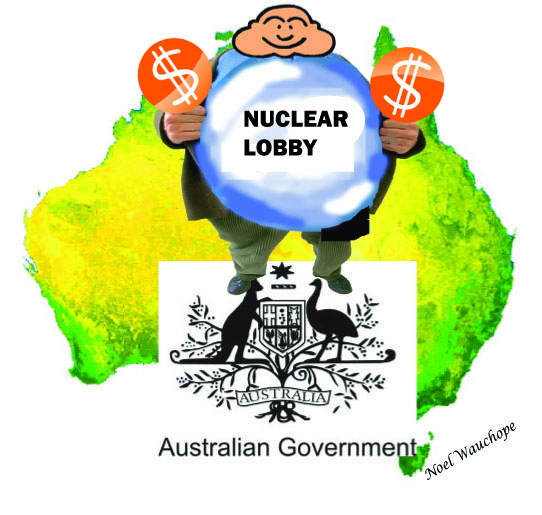 cannot implement the recommendations from the nuclear energy select committee unless the Environment Conservation & Biodiversity Act is amended ~ so the Libs will attempt to cripple that legislation. Once they achieve that, then
3. This deep water port connected by rail to Kimba will allow not only the shipment of Australian, but also the  importation of international waste……
Through connection to the national rail and road network, Cape Hardy will become an internationally significant intermodal hub for agriculture, mining, and energy investment that can drive the region’s economy into the next century.
https://minister.infrastructure.gov.au/mccormack/media-release/25-million-support-cape-hardy-port-precinct?utm_source=miragenews&utm_medium=miragenews&utm_campaign=news
While ignorant tunnel-visioned politicians kowtow to irrigators, the Murray River system faces death
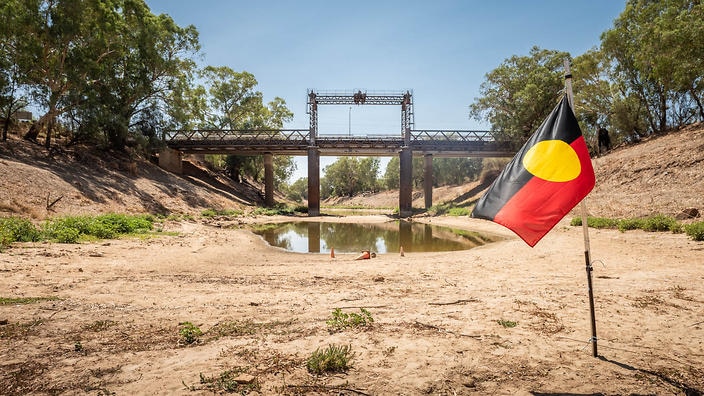
Water wars: will politics destroy the Murray-Darling Basin plan – and the river system itself?
Drought is not the only threat to the river system: the plan to save it is in doubt as states spar over the best way forward, Guardian, Anne Davies
The basin states – Queensland, New South Wales, Victoria and South Australia – as well as the federal government, are due to meet on Tuesday in Brisbane amid threats from the NSW Nationals that it will walk away from the plan unless major changes are made.
“We simply can no longer stand by the Murray-Darling Basin plan in its current form, the plan needs to work for us, not against us,” NSW Nationals’ leader John Barilaro warned last week.
“NSW is being crippled by the worst drought on record and our future is at risk. The plan should be flexible, adaptive and needs to produce good environmental outcomes for this state.”
NSW has already flagged that it will be asking to be relieved of its remaining contributions towards the environmental water target – it has committed to saving a further 450GL – while Victoria is balking at meeting its commitments as well.
There have also been calls from various ministers to end environmental flows during the drought and to instead allocate more water for agriculture. In particular is unhappiness from NSW at the amount of water stored in the lower lakes in South Australia. That will be fiercely resisted by SA. Continue reading
Albanese attacks Coalition’s nuclear ‘fantasy’ as Greens say report should ‘alarm all Australians’
 Albanese attacks Coalition’s nuclear ‘fantasy’ as Greens say report should ‘alarm all Australians’,https://www.theguardian.com/australia-news/2019/dec/14/albanese-attacks-coalitions-nuclear-fantasy-as-greens-say-report-should-alarm-all-australians Government-dominated committee calls for partial lifting of nuclear ban and for greater work on nuclear technology, Australian Associated Press
Sat 14 Dec 2019 The Labor leader, Anthony Albanese, has described the call from Coalition MPs to lift a longstanding ban on nuclear energy as “fantasy”.
A 230-page report released on Friday by the chairman of the parliament’s energy committee and Liberal MP Ted O’Brien said nuclear energy should be considered as part of Australia’s future energy mix.
The government-dominated committee called for further work on nuclear technology and the partial lifting of the current moratorium on nuclear energy to allow for “new and emerging nuclear technologies”.
O’Brien said nuclear energy would also complement the government’s climate policy.
“If we’re serious about reducing greenhouse gas emissions, we can’t simply ignore this zero-emissions base-load technology,” he said.
A dissenting report by Labor MPs said there was no economic case for pursuing nuclear energy and safety issues had not been addressed.
Nuclear power has never overcome the dangers that we have seen played out around the world time after time,” Albanese told reporters on Friday after finishing off his week-long trip to Queensland.
“This is a fantasy from the government in order to avoid the real decisions that are needed of having a national energy policy that drives down emissions, drives down prices, and creates jobs.”
The inquiry, sought by the energy minister, Angus Taylor, received more than 300 submissions.
The Greens’ nuclear power spokesman, Sarah Hanson-Young, said the committee’s report should “alarm all Australians”.
She said the report opens the door to nuclear power stations and subsequent waste dumps here in Australia.
“This is absurd at best and dangerous at worst,” she said in a statement.
Is the Minister Against the Environment, Angus Taylor, really bad at arithmetic, or just a liar?
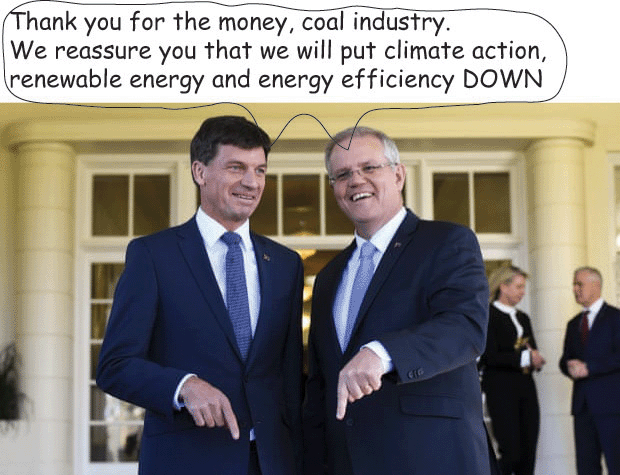 Angus Taylor spotted fiddling more figures, New Daily, 15 Dec 19 Angus Taylor spotted fiddling more figures, New Daily, 15 Dec 19The Minister for the Environment and Energy, Angus Taylor, seems to have a problem with numbers, whether it’s the Sydney City Council’s travel budget or what year Naomi Wolf was at Oxford. His latest figure fiddling though is much bigger and more serious than either of those embarrassments. And it’s possibly more absurd. At the COP25 climate summit in Madrid last week, Mr Taylor was pushing the government line that Australia would meet and exceed its Paris agreement to reduce greenhouse gas emissions by 26 per cent from 2005 levels by 2030 – “in a canter”, according to Prime Minister Scott Morrison. But all the while, Mr Taylor had a graph from his department showing the claim was, shall we politely say, “false”. Without much fanfare, the Department of Environment and Energy earlier this month published its annual emissions projections. At the core of the report is the accompanying graph of Australia’s emissions of millions of tonnes of CO2-equivalent from 1990 projected out to 2030. Blind Freddy can see the government’s forecast reduction from nearly 600Mt in 2005 to 511Mt in 2030 does not represent 26 per cent. It’s actually less than 15 per cent. But with Mr Taylor’s talent for figure fiddling, the sun rises in the west, bears no longer defecate in the woods, and somehow less than 15 per cent is turned into more than 26 per cent. Because he says so. Blind Freddy can see the government’s forecast reduction from nearly 600Mt in 2005 to 511Mt in 2030 does not represent 26 per cent. It’s actually less than 15 per cent. But with Mr Taylor’s talent for figure fiddling, the sun rises in the west, bears no longer defecate in the woods, and somehow less than 15 per cent is turned into more than 26 per cent. Because he says so.\The government attempts this particular distortion of reality by claiming “carry-over credits” from overachieving in the previous Kyoto agreement reached in 1997. (That ‘overachievement’ was totted up primarily in LULUCF – “land use, land use change and forestry” – an area particularly prone to creative accounting as it involves such things as promising not to clear bush at some stage in the future.) How inconvenient that the government’s graph, including buying some for LULUCF, goes back to 1990 and shows our emissions reduction from then, or from the 611Mt peak in 2006, is still less than 15 per cent. [graph on original] The government’s claim is an international joke. What’s worse is that the Madrid meeting was supposed to be about moving the needle on from the Paris agreement. Salient nations were supposed to be able to feel the heat, smell the smoke, see the glaciers melt and therefore work to achieve more than Paris. Instead, Mr Taylor led Australia as one of the recalcitrant countries sabotaging that reasonable aim. And claiming black was white, or at least that coal isn’t a problem, wasn’t the Environment Minister’s only fiddle. He also declared that Australia is backing an unprecedented wave of clean energy investment. Well, yes – and no. Australia is enjoying a surge in clean energy generation investment this year, but then it falls away quite rapidly, as shown in another graph, this time by the construction industry analysts at Macromonitor. [graph on original] Macromonitor reckons the next clean energy investment boom doesn’t kick in until the middle of the decade when the need for storage – pumped hydro, batteries – is more acute. … https://thenewdaily.com.au/news/politics/australian-politics/2019/12/16/angus-taylor-emmissions-numbers/ |
|
Scott Morrison, comfy in his Morrison bubble, trashes Environment Department
 Morrison torches Environment Department, Independent Australia, By Stephen Saunders | 15 December 2019, For a time, Arts and Environment were in the same federal department. Both functions have taken a hit, in Scott Morrison’s Christmas departmental reshuffle.
Australia’s first federal Environment Department debuted 1971. The function has carried forward to this day, under varying departmental banners. Since 1993, “Environment” (or “Sustainability, Environment”) has always been the leading item in a departmental title.
Not any more. “Busting” congestion, blindsiding the public service, Morrison has reversed recent history. The Environment function of the previous Environment and Energy Department goes into the Agriculture Department. It’s never been parked there before. The Industry Department mops up most of Energy and Climate.
Apparent wins there, for fossil fuels and land conversion. And never mind the fire and smoke. Brand-new Environment chief David Fredericks has been recycled as Industry chief…….
With endless growth running the show, the Department has won battles and lost wars. Our first State of the Environment report surfaced in 1986. When you decode the polite language of the scientific committees, successive reports reveal steady decline up to 2016.
It’s simplistic to say, but the Department has prospered more under Labor……
In his [Morrison’s] inflated opinion, ministers can always be relied on to “set the policy direction” correctly. As they surround themselves with increasingly docile public service chiefs.
On top of all this, he cashiers the Environment Department. And puts Energy and Climate under Industry. His religion and ideology seem to be clobbering reason and science.
Labor’s bulldog adherence to Big Coal and Big Australia undermines their credibility to oppose environmental overreach. Still, Morrison’s arrogance might come back to bite him.
Over its first 30 or 40 years, the Federal Environment Department attracted a keen cadre of officials, whose commitment and knowledge could be turned to disparate environmental issues at short political notice. They had notable successes and signal failures. But their relationships with ministers held more nuance than the feudal deference that Morrison now demands.
You can’t throw the switch, to recharge independent and vigorous environment policy advice at a moment’s notice. Rationally speaking, we need those skills, more than ever.
Weather, rain and fire are visibly different, within our own short lifetimes. Environment and growth problems have never been more obvious. The environment has returned to the public consciousness bigtime.
The “bubble” isn’t around Canberra. It’s around Morrison himself. Sure, the weakened Environment and Climate bureaus will have to answer, to him and his ministers. The physical environment may not be so obliging. https://independentaustralia.net/environment/environment-display/morrison-torches-environment-department,13415
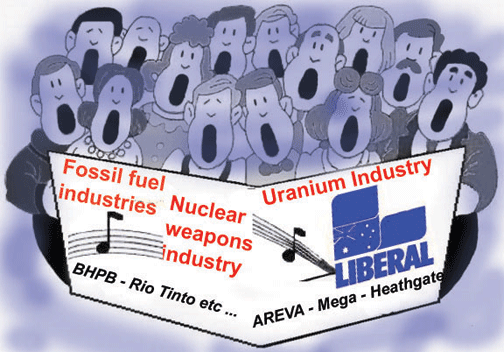
Scott Morrison and Liberals recommended lifting Australia’s ban on nuclear power
|
Josh Burns Fight To Stop Nuclear Waste Dump In Flinders Ranges SA, 13 Dec19 Today, Scott Morrison and his Government MPs ignored the experts and recommended lifting the bipartisan ban on nuclear energy in Australia.
I’ve been part of the Parliamentary Inquiry into nuclear energy for the past few months. The overwhelming evidence said that Australia should not move towards this expensive and dangerous technology. Instead of actually creating a national energy policy, Scott Morrison is now looking at a location near you to build Australia’s first nuclear power station https://www.facebook.com/groups/344452605899556/ |
|
Labor leader Anthony Albanese dismisses nuclear ambitions as a fantasy
|
A 230-page report released on Friday by chairman of the parliament’s energy committee and Liberal MP Ted O’Brien said nuclear energy should be considered as part of Australia’s future energy mix.
The government-dominated committee called for further work on nuclear technology and the partial lifting of the current moratorium on nuclear energy to allow for “new and emerging nuclear technologies”…….
A dissenting report by Labor MPs said there was no economic case for pursuing nuclear energy and safety issues had not been addressed.
“Nuclear power has never overcome the dangers that we have seen played out around the world time after time,” Mr Albanese told reporters on Friday after finishing off his week-long trip to Queensland. https://www.9news.com.au/national/nuclear-ambition-a-fantasy-albanese-says/00946ea2-8c16-45ba-b76d-5c36c8de5785#close
|
|
Energy and Emissions Reduction Minister Angus Taylor rejects call for partial lift of nuclear power
 Taylor rejects call for partial lift of nuclear power ban, https://www.smh.com.au/politics/federal/taylor-rejects-call-for-partial-lift-of-nuclear-power-ban-20191213-p53jsf.html By Mike Foley Taylor rejects call for partial lift of nuclear power ban, https://www.smh.com.au/politics/federal/taylor-rejects-call-for-partial-lift-of-nuclear-power-ban-20191213-p53jsf.html By Mike Foley
December 13, 2019 Energy and Emissions Reduction Minister Angus Taylor has poured cold water on calls to partially lift Australia’s moratorium on nuclear power to allow investigation of emerging technologies.
A Coalition-dominated parliamentary inquiry found next-generation technologies such as small modular reactors should be explored by experts for use in Australia. “If we’re serious about reducing greenhouse gas emissions, we can’t simply ignore this zero-emissions baseload technology,”committee chairman and LNP MP Ted O’Brien said. “Australia should say a definite ‘no’ to old nuclear technologies but a conditional ‘yes’ to new and emerging technologies such as small modular reactors.” But Mr Taylor said the government had “no plans” to lift the moratorium, which has been maintained by Labor and Coalition governments since 1998. “Any changes to the moratorium would need bipartisan support and broad community acceptance,” he said. The House of Representatives’ Standing Committee on the Environment And Energy acknowledged public controversy around the nuclear debate in the title of its report – Not without your approval: a way forward for nuclear technology. “Rather than a total and immediate lift of the moratorium, only a partial lift for new and emerging technologies is proposed, subject to the results of a technology assessment and a commitment to community consent as a condition of approval for nuclear facilities,” it said. Labor committee members issued a dissenting report saying there was “no basis” for lifting the prohibition and no need for additional investigations into the science or economics of nuclear energy. Macnamara MP Josh Burns said it was “madness” to consider nuclear power given small reactors were not yet available, renewable energy was becoming cheaper and existing technology would need to be located in populated areas.
The only technology that is available now is the large nuclear reactors, which require an abundance of water to keep the reactors cool. And the only viable water supply is along the coastline,” Mr Burns said. “Australian experts have warned against being the first country to buy new nuclear technology. We don’t have the capability for nuclear energy now. We need to upskill and that comes with serious risk and cost. To do that with technology where we’re not confident in the safety would be negligent.” Australian Conservation Foundation spokesman David Sweeney said lifting the ban would start a “conga line of supplicants to Canberra promising low carbon energy and seeking high public subsidy”. |
|
Prudent nuclear ban should remain: ACF
 Prudent nuclear ban should remain: ACF, https://www.miragenews.com/prudent-nuclear-ban-should-remain-acf/ 13 Dec 19, Australia’s bipartisan, long standing and prudent prohibition on nuclear energy should remain in force as it stands.
In response to the release of the House of Representatives standing Committee on Environment and Energy’s report into the prerequisites for nuclear energy in Australia, the Australian Conservation Foundation’s (ACF) Nuclear Free Campaigner, Dave Sweeney, said:
“ACF strongly holds that the bipartisan, long standing and prudent prohibition on nuclear energy in Australia should remain in force as it stands.
“From the heartland to the harbour, the terrible drought and bushfires we are experiencing leave no doubt that Australia must quickly transition away from climate-wrecking fuels like coal, oil and gas.
“The Australian Energy Market Operator’s roadmap for the efficient development of the National Electricity Market makes it clear that Australia’s energy transition is heading towards small and large-scale renewables.
“Australia’s long standing, sensible moratorium on nuclear energy, enacted by John Howard, does not preclude discussion or debate on nuclear. There has been plenty of both.
“But while no commercial operator will touch nuclear, the moratorium remains important as it prevents a reckless government pouring public money into this economically and environmentally risky industry.
“Australians know nuclear reactors overseas cost a fortune, take decades to build and come with the possibility of disastrous accidents and the certainty of eternal radioactive waste.
“Cheap, clean, safe reactors don’t exist outside the minds of nuclear true believers. Flirting with nuclear is no basis for a credible national energy policy.
“The climate crisis we are living through is too serious and too urgent to fiddle at the margins with nuclear.
“We need to avoid the distraction of a nuclear cul de sac and take the renewable path.
“Australia’s future is renewable, not radioactive.”
In September a broad coalition of faith, union, environmental, Aboriginal and public health groups, representing millions of Australians, issued a strong statement opposing nuclear power.
Coalition MPs squabble over climate science as Australia burns
 , New Daily, Daniel McCulloch 13 Dec 19, Nationals deputy leader Bridget McKenzie has blasted an “irrational” state colleague for daring to link the NSW bushfires to climate change.
Their ugly public stoush has dragged on for several days.
He inflamed the internal spat after suggesting he would rather listen to climate scientists than the federal frontbencher on the effects of global warming.
But Senator McKenzie said “I actually have a science degree – I am one of the few in parliament that does”.
Coalition pushes for nuclear ban to be lifted, Labor says its madness,

Coalition pushes for nuclear ban to be lifted, Labor says its madness, https://reneweconomy.com.au/coalition-pushes-for-nuclear-ban-to-be-lifted-labor-says-its-madness-43980/, Sophie Vorrath, Federal Coalition MPs have called on the Morrison government to lift the ban on nuclear energy and pave the way for “emerging nuclear technologies to be introduced into Australia’s energy mix, despite their enormous expense, huge environmental risks, and as-yet unproven technical status.
The controversial push comes with the tabling of a 230-page report on Friday, the result of the inquiry into nuclear power called by energy and emissions reduction minister, and ex anti-wind campaigner Angus Taylor.
It was conducted by the Liberal dominated House Standing Committee on the Environment and Energy and chaired by pro-nuclear MP Ted O’Brien. See also: Federal nuclear inquiry report: Loopy lunatics in charge of the asylum
The finding from the Coalition MPs is unsurprising, but it should be noted that it goes against the advice from some of Australia’s foremost energy market authorities, including the Australian Energy Market Operator, who – as part of an expert panel including representatives from the market regulator (AER) and rule maker (AEMC) – told the inquiry that nuclear power just didn’t stack up against firmed renewables.
The nuclear report – entitled Not without your approval – was unveiled by O’Brien on Friday, who said it was “informed” by months of evidence-taking and the assessment of over 300 submissions on the prerequisites for nuclear energy in Australia.
In a statement released with the report, O’Brien urged Australians to “say a definite ‘No’ to old nuclear technologies but a conditional ‘Yes’ to what he called new and emerging technologies such as “small modular reactors,” which the inquiry was told by nearly all experts would not be commercially available for at least a decade.
But the Coalition report largely skated over the costs, and the delays in new technologies, and the projections from AEMO that Australia’s grid could reach 90 per cent renewables by the time that nuclear could be built in Australia, and instead relied on the highly contestable submissions from a group of nuclear proponents and ginger groups.
The focus on small modular reactors, or SMRs, is in line with the advice to the Committee from Ziggy Switkowski, who headed up the Coalition’s last nuclear thought bubble.
In fact, Switkowski told the Committee that the only hope for nuclear in Australia hinged on the future of Small Modular Reactors – which, as Jim Green explains here, are currently “non-existent, overhyped, and obscenely expensive.” The CSIRO and the AEMO agree – at least on the expensive bit.
O’Brien appears to have taken Switkowski’s advice and spun it into something resembling action on climate change, which is a new angle for the federal Coalition.
“If we’re serious about reducing greenhouse gas emissions, we can’t simply ignore this zero-emissions baseload technology,” he said, ignoring AEMO’s and other advice about the potential of emission cuts from renewables, something backed up by the latest government report.
“But we also need to be humble enough to learn lessons from other countries who have gone down this path. It’s as much about getting the technology right as it is about maintaining a social license based on trust and transparency.” No mention of the massive cost blowouts and delays in every other western country that has tried to build new nuclear.
O’Brien said “the Australian people should be at the centre of any approval process, and refer to a separate and possibly self-defeating recommendation of the report, that the partial-lift of the moratorium be subject to a technology assessment and a commitment to community consent as a condition of approval for any nuclear power or nuclear waste disposal facility.
The federal opposition has slammed O’Brien’s recommendation, which it says has been made “despite clear evidence nuclear power is enormously expensive, slow, inflexible, and dangerous to the environment and human health.”
The Committee’s deputy chair, ALP MP Josh Wilson, said O’Brien’s view was not supported by Labor – which has argued in a dissenting report that the pursuit of nuclear power is “madness.”
Senate Inquiry recommends consideration of nuclear energy, but public must approve
 Dave Sweeney, 13 Dec 19, A parliamentary committee has released a report into nuclear energy that puts the Australian people at the centre of any approval process for a future nuclear plant. “Nuclear energy should be on the table for consideration as part of our future energy mix”, said Member for Fairfax Ted O’Brien who chairs the House Standing Committee on the Environment and Energy. “Australia should say a definite ‘No’ to old nuclear technologies but a conditional ‘Yes’ to new and emerging technologies such as small modular reactors. “And most importantly,” said Mr O’Brien “the Australian people should be at the centre of any approval process”.
Scott Morrison and the Coalition are fiddling as Australia burns
|
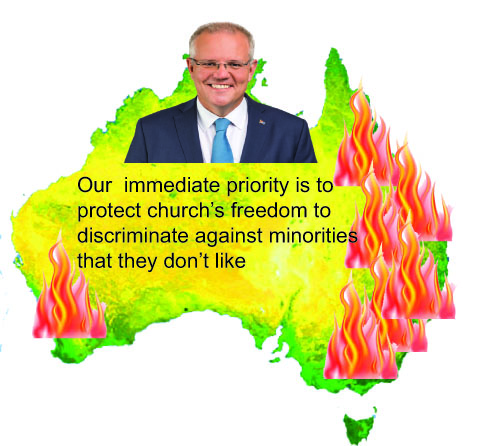
Scott Morrison and the Coalition are fiddling as Australia burns On climate action, the Coalition is the party of wreck, defer and obfuscate, the party with a shameful and indefensible record, Guardian Katharine Murphy Political editor, @murpharoo, Tue 10 Dec 2019 “………… Swathes of the country are burning, and we’ve only just entered summer. While Christian Porter was working through his various concessions on religious discrimination on Tuesday, trying to contain blowback from the churches and from colleagues, dot point by dot point, thick smoke was choking Sydney. In Canberra, the heat is also blistering, and the smoke from Braidwood rolls in and out, triggering memories of that traumatic January in 2003 that many of us lived through, our treasured possessions tucked in boxes, babies on hips, sheltering friends displaced from the western suburbs of the city; a city ready to flee, watching a red sky, raining ash and burning cinders, houses on fire, trees on fire. I flew to Brisbane on Sunday. The ground below me was dust for a thousand kilometres and the sky was a milky fog of smoke and heat haze. Dear prime minister. The country is not parched but desiccated, and it is burning like a tinderbox, and people are frightened. They are frightened about today and the terrible business of defending property and saving lives, and they are frightened about whether this is what spring and summer in Australia now looks like as droughts lengthen and deepen, and the fire season extends and intensifies because of climate change – which is what scientists have been trying to tell us all these years, so many times, in so many different ways, experts maligned and mangled in a culture war, pleading to be understood. Fear has accompanied the dry, and the heat and the flames, and that is a difficult and frankly politically unwelcome development for a prime minister who won an election just a few months ago at least in part by telling people to calm down about climate change, because the Coalition had things under control. It wasn’t true of course. That pitch has no basis in fact because the Coalition has done more than any other political party in Australia to frustrate climate action. If anyone is inclined to think wrecking is behaviour of the past, a vestige of Abbottism rather than behaviour of the present, because Morrison is so much more sensible, just remember this very week, in Madrid, Australian officials are making the case we need to use an accounting loophole to meet our Paris target. Far from meeting our 2030 target in a canter, Australia will not meet the target at all unless we invoke carryover credits to carry about half the abatement load. By taking this stance, we not only defer corrective action in our own country that should be happening now, in orderly fashion over this decade, we also validate the inclination of other countries, with higher emissions than us, to hunt for workarounds too. To cut a long story short, we make it less likely that the world will deliver the ambition we need to avert the worst of warming. So let’s be very clear. On climate action, the Coalition is the party of wreck, defer and obfuscate, the party with a shameful and indefensible record, the party that only last year bundled Malcolm Turnbull out of office in part because of a policy idea that might have settled a decade of partisan warfare that the Coalition believes is helpful to its re-election prospects. Morrison pursued an electoral strategy in May of telling voters in the cities the Coalition had climate under control, there was no need for hysterics, while in the regions, out of sight of the metro campaigns, the government weaponised climate change against Labor. So the Coalition in 2019 is the party of placate where necessary and punch on where politically profitable – which feels like the grimmest story of all. It might be grim, but it will remain the model as long at there’s enough voters in enough regional seats either not buying the science, or more worried about their immediate material circumstances than the science, to swing an election in the Coalition’s favour. As long as the status quo delivers a pathway to victory, the climate war in Australia will go on being an artefact of partisan politics rather than a practical problem to be solved. It’s hard, that truth, so hard I flinch. But truth is hard, and it’s past time truth won this argument rather than being obscured in the emoting, and the bobble head ranting, and the posturing, and the dissembling, and the clever strategising. Now by carrying on resolutely while the country burns, and being seen to carry on while things are being managed, Morrison is not avoiding the issue so much as trying to set the tone. The prime minister doesn’t want to validate the rising fear in the community by looking perturbed about the disaster currently in progress, because that obviously makes a lie of the Coalition’s “everything is fine” messaging. He wants to be getting on with ordinary business in full public view, not flapping about with special summits with the premiers just because Turnbull said he should do it on Q&A. …… The obfuscation, the false comfort, the changing of the subject, the head-patting, will keep happening as long as we let it. It will keep happening as long as soft and hard denialism is enabled in mainstream media outlets, as long as journalists prioritise other lines of inquiry over rigorously pursuing accountability on this issue, and as long as Australian voters abdicate responsibility by telling themselves all political parties are as bad as each other so it doesn’t matter who you vote for. The only way things will change is if we choose, as a country, to do something else. To take responsibility. To demand something better. Because, ultimately, this, the future, is on us. https://www.theguardian.com/australia-news/2019/dec/10/australia-is-burning-like-a-tinderbox-and-the-coalition-wont-acknowledge-voters-rising-fears |
|
Community of small rural town Kimba “blown apart” by nuclear waste dump plan
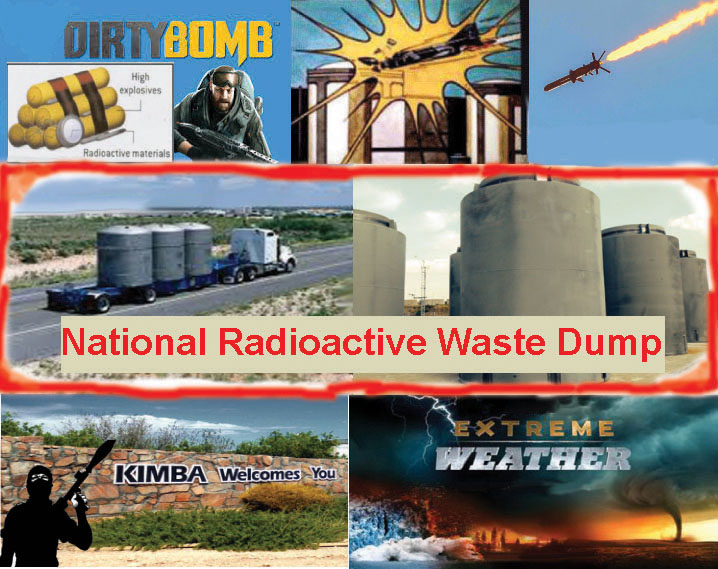
The Australian town divided over hosting the country’s first nuclear waste dump, The small South Australian farming town of Kimba is split in two by the proposal to host Australia’s first permanent nuclear waste facility. Here, SBS News meets residents on both sides of the debate.
The women, who both live with their families on farms, have come to the decision that it is time to move on.
“It used to be such a close-knit community, but it’s blown apart.”
Ms Miller says the debate over the proposal for Kimba to host Australia’s first permanent nuclear waste facility has led to so much community division that some people no longer talk to each other.
“It’s not a nice place to live, you don’t want to go down the street because there are people that shun you and won’t talk to you,” Ms Miller says.
“The whole atmosphere is just really depressing”.
For four years, this small town on the edge of the Australian outback has been at the centre of debate, consultation and planning as a potential site to host the facility.
After promises of 45 ongoing full-time jobs and more than $30 million in federal government money earmarked to flow into town projects if the proposal goes ahead, the community last month voted on whether or not to host the site.
Sixty-two per cent of Kimba residents backed the site going ahead in the ballot run by the Australian Electoral Commission, and 38 per cent voted against it.
The public vote was a key final hurdle to indicate community support for the plan and federal resources minister Matt Canavan is expected to make a decision on which site will host the dump in early 2020.
There are three sites that remain on the shortlist, two near Kimba and the other further north near Hawker, in South Australia’s Flinders Ranges region.
Support for the facility
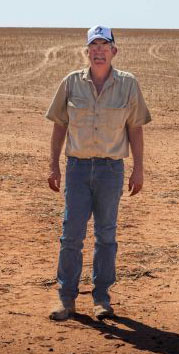 Grain and livestock farmer Geoff Baldock is a third-generation farmer in the Kimba region. He and his family farm more than 700 hectares of land here and he is preparing to sell off a small slice of that, around two per cent, to the federal government for them to build their nuclear waste facility.
He won’t reveal exactly how much the government is offering to pay for his land but says the offer has been “generous”…..
He hopes the proposal will go ahead and play a vital role in securing the future of the Kimba town, which has been in economic and population decline for a number of years. ……
Opponents of the proposal are deeply distrustful of the federal government and the promises made by politicians and scientists on government-paid salaries. They want independent scientists brought in to the safety assessments of the site. ……
The public vote in the town of Hawker closes on December 12 and the government will make a decision on which site will go ahead with the plan early next year.
But for friends Ms Tiller and Ms Miller it is too late. Their properties are on the market and both families are planning to move elsewhere in South Australia as soon as they can. HTTPS://WWW.SBS.COM.AU/NEWS/THE-AUSTRALIAN-TOWN-DIVIDED-OVER-HOSTING-THE-COUNTRY-S-FIRST-NUCLEAR-WASTE-DUMP?CX_CID=EDM%3ANEWSAM%3A2019&FBCLID=IWAR2B19ZUOG9WHGBO9CVSO_81AOYNXY0R4AFZAJFJW4EJWKMW_N6_B2M01WQ
BHP’s Olympic Dam expansion plan deserves serious attention and scrutiny
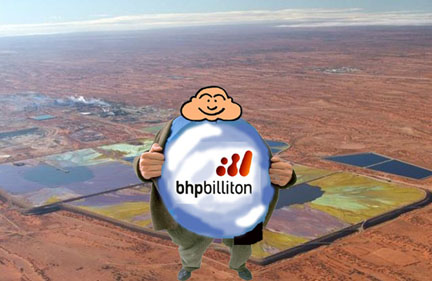
10 Dec 19, BHP is formally seeking to expand the Olympic Dam mine in northern South Australia and public comment on the federal EPBC referral – the Olympic Dam Resource Development Strategy – closes today.
Conservation SA, Friends of the Earth Australia and the Australian Conservation Foundation have sent a joint submission to the federal Environment department.
After today’s close of public comment the federal Minister has up to twenty business days to make a decision on the required level of assessment.
We maintain that the Olympic Dam expansion plan deserves serious attention and scrutiny for three key reasons: it involves the long lived and multi-faceted threat of uranium, it proposes to use massive amounts of finite underground water and the company is in trouble globally over the management of mine wastes and residues currently stored in multiple leaking – and sometimes catastrophically failing – tailings dams. BHP has identified and conceded that three of the existing Olympic Dam tailings dams are in the most severe global ‘extreme risk’ category.
The key recommendations from environment groups include:
- That BHP’s Olympic Dam operation be assessed in its entirety with the full range of project impacts subject to public consultation.
At a minimum, EPBC Act responsibilities to protect Matters of NES require that the BHP Olympic Dam Referral must be subject to a public environmental impact assessment process.
- A comprehensive Safety Risk Assessment is needed for all Olympic Dam mine tailings facilities.
- BHP must lodge a Bond to cover 100% of Olympic Dam rehabilitation liabilities.
- BHP must stop the use of evaporation ponds to reduce mortality in protected bird species.
These issues are further explored in detailed project briefing papers linked with the joint groups submission.
David Noonan – the submission author is available to provide further issue background on 0414 519 419
The comments below are attributable to ACF spokesperson Dave Sweeney (0408 317 812):
“As the world’s largest miner BHP has a responsibility to adopt best practise standards to every aspect of its Olympic Dam operation, including transparency, rigour and extent of assessment.
“A federal review when BHP wanted to expand Olympic Dam as an open cut mine earlier this decade made clear recommendations about the need to assess the projects cumulative impacts – this approach must be reflected in the current federal consideration of BHP’s proposal.
“Uranium is a unique mineral and risk and is always contested and contaminating.
“The global uranium price remains depressed after Fukushima and BHP should actively model a project configuration where uranium is not part of Olympic Dam’s mineral products.”
(note: there is direct DFAT confirmation that Australian uranium was inside Fukushima when the reactors failed: Australian uranium fuelled Fukushima’s fallout)
“Any increase in the footprint of Olympic Dam would mean an increase in the complexity and cost of future clean up and rehabilitation.
“Cleaning up a uranium mine is never easy and always costly – BHP must be required to ensure there is the dedicated financial capacity to fund this clean-up work – it cannot be allowed to become a future burden to the SA taxpayer or wider community.
“Existing federal government standards require the Ranger uranium mine in Kakadu to isolate its radioactive tailings for at least 10,000 years. The same standard must be applied at Olympic Dam – especially as BHP has confirmed that three of Olympic Dam’s existing tailings dam are in the global ‘extreme risk’ category. There should be no new pressure on this already compromised tailings management system without comprehensive and independent review.”
1 This month

of the week – Australians for War Powers Reform (AWPR)
To see nuclear-related stories in greater depth and intensity
 Antinuclear