Federal Nuclear Inquiry Report expected this week
 Report due on nuclear power industry, Canberra Times, Report due on nuclear power industry, Canberra Times, Paul Osborne, 9 Dec 19, A report looking into the potential for nuclear power in Australia is expected to be released later this week. The parliamentary environment and energy committee was tasked by Energy Minister Angus Taylor in August to examine the potential for nuclear power. Mr Taylor told the committee the moratorium on nuclear energy would remain, but he wanted some “sensible” advice on economic, environmental and safety implications. The inquiry received evidence on the potential for micro-reactors – some as small as five megawatts – and even floating nuclear power stations which are being developed in Russia……. Environment groups said there were huge health, environmental and financial risks from a nuclear industry, which would also need massive taxpayer subsidies. They warned suggestions of small modular reactors were a pipedream and the nuclear waste storage problem had not yet been solved…… It is understood the committee is aiming to table the report in parliament by the end of the week, but no formal release date has been set. https://www.canberratimes.com.au/story/6534160/report-due-on-nuclear-power-industry/ |
|
|
Australia on fire. Scott Morrison under fire over bushfire emergency
‘Australians are paying the price’: Scott Morrison under fire over bushfire emergency, The unprecedented severity of Australia’s bushfire season is igniting calls for stronger action in response to the climate emergency. SBS, BY TOM STAYNER , 9 Dec 19, As Australia burns, public concern over the need for greater action against the devastating bushfire season and climate change is igniting.
Dozens of bushfires continue to burn across the nation’s east coast with the effects of these blazes ranging from razed homes on the frontlines to smoke choking metropolitan centres.
The fire season has captured international attention with media outlets from the New York Times to the BBC drawing attention to criticism against the Morrison government’s inaction on climate change.
The Climate Council has also laid fresh blame on the Federal government, accusing it of being “out of touch” with the action Australians are demanding.
“It is irresponsible not to connect the dots – it is absolutely clear … that climate change is exacerbating dangerous bushfire conditions,” the Climate Council’s Dr Martin Rice told SBS News.
“Australia must act on climate change it must join the global collective effort – we’re falling woefully behind and Australians are paying the price.”…..
The Department of Environment and Energy released the “Australia’s emissions projections 2019” report on Sunday citing the nation would exceed its 2030 Paris target by 16 million tonnes of carbon dioxide equivalent.
But Dr Rice said the numbers point to a “dodgy accounting” trick through using “carry-over” credits to reach the commitment, symptomatic of a failure to respond to the “escalating climate crisis”.
“Australia is on the frontline of the escalating crisis, now is not the time to cut corners on climate,” he said.
“We need to actually prepare our emergency services and our fire services and our community for the escalating threats.”…..
More than 90 fires were burning across NSW alone on Sunday evening and there are fears of worsening conditions when temperatures soar later this week.
Amid these conditions, Labor has again urged Mr Morrison to hold an urgent COAG meeting to prepare Australia for the bushfire season.
“We can see, smell and feel the changing climate but our Government says we’re only imagining it,” Opposition leader Anthony Albanese said over the weekend…..
[Morrison] has faced criticism for not meeting with a group of ex-fire chiefs, at the centre of a petition signed by more than 100,000 Australians which calls for a national emergency summit…..
Climate change is Australia’s labyrinth without an exit’
The horrific fire conditions have spawned international headlines about Australia’s response with the New York Times writing the fires revealed “once again” that Australia’s “pragmatism stops at climate change”.
The outlet cited political spats over climate changes and the link to bushfires including Deputy Prime Minister Michael McCormack’s jibe against “raving inner-city lunatics”, The Greens.
“Climate change is Australia’s labyrinth without an exit, where its pragmatism disappears,” the New York Times wrote.
One of those Greens, Senator Sarah Hanson-Young again took aim at Mr Morrison this weekend over his government’s response.
“Our nation is our fire,” she said.
“Australians deserve better than politicians with their heads in the sand.” HTTPS://WWW.SBS.COM.AU/NEWS/AUSTRALIANS-ARE-PAYING-THE-PRICE-SCOTT-MORRISON-UNDER-FIRE-OVER-BUSHFIRE-EMERGENCY
Hypocrisy of Australian Labor Party on climate change
The ALP remains far more worried about looking like it is attacking people who work in coalmines than getting on the front foot on climate change.
It is 2019 and the leader of the ALP is now repeating lines about our exports of coals that Tony Abbott used.
The ALP cannot afford to play games on this issue. You can’t say climate change is real and then ensure your messaging is about protecting coal.
|
The Coalition isn’t being honest about the climate crisis. But neither is Labor https://www.theguardian.com/business/grogonomics/2019/dec/10/the-coalition-isnt-being-honest-about-the-climate-crisis-but-neither-is-labor, Greg Jericho @GrogsGamut Tue 10 Dec 2019
Of course we need to think about those who will be affected by mine closures, but cripes, we’re all affected by climate change. In the weekend I flew up to Sydney to attend a conference held by the Chifley Research Centre, the ALP’s thinktank. As the plane approached Sydney, the site of the fire front in the Blue Mountains was stomach-churning. And then I got to experience the air quality of Sydney that has become news around the world.Upon returning to Canberra, I discovered a wind change had meant the nation’s capital was now enveloped in a haze of smoke – and expected to be so for the rest of the week. This, I need not tell you, is not normal. Because of climate change, areas of south-eastern Australia are going to be drier and hotter, the times for doing preventative hazard reduction burning will shrink, and as a result our fire seasons will become longer, and the fires will become more intense. This is due to one thing – climate change. The only way to prevent this is to reduce our emissions and to pressure the rest of the world to reduce emissions as well. We are not doing either of those things. Continue reading |
Peter Garrett urges Labor to reconnect with environmental movement, warns ‘true believers are dying’
|
Peter Garrett urges Labor to reconnect with environmental movement, warns ‘true believers are dying’, Brisbane Times, By Rob Harris
December 7, 2019, Midnight Oil frontman and environmental campaigner Peter Garrett has urged Labor to stare down the “self interest” within its ranks and commit to ambitious plans to avoid the “catastrophe” of climate change.
Warning that the suburbs of western Sydney and Melbourne are being “crucified on the altar of inaction” and regional and rural communities were “hostage to climate damage”, the former Labor minister said the party’s true believers are “dying out” and a younger generation of voters will be “more radical and less forgiving” if it fails to act. Speaking to Labor’s Environmental Action Network on Saturday night, Mr Garrett took direct aim at former colleague Joel Fitzgibbon and “some in the CFMEU”, who he accused of deliberately undermining the party and “not committed to the challenge” of reducing emissions. “The natural world is under siege. The threat we face is literally existential,” Mr Garrett told the gathering of about 100 people at the Keg and Brew Hotel in Sydney’s Surry Hills. “We are surrounded by fires, force-fed by a super hot spring. Our cities and towns are blanketed with smoke and the sun has gone out, it’s hard to breathe.” Labor has engaged in a fierce internal debate since its shock election loss on May 18 with Mr Fitzgibbon, the agriculture and resources spokesman, arguing the ALP should offer “a political and policy settlement” on climate policy to make a 28 per cent reduction in emissions the target by 2030. Opposition Leader Anthony Albanese has signalled Labor’s future climate policy platform will be focused on jobs in the low-emissions energy sector. Mr Garrett said progressive politics must realise the world was “witnessing a tectonic shift” in the climate and its faith was waning in established institutions. “Our times do not call for ‘business as usual’ politics,” Mr Garrett said. Labor must face down self-interest and sectional interest, whether from some in business, or some in the CFMEU, or from individual members who eschew reality and are not committed to the challenge, and indeed in the case of the shadow minister for Agriculture and Resources Joel Fitzgibbon, deliberately undermine the party whilst still holding their position.” …….. https://www.brisbanetimes.com.au/politics/federal/peter-garrett-urges-labor-to-reconnect-with-environmental-movement-warns-true-believers-are-dying-20191206-p53hqe.htm |
|
Why Australia must retain its nuclear bans: Dr Jim Green explains to Senate Nuclear Inquiry.

REPORT ON PROCEEDINGS BEFORE STANDING COMMITTEE ON STATE DEVELOPMENT URANIUM MINING AND NUCLEAR FACILITIES (PROHIBITIONS) REPEAL BILL 2019 At Macquarie Room, Parliament House, Sydney, on Monday 11 November 2019
PRESENT The Hon. Taylor Martin (Chair) The Hon. Mark Banasiak The Hon. Mark Buttigieg The Hon. Wes Fang The Hon. Scott Farlow The Hon. Mark Latham The Hon. Natasha Maclaren-Jones The Hon. Mick Veitch (Deputy Chair) JIM GREEN, National Anti-Nuclear Campaigner, Friends of the Earth Australia, affirmed and examined DAVE SWEENEY, Nuclear Policy Analyst, Australian Conservation Foundation, affirmed and examined CHRIS GAMBIAN, Chief Executive, Nature Conservation Council of NSW, sworn and examined Monday, 11 November 2019 Legislative Council Page 30
The CHAIR: Would anyone like to begin by making an opening statement?
 Dr GREEN: Yes, we all would, with your permission. I am going to speak about nuclear power. Dave will speak about uranium, and Chris will speak about New South Wales energy issues—opportunities, road blocks and so on. I am going to quickly run through issues canvassed in our joint submission, and in particular the reasons why we believe that State and Federal bans against nuclear power should be retained.
The first one is that those bans have saved Australia and saved New South 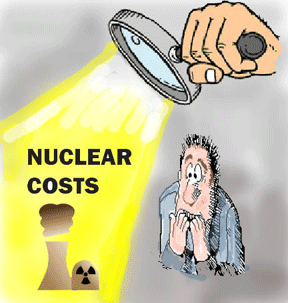 Wales from the catastrophic cost over-runs with every reactor project in Western Europe and the United States over the past decade. It is a sad truth that every one of those reactor projects is at least A$10 billion over budget. That’s $10 billion—with a ‘B’. It is hard to believe that but it is true. Perhaps the most catastrophic of all those catastrophic projects was in South Carolina, where they have had to abandon a reactor project mid-stream, having already spent over A$13 billion.
Nuclear power could not possibly pass any reasonable economic tests, and it certainly would not pass the tests set by Prime Minister Scott Morrison. It 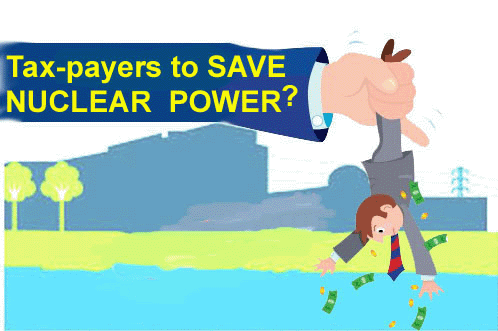 could not possibly be introduced or maintained without massive taxpayer subsidies. There are a couple of examples. Hitachi has recently walked away from a project in Wales in the United Kingdom, despite the offer of staggering, unprecedented subsidies. Also in the UK, the lifetime subsidies for the Hinkley Point project alone—a 3.2 gigawatt project—are estimated by the European Union to be A$55 billion for a two-reactor project. Other credible estimates put those lifetime subsidies at A$91 billion. These are extraordinary figures. I know it is hard to believe but it is all documented.
The other economic test set by Prime Minister Morrison is that nuclear power would need to reduce electricity prices, and clearly it would do no such thing. It would clearly increase electricity prices. Legislation banning nuclear power should also be retained because of the lack of a social licence, and in particular numerous polls over the past 10 years have found that only 20 per cent to 28  per cent of Australians would support living in the near vicinity of a nuclear power plant. As the Clean Energy Council put it, in its submission to this inquiry, it would require “a minor miracle” to win community support for nuclear power in Australia.
There is a lot more that could be said about nuclear economics and I am happy to field questions on that issue. There is plenty of information in our joint submission and in the separate Friends of the Earth submission dealing specifically with small modular reactors. There is one point that I would particularly like to make to the committee and to the secretariat, which is that there is an excellent critique of some of the claims made by nuclear lobbyists, both to this inquiry and to the Federal inquiry. This article neatly corrects and debunks those claims. The article is by Giles Parkinson. It was published at reneweconomy.com.au on 23 October. It is called, “Why the nuclear lobby makes stuff up about cost of wind and solar”. Our joint submission also does some of that work— debunking highly questionable claims made by nuclear lobbyists about nuclear economics. In particular I would draw your attention to sections 3.5 and 3.6 of our joint submission.
 The next issues is that we believe legal prohibition should be retained because the pursuit of a nuclear industry would almost certainly worsen patterns of disempowerment and dispossession experienced by Australia’s First Nations. To give just one example of that, the National Radioactive Waste Management Act dispossessed and disempowers traditional owners in many different ways. To list one of many, the Act states that the nomination of a site for a radioactive waste dump is valid even if Aboriginal owners were not consulted and did not give consent. I would ask this Committee to consider recommending that those appalling and indefensible clauses of the National Radioactive Waste Management Act be repealed.
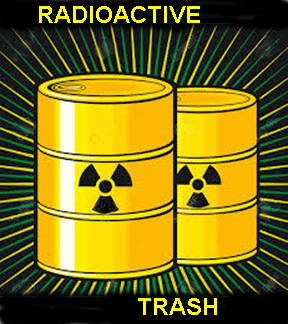 Legislation banning nuclear power should also be retained because no-one could have any confidence that satisfactory solutions could be found for waste streams. Globally, no country has a repository for high-level nuclear waste. There is one deep underground repository for long-lived intermediate level waste in the United States. It was set up in the late nineties. Almost as soon as it was set up, safety standards and layers of regulatory oversight were peeled away, and those failures led to a chemical explosion in an underground waste barrel, which shut the repository down for three years. Direct and indirect costs amounted to about $3 billion. The thing that I really want to focus on there is that safety standards and regulatory standards fell away straight away—and you are dealing with plutonium, with a half life of 24,000 years. We need to safely manage this waste for millennia; they failed to safely manage it for one single decade.
I want to make a quick point on wastage of another sort. That is that nuclear 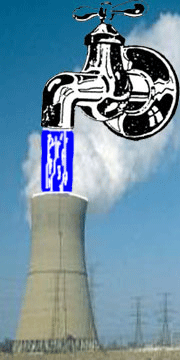 power reactors are voracious consumers of water. A single reactor typically consumes 50 million litres of cooling water every single day. Their water intake pipes are slaughter houses for fish and other marine creatures. Arguably, the best way to destroy a local fishery is to build a nuclear power plant nearby. This is just considering routine operations of a nuclear power plant. In the case of Fukushima, that disaster has crippled and almost killed the local fishing industry. Currently fishers in the region are fighting plans to dump vast amounts of contaminated water into the ocean surrounding the nuclear plant.
I have one final point. Legislation banning nuclear power should be retained because the introduction of nuclear power would delay and undermine the development of effective economic energy and climate policies based on renewables and energy efficiency. A December 2018 report by CSIRO and AEMO found that the cost of power from small modular reactors would be more than twice as expensive as power from wind and solar PV, even with some storage costs included. CSIRO and AEMO are about to release another report, which firms up that conclusion and also considers the costs of a higher degree of storage attached to renewables. They have canvassed the findings of that report. They find that, even with a considerable amount of storage factored in, renewables are still far cheaper than nuclear, comparable to the costs of existing fossil fuels and are almost certain to become cheaper than fossil fuels because of the clear cost trajectory of renewables and storage.
So nuclear simply is not even in this debate. There has been a big spat about the CSIRO and AEMO costings with respect to small modular reactors. Their costing is $16,000 per kilowatt of installed capacity, and the nuclear lobbyists are furious with that and strongly contesting it. What I would say is that if you average the cost of small modular reactors, which are actually under construction in China, Russia and Argentina, that average is higher than the figure given by CSIRO and AEMO. Also, if you look at the reactors being built in the United States—the large reactors—one again, the CSIRO and AEMO figure for nuclear is lower than the real-world cost for reactors that are actually under construction in the US. So the CSIRO and AEMO figure is entirely defensible. In conclusion I quote the senior vice-president of Exelon, which is the largest nuclear company in the United States, who said:
I don’t think we’re building any more nuclear plants in the United States. I don’t think it’s ever going to happen … They are too expensive to construct …
That is in the US where they have a vast amount of infrastructure and expertise but nuclear has clearly priced itself out of the market. The calculations in Australia would certainly be worse because we do not have that infrastructure, we do not have that expertise and we are blessed with renewable energy resources. As the Climate Council, comprising Australia’s leading climate scientists, puts it, nuclear power reactors “are not appropriate for Australia—and probably never will be.” I will leave it there.
Australia burns, as government leaders choose not to discuss this
Leading scientists condemn political inaction on climate change as Australia ‘literally burns
Climate experts ‘bewildered’ by government ‘burying their heads in the sand’, and say bushfires on Australia’s east coast should be a ‘wake-up call’, Lisa Cox, Sat 7 Dec 2019 , Leading scientists have expressed concern about the lack of focus on the climate crisis as bushfires rage across New South Wales and Queensland, saying it should be a “wake-up call” for the government.
Climate experts who spoke to Guardian Australia said they were “bewildered” the emergency had grabbed little attention during the final parliamentary sitting week for the year, which was instead taken up by the repeal of medevac laws, a restructure of the public service, and energy minister Angus Taylor’s run-in with the American author Naomi Wolf.
Escalating conditions on Thursday and Friday led to dozens of out-of-control bushfires, including in the NSW’s Hawkesbury region, where a fire at Gospers Mountain merged with two other blazes burning in the lower Hunter on Friday.
Sydney has been blanketed with a thick smoke haze that health officials said had led to a 25% increase in people presenting in emergency departments for asthma and breathing problems.
Sarah Perkins-Kirkpatrick, a climate scientist with the University of NSW’s Climate Change Research Centre, said she was “surprised, bewildered, concerned” that the emergency had prompted little discussion from political leaders this week.
“Here we are in the worst bushfire season we’ve ever seen, the biggest drought we’ve ever had, Sydney surrounded by smoke, and we’ve not heard boo out of a politician addressing climate change,” she said.
“They dismissed it from the outset and haven’t come back to it since.
“They’re burying their heads in the sand while the world is literally burning around them and that’s the scary thing. It’s only going to get worse.” Continue reading
Fire? What fire? It’s business as usual in Morrison’s Canberra bubble

|
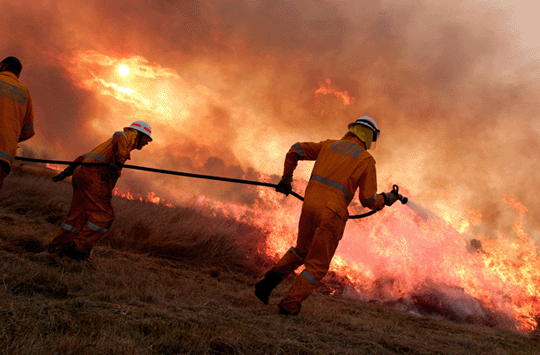
Fire? What fire? It’s business as usual in Morrison’s Canberra bubble, SMH, Peter Hartcher, Political and international editor for The Sydney Morning Herald, December 7, 2019, Subtitles are supposed to help you make sense of what you’re seeing but can’t quite understand. Like a foreign language film. But if you saw the subtitles to Federal Parliament’s final question time of 2019, the flow of text only made it more incomprehensible.
The politicians talked about a great many things. But if you watched it on TV, the subtitles were about only one. As Labor cycled through its list of grievances against the government, and the government rehashed its self-congratulatory talking points, the news crawl across the bottom of the screen announced a non-stop series of fire alerts. Did the two worlds connect? At no point in an hour-and-a-quarter did the politicians discuss the most obvious and pressing concern for most of the people they represent. The disconnect was emblematic of the week. Indeed, it’s an emerging motif of the Morrison government. There is no emerging crisis so big that the government cannot find a way to look past it. Australia, parched, baking, burning, is heading into an anxious Christmas and a joyless new year. The Prime Minister sends his best wishes but he wants to get on with talking about his real priorities. The final showcase moment for Parliament for the year only managed to showcase political self-absorption. It’s understandable that the bushfires weren’t a feature of question time. Question time is customarily a clash over highly political differences, and neither party wanted to politicise fires. It’s just that it was all business as usual in Parliament. As if there were no accelerating national emergency. The disconnect is that it’s not business as usual for the rest of Australia…….. The government, having campaigned for re-election on a minimalist platform, wants to govern with a minimalist agenda. It seeks to deliver its promised agenda to its “base”, while ignoring other demands unless — and until — they become politically overwhelming. The fires are a national emergency. They are an invitation to national leadership. And, therefore, they are an opportunity for Morrison to look beyond the 30 to 40 per cent of voters who constitute his “base” to making common cause with the other 60 to 70 per cent of the community. Besides, even “quiet Australians” are increasingly anxious ones. …… The entire pyro-hydro complex of problems and solutions does lead, inevitably, to that most delicate political question of climate change mitigation. Morrison will have to brace his party to deal squarely with this, too. At the moment, he is in frozen immobility on this because he does not want to upset the internal Coalition truce on climate and coal. This will require of him active management. It will test his skills. But this is all big and bold and demanding and, above all, risky. It’s far from the minimalist and incrementalist prime ministership that Morrison has kept to so far. More likely, he’ll just continue to preside over an unfolding disaster armed only with grudging, inadequate responses and an unending list of excuses and talking points. …… We don’t need subtitles to explain the subtext. The country is in crisis and the national government is in denial. …https://www.smh.com.au/politics/federal/fire-what-fire-it-s-business-as-usual-in-morrison-s-canberra-bubble-20191206-p53hom.html |
|
Australia’s submarine project is dubious, as supplier France’s nuclear industry withers
 The French nuclear revolution is rusting away, December 6, 2019, THE AUSTRALIAN, Henry Ergas “……..France’s nuclear power industry faces a future that is more uncertain than ever. The problems gripping the industry were highlighted late last month in an official report prepared by the former president and chief executive of PSA Peugeot Citroen, Jean Martin Folz.
While the report’s focus is on the difficulties that have plagued the construction of a new reactor at Flamanville in northwestern France, its implications reach much further.
With nuclear power plants accounting for more than 70 per cent of its overall electricity generation, no country is as dependent on nuclear energy as is France.
The decision to rely so massively on nuclear energy was taken in 1974, after the oil shock of the previous year had underlined France’s vulnerability to Middle Eastern oil. Prime minister Pierre Messmer launched a crash program that led to the construction of 56 reactors in just 15 years.
…….. however, most of France’s generators are approaching the final decade of their useful life. Planning for their replacement has been a stop-start affair, with the Greens’ increasingly strident opposition to nuclear power deterring successive governments from taking action.
As a result, only the Flamanville plant received the go-ahead, with construction beginning in 2007 for an expected entry into service in 2012. Virtually from the outset, the project was beset by woes. At this stage, the total costs of construction are four times greater than initially estimated, while the plant will not enter service before the end of 2022.
The problems stem partly from the sheer complexity of the new reactor, which is the first of its kind to be built in France.
Additionally, the catastrophe at Fukushima in 2011 led to regulatory changes that necessitated costly redesigns. And the project has suffered more than its fair share of mismanagement, aggravated by a byzantine allocation of responsibilities between EDF, the main French electricity utility, which oversaw the project, and many layers of subcontractors.
However, as the Folz report shows, the primary cause of the difficulties lies in the erosion of the industry’s skill base during the long hiatus from the end of the crash program in 1990 to the initiation of Flamanville………
There is, at this point, no prospect of France scaling up its nuclear program ………The cost blowout at Olkiluoto drove Areva, the “national champion” of France’s nuclear industry, into bankruptcy.
Even with an injection of $7.3bn in public funds EDF, which acquired Areva, lacks the balance sheet strength to underwrite new projects, while the French government’s borrowing ability is hampered by its already too high levels of debt.
To make matters worse, the regulated prices at which EDF has to sell the power it generates mean that it cannot charge its European clients the full value of the baseload it supplies.
As for global investors, who might provide the debt financing EDF would require, they are wary of projects that are risky in themselves ….
Given those constraints, the government has announced a modest plan to eventually build six additional reactors. So far, however, there are no actionable decisions beyond the completion of Flamanville. And work on the next generation of reactors….. has been quietly downgraded, making it likely that there will no fourth generation reactor of French design.
The consequences for France itself are far-reaching. Beginning in the late 1950s, French firms succeeded in one high-technology market after the other by developing or acquiring a rather basic design (including the Westinghouse Pressurised Water Reactor, the Mirage jet fighter and the TGV high-speed train) that they upgraded while producing it on a large scale.
That era is over, and there is every sign France is struggling with almost all the major projects it has in train.
The Folz report should therefore come as an ominous warning for our submarine project, as it identifies French industry’s serious managerial and technological weaknesses in a range of areas, such as precision welding, that are crucial to that project’s success……. https://www.theaustralian.com.au/commentary/the-french-nuclear-revolution-is-rusting-away/news-story/afe4546ed799939cf117d71f05035c5e
Environment is downgraded, as Morrison merges government departments
Concerns for environment as Morrison merges government departments Newsline, 5 Dec 19, “……. Farmers for Climate Action spokesperson Verity Morgan-Schmidt said strong environmental policy was essential to make the agriculture sector sustainable.
“We’re failing to address climate change, which is the biggest threat to agriculture, and the concern in this merger is that ecological outcomes will be overlooked,” Ms Morgan-Schmidt said.
……. Farmers for Climate Action spokesperson Verity Morgan-Schmidt said strong environmental policy was essential to make the agriculture sector sustainable.
“We’re failing to address climate change, which is the biggest threat to agriculture, and the concern in this merger is that ecological outcomes will be overlooked,” Ms Morgan-Schmidt said.
……. Infrastructure, transport, regional development, communications and the arts will also come together in another massive new department.
Education, skills and employment will be merged in a move welcomed by vocational education advocates…….. https://www.newsline.com.au/2019/12/05/concerns-for-environment-as-morrison-merges-government-departments/
To National Party members. “Climate Change” is real, not “dirty words”
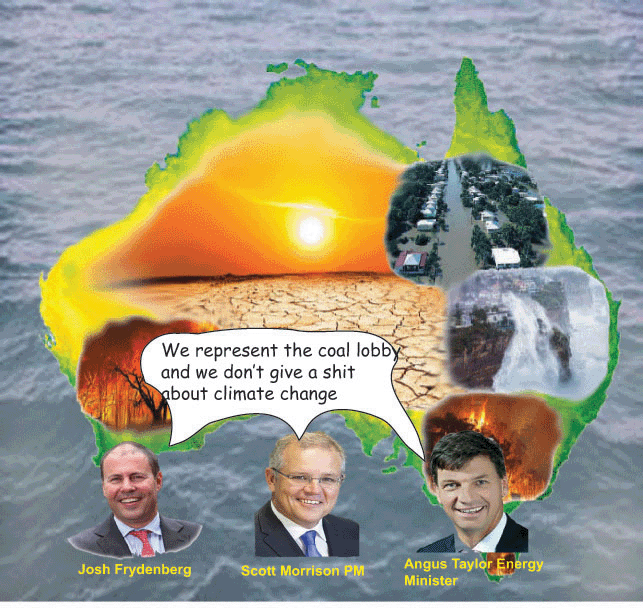
Nobody called the thoroughly urban mayor of Venice, Luigi Brugnaro a “raving inner city lunatic” when he said flooding due to climate change had brought his city “to its knees”.
Equally not prone to lunacy, Japan’s Prime Minister, Shinzo Abe, cautioned in the wake of Typhoon Hagibis that “making the world more resilient to natural disasters will be more important in the years to come”, in light of studies showing an “increase in cyclone intensity because of climate change”.
In contrast, amid recent Californian wildfires, US President Donald Trump tweeted the state’s Governor, Gavin Newsom, had done “a terrible job of forest management”, failing to “clean” his forest floors. Newsom retorted: “You don’t believe in climate change. You are excused from this conversation.”
In their absolute refusal to “go there” on climate change, our parliamentarians have more in common with Trump than the rest of the world when it comes to their inability to walk and chew gum on disaster response and climate change.
Fair enough, Deputy Prime Minister Michael McCormack was right to point out that what people in the grip of disaster most urgently need “is a little bit of sympathy, understanding and real assistance”. But that shouldn’t mean treating them like simpletons, and ruling out any discussion on the cause of their trauma and strategies to prevent it.
And it’s not just, as McCormack claimed, “woke capital city greenies” demanding answers. The Nationals’ own constituency wants to have the conversation.
Rural newspaper The Land surveyed its readers on the eve of the March NSW election. A “whopping 63 per cent” of respondents, the news outlet declared, “believed in climate change”. And 15 per cent said the issue would determine their vote.
The state poll delivered an average swing of 25 per cent against the Nationals in four seats. These are electorates devastated by mass fish kills and long-term drought. There’s no hesitation among some in National Party ranks about what needs to change.
WA Nationals leader Mia Davies told The West Australian that the party’s constituents expect them “to be a part of the conversation” on climate change. “When you live in regional Western Australia you see the impact of climate change … we are dealing with [it] on a day-to-day basis.”
The party’s own polling ahead of the May federal election revealed “climate change is a key issue” for voters in National-held seats. The party’s member for Gippsland, Darren Chester, remarked many of his most ardent supporters are “practical environmentalists” who “expect a balanced and rational … response to climate change”.
There. He said it. Climate change. Not so hard after all.
Nuclear Inquiry Report now delayed, due to scandal over Energy Minister Angus Taylor?
Nuclear power inquiry to be pushed back amid scandal over Energy Minister Angus Taylor, Lanai ScarrThe West Australian, Monday, 2 December 2019
A parliamentary inquiry report on nuclear power is likely to be pushed back until next year amid Energy Minister Angus Taylor’s woes surrounding a police investigation of allegations his office forged documents to accuse Sydney’s Lord Mayor of excessive travel spending.
The West Australian understands the committee examining the prerequisites for nuclear energy in Australia, which was due to release its report before the end of the year, could now delay it until mid-January or later.
The standing committee on the environment and energy, which includes two West Australians Labor’s Josh Wilson and the Coalition’s Rick Wilson was directed by under siege Mr Taylor in August to hold the first probe into nuclear power in more than a decade after calls from within his party to put the option on the table for reliable, zero-emissions power.
Among them was former deputy prime minister Barnaby Joyce.
It is not clear if the potential delay is linked to Mr Taylor’s woes or due to other scheduling issues.
A meeting on Wednesday will discuss the proposed recommendations.
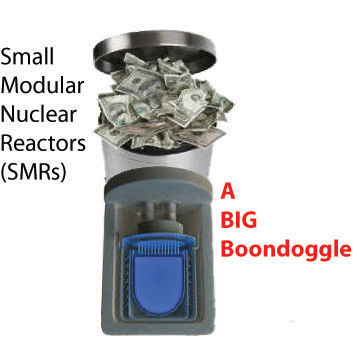 It is understood one recommendation to be considered is an economic feasibility study into nuclear power, particularly emerging technology such as small modular reactors.
News of the push back comes after NSW Police last week launched an investigation of Mr Taylor and his office for false accusations that Sydney Lord Mayor Clover Moore spent $15 million on travel.
It also comes as research conducted on behalf of the Minerals Council of Australia today reveals more Australians support lifting the ban on nuclear energy in Australia than those who are opposed.
Under the current Environment Protection and Biodiversity Act, which is under review, there is a moratorium on nuclear power.
The research by JWS Research of 1500 Australians found 39 per cent support using nuclear power and 40 per cent support lifting the nuclear power ban.
“39 per cent support using nuclear power and 40 per cent support lifting the nuclear power ban.”
Even key Green seats those with twice the national average number of Greens voters are just as likely as everywhere else to be in favour.
Chair of the standing committee on the environment and energy, Liberal National Party of Queensland MP Ted O’Brien, said the report validated the need for a thorough inquiry.
On his inquiry’s report being pushed back, Mr O’Brien said: “I can’t pre-empt the conclusions that will be drawn from our inquiry and nor has a date been set for the inquiry to be concluded.”
Fremantle MP Mr Wilson, who is deputy chair of the inquiry, said the Minerals Council survey material contained some “misleading claims” and could not be relied on.
Council chief executive Tania Constable said WA would be a “big winner” if the moratorium on nuclear power were lifted.
Religiosity of Scott Morrison – about global heating and bushfires
Scott Morrison’s religion and the bushfire crisis https://independentaustralia.net/politics/politics-display/scott-morrisons-religion-and-the-bushfire-crisis,13344, By Jennifer Wilson | 25 November 2019, As firefighters in four Australian states struggled to contain unprecedented bushfires that threatened life, property and wildlife, Prime Minister Scott Morrison argued that there is no direct link with Australia’s greenhouse gas emissions.
Morrison claimed there is no “credible scientific evidence” that cutting our emissions could reduce the intensity of bushfires.
The Prime Minister even went so far as to suggest that we could
“… increase our emissions without making the current fire season worse.”
This last claim is a bizarre one to make, obviously calculated to appeal to a base that apparently doesn’t know very much about these matters. Yes, we likely could increase our emissions without impact on the current Australian bushfires. However, emissions must be accounted for on a global scale and, while central, are one part of the complex story of the impact of climate change.
Morrison was swiftly contradicted by Climate Council head of research Dr Martin Rice. Dr Rice stated that there is indeed a direct link between climate change and heightened bushfire risk. CSIRO research scientist Dr Pep Candell agreed with Dr Rice. Morrison did not cite any scientific research to back up his claim that the two are not linked, leaving the impression that it is little more than his opinion. If politicians do have evidence to back up their claims, they are not usually coy about revealing it.
It is well established by major science agencies that while climate change does not create fires it can and does make them worse. The above link is an excellent explainer of a complex situation.
It’s high time that any statement by Morrison on emissions and their effects on climate is required to include a disclaimer noting that the Prime Minister is a follower of the evangelical Pentecostal religion. This sect is not known for its interest in science, and some followers believe the Earth is only 6,000 years old.
As James Boyce wrote in his Monthly essay, ‘The Devil and Scott Morrison’:
Belief in Satan and the imminent return of Christ also helps explain the Prime Minister’s less-than-passionate response to the most pressing environmental issue of our time. It is not surprising that Pentecostal activism about climate change is non-existent — the end of the known world is not a matter for mere mortals to decide. When Morrison proudly showed off a piece of coal in parliament, there is no reason to doubt that he believed what he held in his hand was a gift from God.
Morrison also shares the Pentecostal belief in “divine providence” — that is, everything under the sun – past, present, and future – is the will of God, including natural disasters, such as we are currently experiencing in four states.
his goes some way to explaining why
… taking further action on reducing carbon emissions to counter the environmental damage wrought by climate change may have little intellectual purchase with the PM. If the end of the world through climate change is part of God’s providential plan, there is precious little that we need to or can do about it.
Given these beliefs are core contributors to the Prime Minister’s environmental agenda it seems reasonable to demand they be disclosed whenever he comments on climate, emissions, bushfires or other natural disasters. A man who is convinced that everything is God’s will is unlikely to take any action he perceives might thwart that will.
He is also unlikely to be overly troubled, and there is no doubt that since the first bushfire broke out, Morrison has appeared largely untroubled, even going so far as to post this jolly tweet as people in four states endured all manner of horror and fear:
It’s tempting to conclude that Morrison is too stupid to understand the magnitude of what we are facing this summer, however, I’d argue that his belief in the tenets of Pentecostalism has granted him immunity against mere human concerns, particularly when they don’t directly affect him and his family.
But that’s not all. In Morrison, we see the confluence of religious belief and venal profitability that results from his passionate belief in the fossil fuel industry. This is one example of how neoliberalism and evangelical Christianity most conveniently complement one another. Coal is “God’s will”.
In the Prime Minister we encounter a most unholy alliance of the fossils fuel industry and religion.
Morrison is in deep with the coal industry — many of his closest advisors come from that industry.
We have not seen any leadership from the Prime Minister during this current outbreak of bushfires. Leadership might include immediate consultation with a wide range of experts in an effort to prepare as best we can for the coming conflagrations, of which there are likely to be many across the country. It might be a commitment to the purchase of more aircraft capable of dumping fire retardant. It might be a commitment to a system of payment for volunteer firefighters, who currently give up their jobs, holidays and family time to do their absolute best for the rest of us.I cannot think of one reason why women and men who do a far more significant, dangerous and essential job than Scott Morrison should be expected to continue to do it for free. Given the horrific projections for the coming summer, volunteer firefighters are going to be busy. While he’s at it, Morrison could organise some one-off payments to the states to fund the purchase of equipment for the volunteers, so they don’t have to send what time they have left between fighting fires, doing their day jobs and being with their families, organising cake stalls and raffles to raise money for some new hoses.
One odd thing about Morrison’s attitude is that most politicians do not turn down the opportunity to appear heroic, especially in catastrophes such as this one. He has not availed himself of any such opportunities. One can only conclude that the combination of his religion and his commitment to the coal and extraction industries take precedence over his desire to shine. Sadly, he must rely on carrying water for football teams.
None of this augurs well for our future. If, like me, you are affected by the bushfires in any way, you may have the sense that you have been utterly abandoned by Coalition politicians, on a state and Federal level. No word of what these governments plan to do over the coming summer — no word because they haven’t planned anything. It beggars belief. It breaks the heart. And it fills any sensible person with foreboding. Fasten your seatbelts. It’s going to be a bumpy ride.
Previous Prime Minister intervened to help political prisoner: Scott Morrison could do this for Julian Assange
“This is how diplomacy works,” “You can pick up the phone, Mr Morrison, and  speak with whoever the United Kingdom’s next prime minister is; requesting that Julian Assange not be extradited to the United States to face the very real possibility, if not the certainty, that he will die in prison.”
 Former political prisoner pleads for Scott Morrison to not let Assange ‘die in jail’, The Age By Rob Harris, Filmmaker James Ricketson, who spent 15 months as a political prisoner in a Cambodian jail, has implored Prime Minister Scott Morrison to “pick up the phone” to his British counterpart to ensure Julian Assange does not die in prison.
There are growing fears for the psychical and mental health of the 48-year-old WikiLeaks founder, who is in a London prison fighting an extradition request to the United States, where he faces espionage charges relating to the release of classified files on the Iraq and Afghanistan wars.
In an open letter to Mr Morrison, Mr Ricketson has joined a “rising tide of voices” in support of Australian government intervention to bring Mr Assange back to Australia before full extradition proceedings in February.
“The evidence that Julian Assange is not being ‘treated fairly’ in accordance with UK law is now overwhelming, as is evidence of the psychological torture he is being subjected to in Belmarsh Prison,” Mr Ricketson writes.
“If Julian Assange does die in prison, will you, with a clear Christian conscience, be able to inform the Australian public, in all honesty, that you did all within your power (and more) to protect Assange’s legal and human rights.”
Mr Ricketson was arrested and charged with espionage in June 2017 for flying a drone over an anti-government rally in Phnom Penh. He was held in the notoriously overcrowded Prey Sar prison for 15 months until he was pardoned by Cambodian authorities.
The filmmaker said it was former prime minister Malcolm Turnbull who intervened to secure his release, despite the Department of Foreign Affairs and Trade’s insistence that it could not interfere with another country’s legal proceedings.
“This is how diplomacy works,” he writes. “You can pick up the phone, Mr Morrison, and speak with whoever the United Kingdom’s next prime minister is; requesting that Julian Assange not be extradited to the United States to face the very real possibility, if not the certainty, that he will die in prison.”
A newly formed federal cross-party parliamentary group, comprising 11 MPs dedicated to advocating for the return of Mr Assange, will meet formally for the first time on Monday in Canberra. ….
Mr Morrison and Foreign Minister Marise Payne have repeatedly ruled out any intervention in the case, with the PM saying last month he believed Mr Assange should “face the music” in court.
The former Australian high commissioner to Britain earlier this month mocked the idea of Mr Morrison acting on calls from Mr Assange’s supporters to do all he could to bring him home from Belmarsh Prison, where he has been held since his April 11 arrest at the Ecuadorian embassy, which gave him asylum for almost seven years. https://www.theage.com.au/politics/federal/former-political-prisoner-pleads-for-scott-morrison-to-not-let-assange-die-in-jail-20191124-p53dks.html
Cuddling coal and people: does Scott Morrison think that Australians are that stupid about climate change?
 Scott Morrison and the big lie about climate change: does he think we’re that stupid? Guardian, Richard Flanagan, 25 Nov 19, Australians everywhere are ready to get on with the job of dealing with the climate crisis. We just need a prime minister to lead us
Of all the horrors that might befall the burnt out, the flooded, the cyclone ravaged and the drought stricken Australian this summer, perhaps none could be viewed with more dread than turning from their devastated home to see advancing on them a bubble of media in which enwombed is our prime minister, Scott Morrison, arriving, as ever, too late with a cuddle….
In Australia we are all now being treated as children, quietened Australians, most especially on the climate crisis. While the climate crisis has become Australians’ number one concern, both major parties play determinedly deaf and dumb on the issue while action and protest about the climate crisis is increasingly subject to prosecution and heavy sentencing.
In Tasmania, the Liberal government intends to legislate sentences of up to 21 years – more than many get for murder – for environmental protest, legislation typical of the new climate of authoritarianism that has flourished under Morrison. As Australia burns, what we are witnessing nationally is no more or less than the criminalisation of democracy in defence of the coal and gas industries.
n this regard, the climate crisis is a war between the voice of coal and the voice of the people. And that war is in Australia being won hands down by the fossil fuel industry.
Which brings us back to that industry’s number one salesman, the prime minister, standing there in the ash in the manner of Humphrey B. Bear on MDMA, as, mollied up, he pulls another victim in the early stages of PTSD into his shirt, his odour, his aura – such as it is – and holds them there perhaps just a little too long. Sometimes, at his most perplexing, he lets that overly large head loll on the victim’s shoulder and leaves it there. Prayers and thoughts naturally follow.
Perhaps it is just his way. Certainly, the prime minister is an unusual issue of two stock types frequently derided in broader Australian culture: the marketing man and the happy-clappy. But in fairness to both tribes, he seems to draw on the worst in both traditions and make of them something at once insincere, sinister and vaguely threatening…..
All this theatre hides a deeply cynical calculation: that Australians will keep on buying the big lie, a lie given historic expression last Thursday morning when on national radio the prime minister declared that Australia’s unprecedented bushfires were unconnected to climate change…….
Two days before saw the release of a major UN report that forecast Australia to be the sixth largest producer of fossil fuels by 2030. Between 2005 and 2030 Australia’s extraction-based emissions from fossil fuel production will have increased by 95%. By 2040, according to the report, on current projections the world’s annual carbon emissions will be 41 gigatonnes, four times more than the maximum amount of 10 gigatonnes required to keep global heating below 1.5 C.
According to the Economist: “The report lays much blame on governments’ generosity to fossil-fuel industries.” The report details at length how Australia supports its fossil fuel industries.
Actively working through legislation, subsidy, and criminalisation of opposition to enable Australia to become one of the world’s seven major producers of fossil fuels makes Australia’s actions directly and heavily responsible for the growing climate catastrophe we are now witnessing in Australia. It gives the lie to the nonsense that we will make our Paris commitments “in a canter”.
It cannot be explained away. It cannot be excused. Australia is actively working hard to become a major driver of the global climate crisis. That is what we have become.
The same day Morrison went to the Gabba, got photographed with cricketers and tweeted: “Going to be a great summer of cricket, and for our firefighters and fire-impacted communities, I’m sure our boys will give them something to cheer for.”
To the question does he think we are that stupid, the answer was implicit in an interview the same day when the prime minister justified not meeting with 23 former fire chiefs and emergency services leaders calling for a climate emergency declaration in April, claiming the government had the advice it needed.
He went on to say that: “We’re getting on with the job, preparing for what has already been a very devastating fire season.”
Only he’s not.
Getting on with the job would be calling a moratorium on new thermal coalmines and gas fracking. Getting on with the job would be announcing a subsidised transition to electric vehicles by 2030. Getting on with the job would be working to close down all coal-fired powered stations as a matter of urgency. Getting on with the job would be calling a summit of the renewable energy industry and asking how the government can help make the transition one that happens now and one that creates jobs in the old fossil fuel energy communities.
And getting on with the job would be going to the world with these initiatives and arguing powerfully, strongly, courageously for other countries to follow as we once led the way on the secret ballot, women’s suffrage, Antarctic protection, the charter of human rights.
We are not a superpower, but nor are we a micronation. We have an economy the size of Russia’s. Our stand on issues whether good or bad is noted and quoted and used as an example. And one only has to look at the global standing of New Zealand to see the power of setting a moral and practical example, and the good that flows from it for a nation and its people. Australians everywhere are ready to get on with the job of dealing with climate change. We just need a prime minister to lead us. In the meantime though we are left with a mollied-up Humphrey B. Bear……
The man who brandished a lump of coal and told us not to be scared, the man who last October told farmers to pray for rain, the man who says there is no link between the climate emergency and bushfires, the man whose party has for 30 years consistently and effectively sought to prevent any action on carbon emissions nationally and internationally will finally have to answer for the growing gap between his party’s ideological rhetoric and the reality of a dried out, heating, burning Australia. And as the climate heats up ever quicker, and as the immense costs to us all become daily more apparent, that day draws ever closer. …..https://www.theguardian.com/australia-news/2019/nov/25/scott-morrison-and-the-big-lie-about-climate-change-does-he-think-were-that-stupid
Australian government rushing laws to crack down on protestors
The government is under fire from within its own ranks for trying to “rush” anti-protest laws through Parliament in the last sitting week for the year.
Liberal member for Clark and Speaker Sue Hickey said she would listen to debate before casting her vote on the laws – as did Independent member for Clark Madeleine Ogilvie.
1 This month

of the week – Australians for War Powers Reform (AWPR)
To see nuclear-related stories in greater depth and intensity
 Antinuclear