Former Environment Minister rejected department advice and approved uranium mine day before election called
The admission is contained in a statement of reasons signed by the minister before she approved the Yeelirrie uranium mine, 500km north of Kalgoorlie, the day before the federal election was called in April.
The document also shows the environment and energy department recommended conditions that would require the developer, Cameco, to ensure the project would not result in the extinction of up to 11 stygofauna, which are tiny groundwater species.
But Price instead adopted a weaker set of conditions aimed at reducing the risk to groundwater species but which the department said contained “significant uncertainties” as to whether or not they would be successful.
Price acknowledged the department had recommended tougher conditions but said in the statement that if they were imposed there was “a real chance that the project would not go ahead”.
“In making this recommendation, the department considered only the environmental outcomes, and did not weigh the environmental risks against the social and economic benefits of the project,” she said.
“Rather, as the department’s briefing noted, this balancing exercise was for me to do”.
Price wrote that she “accepted that there was a risk” that species could be lost but that the department’s advice was this was not “inevitable” if the project went ahead.
The statement of reasons also notes that the project could lead to the wipeout of the entire western population of a species of saltbush, known as the Atriplex yeelirrie.
The saltbush has just two distinct populations, the western and eastern population, both of which are found on Yeelirrie station.
The statement of reasons says the western population occurs entirely within the proposed area for the mine and there is a risk the development would clear all of it.
The Australian Conservation Foundation, which requested Price’s statement of reasons, described the document as “an extraordinary piece of decision making”.
Nuclear enthusiasm from Australia’s right-wing MPs – the triumph of quackery over substance
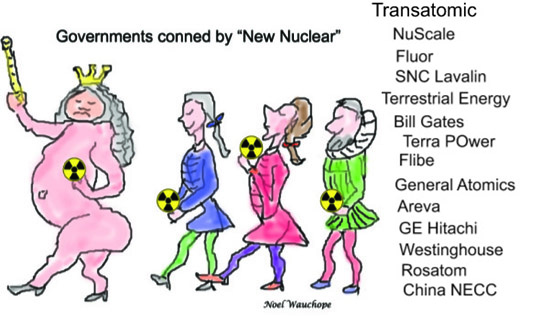 Minister Sussan Ley could open the door to overturning Australia’s nuclear power ban, news.com.au, 27 June 19 There are some very good reasons why the push to reverse Australia’s ban on nuclear power is a bad idea. Malcolm Farr@farrm51
in numerology. That pretty well sums up the new enthusiasm for nuclear power within Government ranks — a triumph of quackery over substance. The nuclear proponents and their media cheer squad seem so determined to see Australian uranium dug up and used to light up the nation, they have diminished the scientific realities of the exercise.
Minister Ley has said she is open to a review of the ban on nuclear power plants.
This isn’t as easy as her turning Susan into Sussan because, as she explained in 2015, “if you add the numbers that match the letters in your name you can change your personality”.
It is a matter of introducing a power source which would be expensive to build, expensive to run, and expensive to turn off. Plus it would be dangerous.
Make that “very dangerous”.
We have a National Wind Farm Commissioner — created by Tony Abbott when PM — overseeing the largely mythical health hazards caused by turbines generating electricity.
If we do that for a few hundred windmills, imagine the huge bureaucracy monitoring the health effects of a nuclear power plant.
Little of which is being addressed by the new gushing tribe of nuclear fans.
It is unfair to load all of this on Ms Ley, but she does administer the Environmental Protection and Biodiversity Conservation Act, which contains the nuclear ban.
It says, “Nuclear action will require approval if it has, will have, or is likely to have a significant impact on the environment. Nuclear actions should be referred to the Minister and undergo an environmental assessment and approval process.”
The pressure for change is coming from a wide range of political figures including One Nation’s new NSW Legislative Council member Mark Latham. And within the Government the pro nuclear voices have included that of Queensland Nationals federal MP Keith Pitt who told The Australian this month, “In our view, the technology has moved on and small modular reactors and thorium need to be investigated…….
If the pro-nuclear MPs are so confident of safety they would have to accept a reactor in their own neighbourhoods, assuring voters they would not become the next Chernobyl, Fukushima or Three Mile Island….
If not, maybe they would accept nuclear waste being buried in their patch, where it would contaminate for thousands of years.
Neither opportunity is likely to embraced by them. https://www.news.com.au/technology/environment/minister-sussan-ley-could-open-the-door-to-overturning-australias-nuclear-power-ban/news-story/2c6214dd0abf15c02f7f9c6dc62fbf11
Australia’s escalatede defence spending, Christopher Pyne and his convenient advice to Ey defence consulting
 Pay Day: Christopher Pyne’s Defence bonanza a fee fillip for EY https://www.michaelwest.com.au/pay-day-christopher-pynes-defence-bonanza-a-fee-fillip-for-ey/, Jun 27, 2019 It dwarfs all other government spending. It is secretive. A huge chunk of it does not even go out to tender. The lion’s share goes to foreign multinationals who pay no tax in Australia. It is defence spending. Michael West reports on the explosion in defence spending which has tripled to more than $60 billion in one year since the Coalition took office, and since Christopher Pyne became Minister for Defence Industry on July 19, 2016.
Christopher Pyne – Defence Minister in May – Defence Industry Lobbyist in July
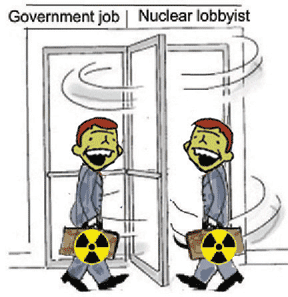 The Fixer in a fix over EY move https://www.afr.com/business/accounting/the-fixer-in-a-fix-over-ey-move-20190626-p521cj Edmund Tadros and Tom McIlroy 26 June 19 Former defence minister Christopher Pyne is under fire for taking a role at big four advisory firm EY that will see him consult to companies in the defence sector.
Despite the lion’s share of the defence sector stemming from federal procurement, EY said the former minister, who retired from politics at the election, would not be lobbying or meeting with MPs or the Defence Department.
The ministerial code of conduct requires cabinet members to wait for 18 months after leaving office before advocating or having business meetings with members of the government, Parliament, public service or defence force on any matters on which they have had official dealings.
Outgoing ministers cannot take personal advantage of information to which they have had access or which is not generally available to the public.
Mr Pyne’s two most recent ministerial roles were as minister for defence and minister for defence industry. He issued a short statement about the job on Wednesday after it was revealed by The Australian Financial Review: “I’m looking forward to providing strategic advice to EY, as the firm looks to expand its footprint in the defence industry.”
A spokeswoman for the Office of the Prime Minister, which administers the code of conduct, did not comment when asked if the role breached the code of conduct
“The rules for former ministers are clear and we refer you to the statements made by Mr Pyne and EY on his new position,” the spokeswoman said.
EY at first described Mr Pyne’s role in the context of “ramping up its defence capability”, but later clarified that Mr Pyne would only deal with the “private sector side of the business”.
“He will not be lobbying or meeting with public sector MPs, public service or defence force in his EY role. He is supporting the private sector side of the business,” the EY spokeswoman said.
Pyne to ‘lead conversations’
EY’s defence leader Mark Stewart said: “Christopher Pyne is also here to help lead conversations about what states need to do to meet the challenges and opportunities this huge defence investment will bring.”
He said EY was “ramping up its defence capability ahead of a surge in consolidation activity and the largest expansion of our military capability in our peacetime history … Large domestic defence players are actively looking for mergers to bulk up to deliver on the government’s $200 billion integrated investment program”.
Australia a top G20 leader in subsidising the coal industry
 Australia leads the G20 nations’ pack in aid for coal-fired power, SMH Peter Hannam, June 25, 2019 Subsidies for coal-fired power production almost tripled in the three years to 2016-17 among G20 nations, with Australia providing among the largest support, an international study has found.The report by UK think tank, the Overseas Development Institute, found aid for such power stations soared from US$17.2 billion ($24.7 billion) in 2013-14 to $US47 billion in the most recent year. It’s in contrast to pledges made by the 20 biggest economies in 2009 to phase out subsidies to reduce the risks of climate change……
The highest amounts of total support to coal consumption were identified in Indonesia at US$2.3 billion per year, Italy and Australia, both about US$870 million, the US at US$708 million, and the UK with US$682 million, it reported.
“These tens of billions of dollars a year of G20 support to coal are not just locking in the high-carbon
economy and leading to stranded assets, they are also a missed opportunity to support a clean energy transition and to achieve other sustainable development objectives,” the study said……
‘Ecological crisis’
Jamie Hanson, head of campaigns at Greenpeace Australia Pacific, said Australia was in an “ecological crisis driven by climate change”.
“Coal is the primary cause of the climate damage that is causing extinctions all over the country, drought and fire that has torched ancient rainforests, and that has killed half the Great Barrier Reef in the last five years,” he said.
“Climate-destroying government handouts to the coal industry defy all logic – especially now, when we know that clean renewable energy is the cheapest form of new power.”
Separately, Australia’s climate ambassador Patrick Suckling has argued at a United Nations conference in Bonn, Germany that the country’s carbon reduction efforts were “having a positive effect”. https://www.smh.com.au/environment/climate-change/g20-nations-aid-for-coal-fired-power-triples-in-three-years-report-20190625-p5213r.html
Ignorance of the Morrison Government on the scientific and medical aspects of Small Modular Nuclear Reactors
Fancy giving the go-ahead the day before the 2019 Federal Election was announced for the Yeelirrie Uranium Mine in Western Australia, with no time for rational and informed input or debate! The fact is that Canadian Cameco, the world’s largest uranium miner and processor, wants to mine this uranium. Our alliance with spurious organisations clearly leads us astray.
To be quite frank, almost all of our politicians are scientifically and medically ignorant and in an age where scientific evolution has become extraordinarily sophisticated, it behoves us – as legitimate members of democracy – to both educate ourselves and our naive and ignorant politicians for they are not our leaders, they are our representatives.
Many of these so-called representatives are now being cajoled into believing that electricity production in Australia could benefit from a new form of atomic power in the form of small modular reactors (SMRs), allegedly free of the dangers inherent in large reactors — safety issues, high cost, proliferation risks and radioactive waste.
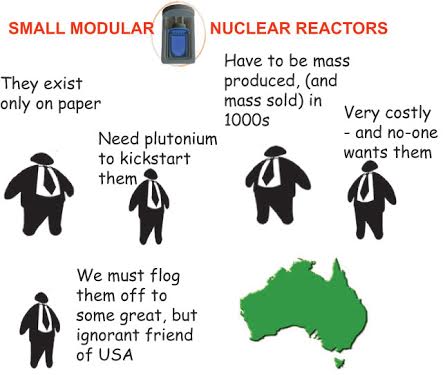
But these claims are fallacious, for the reasons outlined below. Continue reading
BHP’s Olympic Dam uranium mine: tailings dump to larger than Adelaide and up to 30 metres high

All BHP Olympic Dam radioactive toxic mine tailings waste must be isolated from the environment for over 10,000 years…
Please consider making a submission to the federal government who are inviting comments on the BHP Olympic Dam Tailings Storage Facility (TSF) 6 project – but only up to cob Friday 28th June, with no extensions (scroll down for info). Tell the fed’s they must not just approve this TSF 6 on the basis of the vested interest BHP Referral documents.
Key Recommendations are provided along with two Briefing papers prepared for Friends of the Earth Australia (FoEA) and available on-line:
“BHP seek a Toxic Tailings Expansion without a full Safety Risk Assessment” (DN, June 2019, 3 pages)
https://nuclear.foe.org.au/wp-content/uploads/ODM-Tailings-Briefing-22June2019.pdf
and
“Migratory Birds at Risk of Mortality if BHP continues use of Evaporation Ponds” (DN, June 2019, 3 pages)
https://nuclear.foe.org.au/wp-content/uploads/ODM-Migratory-Birds-BHP-Evaporation-Ponds-22June2019.pdf
A set of Key Recommendations on these issues to put to the federal government:
1. The Olympic Dam operation be assessed in its entirety with the full range of project impacts subject to public consultation
Given that uranium mining at Olympic Dam is a controlled “nuclear action” and Matter of National Environmental Significance (NES) under the federal Environment Protection and Biodiversity Conservation Act 1999 (EPBC Act), the integrity of environmental protection requires that the entire Olympic Dam operation be subject to impact assessment so that regulatory conditions can be applied “to consider impacts on the whole environment”. Continue reading
Queensland’s nuclear cowboy MPs join One Nation’s Marlk Latham to push for nuclear power
 Nationals MPs urge rethink on nuclear, THE AUSTRALIAN GRAHAM LLOYD, ENVIRONMENT EDITOR, 24 JUNE 19, Scott Morrison is being asked to support a full investigation of nuclear energy in Australia.
Queensland Coalition MPs Keith Pitt and James McGrath have drafted a letter to the Prime Minister together with proposed terms of reference for an inquiry, which will be delivered this week.
The letter will call for a review of advances in nuclear energy including small nuclear reactors and thorium technology, both of which could produce less radioactive waste than existing nuclear plants.
Commercial investigation of nuclear energy will require that a ban on considering the technology be removed from the Environmental Protection and Biodiversity Conservation Act.
Mr Pitt said that the nuclear issue was “a debate we are ready to have”.
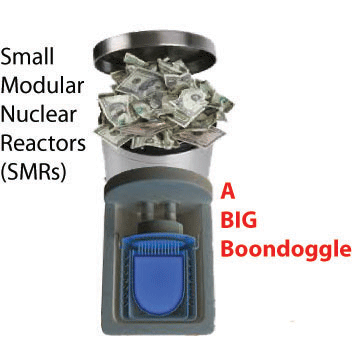 “In our view the technology has moved on and small modular reactors and thorium need to be investigated,” Mr Pitt said.
…….. Critics of nuclear energy claim it would be unable to compete economically with renewable energy and storage.
……. The Morrison government has been reluctant to consider changes to the EPBC Act on nuclear power. But the act in its entirety is up for statutory review this year.
……. The Nationals MPs expect a public review to take from 18 months to two years.
 The call for a national inquiry coincides with a review into the potential of nuclear power in NSW, to include former federal Labor Party leader and newly elected One Nation MP Mark Latham.
Mr Latham has introduced a bill in the upper house of the NSW parliament to repeal the uranium mining and nuclear ban in the state.
A parliamentary inquiry will be held by the eight-member, multi-party Standing Committee on State Development of the upper house. Mr Latham will be a member of the committee.
An issues paper is being prepared by the NSW Parliamentary Research Service for public release. The committee will call for submissions and is likely to conduct public hearings as early as September. https://www.theaustralian.com.au/nation/nationals-mps-urge-rethink-on-nuclear/news-story/4c5c90a4b49f890dba49a10444f1294d
Robert Parker still pushing the fantasy that nuclear power could be viable in Australia
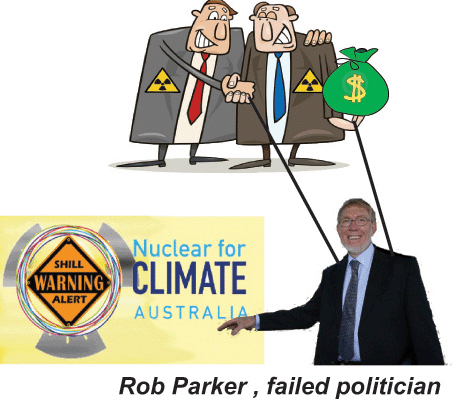
Australian Nuclear Association vice-president Robert Parker joins Jane to discuss the future of the industry in Australia.
Australian States taking the lead on energy policy, as renewable energy generates more Queensland jobs than coal does,
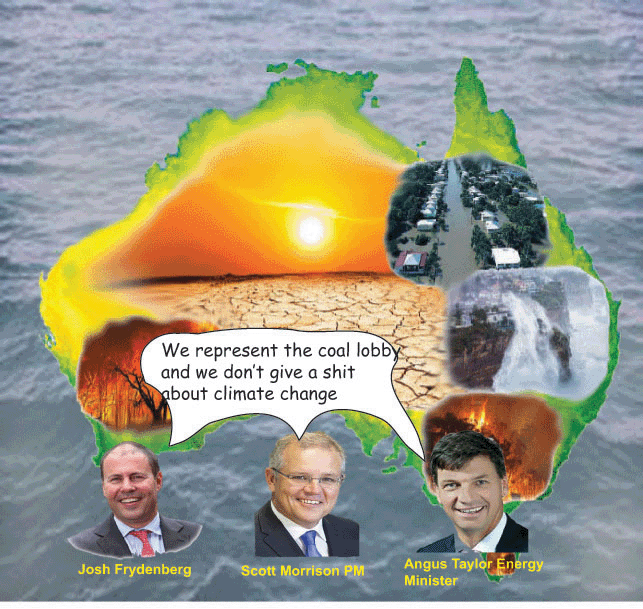
It’s ironic, perhaps, that in an election cycle where a number of regional Queenslanders voted for the promise of blue-collar jobs, backing the party that backed the Adani coal project, renewables generated more than 13,000 actual jobs in construction, with a lot of that activity in north Queensland.
Liberal states in talks to revive Turnbull’s dumped energy policy In Canberra, a month on from Scott Morrison’s election victory, there is talk of feasibility studies for a new Queensland coal plant, and a nascent nuclear debate. But if we shift our vantage point to Adelaide, Australia’s near-term energy outlook looks very different.
Dan Van Holst Pellekaan, the Liberal energy minister, is talking about South Australia hitting 100% net renewables by the 2030s. When asked to explain what that means, he tells Guardian Australia “producing more renewable energy in South Australia than we need for our own consumption and exporting the surplus”.
There is no talk of coal, apart from the inevitability of its displacement.
The South Australian renewables export plan relies on a new interconnector with New South Wales. Van Holst Pellekaan says if the proposed interconnector is approved, there are opportunities to construct large-scale solar and wind farms in the north-east of the state, on pastoral land, adjacent to the transmission equipment. “Then we start to displace coal in NSW,” he says. “It’s not just about a bit of renewable energy making a difference … that’s where you start to get a really big win on emissions reduction.”
But pushing ahead with that kind of progress is much easier if there’s a national framework driving the transition. Post-election, Van Holst Pellekaan wants Canberra back at the table being collaborative, implementing a coherent energy policy.
What the South Australian doesn’t say, but is obvious to people who know how the Coag energy council works, is the states can force this issue if they choose to.
If they can agree among themselves about what needs to happen, they can create a framework setting out the rules of the road even if the commonwealth resists.
Liberal states drive energy policy reboot Continue reading
Sydney City Council. Mayor Clover Moore to declare city climate emergency
Sydney Lord Mayor Clover Moore said Australia’s largest city needed to step up and show global leadership, especially given the failure of “successive federal governments (which) have shamefully presided over a climate disaster”.
Liberal Sydney Councillor, Craig Chung, one of two Liberal councillors who plan to oppose the motion, told The Australian while he supported action on climate change, he strongly objected to Ms Moore’s “hysterical, catastrophising” message.
“Language like climate emergency, climate catastrophe and extinction rebellion do nothing to further reasoned and rational debate,” Mr Chung said.
“If we learned one thing from the May 18 (federal) election, polarised fear mongering is not what the community want. The electorate expects us to take action, debate clearly and rationally about solutions, stop weaponising language and to deliver measurable and tangible outcomes for all Australians.”
Mr Chung said he would be proposing an amended version of the lord mayoral motion, stripped of all its “hysterical elements”.
Ms Moore said the nation was now experiencing such extreme weather “91 of the hottest places on Earth were in Australia”.
She said heatwaves across the country were now five times more likely, and “even more alarming — they start earlier, become hotter and last longer”.
“Seventy per cent of the world’s emissions are generated from cities, so the action city governments take is absolutely critical,” Ms Moore said.
Ms Moore has asked Council to call on the Federal Government to respond urgently to the emergency, by reintroducing a price on carbon to meet the Paris Agreement emissions reduction targets, and establishing a Just Transition Authority to ensure Australians employed in fossil fuel industries find appropriate alternate employment.
“Successive federal governments have shamefully presided over a climate disaster, and now we are at a critical juncture — we face a climate emergency,” she said.
“Australia’s greenhouse gas emissions have increased for four consecutive years. It is clear that the current Federal Government’s policies are simply not working and I call on council to declare a climate emergency, step up our efforts to hold the Federal Government to account. “With 96 per cent of NSW still drought affected, our farmers and rural communities are being decimated by drought, suffering from water shortages and extended bush fire seasons, witnessing unprecedented fish kills and the death of once mighty river systems.”
The Lord Mayor, outlining the City of Sydney’s action on climate change since 2008, committed to accelerate work in the development of its strategic plan till 2050.
“We set a goal to reduce our emissions by 70 per cent by 2030, and — following the Paris Climate Agreement in 2015 — we set a more ambitious goal to reach net zero emissions by 2050”, she said.
“We became Australia’s first carbon neutral council in 2007, and as of June 2017, we’d reduced emissions in our own operations by 25 per cent. By 2020, we will be powered by 100 per cent renewable energy, allowing us to meet our 2030 target by 2024 — six years early.”
According to the International Climate Emergency Forum, over 600 jurisdictions in 13 countries have now declared a climate emergency. The Climate Emergency Declaration campaign in Australia is supported by over 50 climate action groups, including the International Climate Emergency Forum, Extinction Rebellion, and Greenpeace Australia.
Resources Minister Matt Canavan changes his tune – now REJECTS nuclear power !
 What a waste: Minister’s question for nuclear inquiry, Courier Mail, 21 June 19, RESOURCES Minister Matt Canavan has shied away from backing an inquiry into nuclear power in Australia, as he warns a permanent home would need to be found for high-level waste first.
He said a facility to store low-level radioactive waste from medical facilities had not been agreed on, despite a 40-year search.
Some of his Queensland LNP colleagues, led by Member for Hinkler Keith Pitt and Senator James McGrath, are pushing for a two-year inquiry into nuclear power
Senator Canavan said he did not believe it stacked up financially and it could cost more to generate power than existing energy sources.
He said the British Government had recently underwritten a nuclear power station, guaranteeing a price of $140/megawatt hour, which is higher than the $100/megawatt hour price currently paid in Australia.
“I don’t think it’s the right choice right now for Australia, mainly from a financial and cost perspective,” Senator Canavan said.
“The Government’s focus has been on getting prices down in Australia.
“That’s why right now I don’t think the current technology of nuclear technology is a solution to that.”
Senator Canavan also warned that a facility for storing high-level radioactive waste would need to be found. “We have been trying for 40 years to find a long-term repository for radioactive waste that is produced at Lucas Heights (nuclear reactor in Sydney) and some legacy waste we have from other activities,” he said.
“If we can’t find a permanent home for low-level radioactive waste associated with nuclear medicines, we’ve got a pretty big challenge dealing with the high-level waste that would be produced by any energy facilities.”
But he said he welcomed his colleagues bringing forth significant policy issues, and would speak to them seeking further detail.
Senator McGrath and Mr Pitt said this week they would write to the Prime Minister seeking his support for an inquiry into nuclear power to go ahead, given it has been more than a decade since the previous investigation.
Australian Nuclear Association lobbies government with its “nuclear vision”
 Australians urged to adopt nuclear power, World Nuclear News, 20 June 2019 The
  Australian Nuclear Association (ANA) has appealed to Australians to understand that nuclear energy is ready to make a valuable contribution to low emission dispatchable generation for Australia…… Although it is home to the 20 MWt Opal research reactor, nuclear power has been prohibited in Australia since 1998 under two Acts of Parliament: the Australian Radiation and Nuclear Safety Act and the Environment Protection and Biodiversity Conservation Act.In a declaration yesterday, signed by ANA President Dr Mark Ho, ANA noted that nuclear energy supplies 10% of the world’s electricity “safely, reliably, cleanly and economically”…….
To achieve these benefits, Australia needs to do nine things, the declaration says.
These are: repeal long-outdated federal and state legislation preventing its proper consideration; initiate informed public debate towards achieving social licence while acknowledging concerns of safe waste disposal and radiation protection; commit to a genuinely technology-neutral long-term energy policy; focus on affordability, reliability and sustainability, accounting for total system costs in establishing the optimal mix of low emission technologies; enhance Australia’s internationally respected nuclear regulatory regime; facilitate supportive international technology exchange linkages; invite proposals to establish the business case; enhance research and development, drawing on ANSTO’s facilities and expertise; and support every level of education and training needed by emerging industries.
ANA “strongly encourages” the governments of Australia and its states and territories and industry to deliver this vision. “We will contribute to balanced and open public education and communicate constructively with the media on the benefits of nuclear power to help Australia develop a safe, reliable and cost-effective energy sector,” it adds.
ANA is an independent incorporated scientific institution made up of people from the professions, business, government and universities with an interest in nuclear topics. http://www.world-nuclear-news.org/Articles/Australians-urged-to-adopt-nuclear-power
“Chernobyl” miniseries is scary, but the dis-economics of nuclear power for Australia is scary, too
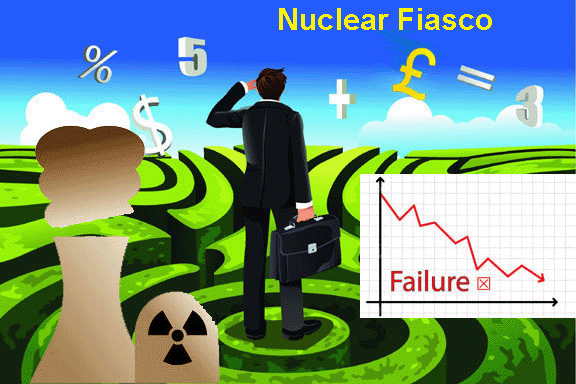
What’s more chilling: watching Chernobyl or cogitating on the cost of going nuclear? Michael West Investigative Journalism Jun 20, 2019, The sudden push by the Murdoch media and Coalition right-wingers to overturn Australia’s nuclear power ban ignores the chilling economic cost — huge public subsidies, storing radioactive waste for thousands of years, the heavy costs of decommissioning and, potentially, radiation-related health costs. Veteran nuclear writer Noel Wauchope reports on the popular TV series, Chernobyl, and the economics of nuclear power.
THE frightening TV miniseries “Chernobyl” could put a few Australians off the idea of nuclear power but nuclear economics might turn out to be the bigger scare.
It is bad news for the Minerals Council of Australia and nuclear lobbyists, that Chernobyl has now arrived on some Australian TV screens, but pro-nuclear advocates are continuing to push their campaign anyway.
The miniseries “Chernobyl” has just finished in Europe and USA, outdoing “Game of Thrones” in popularity. HBO’s Chernobyl topped film and TV database IMDB’s list of the greatest 250 TV shows of all time. The first episode was screened on 12 June, 2019 in Australia, on Foxtel.
The series has had a big impact. It was highly praised by numerous reviewers but criticised by pro-nuclear lobbyists, and infuriated some Russian politicians. ………
The Coalition’s renewed push for nuclear power
In March this year, 11 Coalition MPs (Andrew Broad, James Paterson, Tony Pasin, Tim Wilson, Chris Back, Craig Kelly, Eric Abetz, Andrew Hastie, Warren Entsch, Bridget McKenzie and Rowan Ramsey) urged then Prime Minister Malcolm Turnbull to put nuclear power on the table as an electricity source for Australia. That call is now repeated by Queensland and Coalition MPs calling for an inquiry into the feasibility of nuclear power in Australia.
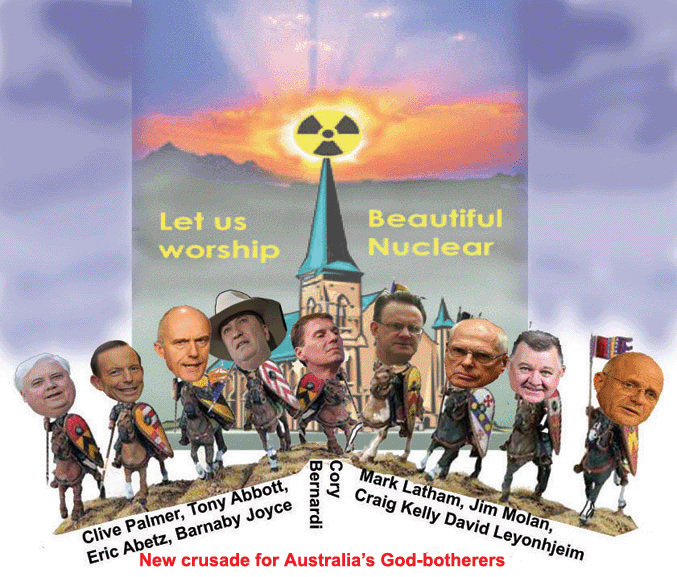
Prime Minister Scott Morrison said he is open to considering nuclear power if it can stand on its own two feet. Energy Minister Angus Taylor told The Guardianon 12 June 2019 he wouldn’t rule out revising Australia’s nuclear ban “when there is a very clear business case which shows the economics of this can work”. Two days later, Environment Minister Sussan Ley also told TheGuardian she was open to the review considering a removal of the ban.
But — are the economics of nuclear power viable for Australia?
When even Australia’s former top nuclear promoter has doubts, it doesn’t look promising……….
How viable is nuclear power elsewhere?
Nuclear economics in America is really a tale of woe. You hardly know where to start, in trying to assess how much this industry is costing communities and tax-payers. There are the attempts to save the nuclear industry via subsidies. There are the continuing and ever-increasing costs of radioactive wastes. There are the compensation payments to workers with radiation-caused illnesses, $15.5 billion and counting, and the legal battles over where to put the wastes. Needless to say, really, America is not initiating any new nuclear “big build”. The much touted “Small Modular Nuclear Reactors” are turning out to have no market and little prospect of being economically viable……
The UK nuclear industry is in the doldrums with repeated postponement of new projects – Hinkley Point C, Wylfa Newydd, Moorside, Sizewell C, Oldbury B and Bradwell B……The 2018 forecast for future clean-up of Britain’s aging 17 nuclear power stations has blown out to £121 billion which has had to be spread across the next 120 years……
France’s Flamanville nuclear project is taking years, remains bogged down with costly problems. Electricite de France (EDF) has financial woes but hopes to save itself by switching from nuclear to renewables. France’s former nuclear giant AREVA went bankrupt and has changed its name to Orano and Framatome — and French tax-payers are still caught up in Areva/Orano costly legal corruption scandals.
Canada is up for increasing costs for managing its nuclear wastes. Interestingly, Canada abandoned its nuclear project for producing medical radioisotopes and now leads in non nuclear production of these isotopes.
India had grand plans for nuclear power, but has cut these back, and recently cancelled 57 reactors. It continues to have problems and many outages, at its huge Kudankulam nuclear station. ….
Russia keeps offering “generous” funding to the buyer countries. But will those countries end up with big debts? Reuters reports that in China, “No new approvals have been granted for the past three years, amid spiralling costs” ………….. https://www.michaelwest.com.au/whats-more-chilling-watching-chernobyl-or-cogitating-the-cost-of-going-nuclear/
Liberal and National party MPs mistaken. Nuclear power WAS investigated in 2015, and found to be uneconomic
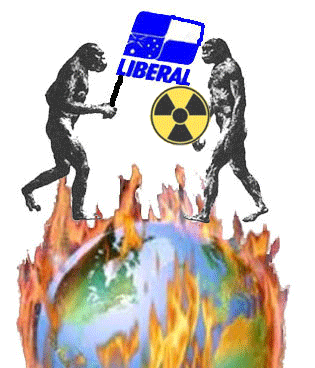 Robyn Wood, 20 June 19, The Liberal and National party MPs are mistaken when they say that nuclear power hasn’t been investigated since nuclear physicist Ziggy Switowski. They need to be aware that the South Australian government had a Nuclear Royal Commission in 2015/6. The majority pro nuclear power members found that nuclear power was not economic compared to renewables. Renewable technology is rapidly improving and the price dropping, while nuclear power plant costs are rapidly escalating and plants being shut down across the world. The report is available online. Even Mr Switkowski said in 2018 “the window for gigawatt-scale nuclear has closed”. Now is not the time to waste precious taxpayer’s money but to get on building renewables that are cheaper than even coal.
1 This month

of the week – Australians for War Powers Reform (AWPR)
To see nuclear-related stories in greater depth and intensity
 Antinuclear