Council announces dates for Kimba radioactive waste ballot
 Council announces dates for Kimba radioactive waste ballot, Kimba District Council, 21 Aug 19, The Kimba community will have its say on the of the Commonwealth Government’s proposed National Radioactive Waste Management Facility at one of two nominated sites in the district from October 3.
The District Council of Kimba today announced the dates for the long-awaited ballot, which has been delayed for more than 12 months due to litigation.
While the favourable judgment received by Council in the Federal Court of Australia on 12 July has been appealed, Mayor Dean Johnson said that there was no legal impediment to the ballot proceeding to determine the level of community support as part of the overall site selection process.
“Council’s position has always been to facilitate the ballot on behalf of the Minister for Resources and Northern Australia so our community could have its voice heard, and we reaffirmed that position at our ordinary meeting last week,” he explained.
“We were advised this morning that the Minister no longer requests that the Kimba and Hawker ballots to be run concurrently, so Council has commenced planning with a view to ballot papers being posted out on 3 October.”
The ballot will be run in a manner identical to that scheduled to be held in 2018, and applications from eligible ratepayers and residents for inclusion on the voters roll will be open for a period of three weeks from 23 August 2019 until midday on 13 September 2019…..http://www.kimba.sa.gov.au/page.aspx?u=408&c=10102&fbclid=IwAR1y2ZfiGYV6gFpnvtTkWYWNs1_LcelO3cQ1iLG3RaC22tVRoHy0NHQ2igg
DELAY is the most salient reason why Small Modular Nuclear Reactors can’t work in Australia
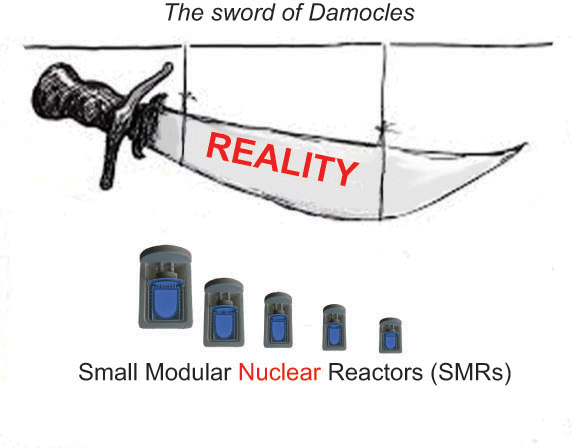
7 reasons why Small Modular Nuclear Reactors are a bad idea for Australia, more https://independentaustralia.net/environment/environment-display/seven-reasons-why-small-modular-nuclear-reactors-are-a-bad-idea-for-australia,13010
International news reports that, in a failed missile test in Russia, a small nuclear reactor blew up, killing five nuclear scientists, and releasing a radiation spike.
In Australian news, with considerably less media coverage, Parliament announced an Inquiry into nuclear energy for Australia, with an emphasis on Small Modular Reactors (SMRs). Submissions are due by September 16.
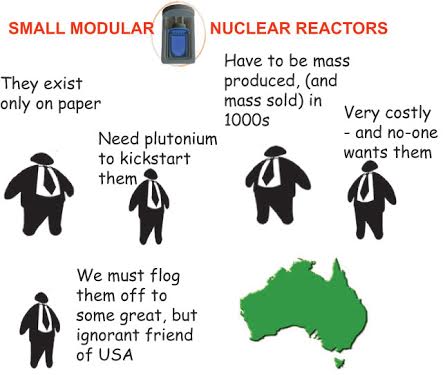 A bit of background. The U.S. government and the U.S. nuclear industry are very keen to develop and export small modular nuclear reactors for two main reasons, both explained in the Proceedings of the National Academy of Sciences, 2018 Firstly, with the decline of large nuclear reactors, there is a need to maintain the technology and the expertise, trained staff, necessary to support the nuclear weapons industry. Secondly, the only hope for commercial viability of small nuclear reactors is in exporting them – the domestic market is too small. So – Australia is seen as a desirable market.
The USA motivation for exporting these so far non-existent prefabricated reactors is clear. The motivation of their Australian promoters is not so clear.
These are the main reasons why it would be a bad idea for Australia to import small modular nuclear reactors.
-
 COST.Researchers from Carnegie Mellon University’s Department of Engineering and Public Policy concluded that the SMR industry would not be viable unless the industry received “several hundred billion dollars of direct and indirect subsidies” over the next several decades. For a company to invest in a factory to manufacture reactors, they’d need to be sure of a real market for them – Australia would have to commit to a strong investment up front.
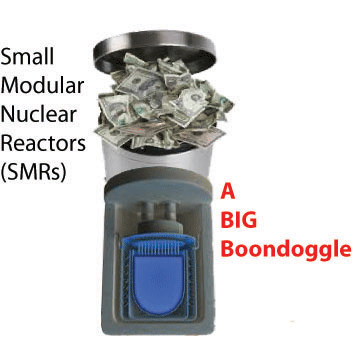
The diseconomics of scale make SMRs more expensive than large reactors. A 250 MW SMR will generate 25 percent as much power as a 1,000 MW reactor, but it will require more than 25 percent of the material inputs and staffing, and a number of other costs including waste management and decommissioning will be proportionally higher.
A study by WSP / Parsons Brinckerhoff, commissioned by the 2015/16 South Australian Nuclear Fuel Cycle Royal Commission, estimated costs of A$180‒184/MWh (US$127‒130) for large pressurised water reactors and boiling water reactors, compared to A$198‒225 (US$140‒159) for SMRs.
To have any hope of being economically viable, SMRs would have to be mass produced and deployed, and here is a “Catch-22″ problem The economics of mass production of SMRs cannot be proven until hundreds of units are in operation. But that can’t happen unless there are hundreds of orders, and there will be few takers unless the price can be brought down. Huge government subsidy is therefore required
-
 Safety problems. Small nuclear reactors still have the same kinds of safety needsas large ones have. The heat generated by the reactor core must be removed both under normal and accident conditions, to keep the fuel from overheating, becoming damaged, and releasing radioactivity. The passive natural circulation coolingcould be effective under many conditions, but not under all accident conditions. For instance, for the NuScale design a large earthquake could send concrete debris into the pool, obstructing circulation of water or air. Where there are a number of units, accidents affecting more than one small unit may cause complications that could overwhelm the capacity to cope with multiple failures.

Because SMRs have weaker containment systems than current reactors, there would be greater damage if a hydrogen explosion occurred. A secondary containment structure would prevent large-scale releases of radioactivity in case of a severe accident. But that would make individual SMR units unaffordable. The result? Companies like NuScale now move to projects called “Medium” nuclear reactors – with 12 units under a single containment structure. Not really small anymore.
Underground siting is touted as a safety solution, to avoid aircraft attacks and earthquakes. But that increases the risks from flooding. In the event of an accident emergency crews could have greater difficulty accessing underground reactors.
 Security
Proponents of SMRs argue that they can be deployed safely both as a fleet of units close to cities, or as individual units in remote locations. In all cases, they’d have to operate under a global regulatory framework, which is going to mean expensive security arrangements and a level of security staffing. ‘Economies of scale’ don’t necessarily work, when it comes to staffing small reactors. SMRs will, anyway, need a larger number of workers to generate a kilowatt of electricity than large reactors need. In the case of security staffing, this becomes important both in a densely populated area, and in an isolated one.
-
 Weapons Proliferation.

The latest news on the Russian explosion is a dramatic illustration of the connection between SMRs and weapons development.
But not such a surprise. SMRs have always had this connection, beginning in the nuclear weapons industry, in powering U.S. nuclear submarines. They were used in UK to produce plutonium for nuclear weapons. Today, the U.S. Department of Energy plans to use SMRs as part of “dual use” facilities, civilian and military. SMRs contain radioactive materials, produce radioactive wastes – could be taken, used part of the production of a “dirty bomb” The Pentagon’s Project Dilithium’s small reactors may run on Highly Enriched Uranium (HEU) , nuclear weapons fuel – increasing these risks.
It is now openly recognised that the nuclear weapons industry needs the technology development and the skilled staff that are provided by the “peaceful” nuclear industry. The connection is real, but it’s blurred. The nuclear industry needs the “respectability” that is conferred by new nuclear, with its claims of “safe, clean, climate-solving” energy.
- Wastes.
 SMRs are designed to produce less radioactive trash than current reactors. But they still produce long-lasting nuclear wastes, and in fact, for SMRs this is an even more complex problem. Australia already has the problem of spent nuclear fuel waste, accumulating in one place – from the nuclear reactor at Lucas Heights. With SMRs adopted, the waste would be located in many sites, with each location having the problem of transport to a disposal facility. Final decommissioning of all these reactors would compound this problem. In the case of underground reactors, there’d be further difficulties with waste retrieval, and site rehabilitation.
6. Location.
I have touched on this, in the paragraphs on safety, security, and waste problems. The nuclear enthusiasts are excited about the prospects for small reactors in remote places. After all, aren’t some isolated communities already having success with small, distributed solar and wind energy? It all sounds great. But it isn’t.
With Australia’s great distances, it would be difficult to monitor and ensure the security of such a potentially dangerous system, of many small reactors scattered about on this continent. Nuclear is an industry that is already struggling to attract qualified staff, with a large percentage of skilled workers nearing retirement. The logistics of operating these reactors, meeting regulatory and inspection requirements, maintaining security staff would make the whole thing not just prohibitively expensive, but completely impractical.
- Delay.
For Australia, this has to be the most salient point of all. Economist John Quiggin has pointed out that Australia’s nuclear fans are enthusing about small modular nuclear reactors, but with no clarity on which, of the many types now designed, would be right for Australia. NuScale’s model, funded by the U.S. government, is the only one at present with commercial prospects, so Quiggin has examined its history of delays. But Quiggin found that NuScale is not actually going to build the factory: it is going to assemble the reactor parts, these having been made by another firm, – and which firm is not clear. Quiggin concludes:
Australia’s proposed nuclear strategy rests on a non-existent plant to be manufactured by a company that apparently knows nothing about it.
As there’s no market for small nuclear reactors, companies have not invested much money to commercialise them. Westinghouse Electric Company tried for years to get government funding for its SMR plan, then gave up, and switched to other projects. Danny Roderick, then president and CEO of Westinghouse, announced:
The problem I have with SMRs is not the technology, it’s not the deployment ‒ it’s that there’s no customers. … The worst thing to do is get ahead of the market.
Russia’s programme has been delayed by more than a decade and the estimated costs have ballooned.
South Korea decided on SMRs, but then pulled out, presumably for economic reasons.
China is building one demonstration SMR, but has dropped plans to build 18 more, due to diseconomics of the scheme.
There’s a lot of chatter in the international media, about all the countries that are interested, or even have signed memoranda of understanding about buying SMRs, but still with no plans for actual purchase or construction.
Is Australia going to be the guinea pig for NuScale’s Small and Medium Reactor scheme? If so,when? The hurdles to overcome would be mind-boggling. The start would have to be the repeal of Australia’s laws – the Environment Protection and Biodiversity Conservation (EPBC) Act 1999 Section 140A and Australian Radiation Protection and Nuclear Safety Act 1998. Then comes the overcoming of States’ laws, much political argy-bargy, working out regulatory frameworks, import and transport of nuclear materials, – finding locations for siting reactors, – Aboriginal issues-community consent, waste locations. And what would it all cost?
And, in the meantime, energy efficiency developments, renewable energy progress, storage systems – will keep happening, getting cheaper, and making nuclear power obsolete.
Beautiful Flinders Ranges – no place for a nuclear waste dump
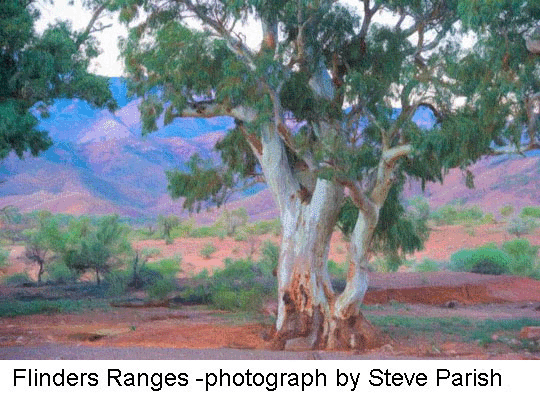
Beautiful Flinders, The Advertiser, MICHELE MADIGAN, 15 Aug 19
RE Susan Andersson’s letter “No nuclear move” (The Advertiser, yesterday): As I travelled south along the highway from Coober Pedy this week, the glorious Flinders Ranges to the east were an inspiring sight.
One can only wonder at a Federal Government, which proposes to build a low-level nuclear dump (toxic for 300 years) and, even more concerning, as the letter stated, to simply store intermediate nuclear waste (toxic for 10,000 years) at such an iconic Australian site.
Neither does it make sense to build and store such literally halfway across the country in the international grain farming area of the Kimba region.
Yes, surely, both for residents and we travellers, it is safer (and better for the SA economy) to store the intermediate-level waste where it is – under the eyes of the nuclear experts.
How will Zali Steggall vote, in the Liberal Coalition’s Parliamentary Nuclear Inquiry
Coalition MPs are usually loyal to the government. If Taylor didn’t want to build the case for nuclear power, it is hard to see why he would have commissioned the inquiry.
In that case, it may be that the process is more important than the outcome. Get ready for a nuclear sales job.
Parliamentary Inquiry into nuclear power for Victoria
Inquiry to explore Victoria going nuclear, Yahoo News Benita Kolovos
Australian Associated Press, 14 August 2019 The Victorian parliament is set to explore lifting the state’s bans on nuclear activities in an effort to tackle climate change.
A Liberal Democrats motion for an inquiry into the potential for nuclear power passed the state’s upper house on Wednesday.
The 12-month inquiry will explore if nuclear energy would be feasible and suitable for Victoria in the future, and will consider waste management, health and safety and possible industrial and medical applications.
Liberal Democrat MP David Limbrick said the political climate – and actual climate – have changed significantly since nuclear energy was last seriously considered in the 1980s.
“The young people of today no longer fear nuclear holocaust. Today’s young have a new fear – global warming,” he told the Legislative Council…….
The Greens’ Tim Read said it makes “absolutely no sense” for Victoria to consider getting into nuclear energy.
“This inquiry is a waste of resources and a waste of time,” he said in a statement.
“Dredging up the tired old debate on nuclear will only delay the urgent work needed to end our reliance on coal and gas and transitioning to clean and safe renewable energy.”
Similar inquiries are being held in NSW and federal parliament…… https://au.news.yahoo.com/inquiry-explore-victoria-going-nuclear-093346544–spt.html?guccounter=1&guce_referrer=aHR0cHM6Ly9uZXdzLmdvb2dsZS5jb20v&guce_referrer_sig=AQAAABq2naeyyQ9ohtcPQW2Ho9e2-qDfI6XSbDwfZUneTxi4VhdT3GWx-zWbqg0MCFS2ArOO-cBI7xrEXbGJxc_Z4MEQGCMb8xZYz9GdF6dLu3azUPUvN5EB4x2GgyUSjwZkX1E93xGECuqxS4HnxqOETaVwytGf9KBTZIzT3QuaBP-R
21 August Senator Matt Canavan to hold closed meeting , then 2 open ones, in region designated for nuclear waste dumping

Queensland Sinister Matt Canavan is having a closed door meeting with the Barndioota Consultative Committee before the Hawker meeting. No doubt the serious nuclear waste dump decisions will be made then
But there’ll be open meetings – ?window dressing – at Hawker 21 August, and at Kimba 22 August.
21 August Wed 3.30 – 430 pm Hawker Sports Centre – Druitt Range Drive, Hawker
22 August Thurs 11 a.m – 12. pm Kimba Gateway Hotel- 40 High St Kimba
False statements on nuclear power by Federal Liberal National Party MP Keith Pitt.

|
Aust OECD nuclear power claim is false, Leader, Australian Associated Press, 12 Aug 19,
AAP Fac tCheck Investigation: Is Australia the only OECD country that does not use nuclear power?
The Statement: “We are the only OECD country that doesn’t utilise this type of technology (nuclear power).” – Federal Liberal National Party MP Keith Pitt. August 7, 2019. The Verdict False – The checkable claim is false.
The Analysis Federal coalition MP Keith Pitt has campaigned for nuclear power to be investigated as an option to form part of Australia’s energy mix. Mr Pitt believes nuclear should not be excluded and Australia should re-examine its moratorium on the construction of nuclear power plants. AAP FactCheck examined the Queensland MP’s claim that Australia is the only OECD country that does not use nuclear power. [1] Mr Pitt’s statement was made as the federal government announced on August 7 an inquiry into the feasibility of using nuclear energy as a power source for Australia. The new inquiry follows a 2016 nuclear fuel cycle royal commission by the South Australian government and a 2006 federal review by the Howard government. The 2006 review found Australia would need about 25 reactors to supply one-third of the nation’s electricity supply by 2050, while the 2016 commission’s found SA “could safely manage” used nuclear fuel from other countries. Submissions to the new federal government review are open until September 16 with a view to finalising a report by the end of the year. [2][3]…… Australia’s ban on nuclear power and nuclear power plant construction is enforced by two acts of federal parliament – the Environment Protection and Biodiversity Conservation (EPBC) Act 1999 and Australian Radiation Protection and Nuclear Safety Act 1998.Section 140A of the EPBC Act 1999 states: “The minister must not approve an action consisting of or involving the construction or operation of any of the following nuclear installations: a) a nuclear fuel fabrication plant; b) a nuclear power plant; c) an enrichment plant; d) a reprocessing facility”. The Australian Radiation Protection and Nuclear Safety Act applies to Commonwealth bodies and is not a barrier for state government body or private developer. [4] [5] [6] [7] ……. Listed under non-nuclear countries for OECD Pacific are Australia and New Zealand, while in Europe there are 14 nations listed and for the Americas, Chile is a non-nuclear country. [8] [9] Industry Super Australia chief economist Stephen Anthony, was quoted as saying on June 26, 2019: “The point about nuclear is that all other OECD countries have nuclear, we do not.” Mr Anthony’s interview with the ABC’s World Today program included an editor’s note which stated: “The interviewee in the report states that all OECD countries use nuclear power – except for Australia. According to OECD figures, 16 of its members do not use nuclear power”. [10] When contacted about the source of his claim, Mr Pitt’s office told AAP FactCheck that the Hinkley MP “misspoke” during the interview with Sky News. Based on this evidence AAP FactCheck found Mr Pitt’s statement to be false. Australia is not the only OECD nation that does not use nuclear power. The Verdict False – The checkable claim is false. https://www.theleader.com.au/story/6324450/aust-oecd-nuclear-power-claim-is-false/?cs=9397 The References Continue reading |
$40 billion a year needed for infrastructure to catch up with our population growth
Australia needs to commit to spending $200 billion every five years on a range of infrastructure projects if it wants to keep pace with population growth.
Infrastructure Australia has warned a new wave of investment is needed to ensure roads and public transport, schools, water, electricity and health services support people’s quality of life and economic productivity.
The most visible example of the impact of poor infrastructure is the increasingly congested roads and crowded public transport in our biggest cities, the 2019 Australian Infrastructure Audit published on Tuesday says.
At the moment, this congestion costs the economy $19 billion a year but if no more is spent on upgrades, that will double to nearly $40 billion by 2031.
Less visible but just as frustrating to people are hospitals and schools that are ageing or reaching capacity, overcrowded parks and city green spaces, ageing water pipes, and the quality of services like the NBN……..
Planning problems have occurred because population projections have traditionally been based on past growth areas, whereas actual growth has been faster and in different areas than anticipated. ……..https://www.sbs.com.au/news/40-billion-a-year-needed-for-infrastructure-to-catch-up-with-our-population-growth
Submissions can be sent to three Parliamentary Inquiries about nuclear issues now underway
 There are currently at least 3 parliamentary inquiries underway that are relevant to nuclear issues. There are opportunities to make submissions to each of them. Details below:
1. Sustainability of energy supply and resources in NSW (Submissions close 15 September 2019)
https://www.parliament.nsw.gov.au/committees/inquiries/Pages/inquiry-details.aspx?pk=2542#tab-termsofreference
2. Inquiry into the prerequisites for nuclear energy in Australia (Submissions close 16 September 2019)
3. Uranium Mining and Nuclear Facilities (Prohibitions) Repeal Bill 2019 (Submissions close 18 October 2019)
Jervis Bay and previous governments’ secret plans for nuclear weapons

|
Nuclear reactor and steelworks plan once considered for pristine beaches of Jervis Bay Key points:
A steelworks, petrochemical plant and an oil refinery were also slated for the site at Jervis Bay, but what was not announced was a plan to generate weapons-grade plutonium that could have seen Australia become a nuclear power. Fifty years later, Australia is again mulling over the question of nuclear energy with two separate inquiries underway. A federal parliamentary committee is investigating the economic, environmental and safety implications of nuclear power in Australia. In NSW, meanwhile, a committee is looking into overturning a ban on uranium mining and nuclear facilities. While neither is talking specifics in terms of where nuclear enrichment technology or modern-day facilities like small modular reactors (SMRs) could be located, it has brought to the forefront questions of geography. Jervis Bay is a Commonwealth territory, located within NSW, but the laws of the Australian Capital Territory apply. Potential reactor sitesIn 2007, in the wake of the Switkowski nuclear energy review under the Howard government, the Australia Institute published a research paper identifying 19 of the most likely reactor sites. The sites were located across Queensland, Victoria, South Australia, NSW, and the ACT. It found the most suitable sites were close to major centres of demand and preferably in coastal areas to ensure easy access to water. Jervis Bay inevitably comes up as a potential reactor location due to its history as the only nuclear power plant to have received serious consideration in Australia. At the time it was promoted as the first of many. In February 1970, the Illawarra Mercury proclaimed:
That was the blueprint that nearly became a reality. Shrouded in secrecyThere was a darker side to the Jervis Bay reactor too, with evidence revealed in a 2002 ABC documentary, Fortress Australia, that the 500-megawatt fast breeder reactor was chosen due to its ability to generate weapons-grade plutonium for use in an Australian nuclear weapon Fortress Australia uncovered secret documents showing how the chairman of the Australian Atomic Energy Commission (AAEC), Phillip Baxter, influenced three Liberal prime ministers (Menzies, Holt and Gorton) to support the project. ….. Associate Professor Wayne Reynolds from the University of Newcastle told ABC podcast The Signal how Gorton pushed for the nuclear power station at Jervis Bay…….”They did the study, they worked out the capability, they had to go negotiate with the British about the technology, then they actually started to build this reactor at Jervis Bay.” The project was first delayed after William McMahon became prime minister in 1971 and was later put on hold indefinitely, despite efforts to keep the project alive. As late as March 1975, the Illawarra Mercury was reporting:
But the horse had bolted. Any hopes of a nuclear power industry in Australia effectively ended when McMahon lost government to Gough Whitlam’s Labor in December 1972. Whitlam’s signing of the Non-Proliferation of Nuclear Weapons Treaty in 1973 also ended any plans by the AAEC to provide Australia with the capacity to manufacture atomic weapons……. The Booderee National Park, meaning “bay of plenty” in the Dhurga language, was created out of the Jervis Bay National Park in 1992, which underlined the cultural significance of the lands and surrounding ocean. https://www.abc.net.au/news/2019-08-12/jervis-bay-once-site-for-nuclear-proposal/11371296?fbclid=IwAR16IqfL2gPD9lS6u9xoMkedjYNqJ1TKT_MoGww_5iwNVfq-vqYjfOrz3S4
|
|
Does Angus Taylor REALLY believe that nuclear energy would be viable in Australia
 Nuclear energy inquiry: is Angus Taylor’s move logical or just for the backbench?
Guardian, Adam Morton Environment editor@adamlmorton 11 Aug 2019 Political arguments about nuclear power in Australia are not new, but the energy minister, Angus Taylor, says this time is different.
Submissions due by 16 September to the parliamentary Inquiry on Nuclear Power for Australia
 One month for nuclear inquiry submissions, Daily Telegraph, Rebecca Gredley, Australian Associated Press, August 8, 2019
Australians have until next month to make a submission to the federal government’s inquiry into the feasibility of using nuclear energy as a local power source.
Submissions are open until September 16, with the hope of finalising the report by the end of the year…….
The committee will consider waste management, health and safety, environmental impacts, affordability and reliability, economic feasibility and workforce capability.
Security implications, community engagement and national consensus will also be reviewed.
Despite calling for the inquiry, Energy Minister Angus Taylor has continued sending mixed messages over his intentions with nuclear power……
The new probe will have regard to two previous inquiries, a 2016 look at the nuclear fuel cycle by the South Australian government and a 2006 review by the Howard government.
The SA inquiry recommended pursuing a dump for overseas nuclear waste in the state, which hit a wall ahead of the last state election.
However, a federal government proposal to store low-level and intermediate-level waste generated in Australia is subject to ongoing debate on a suitable location.
The Howard government review found Australia would need about 25 reactors to supply one-third of the nation’s electricity supply by 2050. https://www.dailytelegraph.com.au/news/breaking-news/one-month-for-nuclear-inquiry-submissions/news-story/50cdda8762cd616650dde4f662c065da
Energy Minister Angus Taylor orders inquiry into nuclear energy – a distraction from Australia’s climate policy failure?
 We’re wasting too much energy on nuclear talk https://www.canberratimes.com.au/story/6320212/were-wasting-too-much-energy-on-nuclear-talk/?cs=14246, Richie Merzian, 10 Aug 19 Late last Friday – a timeslot where ministers are known to announce policies they are most proud of – the Minister for Energy, Angus Taylor, ordered a parliamentary inquiry into nuclear energy.
As the Prime Minister flies to the Pacific Island Forum on Tuesday, he will now be armed with another sorry excuse as to why Australia is not expediting the transition to renewables and storage: ‘Sorry, we are still looking into nuclear’. But in the end, whatever is sparking this debate is less important than the economic and safety risks of nuclear. You don’t need to be an economist to see that nuclear power is an expensive and dated solution.
Richie Merzian is climate and energy program director at the Australia Institute.
Australia’s Liberal Coalition government still dreaming about nuclear power

|
Although a parliamentary inquiry is revisiting the possibility of nuclear power in Australia, recent history suggests any support is unlikely to gain critical mass.
when it delivered its findings, the [South Australian ]royal commission found that a nuclear power plant was not commercially viable, and this was considered to have killed off any prospect of a nuclear-powered Australia.
the federal government’s determination to keep the nuclear option alive a source of confusion to many in South Australia and beyond.
the legislative and regulatory work required to choose a site, select designs, approve them, build prototypes and carefully oversee the process to completion would take at least two decades. “And that is being optimistic,”
“There’s a core group of mainly older white blokes who think nuclear is a great idea”
The pipe dream of nuclear power https://www.thesaturdaypaper.com.au/news/environment/2019/08/10/the-pipe-dream-nuclear-power/15653592008587, By Royce Kurmelovs.
When the federal energy minister, Angus Taylor, announced a new parliamentary inquiry into what it would take for Australia to get into the nuclear power business, he might have expected a bigger headline.
In a letter sent last Friday, the minister said the inquiry would “consider the economic, environmental and safety implications of nuclear power” and that he was confident the multi-party committee was “the best way to consider this issue in a sensible way”. Taylor, himself a long-time advocate for nuclear power, made the announcement on the heels of a recent campaign by Coalition MPs and the Australian Minerals Council to consider the economic benefits of going nuclear. Queensland MP Ted O’Brien, chair of the standing committee on the environment and energy, which will oversee the inquiry, said he took seriously the responsibility handed to him, and the committee would “determine the circumstances under which future Coalition or Labor governments might consider nuclear energy generation”. O’Brien stressed the Coalition government had no current plans to lift the moratorium on nuclear power generation. All told, it was an odd series of qualifiers for an announcement meant to shock, leading some observers to ask: Why bother? Continue reading |
Australia’s Emissions Reduction Minister Angus Taylor makes light of UN’s urgent climate warning
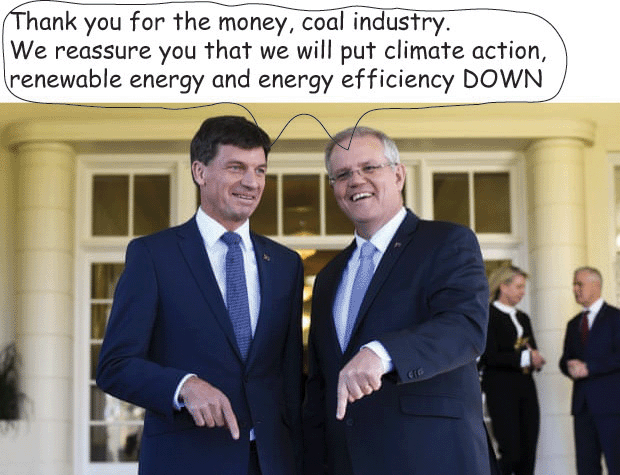 Australian government brushes off UN’s urgent climate warning, SBS News 9 Aug 19 Humanity faces increasingly painful trade-offs between food security and rising temperatures within decades unless emissions are curbed and unsustainable farming and deforestation halted, according to a landmark climate assessment.
The federal emissions reduction minister has defended Australia’s land management practices after a new United Nations climate change report called for changes in the way the world produces and consumes food.
The UN’s Intergovernmental Panel on Climate Change warned efforts to limit global warming while feeding a booming population could be wrecked without swift and sweeping changes to how we use the land we live off.
The report on land use and climate change highlighted the need to protect remaining tropical forests as a bulkhead against future warming. It offered a sobering take on the hope that reforestation and bio-fuel schemes alone can offset mankind’s environmental damage, underlining that reducing emissions will be central to averting disaster.
“Land is a source of emissions as well as a sink,” IPCC chair Hoesung Lee told AFP.
“Obviously you want to reduce emissions from land as much as possible. But that has a lot to do with what’s happening to the other side of the equation: greenhouse gas emissions, mainly from the energy sector.”
But Emissions Reduction Minister Angus Taylor said Australia is already absorbing emissions from land management. “This is a very, very important success story in Australia. Farmers, in particular, haven’t been given the credit they deserve for the role, the enormous role, they’ve played on this front,” he told ABC News on Friday.
But the minister brushed off concerns about the role meat-heavy diets play in climate change, suggesting the report was “forcing” people to become vegan……..
Land is intimately linked to climate. With its forests, plants, and soil it sucks up and stores around one-third of all man-made emissions. Intensive exploitation of these resources also produces huge amounts of planet-warming CO2, methane and nitrous oxide, while agriculture guzzles up 70 percent of Earth’s freshwater supply.
National Farmers Federation president Fiona Simson said the food warning should send “a shiver down your spine”…….
As the global population balloons towards 10 billion by mid-century, how land is managed by governments, industry and farmers will play a key role in limiting or accelerating the worst excesses of climate change.
Farmers for Climate Action want the federal government to implement a national strategy on climate change and agriculture, and to speed up the transition to clean energy.
“With NSW marking one year since it was 100 per cent drought-declared … and farmers across the country hurting from droughts, heatwaves and other extreme weather events, it is clear that climate change is already hurting Australian agriculture,” the group said in a statement……https://www.sbs.com.au/news/australian-government-brushes-off-un-s-urgent-climate-warning
1 This month
17 October, Free Public Talk on Nuclear Issues in South Australia
David Noonan will speak on public interest concerns over the new Roxby Downs Indenture Act 2026 on BHP copper-uranium mining and ore processing in SA, and on how AUKUS may face SA with a High-Level nuclear waste agenda.
Dr Jim Green will discuss international developments in the field of nuclear power including ‘small modular reactors’ and Generation 4 ‘advanced’ nuclear reactor concepts.


Help Aunty Sue Protect Her Land and Sacred Sites From Destructive Rocket Testing.
.

Australians deserve the truth
about
AUKUS – https://aukuspublicinquiry.com/

PETITION – To: Prime Minister Anthony Albanese and the Australian Labor Government

of the week – Australians for War Powers Reform (AWPR)
To see nuclear-related stories in greater depth and intensity

