|
We are now in a place we’ve never been before https://southwind.com.au/, 
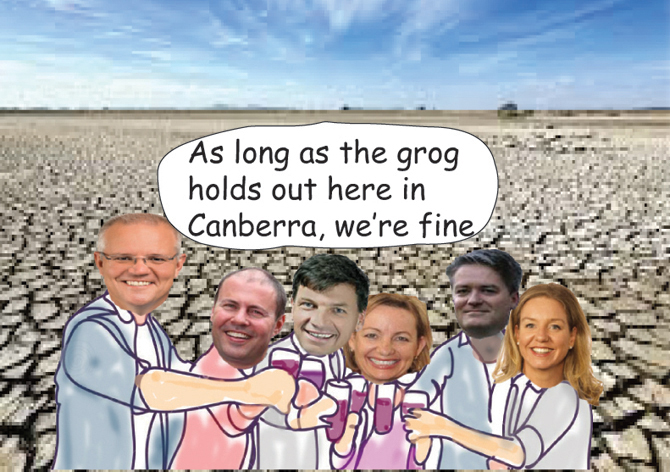
23 July 2019 by Peter Boyer Australia’s big dry is now its worst drought on record. Which is pretty much the way it is everywhere. Following a lead from our state and federal governments, today I’m going to avoid the delicate matter of future climate. Instead I’ll focus on what’s happening around us now.
Weather records tell us that June in Australia was 0.26C warmer than average and 31 per cent drier. The first half of 2019 produced the continent’s second warmest and seventh driest conditions in 120 years of records.
In those six months the Murray-Darling Basin had about half its normal rainfall. Basin residents might have coped with this in normal times, but these are not normal times. Dry, warm, high-evaporation weather since January 2017 has left them with conditions they’ve not seen before.
Now it’s official. Rainfall records reveal that today’s Murray-Darling experience is Australia’s worst drought on record – more severe than the Federation, the World War II, the Millennium or any other drought in our recorded history.
Bureau of Meteorology climatologist David Jones told a BOM seminar last week that proxy evidence indicates Australia hasn’t been as dry as this for two or three million years, long before humans existed. This puts the current state of our weather in a completely new place.
Numerous NSW and southern Queensland towns now have emergency water restrictions in place. Many towns in upper Darling catchments calculate their water storage as a few months at most. In Tenterfield they’re pumping already-depleted groundwater to try to keep storage levels stable.
Water is now being carted to the small town of Guyra, 150 km away, but for Tenterfield that’s not an option – at least not a sustainable one. Its businesses and 4000 residents would need 1400 B-double truckloads a month, or nearly 50 each day, to sustain even minimal water use.
The list of towns threatened with losing their water supply is growing, including Warwick and Stanthorpe in Queensland. The larger centres of Tamworth, Armidale, Orange and Dubbo are lining up to join them if good rain doesn’t come this year. The Bureau is not hopeful of that happening.
Running out of water is a nightmare for any community. Cape Town almost ran out a year ago and is still in a tenuous position. In much-larger Chennai on India’s southeast coast, where it hasn’t rained for six months, the situation is dire. Monsoon rain is not expected for another month or two.
This city of 10 million people consumes over 500 million litres a day. The provincial government is now using trains to transport water every day from a half-full storage over 300 km away, but if the city were to run out completely that supply would have to increase 50-fold. That won’t happen.
Early monsoonal downpours in India’s Assam along with Nepal and Bangladesh have brought the opposite problem: too much water, displacing millions of people and killing over 100. Not far away in the high Himalayas, the rate of glacier melt has been found to have doubled in less than 20 years to more than eight billion tonnes a year. A scientific assessment published in June is a very bad omen for downstream communities depending on glacial meltwater.
Meanwhile America’s Pacific north-west is preparing for another nasty fire season. A scientific wildfire survey has just informed Californians, after their worst season ever last year, that the state’s summer fires have increased five-fold since the 1970s, with rising temperature the key cause.
Wildfire anxiety has spread northward, to the dark, dank forests of British Columbia. The Canadian province’s wildfire service has warned that abnormally high fire conditions will be experienced in coastal regions including Vancouver Island at least till the end of summer.
This comes after several summers of intense wildfires up and down the Canadian west coast, mostly started by lightning strikes. They have been especially devastating in new-growth forests, where less genetic diversity and lower tree density allows higher moisture loss.
Things are hotting up in the far north. Alert, a Canadian military base on Ellesmere Island in the high Arctic, normally has a daytime maximum around 7C in July, but it’s currently experiencing an unprecedented heatwave that has seen temperatures climb above 20C.
Canada’s chief climatologist, David Phillips, says this heatwave is just the latest indicator of what will be a long, hot Arctic summer. The main trigger, say scientists, was a dramatic loss of Arctic sea ice over the past decade that allowed the ocean to absorb much more heat from the sun.
Smoke has become a regular contributor to Arctic weather, and this year is no exception. These are not forest fires so much as peat fires. The dried-out tundra itself is now burning in Alaska and across wide Siberian expanses, sending choking black smoke into the air.
Among the many things I’ve left out are Darwin’s groundwater crisis, depleted Great Barrier Reef coral, Europe’s unprecedented June heat, vanishing Antarctic sea ice, chronic drought in Africa and the Americas and floods in Asia, Africa and Latin America. Did I mention climate change?
VICTIM of a chronic decline in government support, Hobart’s venerable environment and sustainability body, Sustainable Living Tasmania, has been forced to close its doors after nearly 50 years of quiet achievement. It will continue as a volunteer-run organisation with no office
|
|
July 23, 2019
Posted by Christina Macpherson |
AUSTRALIA - NATIONAL, climate change - global warming, politics |
Leave a comment
Make nuclear power free, Barnaby Joyce says. https://www.smh.com.au/politics/federal/make-nuclear-power-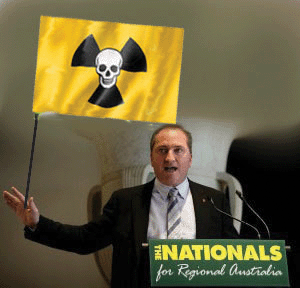 free-barnaby-joyce-says-20190721-p5299j.html, By Nicole Hasham, July 21, 2019 Nationals MP Barnaby Joyce says free nuclear power could be offered to residents living close to a reactor to help build support for the controversial technology, as an analysis pinpoints which Australian towns are best placed to host a nuclear plant.
But the pro-nuclear push by Coalition backbenchers may be losing momentum after one colleague dismissed it as a “distraction” and a senior minister said the government had “no desire to go down that path”.
Federal and state laws prohibit the development of a domestic nuclear power industry. However, federal MPs Keith Pitt and James McGrath are pushing for a parliamentary inquiry into the technology’s feasibility in Australia and the NSW Nationals last month passed a motion supporting nuclear energy.
A leading lobby group for the technology, the Australian Nuclear Association, has identified dozens of potential sites for nuclear reactors – those with stable geology and proximity to the existing grid, transport and water. The locations include those in Mr Joyce’s New England electorate in northern NSW and Liberal Ken O’Dowd’s Queensland seat of Flynn. Both MPs have backed a nuclear inquiry.
Mr Joyce said nuclear technology had come a long way in the past few decades and rejected claims that even if Australia’s nuclear ban was overturned, communities would refuse to host reactors over safety and environmental concerns.
“You just have to come up with the right policy settings and they will accept it … People will think with their wallets,” he said.
Mr Joyce floated a potential policy whereby “if you can see the reactor [from your house], your power is for free. If you are within 50 kilometres of a reactor, you get power for half price.” Discounts would scale down to 25 per cent for those living 75 kilometres from a nuclear facility.
Such a policy would trigger a rush of proposals for “hills in the middle of towns that people want a reactor on”, Mr Joyce said.
In NSW, the association also identified sites in Energy Minister Angus Taylor’s seat of Hume and Environment Minister Sussan Ley’s seat of Farrer. Proposed Victorian sites include those in the seats of Wannon and Gippsland, held by ministers Dan Tehan and Darren Chester.
Wide Bay MP Llew O’Brien, whose Queensland electorate is also on the list, said he was “not enthusiastic” about the prospect of a parliamentary probe into nuclear power.
“We need to focus on bringing down power prices and bringing more supply into the market … which can be done a lot quicker than legalising nuclear energy and then building the infrastructure needed,” he said.
“It seems to be a distraction from the very real issues at hand.”
Prime Minister Scott Morrison said during the election campaign that his party had “no plans” to change its nuclear power stance and Mr Taylor told this publication on Sunday “the business case has got to stack up”.
A government minister told the Sydney Morning Herald and The Age that “there’s no desire to go down this path” in the broader Coalition.
“Financially it doesn’t stack up and … there’s also the not-in-my-backyard issue, which is a very difficult one,” the minister said.
Labor’s climate change and energy spokesman Mark Butler said Mr Morrison had allowed Mr Taylor and backbenchers to “pursue their nuclear power fantasy” as power prices rose.
Consultancy SMR Nuclear Technology promotes the benefits of small, modular nuclear reactors. Technical director Tony Irwin said about ten community groups and others had expressed interest to his firm in hosting such a reactor, should the ban in Australia be lifted.
“People are now concerned about climate change and they can see that renewables aren’t the total answer and we need everything that we’ve got,” he said.
July 22, 2019
Posted by Christina Macpherson |
AUSTRALIA - NATIONAL, politics |
Leave a comment
 Greens seek ‘climate emergency’ this year, SBS News 20 July 19
The Australian Greens are focusing on climate change and the need to transition to renewable energy at its annual conference in Adelaide. The Australian Greens are demanding the country declare a “climate emergency” while calling for a royal commission into the Murray-Darling Basin plan.
Aside from those core messages at the party’s annual conference, Greens leader Richard Di Natale also had a crack at the Labor Party for capitulating on the Morrison government’s personal income tax cuts.
And he urged Australia to forge an independent, non-aligned foreign policy rather being tied to a “dangerous and unhinged” US President in Donald Trump.
It’s now clearer than ever that the Greens are the real opposition,” Senator Di Natale declared at the Greens national conference in Adelaide on Saturday in response to the actions of Labor since the May election.
“We don’t believe one thing before an election and another thing after it.”
Addressing reporters after his speech, Senator Di Natale said a key focus for the conference will be the transition from coal and fossil fuels to renewable energy.
“There needs to be a transition that brings tens of thousands of new jobs and that looks after people so that we are better off as a result of making this transition,” he said.
“Unless you accept that there is a serous problem you’re not going to come up with the solutions that are necessary to deal with it.”
Greens federal spokesman on climate change, Adam Bandt said he hopes to bring a motion to have the parliament declare a climate emergency before the end of the year.
He said the UK, France and Canada have already made such declarations, as has the ACT government. Labor and the crossbench also took climate change policies to the election.
“We think there is a really good chance in having the parliament unanimously declare a climate change emergency before the end of the year,” Mr Bandt told reporters……. https://www.sbs.com.au/news/greens-seek-climate-emergency-this-year
July 22, 2019
Posted by Christina Macpherson |
AUSTRALIA - NATIONAL, climate change - global warming, politics |
Leave a comment
Barnaby Joyce’s thwarted ambitions glow like a nuclear meltdown,  “………. Mr Joyce’s commentary this week on nuclear energy, raising Newstart, and an Indigenous voice to Parliament is also a transparent re-branding exercise – the type favoured by disgraced politicians when they’re trying to rebuild their leadership credentials.
You might recall that Mr Joyce was doing a lot of leadership posturing in the lead-up to the May federal election. Some political observers even reported that the former Deputy PM’s return to the Nationals leadership was such an inevitability that it could possibly happen even before the election…….
the backbencher missed out on a seat in Scott Morrison’s new ministry and also lost his special drought envoy role, although Mr Joyce did retain a gig as chair of a parliamentary committee.
Using what was left available to him, namely the chairman’s role, Mr Joyce kicked off a campaign to become relevant again by claiming his committee should hold an inquiry into establishing nuclear power in Australia.
Yet again demonstrating his expertise in energy policy, the former accountant claimed in a radio interview last weekend that technological advances had essentially made nuclear energy “safe” – and that impoverished Australians living in regional Australia would vie to live near a nuclear power plant if it meant they would receive lower-cost or free electricity in return. To be fair, this is how the French established their nuclear power stations with minimal community dissent.
These reassuring words may well be what mining magnate Gina Rinehart and other investors with uranium interests told Mr Joyce, but the vested interests omitted to explain how expensive it is to build a safe nuclear power station, and how long it takes.
Meanwhile, solar and wind farms with battery storage can be built in remote locations too, but at less cost and in less time, with no need to worry about long-term radioactive waste. Yet pesky details are not what the Barnaby 2.0 campaign is all about……… https://thenewdaily.com.au/news/world/2019/07/19/barnaby-joyce-leadership-ideas/
July 20, 2019
Posted by Christina Macpherson |
AUSTRALIA - NATIONAL, politics |
Leave a comment
Adani has set a dangerous precedent in requesting scientists’ names, The Conversation Samantha Hepburn, Director of the Centre for Energy and Natural Resources Law, Deakin Law School, Deakin University
July 17, 2019 A freedom of information request has revealed Adani sought the names of CSIRO and Geoscience Australia scientists involved in reviewing
groundwater management plans related to its proposed Carmichael mine.
Adani argued it required a list of people involved in the review so as to have “peace of mind” that it was being treated fairly and impartially on a scientific rather than a political basis.
Ten days before Adani’s request, Geoscience Australia’s acting director of groundwater advice and data reportedly raised concerns that Adani had “actively searched/viewed” his LinkedIn profile and that of a colleague.
Significantly, Adani’s request to the government was made before CSIRO and Geoscience Australia had reported their review findings back to the Queensland government.
While the federal Department of the Environment and Energy reportedly declined to hand over the names, the fact the letter was sent in the first place is concerning. It fundamentally interferes with the capacity of individual scientists to provide clear and informed evaluation………..
The letter sent by Adani requesting the names of scientists was allegedly grounded in concerns about the possibility of anti-Adani activism by expert reviewers. Despite this, Adani made it clear that it was not explicitly alleging bias. Its objective, the letter said, was a desire to be “treated fairly and in a manner consistent with other industry participants”.
The real purpose of the letter
If Adani was seriously concerned about a breach of procedural fairness in the review of their groundwater management plan, it would have sought a judicial review. It did not – because there was no breach.
The scientists working at CSIRO and Geoscience Australia are all experts in their disciplines. They were engaged in the important process of determining whether Adani’s plan for managing groundwater around their mine would meet the environmental conditions of their mining licence. In other words, the scientists were doing their job…….
As Adani has not brought an action for judicial review, the substantive purpose of the letter appears to be, as suggested by CSIRO representatives, to pressure scientists and potentially seek to discredit their work. The potentially chilling effect is clear.
Concern about climate change is not bias
The profound concerns raised by climate change and fossil fuel emissions are shared by many scientists around the world. The reports prepared for the International Panel on Climate Change make it clear that coal fired electricity must drop to nearly zero by 2050 to keep warming within 1.5℃.
This shared concern does not make scientists political activists. Nor does it prevent scientists from acting fairly and impartially when reviewing a groundwater management plan.
An acceptance of climate science and even a belief that coal-fired energy should be decommissioned does not constitute bias. A reasonable bystander would expect most environmental scientists to be concerned about climate change…….
The letter, sent before the review was handed down, sets a dangerous precedent. Not because it suggests the scientists were impartial or there was any procedural unfairness involved in the process. But rather, because it jeopardises the independence of our scientists who, in seeking to ensure the longevity of our water, food and energy resources, carry a heavy responsibility to the public interest. https://theconversation.com/adani-has-set-a-dangerous-precedent-in-requesting-scientists-names-120487?utm_medium=email&utm_campaign=The%20Weekend%20Conversation%20-%201363812812&utm_content=The%20Weekend%20Conversation%20-%201363812812+CID_b76b199d2a9f41a0b97b5b71ad372c57&utm_source=campaign_monitor&utm_term=Adani%20has%20set%20a%20dangerous%20precedent%20in%20requesting%20scientists%20name
July 20, 2019
Posted by Christina Macpherson |
AUSTRALIA - NATIONAL, civil liberties, politics |
Leave a comment
The idea of producing nuclear energy in Australia before 2040 is absurd https://www.theguardian.com/commentisfree/2019/jul/16/the-idea-of-producing-nuclear-energy-in-australia-before-2040-is-absurd
Joyce and Barilaro revived this idea after the release of a report by Industry Super Australia, which took as the starting point the need to replace most of Australia’s coal-fired power stations by 2040. The report concluded: “It is difficult to see how the the problem can be resolved without some nuclear in the mix.”
 It would perhaps be churlish to observe that the small reactors advocated by Barilaro exist only as designs and may never be built. There is a much bigger obstacle which is essentially impossible to overcome.
To make the central point as bluntly as possible: even with a crash program there is no chance of deploying nuclear power in Australia in the required timeframe. I looked at this question in a submission to the South Australian royal commission into the nuclear fuel cycle and concluded that “there is no serious prospect of Australia producing nuclear energy before 2040”.
That was in 2015, and the news for nuclear power since then has all been bad. All of the nuclear power plant construction projects under way in the developed world have experienced substantial delays (the VC Summer plant in the US has been cancelled with a loss of billions of dollars).
Most of these projects (Flamanville in France, Olkiluoto in Finland and Vogtle in Georgia) received their initial approval around 2005, and none is now likely to start before 2020. So, to be sure of getting nuclear power going by 2040, we’d need to have projects in their initial stages before 2025, in the term of the next parliament.
To see how absurd this is, consider some of the steps that will be needed before a project could begin.
First, both major parties need to be convinced of the case for nuclear power. That’s highly unlikely but let’s suppose it can somehow be done by 2020. Next, the current ban on nuclear power needs to be repealed. This ban looms large in the minds of nuclear advocates but actually it’s such a minor problem we can ignore it.
The first big problem is the need to set up, from scratch, a legislative and regulatory framework for nuclear power. That would require adapting an overseas model such as that of the US, where the nuclear industry is regulated by at least eight different acts, covering more than 500 pages. Back in the 1970s the French government could do this kind of thing by fiat, without parliamentary debate, but that’s not a feasible option for Australia.
Having passed the necessary legislation, the next task would be to establish and staff a regulator similar to the US Nuclear Regulatory Commission or the UK Office for Nuclear Regulation. The only Australian body with any relevant expertise is the Australian Nuclear Science and Technology Organisation which operates a 20 megawatt (research reactor at Lucas Heights. Ansto has little or no capacity to deal with the problem of licensing and regulating commercial reactors of 1,000MW.
Even with a massive effort, and assuming no political obstacles, it’s hard to see these tasks being accomplished within five years, which would already take us to 2025. But there are many more remaining difficulties.
Most obviously, as the Industry Super report states, we would need a carbon price or a market mechanism with similar effects, such as an emissions trading scheme. On any realistic political analysis, that’s impossible – the overlap between supporters of nuclear power and advocates of carbon pricing in Australia is virtually zero. At a minimum, the adoption of a carbon price would require a change of government at the next election, which may happen though it doesn’t seem likely at the moment. Even if it would occur (and assuming, improbably, that a Labor government relying on Green support could be persuaded to back nuclear power), there would be further delays before the carbon price could be put in place.
But that’s just the beginning. Before any project could be considered, it would be necessary to license designs that could be built and operated here. The processes of the NRC in the US, which were expedited in the hope of spurring a “nuclear renaissance” typically take three to four years.
We could simply accept the judgement of overseas regulators, but even then we would have a problem – there may be no designs available.
In my submission to the SA royal commission, I argued that the only serious contender for Australia was the Westinghouse AP1000. Since then, however, cost overruns and cancellation have sent Westinghouse bankrupt, almost taking its owner, Toshiba, with it. There is no serious prospect of any more plants of this design being built. Areva, which is building its EPR model in Europe, is in similar difficulty. There’s a serious risk that the only contenders would be Chinese or Russian designs, which would pose some obvious problems.
The most difficult step would be the need to identify greenfield sites for multiple nuclear power plants, almost certainly on the east coast, and go through the relevant environmental processes. Reliance on overseas models won’t be of much use here. All the plants under construction in western countries are “brownfield”, that is, situated next to existing plants, built last century, and approved as far back as the 1970s.
In summary, it would be a heroic endeavour to get construction started on a nuclear plant even by 2030. Getting it finished and generating electricity by 2040 is virtually impossible.
Fortunately, there are alternatives, though the Industry Super report dismisses them. The combination of solar photovoltaics and battery storage is already cheaper than new coal-fired power. As a backup, Australia has huge potential for storage using pumped hydroelectricity. We don’t need to call on the phantom of nuclear power to secure a reliable, carbon-free electricity supply for the future.
• John Quiggin is professor of economics at the University of Queensland
July 18, 2019
Posted by Christina Macpherson |
AUSTRALIA - NATIONAL, politics |
Leave a comment
Nuclear lobby identifies preferred sites for 20 nukes in Australia https://reneweconomy.com.au/nuclear-lobby-identifies-preferred-sites-for-20-nukes-in-australia-19298/?utm_source=RE+Daily+Newsletter&utm_campaign=11f2638fe2-EMAIL_CAMPAIGN_2019_07_15_03_5, Giles Parkinson15 July 2019 National Party luminaries such as Barnaby Joyce and NSW deputy premier John Barilaro must be tickled pink. The electorates of these outspoken pro-nuclear advocates have been identified by the local nuclear lobby as some of the most prospective locations for their call to build 20 nukes in Australia’s main grid.

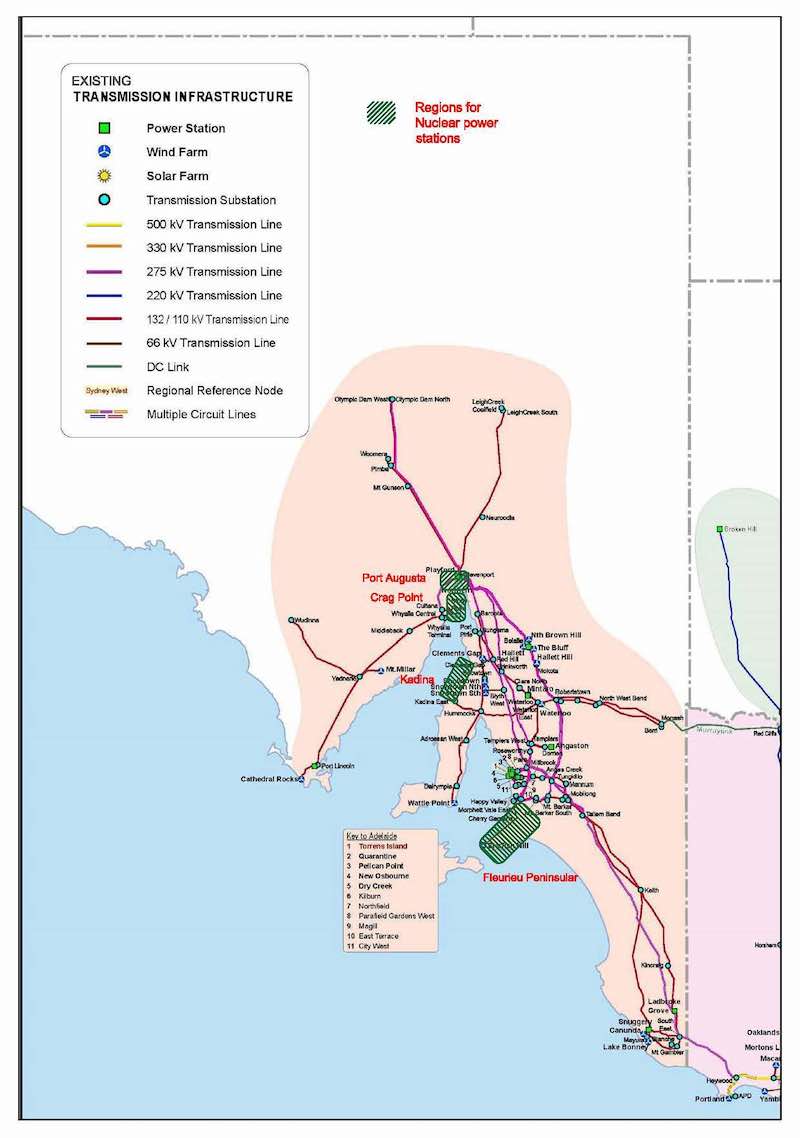
The organisation’s website includes this map and others that outline preferred sites for nuclear plants in NSW, Queensland and South Australia. (See below.)
It comes as the Coalition faces intense pressure from its own MPs and Senators, and One Nation, and, of course, the conservative media, to allow nuclear to be built in Australia.
Most of the MPs behind this push – like Joyce, Barilaro, Keith Pitt and Mark Latham – either reject climate science outright, mock any moves to address it, and/or at the same time are pushing for the construction of new coal-fired generators. That shouldn’t surprise anyone. At an industry level, the push for nuclear also comes from the main coal lobby, the Minerals Council of Australia, whose former CEO and deputy CEO are key advisors in prime minister’s Scott Morrison’s office, and who, of course, also want the government to underwrite new coal-fired generators, and are ensuring the current government has no long-term policy or plan for renewables.The reason for this symbiotic relationship is that the coal and nuclear industries share a common enemy – wind and solar and distributed renewables plus storage that undermine the traditional energy system of centralised power generation and “base-load” power.
So, the nuclear lobby had dusted off its plans and ramped up its campaign to demonise the competition. Seminars are being held, reports are being released, and the trolls have been let loose on social media.
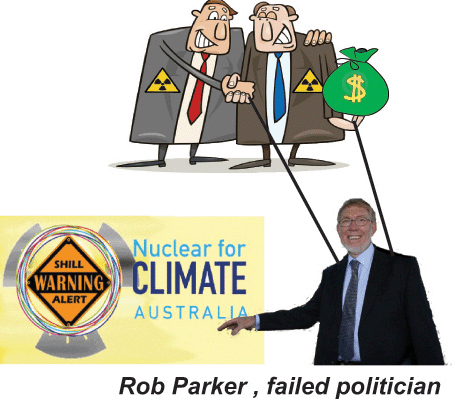
Parker’s presentation is interesting only because it gives warning to residents of where the nuclear proponents think they could build a nuclear power plant.
Of course, how and why Australia would build the 20 gigawatts of nuclear plants he suggests – and in the time-frames offered and at a cheap enough price – is not addressed by Parker, who often refers to renewables as “pixie dust”.
Dylan McConnell, from the Climate and Energy College, attended the presentation and tweeted his observation that neither cost nor social licence were addressed in the seminar. He said it “defied credulity” and further comments can be found here.
That the nuclear boosters don’t address this issue is not surprising, because these are the impossible questions for the nuclear industry.
A new study by the CSIRO and the Australian Energy Market Operator found nuclear to be by far the most expensive option for Australia’s main grid, and the very idea of new nuclear plants is laughed at by those with a serious interest in the electricity industry and its future.
Parker suggests – the EIA has published the slideshow – that a nuclear grid providing 82 per cent of Australia’s annual demand would deliver output that looks something like this:
It’s a fantasy, of course, and deliberately misleading, like much of what is said by the coal and nuclear lobbies and climate deniers.
Apart from not mentioning the enormous cost of nuclear, Parker simply wishes away wind energy, ignores the more than 10GW of large-scale wind and solar currently installed or committed to the main grid, not to mention the 9GW of rooftop solar, which is likely to total close to 30GW by 2030, when Parker heroically suggests the first nuclear plant could be completed.
Even South Australia is suggested for one or more nuclear plants, despite the fact that even the state’s conservative government suggests that the local grid will be “100 per cent net renewables” by that time, and the idea of trying to jam a nuclear plant into the local grid was rejected by the Nuclear Royal Commission.
That 10-year time-line for the first nuke in Australia, apparently based on approval being given last year, isn’t remotely realistic given the huge delays in every new reactor currently being built in the UK, Europe and north America, not to mention the huge cost blowouts.
At best, Australia is looking at a 20-year timeframe for its first nuclear reactor, should approval be given now. But by then, like South Australia, the rest of the main grid will be largely renewable, with close to 50 per cent delivered by distributed energy.
The centralised system will be rapidly becoming a thing of the past, as market operators around the world readily acknowledge.
So, in reality, the regions identified by the nuclear lobby should have nothing to worry about at all, apart from their elected representatives doing all they can to deprive them of the opportunities that might be presented in wind, solar and storage.

July 15, 2019
Posted by Christina Macpherson |
AUSTRALIA - NATIONAL, politics |
Leave a comment
New light on WA uranium mine approval sparks call to put environment before economics, WA Today. By Cameron Myles, July 10, 2019 — New light shed on the “clandestine” approval of a uranium mine in Western Australia’s outback has sparked calls to beef up the country’s environmental laws, amid concerns the minister responsible prioritised the economy over the environment.Then-environment minister Melissa Price signed off on Cameco’s Yeelirrie project near Wiluna on April 10 this year, the day before the federal government called the May 18 election.
News of the project’s approval did not emerge until around Anzac Day later that month, with no releases announcing the minister’s decision, prompting Australian Conservation Foundation (ACF) nuclear free campaigner Dave Sweeney’s call that it was a “clandestine approval under the cover of a national election”.
Yeelirrie, which sits within the boundaries of Ms Price’s vast federal electorate of Durack, had a long history of resistance.
It was previously rejected by the WA Environmental Protection Authority which flagged, among others, concerns about the project’s impact on 12 species living underground and in the water table.
Some species were only found in the area covered by the project and there were fears they could go extinct as the miner dug through groundwater to get to the uranium below.
It was later approved at a state level by the then-Barnett government, and several options on how to proceed were presented to Ms Price by the federal Department of the Environment and Energy on April 5 this year.
But the release last week of a statement of reasons from Ms Price – secured by the ACF – has revealed she signed off on the project with a less stringent set of environmental conditions than those recommended by the department, noting that if she attached the more onerous conditions “there is a real chance that the project could not go ahead”.
“I was satisfied that if the project did not go ahead and the social and economic benefits would not be realised, this would have an adverse effect on the region and the State as a whole,” Ms Price wrote.
The Wilderness Society WA state director Kit Sainsbury said the revelation meant the minister put economic and social conditions ahead of what should be her primary consideration – the environment.
“To see both at the state and federal level such contempt for the scientific evidence suggesting that this project is environmentally unsustainable – yet receiving approval – is galling and highly contentious,” he said.
“As the Yeelirrie decision proves, too often decisions affecting the environment are made behind closed doors … a national body with teeth can stand up for the communities which need it and their country they honour.”……….
Tjiwarl native title holders and conservationists are also appealing a Supreme Court decision against their challenge to the WA government’s approval of Yeelirrie, which Ms Price had previously told media she would wait for the outcome of before signing off on the approval. …….. https://www.watoday.com.au/national/western-australia/new-light-on-wa-uranium-mine-approval-sparks-call-to-put-environment-before-economics-20190709-p525mx.html
July 13, 2019
Posted by Christina Macpherson |
AUSTRALIA - NATIONAL, environment, politics, uranium, Western Australia |
Leave a comment
The nuclear cycle of destruction , RedFlag, James Plested, 12 July 2019, The hit HBO series Chernobyl portrays in chilling detail the horror of a serious nuclear accident and the scale of the destruction it can unleash. Predictably, the series has provoked a backlash from the nuclear lobby, which has sought to downplay the seriousness of the accident and spruik the potential of nuclear power as a “clean, green” alternative to fossil fuels.
Melbourne Herald Sun columnist and Sky News host Andrew Bolt has led the charge in Australia, questioning the results of research by the World Health Organisation and others about the scale of the Chernobyl casualties. According to the ABC’s Media Watch, in the first half of June more than a dozen articles in support of Australia developing nuclear power were published in the Murdoch press alone.
Bolt and Co. have some powerful backers. Writing at RenewEconomy, Jim Green points out that nuclear power has become something of a political talisman for those on the far right, with figures such as Clive Palmer, Tony Abbott, Cory Bernardi, Barnaby Joyce, Mark Latham, Jim Molan, Craig Kelly, Eric Abetz and David Leyonhjelm all expressing their support.
On one level, as Green argues, nuclear power is just another front in the broader “culture wars”, and as such is likely to remain marginal to the debate about Australia’s energy policy. But when you add the likes of the Minerals Council of Australia, the Business Council of Australia, the Institute of Public Affairs and conservative radio host Alan Jones – all strong advocates of nuclear power, and all closely linked to the recently re-elected Coalition government – the pro-nuclear club suddenly seems like a force to be reckoned with.
There is strong pressure coming from within the Coalition’s ranks to overturn the current ban on nuclear power. A group from Queensland, led by MP Keith Pitt and senator James McGrath, is pushing for a feasibility study of nuclear power in Australia, and environment minister Sussan Ley has said she’s open to reviewing the ban.
And nuclear power isn’t as unpopular as you might think. Recent polling by Essential found that 44 percent of Australians support it, an increase of 4 percent from their last survey in November 2015, while 40 percent oppose it (tellingly, however, only 28 percent report being “comfortable living close to a nuclear power plant”).
With any luck, the popularity of Chernobyl will help inoculate more people against the arguments of the nuclear lobby. But there can be no doubt that the push to develop nuclear power in Australia will continue. And there can equally be no doubt that nuclear power, far from being a clean, green alternative to fossil fuels, is an inherently dangerous and destructive technology that Australia, and the world, can do without.
The nuclear industry is like a crucible in which all the most destructive and irrational elements of capitalism have been melded into a single deadly alloy. It’s not just nuclear power itself that’s the source of the danger. It’s the whole nuclear cycle – from the mining of uranium, to the use of that uranium in nuclear power stations, the production of radioactive waste and, most threateningly, the production of nuclear weapons..……
Australian business heads and governments have long had an eye on further uranium mines. The anti-nuclear movements of the 1970s and early 1980s, as well as the later campaign against the proposed Jabiluka uranium mine (see article in this issue), kept this aspiration in check. In recent years, however, state and federal governments have renewed the push.
The South Australian government is supporting a proposal by BHP to expand massively the operations of its existing Olympic Dam mine – which contains the largest single uranium deposit in the world. And the day before the last election was called, the federal government abruptly announced its approval of a new uranium mine in Western Australia.
The next stage in the nuclear cycle is the use of enriched uranium in nuclear power plants. Supporters of nuclear power claim it’s the safest form of power generation. But this factors in only the most immediate and direct impacts. Take Chernobyl, for example. Andrew Bolt’s claim that fewer than 100 people died is based on the (by far) most conservative assessment – which focusses almost exclusively on deaths from radiation sickness in the first few months after the disaster – and massively downplays the long term increase in the rate of cancer among radiation-exposed populations.
A 2006 report by Greenpeace – involving 52 scientists using demographic data and cancer statistics from Belarus, Ukraine and Russia – found that total Chernobyl-related deaths are likely to reach into the hundreds of thousands.
And unlike other sorts of accidents, nuclear accidents have long-term effects, poisoning the earth and human health for decades afterwards and resulting in mass evacuations, with many people unable ever to return to their homes. ……… Continue reading →
July 13, 2019
Posted by Christina Macpherson |
AUSTRALIA - NATIONAL, politics |
Leave a comment
Barnaby Joyce to push for inquiry into nuclear power https://www.theaustralian.com.au/nation/barnaby-joyce-to-push-for-inquiry-into-nuclear-power/news-story/eb626f6785e7ad90bbec9aa504615690Barnaby Joyce wants an inquiry into nuclear power. RICHARD FERGUSON, REPORTER, JULY 11, 2019
Former Nationals leader Barnaby Joyce will use his position as the chair of a parliamentary committee to push for an inquiry into nuclear power, saying it is the only way to get to zero emissions.
Mr Joyce is the chairman of the House of Representatives standing committee into industry, innovation, sciences and resources and says his committee is better placed to look into nuclear power than the Senate.
The Australian reveals today that Scott Morrison was sent a draft terms of reference into a nuclear power inquiry by Coalition MPs last month.
Mr Joyce said this morning that he will push for a nuclear power inquiry in his committee and that those who want zero emissions but no nuclear option should “shut up.” Continue reading →
July 13, 2019
Posted by Christina Macpherson |
AUSTRALIA - NATIONAL, politics |
Leave a comment
Defence: the appalling US corollary, Crispin Hull, 12 July 19 The defence commentary that bloomed in the wake of the publication of Hugh White’s “How to Defend Australia” has largely failed to mention the appalling corollary to White’s wise assertion that Australia has to prepare itself for the possibility that the US would not come to Australia’s defence if attacked from without.The corollary is, of course, the question as to why, over the past decades, have we sucked up to the US, done all its bidding, and entered wars at its behest that really had nothing to do with us? Why did we expend so much blood and treasure when, now, at the critical juncture of the rise of an aggressive China we will not be able to expect the help we have relied upon from the US these past 75 years……..
the important point is what flows from that. White, one of Australia’s clearest statregic thinkers, says we should therefore be more self-reliant.
So far, so good. But his suggested options of meeting the challenge of being less reliant on the US displays a nation-state mentality which is quite outdated. ……
the question is not only how much money should be spent, but upon what it should be spent upon, to address our national security.
In the past two decades we have spent it in precisely the places which have reduced, not increased, our national security: Iraq and Afghanistan in particular. If we had stayed out, Australia would not have attracted the attention of jihadists and terrorists.
Spending money on a nuclear deterrent, which White does not rule out, did not help the US in its interventions in Afghanistan, Iraq, Syria, Libya, Lebanon etc……..
A better way is to make our forces responsive to Australian, not US, needs, as White suggests. But we do not have to spend a vast amount more. Rather than spend more on the military element of our national-security expenditure, we should spend more on the relationship-building expenditure – particularly foreign aid and the soft power of Australian TV and radio broadcasts into our region, and beyond – areas we have cut so stupidly against our national interest in the past two and half decades.
And surface ships which can respond to humanitarian crises, are critical. Submarines cannot do that.
The foreign-aid budget should be part of the defence budget. Australians have no idea how little we spend on foreign aid, so governments can get away with cutting it. The Lowy Institute (which, as it happens, I criticised last week on its inept polling on population) has done a first-rate job on exposing this. ……..
We can bluff our neighbours with a nuclear weapon that attacking Australia might or might not result in a painful rebuff. But the bluff might be called. On the other hand, if we build trade, educational and cultural exchanges and health, educational and economic aid with our neighbours they will never want to attack, and if they ever have totalitarian leaders those leaders will never be able to point to Australia as the wicked outsider deserving of attack.
To the extent we are no longer under the US nuclear umbrella, as White correctly points out, we should be grateful. The price has never been worth it. And Iran could well, one hopes not, prove the point yet again. ……..http://www.crispinhull.com.au/2019/07/12/defence-the-appalling-us-corollary/
July 13, 2019
Posted by Christina Macpherson |
AUSTRALIA - NATIONAL, politics, safety |
Leave a comment
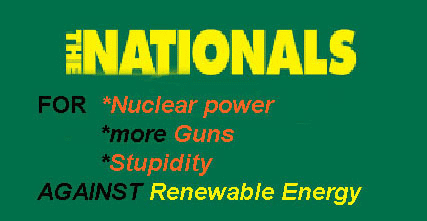
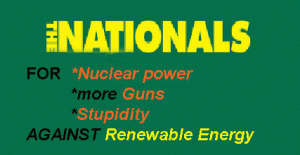 NSW Nationals formally support nuclear power stations, The Northern Daily Leader, 8July19
THE NSW Nationals have formally made supporting nuclear power a part of its policy platform, following a grassroots push from within the party.
At the recent annual conference in Inverell, a motion to “support the use of nuclear power in Australia” was put forward by both the Orange and Narrabri Nationals branches, and passed unanimously.
Narrabri chair David Scilley said the motion was born out of frustration with the nation’s energy debate.
“If they’re not going to let us have a new coal-fire power station, we have to look at nuclear power,” Mr Scilley said. “Renewables work when the winds blows and the sun shines, but they’ve got no back up. We need to cover base-load power.”
Mr Scilley said it was up to the regions to lead the controversial debate.
“People out in the country are more practical – people in the city don’t realise where their food comes from or what it takes to produce it,” he said “The government needs a push in the right direction. The biggest problem is minority groups get too much of a say.” Mr Scilley believes the majority of Australians would support nuclear power “if it meant a lot cheaper power”.
New England Nationals chair Russell Webb was singing off the same hymn sheet…..
“I think if we take emotions out of it and face the topic realistically, we can see that this nation has some fantastic resources, ones that can supply either fuel for coal-fire power stations or nuclear power.” Mr Webb said it was “foolish” for Australia to think of an energy future without a secure base-load supply. Nuclear power stations, which are used across the world, are one great solution for that,” he said.
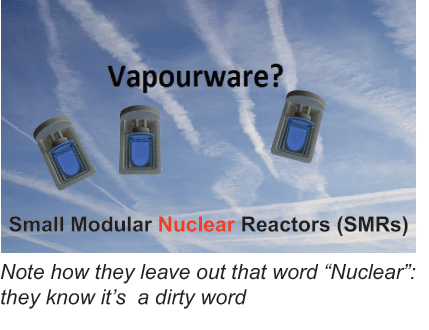
NSW Nationals leader and Deputy Premier John Barilaro recently said Tamworth or Armidale could be the site of a new nuclear power station. Mr Barilaro said modern nuclear power technology means small scale plants could be established in parts of regional Australia. “If you want to get away from coal, well nuclear energy, there’s a real chance for it because of the new technology, the new small modular reactors that are now on the horizon,” Mr Barilaro said.
July 9, 2019
Posted by Christina Macpherson |
New South Wales, politics |
Leave a comment
AFP emails shed new light on media investigations, show officers were armed during raids, SMH, By Kylar Loussikian and Bevan Shields, July 5, 2019 The Australian Federal Police initially classified its investigation into a high-profile national security leak as “routine” and of “low value”, according to a cache of documents that also reveals police were armed when they launched two recent raids on the media.
Emails obtained by The Sydney Morning Herald and The Age under freedom of information laws also offer fresh evidence that Annika Smethurst, a senior member of the Canberra press gallery, could be prosecuted for publishing secret government information.
July 8, 2019
Posted by Christina Macpherson |
AUSTRALIA - NATIONAL, media, politics, secrets and lies |
Leave a comment
 (salient bits of the long, rather weird ramble)
The nuclear energy option A new paper undermines the claim it’s more about culture wars than electricity generation. THE AUSTRALIAN , By GRAHAM LLOYD , 4 July 19, “……….. A discussion paper prepared for the union-backed Industry Super Australia provides a blueprint for patient capital in the energy sector.
……….The view globally is that nuclear power provides the best emissions-free hedge against a failure of renewables to satisfy more than about one-third of a nation’s energy requirements.
Ed. the view globally – whose view exactly?
The Prime Minister is being urged to give his blessing to a review of the potential for nuclear energy in Australia.
Queensland MPs Keith Pitt and James McGrath have proposed terms of reference for an inquiry that will review advances in nuclear energy including small nuclear reactors and thorium.
The NSW parliament will conduct its own review.
One Nation MLC Mark Latham has legislation before parliament to legalise uranium mining and nuclear facilities.
“The climate change challenge is real but a renewables fetish can’t solve it,” he says.
NSW Deputy Premier John Barilaro has called for a national vote to end the ban and says the northern cities of Tamworth or Armidale could be the site of a new nuclear power station.
Scott Morrison says he won’t oppose nuclear if the economics stack up but no one is offering to build a reactor in Australia.
Advocates of the nuclear option are playing a long-term game.
In April, OECD Nuclear Energy Agency director general William Magwood made his first official visit to Australia. He met the energy ministry, the Australian Safeguards and Non-proliferation Office, the Australian Radiation Protection and Nuclear Safety Agency, the Australian Nuclear Science and Technology Organisation and the Energy Policy Institute of Australia……
Magwood’s discussions highlighted uranium resource issues but also focused on NEA analyses related to the decarbonisation of electricity systems and radioactive waste management.
While Australia has no plans to build nuclear plants, in 2016 the country joined the Generation IV International Forum, for which the Nuclear Energy Agency acts as technical secretariat.
Ed note: Let us not forget that nuclear industry law-unto-himself Dr Adi Paterson signed Australia up to this with no Parliamentary discussion and no government authorisation . A month later a senate committee ratified this – still no parliamentary discussion, despite the fact that Australa has laws against constructing nuclear reactors.
Magwood’s talks with Australian authorities included the latest research and development on advanced nuclear systems………
One of the themes of the discussion paper is that mainstream thinking on the energy market may be misleading in many areas…….Ultimately, there is the prospect that some wind and solar projects themselves may become stranded assets.
The problems of intermittency are at the heart of global concerns. Federal Energy Minister Angus Taylor is trying to address the issue with a reliability obligation for generators………
nuclear has advantages that intermittent sources of energy cannot provide.
And a recent OECD report assesses the levelised cost using a 3 per cent interest rate at $US100 per megawatt hour for commercial solar, $US70 per megawatt hour for onshore wind and $US50 a megawatt for nuclear………..
Ed. note. Really – source?
Australia lagging
It was noted that Australia is one of the few First World economies without nuclear power and experience in managing a nuclear plant…….
Ed note. Along with Austria, Denmark, Greece, Ireland, Italy, Latvia, Liechtenstein, Luxembourg, Malaysia, Malta, New Zealand, Norway, Philippines, and Portugal. Belgium, Germany, Spain and Switzerland are phasing-out nuclear power
Not considering nuclear puts Australia in the minority of First World economies. It is also lagging several Second and Third World economies in our region and elsewhere such as Argentina, Mexico, Bangladesh and Turkey and geographical neighbours such as Indonesia and Vietnam…….
Based on the Tesla battery in Adelaide, achieving 1½ days’ energy storage would cost $6.5 trillion, enough to build about 1000 nuclear reactors.
For household batteries, it would cost about $US7000 per household every 10 years to provide back-up for 36 hours……..
One important step would be to build some capacity to operate a nuclear facility.
This would provide insurance against failure in alternative options or rapid change in technology.
It says a single reactor would be a relatively small investment.
Ed note: really? https://www.theaustralian.com.au/inquirer/report-argues-for-the-nuclear-energy-option/news-story/f3faf4befb3d68cedc01c6735d467976
July 4, 2019
Posted by Christina Macpherson |
AUSTRALIA - NATIONAL, media, politics |
Leave a comment
The admission is contained in a statement of reasons signed by the minister before she approved the Yeelirrie uranium mine, 500km north of Kalgoorlie, the day before the federal election was called in April.
The document also shows the environment and energy department recommended conditions that would require the developer, Cameco, to ensure the project would not result in the extinction of up to 11 stygofauna, which are tiny groundwater species.
But Price instead adopted a weaker set of conditions aimed at reducing the risk to groundwater species but which the department said contained “significant uncertainties” as to whether or not they would be successful.
Price acknowledged the department had recommended tougher conditions but said in the statement that if they were imposed there was “a real chance that the project would not go ahead”.
“In making this recommendation, the department considered only the environmental outcomes, and did not weigh the environmental risks against the social and economic benefits of the project,” she said.
“Rather, as the department’s briefing noted, this balancing exercise was for me to do”.
Price wrote that she “accepted that there was a risk” that species could be lost but that the department’s advice was this was not “inevitable” if the project went ahead.
The statement of reasons also notes that the project could lead to the wipeout of the entire western population of a species of saltbush, known as the Atriplex yeelirrie.
The saltbush has just two distinct populations, the western and eastern population, both of which are found on Yeelirrie station.
The statement of reasons says the western population occurs entirely within the proposed area for the mine and there is a risk the development would clear all of it.
The Australian Conservation Foundation, which requested Price’s statement of reasons, described the document as “an extraordinary piece of decision making”.
July 4, 2019
Posted by Christina Macpherson |
AUSTRALIA - NATIONAL, environment, politics, uranium |
Leave a comment