Safety problems, conflict of interest in Lynas rare earths factory
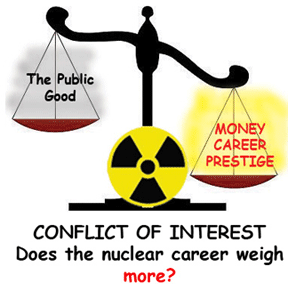 “Section 11 of the law allows the minister to direct regulators toward certain policies and so there’s massive
  conflict of interest,” said Dr Peter Karamoskos, an Australian nuclear radiologist.
Problems at Lynas factory can cause radioactive leaks, say experts The Malaysian Insider, 24 Nov 13, Prevailing problems in waste management, storage, disposal facility and waste cleaning at the Lynas factory can lead to radioactive leakages if the Australian firm fails to address the issues, said experts t at a seminar in Kuala Lumpur today.
The mining company’s refinery near Kuantan, Pahang, has several problems, which experts said in the event of an accident or carelessness, could harm to residents near the factory. Continue reading
Ranger Uranium Mine safety record cause for concern…again
20 Nov 13 The Northern Territory (NT) Branch of the Public Health Association of Australia (PHAA) is very concerned that four drums used for yellowcake transport have recently been found at a property in Darwin’s rural area, as reported in local media.
“We expect an immediate investigation into the radioactivity of these drums will follow and a further public and environmental health response will be taken accordingly. We understand these drums have since been claimed by ERA and taken to the Ranger mine,” said Dr Michael Fonda, PHAA’s NT Branch Secretary.
This current case follows a serious operational breach earlier this month where a Ranger mine vehicle left a controlled and contaminated area without authorisation.
“These latest incidents – in the context of more than one hundred reported safety failures over the last 30 years – continue to cast doubt on the effectiveness of the safety regulations at Ranger. They also come at a time when ERA is seeking approval for an expansion to uranium mining at the Ranger mine with the 3 Deepsunderground project,” explained Dr Fonda.
Of further concern are comments made by NT Mines Minister Willem Westra van Holthe yesterday, suggesting less Federal Government scrutiny in future NT uranium mining projects.
“These safety incidents, along with the inherent dangers associated with the uranium industry, reinforce the importance of strict government regulation at a federal level. The NT Branch of PHAA is calling for an urgent independent public inquiry into the safety operations at Ranger, including any proposed expansion of the industry in the region,” said Dr Fonda.
For further information/comment: Dr Michael Fonda, NT Branch Secretary, Public Health Association of Australia 0429 435 595
ERA’S GROWING LIST OF URANIUM FAILURES IS NO BARREL OF LAUGHS
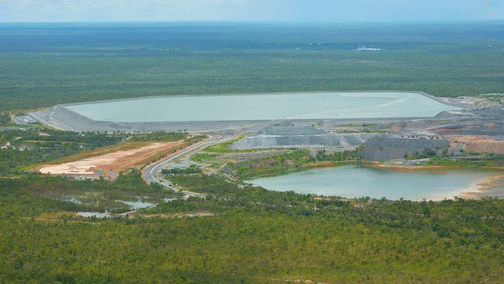 The Environment Centre NT and the Australian Conservation Foundation have condemned the latest in a conga line of failures at Ranger uranium mine amid revelations that four uranium barrels were discovered abandoned in Darwin’s rural area today.
Energy Resources of Australia (ERA) is currently under investigation for a serious operational breach following the recent unauthorised removal of a mine vehicle used in the controlled and contaminated area of the Ranger mine. This latest incident is further evidence of systemic failure at Ranger and highlights the need for an urgent review into the mine’s operations.
“ERA has not only lost control of a vehicle and uranium barrels, they’ve also clearly lost the capacity for responsible management and effective operations”, said Lauren Mellor from the Environment Centre NT. “Uranium mining, with its risks to public health and safety and long-term environmental contamination must be subject of greater Federal government scrutiny – not less as Northern Territory Mines Minister Willem Westra Van Holthe suggested today”.
Environmentalists are calling for a full, public and independent review of the operations and impacts of Ranger. “These drums are literally warning drums about the serious regulatory problems at Ranger and their description matches ERA’s assurances – empty, weathered and fire damaged”, said ACF nuclear campaigner Dave Sweeney. “ERA is currently undergoing an environmental assessment process for their proposed Ranger 3 Deeps underground mine and these systemic breaches should be a red light to Federal and Northern Territory Government assessors that ERA does not have either the capability or credibility to mine and export uranium safely and securely.”
“While there is still uncertainty as to the outcome of the investigation into ERA’s security breach, some things are crystal clear. It is clear that ERA has failed to control its operations on or off the Ranger mine, clear that the regulatory regime is deficient and clear that there is an urgent need for an open and independent review of Ranger.”
In 2011 it was confirmed that Australian uranium was inside the failed Fukushima nuclear reactor and the UN Secretary-General called on Australia to conduct an in-depth assessment of the net cost impact of the impacts of uranium mining on local communities and ecosystems. Environmentalists are calling for this assessment to now be urgently implemented.
“ERA is losing vehicles, barrels and credibility and the Northern Territory community is losing confidence and patience. It is time for the regulators and those who are meant to protect the community and country of Kakadu to get serious and get to work on closing the door to this toxic industry for good,” concluded Ms Mellor.
Lost uranium drums show regulatory failure at Rio’s Ranger mine
 20 Nov 13, The Gundjeihmi Aboriginal Corporation (GAC) is outraged by revelations that four uranium barrels from Ranger uranium mine have been located at Noonamah south of Darwin. It is understood that the NT Department of Health yesterday notified Energy Resources of Australia (ERA) of the drums and asked that they be removed. The drums have been returned to the Ranger mine within the bounds of Kakadu National Park for safe storage. This incident comes within weeks of another serious breach of radiation management at Ranger when a potentially contaminated vehicle left the Ranger site without authorisation
GAC’s Chief Executive Officer Justin O’Brien said: “It is clear that the radiation control measures at the Ranger mine site have failed on multiple occasions. While we welcome the timely reporting of this issue by the company, ERA’s management of radiation is plainly inadequate.
“The Commonwealth Government must step in and ensure that this matter is taken seriously. To date the response by the Office of the Supervising Scientist (OSS) has been dismissive and woefully inadequate. Both the NT and Federal Governments must broaden their current investigations into the vehicle incident and examine the entire management of radiation at the Ranger mine.
“This is not a only a matter between the Mirarr and the mining company, there are significant questions of public health to be considered here. We expect these issues to be considered in a comprehensive investigation of these incidents.
“This revelation raises very serious concerns for the Mirarr Traditional Owners regarding the suggestion of further mining at Ranger,” Mr O’Brien concluded.
Doubts raised on the safety of Ranger uranium mine
ACF questions Ranger uranium mine safety http://news.ninemsn.com.au/national/2013/11/08/16/49/acf-questions-ranger-uranium-mine-safety 8 Nov 13 It would be a case of good luck rather than good management, if it turns out there is no radiation contamination due to an an unauthorised vehicle leaving the Ranger uranium site in Kakadu, an environment group says. At about midnight on Sunday, a controlled vehicle used in the most contaminated parts of the Rio Tinto-owned Ranger mine left the site without permission. Continue reading
Safety slip up at ERA’s Ranger uranium mine disturbs Aboriginal landowners
Uranium contamination fears: police investigate Rio Tinto Ranger mine SMH, November 8, 2013 Peter Ker Resources reporter Rio Tinto’s relationship with an indigenous group in Kakadu National Park has taken ”two steps backward” after a safety breach at the Ranger uranium mine.
The Rio subsidiary that operates Ranger, Energy Resources of Australia, has confirmed that a vehicle used within the mine was taken out of controlled areas, sparking contamination fears among the nearby Mirrar people. Police are investigating the incident, which took place without the consent of ERA management in the early hours of Sunday morning, and which some believe may be a breach of the company’s authorisation to mine.
Like all uranium mines, Ranger operates under strict conditions to ensure dangerous levels of uranium do not contaminate the nearby area. ERA said the car – which was supposed to remain inside the mine at all times – had been checked and was ”free of contamination”.
But Justin O’Brien, who represents the Mirrar people, said it had caused great concern among the local community.
”We think it is very serious that you could take potentially contaminated material from an operational mine site, avoid all scrutiny, leave the mine site with it and then be found down the highway,” he said. ”There needs to be a broader inquiry into how on earth this could happen in the first place.”
ERA’s relationship with the Mirrar people is crucial to its survival, given the company has agreed not to restart mining at Ranger without approval from the group. Ranger ceased operating as an open-cut mine last year, and its only future lies in winning approval to become an underground mine in coming years.
The nearby Jabiluka uranium deposit will also not be mined until the Mirrar people give their full support, something that appears unlikely any time soon………Australian Conservation Foundation spokesman Dave Sweeney said it was not the first breach at Ranger, and it was time for Rio Tinto to ”reconsider the project”. http://www.smh.com.au/business/uranium-contamination-fears-police-investigate-rio-tinto-ranger-mine-20131107-2x46w.html#ixzz2k5tWwFN7
US bombs on the Great Barrier Reef are PROBABLY safe
Bombs dropped on Reef ‘virtually impossible’ to explode SMH, Kim Stephens, July 24, 201 US naval authorities say it is ‘‘virtually impossible’’ two undetonated bombs lying on the Great Barrier Reef will explode.
United States 7th fleet spokesman Lieutenant David Levy has revealed four bombs – two inert and two explosive – dropped in the ocean off Rockhampton by US warplanes during a recent bungled training exercise may not be recovered.
‘‘The Australian and US governments are currently reviewing this possibility’’, Lieutenant Levy said, when asked if they would be retrieved……: http://www.brisbanetimes.com.au/queensland/bombs-dropped-on-reef-virtually-impossible-to-explode-20130724-2qi1l.html#ixzz2a6oHziSi
Mobile phones and kids; not ionising radiation, but still cause for concern
Cell phone radiation has been classed by the World Health Organization as a possible human carcinogen in the same category as diesel engine exhaust, some pesticides, and some heavy metals. As Dr. Devra Davis of the Environmental Health Trust points out, “we would never let a child play with some pesticides, heavy metals, or diesel engine exhaust. Yet people are giving their children cellphones.”
The people from down under are waking up to the importance of keeping children safe from cell phone radiation; all parents must wake up and act now
Parents should limit their child’s cell phone use; says federal radiation health watchdog http://www.naturalnews.com/041231_children_cell_phone_use_radiation_exposure.html#ixzz2ZQSQ02gK , July 17, 2013 by: Lloyd Burrell (NaturalNews) It’s an all too familiar scene: children, some as young as nine, spending an exorbitant amount of time on cell phones. What may not be as familiar, and therefore go unnoticed, is the sight of children who are suffering and sick from cancer, specifically brain cancer. Australia has noticed and is very concerned about the connection between these two trends. Through the federal government health watchdog, Australian Radiation Protection and Nuclear Safety Agency (ARPANSA), Australia has issued a warning. One which speaks volumes.
In a “fact sheet” distributed to parties interested in purchasing and using cell phones, the consumer watchdog group has put out a warning in regards to children and mobile phones. Or more importantly, children and cell phone radiation.
How many kids does this really affect?
As many as 25 percent of nine-year-olds living in Australia and three out of four teenagers attending high school in the land down under have regular access to a cell phone. ARPANSA recommends that parents assist their children in limiting their exposure to the radiation that is emitted from cell phones. The federal organization bases this on the research surrounding children and cell phone use. Continue reading
Radiation leak plans at Olympic Dam uranium mine – 15 years out of date
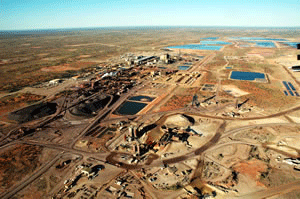 Olympic Dam mine radiation leak plan 15 years out of date news.com.au by: Miles Kemp The Advertiser July 07, 2013 THE radiation plans for Olympic Dam are more than 15 years out of date because of an administrative bungle, the Environment Protection Authority has revealed.The plans are needed because between 2003 and 2012, BHP-Billiton reported 31 radiation leaks at its Olympic Dam mine, totalling more than 3000 cubic metres of material, or the volume of a large hot-air balloon.
Responding to a Freedom of Information application that exposed the problem, the EPA could only find plans from 1997 and 1998 and has stated: “We acknowledge that an update is overdue and action is being taken to address this situation”. Greens MLC Mark Parnell said he sought a copy of the management plan to monitor how BHP-Billiton dealt with radiation leaks to protect workers and the environment.”Workers at Olympic Dam are at risk because the EPA and BHP-Billiton have failed to update their practices for over 15 years,” he said. “What sort of oversight is there by the EPA at Olympic Dam when the basic management plan required under the National Code is ridiculously out of date?”
The EPA searched its records for 10 months before responding that there was no up-to-date plan and it needed a new one. “All these plans should be available in the public realm and not have to be chased using FOI application,” Mr Parnell said.
He said there had been six triggers since 1998 that should have prompted an updated plan, including an expansion in the mine’s capacity.”Between 1998 and 2013, an extraordinary amount of change has occurred in the regulation of radioactive material, with increasing awareness of the risks to workers and the natural environment and advances in processing,” he said…….. http://www.adelaidenow.com.au/national-news/south-australia/olympic-dam-mine-radiation-leak-plan-15-years-out-of-date/story-fnii5yv4-1226675659296#ixzz2YU1PMjCI
Australia’s SILEX uranium enrichment technology – a nuclear weapons danger
a SILEX facility could make it much easier for a rogue state to clandestinely enrich weapons grade uranium to create nuclear bombs
SILEX could become America’s proliferation Fukushima,
Controversial nuclear technology alarms watchdogs http://www.smartplanet.com/blog/intelligent-energy/controversial-nuclear-technology-alarms-watchdogs/18138 By David Worthington | July 30, 2012 A controversial nuclear technology is raising alarms bells among critics who claim it may be better suited for making nuclear weapons than lowering the cost of nuclear power and could lead to a nonproliferation “Fukushima” for the United States.
SILEX (separation of isotopes by laser excitation) is a method for enriching uranium with lasers. It was developed by Australian scientists during the mid 1990’s as a way to reduce the cost of nuclear fuel, because uranium must be processed before it can be used to generate power.
The scientists formed Silex Systems to license the technology for commercialization, and that process is still ongoing. In 2000, the governments of Australia and the United States signed a treaty, giving the U.S. authority to review whether SILEX should be deployed. That’s because there could be a major proliferation problem. SILEX reduces the steps necessary to transform fuel grade uranium into to weapons-grade uranium, and the process doesn’t create telltale chemical or thermal emissions, according to an article published by the Bulletin of the Atomic Scientists. R. Scott Kemp, an assistant professor of nuclear science and engineering at MIT, has the byline. Continue reading
Don’t let Australia’s uranium lobby remove safeguards – say doctors
It is essential that appropriate environmental and human safeguards remain, and that uranium mining and milling remains within the definition of “nuclear actions” for the purposes of the EPBC Act. There is a clear need for federal oversight to ensure clear and consistent implementation of these measures
Medical Assocation for the Prevention of War (MAPW) SUBMISSION ON FEDERAL REGULATION OF URANIUM MINING, by Dr Margaret Beavis April 2013 The uranium mining industry is attempting to remove federal overview of uranium mining. MAPW Vice-President Dr Margaret Beavis has prepared this submission to the Productivity Commission arguing that federal oversight should remain, and noting that as risks to health and the environment become more apparent, radiation regulation is increasing internationally.:
 It is concerning that the uranium industry has used the expression “mild radiation” to describe its radiological environmental impacts, when there is no regulatory basis or definition to use this term, potentially giving the impression that the levels of radiation in the uranium mining industry are without risk to the environment. The evidence is clear and unassailable that this is not correct. Furthermore, it is appropriate that uranium mining continue to be considered a ‘nuclear action’ as specified by the EPBC Act as the radioactivity derives specifically from nuclear decay processes. Tailings from uranium mining are radioactive for millennia, resulting in unique environmental considerations for every uranium mine.
The International Commission on Radiological Protection has determined that the dose coefficient for radon gas, one of the sources of radioactivity from uranium mining, needs to be doubled, indicating that it is actually thought to be double the previously estimated carcinogenic hazard.1. ARPANSA is currently in the process of revising dose estimates to workers. It follows that risks to others is doubled and makes it even more essential appropriate mitigation strategies are introduced. It also follows that the environmental risk is also increased. Continue reading
Radiation in consumer products:Australian Radiation Protection and Nuclear Safety Agency calls for comments
 Draft IAEA Safety Guide for Comment: DS458 – Radiation Protection and Regulatory Control for Consumer Products
By Judi Anderson – 08 February 2013
 The IAEA has requested comment on a draft safety guide DS458 – Radiation Protection and Regulatory Control for Consumer Products. The object of the document is to provide recommendations for the application of the requirements relating to the system of regulatory control for consumer products laid down in Radiation Protection and Safety of Radiation Sources: International Basic Safety Standards – Interim Edition (IAEA Safety Standards Series No. GSR Part 3 (Interim)).
so that we can forward a consolidated Australian response to the IAEA by the due date.
Lucas Heights nuclear reactor shut down. Fire has been brought under control
 “The OPAL reactor is shut down and is safe.
Some sources say that the fire broke out as the city sweltered through a heat wave, which has caused dozens of bushfires, but the ANSTO saidthe incident was not related to the current weather conditions.
Fire has broken out at a nuclear research facility in Sydney, but its
operators say the blaze has been brought under
control.http://www.presstv.ir/detail/2013/01/08/282384/fire-breaks-out-at-sydney-nfacility/
The fire broke out at the Lucas Heights nuclear plant in southern
Sydney on Tuesday (local time)
The Australian Nuclear Science and Technology Organization (ANSTO)
raised the alarm at 10.36 a.m. local time (12.36 p.m. NZT) after smoke
was detected in an electrical substation at the rear of the facility,
which contains two nuclear reactors. Continue reading
Lucas Heights nuclear reactor has fire in two rooms
 Fire burning at Lucas Heights nuclear reactor http://www.abc.net.au/news/2013-01-08/fire-burning-at-lucas-heights-nuclear-reactor/4456538 MAP: Lucas Heights 2234
A fire has broken out in an electrical substation building at the Lucas Heights nuclear reactor in Sydney’s south.
Fire crews are attending the scene.
A Fire Brigade spokesman says smoke has been reported in two rooms.
The fire is believed to have been started by an electrical failure.
Australian govt promotes uranium industry – regardless of safety and weapons proliferation issues
Australian governments and uranium companies could help to break the vicious cycle by making uranium exports conditional on adequate safety standards and proper regulation – but they don’t.
Even more troubling is the willingness of successive Australian governments to turn a blind eye to weapons proliferation concerns in North Asia.
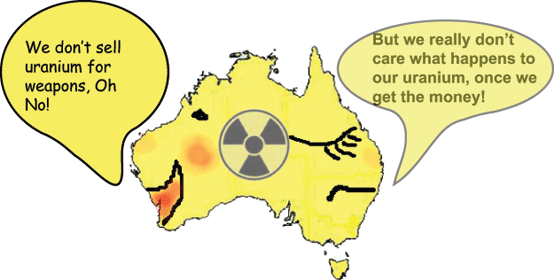
How can we trust nuclear, if we can’t trust its operators? http://www.thepunch.com.au/articles/how-can-we-trust-nuclear-if-we-cant-trust-its-operators/ by Jim Green 13 DEC Whether it’s nuclear safety or weapons proliferation, the federal government (and the Opposition and the mining companies) can be safely relied upon to exacerbate problems with irresponsible uranium export policies.
Widespread safety breaches and proliferation concerns in North Asia are recent manifestations of the problem. In May, five
engineers were charged with covering up a potentially dangerous power failure at South Korea’s Kori-I reactor which led to a rapid rise in the reactor core temperature. Continue reading
1 This month.
20 September –National Day of Action in Melbourne on the International Day of Peace


Help Aunty Sue Protect Her Land and Sacred Sites From Destructive Rocket Testing.
.

Australians deserve the truth
about
AUKUS – https://aukuspublicinquiry.com/
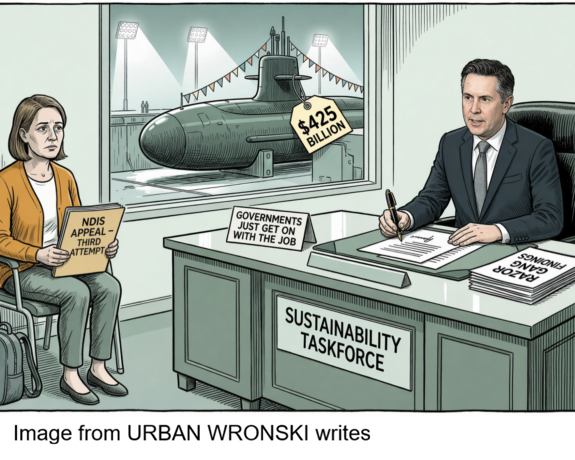

PETITION – To: Prime Minister Anthony Albanese and the Australian Labor Government

of the week – Australians for War Powers Reform (AWPR)
To see nuclear-related stories in greater depth and intensity
 Antinuclear