Defence hides Australia’s weapon sales to Israel amid war crimes investigation into Palestine,
The Australian Centre for International Justice joined with the Palestinian Human Rights Organizations Council to write a submission to the Department of Foreign Affairs and Trade on the feasibility of a free trade agreement (FTA) with Israel. The organisations said Australia should not negotiate an FTA but should instead impose an arms embargo on Israel and suspend defence cooperation and defence industry partnerships.
This call was echoed in a petition signed by 22,000 Australians and tabled in federal parliament last week. The petition demanded targeted sanctions, an arms embargo, an end to defence cooperation and an end to all Australian support for Israeli settlements.
Defence hides Australia’s weapon sales to Israel amid war crimes investigation into Palestine, https://www.michaelwest.com.au/defence-hides-australias-weapon-sales-to-israel-amid-war-crimes-investigation-into-palestine/ By Michelle Fahy Revolving Doors|August 16, 2021
Defence has elevated “opportunities for Australian companies” over human rights and transparency in weapons sales, as an investigation by Michelle Fahy reveals 187 permits for military exports to Israel.
The Defence Department approved 187 permits for military exports to Israel in the six years to March 31, according to figures released under Freedom of Information (FOI).
The figures prompted questions about the ethics of Australia approving the export of weapons, military technology and other military goods to Israel, given its large number of documented violations of international human rights law in Palestine over decades.
In May, Israel conducted a devastating military campaign against the Gaza Strip and the West Bank. The bombardment lasted 11 days with the UN reporting more than 220 Palestinians killed, including 63 children, and thousands injured. At least 12 Israelis also died following indiscriminate rocket attacks by armed Palestinian groups.
There are Defence reports showing Australia has sent military exports to Israel from the early years of this century, but ties between the two countries have deepened in the past few years. Australia and Israel have recently expanded cooperation on national security, defence and cyber security. The two countries signed a defence industry cooperation agreement in October 2017. Eighteen months later, a new Australian Trade and Defence Office opened in West Jerusalem tasked with facilitating trade, investment and defence industry partnerships. Trade Minister Dan Tehan is also canvassing a free trade agreement with Israel.
“It is horrifying to learn that Australia is approving so many export permits to Israel – one of the most heavily militarised states in the world, which has been subjecting the Palestinian people to a brutal military occupation for over five decades,” said Rawan Arraf, Executive Director, Australian Centre for International Justice. “It’s highly likely then, that Australian goods are being used in aiding and abetting war crimes and crimes against humanity. We have a right to know what is being exported and to demand that it ends.”
Continue readingMinister Pitt – an expert in ”weasel words”, obscuring the truth about nuclear waste
https://www.neimagazine.com/news/newsaustralian-government-names-preferred-site-for-waste-facility-8991297?fbclid=IwAR2ff81oErRTHbzggGt3GeqqghFSYmbu6HPECUgpUbBPOmlbKf1Sx5Fg0OE
—
Napandee station, near Kimba on South Australia’s Eyre Peninsula has been officially named as the preferred site for Australia’s domestically generated nuclear waste.

Note Minister Pitt’s declaration that waste classified as “intermediate” will only be stored “temporarily” and “sometimes”.
We’ve discussed the deceptive labeling of reprocessed spent fuel as intermediate level nuclear waste in this group before- other countries consider this substance to be high level nuclear waste.
Newcomers to this subject (ie. the general public) could be easily misled to believe that there is no spent nuclear fuel to be stored at the site through this wordsmithery.
Resources Minister Keith Pitt and his bald-faced lies about the Leonora nuclear waste proposal
26 July Kazzi Jai on Whyalla Pitt lies
“Federal Resources Minister Keith Pitt said the government did not receive detailed information to independently assess a site at Leonora, and couldn’t accept “unverified information” which could “cut short” the consultation and assessment process.”
This is the BIGGEST BALD FACED LIE Minister Keith Pitt has said yet!!
The current Leonora site proposal HAS been actively giving the Feds detailed information since 2017 I believe…..at EXACTLY the SAME TIME as Kimba was allowed to SUBMIT AGAIN into the mix after being taken COMPLETELY OFF the list in April 2016, after being deemed unsuitable!
Can’t have it both ways!
In fact ANOTHER site in Leonora Western Australia WAS in the mix back in 2015, as one of the SEVEN short listed sites deemed suitable by the Feds – by the then Josh Frydenberg as Minister at the time!
It was a different site in Leonora – but nevertheless, echoes the SAME SITUATION as Kimba in many ways!
Key witness in Julian Assange case admits to lies in indictment
A major witness in the United States’ Department of Justice case against Julian Assange has admitted to fabricating key accusations in the indictment against the Wikileaks founder. STUNDIN, Bjartmar Oddur Þeyr Alexanderssonbjartmar@stundin.is, Gunnar Hrafn Jónssonritstjorn@stundin.is 26 June 21,
A major witness in the United States’ Department of Justice case against Julian Assange has admitted to fabricating key accusations in the indictment against the Wikileaks founder. The witness, who has a documented history with sociopathy and has received several convictions for sexual abuse of minors and wide-ranging financial fraud, made the admission in a newly published interview in Stundin where he also confessed to having continued his crime spree whilst working with the Department of Justice and FBI and receiving a promise of immunity from prosecution.
The man in question, Sigurdur Ingi Thordarson, was recruited by US authorities to build a case against Assange after misleading them to believe he was previously a close associate of his. In fact he had volunteered on a limited basis to raise money for Wikileaks in 2010 but was found to have used that opportunity to embezzle more than $50,000 from the organization. Julian Assange was visiting Thordarson’s home country of Iceland around this time due to his work with Icelandic media and members of parliament in preparing the Icelandic Modern Media Initiative, a press freedom project that produced a parliamentary resolution supporting whistleblowers and investigative journalism.
The United States is currently seeking Assange’s extradition from the United Kingdom in order to try him for espionage relating to the release of leaked classified documents. If convicted, he could face up to 175 years in prison. The indictment has sparked fears for press freedoms in the United States and beyond and prompted strong statements in support of Assange from Amnesty International, Reporters without borders, the editorial staff of the Washington Post and many others.
US officials presented an updated version of an indictment against him to a Magistrate court in London last summer. The veracity of the information contained therein is now directly contradicted by the main witness, whose testimony it is based on.
No instruction from Assange
The court documents refer to Mr Thordarson simply as “Teenager” (a reference to his youthful appearance rather than true age, he is 28 years old) and Iceland as “NATO Country 1” but make no real effort to hide the identity of either. They purport to show that Assange instructed Thordarson to commit computer intrusions or hacking in Iceland.
The aim of this addition to the indictment was apparently to shore up and support the conspiracy charge against Assange in relation to his interactions with Chelsea Manning. Those occurred around the same time he resided in Iceland and the authors of the indictment felt they could strengthen their case by alleging he was involved in illegal activity there as well. This activity was said to include attempts to hack into the computers of members of parliament and record their conversations.
In fact, Thordarson now admits to Stundin that Assange never asked him to hack or access phone recordings of MPs. His new claim is that he had in fact received some files from a third party who claimed to have recorded MPs and had offered to share them with Assange without having any idea what they actually contained. He claims he never checked the contents of the files or even if they contained audio recordings as his third party source suggested. He further admits the claim, that Assange had instructed or asked him to access computers in order to find any such recordings, is false.
Nonetheless, the tactics employed by US officials appear to have been successful as can be gleaned from the ruling of Magistrate Court Judge Vanessa Baraitser on January 4th of this year. Although she ruled against extradition, she did so purely on humanitarian grounds relating to Assange’s health concerns, suicide risk and the conditions he would face in confinement in US prisons. With regards to the actual accusations made in the indictment Baraitser sided with the arguments of the American legal team, including citing the specific samples from Iceland which are now seriously called into question.
Other misleading elements can be found in the indictment, and later reflected in the Magistrate’s judgement, based on Thordarson’s now admitted lies. One is a reference to Icelandic bank documents. The Magistrate court judgement reads: “It is alleged that Mr. Assange and Teenager failed a joint attempt to decrypt a file stolen from a “NATO country 1” bank”………..
On the FBI radar
Thordarson’s rogue acts were not limited to communications of that nature as he also admits to Stundin that he set up avenues of communication with journalists and had media pay for lavish trips abroad where he mispresented himself as an official representative of WikiLeaks………………………. https://stundin.is/grein/13627/key-witness-in-assange-case-admits-to-lies-in-indictment/
Maralinga nuclear bomb tests – British and Australian governments’ callous cruelty to First Nations people.

Australia’s Chernobyl: The British carried out nuclear tests on Indigenous land. It will never heal. https://www.mamamia.com.au/maralinga-nuclear-testing/ CHELSEA MCLAUGHLIN, JULY 5, 2021 For tens of thousands of years, the Aṉangu people lived on the warm, red earth of their country.
The land provided them with food, water and shelter as they travelled around an area we now know as outback Far North South Australia.
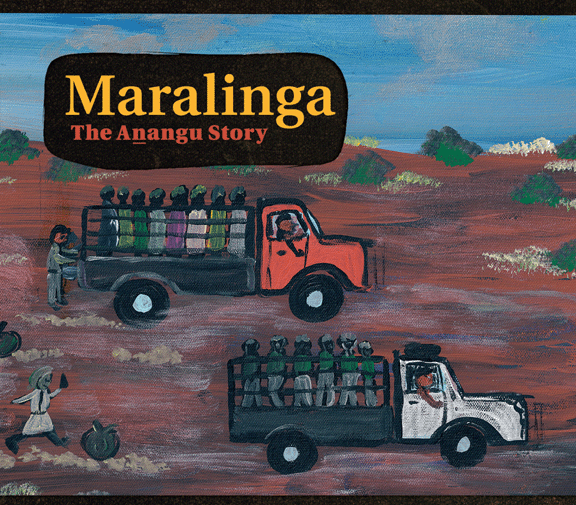
But after colonisation, they were moved off their land: forcibly removed, sent into missions across the region and displaced by train lines linking Australia’s east and west that impacted their water supply.
Much of the information around the tests was highly classified, and some information remains so.
For tens of thousands of years, the Aṉangu people lived on the warm, red earth of their country.
The land provided them with food, water and shelter as they travelled around an area we now know as outback Far North South Australia.
But after colonisation, they were moved off their land: forcibly removed, sent into missions across the region and displaced by train lines linking Australia’s east and west that impacted their water supply.
Much of the information around the tests was highly classified, and some information remains so.
Thirty per cent of the British and Australian servicemen who were exposed during these tests died of cancer, though a Royal Commission in 1984 was not able to reach a conclusion linking their health issues directly to the blasts.
Similarly, many locals died prematurely, went blind and suffered from illness that may have been linked to radiation.
British nuclear scientists, wanting to determine the long-term effects of the tests on Australia and its citizens, ordered the testing of dead Australian infants and children for radiation contamination.
Between 1957 and 1978 in hospitals around Australia, bones were secretly removed from 21,830 bodies. They were reduced to ash and sent away to be analysed for the presence of Strontium 90, a radioactive isotope produced by nuclear fission.
Unsurprisingly, none of the First Nations people of the region were told about the tests and many of the bones were taken without permission.
Associate professor Liz Tynan, the author of Atomic Thunder: The Maralinga Story, told Mamamia‘s The Quicky First Nations people were still in the area during the periods of testing, and this led to disastrous consequences.
Tynan said the Milpuddie family – Charlie, Edie, two kids and their dogs – were found by British service personnel in 1957, camped on the crater left by the bomb Marcoo soon after it had been detonated.
They were rounded up and most of the family, not Edie, but most of them, were given showers. Edie didn’t wish to have a shower,” Tynan explained.
“They were tested for radioactivity and the geiger counters did detect radioactivity, particularly on the young boy Henry. Anyway, there were rather insensitively treated I suppose, given showers, had clothes put on them and then take off down south to a mission.”
Their dogs were shot in front of them. Edie was pregnant at the time, and she later lost her child.
“It was a tragic story and indicative of the callous approach to Indigenous people that was displayed by both the British government and their officials that were conducting the tests, and by the Australian government as well,” Tynan said.
Following the testing, many Aṉangu people returned to the area, but the lands that had previously sustained and protected them were now poison.
We still don’t know the truth impact of the bombs at Maralinga, as well as nearby Emu Fields and the Montebello Islands off the coast of Western Australia.
“The South Australian Department of Health commissioned a fairly extensive study, [but] that study was hampered by the fact there was no base-line data from which to understand the general health of the population before the tests,” Tynan said.
The study did show an increase in various cancers, but most of the findings were inconclusive due to a lack of information. Indigenous Australians were not counted in the census at the time and there was very little known about the health of the populations.
In 1964, a limited cleanup of the Maralinga site, named ‘Operation Hercules’, took place.
A year after a 1966 survey into the level of contamination at the site, a second clean-up titled ‘Operation Brumby’ filled 21 pits with contaminated equipment and covered them with 650 tonnes of concrete.
Tynan said it was later found the survey data was drastically wrong, and the contamination was 10 times worse than thought.
It wasn’t until decades later, with the help whistleblowers and scientists, that the government began to realise the true, horrifying extent of the damage done to the land at Maralinga.
Under an agreement between the governments of the United Kingdom and Australia in 1995, another clean-up took place. And while this was more thorough than the previous, it still came with issues.
Whistleblower Alan Parkinson, who wrote the 2007 book Maralinga: Australia’s Nuclear Waste Cover-up, exposed the unsatisfactory methods.
The plan had been to treat several thousand tonnes of debris contaminated with plutonium by a process called situ vitrification. Against the advice of Parkinson, the government extended the contract of the project manager, even though that company had no knowledge of the complex process of vitrification.
Parkinson was let go from the project.
The government and the project manager then embarked on a hybrid scheme in which some pits would be exhumed and others treated by vitrification. After successfully treating 12 pits, the 13th exploded and severely damaged the equipment. The government then cancelled the vitrification and simply exhumed the remaining pits, placed the debris in a shallow pit and covered it with clean soil.
Parkinson told The Quicky another, complete clean-up of Maralinga could take place, but it was unlikely because of the cost and the courage it would take to admit the previous attempts were insufficient.
Around the same time as the 90s clean up was the Australian government push for a nuclear waste dump to be located nearby.
Fearing even further poisoning of their country, First Nations woman Eileen Wani Wingfield co-founded the Coober Pedy Women’s Council to campaign against the proposal.
The plan was eventually abandoned, but has popped up again in many forms over the decades. Currently, the Coalition is amending a bill that could see a site set up near Kimba.
Glen Wingfield, Eileen’s son, has spent his life working and learning from his parents’ tireless campaign for protection of their country.
The theme of NAIDOC Week 2021 is Heal Country! but as Wingfield told The Quicky, much of the Aṉangu lands in and around Maralinga are beyond healing.
“A lot of the Aboriginal communities that live in and around that area, they just will not and do not go back near that country. I think that’s a word, healing, that we can’t use in the same sentence with that area.”
Tynan agreed, saying there are parts of the area that will be uninhabitable for a quarter of a million years.
“There are parts of the site that you can’t go to, that are still very dangerous,” she said.
“The real problem at Maralinga was the plutonium which was detonated in a series of trials… The particular type of plutonium they used, plutonium 239, has a half-life of 21,400 years which takes hundreds of thousands of years for that radioactivity to diminish.”
Wingfield said the broken connection between these people and their lands is “just downright disgraceful and horrible”.
“No amount of conversation will ever cover what’s been done for people in and around. The lasting effects of health issues on people have been passed through people who were there to generational abnormalities… I think when you talk compensation and stuff, I don’t think we’ll ever get close.”
Nuclear waste intended for Kimba, -used to be classified as ”high level” – now called ”intermediate”.
Zac Eagle No nuclear waste dump in South Australia , 16 June 21
teSponst9oreduh · “High Level waste from the existing HIFAR reactor is due to return in 2015 from reprocessing in France”Federal Parliament – 24 January 2005.
This is the stuff they want to dump in SA.When was it reclassified as Intermediate Waste? The link https://www.aph.gov.au/…/BN/2011-2012/RadioActiveWaste
ANSTO’s dodgy classification of nuclear wastes.
When the re-processed material is returned to Australia invariably the processing country refers to that material as high-level waste but ANSTO reclassifies it as intermediate level on the very weak argument of the classifications in Europe being different to Australia…… it seems ludicrous that it should assume its own manner of classification and against the treaty adopted classifications of IAEA and adhered to by other countries.
(b) the intermediate level waste should even when stored on a temporary basis be geologically buried at appropriate depths.
The prescriptive codes of IAEA have been fully adopted by ARPANSA12 as its standards for the classification and treatment and management of nuclear waste in Australia.
It is interesting that a new subsection 3(2) of the Bill gives effect to Australia’s obligations as a party to the Joint Convention for the safe and secure management of what is defined as decontrolled material and in particular Australia’s obligations under Chapters 3 and 4 of the Joint Convention.
The government has always stated that the facility at Kimba would only be used for the permanent disposal of low-level waste and indefinite storage of intermediate level waste with that storage period being up to 100 years.
The government has described the facility at Kimba as being a central one for Australia with the implication that it would dispose of or store as required all the present legend or stockpiled waste in Australia and all waste generated locally in the future.
After accepting Napandee as a nominated site the government engaged AECOM to carry out what is described as a characterisation study of the site at Napandee which concluded with a technical report dated 23 July 2018.
That summary added little to the technical nature of both Kimba sites and dealt principally with community consultations and the results of a recent ballotWhile all three reports were colourful presentations with elaborate artwork and photographs in reality by technical standards they contained little proper information to support and satisfy the selection of Napandee as the site for the waste management facility.
environmental hazards such as seismic and flooding events, can be mitigated via design solutions.
This conclusion again shows that the Napandee selection was both premature as to its choice by the government due to the lack of a full assessment and investigation of the site and completely unsuitable for the facility.
Australia’s News Corpse, Nine media, and Resources Minister Keith Pitt have been duped by the Minerals Council of Australia.
Australia’s major media organisations, News Corp and Nine Entertainment, have been duped by the mining lobby’s false claims about its contribution to Australia. The industry peak body, Minerals Council of Australia, has failed to include in its analysis the more than $72 billion in GST rebates the industry has received between 2010 and 2018, and an estimated $80.6 billion over the past 10 years.
The Australian, the Australian Financial Review, and the Minister for Resources Keith Pitt have consistently repeated the misleading claims provided to them by the mining lobby via the firm the MCA hired to conduct its reports, Deloitte Access Economics.
Deloitte found that the minerals industry had contributed more than $238 billion in company tax and royalty payments since 2010, with $132 billion from company tax alone.
However, the report avoids mentioning that the mining industry, as an exporting industry, receives a huge GST rebate every year…………. https://www.michaelwest.com.au/murdoch-media-nine-entertainment-mining-lobby-busted-for-record-bullartistry-go-into-hiding/
Australia/UK Free Trade Agreement will give corporations the right to sue governments.

Australia/UK Free Trade Agreement: What’s the Scam? https://www.michaelwest.com.au/australia-uk-free-trade-agreement-whats-the-scam/
by Michael West | May 31, 2021 The British Trade Minister has confirmed that corporations are likely to have the right to sue the Australian and UK governments if governments make laws which hit their profits. What’s the scam?
ISDS is the scam; Investor-State Dispute Settlement that is, clauses buried in “Free Trade” agreements, such as this one, which allow corporations to sue governments in obscure foreign tribunals. Australia’s most celebrated ISDS case was brought by tobacco giant Phillip Morris which sued Australia in Hong Kong when Australia introduced its wonderfully successful plain packaging laws.
“There are now over 1,000 known ISDS cases, with increasing numbers against health and environment laws, including laws to address climate change,” says Patricia Ranald convenor of the Australian Fair Trade & Investment Network (AFTINET).
“ISDS would give UK corporations the right to sue Australia over democratic legal changes in Australia. For example, British aged care company BUPA could claim compensation if the government follows the recommendations of the Royal Commission into Aged Care Quality and Safety and regulates for improved staffing levels and quality of care.”
Just another chapter in the saga of rising corporate power over democracy.
The appalling mistreatment of Australian citizen, Julian Assange, – by USA, UK, and Australia
CHRIS HEDGES ON THE RULING CLASS’ REVENGE AGAINST JULIAN ASSANGE, May 31, 2021 · by Rise Up Times ·
Pulitzer Prize-winner Chris Hedges joins Robert Scheer to discuss the WikiLeaks founder’s plight as he languishes in a British prison. SCHEER INTELLIGENCE: A ROBERT SCHEER PODCAST
BY MODERATOR SCHEERPOST MAY 7, 2021
The mistreatment of WikiLeaks founder Julian Assange over the past decade has been defined as “psychological torture” by the UN Special Rapporteur on Torture, Nils Melzer. Yet, there is still no real end in sight to Assange’s promethean plight. Several months after a British judge blocked his extradition to the U.S.–citing that conditions in America’s inhumane prison system would be detrimental to his health–the WikiLeaks founder continues to be held in a maximum security prison in the U.K. The U.S. government, first under Donald Trump’s rule and now under Joe Biden’s, is appealing the extradition ruling. With a new decision in the case is due to be announced any day now, Pulitzer Prize-winning journalist and ScheerPost columnist Chris Hedges joins Robert Scheer on this week’s installment of “Scheer Intelligence” to discuss what Hedges has called Assange’s “martyrdom.”
Scheer and Hedges assert that Assange’s case is a clear threat to freedom of the press given that he acted in the capacity of a publisher in the same way the global media outlets that printed the content released by WikiLeaks did. Should the publishers of the Washington Post, New York Times and other media have been charged with a crime for publishing the content? Hedges and Scheer, who have both been staunch supporters of the WikiLeaks founder, conclude that there can only be one reason for all recent Republican and Democratic administrations to doggedly persecute Assange: he is a major threat to the establishment’s most sinister interests.
“Your job [as a publisher] is not to be partisan,” says Hedges. “Your job is to expose the machinations of power, the crimes of power, the lies of power–whoever’s in power. And that’s precisely what Julian did. when he was going after Bush with the Iraq War Logs, the Democrats loved him. But as soon as his journalistic integrity led him to also expose the inner workings of the Democratic Party establishment, they turned on him as vociferously as the Republicans.
“I’ve been stunned at what an egregious assault [Assange’s persecution] is on press freedom and how the institutions that purport to care about freedom of the press have been complicit in the persecution of Julian.”
As Assange is tortured before our eyes, Hedges decries the silence of organizations such as PEN, which “are tasked with holding up the kind of liberties and press freedoms that we care about.” The award-winning journalist argues that PEN and others have not only sold out to their liberal donor base, but have been “taken over” by Democratic establishment figures such as Suzanne Nossel, the current head of PEN America and former member of the State Department under Secretary of State Hillary Clinton. Scheer also highlights the plight of another person who has become collateral damage in America’s tyrannical mission against Assange.
“The real hero of this whole thing is Chelsea Manning,” says Scheer. “The U.S. government has been tormenting Chelsea Manning because they basically want to get her to say: ‘Julian Assange put me up to this; he’s the really bad guy.’ It’s a horrible story of government torture and manipulation that you have this rare, exemplary citizen, Chelsea Manning, who does the right thing and says our government, in our name, is committing war crimes–killing innocent children and journalists and everything–and then they want to now break her so she’ll go against Julian Assange.”
Listen to the full conversation between Hedges and Scheer as they examine in detail the U.K.’s role in the Assange trial, as well as discuss the very real dangers the results of the case could pose to journalists and journalism the world over.
TRANSCRIPT
RS: Hi, this is Robert Scheer with another edition of Scheer Intelligence, where the intelligence comes from my guests. And in this case, unquestionably; a very shrewd observer, Chris Hedges, longtime correspondent, bureau chief for the New York Times, and wrote for a lot of other publications.
But I want to get Chris on now with some urgency, because I’m really concerned about the fate of Julian Assange. I’ve turned 85; in my whole life I don’t think I’ve had, experienced a case of such splendid indifference to press freedom and the suffering of a brave journalist in this country, in the United States. He’s of course not from the U.S., which makes it even more appalling that he’s being held under terrible conditions in an English prison……………….. https://riseuptimes.org/2021/05/31/chris-hedges-on-the-ruling-class-revenge-against-julian-assange/
Nuclear trash – a tale of two Sydney suburbs

Radioactive trash – a tale of two Sydney suburbs, https://johnmenadue.com/radioactive-trash-a-tale-of-two-sydney-suburbs/ By Noel Wauchope, May 26, 2021
Australia is relatively clear of nuclear reprocessing waste problems. But the Sydney suburbs of Hunters Hill and Barden Ridge have radioactive wastes from uranium processing which have been sitting there for decades. A bill is now before the Senate addressing the issue.
Australia does have radioactive waste problems in the lingering concerns over historic atomic bomb test sites in South Australia., and in both the functioning and the closed uranium mines. But there is only one uranium-processing facility producing radioactive wastes, the Opal nuclear research reactor at Lucas Heights in Sydney.
Now, Federal and State governments are making decisions on the disposal of these wastes. But there is still uncertainty and lack of public information on just how [or whether] these decisions will be carried out. For example, there’s no detail on transport routes, dates etc.
There are significant differences between the situations of the two suburbs. Perhaps the most significant one is that at Barden Ridge, the nearby Opal nuclear research reactor will be continuing to produce nuclear wastes for the foreseeable future, whereas the Hunters Hill wastes are set for final and permanent removal. Hunters Hill residents have been worried about this for over a century. For Barden Ridge, it has been been recognised as a problem for a much shorter time.
2021 looks like being a watershed year for both.
Hunters Hill.
n 1911, radium was a valuable commodity, and was processed was processed at Hunters Hill, Some 2,000 tonnes of uranium ore were transported from Radium Hill in South Australia, to extract the radium. Several tonnes of uranium oxide were left, and also thorium 230, which itself decays to form more radium and is therefore dangerous for thousands of years. The project closed in 1915. From then on, it was a saga of mistakes and failed attempts to clean up this remaining debris. There was a tin smelter there until 1964.
Then the Australian Atomic Energy Commission (AAEC, now ANSTO) decided it was safe for housing. In the following years, residents and others became concerned about the uranium tailings spread over 6 housing blocks, in Nelson’s Parade, with the risk to health. They were met with cover-ups and obfuscation from the government. Health tests were kept secret, radiation hotspots were found, and cancers and deaths were claimed to be linked to this, and legal cases ensued.
Government plans to solve the problem included dumping the wastes at sea. This was resisted by environmentalists. The next plan was to dump it in Western NSW. This was strongly opposed by Aborigines from the area’s Bakandii tribe. When several Nelson Parade residents fell ill in the 1970s, the NSW government purchased several houses and demolished them, but failed to remediate the site.
in 1981 The then NSW Premier, Mr Wran asked South Australia to take 5,000 tonnes of contaminated soil. A NSW Upper House Inquiry in 2008 led to the government attempting to plan for the clean-up of 2,000 tonnes of radioactive waste. The Australian Radiation Protection and Nuclear Safety Agency said radioactive waste from Hunters Hill wasn’t permitted to be stored at ANSTO’s Lucas Heights interim waste storage facility.
In 2012, most of the contaminated earth was reclassified as ”restricted solid waste”. Two Sydney suburbs were mooted as destinations for the wastes – Kemps Creek and Lidcombe. This was resisted by the local residents. Then in 2019, the New South Wales government proposed to store the contaminated soil on site in an ”encapsulated” form. This was vigorously rejected by the Hunters Hill residents.
Now, in 2021, beginning in July, New South Wales Property and Housing Minister Melinda Pavey announced that the radioactive material will beexcavated and and be shipped to Idaho ,USA. The contaminated soil is to be sealed in bags, loaded into shipping containers and taken to a secure facility in the Eastern Sydney suburb of Matraville before shipping them overseas in scheduled consignments. ANSTO would oversee the process with up to 1800 tonnes to be transported to Idaho in an18-month-long mission.
Barden Ridge.
The radioactive waste problem of formerly Lucas Heights has a more recent history, with the original HIFAR nuclear research reactor starting operations in 1958. Lucas Heights was then a remote bushland site well outside the suburban area of Sydney. Nuclear development was meshed in secrecy, and controlled by influential experts Philip Baxter, and Ernest Titterton., without much understanding by the parliament or the public. It was the time of British atomic weapons tests in Australia, and heightened fears about the cold war. Little attention was paid to the subject of radioactive wastes.
In later years, as Sydney grew, Lucas Heights did become more of a suburb. And the Three Mile Island 1979 and Chernobyl 1986 nuclear accidents aroused a general awareness of nuclear risks. Radioactive wastes from Fisherman’s Bend in Victoria was brought to Lucas Heights in 1990. By now, public concern was raised. When Lucas Heights agreed to take the waste from St Mary’s Defence Base NSW (1991) the Sutherland Shire Council won a court case against ANSTO to stop Lucas Heights taking waste from other entities.
In 1992, local residents voted to rename the suburb of Lucas Heights, and in 1996 it officially became Barden Ridge. It is widely accepted that this was done to increase the real estate value of the area, as it would no longer be instantly associated with the HIFAR nuclear reactor.
Barden Ridge has a conservative community, historically voting Liberal, that accepts the reality of ANSTO and the now Opal nuclear reactor, with the jobs that come with it. Still, the presence of nuclear wastes is an issue. The Sutherland Shire Council in 2013 said that they liked having the nuclear reactor, but not the radioactive wastes. Local people and Council were relieved to learn, in 1997, of the federal government’s plan to set up a waste facility in another State. Sutherland Shire Council rejoiced in 2014, when the federal government announced plans for a nuclear waste facility in the Northern Territory.
Which brings us to the Australian Government’s Bill about radioactive waste, now before the Australian Senate, the National Radioactive Waste Management Amendment (Site Specification, Community Fund and Other Measures) Bill 2020. This Bill specifies Napandee, a farm near Kimba, South Australia, as the nation’s nuclear waste dump. Resources Minister Keith Pitt has recently announced more grants to the local community .Yet there is significant local opposition to the plan, from Aborigines and farmers. If this Bill is passed, there can be no judicial review of the decision. So, Barden Ridge residents will get their solution. Or maybe not.
The Hunters Hill solution is an unusual one, and quite a precedent. There could still be some opposition to the planned process. The Barden Ridge one is also fraught with problems, as nuclear waste will continue to be produced by the nearby nuclear reactor. The Senate might not pass this Bill, leaving the Resources Minister with the option of declaring the Napandee site, which would then open the matter up for court action.
It’s again ‘wait and see’ time for two worried communities.
Unrelenting dishonest propaganda leading us to war against China
Not sleepwalking but marching with eyes wide open to war. Independent Australia, By William Briggs | 13 April 2021 While the USA moves towards war, anti-China rhetoric grows on a daily basis and the idea of war is being sold as the “right” thing, writes Dr William Briggs.
A LIE told often enough can become accepted, but it can never be the truth. China has been declared a threat to all that we hold dear, but it is just not so. China, for all its faults, is not a threat and nor is it practising genocide!
The Uyghur genocide claim gets bigger as each day dawns. Peter Hartcher, in The Age on the 10 April, writes of this genocide and of ‘the evil genius of the system of genocide with Chinese characteristics.’ The “genius” according to Hartcher is that the Chinese are allowing the Uyghurs to live. What a clever and cunning genocide that is!
The plight of the Uyghurs is but the latest lurid episode in a sustained and enormously successful push to demonise China in the eyes of the world. The motivations behind this are simple enough. China’s economic star is rising and America’s best days are behind it.
The world is certainly on the edge of a precipice. There is a broad acceptance, despite an embarrassing lack of evidence, that China is an enemy and, as an enemy, a threat. Nobody is ever eager for war, but people have often enough been persuaded that war is an acceptable option. This is particularly so when an existential threat exists, or in this case, is manufactured. The potential for war, justifications for it and warnings of how it might almost “accidentally” become a reality have come to dominate thought……..
If the USA goes to war with China, it will not be by chance. It has been meticulously planned, costed, budgeted for and the weapons, including “low-yield” nuclear weapons, have been manufactured and deployed by the USA. The world should be aghast at such blatant preparations, but it is not. Those who would take us to war need first to convince us that we have no option, that we are protecting freedom, that we are standing for justice and that a threat exists that the enemy is engaging in genocide.
In the space of just a decade, the people have come to accept this. China has gone from economic saviour of the world to arch enemy. Governments begin the process but could not be expected to convince the people alone. Television and print media: editorials, opinion pieces from leading journalists and international editors, columnists and experts, have all played a decisive role.
A recent poll by the Lowy Institute showed that in 2018, 52 per cent of Australians believed that China would act responsibly in the world. Two very short years later and that figure had dropped to just 23 per cent! The polls are then used by the same anti-China crusaders to prove that a problem exists. They are happy to ignore the effect that a daily barrage of anti-China campaigning can do and how it can shift people’s views…….
The most recent reporting of the treatment of the Uyghurs is that the Chinese are engaged in a campaign of genocide. Genocide was practised in Nazi Germany, in Kampuchea, in Rwanda, in Armenia, in Australia, but to suggest that the Chinese behaviour towards the Uyghurs, while quite possibly repressive, even reprehensible, is genocidal is ludicrous.
There has been discrimination and persecution. Life, for the Uyghurs, has never been easy. However, the West paid little or no attention to these people until about the time that the USA began to talk of “containing” China. It was, for the USA, a fortuitous discovery.
The Chinese, at the end of the 20th Century, waged a campaign against Islamist separatist groups that had become active within the Uyghur population. Violence met violence and conditions worsened for the Uyghurs. None of this concerned Washington. What happened to make things change so dramatically? The Chinese, in all likelihood, did step up repressions but the USA have manipulated events to suit a specific propaganda purpose.
Uyghur stories become more and more horrifying. The Western media was once content to rail against the existence of “re-education” camps. Then it was reports of campaigns of mass rape and then mass sterilisation programs. This morphed into claims of social genocide. Reports of forced labour emerged and evolved into stories of slave labour. The term “social” genocide came into use but has now been shortened to genocide.
This ramping up of rhetoric has one real purpose. China must, at every turn, be shown to be a malignant force. The editorialists, international editors, columnists and journalists have become a willing and shameless weapon in this campaign. If it all ends in war it will not be a chance thing. The world will not be “sleepwalking”.
Nobody wants war but we are being prepared for it. https://independentaustralia.net/politics/politics-display/not-sleepwalking-but-marching-with-eyes-wide-open-to-war,14982#.YHZ_2MRzAdY.twitter
Two years since Julian Assange was seized from the Ecuadorian Embassy
the Biden administration has continued Trump’s pursuit of the WikiLeaks founder—in 2010, Biden had labelled him a “high-tech terrorist”.

Two years since Assange was seized from the Ecuadorian Embassy, World Socialist Website, Thomas Scripps, 9 April 2021 Two years ago on Sunday, WikiLeaks founder Julian Assange was seized from the Ecuadorian embassy in London. He has been incarcerated ever since, fighting extradition to the United States where he faces life imprisonment in barbaric conditions for exposing war crimes, coup plots, mass state surveillance, torture and corruption.
On April 11, 2019, Assange’s political asylum status was revoked by the Ecuadorian government and British police entered the embassy building, dragging him away. The recently published diaries of former Foreign Office minister Sir Alan Duncan confirm the involvement of the highest levels of the state in this lawless operation.
Duncan explains how he watched the police raid on a live feed from the “Operations Room at the top of the Foreign Office.” Codenamed “Pelican”, Duncan recalled how one of its officials looked on, “wearing a pelican-motif tie.” Duncan’s diary entry concludes, “So, job done at last—and we take a commemorative photo of Team Pelican. It had taken many months of patient diplomatic negotiation, and in the end it went off without a hitch. I do millions of interviews, trying to keep the smirk off my face.”
The sadism of the British state’s snatch-and-grab operation was matched only by the degraded efforts of the pseudo-left to vilify Assange and blacken his reputation in support of a manufactured sexual assault investigation launched by Sweden in 2010. Rightly fearing that his extradition to Sweden would be a stepping-stone to US extradition, Assange sought asylum in the Ecuadorian embassy. While he was there, his former “media partners”, most prominently the Guardian, and an international roll call of pseudo-left groups, launched a despicable years’ long slander campaign to smear him as a sexual predator………………
The Trump administration, it was later revealed, was working with the CIA to spy on Assange, including his privileged communications with lawyers and doctors, and to steal his personal documents. CIA operatives discussed plans for Assange’s kidnap or assassination, until Ecuadorian President Lenin Moreno agreed to turn him over to the UK police.
Once in the hands of the British state, Assange was subjected to two years of pseudo-legal persecution, culminating in a degrading show trial. Hauled in front of Westminster Magistrates Court just hours after he was seized from the embassy, Assange was found guilty of violating bail. District judge Michael Snow declared, “His assertion that he has not had a fair hearing is laughable. And his behaviour is that of a narcissist who cannot get beyond his own selfish interests.”………..
Assange’s time in Belmarsh was characterised by the repeated and flagrant denial of his legal rights, aimed at crushing him and which left him suicidal. He was repeatedly denied proper access to his lawyers and to materials necessary to prepare his defence. When Assange reached the end of his sentence, District Judge Vanessa Baraitser ordered that he continue to be held in Belmarsh on remand. During the initial week of Assange’s extradition hearing, held in February 2020 at Woolwich Crown Court, he was held in a glass box, with Baraitser preventing him from speaking or communicating effectively with his lawyers. He was stripped twice and handcuffed 11 times on the first day.
In the run-up to the main hearing at Westminster Magistrates Court in September 2020, Assange was repeatedly denied bail, even as COVID-19, to which he is especially vulnerable on account of a respiratory condition, ripped through Belmarsh prison.
The US government used this time to develop its monstrous assault on democratic rights. The initial indictment of the WikiLeaks founder, unsealed on the day of his seizure from the embassy, charged him with conspiracy to commit computer intrusion, with a maximum sentence of five years. On May 23, 2019, the US unveiled 17 new charges under the 1918 Espionage Act with a combined potential sentence of 170 years. These charges have chilling implications for freedom of the press, criminalising basic journalistic practices and holding them tantamount to treason or espionage.
Another superseding indictment was issued on June 24, 2020, after one phase of Assange’s hearing had been completed and a matter of weeks before the defence was due to submit its skeleton argument for the second. Besides being a gross abuse of due process, the new indictment, based largely on testimony from FBI informants with histories of fraud and entrapment, expanded the framework of the charges to an even wider range of journalistic activity.
The immense significance of WikiLeaks’ and Assange’s journalism, and the criminality of their persecution, was underscored at his hearing in September. Dozens of witnesses spoke to WikiLeaks’ pioneering source protection and the global impact of releases like the Collateral Murder video, revealing the massacre of Iraqi civilians, journalists and first responders by a US Apache helicopter gunship. The US case was exposed as a groundless, vindictive witch-hunt designed to destroy Assange and set a dictatorial precedent for what will happen to any journalists who dare expose imperialist crimes.
With a ruling in favour of extradition considered all but assured, Baraitser delivered a surprise decision against on January 4 of this year. But her politically calculated ruling blocked the extradition request solely on the grounds that it would be oppressive by reason of Assange’s compromised mental health and his risk of suicide if he were imprisoned in the US. She accepted every other element of the prosecution’s case, including its denial of free speech and freedom of the press, and its justification of the abuse of Assange’s democratic rights.
This left the gate wide open to a US appeal. The US Department of Justice quickly responded, “While we are extremely disappointed in the court’s ultimate decision, we are gratified that the United States prevailed on every point of law raised. In particular, the court rejected all of Mr. Assange’s arguments regarding political motivation, political offense, fair trial, and freedom of speech. We will continue to seek Mr. Assange’s extradition to the United States.”………
the Biden administration has continued Trump’s pursuit of the WikiLeaks founder—in 2010, Biden had labelled him a “high-tech terrorist”. As the World Socialist Web Site and the International Committee of the Fourth International (ICFI) have warned, Assange’s persecution is integral to the war drive of US imperialism, escalated by Trump and now intensified by his successor.
Biden has engaged in an aggressive anti-China campaign and is whipping up anti-Chinese xenophobia at home, promoting conspiracy theories on the origin of COVID-19. The US and its allies stand on a cliff edge with Russia over Crimea and eastern Ukraine, with NATO’s endless anti-Russia provocations and proxy incursions threatening to spill into war.
Military conflicts of such catastrophic scope can only be pursued abroad by destroying democratic rights at home. WikiLeaks’ releases of the Afghanistan and Iraq war logs were a spark to mass anti-war sentiment all over the world. The ruling class in the imperialist countries around the world are determined to prevent their war plans and crimes being reported and have sought to crack down on left-wing, socialist and anti-war opposition. The Assange case is emblematic of this turn to dictatorship.
In the two years since Assange’s arrest, two sharply opposed political perspectives have defined themselves in the fight for his freedom. The official campaign, run by Don’t Extradite Assange (DEA), has based itself on rotten appeals to the state and its representatives. The DEA’s first champion was former Labour leader Jeremy Corbyn. Throughout the 2019 general election, as leader of the Labour Party, Corbyn maintained a politically criminal silence on Assange, blocking the development of a mass movement against British and US imperialism to secure his freedom. When Corbyn did finally speak, it was to appeal to Boris Johnson and the British justice system that had trampled Assange’s democratic rights………..
The pandemic has proved beyond all doubt that there is no constituency in the ruling class for even the most basic democratic rights, including the right to protest and assembly and the right to life. It has responded to the virus with a policy of social murder and by advancing its preparations for state repression and war on a vast scale……….
On the second anniversary of the WikiLeaks founder’s seizure, we reaffirm our demand for Assange’s immediate, unconditional freedom and our commitment to a programme of class struggle to achieve it. https://www.wsws.org/en/articles/2021/04/10/assa-j01.html?pk_campaign=assange-newsletter&pk_kwd=wsws
Australia’s part in continuing nuclear havoc in Pacific islands – legacy of atomic bomb tests
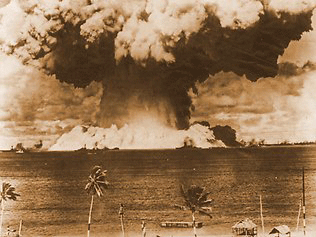
| 75 years after nuclear testing in the Pacific began, the fallout continues to wreak havoc https://theconversation.com/75-years-after-nuclear-testing-in-the-pacific-began-the-fallout-continues-to-wreak-havoc-158208?fbclid=IwAR3q9QJvy507ds2kD0ibOvkD6ZzxFqgGjfHsGrwqJUVMNpujOu8sAeLVPtY April 6, 2021 Patricia A. O’Brien Patricia A. O’Brien is a Friend of The Conversation.Historian, Visiting Fellow in the School of History, Australian National University and Adjunct Professor in the Asian Studies Program, Georgetown University, This year marks 75 years since the United States launched its immense atomic testing program in the Pacific. The historical fallout from tests carried out over 12 years in the Marshall Islands, then a UN Trust Territory governed by the US, have framed seven decades of US relations with the Pacific nation.Due to the dramatic effects of climate change, the legacies of this history are shaping the present in myriad ways. This history has Australian dimensions too, though decades of diplomatic distance between Australia and the Marshall Islands have hidden an entangled atomic past. In 1946, the Marshall Islands seemed very close for many Australians. They feared the imminent launch of the US’s atomic testing program on Bikini Atoll might split the earth in two, catastrophically change the earth’s climate, or produce earthquakes and deadly tidal waves. A map accompanying one report noted Sydney was only 3,100 miles from ground zero. Residents as far away as Perth were warned if their houses shook on July 1, “it may be the atom bomb test”. Australia was “included in the tests” as a site for recording blast effects and monitoring for atom bombs detonated anywhere in the world by hostile nations. This Australian site served to keep enemies in check and achieve one of the Pacific testing program’s objectives: to deter future war. The other justification was the advancement of science. The earth did not split in two after the initial test (unless you were Marshallese) so they continued; 66 others followed over the next 12 years. But the insidious and multiple harms to people and place, regularly covered up or denied publicly, became increasingly hard to hide. Radiation poisoning, birth defects, leukaemia, thyroid and other cancers became prevalent in exposed Marshallese, at least four islands were “partially or completely vapourised”, the exposed Marshallese “became subjects of a medical research program” and atomic refugees. (Bikinians were allowed to return to their atoll for a decade before the US government removed them again when it was realised a careless error falsely claimed radiation levels were safe in 1968.) In late 1947, the US moved its operations to Eniwetok Atoll, a decision, it was argued, to ensure additional safety. Eniwetok was more isolated and winds were less likely to carry radioactive particles to populated areas. Australian reports noted this site was only 3,200 miles from Sydney. Troubling reports of radioactive clouds as far away as the French Alps and the known shocking health effects appeared. Dissenting voices were initially muted due to the steep escalation of the Cold War and Soviet atomic weapon tests beginning in 1949. Opinion in Australia split along political lines. Conservative Cold War warriors, chief among them Robert Menzies who became prime minister again in 1949, kept Australia in lockstep with the US, and downplayed the ill-effects of testing. Left-wing elements in Australia continued to draw attention to the “horrors” it unleashed. The atomic question came home in 1952, when the first of 12 British atomic tests began on the Montebello Islands, off Western Australia. Australia’s involvement in atomic testing expanded again in 1954, when it began supplying South Australian-mined uranium to the US and UK’s joint defence purchasing authority, the Combined Development Agency. Australia’s economic stake in the atomic age from 1954 collided with the galvanisation of global public opinion against US testing in Eniwetok. The massive “Castle Bravo” hydrogen bomb test in March exposed Marshall Islanders and a Japanese fishing crew on The Lucky Dragon to catastrophic radiation levels “equal to that received by Japanese people less than two miles from ground zero” in the 1945 Hiroshima and Nagasaki atomic blasts. Graphic details of the fishermen’s suffering and deaths and a Marshallese petition to the United Nations followed. When a UN resolution to halt US testing was voted on in July, Australia voted for its continuation. But the tide of public opinion was turning against testing. The events of 1954 dispelled the notion atomic waste was safe and could be contained. The problem of radioactive fish travelling into Australian waters highlighted these new dangers, which spurred increasing world wide protests until the US finally ceased testing in the Marshalls in 1958. In the 1970s, US atomic waste was concentrated under the Runit Island dome, part of Enewetak Atoll (about 3,200 miles from Sydney). Recent alarming descriptions of how precarious and dangerous this structure is due to age, sea water inundation and storm damage exacerbated by climate change were contested in a 2020 Trump-era report. The Biden administration’s current renegotiation of the Compact of Free Association with the Republic of the Marshall Islands, and its prioritisation of action on climate change, will put Runit Island high on the agenda. There is an opportunity for historical redress for the US that is even more urgent given the upsurge in discrimination against US-based Pacific Islander communities devastated by the COVID-19 pandemic. Some are peoples displaced by the tests. Australia is also embarking on a new level of engagement with the Marshall Islands: it is due to open its first embassy in the capital Majuro in 2021.It should be remembered this bilateral relationship has an atomic history too. Australia supported the US testing program, assisted with data collection and voted in the UN for its continuation when Marshallese pleaded for it to be stopped. It is also likely Australian-sourced atomic waste lies within Runit Island, cementing Australia in this history. |
Australian government’s brazen duplicity concerning Julian Assange
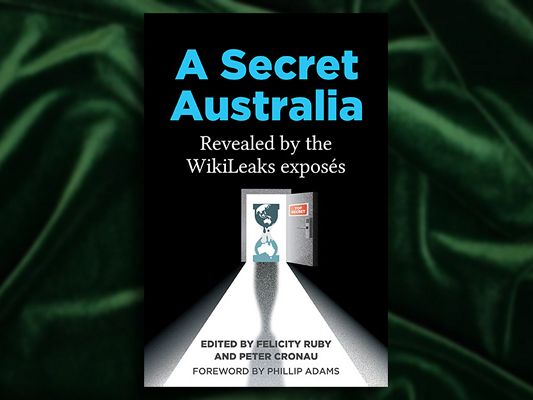 What Assange and WikiLeaks said about Australia, https://www.smh.com.au/culture/books/what-assange-and-wikileaks-said-about-australia-20210129-p56xyo.html
By Jessie Tu February 4, 2021 He has been called “truth-telling hero”, “evil and perverted traitor”, “heroic, trickster, mythical – reviled”. Robert Manne called him the “most consequential Australian of the present time”. The new US President has called him a “high-tech terrorist”.
The protean narratives of Julian Assange, who will be 50 in July, have been brewing since 2010, when his website published “The Afghan War Diaries”, “Iraq War Logs” and “Collateral Murder”, a video showing the US military killing two Reuters employees in Iraq.
December marked 10 years since Assange has been “arbitrarily detained” in Britain, according to Felicity Ruby and Peter Cronau in their introduction to A Secret Australia – a collection of 18 essays that survey the impact WikiLeaks has had on Australia’s media landscape and the consequences of our government’s attraction towards America’s intelligence and military empire.
The potpourri of authors and thinkers includes Julian Burnside, Antony Loewenstein, Scott Ludlam and Helen Razer, who critique “the powers opposed to openness and transparency” and examine the evidence, “not the likelihoods, the probabilities, the suspicions, and assumptions” around the “subversive, technology-based publishing house”.
WikiLeaks invented a “pioneering model of journalism” – one that embodied the “contemporary spirit of resistance to imperial power”, says Richard Tanter, from the school of political and social sciences at the University of Melbourne. It brought renewed debates on free speech, digital encryption and questions around the management and protection of whistleblowers who risk their lives to expose covert, deceitful actions by governments.
The documents exposed the “brazen duplicity” of the Australian government towards its citizens and presented “off-stage alliance management conversations”, Tanter writes. They invited the layperson into the green room of the performance that is politics and international diplomacy.
WikiLeaks unmasked reports that showed governments recommending media strategies to deceive the public, demonstrating their unethically utilitarian approach to international diplomacy and governance and “enlightened the public on the dark corners of wars”, writes journalist and author Antony Loewenstein.
Assange is still in a cell at London’s Belmarsh Prison, facing an appeal by the United States in its bid to extradite him to face charges for the 2010 publications. He is continuing to be “denied adequate medical care” and “denied emergency bail in light of the COVID-19″, says Lissa Johnson, a clinical psychologist and writer for New Matilda – one of the few Australian publications that have paid genuine attention to the WikiLeaks saga.
In Australia, there’s been a “striking absence of a solid debate on WikiLeaks in the mainstream public discourse”, according to Benedetta Brevini, a journalist and media activist who insists that our concerning “lack of a thorough and sustained debate” is incomprehensible. Loewenstein calls Australia’s lack of journalistic solidarity with Assange “deeply shameful”. He says we have an “anodyne media environment” – perhaps not unsurprising, considering our highly concentrated media market, one of the most severe in the world.
The standout essays come from Guy Rundle and Helen Razer – whose amusing voice cuts through the somewhat parched tenor of cold academic-speak that lightly threads through the other essays. Her addition is a breath of fresh air in the middle of a chain of same-same arguments.
The most useful essay is Rundle’s take on the historical basis for WikiLeaks. He surveys the swirling currents of Australian history that led to its founding, identifying WikiLeaks as a continuation of political activist Albert Langer’s resistance to capital.
“We need a whole new organisation of how recent Australian history is told,” Rundle concludes, seconding Lissa Johnson’s opinion that we demand citizens who “cut across the acquiescence and consent, remove the deadbolt on the torture chamber door, turn down the music and expose what is going on inside”. This collection of polemics, though at times repetitive, takes us closer to a future where these demands no longer seem beyond reality.
1 This month
Chernobyl: The Lost Tapes – A good documentary on Chernobyl on SBS available On Demand for the next 3 weeks– https://www.sbs.com.au/ondemand/tv-program/chernobyl-the-lost-tapes/2352741955560
15 April – Zoom –Nuclear Power is Not the Solution
Apr 15, 2026 01:00 AM in Canberra, Melbourne, Sydney

Join the International Physicians for the Prevention of Nuclear War (IPPNW) on Tuesday, April 14th for a timely webinar exploring the risks associated with nuclear power and challenging the myth that it offers a simple, safe, carbon-free solution to the climate crisis

21 April Webinar: No Nuclear Weapons in Australia
Start: 2026-04-21 18:00:00 UTC Canberra, Melbourne, Sydney (GMT+10:00)
End: 2026-04-21 19:30:00 UTC Canberra, Melbourne, Sydney (GMT+10:00)
Event Type: Virtual
A virtual link will be communicated before the event.
Host Contact Info: australia@icanw.org

of the week – Australians for War Powers Reform (AWPR)
To see nuclear-related stories in greater depth and intensity
 Antinuclear