Federal govt open door to international high level nuclear waste dump
Nuclear Shipment Truth Exposed
If the Fed Govnt establish proposed nuclear waste dumps in SA and they get away with reclassifying reprocessed vitrified High Level Nuclear Waste from France as Intermediate Level Nuclear Waste, on arrival back in Australia (like they plan to do) – then it opens the door for importing International High Level Nuclear Waste into Australia, and dumping in SA as reclassified Intermediate Level Nuclear Waste. Reprocessed vitrified High Level Nuclear Waste is highly radioactive and contains 95% of the total radioactivity (the worst elements) from Nuclear reactor spent nuclear fuel – is long lived – and is classified High Level Nuclear Waste everywhere in the world except Australia.
Australian media push for press freedom (pity they’re not helping Julian Assange, though)

|
‘A culture of secrecy’: what is the Right to Know campaign about? Media companies say their journalists are being stopped from holding the powerful to account. What’s stopping them? What do they want government to do about it? Why should you care? The Age By Fergus Hunter, OCTOBER 20, 2019 All of Australia’s major media organisations have joined forces to call for reforms to protect public interest journalism in Australia. Australia’s Right to Know coalition includes Nine, News Corp, the ABC, SBS, The Guardian, and journalists’ union the Media, Entertainment and Arts Alliance. The campaign, an unprecedented show of unity between competitors, is pushing for stronger protections for media freedom after years of perceived deterioration. The outlets are seeking to combat a growing culture of secrecy that restricts journalists’ ability to hold the powerful to account.
Did anything, in particular, spark this?Media organisations in Australia have long been concerned about threats to journalism, but the issue exploded into the public consciousness following two consecutive police raids earlier this year. On June 4, police conducted a six-hour raid on the home of News Corp political journalist Annika Smethurst over an April 2018 story. The story had revealed a proposal for electronic intelligence agency the Australian Signals Directorate to take on an expanded domestic role and that figures inside government were concerned about the idea.
Did anything, in particular, spark this?Media organisations in Australia have long been concerned about threats to journalism, but the issue exploded into the public consciousness following two consecutive police raids earlier this year. On June 4, police conducted a six-hour raid on the home of News Corp political journalist Annika Smethurst over an April 2018 story. The story had revealed a proposal for electronic intelligence agency the Australian Signals Directorate to take on an expanded domestic role and that figures inside government were concerned about the idea.
What was the government’s response?Prime Minister Scott Morrison and senior colleagues defended the police raids as the independent actions of an agency doing its job to protect national security. They have responded to the broader furore over press freedom by calling a parliamentary inquiry and issuing directives to agencies emphasising the importance of a free press. The inquiry, conducted by the intelligence and security committee, is examining the impact of national security laws on press freedom. This inquiry has heard from media outlets, government officials and independent experts. It is being conducted alongside a more wide-ranging press freedom inquiry by a Senate committee. Officials, including senior figures at the Australian Security Intelligence Organisation and the Department of Home Affairs, have defended the need for a high level of secrecy, criticised media coverage and argued that some of the recommendations put forward by media organisations would threaten national security. Ministers and officials have declined to rule out pursuing charges against the News Corp and ABC journalists targeted in the raids.
Home Affairs Minister Peter Dutton has issued a directive to the federal police stating they should consider the “importance of a free and open press” and broader public-interest implications before involving media outlets in investigations. Attorney-General Christian Porter also instructed Commonwealth prosecutors not to charge journalists under certain secrecy laws without his approval. Porter has said he would be “seriously disinclined” to authorise the prosecutions. Privately, the Morrison government has indicated a scepticism that media freedom is something that grabs the public’s attention. There is also hostility within the Coalition towards any changes seen as weakening national security. With these political and policy factors in mind, the government does not yet seem convinced of the need for sweeping law reform. What do the media companies want to achieve?Australia’s Right to Know coalition has six key proposals for “necessary and urgent” reform. The changes would strengthen rights and protections for public-interest journalism.
|
|

Julian Assange and Wikileaks have exposed nuclear scandals
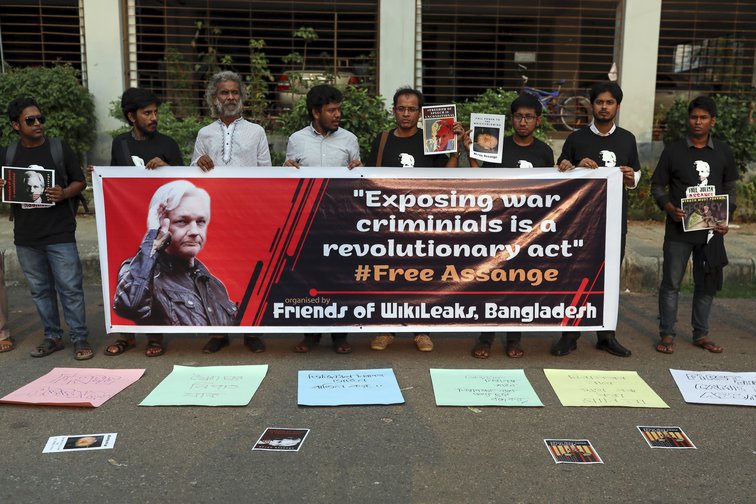
What we know about nuclear weapons and the nuclear industry thanks to WikiLeaks
“The Nobel Peace Prize will be awarded on 11 October. Why I support the nomination of Julian Assange and WikiLeaks.” Open Democracy, Felicity Ruby, 7 October 2019 The Nobel Peace Prize will be awarded on 11 October. Julian Assange and WikiLeaks have been nominated for the prize again this year, as they have since 2010. As the first staffer of the campaign that won the Peace Prize in 2017, the International Campaign to Abolish Nuclear Weapons (ICAN), I support this nomination for a number of reasons.
Below are just ten examples of where WikiLeaks exposed wrongdoing on the part of governments and corporations that meant citizens could take action to protect themselves from harm, or governments were held to account:
After the Chalk River nuclear reactor was shut down for routine maintenance on 18 November 2007, inspectors verified the reactor’s cooling systems had not been modified as required by an August 2006 licensing review. Atomic Energy of Canada Limited (AECL) did not start the reactor but said upgrades could be done as part of maintenance while still operating safely. This impasse lasted a month, with the government intervening to grant an exemption to the reactor to allow its restart. The responsible Minister for Natural Resources, Gary Lunn MP, fired Linda Keen, the President of the Nuclear Safety Commission. Their exchange of letters revealed much about the safety standards and routine practices of the Canadian nuclear regulatory system, and particular problems with the ageing Chalk River reactor previously unknown to the public.
– Footage of the 1995 disaster at the Japanese Monju nuclear reactor – released 25 January 2008
Following the 2008 announcement that the Japanese Monju fast breeder nuclear reactor would be reopened, activists leaked the suppressed video footage of the sodium spill disaster that led to its closure in 1995. Named after the Buddhist divinity of wisdom, Monju, located in Japan’s Fukui prefecture, is Japan’s only fast-breeder reactor. Unlike conventional reactors, fast-breeder reactors, which “breed” plutonium, use sodium rather than water as a coolant. This type of coolant creates a potentially hazardous situation as sodium is highly corrosive and reacts violently with both water and air. On December 8, 1995, 700 kg of molten sodium leaked from the secondary cooling circuit of the Monju reactor, resulting in a fire that did not result in a radiation leak, but the potential for catastrophe was played down the extent of damage at the reactor and denied the existence of a videotape showing the sodium spill. Further complicating the story, the deputy general manager of the general affairs department at the PNC, Shigeo Nishimura, 49, jumped to his death the day after a news conference where he and other officials revealed the extent of the cover-up.
– Serious nuclear accident lay behind Iranian nuke chief’s mystery resignation – released 16 July 2009 WikiLeaks revealed that a source associated with Iran’s nuclear program confidentially told the organisation of a serious, recent, nuclear accident at Natanz. Natanz is the primary location of Iran’s nuclear enrichment program and the site targeted with the Stuxnet worm that contained 4 zero days and was designed to slow down and speed up centrifuges enriching uranium. WikiLeaks had reason to believe the source was credible, however contact with this source was lost. …………..
WikiLeaks and Assange have brought forward many truths that are hard to face, publishing well over 10 million documents since 2006. Often forgotten is that each one was provided by a whistleblower who trusted this platform to publish, and who sought reform of how political, corporate and media power elites operate. Each release has shared genuine official information about how governments, companies, banks, the UN, political parties, jailers, cults, private security firms, war planners and the media actually operate when they think no one is looking.
Assange is nominated for the Nobel Peace Prize because of these many releases of information, used as evidence in court cases, freeing prisoners and exposing scandals, torture, murder and surveillance for which redress is only possible when the wrongdoing is dragged into the light. For publishing this true information, Assange, an Australian based in the UK at the time of publication, is on the health ward of Belmarsh Prison, facing extradition and charges attracting 175 years in a US jail, an effective death sentence….. https://www.opendemocracy.net/en/can-europe-make-it/what-we-know-about-nuclear-weapons-and-nuclear-industry-thanks-wikileaks/
Exposing misleading evidence to the federal nuclear inquiry
Big claims and corporate spin about small nuclear reactor costs, Jim Green, 19 September 2019, RenewEconomy https://reneweconomy.com.au/big-claims-and-corporate-spin-about-small-nuclear-reactor-costs-65726/
The ‘inquiry into the prerequisites for nuclear energy in Australia’ being run by Federal Parliament’s Environment and Energy Committee has finished receiving submissions and is gradually making them publicly available.
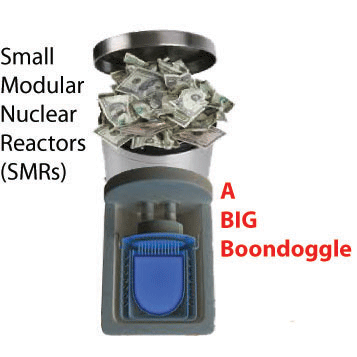 The inquiry is particularly interested in ‘small modular reactors’ (SMRs) and thus one point of interest is how enthusiasts spin the economic debate given that previous history with small reactors has shown them to be expensive; the cost of the handful of SMRs under construction is exorbitant; and both the private sector and governments around the world have been unwilling to invest the billions of dollars required to get high-risk SMR demonstration reactors built.
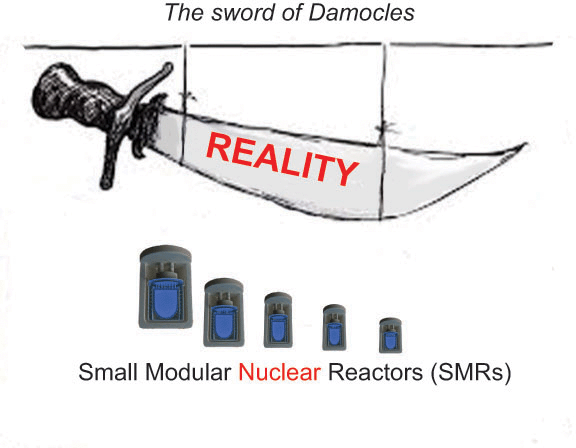 To provide a reality-check before we get to the corporate spin, a submission to the inquiry by the Institute for Energy Economics and Financial Analysis notes that SMRs have been as successful as cold fusion – i.e., not at all. The submission states:
“The construction of nuclear power plants globally has proven to be an ongoing financial disaster for private industry and governments alike, with extraordinary cost and construction time blow-outs, while being a massive waste of public monies due to the ongoing reliance on government financial subsidies. … Governments have repeatedly failed to comprehend that nuclear construction timelines and cost estimates put forward by many corporates (with vested interests) have proven disastrously flawed and wrong.”
The Institute is equally scathing about SMRs:
“For all the hype in certain quarters, commercial deployment of small modular reactors (SMRs) have to-date been as successful as hypothesized cold fusion – that is, not at all. Even assuming massive ongoing taxpayer subsidies, SMR proponents do not expect to make a commercial deployment at scale any time soon, if at all, and more likely in a decade from now if historic delays to proposed timetables are acknowledged.”
Thus the Institute adds its voice to the chorus of informed scepticism about SMRs, such as the 2017 Lloyd’s Register survey of 600 industry professionals and experts who predicted that SMRs have a “low likelihood of eventual take-up, and will have a minimal impact when they do arrive“.
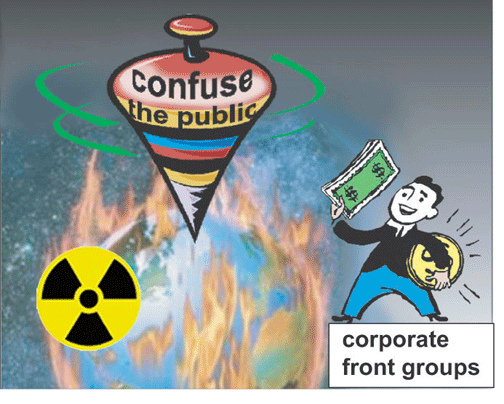 Corporate spin #1: Minerals Council of Australia
The Minerals Council of Australia claims in its submission to the federal inquiry that SMRs could generate electricity for as little as $60 per megawatt-hour (MWh). That claim is based on a report by the Economic and Finance Working Group (EFWG) of the Canadian government-industry ‘SMR Roadmap’ initiative.
The Canadian EFWG gives lots of possible SMR costs and the Minerals Council’s use of its lowest figure is nothing if not selective. The figure cited by the Minerals Council assumes near-term deployment from a standing start (with no-one offering to risk billions of dollars to build demonstration reactors), plus extraordinary learning rates in an industry notorious for its negative learning rates.
Dr. Ziggy Switkowski noted in his evidence to the federal inquiry that “nuclear power has got more expensive, rather than less expensive”. Yet the EFWG  paper takes a made-up, ridiculously-high learning rate and subjects SMR cost estimates to eight ‘cumulative doublings’ based on the learning rate. That’s creative accounting and one can only wonder why the Minerals Council would present it as a credible estimate.
Here are the first-of-a-kind SMR cost estimates from the EFWG paper, all of them far higher than the figure cited by the Minerals Council:
- 300-megawatt (MW) on-grid SMR: C$162.67 (A$179) / MWh
- 125-MW off-grid heavy industry: C$178.01 (A$196) / MWh
- 20-MW off-grid remote mining: C$344.62 (A$380) / MWh
- 3-MW off-grid remote community: C$894.05 (A$986) / MWh
The government and industry members on the Canadian EFWG are in no doubt that SMRs won’t be built without public subsidies:
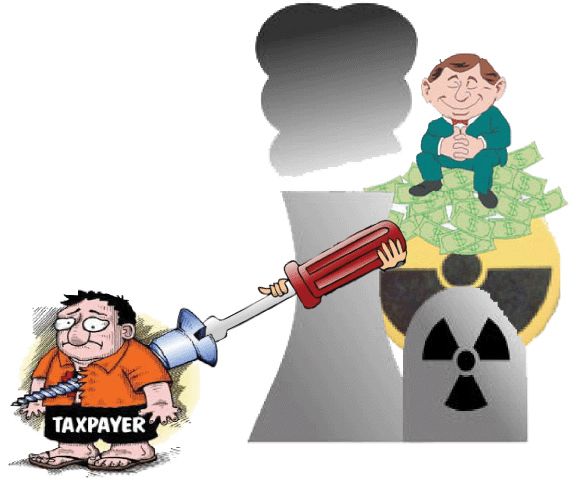 “The federal and provincial governments should, in partnership with industry, investigate ways to best risk-share through policy mechanisms to reduce the cost of capital. This is especially true for the first units deployed, which would likely have a substantially higher cost of capital than a commercially mature SMR.”
The EFWG paper used a range of estimates from the literature and vendors. It notes problems with its inputs, such as the fact that many of the vendor estimates have not been independently vetted, and “the wide variation in costs provided by expert analysts”. Thus, the EFWG qualifies its findings by noting that “actual costs could be higher or lower depending on a number of eventualities”.
Corporate spin #2: NuScale Power
US company NuScale Power has put in a submission to the federal nuclear inquiry, estimating a first-of-a-kind cost for its SMR design of US$4.35 billion / gigawatt (GW) and an nth-of-a-kind cost of US$3.6 billion / GW.
NuScale doesn’t provide a $/MWh estimate in its submission, but the company has previously said it is targeting a cost of US$65/MWh for its first SMR plant. That is 2.4 lower than the US$155/MWh (A$225/MWh) estimate based on the NuScale design in a report by WSP / Parsons Brinckerhoff prepared for the SA Nuclear Fuel Cycle Royal Commission.
 NuScale’s cost estimates should be regarded as promotional and will continue to drop – unless and until the company actually builds an SMR. The estimated cost of power from NuScale’s non-existent SMRs fell from US$98-$108/MWh in 2015 to US$65/MWh by mid-2018. The company announced with some fanfare in 2018 that it had worked out how to make its SMRs almost 20% cheaper – by making them almost 20% bigger!
Lazard estimates costs of US$112-189/MWh for electricity from large nuclear plants. NuScale’s claim that its electricity will be 2-3 times cheaper than that from large nuclear plants is implausible. And even if NuScale achieved costs of US$65/MWh, that would still be higher than Lazard’s figures for wind power (US$29-56) and utility-scale solar (US$36-46).
Likewise, NuScale’s construction construction cost estimate of US$4.35 billion / GW is implausible. The latest cost estimate for the two AP1000 reactors under construction in the US state of Georgia (the only reactors under construction in the US) is US$12.3-13.6 billion / GW. NuScale’s target is just one-third of that cost – despite the unavoidable diseconomies of scale and despite the fact that every independent assessment concludes that SMRs will be more expensive to build (per GW) than large reactors.
Further, the modular factory-line production techniques now being championed by NuScale were trialled with the AP1000 reactor project in South Carolina – a project that was abandoned in 2017 after the expenditure of at least US$9 billion.
Corporate spin #3: Australian company SMR Nuclear Technology
In support of its claim that “it is likely that SMRs will be Australia’s lowest-cost generation source”, Australian company SMR Nuclear Technology Pty Ltd cites in its submission to the federal nuclear inquiry a 2017 report by the US Energy Innovation Reform Project (EIRP).
According to SMR Nuclear Technology, the EIRP study “found that the average levelised cost of electricity (LCOE) from advanced reactors was US$60/MWh.”
However the cost figures used in the EIRP report are nothing more than the optimistic estimates of companies hoping to get ‘advanced’ reactor designs off the ground. Therefore the EIRP authors heavily qualified the report’s findings:
“There is inherent and significant uncertainty in projecting NOAK [nth-of-a-kind] costs from a group of companies that have not yet built a single commercial-scale demonstration reactor, let alone a first commercial plant. Without a commercial-scale plant as a reference, it is difficult to reliably estimate the costs of building out the manufacturing capacity needed to achieve the NOAK costs being reported; many questions still remain unanswered – what scale of investments will be needed to launch the supply chain; what type of capacity building will be needed for the supply chain, and so forth.”
SMR Nuclear Technology’s conclusions – that “it is likely that SMRs will be Australia’s lowest-cost generation source” and that low costs are “likely to make them a game-changer in Australia” – have no more credibility than the company estimates used in the EIRP paper.
SMR Nuclear Technology’s submission does not note that the EIRP inputs were merely company estimates and that the EIRP authors heavily qualified the report’s findings.
The US$60/MWh figure cited by SMR Nuclear Technology is far lower than all independent estimates for SMRs:
- The 2015/16 South Australian Nuclear Fuel Cycle Royal Commission estimated costs of A$180-184/MWh for large light-water reactors, compared to A$225 for an SMR based on the NuScale design (and a slightly lower figure for the ‘mPower’ SMR design that was abandoned in 2017 by Bechtel and Babcock & Wilcox).
- A December 2018 report by CSIRO and the Australian Energy Market Operator found that electricity from SMRs would be more than twice as expensive as that from wind or solar power with storage costs included (two hours of battery storage or six hours of pumped hydro storage).
- A report by the consultancy firm Atkins for the UK Department for Business, Energy and Industrial Strategy found that electricity from the first SMR in the UK would be 30% more expensive than that from large reactors, because of diseconomies of scale and the costs of deploying first-of-a-kind technology. Its optimistic SMR cost estimate is US$107-155 (A$157-226) / MWh.
- A 2015 report by the International Energy Agency and the OECD Nuclear Energy Agency predicted that electricity from SMRs will be 50−100% more expensive than that from large reactors, although it holds out some hope that large-volume factory production could reduce costs.
- An article by four pro-nuclear researchers from Carnegie Mellon University’s Department of Engineering and Public Policy, published in 2018 in the Proceedings of the National Academy of Science, concluded than an SMR industry would only be viable in the US if it received “several hundred billion dollars of direct and indirect subsidies” over the next several decades.
SMR Nuclear Technology’s assertion that “nuclear costs are coming down due to simpler and standardised design; factory-based manufacturing; modularisation; shorter construction time and enhanced financing techniques” is at odds with all available evidence and it is at odds with Dr. Ziggy Switkowski’s observation in a public hearing of the federal inquiry that nuclear “costs per kilowatt hour appear to grow with each new generation of technology”.
SMR Nuclear Technology claims that failing to repeal federal legislative bans against nuclear power would come at “great cost to the economy”. However the introduction of nuclear power to Australia would most likely have resulted in the extraordinary cost overruns and delays that have crippled every reactor construction project in the US and western Europe over the past decade – blowouts amounting to A$10 billion or more per reactor.
Nor would the outcome have been positive if Australia had instead pursued non-existent SMR ‘vaporware‘.
Dr Jim Green is lead author of a Nuclear Monitor report on SMRs and national nuclear campaigner with Friends of the Earth Australia.
Revealed: Josh Frydenberg was behind the strange Environment Department decision to block wind turbines on Lord Howe Island.
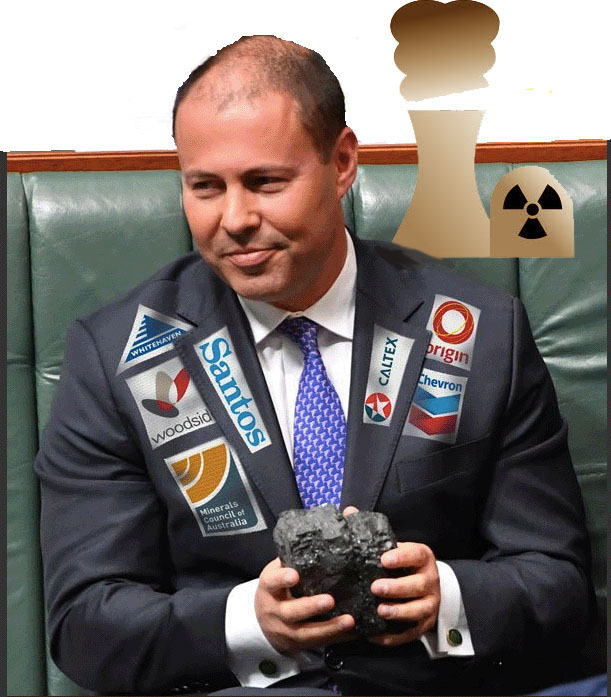 Josh Frydenberg overruled department to block Lord Howe Island wind turbines, FOI documents reveal former environment minister took action despite support from islanders, Guardian, Anne Davies, 18 Sept 19 The former environment minister Josh Frydenberg went against the advice of his departmental experts when he blocked two wind turbines on Lord Howe Island in 2017, consigning the world heritage-listed island to relying on diesel fuel for the bulk of its electricity. Josh Frydenberg overruled department to block Lord Howe Island wind turbines, FOI documents reveal former environment minister took action despite support from islanders, Guardian, Anne Davies, 18 Sept 19 The former environment minister Josh Frydenberg went against the advice of his departmental experts when he blocked two wind turbines on Lord Howe Island in 2017, consigning the world heritage-listed island to relying on diesel fuel for the bulk of its electricity.A freedom of information request by the Guardian has uncovered that the minister took the unusual action of blocking the project under the Environmental Protection and Biodiversity Conservation Act, deeming it “unacceptable”…… Projects are rarely ruled “unacceptable” under federal environmental laws but are often approved with modifications or strict conditions. For instance, the Adani coal project’s groundwater plan was approved in 2019 with conditions; the Abbot Point coal terminal was judged not to have unacceptable impacts on the Great Barrier Reef; and the Watermark coal project near Tamworth was waved through in 2015. But two medium-sized wind turbines on Lord Howe Island proved a bridge too far for Frydenberg as environment minister. Now the Guardian can reveal that his decision was taken despite the advice of his own department, strong support from the majority of residents on Lord Howe Island, the governing board of the island, and even another federal government agency – the Australian Renewable Energy Agency – which had offered $4.6m in funding towards the renewable energy project. The department’s natural heritage section 23 November 2016 advice was that “the proposed action is unlikely to significantly impact the Island Group’s world heritage values” and that moving the island away from reliance on weekly deliveries of diesel would help secure its Unesco world heritage status……… The case raises questions about political influence in environmental decision making. “Former environment minister Josh Frydenberg’s rejection of the Lord Howe Island windfarm is inconsistent with many other environmental approvals where there was strong departmental advice about unavoidable risks to internationally protected places and wildlife,” Basha Stasak, the Australian Conservation Foundation’s nature campaign manager, said.
“For example, Frydenberg ignored clear departmental advice urging a rejection of the Toondah Harbour property development because it would destroy part of an internationally protected wetland. “These inconsistencies go to the heart of the environmental law reform Australia needs. We need strong laws and decisions made under them by an independent national Environment Protection Authority,” she said…….. Lord Howe Island resident Craig Thompson – “Sustainable clean energy for a world heritage site like Lord Howe should be mandatory. We should be setting an example to the whole world, not being held back by a minister’s political ideology or personal opinion.” …….. Lord Howe Island is now exploring what can be done with solar and batteries to meet the island’s needs. New South Wales spends $750,000 a year on shipping diesel to the island to provide power for its 350 residents. https://www.theguardian.com/australia-news/2019/sep/18/josh-frydenberg-overruled-department-to-block-lord-howe-island-wind-turbines |
|
Australia’s nuclear research reactor was always intended as the first step towards the nuclear bomb

The push for an Aussie bomb It took former PM John Gorton almost three decades to finally come clean on his ambitions for Australia to have a nuclear bomb. THE AUSTRALIAN, By TOM GILLING 30 Aug 19,
In December 9, 1966, the Australian Government signed a public agreement with the US to build what both countries described as a “Joint Defence Space Research Facility” at Pine Gap, just outside Alice Springs. The carefully misleading agreement expressed the two countries’ mutual desire “to co-operate further in effective defence and for the preservation of peace and security”.
Officially, Pine Gap was a collaboration between the Australian Department of Defence and the Pentagon’s Defence Advanced Research Projects Agency, but the latter was a red herring meant to conceal the real power at Pine Gap: the Central Intelligence Agency….the truth was that the Joint Defence Space Research Facility was joint in name only and its purpose was not (and never would be) “research”. It was a spy station designed to collect signals from US surveillance satellites in geosynchronous orbit over the equator. ……
The building of an experimental reactor at Lucas Heights in Sydney’s south was supposed to be the first step in a nuclear program that within a decade would see the development of full-scale nuclear power reactors. ……
During the 1950s Australian defence chiefs lobbied vigorously for an Australian bomb. When it became clear that the prime minister, Robert Menzies, had reservations, they went behind his back. Menzies did agree, however, to let Britain test its nuclear weapons in Australia — a decision, according to historian Jacques Hymans, taken “almost single-handedly… without consulting his Cabinet and without requesting any quid pro quo, not even access to technical data necessary for the Australian government to assess the effects of the tests on humans and the environment”……….
Gorton’s political reservations about the non-proliferation treaty masked a deeper fear: that signing the treaty might cause Australia’s nascent atomic energy industry to be “frozen in a primitive state”. Gorton and the head of Australia’s Atomic Energy Commission, Philip Baxter, were both committed to pursuing the development of an Australian bomb. Scientists at the AEC worked with government officials to draw up cost and time estimates for atomic and hydrogen bomb programs. According to the historian Hymans, they outlined two possible programs: a power reactor program capable of producing enough weapons- grade plutonium for 30 fission weapons (A-bombs) per year; and a uranium enrichment program capable of producing enough uranium-235 for at least 10 thermonuclear weapons (H-bombs) per year. The A-bomb plan was costed at what was considered to be an “affordable” $144 million and was thought to be feasible in no more than seven to 10 years. The H-bomb plan was costed at $184 million over a similar period.
Aware of opposition to any talk of an “Aussie bomb”, Gorton carefully played down the military aspect and argued instead for the economic benefits of a nuclear power program. ………
a US mission did visit Canberra at the end of April 1968. Officials from the AEC had impressed the US visitors with “the confidence of their ability to manufacture a nuclear weapon and desire to be in a position to do so on very short notice”.
The Australian officials, they said, had “studied the draft NPT [non-proliferation treaty] most thoroughly… the political rationalisation of these officials was that Australia needed to be in a position to manufacture nuclear weapons rapidly if India and Japan were to go nuclear… the Australian officials indicated they could not even contemplate signing the NPT if it were not for an interpretation which would enable the deployment of nuclear weapons belonging to an ally on Australian soil.”
Eighteen months after Rusk’s fractious visit to Canberra, Gorton called a general election. He declared his commitment to a nuclear-powered (if not a nuclear-armed) Australia, announcing that “the time for this nation to enter the atomic age has now arrived” and laying out his scheme for a 500-megawatt nuclear power plant to be built at Jervis Bay, on NSW’s south coast. While the defence benefits of such a reactor were unspoken, there was no mistaking the military potential of the plutonium it would be producing.
The Jervis Bay reactor never got off the drawing board, although planning reached an advanced stage. Detailed specifications were put out to tender and there was broad agreement over a British bid to build a heavy-water reactor. A Cabinet submission was in the pipeline when Gorton lost the confidence of the party room and was replaced by William McMahon, a nuclear sceptic who moved quickly to defer the project.
It would be another 28 years before Gorton finally came clean on the link between the reactor and his ambition for Australia to have nuclear weapons. . In 1999 he told a Sydney newspaper that “we were interested in this thing because it could provide electricity to everybody and… if you decided later on, it could make an atomic bomb”. Gorton did not identify who he meant by “we” (although Philip Baxter was almost certainly among them) but Gorton and those who shared his nuclear ambitions were unable to win over the doubters in his own government.
Australia signed the non-proliferation treaty in 1970 but even as it did so it was clear that Gorton had no intention of ratifying the treaty. Australia would not ratify it until 1973, and then only after McMahon’s Coalition government had lost power to Gough Whitlam’s Labor Party. As well as ratifying the treaty, the Whitlam government cancelled the Jervis Bay project that had been in limbo since McMahon became prime minister. And with that, Whitlam effectively ended Australia’s quixotic bid to become a nuclear power.
Australia never got its own bomb, although as late as 1984 the foreign minister, Bill Hayden, could still speak about Australian nuclear research providing the country with the potential for nuclear weapons. The Morrison Government is unlikely to let the nuclear genie out of the bottle, with a spokesperson from the Department of Defence telling The Weekend Australian Magazine that “Australia stands by its Non-Proliferation Treaty pledge, as a non-nuclear weapon state, not to acquire or develop nuclear weapons”. ….. https://www.theaustralian.com.au/weekend-australian-magazine/gorton-and-the-bomb-australias-nuclear-ambitions/news-story/00787e322a41d2ff37a146c86a739f02
False statements on nuclear power by Federal Liberal National Party MP Keith Pitt.

|
Aust OECD nuclear power claim is false, Leader, Australian Associated Press, 12 Aug 19,
AAP Fac tCheck Investigation: Is Australia the only OECD country that does not use nuclear power?
The Statement: “We are the only OECD country that doesn’t utilise this type of technology (nuclear power).” – Federal Liberal National Party MP Keith Pitt. August 7, 2019. The Verdict False – The checkable claim is false.
The Analysis Federal coalition MP Keith Pitt has campaigned for nuclear power to be investigated as an option to form part of Australia’s energy mix. Mr Pitt believes nuclear should not be excluded and Australia should re-examine its moratorium on the construction of nuclear power plants. AAP FactCheck examined the Queensland MP’s claim that Australia is the only OECD country that does not use nuclear power. [1] Mr Pitt’s statement was made as the federal government announced on August 7 an inquiry into the feasibility of using nuclear energy as a power source for Australia. The new inquiry follows a 2016 nuclear fuel cycle royal commission by the South Australian government and a 2006 federal review by the Howard government. The 2006 review found Australia would need about 25 reactors to supply one-third of the nation’s electricity supply by 2050, while the 2016 commission’s found SA “could safely manage” used nuclear fuel from other countries. Submissions to the new federal government review are open until September 16 with a view to finalising a report by the end of the year. [2][3]…… Australia’s ban on nuclear power and nuclear power plant construction is enforced by two acts of federal parliament – the Environment Protection and Biodiversity Conservation (EPBC) Act 1999 and Australian Radiation Protection and Nuclear Safety Act 1998.Section 140A of the EPBC Act 1999 states: “The minister must not approve an action consisting of or involving the construction or operation of any of the following nuclear installations: a) a nuclear fuel fabrication plant; b) a nuclear power plant; c) an enrichment plant; d) a reprocessing facility”. The Australian Radiation Protection and Nuclear Safety Act applies to Commonwealth bodies and is not a barrier for state government body or private developer. [4] [5] [6] [7] ……. Listed under non-nuclear countries for OECD Pacific are Australia and New Zealand, while in Europe there are 14 nations listed and for the Americas, Chile is a non-nuclear country. [8] [9] Industry Super Australia chief economist Stephen Anthony, was quoted as saying on June 26, 2019: “The point about nuclear is that all other OECD countries have nuclear, we do not.” Mr Anthony’s interview with the ABC’s World Today program included an editor’s note which stated: “The interviewee in the report states that all OECD countries use nuclear power – except for Australia. According to OECD figures, 16 of its members do not use nuclear power”. [10] When contacted about the source of his claim, Mr Pitt’s office told AAP FactCheck that the Hinkley MP “misspoke” during the interview with Sky News. Based on this evidence AAP FactCheck found Mr Pitt’s statement to be false. Australia is not the only OECD nation that does not use nuclear power. The Verdict False – The checkable claim is false. https://www.theleader.com.au/story/6324450/aust-oecd-nuclear-power-claim-is-false/?cs=9397 The References Continue reading |
National Radioactive Waste Management Facility Taskforce’s heavy-handed repressive approach to community consultation
 Waste dump consultative committee enforces strict observer protocol, Transcontinental Amy Green 9 Aug 19, Waste dump consultative committee enforces strict observer protocol, Transcontinental Amy Green 9 Aug 19,
Tensions over the federal government’s plans to site a National Radioactive Waste Management Facility have reached boiling point in the wake of upcoming community consultation meetings scheduled for Kimba and Hawker next week. The process has been stalled for more than a year because of a federal court challenge by Barngarla traditional owners,but last month the federal court rejected their bid to stop the council ballot. Kimba and Hawker (Barnidoota) are the two communities who have been shortlisted for the proposed facility, which would house low-level nuclear waste and provide temporary storage for intermediate level waste. The Department of Industry Innovation and Science’s National Radioactive Waste Management Facility Taskforce plan to use the committee meetings as its main platform for ongoing community consultation. The level of community consultation has been widely criticised by anti-waste dump groups such as the Flinders Local Action Group (FLAG). In an open letter to the Barnidoota Consultative Committee, FLAG spokesperson Greg Bannon raised further concerns.
“The Flinders Local Action Group, as you know, represents the point of view from community members who continue to hold deep concerns about siting the National Radioactive Waste Management Facility in our region,” he said. “These concerns do not arise from a lack of information on our part. As we have said previously, when the ‘information’ provided comes from only one source, that being the proposer and promoter of the facility, it cannot be unbiased. “The meetings are supposedly for community consultation, but often fail to fulfil that expectation.” Mr Bannon said the meetings leave little time to answer community questions and criticised the timeliness of meeting minutes. Locals have since complained that a new code of conduct for people wishing to observe the Barnidoota meeting is enforcing restrictions that make it even harder for the community to voice their concerns. The code restricts observers from taking notes or recording any part of the meeting without prior agreement from the department, independent convener and all representative members of the committee. It also states that individual ideas or views of committee members cannot be repeated or shared…… The Barndioota Consultative Committee will be held on August, 13 and the Kimba Consultative Committee on August, 15. https://www.transcontinental.com.au/story/6320383/waste-dump-consultative-committee-enforces-strict-observer-protocol/?fbclid=IwAR1v49mvokOwEIjIHWqYf0cMgK2eR6EZBtOiv_5KcmQGWoYADDmdnD7Zj6g |
|
Jervis Bay and previous governments’ secret plans for nuclear weapons

|
Nuclear reactor and steelworks plan once considered for pristine beaches of Jervis Bay Key points:
A steelworks, petrochemical plant and an oil refinery were also slated for the site at Jervis Bay, but what was not announced was a plan to generate weapons-grade plutonium that could have seen Australia become a nuclear power. Fifty years later, Australia is again mulling over the question of nuclear energy with two separate inquiries underway. A federal parliamentary committee is investigating the economic, environmental and safety implications of nuclear power in Australia. In NSW, meanwhile, a committee is looking into overturning a ban on uranium mining and nuclear facilities. While neither is talking specifics in terms of where nuclear enrichment technology or modern-day facilities like small modular reactors (SMRs) could be located, it has brought to the forefront questions of geography. Jervis Bay is a Commonwealth territory, located within NSW, but the laws of the Australian Capital Territory apply. Potential reactor sitesIn 2007, in the wake of the Switkowski nuclear energy review under the Howard government, the Australia Institute published a research paper identifying 19 of the most likely reactor sites. The sites were located across Queensland, Victoria, South Australia, NSW, and the ACT. It found the most suitable sites were close to major centres of demand and preferably in coastal areas to ensure easy access to water. Jervis Bay inevitably comes up as a potential reactor location due to its history as the only nuclear power plant to have received serious consideration in Australia. At the time it was promoted as the first of many. In February 1970, the Illawarra Mercury proclaimed:
That was the blueprint that nearly became a reality. Shrouded in secrecyThere was a darker side to the Jervis Bay reactor too, with evidence revealed in a 2002 ABC documentary, Fortress Australia, that the 500-megawatt fast breeder reactor was chosen due to its ability to generate weapons-grade plutonium for use in an Australian nuclear weapon Fortress Australia uncovered secret documents showing how the chairman of the Australian Atomic Energy Commission (AAEC), Phillip Baxter, influenced three Liberal prime ministers (Menzies, Holt and Gorton) to support the project. ….. Associate Professor Wayne Reynolds from the University of Newcastle told ABC podcast The Signal how Gorton pushed for the nuclear power station at Jervis Bay…….”They did the study, they worked out the capability, they had to go negotiate with the British about the technology, then they actually started to build this reactor at Jervis Bay.” The project was first delayed after William McMahon became prime minister in 1971 and was later put on hold indefinitely, despite efforts to keep the project alive. As late as March 1975, the Illawarra Mercury was reporting:
But the horse had bolted. Any hopes of a nuclear power industry in Australia effectively ended when McMahon lost government to Gough Whitlam’s Labor in December 1972. Whitlam’s signing of the Non-Proliferation of Nuclear Weapons Treaty in 1973 also ended any plans by the AAEC to provide Australia with the capacity to manufacture atomic weapons……. The Booderee National Park, meaning “bay of plenty” in the Dhurga language, was created out of the Jervis Bay National Park in 1992, which underlined the cultural significance of the lands and surrounding ocean. https://www.abc.net.au/news/2019-08-12/jervis-bay-once-site-for-nuclear-proposal/11371296?fbclid=IwAR16IqfL2gPD9lS6u9xoMkedjYNqJ1TKT_MoGww_5iwNVfq-vqYjfOrz3S4
|
|
Sydney Morning Herald article provokes Australian pro nuclear troll’s vicious attack on Dr Helen Caldicott.
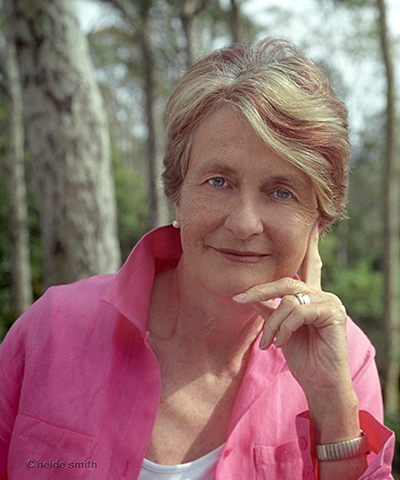 It was remarkable that the Sydney Morning Herald finally had the courage to run an article by globally recognised writer on matters nuclear – Dr Helen Caldicott. The Australian mainstream media generally runs pro nuclear articles, or, at best, steers clear of the nuclear topic altogether.
 This was too much for Australia’s pro nuclear propagandist, Ben Heard. He prides himself on writing information – the facts – and claims to never use ‘ad hominem’ arguments against nuclear critics. But here’s what Ben tweeted yesterday:
“Outrageous that @smh published the conspiratorial, unscientific train-of-thought that is Helen Caldicott. Next week, climatechange by Lord Christopher Moncton?
Any rational person need only spend 5 mins listening to her before feeling the need to back away slowly without making eye contact.”
The raid on journalist’s home by armed federal police
AFP emails shed new light on media investigations, show officers were armed during raids, SMH, By Kylar Loussikian and Bevan Shields, July 5, 2019 The Australian Federal Police initially classified its investigation into a high-profile national security leak as “routine” and of “low value”, according to a cache of documents that also reveals police were armed when they launched two recent raids on the media.
Emails obtained by The Sydney Morning Herald and The Age under freedom of information laws also offer fresh evidence that Annika Smethurst, a senior member of the Canberra press gallery, could be prosecuted for publishing secret government information.
The AFP is expected to be called before a parliamentary inquiry to explain the chain of events leading to raids in early June on Smethurst’s Canberra home and the Sydney headquarters of the ABC over separate stories based on sensitive and secret government information.
The search warrants sparked a major debate over press freedom, with media chiefs lobbying the Morrison government over recent days for swift legal changes to better protect whistleblowers and journalists………
Other documents reveal officers were armed when they entered Smethurst’s home as well as the ABC’s headquarters in inner Sydney. ……
Nine chief executive Hugh Marks, ABC managing director David Anderson and News Corp corporate affairs director Campbell Reid met with the Attorney-General at Parliament this week but were not given a guarantee that the journalists would be spared prosecution……https://www.smh.com.au/politics/federal/afp-emails-shed-new-light-on-media-investigations-show-officers-were-armed-during-raids-20190705-p524kc.html
Australia’s escalatede defence spending, Christopher Pyne and his convenient advice to Ey defence consulting
 Pay Day: Christopher Pyne’s Defence bonanza a fee fillip for EY https://www.michaelwest.com.au/pay-day-christopher-pynes-defence-bonanza-a-fee-fillip-for-ey/, Jun 27, 2019 It dwarfs all other government spending. It is secretive. A huge chunk of it does not even go out to tender. The lion’s share goes to foreign multinationals who pay no tax in Australia. It is defence spending. Michael West reports on the explosion in defence spending which has tripled to more than $60 billion in one year since the Coalition took office, and since Christopher Pyne became Minister for Defence Industry on July 19, 2016.
Christopher Pyne – Defence Minister in May – Defence Industry Lobbyist in July
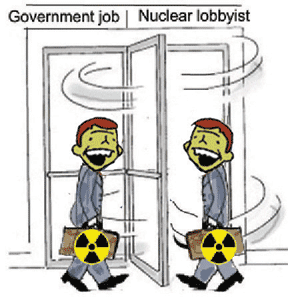 The Fixer in a fix over EY move https://www.afr.com/business/accounting/the-fixer-in-a-fix-over-ey-move-20190626-p521cj Edmund Tadros and Tom McIlroy 26 June 19 Former defence minister Christopher Pyne is under fire for taking a role at big four advisory firm EY that will see him consult to companies in the defence sector.
Despite the lion’s share of the defence sector stemming from federal procurement, EY said the former minister, who retired from politics at the election, would not be lobbying or meeting with MPs or the Defence Department.
The ministerial code of conduct requires cabinet members to wait for 18 months after leaving office before advocating or having business meetings with members of the government, Parliament, public service or defence force on any matters on which they have had official dealings.
Outgoing ministers cannot take personal advantage of information to which they have had access or which is not generally available to the public.
Mr Pyne’s two most recent ministerial roles were as minister for defence and minister for defence industry. He issued a short statement about the job on Wednesday after it was revealed by The Australian Financial Review: “I’m looking forward to providing strategic advice to EY, as the firm looks to expand its footprint in the defence industry.”
A spokeswoman for the Office of the Prime Minister, which administers the code of conduct, did not comment when asked if the role breached the code of conduct
“The rules for former ministers are clear and we refer you to the statements made by Mr Pyne and EY on his new position,” the spokeswoman said.
EY at first described Mr Pyne’s role in the context of “ramping up its defence capability”, but later clarified that Mr Pyne would only deal with the “private sector side of the business”.
“He will not be lobbying or meeting with public sector MPs, public service or defence force in his EY role. He is supporting the private sector side of the business,” the EY spokeswoman said.
Pyne to ‘lead conversations’
EY’s defence leader Mark Stewart said: “Christopher Pyne is also here to help lead conversations about what states need to do to meet the challenges and opportunities this huge defence investment will bring.”
He said EY was “ramping up its defence capability ahead of a surge in consolidation activity and the largest expansion of our military capability in our peacetime history … Large domestic defence players are actively looking for mergers to bulk up to deliver on the government’s $200 billion integrated investment program”.
Victorian Liberal Democrat David Limbrick gets it wrong about nuclear power
Denmark: 1985 law passed by the Danish parliament, prohibiting power production from nuclear energy in Denmark.
Austria has no nuclear power plants. As a result of a public referendum in 1978,Austria follows a strictly non-nuclear energy policy.
Greece has no nuclear power plants
Iceland has no nuclear power plants
Victorian crossbenchers go nuclear, SBS 17 June 19, A couple of Victorian crossbenchers want to explore lifting the state’s bans around uranium and nuclear power in an effort to tackle climate change.
Two of Victoria’s crossbench want the parliament to explore lifting the state’s bans on nuclear activities in an effort to tackle climate change.
The Liberal Democrats this week in the upper house will table a motion to establish a parliamentary inquiry expand the nuclear industry including uranium mining, exploration and exports, power generation, waste management, industrial and medical applications.
“If we have these issues with climate change we need to look at all the options available to us and at the moment we’ve got laws prohibiting certain options and we think that those options should be on the table,” Liberal Democrats MP David Limbrick told AAP….The minor party is still working to garner support for their inquiry, but would hope if it gets up it would be completed in about 12 months. https://www.sbs.com.au/news/victorian-crossbenchers-go-nuclear
Home affairs minister Peter Dutton “knew nothing” about police raids on Australian media offices, and a home!!
 Peter Dutton denies prior knowledge of AFP raids on ABC and News Corp, Guardian, Sarah Martin and Kate Lyons 5 Jun 2019
Following two consecutive days of raids on journalists who had reported on defence matters, Dutton sought to distance himself from the police investigations, saying they were independent from government./////https://www.theguardian.com/australia-news/2019/jun/05/peter-dutton-denies-prior-knowledge-of-afp-raids-on-abc-and-news-corp?CMP=soc_567&fbclid=IwA
1 This month
Chernobyl: The Lost Tapes – A good documentary on Chernobyl on SBS available On Demand for the next 3 weeks– https://www.sbs.com.au/ondemand/tv-program/chernobyl-the-lost-tapes/2352741955560
15 April – Zoom –Nuclear Power is Not the Solution
Apr 15, 2026 01:00 AM in Canberra, Melbourne, Sydney

Join the International Physicians for the Prevention of Nuclear War (IPPNW) on Tuesday, April 14th for a timely webinar exploring the risks associated with nuclear power and challenging the myth that it offers a simple, safe, carbon-free solution to the climate crisis

21 April Webinar: No Nuclear Weapons in Australia
Start: 2026-04-21 18:00:00 UTC Canberra, Melbourne, Sydney (GMT+10:00)
End: 2026-04-21 19:30:00 UTC Canberra, Melbourne, Sydney (GMT+10:00)
Event Type: Virtual
A virtual link will be communicated before the event.
Host Contact Info: australia@icanw.org

of the week – Australians for War Powers Reform (AWPR)
To see nuclear-related stories in greater depth and intensity
 Antinuclear