Australia heads for authoritarian rule, as Federal Police under government control, threatens press freedom
 The AFP media raids aim to suppress the truth. Without it we head into the darkness of oppression https://www.theguardian.com/australia-news/2019/jun/05/the-afp-media-raids-aim-to-suppress-the-truth-without-it-we-head-into-the-darkness-of-oppression
According to the Australian Federal Police Association’s president, Angela Smith, there was a widely shared feeling across the AFP that the body had “lost autonomy”. “It’s an embarrassing situation,” Smith was quoted as saying. “We look the least independent police force in Australia.”
In the wake of the AFP’s raids on a leading News Corp journalist Annika Smethurst on Tuesday and the ABC on Wednesday, the position of the AFP has gone from embarrassing to deeply disturbing.
Even Rupert Murdoch’s News Corp, the cheerleaders of the re-election of the Morrison government, seemed in no doubt as to the political purpose of the raid on Smethurst two weeks after a federal election. It was, News Corp said in an official statement, a “dangerous act of intimidation”.
Implicit in News Corp’s statement is that this is not an act of policing, but an act of politics.
What are we to make of two raids in two days as anything other than a symptom of deeply disturbing developments at the heart of our democracy?Smethurst’s story was over a year old. It was about a plan to allow the National Signals Directorate, for the first time, to directly spy on Australians by “hacking into critical infrastructure”.
In a statement the AFP attempted to justify its raid on Smethurst by arguing the disclosure of “these specific documents undermines Australia’s national security”. But how can our knowing about a possible major change to our freedoms as citizens in any way threaten our national security? The AFP doesn’t tell us because there is no argument they can make, only an unfounded assertion that they can repeat, mantra-like.
If mass surveillance is brought in, how will we know about it? Is national security best served by the inevitable abuses of such a scheme about which we are never told and which would go unpunished? Would national security be enhanced or weakened were Mr Dutton to use such powers for political advantage or to enable political persecution without our knowledge?
And if we cannot know the truth of such fundamental matters, what security as a democracy do we have?
If one raid was “a dangerous act of intimidation” what are we to make of two raids in two days – the second of our national broadcaster – as anything other than a symptom of deeply disturbing developments at the heart of our democracy?
The story in this case was not one but two years old, a major exposé of how Australian special forces soldiers had killed unarmed men and children in Afghanistan. On what possible grounds is it a good thing to not know atrocities have been committed by our nation?
How is our national security threatened by revealing crimes done in our name? Surely we are best served as a nation by a military that we can be confident acts within certain boundaries that are deemed acceptable in war and does not go beyond them?
In all this we cannot pretend to be surprised. The repression and culture of lying, deceit and evasion of public accountability that cloaked previous Liberal governments’ refugees policy is now coming home to haunt us all.
It was after all under Scott Morrison’s stewardship of the immigration portfolio that the notorious section 42 of the Border Force Act was enacted, allowing for the jailing for two years of any doctors or social workers who bore public witness to children beaten or sexually abused, to acts of rape or cruelty. The new crime was not crime, but the reporting of state-sanctioned violence on the innocent.
National security was invoked then to justify the enforcement of a national silence over what were no more or less than crimes.
And so it is again.
The consecutive timing of these acts represents not just a moment when a government crackdown on journalism began. The method may be to intimidate any whistleblower or journalist who would wish to reveal crimes committed by our government or in the name of our government.
But the aim is to suppress the truth.
And without the light of truth shining on what happens in public life we head into the darkness of oppression.
The Morrison government will soon seek to assume the high moral ground by diverting public discussion to the need for religious freedoms. But until I see Hillsong being raided by Dutton’s stooges, with the feds occupying their offices, accessing all their phone and computer records, I am not buying any of it.
This is a new government uninhibited, and it would now seem, unhinged. It does seem extraordinary that two cases, each of long standing, would immediately after an election, suddenly be activated to this level of public attention without ministerial knowledge. And yet, we have Dutton’s word it is not so. And were a news organisation subsequently to report, based on government documents, that the truth is otherwise, who knows who might come knocking on their door in the interest of national security?
Under his home affairs super ministry, Peter Dutton has more overt and covert power than any minister in our history. And this week officers of his ministry have been willing to use their powers recklessly against those practices that make us a democracy.
After the raids of the last two days, Australians would be justified in feeling fearful about their future. The politicians who might speak for us have long ceased to do so. And the journalists who still can, now risk everything if they publish political secrets that may be in our interests to know but are in our political masters’ to keep hidden.
The Morrison government could not have signalled its turn to the new authoritarianism that is poisoning so many other democracies with any clearer message. Get ready for the future, because it may already be here.
Extraordinary Federal Police action! Raiding ABC offices and home of a News Corps editor

Mr Dutton’s office yesterday referred all queries to the AFP and did not responded to a list of questions from news.com.au from early this morning.
“Minister Dutton must explain what he knew about these two raids … freedom of the press is an essential component of our democracy.”
|
Australian media is bracing for more “heavy-handed” Federal Police raids, after extraordinary searches of the ABC and a News Corp editor’s home. https://www.news.com.au/finance/business/media/federal-police-raid-abc-offices-in-sydney-over-a-2017-story-about-afghanistan/news-story/3bb1fbe51571d757ca05bb8da0b763d1 Shannon Molloy 5 June 19, Australia’s media industry is bracing for more “heavy-handed” raids by the Federal Police, following the extraordinary searches of the ABC today and a journalist’s home yesterday. Several officers remain inside the Sydney headquarters of the public broadcaster, trawling through more than 9200 items in relation to reports published two years ago regarding alleged unlawful killings and misconduct by Special Forces troops in Afghanistan. It comes just a day after the Canberra home of Annika Smethurst, political editor of News Corp Australia’s Sunday newspapers, was stormed by seven AFP officers who spent seven hours poking through her personal items, including her underwear drawer. Claire Harvey, deputy editor of The Sunday Telegraph, said she was concerned more journalists would be targeted in what was clearly an attempt to intimidate. “All media organisations should be concerned about who’s going to be next,” Harvey said on ABC News today. “There will be more raids. That’s inevitable. There are plenty of stories I can think of that the government might be targeting next.” The AFP raids, which News Corp Australia — publisher of news.com.au — has described as “outrageous and heavy-handed”, “aren’t about a genuine search for information”, Harvey said. “Seven Federal Police officers spent several hours going through every drawer in (Smethurst’s) home, the kitchen drawers and underwear drawer. Her cookbooks, they went through every page. “It’s interesting they haven’t searched Annika’s office. “This is a really chilling example of what happens when government thinks they aren’t going to be held to account.” The incredibly broad scope of the search warrant executed at the ABC’s offices today should be a concern for all media organisations, Harvey said. STORIES THAT SPARKED CRACKDOWN Continue reading |
Corruption in the Australian uranium industry
Radioactive Corruption Video 1
Gal Vanise, · PREPARE TO BE ABSOLUTELY SHOCKED ………………….Pilot Plant near Roxby 1996 . This was an elaborate Government and corporate cover up under the Lib Government of the day. If you think the mining companies are doing ALL THE RIGHT THINGS…They are not. You only need to ask anyone who works in a mine how things don’t get reported..Out of sight out of mind.
This site was later ‘repatriated’ but no one can say where the contaminated waste was taken to other than ALLEGEDLY by the truckloads carried on trucks from Roxby Downs to Port Adelaide ….through townships and urban residential areas.. I fully expect I will get in trouble for this even though I haven’t committed any free speech crimes. SHARE TO AS MANY PEOPLE AS POSSIBLE.. NOW I ASK YOU THIS!.. WILL THIS NEW LIB GOV DO THE RIGHT THING IN REGARD TO THE PROPOSED RADIOACTIVE WASTE DUMP IRREGARDLESS OF WHERE IN SA THEY PLACE IT?.. NOT IF THESE VIDEOS ARE ANY INDICATION. THIS IS DYNAMITE… AND I WILL NEED A BLOODY GOOD LAWYER ONCE ITS OUT.
Radioactive Corruption Vid 2
-
Peter Jack I worked at Roxby Downs in 1986. I got to go underground. Back then there was about 60 kilometres of roads down there. As we drove around we were shown these massive caverns some were filled with water possibly direct access to the great artesian basin and others with floor to ceiling blue plastic barrels full of yellow cake.
I assume they were all transported through residential areas.
-
Brett Burnard Stokes These unsealed radioactive sources are highly dangerous and illegal. The dust is the big issue, along with radon gas which is heavy and collects in cellars etc, What are the longer term health impacts, you might ask. Radon and uranium dust can cause lung cancer and other issues.
These and other radioactive poisons cause genetic damage and more. -
Trevor Vivian Outta sight, outta mind is the MO of all mining the world over and in Australia the state & Federal govt’s refuse to support whistleblowers. At Mt Todd (NT) photo evidence of unbunded drill pads with waste polluting local creeks caused A Senate review(early 90’s) which shut down this disasterous destruction of Jaywon Sacred sites. The hostility from Mine managers toward bird survey whistleblowers meant never working in Australian mining ever. To me it is a badge of honour to reveal these lying thieving Global Corporate miners outta sight, outta mind operations.
- Gal Vanise HERE IS A QUOTE FOR THE DISBELIEVERS.. I WONT REVEAL THE WHO’s OR IDENTIFY THE PARKERS IN THE SIN BIN. I GAVE MY WORD…………………………”I was XXXXXXXXXXXX I know where it is. 198X. I was told to never tell anyone. It’s worried me ever since We dumped the unprocessed concentrate into the main tailings dam. It’s was blowing all over the place as the nylon bags had broken. Took two nights. Myself xxxxxxxxxxxxxxxboss who oversaw the job.
A couple of days later one of those 7:30 type shows questioned the ……….. mining on tv. He denied any waste dumped.
xxxxxxxxxx only had about xxxxxxx working for xxxxxxxxx. But after we did that job he got all the contracts.
Really shonky. Ive never heard what happened toxxxxxxxxxxxxx but one of the older xxxxxxxxx mining blokes had to take samples from the bags.
Mr.xxxxxxxx went off at him because his radiation tag came back high.
He accused him of putting it in the concentrate. I never wore mine. xxxx was also a lazy buggar.
At the same time they had a ball mill break down.
It was going to take forever to screen the steel balls from the mill. xxxxxxxx got us to dump this as well.
We pushed the whole lot into the water and by day light it was covered.
We then went back and covered the pilot plant with fresh crusher dust.
and finished just before the inspector arrived.” MY ONLY HINT TO THIS IS… WHO WAS A PROMINENT COMPANY THEN AND ISNT ANYMORE? THANK YOU ELEMENTARY FOR YOUR STORY… I HOPE YOU CAN BREATHE NOW YOU GOT IT https://www.facebook.com/danlee67/posts/587530574936680
Why is UK govt covering up the records on nuclear bomb tests in Australia in the 1950s?
|
It was a clusterfuck,” says Elizabeth Tynan, an Australian historian, and the award-winning author of Atomic Thunder: The Maralinga Story. “The disregard was partly driven by the fact they were in a rush. They cut corners. They did it on the cheap – and it showed. They had very little regard for safety. Cavalier. They knew about the risks. There were international protocols. Many were disregarded. I met one man, he was a technician with the British effort in Australia, and he said of Indigenous Australians that they were ‘nothing to do with us – it was the Australian government’s responsibility’.”
For Susanne Roff growing up in Melbourne in the 1950s was uneventful. But later, living in Scotland with her husband, William Roff, an eminent historian, she developed a dogged, almost obsessive interest in this chapter of British history that remains cloaked in secrecy.
Once a month, Roff takes the train south from her home in a Scottish fishing village – to archives in London, Birmingham and Cambridge. She’s still looking for answers. “Why was the purportedly Australia-controlled Atomic Weapons Tests Safety Committee so ineffective?” she asks. “Why was the UK able to continue testing at Maralinga until barely six weeks before opening of the 1956 Olympics despite the known hazards to east coast populations? Why didn’t [Sir Mark] Oliphant ever speak out against the tests and contamination, including when he was governor of South Australia?” Late last year, Roff had another question: Why, more than 60 years after the last nuclear test in Australia, had the British government suddenly vanished previously declassified documents about the tests from its national archives? Roff wasn’t alone in her surprise. The Campaign for Freedom of Information, a British not-for-profit organisation, described it as worrying. All that was certain was that the files had been removed on the order of the Nuclear Decommissioning Authority. “WE CAN BUT WONDER WHY THE WORLD’S THIRD ATOMIC AND THERMONUCLEAR POWER HAS SUDDENLY BECOME SO NERVOUS ABOUT EVENTS THAT HAPPENED DECADES AGO.”“The secrecy is arguably even worse today,” Tynan tells me. She is working on a second book about the British tests. “British service personnel have run into brick walls at every turn [in seeking compensation and acknowledgement]. One of the clues to the attitude of the British government is that it has not really ever properly acknowledged what they did. They were nuclear colonialists and they buggered up a part of our country. One former British personnel I met burst into tears when he thought about how Britain had never said sorry. The secrecy … seems incomprehensible. They continue to be secretive.” But not all documents are closeted. Susanne Roff has some, which she shared with me – British intelligence files on Dr Eric Burhop, an Australian physicist who had worked on the Manhattan Project, which ran from 1939 to 1946. ……. Robert Menzies agreed to the testing immediately, without bothering to consult cabinet. For a time, only three people in the country knew of the agreement: the prime minister, treasurer and defence minister. He asked few questions of the British. “But it wasn’t pure patriotic sycophancy,” Tynan says of Menzies’ decision. “The pragmatic response was: vast reserves of uranium in Australia. It’s central to weaponry and power. It was completely valueless until the Manhattan Project. Then it became a valuable commodity. Australia had a lot of it. That was a very significant part of his reasoning. The other thing that would’ve informed Menzies’ thinking was that he was anxious to ensure Britain and America would protect Australia.” They were also without the counsel of the Australians who had worked on the American tests – notably, Mark Oliphant and Eric Burhop. Both Susanne Roff and Elizabeth Tynan agree Oliphant would have been a strong head of the safety authority, which was otherwise feckless. Both men were long suspected of being Communist spies, and may have been excluded to mollify US doubts about British security. The files on Burhop that I’ve seen are voluminous. The FBI, MI5 and ASIO all had records on him. In England and America, he was aggressively surveilled. His phone was tapped. Even Joseph Rotblat had his doubts about his former colleague. The British intelligence historian Andrew Brown has written: “Rotblat remained convinced that Burhop and other left-wing scientists … opposed the [proposed nuclear] moratorium not for their stated reasons but because it would perpetuate the USA’s monopoly and place the USSR at a dangerous disadvantage.”…… In 1984, Australia held a royal commission into the British tests. It found a litany of negligence and cover-ups. “Britain had to be dragged, kicking and screaming, to it,” Elizabeth Tynan says. Today, their attitude is much the same. In 2015, Fiji – frustrated by Britain’s refusal to compensate its people who suffered radiation poisoning during the Pacific tests – declared it would compensate citizens itself. “We are bringing justice to a brave and proud group of Fijians to whom a great injustice was done,” Fiji’s prime minister said. “Fiji is not prepared to wait for Britain to do the right thing.” Meanwhile, in Britain’s national archives, the nuclear files are still gone. “The UK government has always [downplayed] risks to the servicemen who took part in the tests, the Aboriginal community in the immediate vicinity of them, and the general population downwind … as well as possible genetic effects on subsequent generations,” Susanne Roff says. “We see similar responses in relation to Fukushima in Japan. All the operational and scientific documents relating to the Australian tests that have been on open access in the National Archives have suddenly gone walkabout. We can but wonder why the world’s third atomic and thermonuclear power has suddenly become so nervous about events that happened decades ago.” https://www.thesaturdaypaper.com.au/news/law-crime/2019/05/18/unusual-secrecy-around-1950s-nuclear-testing/15581016008158 |
|

Resources Minister Matt Canavan has failed to comply with an order to process information about the nuclear waste dump plan
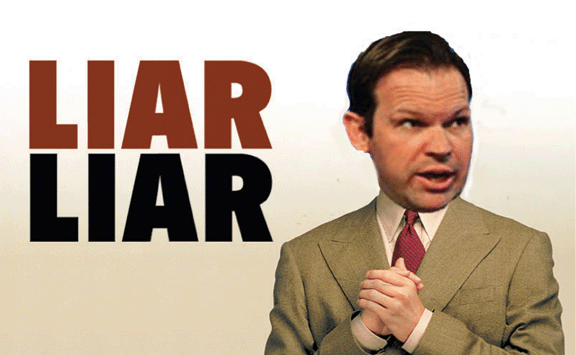
Susan Craig
 THE CANBERRA TIMES MAY 16 2019 Resources Minister could avoid FOI request come Saturday’s election.
A Maralinga nuclear veteran’s grim story
 Maralinga nuclear bomb test survivor reveals truth of what happened in the SA desert https://www.adelaidenow.com.au/messenger/east-hills/maralinga-nuclear-bomb-test-survivor-reveals-truth-of-what-happened-in-the-sa-desert/news-story/697b17f6d3427a78aa0262b09727c169, 24 Apr 19
The nuclear bomb tests, under British Government control, at Maralinga in far west South Australia in the 1950s were conducted at the highest level of secrecy. But they had thousands of witnesses. Most were Australian servicemen, innocently used as guinea pigs and exposed to deadly radiation. Craig Cook talks to a survivor, one of the last of a group of men who built the Maralinga camp as part of 23 Construction Squadron and watched in awe as the bombs were exploded, little knowing they were risking their lives and the futures of their children.
Tony Spruzen knew the drill at the top secret Maralinga facility in the South Australian desert in the spring of 1956.
Just like hundreds of others at the nuclear site at 11-mile camp during Operation Buffalo, he was told to turn his back and cover his eyes to protect himself from the gigantic glare of the exploding atomic bomb.
What they didn’t tell the Australian Army sapper was, at the moment of the flash of detonation, he would see the bones of his hand through his tightly shut eyelids.
“It was like a massive x-ray,” Tony, 83, from Glengowrie says. ‘Unlike anything I’d ever known before.”
A week after One Tree, on October 6, 1956, Spruzen witnessed the detonation of Buffalo 2, named Marcoo.
The bomb was only a tenth the size of One Tree but this time was detonated directly above and just under the ground.
“The bomb was in an amphitheatre of hills and we were far closer to that one, maybe only 200 yards away,” he remembers.
“We were close enough to see the trenches with dummy soldiers in them holding rifles and fake aeroplanes and tanks used to test the blast effect.
“And we could see the scientists walking around in their white suits checking out the site before and afterwards but we were just in khaki shorts and short sleeved shorts. Even the dignitaries had no protection.”
Every hour, from five hours out, an elaborate PA system across the complex announced the timing of the bomb detonation.
In the final 30 seconds, and with a rising and excited inclination, the voice on the PA dramatically counted….ten, nine, eight…down to zero.
When Marcoo exploded at 7am it only took a few seconds for a heavy shower of dust to descend on the witnesses.
“We had this large piece of litmus paper attached to our shirts,” Spruzen recalls
Spruzen, originally from Victoria and a carpenter by trade, enlisted in the Army at just 16.
Four year later he was at Maralinga as part of a detachment of 23 Construction Squadron, an acclaimed unit of the Royal Australian Engineers and exclusively raised in South Australia.
Around 40 young men were selected from the unit to build a desert tent camp with cook houses and latrines for the Commonwealth military ‘high-ups’ who were having their first look at the impact of the devastating nuclear weapon.
Around 200km from the ocean, the tent city gained the facetious name of the ‘Sea View Holiday Camp’.
“It was an adventure…we were all excited,” he recalls.
“A lot of young single guys together and we had some fun.”
The lads knew it was serious too as this was a hush-hush operation. They weren’t even allowed to take a camera along for snapshots so Spruzen has no personal photos from Maralinga.
“Then we all turned around to see this mushroom cloud climbing into the sky. The next thing was the blast. The boom was deafening…and then the wind came about thirty seconds after that blowing dust and soil and debris all over us.”
But he does have a terrible reminder of his three months spent in far western South Australia.
“Of the 40 men who went up with me I only know of three of us still around,” he says. “The rest have all died – many from cancers.”
The first Maralinga bomb, Buffalo 1, with the nickname One Tree, was detonated after being dropped from a 31m high tower.
At 15 kiloton it was the same size as Little Boy, the bomb dropped by the US air force that demolished the Japanese city of Hiroshima in August 1945, killing more than 100,000 instantly and tens of thousands slowly in the aftermath from burns and radiation poisoning.
“They said, keep an eye on that and if it changes to pink come and see us. Well it turned pink for every one of us.
“Had I have known what I know now I wouldn’t have been so close.”
Transferred to Sydney on a training course, Spruzen missed the final two detonations at Maralinga that year: on October 11, 1956, Buffalo 3 (Kite) was released by a Royal Air Force Vickers Valiant bomber, the first drop of a British nuclear weapon from an aircraft; and then on October 22, and again dropped from the 31m tower, (Buffalo 4) Breakaway exploded.
There were a total of seven nuclear desert tests at Maralinga performed during Operations Buffalo and Antler.
The 1985 McClelland Royal Commission heavily criticised the detonations, declaring the weather conditions were inappropriate and led to the widespread scattering of radioactive material.
The radioactive cloud from Buffalo 1 reached more than 11,000m into the air and with a northerly wind blowing radioactivity was detected across Adelaide.
Radioactive dust clouds from other bombs were detected in Northern Territory, Queensland and across New South Wales, as far away as Sydney, 2500km from Maralinga.
Around 12,000 Australian servicemen served at British nuclear test sites in the southern hemisphere between 1952 and 1963.
In recent years, the British Government’s claim that they never used humans “for guinea pig-type experiments” in nuclear weapons trials in Australia has been revealed to be a lie.
Tony Spruzen has struggled to come to terms with being placed in danger by his own government who had full knowledge of the consequences of exposure to radiation.
“Once we all found out later what we’d been exposed to at Maralinga it makes you very angry,” he says.
“We believed them when we were told we would be safe — but we haven’t been.”
Spruzen met his wife Shirley, the daughter of an army veteran, in Adelaide where they settled after marriage in June 1960. He left the army seven months later to work in civil construction. He thought his Maralinga days were well behind him but soon after they came to haunt him.
In the first four years of marriage, the couple agonisingly suffered six miscarriages, including twins.
Alarm bells started ringing when he was sent a survey from Veterans Affairs asking about his general health and, specifically his history of cancers.
“It turned out those involved in the atomic tests had a 30 per cent higher chance than getting cancers than the general public,” he says.
“Most of those got them within the first five years and a majority of those were dead before a decade had passed.”
Spruzen, who eventually had three children with Shirley, didn’t get cancer at that time, although he has since had several melanomas removed.
But when his son was diagnosed with acute myeloid leukaemia at the age of 41, he wondered about the possibility of faulty genes, damaged by exposure to radiation, as has been documented in Japanese survivors of the atomic bombs, jumping a generation.
“My son was told by the QEH (Queen Elizabeth Hospital) there was nothing could be done for him but we went up to Queensland and after a bone marrow transfer from his sister he survived,” he adds.
“A decade on he’s working as strong as he has but I don’t think his condition was a coincidence given my history.
“There’s been nothing (compensation) for those of us who were there although they gave us a white card for our cancers and now we have a (full health) gold card.”
Ken Daly, President Royal Australian Engineers Association says it is the least the men, who literally put their bodies on the line, deserve.
“You get these young men, aged around 25-30, with a history of exposure to radiation, coming down with cancers in those numbers and you just know what has caused it,” he says.
“Many died within a few years of being exposed to the fallout and many passed on generational health problems and birth defects to their children.”
Mr Daly, who was based at Warradale Barracks for 15 years, where 23 Construction was based until being disbanded in the early 1960s, hadn’t heard of the Squadron until around five years ago.
Since then he has been central to the group gaining due recognition.
In its earliest days the Squadron, with a strength of eight officers and 160 in other ranks, built the El Alamein Army Reserve camp, part of which later became the Baxter Detention Centre, outside of Port Augusta.
It also assisted the South Australian community by providing aid during bush fires, the grasshopper plague of 1955, and significant infrastructure construction.
During the record flood of 1956, while those squad members were at Maralinga, the rest of 23 Construction were out sandbagging River Murray towns and then cleaning up after the water receded.
In 2011, the Royal Australian Engineers constructed a memorial at Warradale to all who have served in its ranks.
This year a bronzed engineer’s slouch hat, of actual size, by Western Australian sculptor and former army engineer Ron Gomboc will be incorporated into the memorial.
“The hat will be mounted on the memorial in such a way it will look like it’s suspended in mid-air,” Daly adds.
“It acknowledges the ultimate sacrifice of the more than 1250 engineers who died in World War I and the remarkable service and sacrifice of 23 Construction Squadron that has never been recognised before.”
The slouch hat, costing $6,000 and one of only six to have been cast, will be unveiled during a service at Warradale Barracks at midday on Sunday April 28.
Contact Ken Daly at dailydouble@bigpond.com for further details.
About torture, about pyschology, about the persecution of Julian Assange
John Pilger speaks out for Julian Assange
an example of the sensitive, clandestine, real-world CIA psychology deployed against ‘terrorists’ and enemies of the state, as Julian Assange and Wikileaks have been branded.
In this case, the adversary in the US crosshairs has been not only Julian Assange and Wikileaks, but the global populations that Wikileaks seeks to inform. It is our own vulnerabilities – the vulnerabilities in the information processing systems of all human beings – that have been leveraged and exploited in order to undermine and discredit Wikileaks.
The fundamental psychological task is to render truth suspicious and deceit reassuring, war criminals virtuous and their critics corrupt, pacifism threatening and violence comforting, abuse of power righteous and resistance reprobate, torture forgivable and whistleblowing a crime, censorship a bastion of democracy and free speech a menace to be overcome. Much as George Orwell foresaw.
In order to justify the psychological war on Wikileaks, US powerbrokers have branded Wikileaks and Assange “anti-American” “terrorists”, a “non-state hostile intelligence service” and “enemy combatants”. Bolstered by these factually indefensible slurs, Julian Assange now faces imminent extradition to the United States to face secret charges, most likely for 2010 scoops exposing US war crimes in Iraq and Afghanistan.
Peace is bad. War is good. Truth is dangerous. Censorship will set you free. These are the positions underpinning the war on Wikileaks.
 The Psychology Of Getting Julian Assange, Part 1: What’s Torture Got To Do With It? https://newmatilda.com/2019/02/19/psychology-getting-julian-assange-part-1-whats-torture-got/ Dr Lissa Johnson on February 19, 2019
“…. Assange faces extradition to the United States and secret charges for his publishing activities should he step outside the Ecuadorian Embassy in London. This cross-border, extraterritorial persecution threatens not only Assange’s health, and possibly his life according to a recent UN statement, but poses grave legal risks both to journalism and dissent…..
The Australian rallies join a growing international chorus of organisations and individuals sounding increasingly urgent alarms over Julian Assange’s plight, and its implications for freedom of speech and democratic rights.
Late last year, as secret US charges against Julian Assange surfaced, and the threat of his imminent extradition to the US loomed, the United Nations Working Group on Arbitrary Detention (UNWGAD) issued a strongly worded statement to the UK Government, having previously ruled twice that Assange is being arbitrarily detained in the Ecuadorian Embassy in London.
In its statement, the UNWGAD demanded that the UK abide by its “binding” legal obligations and “immediately” secure freedom for Julian Assange. The UN reminded the UK Government that “human rights treaty law is binding law, it is not discretionary law. It is not some passing fancy”.
The same fears prompted 33 EU parliamentarians to write a similarly strongly worded letter to the British Prime Minister, the Ecuadorian President and the UN Secretary General on December 10th, condemning the “very serious and egregious violations of human rights in the heart of Europe.” They called for Assange’s “immediate release, together with his safe passage to a safe country.”
Two German MPs followed with a visit to the Ecuadorian Embassy on December 20th, at which they denounced the violation of Assange’s “fundamental rights” and expressed their “demand that this case has to be solved: that no publisher, no editor, no journalist is detained because of publishing the truth”.
The politicians’ and UN statements added to previous condemnations of Assange’s persecution from Human Rights Watch, Amnesty International, the American Civil Liberties Union, the Committee to Protect Journalists, and a former senior lawyer for the UNHCR and UN Expert on the Promotion of International Order.
All of these leading legal and human rights authorities have been making essentially the same fundamental point: that Julian Assange is being persecuted for publishing truth in the public interest, placing public interest journalism itself at risk, along with freedom of speech and other democratic and human rights principles.
It is the same fundamental point made by several speakers at an earlier Australian rally to free Julian Assange, held in Sydney in June last year. John Pilger spoke at that rally also.
Pilger’s important 2018 speech, however, like the rally itself, was subject to a near total, if not total, mainstream media blackout. So if you missed it, that may be why. And if you haven’t followed the US war on Wikileaks from the outset, as I hadn’t when I attended last year’s rally, Pilger’s speech is a powerful way to bring yourself up to speed. Continue reading
How Sky News and Peter Ridd try to mislead Australians about the Great Barrier Reef
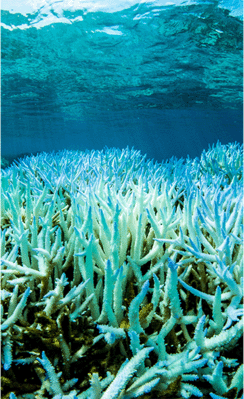 Great Barrier Reef: Sky News and Peter Ridd are deliberately misleading, Independent Australia, By Graham Readfearn | 6 April 2019, According to misinformation from sources such as Sky News and scientist Peter Ridd, the Great Barrier Reef is in perfect health, writes DeSmogBlog’s Graham Readfearn.
AUSTRALIA’S GREAT BARRIER REEF is in some serious trouble, with the latest research in the journal Nature showing the number of new corals has dropped by 89%.
In 2016 and 2017, the Reef was smashed by back-to-back mass bleaching events and heat stress caused by global warming that killed about half the corals.
‘Dead corals don’t make babies,’ said James Cook University’s Professor Terry Hughes, the paper’s lead author.
‘We used to think that the Great Barrier Reef was too big to fail — until now,’ added colleague Professor Morgan Pratchett.
The paper was just the latest in a steady and, many would agree, depressing parade of findings for the World Heritage icon. And if the scientific papers don’t do it for you, then there are always the pictures.
But the release of the study served as a remarkable contrast to the way the Rupert Murdoch-owned Sky News, furnished with material from climate science denial think tank the Institute of Public Affairs, has been “reporting” on reef science in the past week.
On at least five occasions, the channel has interviewed the IPA’s policy director, Gideon Rozner, who has been updating the channel on the case of Dr Peter Ridd, a marine scientist specialising in sediments who was fired in March 2018 from James Cook University.
According to the various interviews, the Reef is in great shape, the science is probably wrong, and Ridd is a “world renowned” Reef expert in a historic fight for freedom. None of this is true, yet the claims have been allowed to stand unchecked.
The saga of Peter Ridd
Ridd’s saga is a long one, but here’s the short version (and, while we’re here, in the interests of full disclosure, in the time since I first started writing about Ridd’s case, I’ve taken a part-time job at an Australian marine conservation charity as a media adviser).
Ridd does not think that human-caused climate change is a problem and he thinks the Reef is in fabulous health. This has been his public position for at least a decade.
But in 2017, Ridd started to publicly accuse his scientific colleagues, some of who were based at his own university in Townsville, of being untrustworthy. This went against the university’s code of conduct. The university censured him. Ridd refused to back down and made more statements. He published “private” university correspondence on his website. He was further disciplined, so he sued his employer. Then they fired him.
Last week, Ridd’s case was finally heard in court with three days of hearings. A judgment is expected in the coming months.
Now, the IPA has gone all out to create a narrative around Ridd’s case. …….https://independentaustralia.net/business/business-display/great-barrier-reef-sky-news-and-peter-ridd-are-deliberately-misleading,12545
Independent report found ANSTO’s health staff lacking in knowledge about radiation exposure
 Kazzi Jai Fight To Stop Nuclear Waste Dump In Flinders Ranges SA
“In addition, based on interviews with ANSTO Health staff working in high hazard areas, the majority of staff did not understand the various health effects of radiation exposures, this being appropriate to individual duties with respect to the hazardous areas in which they work. This is believed by the reviewers to put at risk the ability to verify all persons
performing high risk activities are fully competent to do so. More importantly, this puts the individual at risk.”
– (excerpt from page 7) “INDEPENDENT SAFETY REVIEW OF THE ANSTO HEALTH APPROACH TO OCCUPATIONAL RADIATION SAFETY AND OPERATIONAL PROCEDURES”
OCTOBER 2018
On 5 October 2018, following a direction from ARPANSA’s CEO Dr Carl-Magnus Larsson, the Australian Nuclear Science and Technology Organisation (ANSTO) provided ARPANSA with a report produced by an independent expert review team outlining 85 recommendations to improve ANSTO’s occupational radiation safety processes and operational procedures.
Dr Larsson issued the direction to initiate an independent review on 29 June 2018 under section 41(1A) of the Australian Radiation Protection and Nuclear Safety Act 1998 (the Act) following four separate events with safety implications at ANSTO Health in less than 10 months.

Seems this report was somewhat “buried” in ANSTO’s bright new webpages..….but I got mine from ARPANSA’s webpage instead, since they are the regulator. https://www.facebook.com/groups/344452605899556/
Nuclear Shipment Truth Exposed
David Noonan 24 Feb 19, This shipment came in from France through Port Kembla to Lucas Heights. This was the first shipment ‘returned’ to Australia from previous ANSTO irradiated nuclear fuel waste shipments sent overseas for ‘reprocessing’ – to get it out of the country – while ANSTO continues to produce more… ANSTO have produced nuclear fuel waste for 60 years without a disposal capaciity, and intend to continue to do so for multiple decades to come, while targeting ‘indefinate’ above ground storage (said to be for up to 100 years) on communities in SA…
Judge refuses to unseal criminal charges against Assange
U.S. District Judge Leonie Brinkema said in a 10-page ruling that free-press advocates seeking to unseal the charges have no proof Assange has actually been charged.
The Reporters Committee for the Freedom of the Press sought to unseal the charges after a federal prosecutor inadvertently typed a reference to “the fact that Assange has been charged” in an unrelated case.
The government has acknowledged it made an error but has not publicly confirmed that charges against Assange have been filed.
After the mistake was made, news outlets including The Associated Press reported that Assange has indeed been charged. But those reports relied on anonymous sources.
The precise charges against Assange are unclear. The Wikileaks founder has been staying in the Ecuadorian Embassy in London since 2012 under a grant of asylum and has long expressed fear of a U.S. prosecution. WikiLeaks has served as a vehicle for release of thousands of classified U.S. military and diplomatic cables. In addition, WikiLeaks’ role in releasing emails hacked from the Democratic National Committee in 2016 has also been under scrutiny as special counsel Robert Mueller has investigated Russian interference in the 2016 election and whether the Trump campaign was involved.
Criminal charges typically remain secret and under seal until a defendant has been arrested to prevent a target from fleeing prosecution or destroying evidence. Lawyers for the free-press foundation said that rationale for secrecy no longer exists given the inadvertent disclosure and the fact that Assange has long assumed he has been charged.
Brinkema, though, wrote in her ruling that the Reporters Committee “has not demonstrated with sufficient certainty that Assange has been charged. Unlike in other high-profile cases, the Government has not affirmatively disclosed that charges have been filed. Although the Government acknowledges that it made a mistake … the nature of that mistake is fundamentally unclear.”
Katie Townsend, a lawyer for the Reporters Committee, said no decision has been made on whether to appeal. “The disclosure of the nature of the charges against Assange are a matter of public interest and should be made public,” she said.
UK “reviewing” files on nuclear bomb tests in Australia- this smacks of a cover-up
 “To now withdraw previously available documents is extremely unfortunate and hints at an attempted cover-up.”
“worrying that properly released records can suddenly be removed from public access without notice or explanation.”
Review or ‘cover up’? Mystery as Australia nuclear weapons tests files withdrawn https://edition.cnn.com/2019/01/11/australia/uk-australia-nuclear-archives-intl/index.html, By James Griffiths, CNN
More than 65 years since the UK began conducting secret nuclear weapons testing in the Australian Outback, scores of files about the program have been withdrawn from the country’s National Archives without explanation.
The unannounced move came as a shock to many researchers and historians who rely on the files and have been campaigning to unseal the small number which remain classified.
“Many relevant UK documents have remained secret since the time of the tests, well past the conventional 30 years that government documents are normally withheld,” said expert Elizabeth Tynan, author of “Atomic Thunder: The Maralinga Story”.
“To now withdraw previously available documents is extremely unfortunate and hints at an attempted cover-up.”
Withdrawal of the files was first noted in late December. Access to them has remained closed in the new year.
Dark legacy The UK conducted 12 nuclear weapons tests in Australia in the 1950s and 1960s, mostly in the sparsely populated Outback of South Australia.
Information about the tests remained a tightly held secret for decades. It wasn’t until a Royal Commission was formed in 1984 — in the wake of several damning press reports — that the damage done to indigenous people and the Australian servicemen and women who worked on the testing grounds became widely known.
Indigenous people living nearby had long complained of the effects they suffered, including after a “black mist” settled over one camp near Maralinga in the wake of the Totem I test in October 1953. The mist caused stinging eyes and skin rashes. Others vomited and suffered from diarrhea.
These claims were dismissed and ridiculed by officials for decades — until, in the wake of the Royal Commission report, the UK agreed to pay the Australian government and the traditional owners of the Maralinga lands about AU$46 million ($30 million). The Australian authorities also paid indigenous Maralinga communities a settlement of AU$13.5 million ($9 million).
While the damage done to indigenous communities was acknowledged, much about the Totem I test — and other tests at Maralinga and later at Emu Field — remained secret, even before the recent withdrawal of archive documents.
“The British atomic tests in Australia did considerable harm to indigenous populations, to military and other personnel and to large parts of the country’s territory. This country has every right to know exactly what the tests entailed,” Tynan said. “Mysteries remain about the British nuclear tests in Australia, and these mysteries have become harder to bring to light with the closure of files by the British government.”
Alan Owen, chairman of the British Nuclear Test Veterans Association, which campaigns on behalf of former servicemen, said “the removal of these documents affects not only our campaign, but affects the many academic organizations that rely on this material.”
“We are very concerned that the documents will not be republished and the (Ministry of Defense) will again deny any responsibility for the effects the tests have had on our membership,” Owen told CNN.
Unclear motives Responding to a request for comment from CNN, a spokeswoman for the National Archives said the withdrawal of the Australian nuclear test files was done at the request of the Nuclear Decommissioning Authority (NDA), which has ultimate responsibility over them.
The NDA said that “a collection of records has been temporarily withdrawn from general access via The National Archive at Kew as part of a review process.”
“It is unclear, at this time, how long the review will take, however NDA anticipates that many of the documents will be restored to the public archive in due course,” a spokeswoman said.
Jon Agar, a professor of science and technology at University College London, said the withdrawal “is not just several records but two whole classes of files, many of which had previously been open to researchers at the National Archives.”
“These files are essential to any historian of the UK nuclear projects — which of course included tests in Australia. They have been closed without proper communication or consultation,” he added.
Agar shared correspondence he had with the NDA in which a spokeswoman said some files would be moved to a new archive — Nucleus — in the far north of Scotland. However the Nucleus archives focus on the British civil nuclear industry, and it is unclear why files on military testing would be moved there, or why those files would need to be withdrawn to do so.
Nucleus also does not offer the type of online access to its records as the National Archives does.
“Why not just copy the files if the nuclear industry needs them at Nucleus for administrative reasons? Why take them all out of public view?” Agar wrote on Twitter.
Information freedom In correspondence with both CNN and Agar, the NDA suggested those interested in the files could file freedom of information (FOI) requests for them.
Under the 2000 Freedom of Information Act, British citizens and concerned parties are granted the “right to access recorded information held by public sector organizations.”
FOI requests can be turned down if the government deems the information too sensitive or the request too expensive to process. Under a separate rule, the UK government should also declassify documents between 20 and 30 years after they were created.
According to the BBC, multiple UK government departments — including the Home Office and Cabinet Office — have been repeatedly condemned by auditors for their “poor,” “disappointing” and “unacceptable” treatment of FOI applications.
Commenting on the nuclear documents, Maurice Frankel, director of the Campaign for Freedom of Information, a UK-based NGO, said it was “worrying that properly released records can suddenly be removed from public access without notice or explanation.”
“It suggests that the historical record is fragile and transient and liable to be snatched away at any time, with or without good reason,” he added.
ANSTO’s worrying history of covering up releases of radioactive gases from Lucas heights nuclear reactor
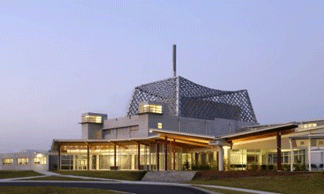 New nuclear reactor spark cover up claims, PUBLIC not told about potentially dangerous gases spread over hundreds of kilometres for fear of causing alarm. https://www.news.com.au/technology/environment/poison-gas-leak-from-sydney-nuclear-reactor-spark-cover-up-claims/news-story/7a2bea7f047cf87f997ad7aff5646213?fbclid=IwAR3YTUCw81aekayba61OSWLYkemq6Eb0u9rlPYnej5B3EUHc9iE0n50_B7I#.s3vdk By Linda Silmalis, The Sunday Telegraph, AUGUST 29, 2010 POTENTIALLY dangerous radioactive gases have been secretly pumped into the atmosphere from Lucas Heights and have spread hundreds of kilometres from the nuclear reactor – but the public have never been told.
The release of the highly volatile radioxenon over several months last year was so concentrated that the plumes were detected in Melbourne up to two days later.
Other plumes were dragged out to sea by winds before drifting back over Sydney.
The Sunday Telegraph understands the Australian Nuclear Science and Technology Organisation (ANSTO) decided against releasing a public statement at the time to avoid causing alarm.
Scientists at a nuclear testing station in Melbourne traced the source of the radioactive gases to Sydney after they picked up 10 specific events between November, 2008 and February last year.
The Comprehensive Test Ban Treaty Organisation International Monitoring System site in Melbourne contacted Lucas Heights after detecting the radioxenon isotope Xe-133.
They were told that 36 hours earlier the first “hot commissioning trials” at ANSTO’s Lucas Heights radioisotope facility for Molybdenum-99 had taken place.
Molybdenum-99 is produced by the fission technique – the intense neutron-bombardment of a highly purified uranium-235 – and is used in nuclear medicine.
While the nuclear reactor – and the government body that oversees it – insists the release of the radioxenon by-product were no threat to public safety, no one, including neighbours of the suburban Sydney plant, were informed.
“Xenon gases are highly volatile and, being inert, they are not susceptible to wet or dry atmospheric removal mechanisms,” a scientific report obtained by The Sunday Telegraph says.
“Consequently, once released to the atmosphere they are simply transported down-wind while radioactively decaying away.”
Significant amounts of the main gas detected – Xenon-133 – can be released during a nuclear reaction or a nuclear explosion.
While it is used in medical procedures, specialists are urged not to administer it to pregnant women and children.
Side effects of its use in medical procedures can include allergic reactions such as itching or hives, swelling of the face or hands, swelling or tingling in the mouth or throat, chest tightness, and trouble breathing.
The report into the release from Lucas Heights says the doses were “well below the annual limit for public exposure”.
Officials from the Australian Radiation Protection and Nuclear Safety Agency said it was notified at the time and that the emissions were within public safety guidelines.
In 2006, ANSTO was forced to allay public fears after a leaked memo revealed xenon and krypton were released into the atmosphere following the rupture of a pipe.
Defence Department accused of deception over Woomera radioactive wastes
Defence under attack on nuclear waste dump https://www.theaustralian.com.au/national-affairs/defence/defence-under-attack-on-nuclear-waste-dump/news-story/fd851b6cefd7c5701d354c7ed1adf09d LUKE GRIFFITHS @_LukeGriffiths DECEMBER 27, 2018
Woomera must be revisited as a potential site for Australia’s first nuclear waste dump, says Centre Alliance senator Rex Patrick, who accuses the Defence Department of deception over claims the site is unsuitable.
Senator Patrick said he would question Defence officials at Senate estimates hearings over why the department dismissed Woomera as a potential site because of an “intolerable risk” and its “impracticability” — a position since backed by Resources Minister Matt Canavan.
The 122,000sq km Woomera Prohibited Area, located in the South Australian outback 450km northwest of Adelaide, is a military testing range under federal government control.
Senator Patrick said significant nuclear waste materials had been stored there since 1994, including 10,000 drums of low and intermediate-level waste from a CSIRO research facility at Fishermans Bend in Melbourne.
In a report published on its website last week, the CSIRO said tests had found the material posed no threat to health or the environment. Tests in May found radiation levels adjacent to the storage had “natural background values” for Australia, as would be found in typical soil and rock.
“The report findings make a mockery of Defence claims there’s no way a national radioactive waste management facility could be located anywhere in the enormous expanse of the WPA,” Senator Patrick said.
“The reality is radioactive waste has been safely stored at Woomera for a quarter of a century. Defence can expect considerable scrutiny in the new year over the bureaucratic obfuscation and deception on this issue. It seems Defence is never stronger in defending territory than when it comes to defending its own.”
Senator Canavan has short-listed two sites near Kimba, 465km northwest of Adelaide, and one site near Hawker, in South Australia’s mid-north, for the waste facility.
The process, which has divided both communities, stalled after a Kimba ballot scheduled for August 20 was delayed by court action from an Aboriginal group that believes traditional owners should vote, despite not living within the shire’s boundaries.
In a similar move, traditional owners at Hawker last week lodged an Australian Human Rights Commission complaint, prepared by Maurice Blackburn Lawyers, that alleged a “fundamentally flawed process”.
Labor has not said how it would proceed should it form government after the election, which must be held by mid-May.D The Department of Defence did not respond to questions.
Fabricated media attacks on Julian Assange
 Last week’s sensationalist allegation by the Guardian newspaper, that WikiLeaks publisher Julian Assange met with Paul Manafort, American political lobbyist and one-time campaign manager for Donald Trump, has been exposed as a politically-motivated tissue of lies. Continue reading
 1 This month
Chernobyl: The Lost Tapes – A good documentary on Chernobyl on SBS available On Demand for the next 3 weeks– https://www.sbs.com.au/ondemand/tv-program/chernobyl-the-lost-tapes/2352741955560
15 April – Zoom –Nuclear Power is Not the Solution
Apr 15, 2026 01:00 AM in Canberra, Melbourne, Sydney

Join the International Physicians for the Prevention of Nuclear War (IPPNW) on Tuesday, April 14th for a timely webinar exploring the risks associated with nuclear power and challenging the myth that it offers a simple, safe, carbon-free solution to the climate crisis

21 April Webinar: No Nuclear Weapons in Australia
Start: 2026-04-21 18:00:00 UTC Canberra, Melbourne, Sydney (GMT+10:00)
End: 2026-04-21 19:30:00 UTC Canberra, Melbourne, Sydney (GMT+10:00)
Event Type: Virtual
A virtual link will be communicated before the event.
Host Contact Info: australia@icanw.org

of the week – Australians for War Powers Reform (AWPR)
To see nuclear-related stories in greater depth and intensity
 Antinuclear