Since 2013, more than $400 million in tax-deductible donations have flowed through an Australian charity, including direct to IDF soldiers. Stephanie Tran reports.
United Israel Appeal (UIA) Australia has remitted $376m to Israel since 2013 via its global partner Keren Hayesod, according to ACNC financial disclosures.
In 2024 alone, UIA Australia received $50.9m in tax-deductible donations and sponsorships.
Financial statements from Keren Hayesod, the Israel-based body that receives and distributes UIA funds, show it received AU$323m in global donations in 2024, with 98.5% originating overseas.
On that basis, Australian fundraising accounted for roughly 13% of Keren Hayesod’s worldwide donation base last year.
UIA Australia first received tax deductible status in January 1998. However, ACNC financial disclosures only go back to 2013. The amount of tax deductible donations made to UIA over its lifetime is likely significantly higher than the figure calculated in this article.
In a press release announcing the decision, then-treasurer Peter Costello stated that “in recognition of the valuable humanitarian service undertaken by [United Israel Appeal], the Government has decided to specifically list it as an international affairs recipient. Legislation to give effect to the Government’s decision will be introduced as soon as practicable.”
“Every dollar aligned with Israel’s national priorities”
At the UIA Victoria AGM in November 2025, UIA leadership were explicit about the organisation’s role in Israel. David Slade, president of UIA Victoria, told members:
“We are the only organisation in Australia raising funds for Israel that holds a seat at every table of decision-making authority mandated to rebuild the country from the north to the south.”
“We are proud that every dollar we distribute is aligned with Israel’s national priorities.”
Julian Black, outgoing federal treasurer of UIA, reported that $39.2m had been sent to Israel nationally, including $14.4m from Victoria, in the 2025 campaign period to mid-November.
UIA Australia describes its central mission as supporting aliyah, “ascent”, referring to Jewish immigration to Israel, and strengthening Israeli society. They state that they “raise funds within Australia and transfer them directly to Keren Hayesod-UIA.”
Keren Hayesod, founded in 1920, describes itself as the “preeminent worldwide fundraising arm for the people of Israel,” operating in dozens of countries. UIA Australia functions as its Australian partner, channelling hundreds of millions of dollars in tax-deductible donations to the fund.
At the 2025 AGM, Slade said:
“This is not theory. It’s delivery. It’s national in scale, national in scope. It aligns with Israel’s priorities and is executed by our global partners.”
1×1515
0:10 / 8:09
1×1515
0:10 / 8:09
Since 2013, more than $400 million in tax-deductible donations have flowed through an Australian charity, including direct to IDF soldiers. Stephanie Tran reports.
United Israel Appeal (UIA) Australia has remitted $376m to Israel since 2013 via its global partner Keren Hayesod, according to ACNC financial disclosures.
In 2024 alone, UIA Australia received $50.9m in tax-deductible donations and sponsorships.
Financial statements from Keren Hayesod, the Israel-based body that receives and distributes UIA funds, show it received AU$323m in global donations in 2024, with 98.5% originating overseas.
On that basis, Australian fundraising accounted for roughly 13% of Keren Hayesod’s worldwide donation base last year.
Source: ACNC
UIA Australia first received tax deductible status in January 1998. However, ACNC financial disclosures only go back to 2013. The amount of tax deductible donations made to UIA over its lifetime is likely significantly higher than the figure calculated in this article.
In a press release announcing the decision, then-treasurer Peter Costello stated that “in recognition of the valuable humanitarian service undertaken by [United Israel Appeal], the Government has decided to specifically list it as an international affairs recipient. Legislation to give effect to the Government’s decision will be introduced as soon as practicable.”
“Every dollar aligned with Israel’s national priorities”
At the UIA Victoria AGM in November 2025, UIA leadership were explicit about the organisation’s role in Israel. David Slade, president of UIA Victoria, told members:
“We are the only organisation in Australia raising funds for Israel that holds a seat at every table of decision-making authority mandated to rebuild the country from the north to the south.”
We are proud that every dollar we distribute is aligned with Israel’s national priorities.
Julian Black, outgoing federal treasurer of UIA, reported that $39.2m had been sent to Israel nationally, including $14.4m from Victoria, in the 2025 campaign period to mid-November.
UIA Australia describes its central mission as supporting aliyah, “ascent”, referring to Jewish immigration to Israel, and strengthening Israeli society. They state that they “raise funds within Australia and transfer them directly to Keren Hayesod-UIA.”
Keren Hayesod, founded in 1920, describes itself as the “preeminent worldwide fundraising arm for the people of Israel,” operating in dozens of countries. UIA Australia functions as its Australian partner, channelling hundreds of millions of dollars in tax-deductible donations to the fund.
At the 2025 AGM, Slade said:
“This is not theory. It’s delivery. It’s national in scale, national in scope. It aligns with Israel’s priorities and is executed by our global partners.”
Support for “lone immigrant soldiers”
Among the programs UIA promotes in Australia is assistance for “lone immigrant soldiers”, individuals who migrate to Israel and serve in the Israel Defense Forces (IDF) without immediate family support in the country.
Through the “Wings Program”, UIA partners with the Jewish Agency for Israel to provide grants and assistance to immigrant IDF soldiers. UIA states that they supported 2,200 lone immigrant soldiers in 2024.
According to a report compiled by the Knesset, in August 2024, there were 6,731 lone soldiers serving in the IDF.
Overseas funding networks and settlement links
In 2022, Pastor Larry Huch raised $8 million for Keren Hayesod through his ministry to help “settlements take over produce farms in the West Bank”.
“One of the main Bible prophecies is helping Jews return to the nation of Israel, so we started working with Keren Hayesod with projects such as making aliyah. We help settlements take over produce farms in the West Bank, which is Judea and Samaria,” Hutch said.
According to an analysis by Canadian human rights organisation Just Peace Advocates, public filings by UIA Canada show that funds linked to the broader Keren Hayesod network have supported organisations assisting IDF veterans and institutions located in Israeli settlements in the occupied West Bank.
At the same AGM, Slade disclosed that his own son is currently serving in the IDF as a lone soldier, describing himself as “a lifelong Zionist”.
UIA also funds the Net@ program, which provides technology education for youth. Promotional materials for the program state that graduates are “strong candidates for elite IDF units”.
[excellent charts here on original]
Comparable program-level detail is not disclosed in Australian ACNC filings, which aggregate remittances to Keren Hayesod. UIA Australia did not respond to questions regarding whether they have oversight of which initiatives are supported by the funds they provide to Keren Kayesod and whether they engage in due diligence practices to ensure that these programs comply with ACNC External Conduct Standards and DGR conditions.
A charity operating in a genocide
UIA’s fundraising expansion has occurred during the Gaza genocide and escalating violence across the occupied Palestinian territories.
A January 2026 report by the UN Office of the High Commissioner for Human Rights found that Israeli laws, policies and practices have created “asphyxiating” conditions for Palestinians in the West Bank and East Jerusalem.
The report stated that there has been an “unprecedented deterioration of the human rights situation” since October 2023, as Israeli government “further expanded the use of unlawful force, arbitrary detention and torture, repression of civil society and undue restrictions on media freedoms, severe movement restrictions, settlement expansion and related violations in the occupied West Bank”.
In his National Press Club address, Chris Sidoti, a commissioner on the UN Commission of Inquiry on Palestine and Israel, stated that in light of the Commission’s finding that Israel has committed genocide in Gaza,
“anyone who has served in any arm of the Israeli military in Gaza should be treated as a suspect.“
UIA CEO Yair Miller previously told MWM that “the United Israel Appeal is fully compliant with Australian law”. They did not respond to a follow-up request for comment regarding the matters discussed in this article.
Cybersecurity company Palantir has received a high-level Australian government security assessment despite concerns about its surveillance and complicity in the Gaza genocide. Stephanie Tran reports.
In November 2025, Palantir Technologies was assessed as meeting the protected level under the Australian Information Security Registered Assessors Program (IRAP). This protection is a key requirement for companies seeking to handle sensitive government information.
The assessment enables a broader range of Australian government agencies and commercial organisations to use Palantir’s Foundry and artificial intelligence platform, AIP.
In a statement, Palantir said the assessment was conducted by an independent third-party assessor in line with requirements set by the Australian Signals Directorate (ASD), and demonstrated its ability to meet “stringent national security and privacy standards”.
The company described Australia as an “important market”, saying the clearance would open “new opportunities” across the public and private sectors.
Mass surveillance without accountability
Palantir has been mired in controversy internationally over how its data analysis and AI tools are deployed by government and military clients, with experts warning that the company’s technology enables mass surveillance and data collection with limited accountability.
An ASD spokesperson stated that IRAP status should “not be interpreted as government approval or endorsement of a company’s broader conduct or use of data.“
“IRAP assessments are third-party commercial arrangements between IRAP assessors (or companies offering ‘IRAP assessment’ services) and assessed entities,” an ASD spokesperson said. “ASD does not sign off or approve IRAP assessments.”
Lobbying push amid political pressure
Palantir’s expanded access to Australian government work comes amid growing political scrutiny. According to reporting by Capital Brief, in July 2025, the company hired lobbying firm CMAX Advisory, after the Greens called for an immediate freeze on government contracts with the company.
“I want to talk to you about Palantir and its expanding footprint in Australia. TLDR: You should be worried. This US surveillance tech company has secured multiple Defence contracts worth over $11 million. We need transparency about what data they’re accessing & why”. — David Shoebridge (@DavidShoebridge) July 7, 2025
CMAX Advisory was founded by Christian Taubenschlag, a former chief of staff to Labor defence minister Joel Fitzgibbon, who is a special counsel at the lobby firm. CMAX Advisory represents a number of major defence contractors, including EOS and Raytheon.
Gaza, ICE and Coles
Palantir has faced sustained criticism globally over how its software is used by government clients.
In April 2025, CEO Alex Karp dismissed accusations that Palantir’s technology had been used to target and kill Palestinians in Gaza, saying those killed were “mostly terrorists”.
The UN Special Rapporteur on the Occupied Palestinian Territories, Francesca Albanese, has said there are “reasonable grounds” to believe Palantir has “provided automatic predictive policing technology, core defence infrastructure for rapid and scaled-up construction and deployment of military software, and its Artificial Intelligence Platform, which allows real-time battlefield data integration for automated decision-making”.
In the United States, Palantir has long worked with Immigration and Customs Enforcement (ICE). An investigation by 404 Media revealed that the company was developing a tool that generates detailed dossiers on potential deportation targets, maps their locations and assigns “confidence scores” to their likely whereabouts.
The company has also attracted attention in Australia for its work with private sector clients, including Coles, where they were hired to cut costs and “optimise” the company’s workforce.
“We kill enemies”
Karp has been blunt about Palantir’s mission. Speaking to shareholders and investors last week, he described the company’s purpose as helping the West “scare enemies” and, “on occasion, kill them”.
Karp also joked about “getting a drone and having light fentanyl-laced urine spraying on analysts that tried to screw us”.
Millions in government contracts
In the United States, Palantir has long worked with Immigration and Customs Enforcement (ICE). An investigation by 404 Media revealed that the company was developing a tool that generates detailed dossiers on potential deportation targets, maps their locations and assigns “confidence scores” to their likely whereabouts.
Despite the controversy, Palantir has quietly built a substantial footprint in Australia. According to Austender data, the company has secured more than $50m in Australian government contracts since 2013, largely across defence and national security-related agencies.
The 2024 financial report of its Australian subsidiary, Palantir Technologies Australia Pty Ltd, show $25.5m in revenue from customer contracts in 2024, though the company’s local financial reports are not audited.
In 2020, Palantir recommended that the Australian government consider “expanding the exemption from public access to disclosure documents”, arguing that filing financial reports with ASIC “is expensive” and “gives competitors access to confidential information”.
Stephanie is a journalist with a background in both law and journalism. She has worked at The Guardian and as a paralegal, where she assisted Crikey’s defence team in the high-profile defamation case brought by Lachlan Murdoch. Her reporting has been recognised nationally, earning her the 2021 Democracy’s Watchdogs Award for Student Investigative Reporting and a nomination for the 2021 Walkley Student Journalist of the Year Award.
Australian taxpayers are subsidising the Israel Defense Forces and illegal settlements in the West Bank via Australian charities. Stephanie Tran reports.
Australian taxpayers are subsidising donations to Israel’s military and to organisations operating illegal Israeli settlements in the occupied Palestinian Territories through a network of registered charities with deductible gift recipient (DGR) status, an MWM investigation has found.
Under Australia’s tax system, donations to DGR-endorsed charities reduce a donor’s taxable income, meaning the public indirectly contributes to the charity’s activities. Documents reviewed by MWM indicate that several Australian charities have raised and transferred funds to Israeli military units and to settlement-linked projects in occupied Palestinian territory.
One People for Israel raises money for IDF. Chai Foundation raises money for One People for Israel.
Financing genocide
The UN Special Rapporteur on the Situation of Human Rights in the Palestinian Territories, Francesca Albanese, has
” described the situation in Gaza as “the shame of our time”.
Concerns about tax-deductible charities supporting Israel’s military and illegal settlement expansion have been raised internationally. In a 2025 report, Albanese described faith-based charities as “key financial enablers of illegal projects” in occupied Palestinian territory, often benefiting from tax concessions abroad despite strict regulatory frameworks.
The report found that the Jewish National Fund and more than 20 affiliated entities fund settlement expansion and military-linked projects, while online platforms such as Israel Gives have enabled tax-deductible crowdfunding in more than 30 countries for Israeli military units and settlers since October 2023.
According to the report, Christian Zionist organisations in the United States, the Netherlands and elsewhere sent more than $US12.25m in 2023 to projects supporting settlements, including some linked to extremist settler groups.
The Jewish National Fund, Israel Gives and Christians for Israel all have subsidiaries in Australia that have been awarded DGR status. ACNC registered charities Chai Charitable Foundation and United Israel Appeal have also raised funds to support the IDF.
The Chai Charitable Foundation
The Chai Charitable Foundation reported more than $19 million in revenue in 2024, with the vast majority of its funding directed overseas. Registered with the ACNC in 2017, Chai says its purpose is
“to alleviate poverty, distress and suffering in Australia and internationally.“
In its 2024 financial report, the charity disclosed $15.39 million in grants and donations for use outside Australia, compared with $1.62 million domestically.
While the charity says it supports low-income families and “civilian victims of terror” in Israel, it has also hosted fundraising campaigns linked to organisations that openly provide equipment to the Israel Defense Forces (IDF).
One such campaign supports One People for Israel, founded in 2023 by Ari Briggs, an Australian-born man who emigrated to Israel. The organisation says it works directly with senior IDF logistics officials to deliver helmets, protective vests and other military equipment to Israeli soldiers. A letter dated October 14, 2023, from the IDF acknowledges (image above) that Briggs was supplying equipment to military units.
Established in 1992 and based in Melbourne, UIA raises funds almost exclusively for overseas use, though it does not publicly break down how much of its income is spent outside Australia.
The charity describes itself as part of Keren Hayesod, a global fundraising network that operates in more than 40 countries and acts as a “works to further the national priorities of the State of Israel”.
“UIA funds programs that assist people to serve in the IDF.”
Through its support of the Jewish Agency for Israel, UIA helps fund the “Lone Immigrant Soldier” program, which provides grants, counselling, employment guidance and housing assistance to immigrants who move to Israel and serve in the IDF without family support.
Around 1,300 lone soldiers complete their army service each year, according UIA.
UIA also funds education and training initiatives such as the Net@ program, which provides advanced technology training to young people. Promotional material for the program states that graduates are “strong candidates for elite IDF units”.
Charities response
MWM contacted each of the charities identified in this investigation, seeking comment on whether they have provided funds, equipment or other support to the Israel Defense Forces or illegal settlements in the occupied West Bank since October 2023
United Israel Appeal CEO, Yair Miller stated that “United Israel Appeal is fully compliant with Australian law”.
The Chai Charitable Foundation provided the following statement:
“The Chai Charitable Foundation does not provide equipment, funds or other support to the IDF or any of its units. The Chai Charitable Foundation does not support any activities that are affiliated with entities on DFATs list of sanctioned entities, including those based in the West Bank. Regular checks are made to ensure that funds are not made available to entities on DFAT’s sanctions list.”
“The Chai Charitable Foundation employs an overseas Compliance Officer who oversees the onboarding, vetting and monitoring of our overseas partners. This includes ensuring that the purposes being advanced align with our mission and status as a registered charity in Australia. We are committed to the external conduct standards issued by the ACNC and the DGR conditions regulated by the ATO.”
The other charities contacted for this story did not respond to requests for comment by deadline.
How DGR status works
In Australia, charities endorsed with DGR status can receive tax-deductible donations, an incentive intended to support activities that advance the public good.
The ACNC oversees charity registration, while the Australian Taxation Office administers DGR endorsement.
MWM has obtained legal advice in respect of charity registrations. To remain registered, charities must continue to pursue a recognised charitable purpose and provide a public benefit.
The ACNC Act allows registration to be revoked if a charity has a “disqualifying purpose”, including where it engages in, or supports,
“serious criminal activity such as terrorism,”
or where it operates for a non-charitable purpose. Charities can also lose registration if they fail to comply with the External Conduct Standards, which apply to overseas activities.
For charities operating internationally, the External Conduct Standards require that funds and resources be applied consistently with the charity’s stated purpose, that reasonable controls and risk-management processes are in place to prevent misuse, and that charities take reasonable steps to comply with Australian law while operating overseas.
This includes compliance with relevant provisions of the Criminal Code, such as those relating to terrorism financing.
Evidence suggesting charitable funds or resources are being used to support foreign military units or settlement-linked activities could justify regulatory scrutiny by the ACNC, particularly where such activities appear to fall outside a charity’s stated purposes or raise risks under Australian criminal law.
Canada’s crackdown on JNF
Regulatory action against charities funding Israeli settlements is not without precedent. In Canada, multiple charities including Jewish National Fund Canada, have had their charitable status revoked after a tax office audit found “the organisation used donations to help fund infrastructure for the Israeli military, a foreign army, which contravenes Canada’s Tax Code”.
JNF Canada was ordered to wind up its operations in Canada and disperse its remaining assets valued at $31 million. The revocation of JNF Canada’s charity status followed decades of grassroots campaigning and activism.
ACNC response
MWM put detailed questions to the ACNC about its oversight of charities funding the Israeli military and illegal settlements, including whether it considers such funding compatible with charitable purposes and whether any compliance reviews have been opened since October 2023.
The ACNC said it cannot enforce international law unless it has been incorporated into Australian domestic legislation. While the United Nations considers Israeli settlements in occupied territory to be illegal under international law, the regulator said this position “has not, at this stage, been incorporated into domestic Australian law”.
The regulator said it does not categorise concerns using identifiers such as “funding the IDF or settlement-related activities”, but stated that “between 7 October 2023 and 31 December 2025 it received 896 concerns relating to 88 charities in connection with the Israel/Gaza conflict.”
The full ACNC response to questions is below.
What obligations do ACNC registered charities with deductible gift recipient (DGR) status have to ensure their activities and overseas funding comply with Australian law, including sanctions law and counter-terrorism financing requirements, as well as Australia’s international legal obligations? How does the ACNC assess whether a charity’s overseas activities are consistent with the requirement to pursue a charitable purpose and to operate for the public benefit, particularly where funds may support foreign military units or activities in occupied territory?
The ACNC registers and regulates charities. The ATO is responsible for DGR endorsement. In most cases, organisations must be registered charities to qualify for DGR endorsement – some limited exceptions apply (government entities, ancillary funds or entities specifically listed in tax law).
Once registered with the ACNC, charities have ongoing obligations to the ACNC that they must meet to remain registered. These obligations include notifying the ACNC of changes, keeping records, reporting annually and complying with the ACNC Governance Standards (unless they are a Basic Religious Charity) and External Conduct Standards.
Australian registered charities that operate outside of Australia must comply with the External Conduct Standards (ECS) set out in Division 50 of the ACNC Act. ECS 1 covers the way a charity manages its activities overseas and how it is required to control its finances and other resources including ensuring resources are applied in accordance with charitable purposes and that reasonable risk management processes are in place to protect against misuse. ECS 1 also requires registered charities to comply with Australian laws while operating overseas, including to take reasonable steps to ensure they are not breaching international sanctions (this only applies where international law has been incorporated into Australian domestic legislation).
Speaking generally, the ACNC has a range of tools to monitor charity compliance with obligations in addition to compliance and enforcement powers.
Since 2020, the ACNC has had a program to review around 2% of all DGR endorsed charities annually (approx. 500 charities per year), focusing on entitlement to charity registration and correct charity subtypes. The selection of charities reviewed as part of this program is based on an assessment of emerging concerns or patterns of risk identified in our work.
Between 2020-2025 the ACNC conducted compliance reviews that sought to identify areas where governance could be improved amongst particular cohorts of charities where emerging risks and/or areas of regulatory focus had been identified by the ACNC and communicated to the sector. Summaries of matters that the ACNC has considered in these proactive reviews are published on the ACNC’s website here: Compliance reviews.
In addition, the ACNC has the power to compel individual charities or cohorts of charities to complete self-audits of their compliance with specific governance obligations. Programs of self-audits allow the ACNC to better understand emerging issues, areas of operating or governance risk in the sector.
Does the ACNC consider funding directed to Israeli settlements in the occupied West Bank, which is illegal under international law, to be compatible with charitable purposes under Australian law? The United Nations’ view that settling civilian populations in an occupied territory is contrary to international law has not, at this stage, been incorporated into domestic Australian law. The ACNC cannot enforce international law unless that law has been incorporated into Australian domestic legislation.
Has the ACNC received complaints or opened compliance reviews or investigations into any Australian charities alleged to be funding the IDF or settlement-related activities since October 2023? The ACNC does not categorise concerns with identifiers such as ‘funding the IDF or settlement-related activities’.
However, between 7 October 2023 to 31 December 2025, the ACNC received 896 concerns relating to 88 charities in relation to the Israel/Gaza conflict.
What enforcement or regulatory action is available to the ACNC if a registered charity is found to be supporting activities that may contravene international humanitarian law or undermine Australia’s stated foreign policy position on settlements? The ACNC can only enforce Australian law.
Is the ACNC working with other government agencies, including the Department of Foreign Affairs and Trade or AUSTRAC, to monitor or address risks associated with overseas charitable funding in conflict zones? The ACNC works collaboratively with other Australian Government agencies to ensure the best placed agency takes a lead. We support a whole-of-government approach to addressing fraud, and work with other government agencies when it is appropriate to do so.
When our intelligence work uncovers broader illegal activity – for example, detecting suspicious conduct that could be related to terrorism financing, money laundering or serious fraud – we refer these matters to the appropriate authorities
the Government is boosting its capability to deal with anticipated political protest activities against a much expanded US military and intelligence presence in Australia.
As public concerns over the AUKUS alliance rise – with expanding US bases in Australia and Donald Trump’s belligerent conduct, FOI documents reveal the Government is secretly expanding its ‘US Department of War Protest’ Force. Rex Patrick reports.
Most people won’t be aware that the Australian Federal Police (AFP) has established a new command.
Headed by Commissioner Krissy Barrett, our national police force is made up of five regional commands (Northern, Eastern, Central, Southern and Western) and a number of functional commanders dealing variously with crime, fraud and corruption, cyber operations, counter-terrorism and special investigations, and protective security. No surprises there – the AFP structure is well established and pretty much what you would expect.
But now there’s a new AFP “AUKUS Command”, established with little fanfare and headed by AFP Assistant Commissioner Sandra Booth.
AFP Assistant Commissioner for AUKUS Sandra Booth at a US naval station. Image: AFP
AUKUS Command’s roles are centred on security for the AUKUS nuclear submarine project and interestingly include ‘Public Order Management’, but its mandate is much broader than protecting nuclear submarines.
MWM’s Freedom of Information (FOI) request to the AFP, amongst other things, sought access to documents that show the terms of reference, functions and responsibilities of AUKUS Command and Documents held by AUKUS Command that relate to potential political opposition and/or protest activity relating to the AUKUS nuclear-powered submarine project.
The AFP’s FOI response came in late and was covered with large swaths of black ink redacting most of the information, but enough has been revealed to show that the Government is boosting its capability to deal with anticipated political protest activities against a much expanded US military and intelligence presence in Australia.
AUKUS Protection
AUKUS Command starts with a “permanent AFP horizontal security overlay” set up at HMAS Stirling (near Perth) to “support the Australian nuclear submarine program under the AUKUS initiative”
The AFP AUKUS Command will initially conduct AUKUS protective security work, including waterborne and remotely piloted aircraft escorting of US Navy, Royal Navy and (eventually, maybe) Royal Australian Navy submarines in and out of waters around the base.
Submarines berthing at HMAS Stirling have to do a lengthy and protest-vulnerable surfaced transit through Gage Roads to get to/from the deep water north-west of Rottnest Island.
The AUKUS Command has established a rapid response capability and is prepared for
“public order management operations. “
Officers in the AUKUS Command are trained in rapid appraisal, coxswaining, jet ski operation, remote piloting of aircraft and countering remotely piloted aircraft, protestor negotiation techniques, protestor removal techniques and “public order management munitions delivery”.
Initially, at least, the Command will comprise four teams, a ready reaction team and a canine unit.
Nuclear protestors not tolerated
Although anti-nuclear protests focused on visiting US Navy nuclear powered submarines have so far been small in scale, the AFP has likely been alerted to the possibilities of larger scale water-borne protest by the “Rising Tide” environmental actions at Australia’s largest coal export terminal at Newcastle.
Protest groups involved in those activities have already been subject to close scrutiny by the AFP and New South Wales Police.
In any case, it’s clear that the Australian Government and the AFP are determined to demonstrate to the United States and the United Kingdom that there will be no tolerating protest activity that might impede or delay the movement of American and British submarines stationed at HMAS Stirling as part of the AUKUS Submarine Rotational Force – West.
But wait, there’s more, much more
But it turns out that protecting nuclear submarines is only part of the AUKUS Command’s responsibilities.
The first giveaway as to the much broader purpose of the Command is the fact that a July 25, 2025, Memorandum of Understanding signed by Assistant Commissioner Booth was between the AFP and, not the Australian Submarine Agency, but the Department of Defence.
The previously secret AFP documents released under FOI show that the AFP AUKUS Command will have strategic responsibility for delivery of protective security services to “specified Defence bases) under the Defence MOU, with a significant focus on building and supporting a future-ready Protective Security Officer workforce.
Pine Gap
The documents do not reveal which Defence bases, but the FOI request did capture emails between Assistant Commissioner Booth and other AFP officers dealing with a protest that took place last year at Joint Defence Facility Pine Gap, the top-secret signals intelligence facility near Alice Springs that’s operated by the US National Security Agency, the US National Reconnaissance Office and the Australian Signals Directorate.
Major upgrades are taking place at a number of other Australian Defence Force facilities to accommodate an expanded US military presence in Northern and Western Australia.
Significant works have also been underway at Australian intelligence facilities, including a major perimeter security upgrade and installation of new satellite dishes at the ASD’s Shoal Bay Receiving Station, nineteen kilometres north-east of Darwin.
As the US defence and intelligence footprint expands, it’s likely that the AUKUS Command’s security and “public order management” responsibilities will be quite wide-ranging.
More protests coming, and costs
As public concerns rise over nuclear issues, it’s very likely the arrival of the US submarine rotational force at HMAS Stirling, the increasing disposition of US forces around Australia and the abandoning by the US of a ‘rules-based order’ will lead to more protests.
The Mid-Year Fiscal and Economic Outlook (MYEFO) handed down in December showed an allocation to the AFP AUKUS Command of $73.8 million in this financial year and $125.2 million in the next.
The expenditure publication was unusual, given that the Government thinks it is entirely appropriate to wrap
“AUKUS costs in total secrecy.”
Indeed, even in this release, cost information in the MOU was redacted.
A lack of transparency
It is accepted that some things around nuclear submarines are properly confidential. But the Australian Government has been wrapping a thick secrecy blanket over everything to do with AUKUS; absolutely everything.
As an FOI related transparency fight goes on in background, including in the Federal Court where this writer is trying to get access to documents that advise the government on how to select a high-level radioactive waste site, the Government has (in contrast to the US and UK) refused to allow for an inquiry into this bankrupting Defence capability.
Instead of bringing the Australian public along with them, instead of generating social licence for the project, instead of being up front about the integration of the Australian Defence Force into the US Armed Forces at a time when Australians are struggling with confidence in the US, opaqueness is the order of the day for the Government.
And now, for good measure, there’s a whole new AFP command to keep a lid on the secrets and to crack down on public protests.
Australians everywhere should be made acutely aware that the Australian Israel lobby is now explicitly advocating a ban on criticism of the state of Israel.
Not just hate speech against Jews. Criticism of a foreign state. They’re coming right out and saying it.
During a recent public video conference with the American Jewish Committee on the topic of the Bondi Beach shooting, the Executive Manager of the Australia/Israel & Jewish Affairs Council (AIJAC) explicitly says he wants pro-Palestine protests to be banned by the Australian government, and that addressing the problem of antisemitic hate speech in Australia necessarily means stopping opposition to Israel’s actions.
About 40 minutes into the American Jewish Committee’s YouTube video of the conference, AIJAC Executive Manager Joel Burnie demands that the Australian government take much stronger action to regulate freedom of expression regarding Israel and Zionism in Australia, saying the following:
“They need to act swiftly. They need to go to their own arms and their own institutions: no longer can you refuse service to a Zionist. We are going to prosecute people that spew hate speech against your people, and we’re not going to tip toe around the fact that the central problem here is Israel. I for one as Jewish leader will no long talk about antisemitism in isolation from Israel, because it’s the rhetoric and language on Israel that motivates the people to come and kill us. Those two terrorists were motivated by what was going on in Israel, and that’s what motivated them to come and kill us. So if they had Israel on their minds why are we acting as though it has nothing to do with the vitriolic binary nature of the pro-Palestinian advocacy movement?”
Burnie goes on to say that he wants a complete government ban on protests against Israel’s abuses throughout the nation:
“So overnight what we want immediately if you ask any Jew, what do you want, what do you want? No more protests! No more protests! No more no-go zones for Jews. I can’t, for two years, cannot take my kids to downtown Melbourne for two years on a Sunday, because of the pro-Palestinian marches, because of the violent nature of them. No more! Because that is an acceptance of the connection between the two. And until the prime minister is willing to do that, this is gonna happen again.”
Burnie is lying here, for the record. Anyone who has gone to the pro-Palestine demonstrations in Melbourne as I have will tell you that the protests are not even slightly violent in nature, and that there are Jews among the demonstrators who actively make their presence known. Those demonstrations have never been “no-go zones for Jews”; Joel Burnie doesn’t want to take his kids to downtown Melbourne on a Sunday because he doesn’t want to expose them to ideas and information which reveal the depravity of his Israel-supporting worldview.
Australians would probably benefit from watching the entire hour-long video of the conference, whose contents I first saw spotlighted on Twitter by Information Liberation’s Chris Menahan.
Some other highlights:
At 4:20 Burnie says that part of his role at AIJAC is “to take non-Jewish politicians and journalists and diplomats and other Australian officials to Israel.”
At 14:00 Nick Aronson, who is Chief of Staff to Australia’s so-called “antisemitism envoy” Jillian Segal, regurgitates the bogus propaganda line we’ve been hearing nonstop from Israel apologists throughout the western political/media class, “the words globalise the intifada actually mean globalise the intifada; it means kill Jews wherever they are”. Pro-Israel spinmeisters have been spouting this line with creepy uniformity ever since the Bondi shooting in order to justify government crackdowns on freedom of speech and assembly to protect Israeli information interests.
At 15:00 Burnie says “the gloves are off now” with regard to stomping out free speech in Australia, saying Jews need stop saying “not all pro-Palestinian supporters are antisemitic”, saying “The pro-Palestinian movement, or the things within the pro-Palestinian movement that we all are exposed to in the public, is too binary: you’re pro-Palestinian so you need to be viciously anti-Israel.”
At 16:20 Burnie claims the Bondi shooting “happened because of the protest movements on the streets”, citing no evidence.
At 17:30 Burnie again makes his “no more protests” demand, saying “If I could ask for one thing of the government today: no more protests. If they cannot utilise language that is not inciting violence, that does not marginalise and dehumanise Jews, they have no right to be on the streets.”
At 21:10 Burnie complains that there haven’t been any prosecutions and arrests for antisemitic speech.
At 33:30 Burnie singles out Australian Muslims, saying “there needs to be more monitoring and surveillance of Islamic hate preachers” and an auditing of their education syllabus because of an “antisemitism problem amongst the Australian Muslim community.”
At 36:25 Burnie says Jillian Segal’s notorious speech-suppressing plan for fighting antisemitism in Australia “wasn’t about quashing debate on Israel, it just happens to be that language on Israel invading all of our social spaces in Australia have made this country a very unsafe space and place for Jews.”
At 46:00 Aronson says “there’s absolutely no doubt that people need to go to jail” for antisemitic hate speech in Australia, but says that won’t be enough to fix the problem because “we can always arrest more people, make no mistake, but you can never arrest enough, to be honest.”
At 54:00 Aronson speaks of the need for regulating online speech, complaining that “a number of the online platforms pride themselves on what they call free speech — obviously we would disagree; we would call it hate speech.” At 56:00 he says “we need to continue to put pressure on these platforms to understand the role they have to play in social cohesion, and how far short they are falling of community standards.”
This comes as the Australian government announces plans to ramp up its war on free speech in the wake of the Bondi Beach attack. We can be sure to see more authoritarian measures rolled out in the weeks to come as Israel’s supporters seize on this opportunity to advance the information interests of a genocidal apartheid state.
This article examines a developing crisis in Australian public integrity: the systematic use of encrypted and unminuted communications between lobbyists and the highest levels of government to evade transparency laws. Drawing on recent investigative reporting and parliamentary analysis, it argues that this practice, occurring alongside legislative efforts to weaken the Freedom of Information (FOI) framework and a failure to implement robust anti-corruption measures, represents a calculated retreat from ethical transparency. This creates a “dark space” in policymaking, fundamentally at odds with the stated mission of the National Anti-Corruption Commission (NACC) and the basic democratic contract of public trust. The article concludes that this constitutes a form of institutionalised obscurity that protects political interests at the expense of democratic accountability.
Introduction: The Promise and the Practice
The election of the Albanese government was heralded with a promise to restore trust and integrity after a decade of scandals. The establishment of the NACC was its cornerstone. However, a parallel track of conduct suggests a different priority: the management of political risk through the control of information. This article synthesises evidence revealing a pattern where commitments to transparency are actively undermined by operational secrecy, creating a profound dissonance between public rhetoric and private practice.
The Architecture of Evasion: “Going Non-Traceable”
At the heart of this issue is a reported, routine practice within the Prime Minister’s office. Lobbyists and stakeholders are advised to use encrypted messaging applications (such as Signal) and direct phone calls for substantive policy discussions, explicitly to avoid creating a discoverable record under the Freedom of Information Act 1982 (Cth). This guidance creates a two-tiered communication system: a formal, sanitised record for public consumption, and a shadow, substantive dialogue where real influence and negotiation occur. The justification – protecting “fluid thoughts” – is a stark departure from the principle that the formation of public policy should be a matter of public interest, not private conjecture.
Weakening the Scaffolding: Legislative and Systemic Failures
This operational evasion is not occurring in a vacuum. It is reinforced by systemic and legislative actions that degrade the infrastructure of transparency:
The FOI Amendment Bill: The government is pursuing amendments that experts from the Australian Law Council and the Grattan Institute describe as “the most significant retrenchment” of transparency in decades. Key changes include a strict 40-hour processing cap – a logistical impossibility for complex requests – and the introduction of new, subjective grounds for refusal. This legally enshrines the difficulty of access.
Chronic Record-Keeping Failure: A 2023 National Archives of Australia report found systemic failure across the Commonwealth in managing digital records. In 90% of recent audits, agencies received negative comments. Only one agency had a clear policy on capturing ministerial and departmental messaging for the official record. This is not negligence; it is a pervasive institutional disregard for the archival compact.
Rejecting Anti-Cronyism Reforms: The government sat for two years on a review into “jobs for mates” in public appointments. When released, it rejected core recommendations to depoliticise the process, such as banning last-minute appointments before elections. This demonstrates a preference for preserving patronage networks over implementing substantive integrity reform.
The NACC in the Dark: An Integrity Watchdog Without a Trail
The establishment of the NACC was meant to be a circuit-breaker. However, its efficacy is premised on the existence of evidence – a paper trail, a digital record, a minute of a meeting. The practices detailed above are designed to eliminate that trail. The NACC’s own definition of “serious or systemic corrupt conduct” includes breaches of public trust and any conduct perverting the impartial exercise of official functions. Influencing policy through hidden channels, deliberately shielded from public and archival scrutiny, aligns precisely with this definition. The NACC’s first major survey, finding 15% of public officials were aware of corrupt conduct in their area, hints at the scale of the challenge it faces in a culture of obscurity.
Analysis: The “Trust Gap” and the Corruption of Process
The outcome is a critical “trust gap.” The public is asked to trust in institutions that are architecturally designed to avoid being held to account. This goes beyond traditional corruption (bribes for favours). It represents a corruption of process, where the very mechanisms for democratic oversight – FOI, archives, parliamentary scrutiny – are rendered inert. The government controls not only policy but the narrative of how that policy was formed, presenting a fait accompli to the public while hiding the machinery of influence. This creates a space where the lines between lobbying, policy development, and undisclosed conflicts of interest dangerously blur.
Conclusion: Gestures Versus Substance in the Democratic Contract
Australia is at an integrity crossroads. It has the gesture – the NACC – but is dismantling the substance required for that gesture to be meaningful. A democracy cannot function on a “need-to-know” basis where the government decides the public does not need to know how it is governed. The use of encrypted lobbying and the erosion of record-keeping are not administrative quirks; they are political strategies that sacrifice long-term public trust for short-term political convenience. Rebuilding trust requires not just new institutions, but a radical recommitment to transparency as the default, not the exception. Until the “dark space” of policymaking is illuminated, the promise of integrity will remain, like the lost records themselves, unfulfilled.
Jillian Segal, Australia’s controversial Antisemitism Czar and Israel lobbyist, procured an extra $12.9m funding from PM Anthony Albanese, heavily redacted FOI documents show. Stephanie Tran reports.
The Albanese government has blocked key details about the appointment of Jillian Segal as Australia’s special envoy for antisemitism, with freedom of information documents (FOI) revealing a process almost entirely obscured by redactions.
The documents, released by the Department of Home Affairs in response to an FOI request, show the government relied on wide-ranging secrecy exemptions to withhold internal briefings, candidate assessments, deliberative advice to ministers, and all correspondence between Segal and the Prime Minister’s Office.
Beyond a set of boilerplate terms of reference, the documents shed little light on why Segal was chosen. What’s deliberately missing, however, is the real story.
Selection process almost entirely redacted
One of the key questions the FOI sought to answer was how Segal came to be selected. In correspondence to staff in March 2024, Home Affairs officials described an intention to provide the Prime Minister with “up to 6 candidates” reflecting “the demography of Australia”, diverse identities and gender, and “trusted relationships” in their communities.
But every document detailing assessments or the rationale for selection was either heavily redacted or withheld in full, primarily under the FOI Act’s deliberative processes exemption under s47C.
The Information Officer’s decision letter notes that Home Affairs undertook “extremely thorough” searches, but still located no resume, no risk assessments and no evaluation criteria.
The Department’s claim that it could not locate a copy of Jillian Segal’s CV appears to be at odds with the government’s own records. In a June 2024 letter to the Prime Minister, Immigration Minister Andrew Giles explicitly stated that Segal’s “Curriculum Vitae, Private Interest Declaration and Appointments Details pro-forma are at Attachment D.”
(Original article copiously shows the government documents)
Urgency and budget blowouts
What survives the redactions paints a picture of a high-speed, politically sensitive process.
The documents reveal the existence of an “Israel Hamas Social Cohesion Taskforce” within Home Affairs, headed by Giles.
In February 2024, Giles wrote to Anthony Albanese seeking “urgent agreement” to appoint envoys to combat Antisemitism and Islamophobia, citing the “immediate and significant rise in Antisemitism and Islamophobia … exacerbated by the 7 October 2023 Hamas terrorist attacks on Israel [and] the ongoing conflict and the dire humanitarian situation in Gaza.”
On 21 June 2024, Giles personally recommended Segal as the preferred candidate for the Special Envoy to Combat Antisemitism.
In a letter dated 25 June 2024, Albanese agreed to Segal’s appointment. Albanese also approved an additional $12.9 million of funding for the two envoy roles.
“The 2024-25 Budget provided $4.0 million over two years from 2023-24 for the appointment of the Special Envoys, as a decision taken but not yet announced. Noting the appointments will now be for three years instead of one and additional support staff may be required, I agree to provide up to an additional $12.9 million in total over three years from 2024-25 for up to 12 staff, with offsets to be agreed in the 2024-25 Mid-Year Economic and Fiscal Outlook (MYEFO) context, subject to agreement with the Department of Finance.”
Public interest outweighed by need for secrecy
In its decision, Home Affairs argued that releasing deliberative material would hinder officials’ ability to provide “full and frank advice” on future appointments, and that releasing names or details of candidates would be an unreasonable breach of personal privacy.
The Department explicitly acknowledged that disclosure would “promote the objects of the FOI Act” and “inform debate on a matter of public importance” but still maintained the public interest favoured secrecy, particularly to avoid “prejudicing” internal government processes.
The information officer stated the following:
“I consider that the public interest in protecting the process of the provision of free and honest confidential advice by a Department to its Minister has, on balance, more weight, than the public interest that might exist in disclosing the deliberative matter. Endangering the proper working relationship that a Department has with its Minster and its ability to provide its Minister with honest advice confidentially would be contrary to the public interest.”
The Federal Government is refusing to release any details of the land purchase for radioactive waste management. Rex Patrick follows the money trail.
n 2023, the current Minister for Resources confessed to the Senate that the Department of Industry, Science and Resources (DISR) had spent $108.6 million not finding a place for a National Radioactive Waste Management Facility (NRWMF).
In July 2023, Federal Court Justice Natalie Charlesworth set aside a November 2021 declaration made by then Minister Keith Pitt that Napandee, a 211-acre property near Kimba in SA, was to be the future site of the NRWMF. Pitt’s declaration for this site was nine years in the making, but he and the Department had botched the site selection process.
Not the way to select a facility
If you wanted to select a site for a national facility to store radioactive waste, you’d look to the storage requirements, including technical, environmental, geological (such as earthquake tendency), social, and indigenous cultural and heritage considerations. And then you’d look for sites that met all those requirements.
That’s not what DISR did.
In September 2012, the Government released a notice of intention to conduct a nationwide request for land owners to nominate land for the NRWMF. The official call for nominations was conducted between 2 March and 5 May 2015.
A sweetener was added to entice landowners; the successful land seller would get four times the market value. It was quite an extraordinary proposition – it wasn’t as though the Government was intending to compulsorily acquire land from an unwilling seller.
But, why not? The geniuses who concocted the plan in DISR knew only too well that the extra money was just taxpayers’ money.
Buy, and then sell back
On 26 November 2021, the Government declared land in Napandee, owned by the Baldock family*, would be the site for the facility.
Minister’s Decision (Source: DISR)
Three days later, the Minister issued a press release stating the Government had acquired the land.Minister’s Decision (Source: DISR)
Three days later, the Minister issued a press release stating the Government had acquired the land.Minister’s Decision (Source: DISR)
Three days later, the Minister issued a press release stating the Government had acquired the land.
MWM is trying to get access to the land sale contract and the purchase price, using FOI. But access to it has been refused. You paid, but are not allowed to know.
The FOI decision is now the subject of challenge, where the Information Commissioner will be the adjudicator.
Last week, the Minister for Resources also refused to answer a formal “how much” question asked by Senator Lambie. Local scuttlebutt is that the Department spent $10m of taxpayers’ money buying that land – almost 8 times the market value. The refusal by the Department and the Minister to give sale price answers under FOI or, respectively, to the Senate adds suspicion that this is correct.
Local scuttlebutt is that the Department spent $10m of taxpayers’ money buying that land – almost 8 times the market value. The refusal by the Department and the Minister to give sale price answers under FOI or, respectively, to the Senate adds suspicion that this is correct. Or when the Department of Infrastructure acquired the Western Sydney Airport ‘Leppington Triangle’ land for $30m, when it was only valued at $3m.
Maladministration or something more sinister?
It’s unheard of that the Senate would be denied past expenditure information on land at Napandee.
The Government has surely overpaid for the site, even after meeting their own unexplained ‘4x price’ rule, by $4 million, but possibly by $9 million if the scuttlebutt is correct.
At best, the Government has engaged in a farce. The Department knew that the path they had taken to select Napandee was flawed.
On 1 February 2020, Senator Matt Canavan, who preceded Pitt as the Minister for Resources, announced Napandee as the site to host Australia’s NRWMF. But the Canavan decision was informal.
Realising the process would be found wanting by a Court, the Government changed tack and on 13 February 2020 introduced legislation into the House of Representatives that would have the Parliament select Napandee as the site.
Representatives that would have the Parliament select Napandee as the site.
On 6 March 2020, a senior departmental official, Sam Chard, met with the Mayor of Kimba, during which he said words to the effect that (as recorded in Justice Charlesworth’s decision) ,
“parliamentary scrutiny would replace the mechanism for legal challenge under the NRWM Act.”
MWM can’t publish for legal reasons – but you can read about it here).
DISR and the Government thought they were onto a winning solution because the proposed legislation would shut down the option of challenging the decision in a court (Courts can’t overturn the decisions of Parliament unless they are unconstitutional). The problem was the Senate refused to pass it. So, they went back to the original plan, and Minister Pitt formally made the ministerial site decision on 26 November 2021.
What the FOI has revealed is an extraordinary fact – the land was actually purchased on 11 November 2021, 15 days before Pitt made the decision that it was the Minister’s chosen site.
* Editor’s note: MWM makes no allegation of wrongdoing by the Baldock family. They are merely a beneficiary of DISR maladministration or of their farce.
AUKUS was hailed as Australia’s biggest defense agreement, one that could redefine the security architecture in the crucial Indo-Pacific region and challenge China’s rising belligerence.
The pact involved providing Australia with eight nuclear-powered submarines.
The Pillar-I involved Canberra buying 3–5 used Virginia-class SSNs from the U.S., and the Pillar-II involved developing and constructing a new SSN-AUKUS submarine class jointly by Australia and the United Kingdom, incorporating US technology, with deliveries to the Royal Australian Navy beginning in the early 2040s.
However, even four years after signing the over USD 368 billion pact, there is little progress on the crucial project.
After months of uncertainty, US President Donald Trump finally endorsed the deal last month, assuring Canberra that “they’re getting them (SSNs).”
However, now a new worry is troubling Australia. The fear of spying by “adversary countries” on sensitive nuclear-propulsion technology can further delay the already-delayed project.
China-India Spying On AUKUS?
Australian media outlet The Australian has reported that Australia’s Defense Force has rejected one in ten applicants for AUKUS submarine work due to dubious foreign ties or security risks.
The highly classified nuclear submarine project employs strict vetting processes, turning away individuals with dual citizenship and suspicious links to China and India.
This affects the recruitment drive for the US$368 billion project, which aims to build a highly-skilled workforce of over 20,000 personnel, including engineers and technicians for nuclear submarine construction and maintenance.
Individuals with family, professional, or financial ties to these nations, particularly those who’re in some way connected to the armed forces or state intelligence agencies, are routinely flagged.
The article further notes that U.S.-imposed ITAR regulations further restrict access for non-citizens or those with overseas parentage from high-risk countries, such as China, exacerbating hiring challenges.
These reports followed Australian Security Intelligence Organisation (ASIO) Director-General Mike Burgess’s warning that foreign spy agencies are intensifying efforts to infiltrate AUKUS through job applications and online networks.
The tactics involve posting fake recruitment ads on social platforms like LinkedIn, and then trying to lure the applicants with a defense background to provide insider information on project timelines and technology specifications.
These fake recruitment ads target people associated with the AUKUS project and sometimes prompt them to unwittingly share sensitive details about the project’s timelines during the interview process.
The tactics involve posting fake recruitment ads on social platforms like LinkedIn, and then trying to lure the applicants with a defense background to provide insider information on project timelines and technology specifications.
Getting access to documents concerning a nuclear submarine base in NSW has become an FOI riddle wrapped in a submarine mystery inside a nuclear enigma. Rex Patrick reports.
You can’t have the documents. Hang on, maybe you can? Nope, they’re too sensitive. OK, they’re not sensitive, you can have them all. Except you can’t.
If you’re struggling to follow this, I’ll try to explain. But keep this in the back of your mind – all Australian taxpayers are paying for the Department of Defence’s part in this, and those NSW taxpayers also get to pay the NSW Crown Solicitor’s part.
It started with a single backflip. When I first asked the NSW Government for access to documents relating to the consideration of a nuclear submarine base in NSW, they said I couldn’t have the documents because they were Cabinet-in-Confidence.
When I took the case to the NSW Civil and Administrative Tribunal (NCAT), the NSW Government backflipped. They stated that their Cabinet exemption claim was wrong and asked NCAT if the Government could remake the decision.
Double backflip
The Tribunal said, “Yes, remake your decision”.
A month later, the NSW Government issued me a new decision. No! Again, “you can’t have them”! Across 12 pages of carefully worded legalese, they tried to explain why the public can’t see the documents.
That was September. Fast forward to late October and, out of the blue, the NSW Crown solicitor wrote to me and advised, “the [NSW Government] position in relation to the information in issue in the proceedings has changed … The [NSW Government] no longer holds the view that information is subject to an overriding public interest against disclosure.”
Woo-hoo! Transparency at last. But wait…
Defence secrecy
The email went on to say, “… Defence has an interest in the Defence Information and it has objected to the release of that information. Defence has a right to appear and be heard in the proceedings …”
What secrets?
I am yet to find out the basis of Defence’s objection to releasing the material, but in a very closely related request for information, Defence objected to the release of information because those documents identified or described Defence infrastructure or capability (e.g. base locations, site suitability studies, strategic assessments).
But seriously, how sensitive can a base’s location be? How sensitive can buildings be? In five minutes, anyone with internet access can use Google Earth to avail themselves of the location and layout of HMAS Stirling in Western Australia, where US and UK nuclear submarines are currently visiting.
Moreover, the buildings that will support the permanent basing of submarines at HMAS Stirling can be seen by visiting the website of the Federal Parliament’s Public Works Committee.
Yellow peril
But what about the Chinese? Won’t they find out?
Defence may be worried that if the location is known, then the Chinese might buy land next door to the planned base. The problem is, the Chinese have already purchased land in the Port Kembla and Newcastle port precinct.
In fact, Newcastle Port is operated by a consortium with 50% Chinese ownership (98-year lease) through China Merchant Port Holdings;
“they probably already know more about Newcastle Port and its environs than Defence does.”
The Chinese purchases in both cities provide considerable ability for them to monitor and evaluate key infrastructure servicing and capacity developments; high voltage power supply arrangements, natural gas supply details, potable water arrangements, fire water supply details, rail and road access arrangements and area telecommunications.
And the Chinese won’t only have access to future strategic plans for the port areas; their purchases are significant enough that they could help shape those plans, having a seat at the table as interested constituents and ratepayers. We know Chinese officials have already used their property interest to have meetings with the Mayor of Newcastle.
And as for the details of what Australia will need to safely support a nuclear sub force,
“the Chinese already know that from their 50 years of operating nuclear attack subs.“
1×1515
0:05 / 5:59
1×1515
0:05 / 5:59
Getting access to documents concerning a nuclear submarine base in NSW has become an FOI riddle wrapped in a submarine mystery inside a nuclear enigma. Rex Patrick reports.
You can’t have the documents. Hang on, maybe you can? Nope, they’re too sensitive. OK, they’re not sensitive, you can have them all. Except you can’t.
If you’re struggling to follow this, I’ll try to explain. But keep this in the back of your mind – all Australian taxpayers are paying for the Department of Defence’s part in this, and those NSW taxpayers also get to pay the NSW Crown Solicitor’s part.
It started with a single backflip. When I first asked the NSW Government for access to documents relating to the consideration of a nuclear submarine base in NSW, they said I couldn’t have the documents because they were Cabinet-in-Confidence.
When I took the case to the NSW Civil and Administrative Tribunal (NCAT), the NSW Government backflipped. They stated that their Cabinet exemption claim was wrong and asked NCAT if the Government could remake the decision.
A month later, the NSW Government issued me a new decision. No! Again, “you can’t have them”! Across 12 pages of carefully worded legalese, they tried to explain why the public can’t see the documents.
That was September. Fast forward to late October and, out of the blue, the NSW Crown solicitor wrote to me and advised, “the [NSW Government] position in relation to the information in issue in the proceedings has changed … The [NSW Government] no longer holds the view that information is subject to an overriding public interest against disclosure.”
Woo-hoo! Transparency at last. But wait…
Defence secrecy
The email went on to say, “… Defence has an interest in the Defence Information and it has objected to the release of that information. Defence has a right to appear and be heard in the proceedings …”
Backflip, with Defence objection (Source: NSW Crown Solicitor)
What secrets?
I am yet to find out the basis of Defence’s objection to releasing the material, but in a very closely related request for information, Defence objected to the release of information because those documents identified or described Defence infrastructure or capability (e.g. base locations, site suitability studies, strategic assessments).
But seriously, how sensitive can a base’s location be? How sensitive can buildings be? In five minutes, anyone with internet access can use Google Earth to avail themselves of the location and layout of HMAS Stirling in Western Australia, where US and UK nuclear submarines are currently visiting.
Moreover, the buildings that will support the permanent basing of submarines at HMAS Stirling can be seen by visiting the website of the Federal Parliament’s Public Works Committee.
Nuclear Submarine Piers (Source: Defence)
Yellow peril
But what about the Chinese? Won’t they find out?
Defence may be worried that if the location is known, then the Chinese might buy land next door to the planned base. The problem is, the Chinese have already purchased land in the Port Kembla and Newcastle port precinct.
In fact, Newcastle Port is operated by a consortium with 50% Chinese ownership (98-year lease) through China Merchant Port Holdings;
they probably already know more about Newcastle Port and its environs than Defence does.
The Chinese purchases in both cities provide considerable ability for them to monitor and evaluate key infrastructure servicing and capacity developments; high voltage power supply arrangements, natural gas supply details, potable water arrangements, fire water supply details, rail and road access arrangements and area telecommunications.
And the Chinese won’t only have access to future strategic plans for the port areas; their purchases are significant enough that they could help shape those plans, having a seat at the table as interested constituents and ratepayers. We know Chinese officials have already used their property interest to have meetings with the Mayor of Newcastle.
And as for the details of what Australia will need to safely support a nuclear sub force,
the Chinese already know that from their 50 years of operating nuclear attack subs.
But that won’t stop Defence objecting to the release of information that would otherwise be reasonable for the grant of social licence. It’s a department addicted to secrecy (how else are they going to keep their multi-billion dollar procurement blunders from public scrutiny).
A political ruse
Greens Senator David Shoebridge offered his perspective on the Federal Government’s secrecy:
“The Albanese government isn’t worried that China will find out where they want to put another US nuclear submarine base, they are worried the Australian public will. “The community of the Illawarra have already made it crystal clear that a nuclear submarine base has zero social licence to operate at Port Kembla. “The other potential target for Defence is Newcastle, and with a growing revulsion there with the use of the Williamtown F35 hub to arm Israel’s genocide in Gaza, Labor knows that option is also deeply unpopular. “Hiding these documents isn’t about preventing a foreign adversary from organising against Labor’s war plans, it’s about preventing the public opposing them.”
So, despite the NSW Government’s double backflip (which, despite them being cavalier in the first place, I do appreciate), it looks like I’ll have to keep fighting for transparency.
At least the backflips mean I’ll stand at the bar of NCAT with the NSW Government on my side of the argument. Meanwhile, we’ll all keep having to pay for both sets of lawyers, all necessary to keep politically sensitive topics from the public.
Prime Minister Albanese’s plan to amend FOI laws and increase government secrecy may be unconstitutional, and the LNP, Greens, and Independents are all opposing it. Rex Patrick reports.
Sussan Ley’s opinion piece in the Canberra Times this week, coupled with strong statements of rejection from Greens justice spokesperson Senator David Shoebridge, looks to be the final nail in the coffin for Prime Minister Anthony Albanese’s hypocritical and evil attempt to clamp down on the ability of citizens to participate in democracy and review the performance of their government.
Every document the government produces is generated for public purposes and on the taxpayer’s coin. The Freedom of Information Act itself states that:
“information held by the Government is to be managed for public purposes, and is a national resource.“
Of course, there is information we should not see; defence secrets, law enforcement tactics, commercially sensitive information shared with government, and citizens’ personal information held by government.
“It is unacceptable in our democratic society that there should be a restraint on the publication of information relating to government when the only vice of that information is that it enables the public to discuss, review and criticise government action.
“Accordingly, the court will determine the government’s claim to confidentiality by reference to the public interest. Unless disclosure is likely to injure the public interest, it will not be protected.”
This judicial declaration was made in 1980, two years before the Freedom of Information Bill was enacted. The principles laid down by Justice Mason were subsequently incorporated into the Act, whereby the default position is that requested information is to be made available to applicants “unless access to the document at that time would, on balance, be contrary to the public interest” – although this default position is:
“effectively being defeated due to a flourishing culture of government secrecy.”
Horse trading risk
Could the Coalition opposition falter in their resolve – maybe in exchange for less stringent environmental regulations for industry? Could the Greens seek to do a deal – maybe in exchange for tighter emission controls?
The problem is that when you horse trade, you sometimes end up with a donkey.
But anything is possible in politics. The Bill is not scheduled to be debated this year. A week in politics is a long time; a few months an eternity.
Unconstitutional?
The fallback, if the Bill passes, would be to mount a constitutional challenge to the prospective crackdown on public access to government information. There is force in the proposition that the:
“Bill intrudes on the implied freedom of political communication in the Australian Constitution.“
In the 1992 High Court case of Australian Capital Television Pty Ltd & New South Wales v Commonwealth, the court ruled that the implied freedom is a necessary incident of the representative democracy which the Australian Constitution provides. Communication is protected because it is the means by which electors inform themselves about government and political matters, which allows them to exercise an informed choice at elections.
Anthony Mason, by then High Court Chief Justice, said in that case:
“… The point is that the representatives who are members of Parliament and Ministers of State are not only chosen by the people but exercise their legislative and executive powers as representatives of the people. And in the exercise of those powers the representatives of necessity are accountable to the people for what they do and have a responsibility to take account of the views of the people on whose behalf they act. Freedom of communication is an indispensable element in representative government.
“Indispensable to that accountability and that responsibility is freedom of communication, at least in relation to public affairs and political discussion. Only by exercising that freedom can the citizen communicate his or her views on the wide range of matters that may call for, or are relevant to, political action or decision. Only by exercising that freedom can the citizen criticise government decisions and actions, seek to bring about change, call for action where none has been taken and in this way influence the elected representatives. By these means the elected representatives are equipped to discharge their role so that they may take account of and respond to the will of the people.
“Communication in the exercise of the freedom is by no means a one-way traffic, for the elected representatives have a responsibility not only to ascertain the views of the electorate but also to explain and account for their decisions and actions in government and to inform the people so that they may make informed judgments on relevant matters. (Author’s emphasis.)
“Absent such a freedom of communication, representative government would fail to achieve its purpose, namely, government by the people through their elected representatives; government would cease to be responsive to the needs and wishes of the people and, in that sense, would cease to be truly representative.”
The FOI Act recognises this Constitutional foundation, with the Parliament declaring one of the objectives of the legislation is to… “promote Australia’s representative democracy.” In 1988, in the High Court case of Egan v Willis, Justices Gaudron, Gummow and Hayne stated:
In Australia, s 75(v) of the Constitution and judicial review of administrative action under federal and State law, together with freedom of information legislation (author’s emphasis), supplement the operation of responsible government in this respect.
Beyond reasonable secrecy
Although the High Court only declared freedom of political communication in the 1990s, it has existed in Australia since 1901.
Whilst the FOI Act only came into effect in 1982, it effectively codified a mechanism and a reasonable limit on what government information could be available to fulfil the Constitutional freedom of political observation.
The Cabinet provisions in Prime Minister Albanese’s FOI Amendment Bill depart from necessary confidentiality in Cabinet solidarity and collective responsibility, and, in a radical departure from established understanding and practice,
“wrap a secrecy blanket over all things being carried out at the top echelons of government.
Secrecy for the sake of secrecy is wrong. Exaggerated secrecy, that is, secrecy beyond the public interest, will warp the foundations of our democracy and will most likely be unconstitutional.
Sections 7 and 24 of the Constitution, which state respectively that the Senate and the House of Representatives shall be composed of senators and members directly chosen by the people of the Commonwealth, imply that citizens have a right to be informed so that they can properly consider their vote.
As such, the passage of the Bill will likely give rise to a challenge as to the validity of
“laws that seek to hide what the public own and should reasonably be able to see.”
Complacency
So, although passage of the Bill through the Parliament looks set to fail, the Government will be working up a negotiating scenario – maybe offering something that the Coalition hates but the Greens really like or something the Greens hate but the Coalition really likes.
But no good could come from negotiation on this Bill. It’s a poison pill for democracy.
Information is to democratic participation as water is to life. We take the water for granted until it stops flowing. Complacency must not set in, and there should be no deals. Albanese’s toxic FOI suppression Bill should be voted down.
The Senate’s Legal and Constitutional Legislation is holding its first hearing into the Bill this Friday.
It is clear to many that AUKUS, in particular its early fulfilment stages, is becoming a debacle. In February, Defence Minister Richard Marles lauded as a ‘very unique’ arrangement Australia’s gift to the United States of $4.7 billion to bolster America’s struggling submarine output, highlighting that such an arrangement hasn’t been seen in other defence pacts globally.
Of course such an arrangement hasn’t been seen elsewhere! Most other countries wouldn’t agree to hand over this massive sum without ensuring there were provisions for a refund should the promised submarines fail to arrive.
In an inept performance in Senate Estimates in June 2024, Vice Admiral Jonathan Mead, head of the Australian Submarine Agency, woodenly refused to answer a straightforward question from Greens’ Senator David Shoebridge about whether the agreement Australia has struck with the US contains a clawback provision should the promised submarines fail to be supplied.
Mead’s performance, as recorded in Hansard, is mordantly comical:
It is thus obvious that Australia has no contractual way of recovering its money should the current or a future US President block the transfer of the submarines, as the US President is entitled to do under US legislation.
Australia is certainly ‘very unique’ in its willingness to part with almost $10 billion (the UK is getting a similar amount) in public funds with no strings attached.
Australia made the first payment of $800 million to the US in February and quietly transferred the second payment, a further $800 million, in July. It has committed to paying a total of US$2 billion ($3 billion) by the end of 2025, with the remainder to be paid over the decade to 2035‒36.
Under the AUKUS deal, both major political parties have committed to spending vast public resources with no consultation and minimal transparency and accountability.
Even though the Australian National Audit Office has exposed, in report after report, serious probity breaches in defence procurement, including unethical conduct between global weapons companies and the Australian government, these transgressions are routinely ignored. The weapons deals continue regardless.
The big winners from AUKUS so far have been nuclear submarine manufacturers in the United States and the United Kingdom. Australia has committed to providing almost $10 billion to boost the output of these companies, helping secure jobs for workers in America and the United Kingdom.
As there are no clawback provisions in either of these agreements, should President Trump ditch AUKUS, or if the submarine manufacturing capacity in the US and UK doesn’t sufficiently increase, Australian taxpayers will be picking up another multibillion-dollar defence tab with nothing to show for it. We’ve already shelled out $3.4 billion for no submarines, following former PM Scott Morrison’s shredding of the pre-AUKUS French submarine contract.
This is far from the only example of waste, misdirection and incompetence in Australia’s dealings with the global arms industry. Take the Albanese government’s engagement with global arms giant Thales. In October last year, the government signed up Thales to a further munitions manufacturing contract and a ‘strategic partnership’ in the new domestic missile-making endeavour, the Guided Weapons and Explosive Ordnance (GWEO) enterprise.
The new deal with Thales was struck despite the fact that Thales is currently being investigated by four countries for widespread criminal activity in three separate corruption probes. …………………….https://undueinfluence.substack.com/p/nothing-to-see-here-says-australia………………………………………… The Thales example illustrates how a key democratic accountability mechanism, the National Audit Office and its reports, is routinely ignored.
…………………………………………………How is it that such imbroglios occur again and again? Australian governments are highly susceptible to the ‘revolving door’ process in which politicians, the military and public servants move effortlessly between government, lobbying and the industry itself.
In what follows, no suggestion is being made of unlawful activity by any person named, nor that any of the appointments noted was unlawful.
The problem for Australia is not one of legality but of the perfectly legal influence of industry insiders within government, the lack of transparency, and the absence of management of the ‘revolving door’.
The revolving door
The ‘revolving door’ describes the movement of public officials into related private roles, and industry executives into related public roles. It is a widespread problem that undermines democracy, yet in Australia it remains unmonitored and unpoliced.
A large number of Australia’s senior government ministers and their staffers, military officers, and defence department officials move through the revolving door into paid roles with the weapons industry. Such moves are not illegal but they require a robust management framework—with rules that are enforced—to mitigate the inherent conflicts of interest. Australia’s feeble attempts at managing the revolving door have been completely ineffective
……………………………………………………………………………………………………………..In the lobby
There are also plenty of former senior military officers pulling strings on behalf of weapons companies too. Examples are listed below.
The federal register of lobbyists provides some transparency, but does not cover the majority of people who lobby politicians. The register applies only to third-party lobbyists. These people operate as paid professionals, either individually or as an employee of a lobbying firm, on behalf of clients. Third party lobbyists make up just 20% of all lobbyists. The remaining 80% include, amongst others, company CEOs and people employed by corporations as ‘government relations’ advisers. This enables employees of major weapons companies to lobby politicians easily and legally, with zero transparency.
Reverse cycle: private to public
The government’s engagement with UK weapons giant BAE Systems’ local subsidiary best illustrates how this works.
The government gave former senior BAE Systems executives influential behind-the-scenes roles both before and during the tender process for Australia’s largest ever surface warship procurement, the $46 billion Hunter class frigates, a contract BAE went on to win. Few of these roles were publicly acknowledged. https://undueinfluence.substack.com/p/sinking-billions-revolving-doors
BAE Systems was awarded the frigates contract by the Turnbull government in mid-2018. The names of the people appointed to an expert advisory panel to oversee the tender evaluation process were not made public. Here’s why: serious conflicts of interest…………………………………………………………………………………………………..
Lockheed Martin utilises the revolving door heavily in the US. Until recently, it had openly adopted the same strategy in Australia. From October 2013 until the end of 2021, the board of Lockheed Martin Australia boasted multiple former senior Australian public officials: at least two at any one time, more often three, and even four during one 20-month period.
They included a roll call of defence heavies from past decades,………………………………………………………………………………………
The UN Special Rapporteur on the occupied Palestinian territory, Francesca Albanese, released a report in July addressing the ‘economy of genocide’ in which she makes special note of Lockheed Martin’s F-35 program…………………………….
Australia’s refusal to cease the supply of parts and components into Lockheed Martin’s F-35 global supply chain places the nation at risk of being found complicit in Israel’s genocide.
Complicity in the world’s worst international crime is just one of the democracy-undermining consequences of Australia’s deep enmeshment in the US and broader Western military industrial complex.
While a treaty prohibits nuclear weapons stationed in Australia, the Government tries to circumvent it. Rex Patrick and Philip Dorling on Labor’s duplicitous nuclear word games.
From 2032, nuclear-armed cruise missiles will be loaded into US Navy Virginia-class subs. The Treaty of Rarotonga prohibits nuclear weapons from being ‘stationed’ at HMAS Stirling, but maybe it’s OK for them to be ‘rotated’ through the base.
The South Pacific Nuclear Free Zone (SPNFZ) Treaty, first signed at Rarotonga in August 1985, was one of the successes of Australia’s activist nuclear disarmament and non-proliferation diplomacy of the Hawke and Keating Governments. Born out of South Pacific opposition to French nuclear testing and broader concerns about superpower competition in the Pacific, the Treaty entered into force on 11 December 1986. Amongst other things,
it prohibits the stationing of nuclear weapons within the South Pacific by member states. Australia is a member state.
Stationing is defined in the treaty as “emplantation, emplacement, transportation on land or inland waters, stockpiling, storage, installation and deployment.”
The treaty doesn’t prevent nuclear-armed ships from visiting a member state’s ports or transiting their waters. The Treaty was drafted to allow this, in part to accommodate Australia’s ANZUS defence relationship with the US. At the time US warships and submarines carried tactical nuclear weapons, but the US ‘neither confirmed or denied’ whether individual vessels were actually carrying them.
Additional protocols not ratified
At the urging of the Keating Government, in March 1996 President Bill Clinton’s Administration signed three Protocols to the Treaty of Rarotonga, giving an undertaking, amongst other things, not to station nuclear weapons on its territories within SPNFZ (American Samoa and Jarvis Island), and not to contribute to any act by a party to the Treaty that constitutes a violation of the Treaty.
After much delay, President Barack Obama’s Administration submitted the SPNFZ Protocols to the US Senate, but ratification has not occurred owing to Republican obstruction.
However, with USN submarines and surface vessels stripped of tactical nuclear weapons in 1991 (at the end of the Cold War), and US ballistic missile submarines not deployed from any South Pacific ports, the Protocols largely fell into contemporary irrelevance. However, with Donald Trump’s return to the White House, that’s all about to change.
Sea launched missiles
Sea launched missiles
In his first term, Trump ordered the US Navy to develop a new nuclear-armed, sea-launched cruise missile, SLCM-N, to provide the US subs and warships with flexible and low-yield nuclear strike options. In 2022, President Biden proposed cancelling the program, but Congress continued to fund it.
Now, with Trump back in the White House, the SLCM-N program is accelerating.
Trump’s ‘big beautiful Bill’ included US$2B for work on the missile and $US400m to accelerate work on its W80-4 warhead, likely to have a variable yield between 5 and 150 kilotons (the weapon that destroyed Hiroshima had a 15 kiloton yield).
Further funding is now proposed in the 2026 budget, with plans to move forward SLCM-N entry into service from 2034 to 2032.
Once the SLCM-N is deployed, the stationing of US attack subs in Australia could give rise to a breach of Australia’s obligations under the SPNFZ Treaty. The US could also be acting contrary to Protocol 2 to the Treaty, which it has signed, though not ratified.
A criminal offence
If US submarines ‘stationed’ in Australia are armed with SLCM-N missiles, Australian officials could be in some legal jeopardy.
The SPNRZ Treaty Act 1986 gives legal effect to Australia’s obligations under the SPNFZ Treaty.
Section 11 of the Act states, “A person who stations, or does any act or thing to facilitate the stationing of, a nuclear explosive device in Australia commits an offence against this section”. The penalty for doing so is imprisonment of up to 20 years, or a significant fine, or both.
So, MWM guesses it’s a really good thing that no US attack subs will be ‘stationed’ at HMAS Stirling, they’ll just be there as a “rotational force”. At least the Albanese Government wants everyone to think this is a big difference.
1×1515
4:46 / 8:46
Listen to this story
9 min
While a treaty prohibits nuclear weapons stationed in Australia, the Government tries to circumvent it. Rex Patrick and Philip Dorling on Labor’s duplicitous nuclear word games.
From 2032, nuclear-armed cruise missiles will be loaded into US Navy Virginia-class subs. The Treaty of Rarotonga prohibits nuclear weapons from being ‘stationed’ at HMAS Stirling, but maybe it’s OK for them to be ‘rotated’ through the base.
The South Pacific Nuclear Free Zone (SPNFZ) Treaty, first signed at Rarotonga in August 1985, was one of the successes of Australia’s activist nuclear disarmament and non-proliferation diplomacy of the Hawke and Keating Governments. Born out of South Pacific opposition to French nuclear testing and broader concerns about superpower competition in the Pacific, the Treaty entered into force on 11 December 1986. Amongst other things,
it prohibits the stationing of nuclear weapons within the South Pacific by member states. Australia is a member state.
Stationing is defined in the treaty as “emplantation, emplacement, transportation on land or inland waters, stockpiling, storage, installation and deployment.”
The treaty doesn’t prevent nuclear-armed ships from visiting a member state’s ports or transiting their waters. The Treaty was drafted to allow this, in part to accommodate Australia’s ANZUS defence relationship with the US. At the time US warships and submarines carried tactical nuclear weapons, but the US ‘neither confirmed or denied’ whether individual vessels were actually carrying them.
Additional protocols not ratified
At the urging of the Keating Government, in March 1996 President Bill Clinton’s Administration signed three Protocols to the Treaty of Rarotonga, giving an undertaking, amongst other things, not to station nuclear weapons on its territories within SPNFZ (American Samoa and Jarvis Island), and not to contribute to any act by a party to the Treaty that constitutes a violation of the Treaty.
After much delay, President Barack Obama’s Administration submitted the SPNFZ Protocols to the US Senate, but ratification has not occurred owing to Republican obstruction.
However, with USN submarines and surface vessels stripped of tactical nuclear weapons in 1991 (at the end of the Cold War), and US ballistic missile submarines not deployed from any South Pacific ports, the Protocols largely fell into contemporary irrelevance. However, with Donald Trump’s return to the White House, that’s all about to change.
Sea launched missiles
In his first term, Trump ordered the US Navy to develop a new nuclear-armed, sea-launched cruise missile, SLCM-N, to provide the US subs and warships with flexible and low-yield nuclear strike options. In 2022, President Biden proposed cancelling the program, but Congress continued to fund it.
Now, with Trump back in the White House, the SLCM-N program is accelerating.
Trump’s ‘big beautiful Bill’ included US$2B for work on the missile and $US400m to accelerate work on its W80-4 warhead, likely to have a variable yield between 5 and 150 kilotons (the weapon that destroyed Hiroshima had a 15 kiloton yield).
Further funding is now proposed in the 2026 budget, with plans to move forward SLCM-N entry into service from 2034 to 2032.
Once the SLCM-N is deployed, the stationing of US attack subs in Australia could give rise to a breach of Australia’s obligations under the SPNFZ Treaty. The US could also be acting contrary to Protocol 2 to the Treaty, which it has signed, though not ratified.
If US submarines ‘stationed’ in Australia are armed with SLCM-N missiles, Australian officials could be in some legal jeopardy.
The SPNRZ Treaty Act 1986 gives legal effect to Australia’s obligations under the SPNFZ Treaty.
Section 11 of the Act states, “A person who stations, or does any act or thing to facilitate the stationing of, a nuclear explosive device in Australia commits an offence against this section”. The penalty for doing so is imprisonment of up to 20 years, or a significant fine, or both.
So, MWM guesses it’s a really good thing that no US attack subs will be ‘stationed’ at HMAS Stirling, they’ll just be there as a “rotational force”. At least the Albanese Government wants everyone to think this is a big difference.
Nuclear re-armament
At the outset of the AUKUS agreement, the Australian Government would have been well aware of the first Trump Administration’s commitment to the SLCM-N program and its continuation under the Biden Administration.
Although this has received no public attention in Australia, the prospect that US Virginia-class subs will be nuclear armed is not a secret.
It’s in this context that the Australian Government have very deliberately used the words “Submarine Rotational Force-West (SRF-West)” to describe the presence of US submarines from 2027.
At a 14 March 2023 press conference, when a journalist asked the question,
“You made it very clear in the literature this morning that the stationed submarines in Western Australia will not constitute a US base. However, if there are up to four submarines out there, helping to train Australian sailors, they could be called on at any time to provide support in the Pacific or in Asia for the US. In what way is that not a base?”
Defence Minister Richard Marles responded with force:
Well, it’s a forward rotation. So, they’re not going to be based there.
When Defence Personnel Minister Matt Keogh introduced the Defence Housing Australia Amendment Bill 2025 in the Parliament in July this year, he explained the Bill was necessary, in part, to ensure housing for US personnel is available in close proximity to HMAS Stirling.
Defence is now committed to spending billions on upgrading and expanding facilities at HMAS Stirling to accommodate the continuous presence of USN attack subs, including housing for hundreds of American personnel and their families.
It’s really hard not to characterise what’s happening as ‘stationing’.
And eventually those stationed USN submarines are going to be nuclear-armed.
Situational double-speak
The stationing of nuclear weapons contrary to the SPNFZ Treaty is undoubtedly an issue the Government’s going to have to grapple with in relation to its leftie rank and file, but also diplomatically and legally.
There’s certainly potential for controversy and collateral damage to Australia’s relations in the South Pacific. Australia’s Pacific Islands partners are deeply attached to SPNFZ as the most significant legacy of the long campaign against nuclear testing in the Pacific and a declaration of the region’s desire for independence from the dictates of nuclear powers.
That was once part of Australia Labor’s political heritage, too, but that’s now being swept aside by AUKUS.
Foreign Minister Penny Wong has insisted that Australia is still committed to SPNFZ. In January 2023 she affirmed that, “… in partnership with the Pacific family, we remain steadfastly committed to the South Pacific Nuclear Free Zone Treaty.”
Three months later, she declared, “I want to make this crystal clear – we will ensure we comply with our obligations under the Treaty of Rarotonga.”
There’s no breach of treaty obligations yet, but Wong’s pledges will look pretty duplicitous when USN Virginia-class subs loaded with nuclear-armed cruise missiles are eventually based at HMAS Stirling.
Pacific Islands countries might wish to take the issue up through the Consultation Committee and complaints process established under Article 10 and Annexes 3 and 4 of the SPNFZ Treaty.
Moreover, while no one’s going to jail under Labor’s watch, the Government’s sophistry may also not stop an application for a permanent injunction being filed in the Federal Court, where the actual disposition of the US subs can be legally tested against the definition of the word ‘stationing’ in the Treaty.
In the meantime, MWM has fired off some new Freedom of Information requests (while we still can) to get to the bottom of it all. That includes one to the Australian Submarine Agency, which, according to a disclosure just made to the Senate, has recently opened a file on their system called “South Pacific Nuclear Free Zone Treaty Act 1986”.
Jillian Segal, the government-appointed Special Envoy for Antisemitism, has refused to answer questions from the NSW parliament about her plan. Emma Thomas reports.
The Special Envoy’s Plan to Combat Antisemitism has been heavily critiqued since it was released last month. The plan proposes a suite of interventions across government and civil society, including allowing the Special Envoy to weigh in on immigration issues and to ‘monitor’ public media.
Among the plan’s more controversial (and impractical) recommendations is a proposal to withhold government funding from universities and arts bodies that fail to meet the Special Envoy’s criteria.
The plan’s architect, Jillian Segal, has meanwhile retreated from public view. This follows her seemingly ill-prepared appearance on ABC on 10 July (coinciding with the release of the plan) and a 12 July report detailing her family trust’s $50,000 donation to the right-wing lobby group Advance, which is known for promoting racism and campaigning against an Indigenous Voice to Parliament.
Last week, however, the Special Envoy responded to a series of questions about her plan posed by the parliamentary committee inquiring into antisemitism in NSW.
Evidence-free policy proposals
The plan’s lack of sources, statistics or citations – that is, any evidence that might support its claims and underpin its proposed policies – has been widely noted and critiqued.
Yet, in her response to the NSW parliamentary inquiry, Segal claimed that there is a “wide base of research” behind her plan, which includes “commissioned surveys, consultations with community organisations, and international comparisons.” The plan, she insists, “is a policy framework grounded in both evidence and expert practice.”
She has, however, refused to provide evidence or publicly release any research supposedly conducted by her taxpayer-funded office, citing “security and privacy reasons.”
When asked specifically about what data or evidence supports her claim of systemic antisemitism in Australia’s public sector, Segal simply reasserted the claim that “There is clear evidence of antisemitic discrimination in parts of the public sector.” Although she provides none, she suggests the committee “review publicly available data.” Again, no such data was provided.
When asked for evidence of “foreign funding” supporting “clusters of antisemitism” in Australian universities, Segal pointed only to “credible concerns” that this “could” be happening. Pressed for specific examples of universities failing to act against antisemitism or of media outlets presenting “false or distorted narratives”, she again provided none. Instead, she described that plan as “proactive” and “precautionary”.
Neither in her plan nor in her responses to the NSW inquiry does Segal cite a single study, piece of evidence or expert assessment, from either the national or international context, that might support the efficacy of her plan to combat antisemitism. It’s possible that there are none.
No evidence for IHRA’s effectiveness
Segal’s plan hinges on Australia’s widespread adoption and application of the International Holocaust Remembrance Alliance (IHRA) working definition of antisemitism – “including its illustrative examples”.
The 11 illustrative examples are highly contested because seven of them relate to criticism of the State of Israel, whose prime minister is currently wanted by the International Criminal Court for war crimes and crimes against humanity.
The examples are so contentious that IHRA’s decision-making body, the Plenary, itself has not endorsed them as part of the definition. IHRA itself describes the examples only as “illustrations” that may guide the organisation’s own work. Segal’s suggestion that the definition, along with the examples, be “required” across all levels of government, public institutions and regulatory bodies
“goes well beyond IHRA’s own framework”.
First published in 2005 by the European Union agency, the European Monitoring Centre on Racism and Xenophobia, the definition was intended for use in data collection, not policymaking. In 2013, the definition was abandoned. It was repackaged as the “IHRA’s non-legally binding working definition of antisemitism” in 2016.
In the nine years since the definition’s adoption by IHRA, no evidence has been provided that it is effective in combating antisemitism – not in Segal’s plan, nor in external studies,
There is, however, a wealth of academic and legal critique showing that the definition fosters self-censorship and penalises speech on Israel’s violations of international law and advocacy for Palestinian rights. The definition’s efficacy – like that of Segal’s proposed plan – lies in the “proactive” and “precautionary” implementation. And as historian Avi Shlaim states, it
Dr Emma Thomas is a researcher and writer based in the Greater Sydney area. As a historian, she has spent the last fifteen years studying and teaching at universities in Australia and the United States. One of the first things she teaches all her students is that opinions and evidence-based arguments are not the same thing.
Officially called a “joint space research facility” until 1988, the intelligence facility was in the crosshairs with a handful of other US bases and installations around Australia.
In fact, almost all United States bases around the world were placed on alert as conflict escalated in the Middle East. Whitlam wasn’t the only leader left out of the loop.
A prime minister in the dark
“Whitlam got upset that he hadn’t been told in advance,” Brian Toohey, journalist and former Labor staffer to Whitlam’s defence minister Lance Barnard, said.
Toohey said Whitlam should have been told that facilities including North West Cape base in Western Australia, and Pine Gap were being put on “red alert”.
“There had been a new agreement knocked out by Australian officials with their American counterparts, that Australia would be given advance warning.”
They weren’t.
Suddenly, the world was on the brink of nuclear war.
Why were parts of Australia on ‘red alert’?
The Cold War superpowers backed opposing sides in the Yom Kippur War.
The Soviet Union supported Egypt and the United States was behind Israel.
As the proxy war escalated in October 1973, United States secretary of state Henry Kissinger believed the crisis could go nuclear and issued a DefCon 3 alert.
A DefCon 3 alert saw immediate preparations to ensure the United States could mobilise in 15 minutes to deliver a nuclear strike.
The aim was to deter a nuclear strike by the Soviets.
And, it simultaneously alerted all US bases including facilities in Australia that a nuclear threat was real.
This level of alert has only occurred a few times, including immediately after the September 11 attacks.
During the 1972 election campaign, the progressive politician had promised to lift the lid on Pine Gap and share its secrets with all Australians.
“He gave a promise that he would tell the Australian public a lot more about what Pine Gap did,” Toohey said.
But according to Toohey, the initial briefing provided to Whitlam and Barnard by defence chief Arthur Tange left the prime minister with little to say.
“Tange came along and he said basically that there was nothing they could be allowed to say. And that was just ridiculous,” Toohey said.
“He said, the one thing he could tell them was the bases could not be used in any way to participate in a war. Well, of course they do.”
Whitlam would cause alarm in Washington when he refused to commit to extending Pine Gap’s future.
In 1974 on the floor of parliament he said:
“The Australian government takes the attitude that there should not be foreign military bases, stations, installations in Australia. We honour agreements covering existing stations. We do not favour the extension or prolongation of any of those existing ones.”
According to Toohey, “the Americans were incredibly alarmed about that”.
“As contingency planning, the whole of the US Defence Department said that they would shift it to Guam, a Pacific island that America owned,” he said.
And the following year, allegations would emerge that the CIA were involved in the prime minister’s dismissal on November 11, 1975.
Former Labor defence minister Kim Beazley labels the scuttlebutt as “bulldust”.
“I’d heard that stuff about the Americans getting frightened and therefore getting involved. I put the matter to study, I got a couple of senior public servants to have a look at it, nothing there, nothing there.”
Despite no conclusive evidence, the rumours continue to swirl.
Episode Two of the ABC’s Expanse podcast: Spies in the Outback is now available. This episode explores the wild political tensions surrounding the spy base in Australia’s backyard. Listen here.
Apr 15, 2026 01:00 AM in Canberra, Melbourne, Sydney
Join the International Physicians for the Prevention of Nuclear War (IPPNW) on Tuesday, April 14th for a timely webinar exploring the risks associated with nuclear power and challenging the myth that it offers a simple, safe, carbon-free solution to the climate crisis
21 April Webinar: No Nuclear Weapons in Australia
Start: 2026-04-21 18:00:00 UTC Canberra, Melbourne, Sydney (GMT+10:00)
End: 2026-04-21 19:30:00 UTC Canberra, Melbourne, Sydney (GMT+10:00)
Event Type: Virtual A virtual link will be communicated before the event.
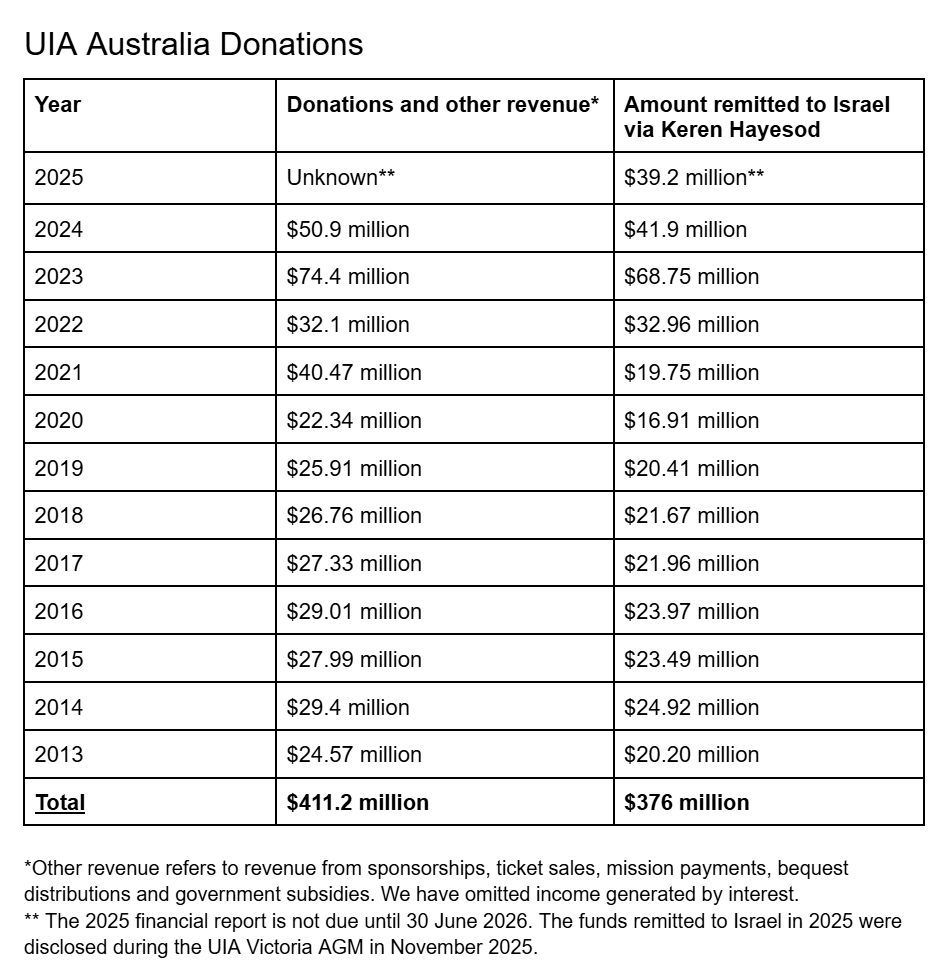



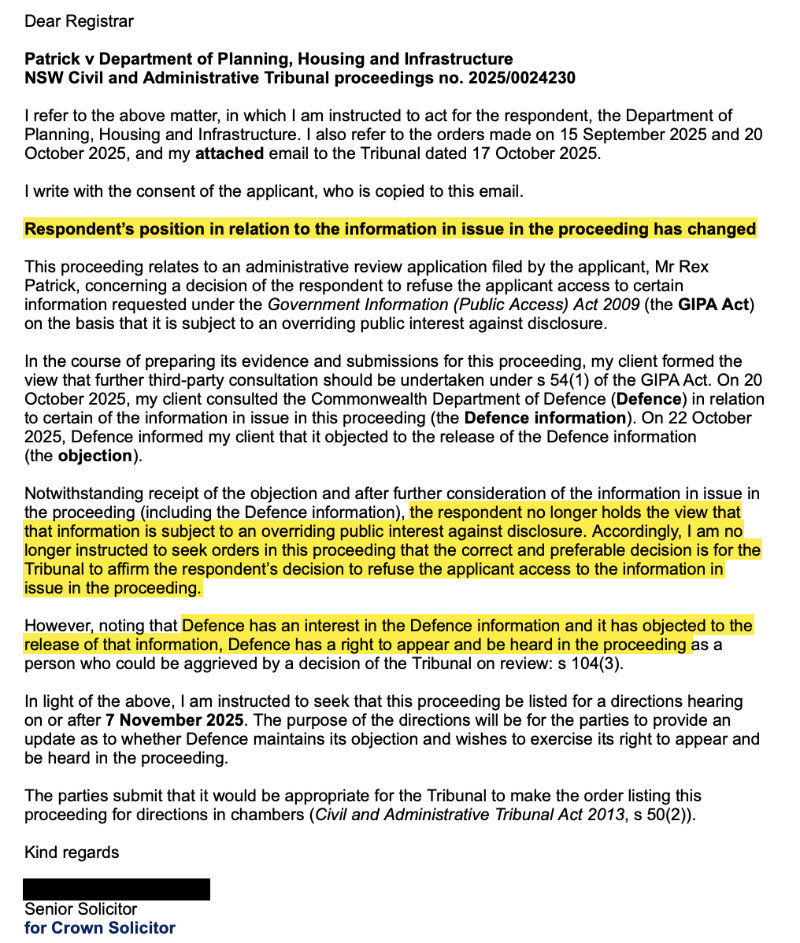
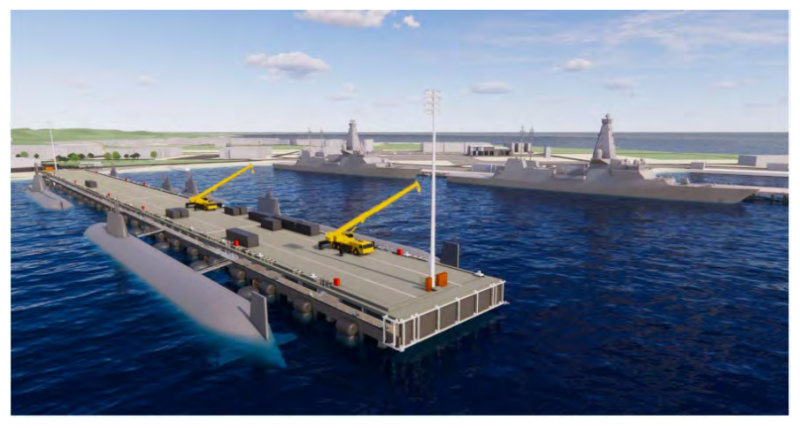

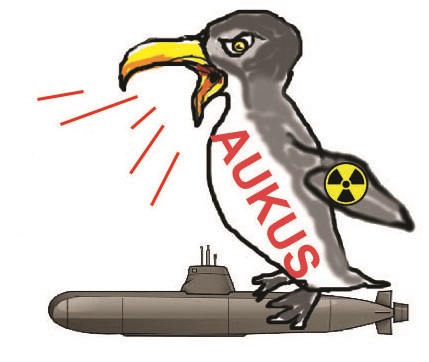
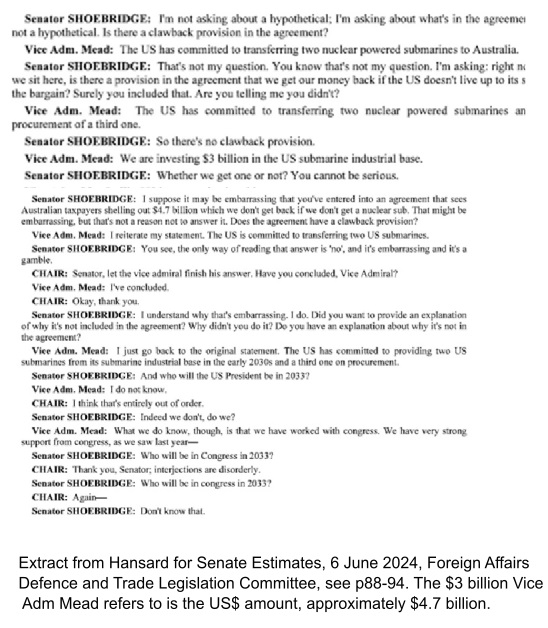
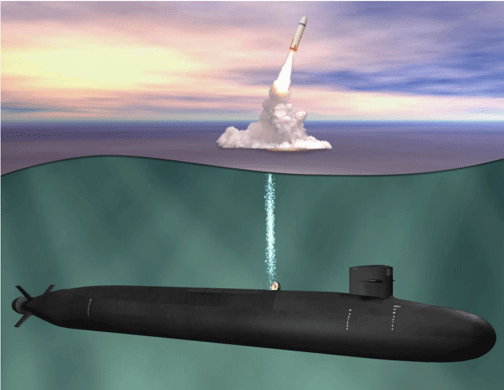
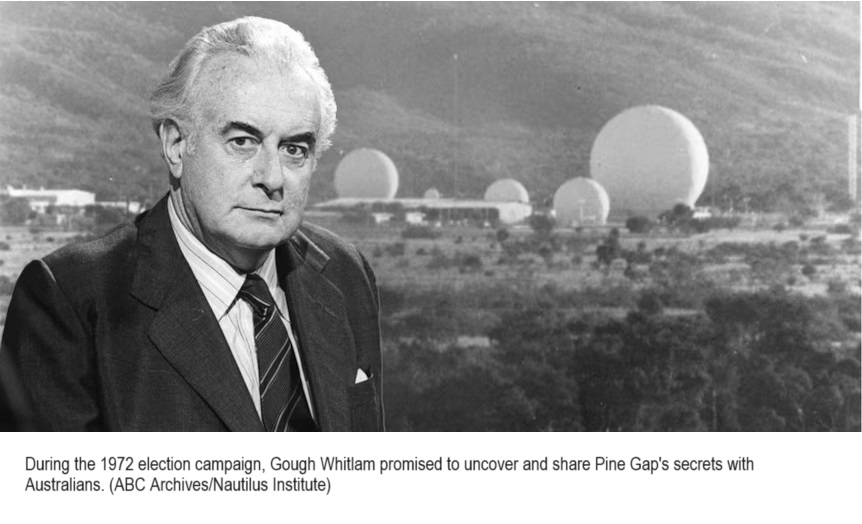



 Antinuclear