Spoils of war? Weapons industry heavyweights wine and dine Defence top brass, Canberra Times Michael Inman, Steven Trask, Markus Mannheim , 9 Mar 18
Weapons industry heavyweights were among companies that lavished almost half a million dollars’ worth of hospitality and gifts on Australian Defence executives and top military personnel.
Government records show sovereign nations, arms manufacturers and private businesses furnished Defence staff with about $490,000 worth of gifts, sponsorships and hospitality in the past four years.
Defence staff are required to register the acceptance or soliciting of gifts, hospitality and sponsorship. The information is kept in a central ledger, which is not published publicly but was made available under freedom of information law.
Six of the world’s largest weapons manufacturers are listed on the register: Lockheed Martin, Boeing, Northrop Grumman, Airbus, Thales and BAE Systems.
Paul Waldon Fight To Stop Nuclear Waste Dump In Flinders Ranges SA 29 Jan 18 “People lie when they want something, because they think the truth wont get it for them.” (Cary Grant, Charade).
DIIS failure to catalogue the known risks of a radioactive waste dump in Hawker or Kimba may be testimony of burying the truth, in a attempt to jump-start the progress of waste abandonment, while knowing they can’t tick all the boxes.
We must remain resolute in our fight to preserve a clean, safe environment for future generations.
Paul Waldon, Fight To Stop Nuclear Waste Dump In Flinders Ranges SA https://www.facebook.com/groups/344452605899556/6 Jan 18 Dr Carl Magnus Larsson is the CEO of ARPANSA, and the man that signs off on a nuclear waste dump, but has he a vested interest in the proposal to abandon such waste?
Is ARPANSA wrongfully regulating and promoting the project? Why did ARPANSA fail to address the safety issues at Lucas Heights that Comcare bought to their attention?
Why does ARPANSA have trouble dealing with people in group discussions?
Is ARPANSA being strong-armed by DIIS, and ANSTO to push a radioactive dump on a community of unwilling people?
Is ARPANSA listening to the majority that are saying “NO”?
Is ARPANSA insensitive to native heritage.? Is ARPANSA ignoring the science of nuclear waste being abandonment in a environment that fails on all the criteria put forward by DIIS?
Is ARPANSA honest and forthcoming with all the issues pertaining to the toxic proposal?
POTENTIALLY dangerous radioactive gases have been secretly pumped into the atmosphere from Lucas Heights and have spread hundreds of kilometres from the nuclear reactor – but the public have never been told.
The release of the highly volatile radioxenon over several months last year was so concentrated that the plumes were detected in Melbourne up to two days later. Other plumes were dragged out to sea by winds before drifting back over Sydney.
The Sunday Telegraph understands the Australian Nuclear Science and Technology Organisation (ANSTO) decided against releasing a public statement at the time to avoid causing alarm.
Scientists at a nuclear testing station in Melbourne traced the source of the radioactive gases to Sydney after the The Comprehensive Test Ban Treaty Organisation International Monitoring System site in Melbourne contacted Lucas Heights after detecting the radioxenon isotope Xe-133.
They were told that 36 hours earlier the first “hot commissioning trials” at ANSTO’s Lucas Heights radioisotope facility for Molybdenum-99 had taken place.
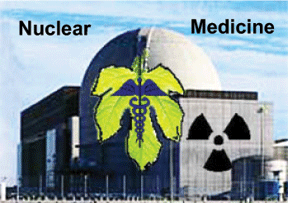
Molybdenum-99 is produced by the fission technique – the intense neutron-bombardment of a highly purified uranium-235 – and is used in nuclear medicine.
While the nuclear reactor – and the government body that oversees it – insists the release of the radioxenon by-product were no threat to public safety, no one, including neighbours of the suburban Sydney plant, were informed.
“Xenon gases are highly volatile and, being inert, they are not susceptible to wet or dry atmospheric removal mechanisms,” a scientific report obtained by The Sunday Telegraph says.
“Consequently, once released to the atmosphere they are simply transported down-wind while radioactively decaying away.”
A Wangan and Jagalingou (W&J) representative said he was paid $2,000 by Adani to boost numbers at the meeting, where he said many who were “not part of my mob” voted on the compensation deal.
Another W&J woman said her family of eight voted against the deal but the official vote recorded just one person against and 294 people in favour.
What’s the deal with the Adani deal?
Traditional owners need to sign off on a deal for compensation
Adani can’t get finance until the deal is done
The deal’s divided the W&J group
Last year’s meeting was to sign off on the deal
A trial next year will decide whether the meeting was legitimate
The claims are made in sworn statements filed in the Federal Court, ahead of a trial in March to decide whether the meeting legitimately endorsed the Adani deal, which has bitterly divided the W&J Continue reading →
URANIUM. From 1944 the purpose of Australia’s uranium industry was to supply nuclear weapons. Up until 1962 Australia supplied 7,730 tonnes of uranium to the USA and UK for their nuclear weapons programs.
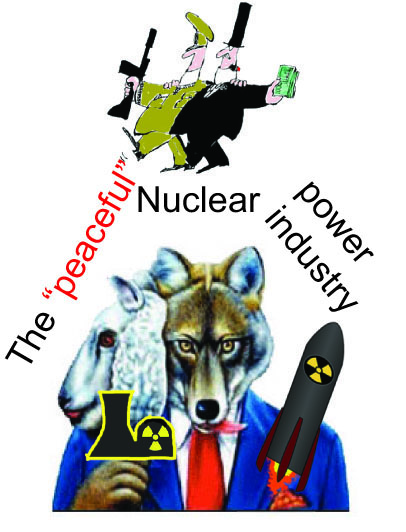
More recently, Australia’s uranium is supposed to go only to “peaceful” nuclear power. So – it can go to India, for example, where there’s dubious supervision anyway, and where it frees up other uranium supplies for India’s burgeoning nuclear weapons.
NUCLEAR BOMBS. The Menzies government allowed Britain to explode its nuclear bombs in South Australia, and also at Monte Bello Island, in the 1950s and 60s. So the nuclear weapons industry has had its dirty foot well into Australia.
NUCLEAR REACTOR. Lucas Heights nuclear reactor was always intended as a step towards nuclear weapons, AND IT STILL IS. In the early 1950s, politicians, scientists and Defence Department enthusiasm for Australia to get a nuclear weapon led to the building, in 1957, of a nuclear reactor at Lucas Heights. A plan to build a nuclear reactor at Jervis Bay was pitched to the public as a commercial venture, but was always intended to provide enriched uranium for Australia’s own nuclear weapons.
Others favoured getting nuclear bombs supplied by Britain. The pro nuclear lobby always had nuclear weapons in mind, and campaigned for them strongly through the 1960s, to 1972, when Prime Minister Whitlam ended these ambitions. The campaign continued, more quietly.
ANSTO. In 1987 the Australian Atomic Energy Commission was abolished, and the Australian Nuclear Science and Technology Organisation (ANSTO) was set up. ANSTO is very secretive about its operations, but does pursue the advanced technology that would make nuclear weapons development possible. Today’s nuclear weapons advocates talk incessantly about “medical research”, and foster the myth of the “peaceful atom”.
As the nuclear weapons establishment in UK and USA now make clear – “peaceful” nuclear power is essential for nuclear weapons – as an industry supplying resources and trained operatives for the weapons industry.
The push for Australia to house nuclear wastes, and the whole nuclear fuel chain is an intrinsic part of the global nuclear weapons industry.
no amount of corporate black washing – including Indigenous participation plans that champion strong and effective relationships between Adani and W&J, alongside jobs and traineeships – can hide Adani’s direct and immediate part in walking over the rights of Traditional Owners.
Traditional Owners Expose Adani’s Relentless Pursuit of W&J Country, New Matilda By Kristen Lyonson
In the third in a five part series on the proposed Adani Carmichael coal mine, Kristen Lyons looks at a deal struck between the miners and the local traditional owners, and why it just adds to the smell that pervades the entire project.
Introduction
The Indian industrial conglomerate, Adani Enterprises – well known for environmental damage and human rights abuses at its project sites around the world, and built upon a complex business structure with tax havens in the Cayman Islands – entered Australia in 2010 with the purchase of coal tenements in the Galilee Basin, in Central Queensland.
Despite its controversial back story, some of which has only come to light since approvals were granted for its Australian project, Adani quickly rose to become a poster child for the State Government, based on promises its Carmichael mine project would deliver jobs and economic growth for regional Queensland.
Managed by its domestic arm, Adani Mining Pty Ltd, over the following years it developed a project proposal that included a coalmine, as well as rail and port infrastructure, thereby opening up the massive Galilee Basin for coal exports.
With seven years gone since acquisition of the coal tenements, and marred by substantial project downsizing, Adani is yet to start construction of its mega mine. Wangan and Jagalingou Traditional Owners Family Councils’ (W&J) defiant opposition to Adani’s proposed Carmichael mine has been central to this delay; opposition that has, in itself, exposed the dirty deeds Adani is willing to perpetrate against Traditional Owners who seek to defend their right to say no to a mine that would destroy their country.
This article exposes some of Adani’s deeds, including its nefarious actions in reaching an ‘agreement’ with Traditional Owners, Continue reading →
This is not an entirely new approach. Before the government decided to abandon the proposed Clean Energy Target it put a lot of effort into redefining coal as “clean”.
Those political objectives are: to provide a point of policy difference with the Labor Party; to meet the demands of the government’s backbench to provide support for coal-fired electricity; and to be seen to be acting to hold power prices down.
Meeting these objectives solves Prime Minister Malcolm Turnbull’s immediate political problems. But it comes at the cost of producing a policy that can only produce further confusion and delay.
The government’s central problem is that, as well as being polluting, coal-fired power is not well suited to the problem of increasingly high peaks in power demand, combined with slow growth in total demand.
Coal-fired power plants are expensive to start up and shut down, and are therefore best suited to meeting “baseload demand” – that is, the base level of electricity demand that never goes away. Until recently, this characteristic of coal was pushed by the government as the main reason we needed to maintain coal-fired power.
The opposite of baseload power is “dispatchable” power, which can be turned on and off as needed.
Adani Australia: Investigation uncovers tax haven ties to British Virgin Islands, Four Corners ,By Stephen Long, Wayne Harley and Mary Fallon , ABC News, 3 Oct 17 An investigation by the ABC’s Four Corners program has uncovered previously unknown tax haven ties for Adani Group’s Australian operations, with key assets ultimately owned in the British Virgin Islands.
Key points:
Adani Group’s filings with ASIC fail to mention a company registered in the British Virgin Islands
Vinod Adani, older brother of Adani Group chairman Gautam Adani, has been under investigation in India
Vinod Adani also a substantial shareholder in Adani Enterprises Limited
Adani Group has promised a $22 billion windfall in taxes and mining royalty payments for Australia over the life of the giant Carmichael coal mine it has been given approval to build in outback Queensland.
But experts say an opaque web of companies and trusts behind its Australian assets gives it ample opportunity to minimise the tax it pays.
Adani Group’s assets in Australia include the Abbot Point Coal Terminal near Mackay in Queensland, a terminal expansion project it has approval to undertake at Abbot Point, and a planned railway line of nearly 400 kilometres from the port to the giant mine it wants to build in the Galilee Basin — aided by a subsidised loan of up to a $1 billion it is seeking from the Federal Government’s Northern Australia Infrastructure Facility.
It was previously thought that Atulya Resources, a Cayman Islands domiciled company controlled by members of the Adani family, was the ultimate holding company for Abbot Point, the expansion project, and the railway.
However, filings in Singapore by privately-owned Adani companies show that a company registered in another notorious tax haven, the British Virgin Islands, sits behind Atulya Resources.
Vinod Adani investigated over alleged scam
It is variously described in the offshore company filings as ARFT Holding Limited, AFRT Holding Limited and Atulya Resources Family Trust.
Adani Group’s filings with Australia’s corporate watchdog, ASIC, fail to mention this company, instead continuing to list Atulya Resources as the owner.
The British Virgin Islands’ company’s apparent position at the apex of the structure is disclosed in the financial reports of a series of Adani companies controlled by Vinod Adani, also known as Vinod Shantilal Adani or Vinod Shah.
Nationals Interest: Larry Anthony, the party president who runs a lobbying firm, The Age, Patrick Begley, Mario Christodoulou, 30 Sept 17,
A lobbying firm run by National Party president Larry Anthony is pushing the interests of energy firms as the Coalition grapples with looming gas shortfalls and bitter infighting over renewable energy policy.
Santos and Delta Electricity this year joined the client list of SAS Consulting Group, the government relations firm founded and co-owned by its executive director, Mr Anthony.
“Through our extensive networks we create powerful, purposeful connections for businesses and organisations,” the SAS Group website says.
The first line of Mr Anthony’s SAS Group biography refers to his presidency of the Nationals, “one half of the ruling Coalition government”.
A leading expert on lobbying said the party president’s absence from the public register of lobbyists “so undermines the intent of the lobbyist code of conduct as to make it nearly useless”………
After a federal conference debate moderated by Mr Joyce and Mr Anthony this month, the Nationals passed a motion urging the government to freeze and then phase out renewable energy subsidies…….
When he became party president in 2015, Mr Anthony was criticised for lobbying for the Shenhua Watermark mining project. At the time, he said he had removed himself from lobbyist registers and had no conflict of interest.
“We do a lot of things aside from government relations – media, communications, stakeholder relations, et cetera,” he said. “But executive director? Yes, I might have to come off that.”
The SAS Group website has promoted the fact Mr Anthony attended the Liberal National Party’s Queensland convention in July. Asked whether his party presidency helped to attract clients, Mr Anthony said: “I don’t know about that, but my name is synonymous with the National Party.”
His father, Doug, served as party leader from 1971 to 1984 and his grandfather, Larry snr, was a Country Party minister…….
The lobbyist code of conduct prohibits lobbyists from being a member of a party executive. It also requires anyone who lobbies or employs lobbyists to register on a public database.
University of Melbourne politics lecturer George Rennie said even if Mr Anthony had not technically breached the code, his failure to appear as a registered lobbyist “so undermines the intent of the code, as to make it nearly useless”.
“Being a part-owner and director of a lobbying firm, while concurrently serving as president of the National Party, creates a clear conflict of interest,” Mr Rennie said……..
The Department of Prime Minister and Cabinet, which administers the lobbyist register, did not respond to specific questions about Mr Anthony but said in general it would investigate evidence or allegations of code breaches.
Noel Wauchope, 20 Sept 17, Now, many weeks after Australia signing up to the Framework Agreement For Generation IV Nuclear Energy Systems, the public is informed of this. I found it at the bottom of page 23 of the print version of The Age today. Why haven’t we heard about this before?
How is it that Dr Adi Paterson of ANSTO signed up to this, in advance of Parliamentary approval, and that the whole thing can be done without any proper public consultation? Australian tax-payers are now to be supporting the development of these new dreams of nuclear power – advanced nuclear reactors that exist now only as blueprints, and will be expensive, require government funding, and will not be commercially operational for many decades, if ever.
Surely it is time for a thorough inquiry into ANSTO’s funding and finances. The New Generation nuclear reactors are controversial, to say the least. They are in fact, part of the global nuclear lobby’s push to save itself – its future being threatened by its dire economics, and by its connection to the nuclear weapons industry.
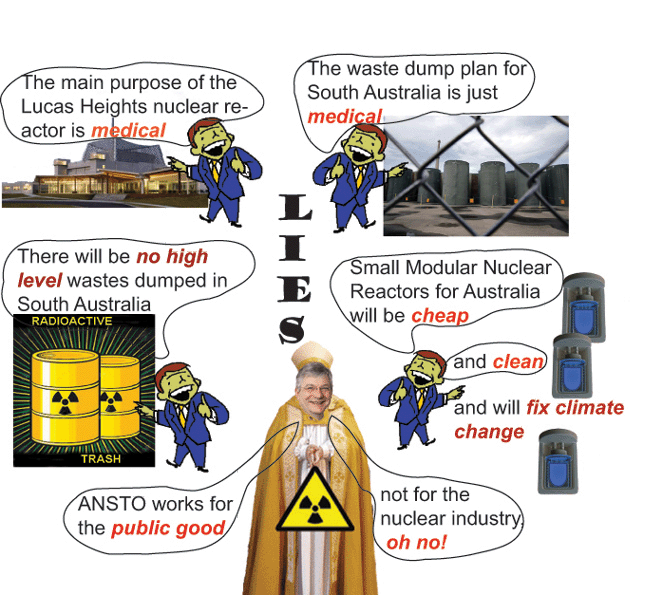
The Australian media is regularly used to promote ANSTO’s nuclear reactor as having as its purpose “medical research” and “medical isotopes saving lives” – despite the fact that non nuclear production of these isotopes can be, and is, being done. The reality is that ANSTO is part of the global nuclear industry lobby, and its reactor produces long-lasting radioactive wastes and it should be shut down.
I couldn’t find it on The Age online. The print version, 19 Sept 17 – small article at the bottom of page 23:
Australia joins nuclear research club,by Cole Latimer
Australia has officially joined an international group focused on developing future nuclear energy systems, The Australian Nuclear Science and Technology Organisation has been welcomed into the Generation IV International Forum Framework, which aims to develop next generation nuclear power systems, and which ANSTO calls “a potential game-changer in global energy creation”.
Although Australia joined the GIF charter last year, the event marked the country’s official accession to the nuclear framework agreement, which is focused on six different nuclear reactor designs that provide poeer and “stringent standards in relation to safety and non proliferation”.
However, ANSTO stated that this was not about advancing the cause of nuclear energy in Australia’s current energy mix: instead it was about utilisingAustralian skills in research and development.
“Australia has no nuclear power program, but we do have significant local expertise in next generation research, which is what this partnership is about” ANSTO chief executive officer Adi Paterson said.
ANSTO will leverage our world class capabilities, particularly in relation to the development of advanced materials and with applications in extreme industrial environments, and of nuclear safety cases.
“This agreement will enable Australia to contribute to an international group focused on peaceful use of nuclear technology, and the international energy systems of the future”
An ANSTO spokesman said Australia was a world leader in terms of nculear safety, “due to the high levels of oversight and paperwork required” to operate.
GIF is a co-operative of 14 nations led by France, a country where nuclear power accounts for nearly 75% of energy generation. This reliance on nuclear energy has helped the nation slash its carbon emissions.
Australia is a particular target of nuclear industry lies.
Unfortunately, both major political parties, and the dominant Murdoch media buy into these lies. Some politicians and journalists actually believe them.
The global industry continues its 70 year campaign of lies. But Australia gets its own very specialised lies, spread by the government, via the Australian Nuclear Science and Technology Organisation (ANSTO) . ANSTO is a law unto itself, working primarily to promote the nuclear industry. The Murdoch media obliges by promoting also the lies of nuclear shills, like Michael Shellenberger, imported from America.
If true, one effect of the alleged scheme would have been to move vast sums of money from the Adani Group’s domestic accounts into offshore bank accounts where it could no longer be taxed or accounted for.
Adani mining giant faces financial fraud claims as it bids for Australian coal loan, Exclusive: Allegations by Indian customs of huge sums being siphoned off to tax havens from projects are contained in legal documents but denied by company, Guardian, Michael Safi in Delhi, 16 Aug 17, A global mining giant seeking public funds to develop one of the world’s largest coal mines in Australia has been accused of fraudulently siphoning hundreds of millions of dollars of borrowed money into overseas tax havens.
Indian conglomerate the Adani Group is expecting a legal decision in the “near future” in connection with allegations it inflated invoices for an electricity project in India to shift huge sums of money into offshore bank accounts.
The directorate of revenue intelligence (DRI) file, compiled in 2014, maps out a complex money trail from India through South Korea and Dubai, and eventually to an offshore company in Mauritius allegedly controlled by Vinod Shantilal Adani, the older brother of the billionaire Adani Group chief executive, Gautam Adani.
Vinod Adani is the director of four companies proposing to build a railway line and expand a coal port attached to Queensland’s vast Carmichael mine project.
The proposed mine, which would be Australia’s largest, has been the source of years of intense controversy, legal challenges and protests over its possible environmental impact.
Expanding the coal port to accommodate the mine will require dredging an estimated 1.1m cubic metres of spoil near the Great Barrier Reef marine park. Coal from the mine will also produce annual emissions equivalent to those of Malaysia or Austria according to one study.
One of the few remaining hurdles for the Adani Group is to raise finance to build the mine as well as a railway line to transport coal from the site to a port at Abbot Point on the Queensland coast.
To finance the railway Adani hopes to persuade the Northern Australia Infrastructure Facility (Naif), an Australian government-backed investment fund, to loan the Adani Group or a related entity about US$700m (A$900m) in public money.
While it awaits the decision on the loan, in Delhi the company is also expecting the judgment of a legal authority appointed under Indian financial crime laws in connection to allegations it siphoned borrowed money overseas.
The Adani Group fully denies the accusations, which it has challenged in submissions to the authority.
The investigation
News of the investigation was first reported in India three years ago, but the full customs intelligence document reveals forensic details of the workings of the alleged fraud which have not been publicly revealed.
The 97-page file accuses the Adani Group of ordering hundreds of millions of dollars’ worth of equipment for an electricity project in western India’s Maharashtra state using a front company in Dubai.
FOI documents confirm government holding almost one year’s worth of pollution data, Brisbane Times, Lucy Cormack 7 July 17 The federal government has been keeping almost a year’s worth of pollution data secret, despite it being scheduled for release in May, documents obtained under freedom of information laws reveal.
Independent estimates suggest Australia’s greenhouse gas emissions have risen sharply since the government last released its quarterly data in December – a trend that would make the nation’s commitment to cutting emissions more disruptive and expensive.
Quarterly updates by the National Greenhouse Gas Inventory, described as “up-to-date information on emissions trends for business, policymakers and the public”, have been released 28 times since 2009, but not since last year.
Hundreds of South Australians have reported seeing a fireball flying through the sky overnight on Friday. An object flew through the sky so quickly it produced a remarkable light show, captured on a security camera at Port Lincoln.
Experts are not sure if it’s a meteor or a piece of space junk.
David Noonan will speak on public interest concerns over the new Roxby Downs Indenture Act 2026 on BHP copper-uranium mining and ore processing in SA, and on how AUKUS may face SA with a High-Level nuclear waste agenda.
Dr Jim Green will discuss international developments in the field of nuclear power including ‘small modular reactors’ and Generation 4 ‘advanced’ nuclear reactor concepts.