Australia’s environmental scientists intimidated, silenced by threats of job loss
 Australia’s environmental scientists intimidated, silenced by threats of job loss, Michael West Media, by Elizabeth Minter | Jan 17, 2021 The silencing of environmental scientists, as revealed in a study late last year, profoundly damages our democracy, wastes taxpayers’ money, takes a huge personal toll, allows fake news to proliferate and short-changes the public. Elizabeth Minter reports. Australia’s environmental scientists intimidated, silenced by threats of job loss, Michael West Media, by Elizabeth Minter | Jan 17, 2021 The silencing of environmental scientists, as revealed in a study late last year, profoundly damages our democracy, wastes taxpayers’ money, takes a huge personal toll, allows fake news to proliferate and short-changes the public. Elizabeth Minter reports.
“I declared the (action) unsafe. I was overruled and … was told to be silent or never have a job again.” “We are often forbidden (from) talking about the true impacts of, say, a threatening process […] especially if the government is doing little to mitigate the threat.” “I was directly intimidated by phone and Twitter by (a senior public servant).” “… governments allow (industry) to treat data collected as commercial in confidence. This means experts most able to comment on the details of big mining and construction projects are hopelessly conflicted and legally gagged from discussing these projects in public.” “(Government) staff are rewarded or penalized on the basis of complying with opinions of senior staff regardless of evidence.” “I proposed an article in The Conversation about the impacts of mining […] The uni I worked at didn’t like the idea as they received funding from (the mining company).” All in a day’s workAll these comments, straight from the mouths of some of Australia’s most esteemed scientists, highlight the threats faced by ecologists, conservation scientists, conservation policy makers and environmental consultants, whether they are working in government, industry or universities. The scientists were responding to an online survey as part of a study conducted by academics Don Driscoll, Georgia Garrard, Alexander Kusmanoff, Stephen Dovers, Martine Maron, Noel Preece, Robert Pressey and Euan Ritchie. In an ironic twist, one of the research team’s initial members declined to contribute to the project for fear of losing funding and therefore their job. As the study’s authors note, scientists self-censor information for fear of damaging their careers, losing funding or being misrepresented in the media. In others, senior managers or ministers’ officers prevented researchers from speaking truthfully on scientific matters. This means important scientific information about environmental threats often does not reach the public or decision-makers, including government ministers. This information blackout, termed “science suppression”, can hide environmentally damaging practices and policies from public scrutiny. Survey methodology……….Ministers not receiving full informationSome 75% of the scientists surveyed reported having refrained from contributing to public discussion when given the opportunity – most commonly in traditional or social media. A small number self-censored conference presentations (9%) and peer-reviewed papers (7%). For scientists working in government, the main reasons they didn’t comment was because of attitudes of senior management (82%), workplace policy (72%), a minister’s office (63%) and middle management (62%). Fear of what would happen to their career prospects (49%) and concern about media misrepresentation (49%) also discouraged those working in government from speaking publicly. Almost 60% of scientists working in government and 36% of scientists in industry reported that internal communications were modified………… Critical conservation issues suppressedThe most common issue on which information was suppressed was threatened species. About half of industry and government scientists, and 28% of academics, said their commentary was constrained. Scientists working in government also reported not being able to comment on logging and climate change………….. The system is brokenOf those scientists who had spoken publicly about their research, 42% had been harassed or criticised for doing so. Of those, 83% believed the harassers were motivated by political or economic interests……. Change is neededAs witnessed by the past four years of Donald Trump’s presidency, it has never been more important to ensure that the public are exposed to facts and information from trusted sources……. The study was published late last year in Conservation Letters, a journal of the Society for Conversation Biology. https://www.michaelwest.com.au/australias-environmental-scientists-intimidated-silenced-by-threats-of-job-loss/ |
|
Australian children targetted for propaganda by the weapons industry
 education https://www.michaelwest.com.au/reputation-laundering-weapons-companies-now-infiltrating-schools-to-promote-education/, by Michelle Fahy | Nov 27, 2020 A Lockheed missile blows up a bus full of Yemeni children; in Australia Lockheed Martin gains kudos by sponsoring the National Youth Science Forum. BAE Systems sponsors underprivileged kids in Australia while being complicit in the killing of thousands of needy children in Yemen. All you see in industry marketing pitches is euphemism, with nary a mention of the word “weapons”. Michelle Fahy reports.
The UK’s largest weapons-maker, BAE, is working inside Saudi Arabia supporting Saudi-United Arab Emirates military operations in Yemen, a war that has killed or injured tens of thousands of civilians, including thousands of children.
Meanwhile in Australia, BAE sponsors The Smith Family’s STEM education program for under-privileged children.
Flagrant hypocrisy? Welcome to the weapons business.
Then there’s Lockheed Martin, the world’s largest weapons-maker, also raking in billions from the Yemen war. A Lockheed missile blew up a bus full of Yemeni school children in 2018, killing at least 29 kids and injuring dozens more. Back in Australia, Lockheed was cultivating kudos with kids as major sponsor of the National Youth Science Forum, a registered charity.
US missile-making giant Raytheon also continues to supply the Saudi-UAE coalition, despite evidence of numerous attacks with Raytheon missiles that targeted and killed civilians, including children. No mention of that in Australia. Instead, Aussie school kids had fun hanging out with the young Australian snowboarding paralympian Raytheon hired to front the launch of its Maths Alive! STEM program.
The French company supplying Australia’s new submarines, Naval Group, is at the centre of multiple corruption scandals globally, some of which involved murder. That hasn’t stopped Naval promoting itself as a model future employer, with the help of Port Adelaide footy heroes, to 90,174 kids in 329 South Australian schools since 2017.
And let’s not forget the list of sponsors of the Australian War Memorial, Legacy, Invictus Games and Soldier On, which include numerous weapons-making corporations.
There’s a name for this cynical behaviour: reputation laundering. And nearly every weapons company is doing it.
Promoted as innovators
The world’s weapons producers have taken with gusto to promoting themselves as innovators in science, technology, engineering and maths (STEM). Military industry has adopted the STEM mantra to target children and young people as future employees, usually with the willing partnership of respected educational institutions. Many, if not most, Australian universities now have joint agreements, strategic partnerships or some other form of collaboration with the weapons industry.
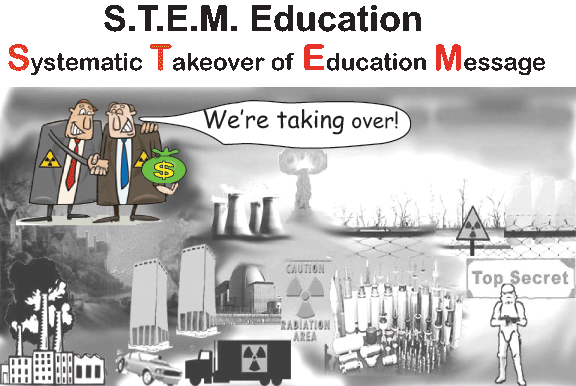
The sales pitch is, join us for an exciting and challenging high-tech career in science. This enthusiastic support of STEM serves two purposes: reputation laundering is one, the other is as a recruitment drive. STEM provides a socially acceptable way to promote the weapons industry to children, and parents, as a potential employer.
There’s nothing wrong with promoting STEM education, or seeking new employees. The issue is the way these companies are now targeting children as young as primary school age, with the full support of government. (eg. The MD of weapons-maker Saab Technologies is on the South Australian education board.) The problem is the spin and glamour applied to increased militarism, with pertinent information omitted from the marketing. Warfare isn’t mentioned, for starters.
There’s nothing about how the kids will use their STEM education to enhance the ‘lethality’ of their employer’s products. Or about a future where employees have eliminated the need for human involvement in the ‘kill chain’ by creating autonomous robotic devices to make those decisions. (This is not science fiction, these research and development programs are already under way.) Working on nuclear weapons isn’t discussed, either.
You won’t find the underlying arms manufacturing realities in the STEM marketing by weapons giants. In fact, you’ll be hard pressed to find the word “weapons” at all.
A world of euphemism
Instead, you’ll enter a world of euphemism: “high end technology company”, “leading systems integrator”, “security and aerospace company”, “defence technology and innovation company”. It’s also a fair bet you’re reading weapons company marketing if you see the phrase “solving complex problems”. Especially if there’s mention of working to make the world safer and more secure.
The following are a few examples of many in which multinational weapons corporations are co-opting organisations of good purpose in Australia.
BAE and The Smith Family
BAE operates inside Saudi Arabia, training Saudi pilots, maintaining Saudi’s BAE-supplied fighter jets, and supervising Saudi soldiers as they load bombs onto the planes. Indiscriminate bombing, a well-known feature of the Yemen war, has killed or injured tens of thousands of civilians, including children.
BAE has earned £15 billion from sales to the Saudis since 2015 when the Yemen war started. A BAE maintenance employee was quoted last year saying, “If we weren’t there, in 7 to 14 days there wouldn’t be a jet in the sky.”
BAE’s role in helping the Saudis prolong the world’s worst humanitarian crisis in Yemen has been pointed out more than once to The Smith Family since news broke of its sponsorship by BAE. Understandably, The Smith Family has responded defensively along the lines that critics are trying to steal an education from needy Australian children.
But what about the tens of thousands of needy children starved, maimed, and killed on the other side of the world? BAE Systems has given The Smith Family a mere $100,000 – about 0.3% of The Smith Family’s $36.3 million in non-government fundraising income.
Cheap reputational PR for a company that has gained tens of billions of dollars in defence contracts in Australia, while facilitating war crimes elsewhere.
Raytheon and Maths Alive!
Raytheon has marketed this program to children across America, the Middle East and Australia. Raytheon’s intention? To reach children at an early age and create a “healthy pipeline” from primary education, through secondary, to tertiary studies, to secure its future workforce.
The then Assistant Minister for Defence David Fawcett lent his support to the 2018 Australian launch of Maths Alive!, telling media: “I welcome the ongoing commitment by Raytheon to engage young Australians by helping them visualise what a career in science or engineering might look like.”
Lockheed Martin and National Youth Science Forum
The National Youth Science Forum was created by Rotary, which remains involved. The forum, now run by a board chaired by former senator Kate Lundy, has several programs, the flagship program being for Year 12 students interested in science.
Each year about 600 students complete the program, which exposes students to various career pathways in science. Since Lockheed started as major sponsor in 2015, students visit Lockheed Martin laboratories and speak with Lockheed staff as part of the program. (Watch a short video here from Lockheed’s website with some students.)
The National Youth Science Forum’s website does not mention Lockheed’s dominant influence as the world’s No. 1 weapons manufacturer or its significant role in producing nuclear weapons. Lockheed’s role in civil sectors is covered, however this work constitutes a minor aspect of its business. The most recent information from Stockholm International Peace Research says 88% of Lockheed’s revenue comes from arms sales.
Lockheed Martin and the Gallipoli Sponsorship Fund
This year Lockheed Martin became the first corporate partner of the Gallipoli Scholarship Fund. This partnership includes the new $120,000 Lockheed Martin Australia Bursary for the educational benefit of descendants of Australian veterans.
One of the aims of the Gallipoli Scholarship Fund is to contribute “to the future security of our nation and our national values of democracy, freedom, and the rule of law”.
Nuclear weapons will become illegal under international law in January 2021 when the new UN treaty prohibiting them comes into force. The world’s nine nuclear-armed countries haven’t signed it – nor their hangers-on, including Australia – so it won’t apply to them. But two-thirds of the world’s countries (including New Zealand) did vote to bring the treaty into being, banning the world’s worst weapons of mass destruction, and setting a new global norm.
Professor Ramesh Thakur, Director of the Centre for Nuclear Non-Proliferation and Disarmament at the Australian National University, has said, “The ban treaty embodies the collective moral revulsion of the international community.”
The awkward truth is that the Gallipoli Scholarship Fund’s new corporate partner, Lockheed Martin, is one of the largest nuclear-weapons-producing companies on the planet. Lockheed is all set to provide its 12 bursaries from now through to the end of 2023.
Such are the ethical dilemmas these weapons corporations create for organisations doing good work that are in need of funding.
Morally indefensible positions
Such sponsorships might appear less self-serving if weapons companies behaved consistently, and stopped supplying weapons to war criminals. Claiming they are just doing the bidding of the US or UK governments in supplying the Saudis, as these companies have, is not a morally defensible position, particularly in the face of evidence of ongoing war crimes in Yemen.
Similarly, claims that they are committed to serving the national interest might be more believable if they ceased bribing and scamming their way into the next arms deal, or concocting endless ways to extend and inflate government contracts and invoices for their own corporate financial benefit, blatantly siphoning funds from the public purse.
Australian Nuclear Science and Technology Organisation (ANSTO) using tax-payer funding to propagandise for nuclear power
TOP STUDENTS SELECTED TO WORK WITH AUSTRALIA’S BEST NUCLEAR SCIENTISTS, 20  February 2019 ANSTO
This month ANSTO is opening its doors to 11 talented young people from across Australia as the two-year Graduate Program kickstarts.
Working from Lucas Heights, ANSTO’s 2019 graduates will get extraordinary insights into nuclear science, engineering and technology and how it is being applied to help achieve sustainability for our health and environment industries.
The global nuclear lobby co-opts academia- now they’ve got University of Tasmania
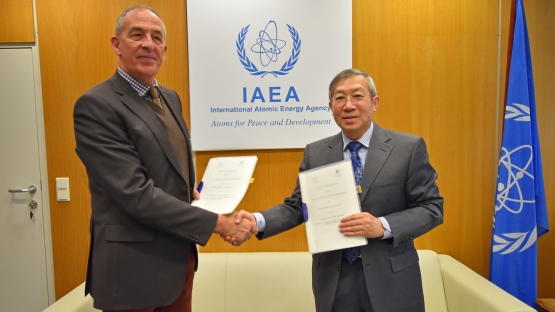 IAEA and University of Tasmania Sign Practical Arrangements Agreement to Enhance Cooperation in Human Health, Agriculture, Environment and Marine Sciences , On 12 December, the IAEA and the University of Tasmania (UTAS) signed a Practical Arrangement which provides a framework for closer collaboration in the areas of health, agriculture and the marine environment. The agreement – the first signed between the two organizations – covers the period of 2018 to 2021.
Australia joins in nuclear industry’s propaganda to schoolchildren in Asia Pacific

IAEA nurtures nuclear education in Asia Pacific http://www.world-nuclear-news.org/NN-IAEA-nurtures-nuclear-education-in-Asia-Pacific-2007185.html20 July 2018
The International Atomic Energy Agency (IAEA) held the first in a series of six regional training courses for secondary school science teachers last month in Indonesia. The courses aim to equip teachers in Asia Pacific to inspire a new generation of nuclear scientists and engineers by engaging students and enhancing their understanding of nuclear science and technology.
The first two-week course was attended by 26 teachers from 17 countries. The course comprised presentations, laboratory work and technical visits to Indonesia’s National Atomic Energy Agency (Batan). It also served a good opportunity for teachers from different countries to network and exchange experiences in teaching. The IAEA said the course marks the first time that it had formally engaged with the secondary education teaching community.
The participants were introduced to diverse methods of teaching nuclear science and technology to children aged 12-18 in an effective and engaging manner. The IAEA said it hoped the attendees will become mentors to other teachers in their countries. “This way, the project aims to reach one million students by 2021,” it said.
Sunil Sabharwal, a radiation processing specialist at the IAEA, said: “The idea is to introduce teachers to the link between the key role being played by nuclear science in enhancing the quality of our everyday life and the simple nuclear concepts being taught in schools as well as to provide them with innovative methods to deliver this knowledge to students through academic as well as extra-curricular approaches.”
Following the course, Jordanian teacher Amal Al-Khassawneh said, “The training course provided me with the necessary confidence, courage and knowledge to talk about the real facts of nuclear science with students.”
The course followed a Regional Workshop on Curriculum Development and Launching of Nuclear Science and Technology for Secondary Schools that took place in the Philippines in February. During an earlier workshop, in Japan, a regional nuclear science and technology competency framework was established that serves as reference for national educational curriculums. The IAEA said the competency framework was crucial in the preparation of the training course in Indonesia.
The next regional training course for secondary school teachers will take place at the Argonne National Laboratory in the USA in August. The following four will take place in Japan, the Philippines, Malaysia and Australia this year and next.
Between 2012 and 2016, the IAEA and experts from Australia, India, Israel, Japan, South Korea and the USA developed a compendium that collects unique teaching strategies and materials to introduce science and technology in education systems across Asian countries. This compendium was piloted in Indonesia, Malaysia, the Philippines and the UAE and reached 24,000 students. The IAEA said the pilot demonstrated that students “were more receptive to learning about nuclear science and technology when teachers used a diverse set of methods, which also increased their problem-solving skills”.
The IAEA said an updated version of the compendium will be prepared over the coming years.
South Australian top university big-wigs are nuclear industry promoters
South Australia’s academic bigwigs infected with pronuclear delusions.
UniSA Chancellor Jim McDowell is also Chair of the ANSTO Board & ex-CEO of BAE.
AdUni Chancellor is Nuclear Fuel Chain Royal Commissioner Kevin Scarce.
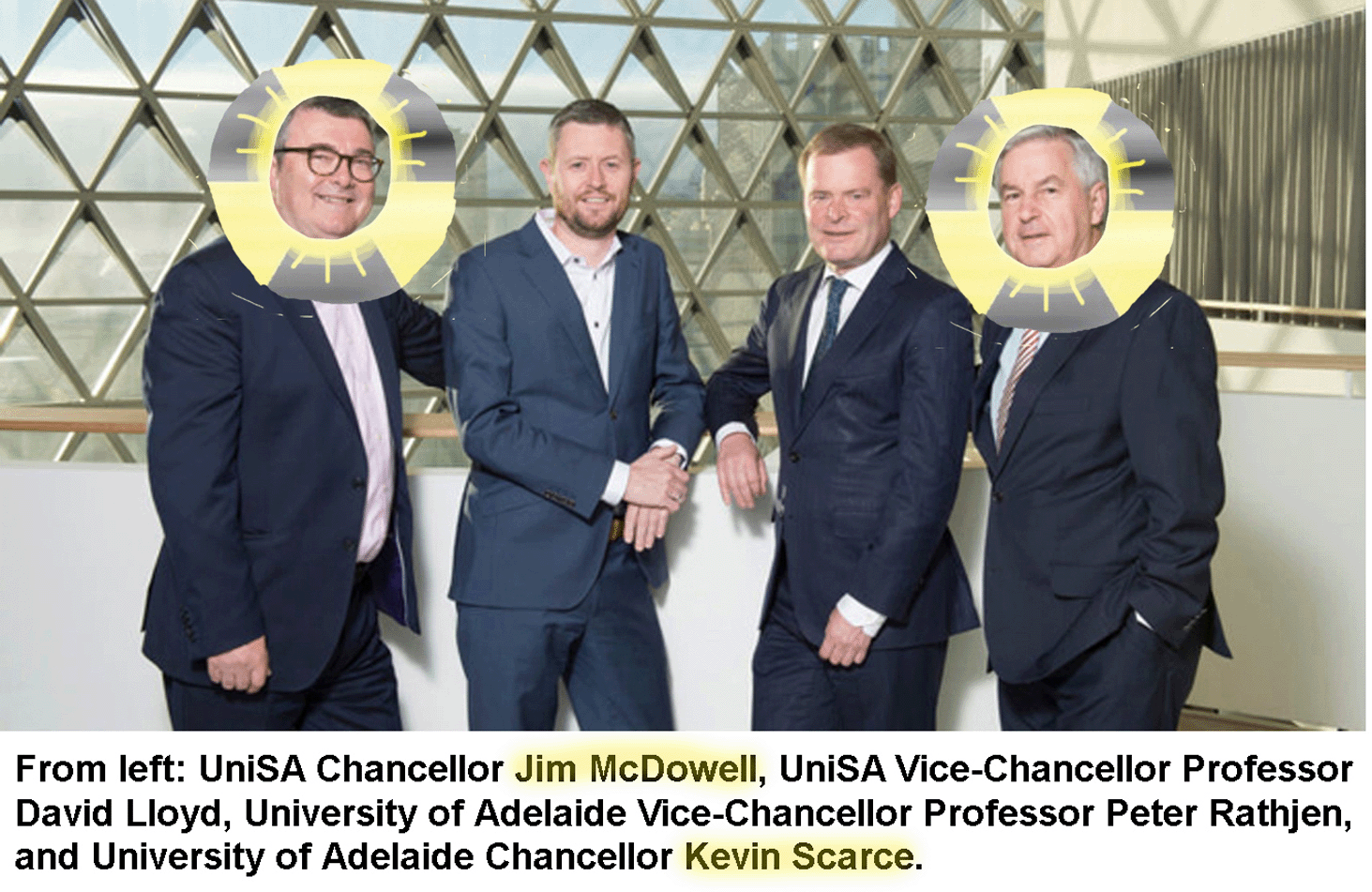
University of Adelaide and UniSA in merger talks, InDaily, Bension Siebert- 19 June 18 The University of Adelaide and UniSA have announced historic talks to merge into a single university which they claim could be immediately placed within the world’s top 100 universities.
The governing councils of both universities have agreed to a six-month “period of collaboration” to negotiate a potential merger, according to a joint statement released by the universities today.
University of Adelaide Vice-Chancellor Professor Peter Rathjen and UniSA Vice-Chancellor David Lloyd will oversee a joint report into the prospective merger, to be delivered by the end of the year.
The university councils will decide on the viability and merits of a merger at that time.
In a joint statement, University of Adelaide Chancellor Kevin Scarce and UniSA Chancellor Jim McDowell say now is the right time to consider joining together as a single university.
“Now is the time to facilitate a conversation about whether uniting our universities would create a new internationally renowned university of scale that would be well placed to anticipate and respond to this changing landscape,” the statement reads……..
Merging the Adelaide University and UniSA was an ambition of former Labor Premier Jay Weatherill in 2015, but universities and both sides of federal politics were opposed to the idea. ……..
However, this morning Federal Education Minister Simon Birmingham, Premier Steven Marshall and SA Labor Leader Peter Malinauskas all congratulated the universities on the move. …..https://indaily.com.au/news/2018/06/19/breaking-university-adelaide-unisa-merger-talks/
1 This month

of the week – Australians for War Powers Reform (AWPR)
To see nuclear-related stories in greater depth and intensity
 Antinuclear