Australian Nuclear Science and Technology Organisation (ANSTO) using tax-payer funding to propagandise for nuclear power
TOP STUDENTS SELECTED TO WORK WITH AUSTRALIA’S BEST NUCLEAR SCIENTISTS, 20
February 2019 ANSTO
This month ANSTO is opening its doors to 11 talented young people from across Australia as the two-year Graduate Program kickstarts.
Working from Lucas Heights, ANSTO’s 2019 graduates will get extraordinary insights into nuclear science, engineering and technology and how it is being applied to help achieve sustainability for our health and environment industries.
The truth about Lucas Heights and the supposed medical need for the nuclear reactor
Kazzi Jai shared a link. 18 Feb 19, Fight To Stop Nuclear Waste In The Flinders Ranges
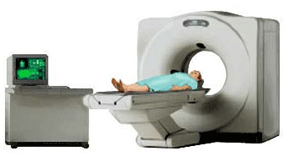
X-rays and CAT scanners (which use x-rays) in hospitals do not use radioactive sources. The films
from X-rays are very valuable due to their silver content, and can be recycled if they are no longer required. There are now hospitals which are using phosphor flat plate detectors on their X-ray machines, so that a digital image is obtained and kept on hospital computer files instead of generating a film.
The disposable items such as gloves, gowns, sheets etc used in hospitals for loved ones using nuclear medicine are withheld for a period of 10 or more days, then deemed, according to safety regulations, to be safe to be discarded in normal waste.
Of the isotopes which ANSTO – Lucas Heights reactor produces, only 28% are actually used in Australian Hospitals. The rest – 72% – are sent overseas. Which is interesting as the majority of Lucas Heights reactor use is for nuclear medical isotope production!
And of that 28% which is quoted as used in Australian hospitals, the majority of those isotopes are used for nuclear medical imaging – the rest is for treatment. So in fact actual nuclear medical treatment using isotopes is very small.
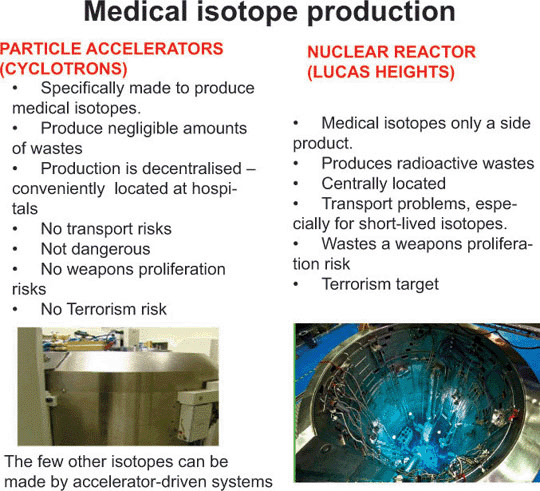
Also noteworthy is that now cyclotron/imaging partnership locations are found in all of the capital cities in Australia including Darwin – only Hobart does not. This means there will be less reliance on the isotope production from Lucas Heights, as cyclotrons allow generation of isotopes for imaging on site, and do not utilize radioactive sources such as a nuclear reactor to generate them! In other words they do not produce nuclear waste!
In Adelaide you will find the cyclotron and an imaging partnership in the SAHMRI building.
And ANSTO is heavily involved in the cyclotron sector as well. They have a cyclotron in Sydney and a similar piece of equipment called a synchrotron in Melbourne. But you rarely hear about those in South Australia……..
The solution to the waste generated at Lucas Heights – and they have the majority of the nuclear waste generated in Australia by the way, because they generate it there – is to keep it at Lucas Heights!
They claim it is safe there – then keep it there, until they have found a way to properly deal with the Intermediate Level Nuclear Waste, and the Low Level Nuclear Waste can follow that!
Double handling of Intermediate Level Nuclear Waste is NOT World’s Best Practice! Neither is transporting nuclear waste
over 1500+kms away from where it is generated!
And Lucas Heights has plenty of space to deal with its waste – and we have been told by DIIS and ARPANSA that should a suitable site not be found, that production of isotopes would not be affected nor Lucas Heights licensing and regulations be affected, and they would simply build more buildings to accomodate it.
Oh….and here is a link on how X-rays in hospitals (both used in X-ray machines and CAT scanners) are generated, if you are interested – https://en.wikipedia.org/wiki/X-ray_tube?fbclid=IwAR1u7fjU4_VazLAkx48teUiEHXccLTZZFKB99C_029yGUXWu18wkbmXaxow
Nuclear Engineering company Frazer Nash increasing its pro nuclear lobbying in Australia
“Since opening its first Australian office in 2010 Frazer-Nash has supported high-profile South Australian projects including ……. the Federal Government’s initiative to develop a low level radioactive waste disposal facility, …..”
https://www.fncaustralia.com.au/…/south-australia-premier-o…
Australian promoters of the coal industry also promote nuclear – as a delaying tactic
Steve Dale Nuclear Fuel Cycle Watch South Australia, I’ve put this up a few times as a comment, but the more I think about it, its significance grows for me. It is a statement by Barnaby Joyce in Parliament. I am not picking on Joyce, in fact I thank him for revealing the normally secretive workings of nuclear lobbying in Canberra. Here it is –
Hansard: Mr. Joyce, Parliament, on the 29/3/2017 “Even today we had one of our leading energy producers, ERM, in my office saying that, if the Victorians think they are going to fix it by gas, at $10 a gigajoule the gas power price would be $100 a kilowatt-hour. He said that at that price you should look at small modular nuclear reactors because they would probably be cheaper than the solution that is being suggested.”
Why would ERM suggest using Small Modular Nuclear reactors when they don’t actually exist?
The only answer I can think of is as a delaying tactic. Don’t go to “gas” (or renewables) because around the corner will be a magical nuclear reactor to solve all problems – in the mean time, we will keep supplying profitable coal fired power to you.
How much of this secretive, manipulative nuclear lobbying of poor gullible politicians has gone on in Canberra? At least Joyce gave us a glimpse. https://www.facebook.com/groups/1021186047913052/
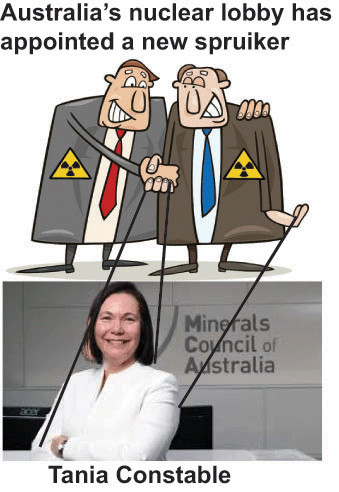
Tania Constable – a new spruiker for Australia’s coal-nuclear lobby
Australia’s coal and nuclear lobbies have just recruited a new puppet, Independent Australia, 25 January 2019, Newly-appointed Mining Council CEO Tania Constable has been championing nuclear power at a time when we should be discussing renewables, writes Noel Wauchope.WHAT BAD TIMING. Only in dictatorships – Russia and China – is nuclear power thriving. In the Western world, it’s problematic due to costs and waste issues. As for coal, even China is working to phase it out.
In Australia, renewable energy is going ahead in leaps and bounds. Our coal-loving Liberal Coalition Government is so on the nose, they’ll be forgotten men within a few months.
But never mind, Australia’s fossil fuel and nuclear lobbies are on the propaganda trail and they’ve just recruited a new puppet, Tania Constable. Appointed as CEO of the Mining Councilin July last year, Ms Constable’s first job is to mouth the standard pro-coal and nuclear platitudes. Here she goes.
A headline in the 22 January edition of The Daily Telegraph reads: ‘Heatwaves proof positive Australia needs nuclear’.
In the article, Constable says:
“Energy costs are rising and renewables can’t meet all our needs but a new generation of clean reactors could.”
‘Heatwaves proof positive Australia needs nuclear’?No, Tania, proof positive that Australia needs solar air conditioners. She seems unaware of the fact that nuclear power is highly water intensive, and subject to shutdowns due to hot weather.
Ms Constable mourns that:
“The influx of part-time power sources such as wind and solar which make it more difficult for older baseload power stations to operate will likely see the early closure of a number of them well before 2030.”
So, it’s renewable energy’s fault that coal is not doing well? She goes on to enthuse about “baseload” power — coal, of course. But that’s seen as a myth, nowdays, as reliable power is no longer synonymous with coal.
She has a bash at the AEMO and CSIRO:
“[They] missed a golden opportunity of lowering power prices, ensuring reliability and lowering emissions through advanced coal technology.”
She doesn’t mention the high costs of this advanced coal technology, needing government subsidy and the fact that it’s not all that clean anyway.
Now she gets to her main point – changing the Environment Protection and Biodiversity Conservation Act 1999 – which happens to be due for review this year.
“The removal of four words — ‘a nuclear power plant’ — in Section 140A(1) (b) would allow nuclear industries to be considered for development in Australia.”
Ms Constable writes approvingly of nuclear power in countries around the world – not a mention of the financial problems of nuclear power development in UK and USA, and Japan, too. Not a mention of the nuclear waste problems…..
[She goes on to praise “new nukes’ – Small Modular Nuclear Reactors, singling out Terra Power and Transatomics, – But]
First of all, Bill Gates has just had the door slammed on his TerraPower project. He’s closed it down for now, but hopes to find a country that will back it.
Secondly, Transatomic has also had a big setback. Its nuclear start-up folded, in disarray. This company was spruiked by an enthusiastic young woman, Leslie Dewan. The nuclear lobby seems to pick them for the poisoned chalice of propaganda work. https://independentaustralia.net/environment/environment-display/australias-coal-and-nuclear-lobbies-have-just-recruited-a-new-puppet,12313

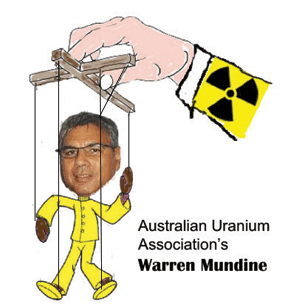
Warren Mundine, new Liberal candidate, makes it clear that he is pro coal and nuclear, and anti environment
Warren Mundin’s article appeared today in the Daily Telegraph. It is behind a paywall. In the Herald Sun, extreme right wing writer Andrew Bolt obligingly supplied extracts from it, and rejoiced in Mundine’s anti-environment stand.MUNDINE’S LIST OF GREEN SABOTAGE Andrew Bolt, Herald Sun January 24, 2019 Warren Mundine, the former Labor president who is now the Liberal candidate for Gilmore, lists just some of the damage done by Greens whose ignorance is even greater than the self-importance that drives them:
|
|
|
Busting the nuclear lobby’s spin about Small Modular Reactors (SMRs
Steve Dale, Nuclear Fuel Cycle Watch South Australia, 23 Jan 19
The nuclear lobby seems to have got a foothold with gullible miners. Ben Heard will be attending “Energy Mines and Money” in Brisbane (June). From the “About” section of the conference – “Energy Mines and Money Australia will showcase the east coast’s strategic mineral, coal and oil and gas opportunities, and match projects with global investment.”
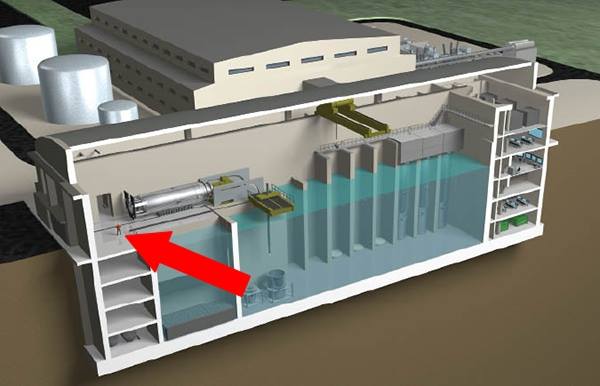
He will be talking about “The role of small modular reactors”. From my observations, the role of small modular reactors is as fantasy bait for gullible politicians, miners, broadcasters – basically anyone silly enough to believe that these things are available, portable and small. A concept picture of a “small” reactor appears below (remember, the red arrow points to a tiny human figure for scale).https://www.facebook.com/groups/1021186047913052/
The global nuclear lobby co-opts academia- now they’ve got University of Tasmania
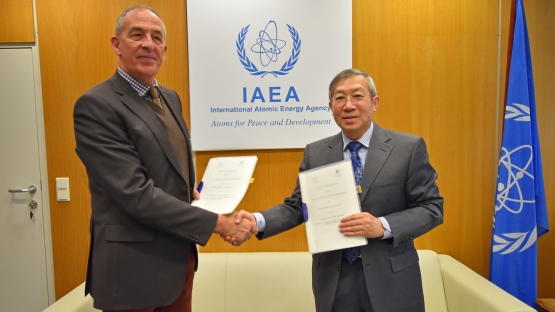
IAEA and University of Tasmania Sign Practical Arrangements Agreement to Enhance Cooperation in Human Health, Agriculture, Environment and Marine Sciences , On 12 December, the IAEA and the University of Tasmania (UTAS) signed a Practical Arrangement which provides a framework for closer collaboration in the areas of health, agriculture and the marine environment. The agreement – the first signed between the two organizations – covers the period of 2018 to 2021.
Scientists refute the nuclear lobby’s paper “Burden of Proof”
Christina’s note: “Burden of Proof”comes from a very small, but very vocal, Australian pro nuclear shill.
Response to ‘Burden of proof: A comprehensive review of the feasibility of
100% renewable-electricity systems’ Science Direct Volume 92, September 2018, Pages 834-847 lT.W.BrownabT.Bischof-NiemzcK.BlokdC.BreyereH.LundfB.V.Mathieseng 847 lT.W.BrownabT.Bischof-NiemzcK.BlokdC.BreyereH.LundfB.V.Mathieseng https://doi.org/10.1016/j.rser.2018.04.113
Highlights
- •We respond to a recent article that is critical of the feasibility of 100% renewable-electricity systems.
- •Based on a literature review we show that none of the issues raised in the article are critical for feasibility or viability.
- •Each issue can be addressed at low economic cost, while not affecting the main conclusions of the reviewed studies.
- •We highlight methodological problems with the choice and evaluation of the feasibility criteria.
- •We provide further evidence for the feasibility and viability of renewables-based systems.
-
Abstract
A recent article ‘Burden of proof: A comprehensive review of the feasibility of 100% renewable-electricity systems’ claims that many studies of 100% renewable electricity systems do not demonstrate sufficient technical feasibility, according to the criteria of the article’s authors (henceforth ‘the authors’). Here we analyse the authors’ methodology and find it problematic. The feasibility criteria chosen by the authors are important, but are also easily addressed at low economic cost, while not affecting the main conclusions of the reviewed studies and certainly not affecting their technical feasibility. A more thorough review reveals that all of the issues have already been addressed in the engineering and modelling literature. Nuclear power, which the authors have evaluated positively elsewhere, faces other, genuine feasibility problems, such as the finiteness of uranium resources and a reliance on unproven technologies in the medium- to long-term. Energy systems based on renewables, on the other hand, are not only feasible, but already economically viable and decreasing in cost every year…………..
-
5. Conclusions
In ‘Burden of proof: A comprehensive review of the feasibility of 100% renewable-electricity systems’ [73] the authors called into question the feasibility of highly renewable scenarios. To assess a selection of relevant studies, they chose feasibility criteria that are important, but not critical for either the feasibility or viability of the studies. We have shown here that all the issues can be addressed at low economic cost. Worst-case, conservative technology choices (such as dispatchable capacity for the peak load, grid expansion and synchronous compensators for ancillary services) are not only technically feasible, but also have costs which are a magnitude smaller than the total system costs. More cost-effective solutions that use variable renewable generators intelligently are also available. The viability of these solutions justifies the focus of many studies on reducing the main costs of bulk energy generation.
As a result, we conclude that the 100% renewable energy scenarios proposed in the literature are not just feasible, but also viable. As we demonstrated in Section 4.4, 100% renewable systems that meet the energy needs of all citizens at all times are cost-competitive with fossil-fuel-based systems, even before externalities such as global warming, water usage and environmental pollution are taken into account.
The authors claim that a 100% renewable world will require a ‘re-invention’ of the power system; we have shown here that this claim is exaggerated: only a directed evolution of the current system is required to guarantee affordability, reliability and sustainability. https://www.sciencedirect.com/science/article/pii/S1364032118303307
Nuclear lobby revs up its frenzied campaign in Australia. Ben Heard is their front man.
Frazer-Nash Consultant, Ben Heard, will be speaking at The International Mining and Resources
Conference (IMARC) in Melbourne on Wednesday 31 October. Nuclear Fuel Cycle Watch South Australia.
Steve Dale “Ben will be giving the keynote address, “Nuclear power in Australia: an ongoing debate”, which discusses the changing nature of the Australian power industry.”
It is only an ongoing debate because lobbyists and unknown sourced lobbying money have such a corrupting influence on our politics. The nuclear push is reaching fever pitch because a lot pro-nuclear pollies will probably be gone after the next election – and the cross bench may get their wish of a Federal ICAC – which could shine a spotlight on the corrupting influence of Nuclear cack lobbying. https://www.facebook.com/groups/1021186047913052/permalink/2171512056213773/?comment_id=2173512052680440¬if_id=1540684271625148¬if_t=group_comment
Ben Heard and pro nuclear company Frazer Nash pushing for nuclear Australia
New industry white paper for Australia from published for the coming mining conference: ‘Identifying the role for nuclear power in Australia’s energy transition’. “Free download” from International Mining and Resources Conference – but ya gotta fill in dirty great forms to read it. The nuke lobby doesn’t want outsiders in on this
Australia’s 60 Minutes – on Fukushima – a nuclear infomercial
The 60 Minutes Fukushima nuclear infomercial, Independent AustraliaNoel Wauchope 23 October 2018 A FEW YEARS AGO, Channel 9’s 60 Minutes did an excellent investigation of the Fukushima nuclear accident.
This Fukushima investigation was compered by Liz Hayes. I recall that, at the time, the program was a much more thorough, serious and well-resourced presentation than anything put forward by even the ABC or SBS. However, I was pretty appalled at the latest 60 Minutes coverage of the Fukushima issue, which screened on Sunday (21 October) titled, Is nuclear power the solution to our energy crisis? The main message of this program is a call to scrap Australia’s legislation against establishing the nuclear industry. The argument given is that we need nuclear power because it is supposedly cheap and dependable. We also need it because it is supposedly essential to combat climate change. This time, the reporter is not Liz Hayes. It’s Tom Steinfort, who is described as a “seasoned Channel 9 star”. Does a seasoned Channel 9 star just accept without question the claims made in this episode? Among claims made:
If Mr Steinfort really is a star reporter, I would expect him to have done his homework before swallowing these claims hook line and sinker. ………
So, what do we make of this latest offering about Fukushima, from 60 Minutes? It must have taken a lot of money and a lot of negotiation to get a 60 Minutes camera team inside the Fukushima nuclear station. I assume that the negotiations were largely arranged by Ben Heard, who has influential nuclear contacts overseas — particularly in Russia and South Africa, where he has been a prominent nuclear spokesperson. In Russia, Heard launched Rosatom National Geographic — a nuclear soft sell environmental program. I think that we can be sure of one thing. As Japan plans for the 2020 Olympics – some sections of which are to take place in Fukushima Prefecture – the Japanese Government is not likely to permit a team with any anti-nuclear perspective access to the crippled nuclear power plant. The 60 Minutes media team would have had to have the Japanese authorities on side. I would bet, some companies keen to set up the nuclear industry in Australia would also be on side and keen to assist. There have been rumblings, too, of yet another resurgence for nuclear energy in Australia, with Prime Minister Scott Morrison declaring that he is ‘open to the idea of nuclear power’ and that ‘the source of Australia’s energy doesn’t bother him and he isn’t interested in an ideological debate’. Is it too much to hope that Channel 9 might do something to correct this nuclear infomercial and give us a different, more comprehensive view, rather than one blessed by Japanese authorities and the nuclear power lobby? https://independentaustralia.net/business/business-display/the-60-minutes-fukushima-nuclear-infomercial,12023 |
|
|
Nuclear lobby is targeting women with propaganda
ANSTO CEO Says There are Real, Lasting and Meaningful Careers for Women in Nuclear https://www.iaea.org/newscenter/multimedia/videos/ansto-ceo-says-there-are-real-lasting-and-meaningful-careers-for-women-in-nuclear Adi Paterson, CEO of the Australian Nuclear Science and Technology Organization (ANSTO), talks about his vision of the future of nuclear science and technology and what role women could play in it.Mr. Paterson will be a speaker at the upcoming IAEA Ministerial Conference on Nuclear Science and Technology: Addressing Current and Emerging Development Challenges, in Vienna, Austria, from 28 to 30 November 2018. The event will be livestreamed at iaea.org.
You can watch Mr Paterson’s presentation on 30 November 2018.
Japanese, Australian and other world governments toe the nuclear industry’s line on radiation
Nuclear industry responds by calling those who disagree with the ICRP and IAEA in these matters “radiophobes”. The Japanese government responds to the disagreement coming from its people with more and more imposed secrecy, and greater compliance with international nuclear bodies. Looked at in another way, the Japanese government obeys the IAEA and ICRP.
It is little wonder theJapanese world nuclear industry via its local mouthpieces and puppets in every land continues to claim the effects of the nuclear disaster have no consequence. Nor is it any surprise that the nuclear industry continues to illegally diagnose opponents to its dictates and insults as being “radiophobic”.
Earthquake Damage At Fukushima – is Industry’s Narrative Truthful or Certain? Nuclear History, 16 Oct 18 “……..As I have pointed out previously, the declared extent of decontamination in Japan has enable some evacuees to return to their homes. The residual contamination remaining in those cleanup areas being about the same, roughly, as the Maralinga lands in South Australia after cleanup there. The risk of radiogenic cancer in the Maralinga Lands in 1 in 50,000 over 50 years. The owners of the Maralinga lands had been suffering forced removal from their lands from the 1950s until the 1990s, with full return of lands completed in the 21st century. Many people died waiting to return.
In Japan many people are concerned that they have been economically forced to return to places prior to a proper cleanup. In Australia, many people are concerned that the Maralinga cleanup was a dud, cheap, and insufficient. As usual vitrification in nuclear residues resulted in explosions and so elements including plutonium were simply buried in trenches.
In Japan, great piles of contaminated material, so active the piles have to be shielded with sand bag shielding in order to protected nuclear garbage workers, remain in the open air. A minority of the material is under cover in interim storage.
But all of this is claimed to be of no consequence according to the nuclear industry.
Since the 1990s, when the Maralinga cleanup was designed around the new intervention level proposed by the ICRP planned for the 21 century, many Australians have stated that the new levels allowed are too high. And that the risk at Maralinga is too high. The ICRP intervention level is 10 mSv. The actual level aimed at Maralinga was 5 mSv. Japan complies with the guidelines. And that fact is in actual reality no comfort for many many affected Japanese people. No comfort at all. Because those people do not trust either nuclear authorities or their own government. Continue reading
The truth about earthquake effects on Fukushima’s nuclear reactors
The status of “Station Blackout” is a serious one.
“it will be many years before the Japanese people know exactly what happened at Fukushima Daiichi on 11 March 2011. One of the key mysteries was role, if any, the magnitude 9 earthquake played in damaging the plant’s reactor cooling systems. Until lethal levels of radiation inside the reactors fall and workers can carry out comprehensive investigations, the truth about the tremor’s impact will remain a subject of conjecture and contention”
Mr. Takamatsu states with expert authority that the pipes of cooling system ware not designed for the 50 second vibration of the magnitude quake. Barry Brook, kangaroo expert, disagrees and tells the world the quake caused no damage at Fukushima. Yet Mr. Brook must surely know the earthquake caused grid blackout. For reactors are all shut down by earthquakes. A solar plant would have kept generating until the last panel shattered. No one would have been evacuated from such a solar plant.
I submit that Prof. Barry Brook’s description of the effects of earthquake upon the Fukushima Diiachi on 11
March 2011 is totally ignorant of the facts as presented by many qualified experts and fly in the face of the independent commission set up by the Japanese Parliament (Diet). It is confirmed that expert investigators concern aspects of TEPCO’s explanations regarding the quake are “irrational”.
Thus any narrative based upon the nuclear industry view, in line with TEPCO’s may fairly be said to be “irrational”. For the industry view is that there is no possibility of quake damage to any structure or sub structure, such as coolant pipes and valves.
Earthquake Damage At Fukushima – is Industry’s Narrative Truthful or Certain? Nuclear History, 16 Oct 18 I am again going to contrast the statements made by Barry Brook in regard to the events and outcomes at Fukushima Daiichi in 2011 with the facts as presented by Mark Willacy. These facts are published in Willacy’s book, “Fukushima – Japan’s tsunami and the inside story of the nuclear meltdowns”, Willacy, M., Pan Macmillan, copyright 2013, Mark Willacy.
However, I will also include information related to the events which were first published and discussed in 2011. ………..
The earthquake generated the tsunami. What else did the earthquake cause?
In this blog I have included posts which give the IAEA considerations for the electrical grids which are connected to nuclear power plants. The IAEA states that the level of engineering and resilience built into such grids may be a significant additional cost for any nation considering generation to nuclear power.
It comes as no surprise then the electrical grid connected to the Fukushima Daiichi NPP failed for two reasons. 1. The earthquake caused all the nuclear reactors connected to the same grid to rapidly shut down. Thus the earthquake caused a blackout due to cessation of electrical generation. 2. The physical grid infrastructure – poles and wires – were damaged by the earthquake. At Fukushima this meant that more than one of the reactors was physically separated from the grid by the earthquake.
It can therefore be seen that the earthquake meant A. Fukushima Diiachi could not generate nuclear electricity as the quake had shut the reactors down. B. The Fukushima Diiachi Nuclear Power Plant was in Station Blackout for one reason: earth quake damage to nuclear infrastructure – the electrical grid. Continue reading