Nuclear Power In Australia: A Little More Conversation?
March 21, 2025 by Michael Bloch, https://www.solarquotes.com.au/blog/nuclear-ban-australia-mb3142/
Self-described grassroots movement Nuclear for Australia is calling for policy makers to kick off a science-driven conversation about including nuclear power in Australia’s future energy mix.
The group announced yesterday that more than 100,000 Australians (101,334 at the time of writing) have signed their petition calling for removing a ban on nuclear power here.
Nuclear for Australia was founded in December 2022 and is chaired by the former CEO of Australia’s Nuclear Science and Technology Organisation (ANSTO) Dr Adi Paterson. Also involved with the organisation is founder of Dick Smith Electronics, Dick Smith, who is a patron.

“Australians are tired of distractions and misinformation,”1 said Will Shackel, Founder of the group. “Over 100,000 signatures show that people want nuclear power on the table as a practical solution for Australia’s energy needs.”
As for the call for a science-based conversation on nuclear power, if only there was a suitable organisation policy makers could turn to for pretty reliable information.
How about the CSIRO? It’s in their name: Commonwealth Scientific and Industrial Research Organisation. Science *and* Industrial research – it seems like a suitable candidate to lead this. Now, if only CSIRO would weigh in on the thorny topic.
What’s that you say? They have?
Nuclear Not A Timely, Cost-Competitive Or Efficient Solution
The answer to the question of nuclear in Australia’s electricity sector is answered on this CSIRO page. The CSIRO is pretty clear in its view, last updated in early December 2024.
- Currently, nuclear power doesn’t offer the most cost-competitive solution for low emission electricity in Australia.
- Long development lead times mean nuclear can’t make a significant contribution to achieving net zero emissions by 2050.
- While nuclear power plants have a long operational life, this offers no unique cost advantage over shorter-lived technologies.
CSIRO’s draft2 GenCost 2024-25 Report found renewables continue to have the lowest cost range of any new build electricity generation technologies (for the seventh year in a row). That’s including the cost of firming – taking into consideration storage, transmission, system security and “spilled” energy.
Reversing The Ban A Pointless Distraction
As for other countries pursuing nuclear power; some are setting a good example of what *not* to do in Australia – and that is pursue nuclear energy.
A recent example is the latest reported cost blow-out for the UK’s proposed Sizewell C nuclear plant3; which has doubled since 2020 to around $80 billion Australian dollars. Along with large-scale firmed renewables, that could buy a lot of rooftop solar power systems and home batteries.
According to the Institute for Energy Economics and Financial Analysis (IEEFA), Sizewell C’s current estimated costs are about 2.5 times the capital cost used in the Coalition’s modelling for its nuclear dreams in Australia.
“For an Australian nuclear plant with similar costs to those reported for Sizewell C to be commercially viable, average household power bills would need to increase by between $561 and $961 per year,” states IEEFA.
It makes the electricity price rises on the cards for many Australians in 2025/26 seem like chump change.
As for mature and scientific conversation, we can do that until the cows come home and we have been; along with plenty of other types of conversations (including some here on SQ). But it’s not really a complicated thing to grasp – reversing a ban wouldn’t change the fact that:
Nuclear power is too expensive for Australia.
But cost alone isn’t a good reason for maintaining a ban. So what harm is there in removing it?
Given all the other issues associated with nuclear energy when there are more appropriate solutions already good to go and being implemented (renewables), just going through the motions and its impacts would turn into a huge time-sucking exercise and dangerous distraction. Time is a luxury we don’t have given all the faffing about with fossil fuels over the years – and that would be extended too.
To have nuclear power on the table as an energy solution in Australia, you’d first need to scrape it off the floor. Maintaining the ban helps save us from ourselves.
The end of coal and the fake nuclear energy ‘red herring’
Coal has had its day as Australia’s key energy source — regardless of what politicians driving an energy debate full of distractions tell you over the next few months.
And the suggestion that nuclear energy is a viable replacement is a red herring.
John Quiggin, New Daily, 16 Mar 25
Coal-fired power is more expensive than renewable alternatives, more polluting and the power stations that use it now are old, generally obsolete and unreliable. They won’t be rebuilt. That’s not just an opinion, it’s backed by all the evidence, regardless of how many political agendas argue otherwise.
Coalition claims that nuclear energy can replace coal simply don’t stack up. It’s expensive and can’t possibly be delivered in time to replace coal-fired energy. And gas is not the stopgap solution some would like to think.
The genuine answer to deliver on Australia’s growing energy needs is to quickly manage the nation’s transition to renewables.
Yet the debate over future energy supply and power prices, which will be front and centre during the election campaign, is part of the ongoing culture wars over energy largely imported from the US.
Coal: the facts
The core of the problem is simple. The coal-fired power stations that supply about 50 per cent of electricity to Victoria, NSW and Queensland are old, unreliable and polluting.
Most are 40-50 years old, using obsolete ‘subcritical’ technology – which is constrained by the boiling point of water, and is about 34 per cent efficient. Even the newest plants at Kogan Creek and Tarong in Queensland use outdated supercritical technology, which is about 39 per cent efficient.
The state of the art in coal-fired power, still highly polluting, is ‘ultra-supercritical’ at 43 per cent efficiency but there are no Australian plants of this kind. Worse still, despite their relative youth and modernity, Kogan Creek and Tarong have been among the least reliable plants in the network.
Most of these plants are due for retirement soon: On current plans, all but a handful will be gone by 2035. Meanwhile, electricity demand is set to grow with the electrification of transport, industry and home heating and perhaps with the development of energy-hungry data centres.
There is no prospect of building new coal-fired power stations. The cost far exceeds that of solar photovoltaics and wind, even after allowing for the cost of battery storage.
Outside China and India, which had 97 per cent of new or revived coal-fired proposals in the first half of 2024, almost no one is building new coal-fired power stations.
Even in those two countries, where demand is growing rapidly, the great majority of new capacity is renewable.
There may be some role for gas in meeting peak demand, though even this is doubtful. Gas is a hugely expensive source of electricity, with the problem made worse by the way successive governments have mishandled Australia’s gas resources, selling gas cheaply to foreign buyers that might have to be bought back at a loss.
It becomes obvious the only real question — despite the imported culture wars — is how rapidly we can manage the transition to renewables and what mix of generation, storage and transmission technologies will best achieve this.
Coalition politicians like Barnaby Joyce have led campaigns against solar and wind projects and the transmission lines needed to incorporate them into the grid………………………………………………………………
Nuclear red herring
Rather than concede that its policy can only delay the transition, the Coalition has relied on the claim that nuclear power will provide a replacement for coal.
Apart from being massively expensive, nuclear power can’t possibly be delivered in time to replace existing coal-fired power stations.
Even in countries with established systems of regulation, trained workforce and ‘brownfield’ sites, construction of reactors commonly takes 15 years or more.
For Australia, starting from scratch, 20 to 25 years is more likely.
Nuclear power is, quite simply, a red herring. Senator Matt Canavan incautiously admitted as much last year, saying that while nuclear is expensive “we’re latching onto it as a silver bullet, as a panacea, because it fixes a political issue for us”.
This dishonest campaign, along with wider voter concerns about the cost of living, may be enough to get the Coalition past the next election.
But the real energy issues will remain and wishing them away with the illusory prospect of nuclear power won’t work. Australians deserve some reality in the political debate.
Professor John Quiggin is a professor of economics at The University of Queensland and a former member of the Climate Change Authority. https://www.thenewdaily.com.au/life/science/environment/2025/03/15/end-coal-nuclear
Australia’s technocratic drive to nuclear ignorance
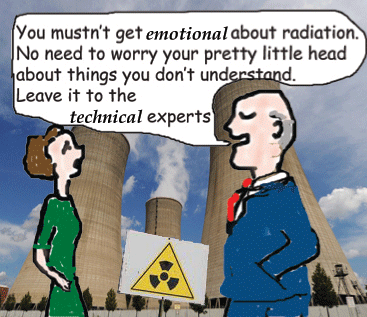
The worshipped role of the expert has excised public debate from nuclear policy. The expert’s validation exonerates the government from the onus of explanation, excluding constituents from relevant information and thus precluding commentary. Nuclear science, a field shrouded in esotericism, marks the summit of techno-scientific rationality, in which utter destruction is intellectually atomised out of politics to the realm of the expert/executive.
ARENA, Sybilla George, 11 Dec 2024
Australia is ‘going nuclear’. The addition of nuclear-powered submarines to Australia’s defence arsenal through the $368 billion AUKUS deal passes a threshold of nuclear legitimisation that Oceania’s anti-nuclear activists have been battling for decades. Nuclearisation used to be an eco-ethical debate, as with the anti- vs pro-uranium mining battles since the 70s that have seen wins and losses on both sides. The rapid increase of Australia’s nuclear involvement, however, signals the reframing of national nuclear rhetoric as techno-scientific rationality that precludes dialogue and authorises executive ruling.
While the AUKUS deal plays out in the limelight, at RAAF Tindal in the Northern Territory the building of facilities to host six United States B-52H Stratofortress bombers on rotational deployment, alongside ‘up to 75’ US Armed Force permanent staff, is underway. The facility renovations are funded through the Force Postures Initiative, the most recent phase of the Force Postures Agreement which since 2014 has defined the United States’s military agenda in Australia, with the consent of successive Australian governments. The Enhanced Air Cooperation branch of the US Alliance was recently ratified when Australian Defence provided ‘air-to-air refuelling’ to B-2 Spirit bombers involved in the US’s October strike on Houthi targets in Yemen.
More than half of the United States’s stock of 76 active B-52 bombers is capable of carrying and deploying nuclear weapons; the remainder is conventionally armed. These jets have been flying over Australian airspace for half a century; however, stationing them at RAAF Tindal signals a significant escalation in nuclear involvement, as it will produce for the first time the conditions ‘to support potential nuclear combat missions from Australian soil’, according to a Nautilus Institute Special Report published in August.
This would be illegal under the United Nations Treaty on the Prohibition of Nuclear Weapons (TPNW), an agreement on which Australia under Labor has abstained since 2022 when it rescinded the Coalition government’s ‘No’ vote. Signing and ratifying the treaty features as a goal in Labor’s 2023 National Platform. Yet progress seems unlikely, given Australia’s third abstention on the TPNW on 1 November 2024 and the persistent silence from the government on the United States’s policy to ‘neither confirm nor deny’ the presence of nuclear arms aboard aircraft or ships. Under this policy, Australia will not be informed whether B-52 bombers on deployment at RAAF Tindal are carrying nuclear weapons.
The public interest in the disclosure of the presence of nuclear weapons includes matters of security, ethics and democratic transparency. Of great concern is the Albanese government’s passive concession to a foreign state’s policy that conflicts with its own commitment to ‘full knowledge and concurrence’ of foreign activities conducted in Australia. Restricted speech has been increasingly utilised as a tactic to expedite pro-nuclear policy in the rush towards technological rationality.
Another example is Albanese’s Nuclear Power Safety Bill, which was rammed through the Senate without debate in October 2024. It stipulates two dumping ‘zones’ for highly irradiated ‘spent nuclear fuel’, to be located within dozens of kilometres of Perth and Adelaide—Western and South Australia being selected once again to play host to nuclear, as during the United Kingdom’s nuclear testing campaign. Indeed, Defence recently withdrew its environmental approval application for developments to prepare HMAS Stirling to host nuclear-powered submarines, and The Australian has reported that the government will resubmit the application with an additional request for the rights to store irradiated waste materials at the facility, which would thus be ‘subject to a single round of community feedback’.
Deferral to the United States’s ‘neither confirm nor deny’ nuclear weapons policy is an appeal to ignorance, and thus innocence, which in turn forecloses systems of accountability, since governments’ denial of information renders their constituents ignorant. The current government’s silence on the presence of nuclear weapons on US aircraft stationed at RAAF Tindal eerily resembles Robert Menzies’ ‘extreme’ commitment to the United Kingdom’s ‘need to know’ policy during the nuclear testing campaign from 1952 to 1963. As prime minister, Menzies exclusively assented without consulting Cabinet or scientific advisers to the use of the Montebello Islands as the site of Operation Hurricane, the nuclear bomb detonation that cemented the United Kingdom as the world’s third nuclear power. The program was not announced until 1952, prior to which Menzies deliberately misled the media about plans for nuclear testing on Australian soil, claiming he had ‘heard nothing’ about it.
The worshipped role of the expert has excised public debate from nuclear policy. The expert’s validation exonerates the government from the onus of explanation, excluding constituents from relevant information and thus precluding commentary. Nuclear science, a field shrouded in esotericism, marks the summit of techno-scientific rationality, in which utter destruction is intellectually atomised out of politics to the realm of the expert/executive.
. The UK nuclear testing campaign caused massive human and ecological suffering to Aboriginal communities in Western and South Australia. It was not until the publication of the 1985 Royal Commission into British Nuclear Tests in Australia, more than two decades after the final tests, that the extent of Australian government collusion was revealed, typified by Menzies’ ‘complete’ acceptance that Australia be entirely excluded from technical information about the tests. This submission to an allied foreign state enacts the technocratic power of nuclear, which pitches influence disproportionally towards those with technical knowledge and renders those without it mute and nakedly vulnerable to, in the case of nuclear arms, annihilation………………………………
The Albanese government’s silence on the presence of nuclear weapons aboard B-52s at RAAF Tindal regurgitates the United States’s policy so as to allow it to skirt its democratic responsibility to inform the public of potential nuclear escalation. Extensive control of messaging and media across the decade-long nuclear testing campaign by Menzies on behalf of the United Kingdom, particularly regarding its true health risks, denied Australians the opportunity to establish informed opinions on the tests. The drive to ignorance common to both Menzies’s and Albanese’s nuclear policy strategies has been achieved via the interiorisation of allied foreign states’ intelligence protocols. This techno-scientific rationale dangerously licences executives to accelerate nuclear proliferation beyond the forum of public debate to which it belongs, and into reality. https://arena.org.au/australias-technocratic-drive-to-nuclear-ignorance/
Confused about nuclear energy? The fossil fuel industry is trying to mislead women.
by Madeline Hislop, https://womensagenda.com.au/latest/confused-about-nuclear-energy-the-fossil-fuel-industry-is-trying-to-mislead-women/ 10 Feb 25
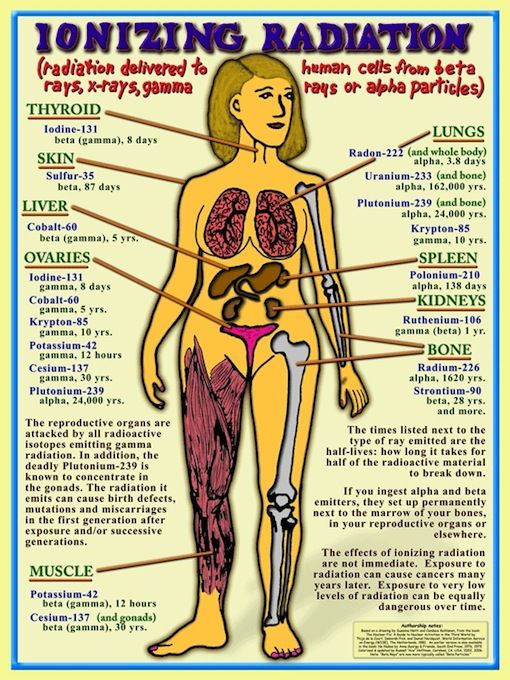
An advertising campaign targeting women ahead of the federal election is promoting misleading information about nuclear energy.
New analysis undertaken by the Climate Council shows that 63 per cent of all nuclear energy advertising active across Facebook and Instagram as of January 2025, was viewed by women.
The ads are largely being driven by the Get Clear on Nuclear group, which is backed by the Minerals Council of Australia, a peak mining lobby group.
The ads are part of a misinformation campaign targeting women voters to undermine their confidence in renewables and promote nuclear energy and gas as false solutions to the climate crisis.
Speaking to Women’s Agenda, CEO of the Climate Council Amanda McKenzie said the advertising campaign is using misinformation to compel women to vote for the Coalition’s nuclear energy policy.
“What [our analysis] indicates is that it’s being pushed specifically towards women, and it’s largely driven by the Minerals Council,” she said.
“That’s where the funding for those ads is coming from, and I think it reveals what is known in the polling, which is that women tend to be more undecided in their vote, and that women need to be persuaded if Australia was to go nuclear.”
Polling shows women are unconvinced about nuclear energy and are more likely to consider nuclear to be high risk and high cost.
“Women are quite inherently skeptical of nuclear power as a proposal,” McKenzie said.
“I think women have a lot of valid concerns about the risks of nuclear reactors, whether that’s concerns around disaster risk, toxic waste, cost blowouts or the length of time it takes to build nuclear. And I think women feel a bit left in the dark when it comes to the Coalition’s nuclear scheme.”
Despite some claims the ads are making, McKenzie says that all the evidence, including from the CSIRO, shows us that nuclear power is the most expensive form of new power. On top of that, the Coalition’s policy would see Australia remain reliant on fossil fuels until at least 2036.
Opposition leader Peter Dutton has pledged to build seven publicly-owned nuclear power plants in locations across the country if he is elected Prime Minister this year. The first of these plants would be operational by 2036, Dutton claims, although experts have questioned this date and suggested it is more likely to be the 2040s.
McKenzie said it’s important to know that over the last few years, Australia has moved to 40 per cent renewable power for our whole economy. And we can get to nearly 100 per cent renewable power within the 2030s.
“Nuclear wouldn’t come online until the 2040s, so it’s inherently a big delay in changing our energy system,” McKenzie says. “Our coal fired generators—all of the ones that are the most polluting energy source—are all slated to retire because they’re very old, by the end of the 2030s.”
“We have this urgent climate crisis because of the pollution that all of those fossil fuels are creating, and we’re actually underway in solving the problem now.
“The main message for women is that there is actually progress that has been made. The energy system is changing and becoming cleaner, but we need to double down on that this decade if we’re going to safeguard our kids’ future.”
Women are not being exposed to the facts
Ahead of the election, McKenzie said she is concerned that women are not being exposed to the information they need to make informed decisions on energy policy.
She says the Get Clear on Nuclear advertising is attempting to persuade women on nuclear power, but it’s misleading.
“The advertising is really being designed to try and persuade women, but our concern is that women are not being exposed to the facts,” she says.
“There is this sort of David and Goliath battle between groups like ours, who are representing the community, trying to educate the community with facts and with scientists versus industry bodies that are trying to push ideas that are going to benefit their vested interests.”
There are also many unanswered questions about nuclear, McKenzie says.
“Where will the toxic radioactive waste be buried? Which communities will the trucks drive through when they carry that toxic rate waste? Will the proposal for seven nuclear power plants be the full story?” she says. “Because actually, you would need far more nuclear plants if you were genuinely going to be powering Australia with nuclear.”
“There’s a sense that there’s a downplaying of risks, and women want those sorts of questions answered.”
Coalition trying to brainwash Queenslanders into nuclear

David Wilson, Rothwell, Qld, The Saturday Paper, 8 Feb 25
The Coalition are spending big trying to brainwash Queenslanders into nuclear, and as this letter to the Saturday Paper points out, it contains a lot of misinformation.
“… Selective reasoning
I have just received the Coalition’s A3 double-sided promo arguing the case for nuclear energy. When a political party argues a policy case based on misinformation, suppression of economic and critical science analysis, and contextomy of scientific experts, they go beyond bias and enter the realms of propaganda.
The pamphlet argues we should develop small modular reactors (SMRs) because nuclear generation is common in 32 other countries. It fails to point out that no country has established the cost-benefit of SMRs or operates them commercially.
Furthermore, the 32 countries cited employ large-scale reactors that have achieved cost-benefit only by their economies of scale. SMRs depend on a supply of enriched uranium. While pointing out Australia has uranium, it fails to address the virtual impossibility of enriching it – given the enormous cost of set-up, supply chains, political opposition, and available expertise (Karen Barlow, “Exclusive: Dutton’s nuclear plan requires ‘huge’ new bureaucracy”, February 1-7). Importing enriched uranium will have similar problems and costs.
Former chief scientist Alan Finkel is quoted selectively as a supporter of Coalition policy when in fact his focus is renewable energy and energy storage. Perhaps we can speed up political fact-checking with AI? – …” https://www.thesaturdaypaper.com.au/letters/2025/02/07/selective-reasoning?fbclid=IwY2xjawITiE1leHRuA2FlbQIxMQABHSG1rbvgyOAkw2CIH8F4KBgSOe81fOz4SJAZ8JmjDMZaGceUg1ZguRtGNA_aem_ki4o0GqJqIOC-jNRB_HK8A#mtr
Lies, damned lies and Coalition energy economics: Dutton’s latest nuclear claim slammed
“Mr Dutton is either dangerously ill‑informed or he is lying to the Australian public.
Sophie Vorrath, Feb 3, 2025, https://reneweconomy.com.au/lies-damned-lies-and-coalition-energy-economics-duttons-latest-nuclear-claim-slammed/
Blink and you might have missed it, but Peter Dutton delivered another toe-curling example of energy policy hokum on Sunday morning, as the first guest of the first episode of the ABC’s Insiders program for 2025.
In amongst other well-spun lies – such as the claim Labor’s energy policy requires 28,000km of new transmission to be built – the leader of the federal opposition appeared to say that electricity bills would be 44 per cent cheaper under a Coalition government than under Labor.
“[Frontier Economics] look[d] at our energy policy compared to Labor’s, they judge[d] that it’s 44 per cent cheaper than Labor’s,” Dutton says.
When Insiders host David Speers points out that the 44% figure – itself hotly contested, as is Frontier’s Economics’ entire approach to modelling nuclear costs for Australia – relates to the cost of building nuclear between now and 2050 and not the power price impact, Dutton fudges further.
“If you’re delivering a model that’s 44% cheaper, that translates into cheaper power prices,” he says.
Pushed on this point, Dutton says, “If you apply the economics, so if there’s a 44% reduction in the model of delivering an energy system, you would expect a 44% reduction, or of that order, being passed through in energy bill relief.”
Pushing once more, Speers says: “But Frontier didn’t tell you that that number, you’re just, you’re just drawing that assumption yourself.”
Dutton: “Again, David, I mean, that’s that’s the economics of it. …All other variables being equal, if you have a 44% reduction in the overall cost to deliver that model, that is going to translate into that price reduction for households and for businesses, and that’s what we must do.”
Happily for Dutton, the discussion switches away from energy at this point, leaving his highly questionable application of “the economics of it” more or less unchallenged.
Unhappily for Dutton, certain energy market experts and actual economists are not having it.
The Smart Energy Council has responded on Monday by publishing the findings of its own analysis and calculations, using – it says – the same assumptions put forward by the federal Coalition and the nuclear policy costings of Frontier Economics. It also uses modelling from the Institute of Energy Economics and Analysis (IEEFA).
This analysis finds that for Australia’s 4 million (and counting) solar homes, power bills would go up more than $1,100 a year under Dutton’s nuclear policy. For non-solar homes, power bills would increase by an average $665 a year – a 30% jump.
The SEC says the hike in energy costs for solar homes of between $1,181 to $2,468 a year would come from lost energy savings, with “always on” nuclear likely to knock out rooftop solar for an average 67% of the year, forcing consumers on to higher nuclear power prices.
For both solar and non-solar homes, part of the jump in energy bills would come from the fact that nuclear power is a more expensive form of generation – as shown in IEEFA’s report, Nuclear in Australia would increase power bills.
The IEEFA report finds that for a nuclear plant with similar costs to those reported for Sizewell C in the UK to be commercially viable in Australia, wholesale energy prices would need to rise by $98 to $168 per megawatt-hour, relative to 2023-24 levels, to enable cost recovery.
This equates to a 74% to 127% rise in wholesale prices, which would see average household power bills across the states in the National Electricity Market increase by between $561 and $961 (with GST), assuming electricity retailers don’t add a margin on top.
“The latest reported cost blow-out for the UK’s proposed Sizewell C nuclear plant further underlines that the Coalition’s proposal to bring nuclear power to Australia is unrealistic,” say the report’s authors, Tristan Edis and Johanna Bowyer.
“Sizewell C’s revised capital cost estimate is about 2.5 times the capital cost used in the Coalition’s modelling.”
And then there are the other, other costs to Dutton’s nuclear policy plan – including the further cost to taxpayers of propping up old coal plants and relying more heavily on expensive gas.
As SEC chief John Grimes put it in a joint press conference with federal energy minister Chris Bowen on Monday, Dutton’s plan to build nuclear is more accurately – for the next decade, at least – a coal keeper, gas booster and renewables stopper program.
“Billions of dollars to go into coal to keep it in the system for as long as possible… [and] a massive scaling up of the amount of fossil gas, the most expensive fuel in the energy system. And a solar stopper program, a cap of 54 percent on renewable energy, solar and wind, by 2050,” Grimes said on Monday.
“Peter Dutton, he has a plan that will double power bills for ordinary Australians. We think that that is outrageous. We’re here today to call it out.
“Mr Dutton is either dangerously ill‑informed or he is lying to the Australian public.
“We know that his plan… will effectively transfer wealth from homeowners to the big fossil fuel companies. Peter Dutton’s plan delivers for his rich fossil fuel mates. But his plan, his power plan, is a big stop in the road, a stop for solar, a stop for wind, a stop for batteries, a stop for EVs, a stop for ordinary Australians slashing their power bills with solar,” Grimes said.
“A stop for the effective transition of our economy and the massive environmental benefits that that delivers, and economic benefits as well.”
Former Miss America’s Australian nuclear tour clouded by Chinese AI blow to her employer

Royce Kurmelovs, Jan 30, 2025, https://reneweconomy.com.au/former-miss-americas-australian-nuclear-tour-clouded-by-chinese-ai-blow-to-her-employer/
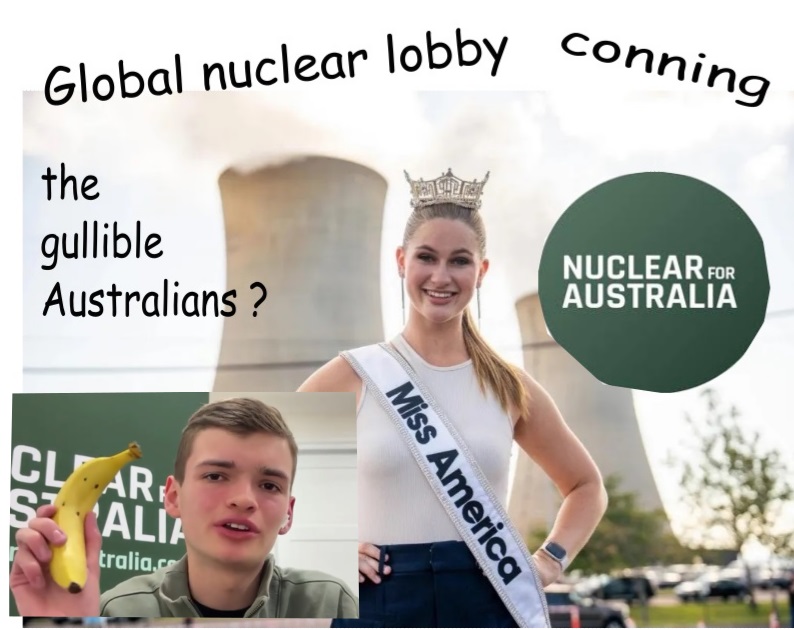
Miss America 2023 winner Grace Stanke has begun her Australian tour to promote nuclear power, just as the US energy giant that employs her has taken a big market hit after Chinese company DeepSeek claimed to have found a cheaper way to make AI.
Stanke, who flew into Perth on Wednesday, is a nuclear engineer who works in public relations for Constellation to promote nuclear technology, and has been brought out for an Australian tour by campaign group Nuclear For Australia in an attempt to drum up local support for the technology.
Nuclear For Australia is nominally headed by 18-year-old Will Shackel. But Stanke’s tour has reportedly been bankrolled by Australian businessman Dick Smith, who also provided the funding to establish the group.
The tour comes amid an aggressive expansion drive by Constellation, which holds a suite of nuclear and fossil fuel assets. According to the company’s 2024 Sustainability Report, nuclear makes up 67% of its generation capacity, with natural gas and oil making up 25% and renewables and storage accounting for 8%.
Constellation has increasingly been looking to capitalise on the development of AI as a driver in future electricity demand that it hopes to meet with nuclear power.
In September last year the company announced it would buy the Three Mile End nuclear facility under a deal to supply Microsoft with power to run its AI data centres.
Earlier in January, Constellation bought out rival Calvine for $US 27 billion, a move that meant it acquired the company’s gas-plants.
As gas-peaking plants currently help smooth out spikes in the wholesale electricity market by turning on during periods of high demand — at the expense of nuclear generators — the acquisition potentially gives Constellation greater influence over wholesale prices.
Late last week, President Donald Trump announced the US would pour $US 500 billion into AI development in what has been described as an “arms race” with China, a decision welcomed by Constellation CEO Joe Dominguez.
“President Trump is right that sustaining and enhancing America’s global AI dominance goes hand in hand with reliable, abundant American electricity,” he said. “Data center developers, generators, utilities, and other stakeholders should continue to work together to accomplish the President’s goals on behalf of the American people.”
On Tuesday, however, the assumption that power-hungry chipsets needed to train and run AI data centres would continue to drive demand for “clean” nuclear power ran into a wall.
Chinese firm DeepSeek announced it developed an open large-language model (LLM) that provides roughly the same service as ChatGPT with a smaller team and a fraction of the hardware as their US counterparts.
With the Chinese market subject to sanctions that limit access to the full-power graphics processing units (GPUs) needed to build their own models, the company was forced to find a workaround to do more with less.
These GPUs perform the calculations needed to drive LLMs and are manufactured by chipmaker Nvidia that was, until Wednesday, considered the world’s most valuable publicly-traded company with a market cap of $3.45 trillion. That changed with the latest news from DeepSeek.
In December, DeepSeek claimed it cost (USD) $5.6m and two months to develop its V3 model – a portion of what it cost to create ChatGPT. The accuracy of this figure, however, is questionable as the price of electricity is unknown.
Last week the company released the full version of its R1 model that it said is 30-times cheaper to run than equivalent models produced by US competitors such as OpenAI. The company has not released the training data, but has published papers outlining its methods, effectively allowing anyone to take DeepSeek work and expand upon it for free.
The announcement of a cheaper, less-demanding model triggered a massive 17% drop in Nvidia shares — wiping off $USD593bn, and knocked 20 per cent off the price of Constellation shares. By Thursday Constellation’s performance had partially recovered but not nearly enough to make up for Tuesday’s losses.
These events coincide with the arrival of 22-year-old Stanke, now a pro-nuclear influencer, in Australia to help local campaigns sell the technology to the Australian public.
Her tour includes appearances in Perth, Brisbane, Melbourne, Adelaide and Sydney, a parliamentary briefing and appearances at private events, including a community meeting in Lithgow, New South Wales.
The town selection is interesting as it has been a flashpoint for an anti-wind and anti-renewables campaign and has traditionally been a strong Nationals stronghold.
Lithgow falls within the federal seat of Calare which is currently held by federal independent Andrew Gee, who resigned from the National Party in 2022 over its opposition to the Indigenous Voice to Parliament.
Miss America and nuclear engineer Grace Stanke will be travelling around Australia with a host of other nuclear experts as a part of the National Nuclear Tour.
COMMENT. As I have predicted, the media emphasis is on “Miss America”, and the propaganda is so shallow as to be laughable. (Despite her obvious intelligence, Ms Stanke is not asked to say anything really sensible).
The tour is hoping to improve the public perception around nuclear science.
Grace Stanke told Peter Fegan on 4BC Breakfast, “I think nuclear energy and nuclear science as a whole is seen as some weird, unknown science that you have to spend 20 years in school to even so much as break into the industry, but that’s not the case.”
“Nuclear science is all around us, it’s in our homes. If you like bananas, you’re actually ingesting some radiation, smoke detectors use some nuclear technology.”
“All of these things that are part of our daily lives, so imagine how much more good nuclear science could do if we fully embrace this technology.”
Dutton’s nuclear plan a “con job” and a recipe for blackouts, says Bowen

Giles Parkinson, Dec 19, 2024, https://reneweconomy.com.au/duttons-nuclear-plan-a-con-job-and-a-recipe-for-blackouts-says-bowen/
Federal energy and climate minister Chris Bowen has lambasted the federal Coalition’s nuclear power plans, describing them as a recipe for blackouts and a “con job”, and has expressed astonishment at Peter Dutton’s assumption of a grid that will use 40 per cent less power than forecast.
Dutton’s nuclear costings – revealed last Friday – and some of its major assumptions have been widely dismissed, even mocked, by the energy industry, although the proposal has garnered support from some with strong connections to the fossil fuel industry.
The reason for that is the Coalition’s focus on extending the life of the country’s ageing coal fired power generators, increasing the dependence on gas, and the implications for renewables, which will largely be stopped in their tracks, and climate targets, which will be ripped up and ignored.
The Coalition says it can get the first nuclear power plant running by the mid 2030s – a target most in the industry find laughable. But its own modelling confirms that most of the planned 14 GW will not be delivered until the mid 2040s, which means it must run ageing coal generators for another two decades.
“This is a recipe for blackouts and unreliability,” Bowen says in the latest episode of Renew Economy’s weekly Energy Insiders podcast. “Sweating the coal assets for longer, I mean, these coal fired power stations are not getting younger. None of us are.
“Just this week, we’ve had 3.4 gigawatts of coal out in the NEM (National Electricity Market, the main grid) and three gigawatts of that was unplanned, ie breakdowns, unexpected breakdowns, three gigawatts out this week.
“Now, the grid’s coped okay, even though it’s been very hot, but you’d still rather not have three gigawatts out, and that’s only going to get worse the longer you rely on coal.”
Indeed, the Australian Energy Market Operator has made it abundantly clear, and even the coal plant owners agree, that the biggest threat to reliability on the grid is the unplanned and sudden losses of big fossil fuel generators, particularly coal.
Over the last two weeks, AEMO has managed the heatwaves and the multiple outages and has turned to more demand and supply flexibility to help manage the situation, including putting several big batteries on standby – a protocol it is now using when the grid faces demand highs, and demand lows.
It is this focus on flexibility that is undermining the case for existing, let alone new even larger “always on” baseload power stations.
Many analysts say there is simply not enough room in the grid. In a submission released this week, Tesla said there was room for barely 1 GW of “baseload” without severe curtailment of household solar.
The Coalition, however, says it is determined to power on, but its costings have also come under heavy criticism – both on the assumed price and timeline of building new nuclear from a standing start, but also its assumption that electricity demand would fall more than 40 per cent below forecasts.
In the energy world, it is generally assumed that less primary energy will be used in an electrified world. But that’s because inefficient fossil fuel engines and generators (in cars, homes and on the grid) are replaced by more efficient inverter based technologies – wind, solar and battery storage.
That means less energy is needed overall (because around two thirds of energy from fossil fuels is lost as waste heat), but more electricity will produced on the world’s grids. The Coalition modelling shuts its eyes to that evolution, and assumes that electrification does not happen and fossil fuels are still burned in huge quantities.
“I spent a fair bit of time thinking about how they (the Coalition) might try and make nuclear look cheaper, and I’ve got a confession to make,” Bowen tells Energy Insiders.
“Not in my wildest dreams did I suspect that they would just assume we need less electricity. So they’ve said we’re going to need 40% less electricity than AEMO’s Step Change scenario.
“And guess what? Who knew if you make 40% less electricity, it’s roughly 40% cheaper. I mean, who would have figured? I mean, what a con job. We all know that nuclear is the most expensive. They had to find a way of pretending it isn’t.”
On Labor’s own policies, Bowen says that the Capacity Investment Scheme, which released the winners of the first major generation tender last week, is working better than expected, with 6.4 GW of capacity awarded rather than the planned 6 GW, and all representing new projects that have not begun construction.
“It’s working better than I thought it would,” Bowen says.
“And that’s a very encouraging thing. The value and the quality of the projects we’re having coming forward means that we can award more than we were intending.
“No, I won’t be giving tenderers an opportunity to know what our reserve price is. That’s not how an auction works, but (the result) meant that I could also announce for the next round that we’re going to target, in effect, 10 gigawatts, four gigawatts of dispatchable and six gigawatts of generation for tenders three and four.
“That’s huge, and that really means that those projects will get into the planning system faster and the emos connection process faster and help us get to our target.
“The only disappointing thing about this round, from my point of view, was the lack of projects that we could award in Tasmania.
“I want to see more Tasmanian projects come forward, and … we have provided feedback to Tasmanian bidders about that …. we’ve got to ensure that we might get more Tasmanian projects into the future.”
However, Bowen says there is more to do, and he is hopeful – should Labor be re-elected and he remains in the portfolio – to make more reforms.
“We’ve made good progress in the first three years, but not yet good enough, in my view, and you really need a good long stretch in a job like this to, you know, bed down the reforms and make them work properly, and keep the momentum growing going and and learn as you go,” he says.
“Obviously, you know, you just get, you just get more proficient on things like the CIS, etc, as you build the experience collectively in the department.
“I would say the next term … should we get one, as I hope and expect we will, is that it’s a combination of consolidation, so a whole bunch of things that are well underway just need to be bedded down and consolidated, including the CIS, including the new vehicle efficiency standards that … have been in the too hard basket for so long, but don’t actually come in until the first of January.
“So they haven’t had any impact yet, to be honest, but they will. Same with the safeguards reforms, again, big and huge and difficult to do, but it has got to be bedded down and continued with and so there’s so much at stake.
“And then there’s the what’s next? And of course, we’ll go through the process of the 2035 target, the climate change authority advice to sector plans. All that process is underway, but I really see it now as a bit of a continuum.
“Having made good progress in the first two and a half to three years, got to build on it, bed it down, continue it. And it’s just unthinkable to me that we would, you know, having made this good progress, then stop, rip some of it up and go backwards, as the alternative would suggest.”
To hear more from Bowen on those plans and more, you can listen to the full episode here once its published later today.
Is big tech going all in on nuclear? Google and Microsoft have just pledged $45 billion on renewables
Sophie Vorrath, Dec 13, 2024, Renew Economy
https://reneweconomy.com.au/is-big-tech-going-all-in-on-nuclear-google-and-microsoft-have-pledged-45-billion-spend-on-renewables/
Did you hear the one about big tech going nuclear? One of the lines being trotted out in support of nuclear power by shadow energy minister Ted O’Brien – and faithfully reproduced by the Murdoch press – is that everyone’s doing it, including global tech giants Google and Microsoft.
“Not only does Labor claim to know the economics of nuclear better than companies like Microsoft who signed a massive nuclear deal, but they also think they can run the numbers better than (US banks and financiers) who have come out in favour of nuclear energy,” O’Brien said in September.
Microsoft did announce, in September, a 20 year power purchase agreement with Constellation Energy to reboot one unit at the mothballed Three Mile Island nuclear power plant in Pennsylvania and rebadge it as the Crane Clean Energy Centre.
Three Mile Island was, in 1979, the site of the worst commercial nuclear power accident in US history. It was shuttered in 2019 for economic reasons, with Constellation’s then parent company Exelon Corp, saying in 2017 that its closure was due to lack of financial rescue from the state.
This is not unusual. According to TechCrunch, in the last decade, seven nuclear reactors have been decommissioned in the US, while only two new ones have been switched on.
Notwithstanding the fact that restarting a nuclear plant that has been shut down for five years has never been done before (according to reports, Constellation Energy is reportedly seeking a taxpayer-subsidised loan it hopes will save it $122 million in borrowing costs) this somewhat baffling deal is expected to supply around 850 MW.
Google, meanwhile, in October announced plans to invest in small modular reactors to meet its own growing data centre needs and Amazon followed suit, with news of “three new agreements to support the development of nuclear energy projects,” again with a focus on the the as-yet commercially unproven SMR technology.
So, yes – all three of these companies have recently announced plans to invest in nuclear power – albeit in markets where it already exists (although not in the case of SMRs) and in technology and applications that are highly speculative.
Does this mean they have come over all Team Nuclear? Hardly.
Amazon, as it bragged in October, has been the largest corporate purchaser of renewable energy in the world for four years running, according to Bloomberg NEF, having invested billions of dollars in more than 500 solar and wind projects globally, which together are capable of generating enough energy to power the equivalent of 7.6 million US homes.
Amazon met its goal of sourcing 100% of the electricity its uses with renewable energy in 2023 – seven years ahead of the 2030 target.
Google announced just this week that it was funding $US20 billion ($A31 billion) worth of renewable power projects across the US, in a deal with Intersect Power and investment fund TPG Rise Climate to develop power to drive several gigawatt-scale data centers.
Microsoft, last week, joined a US investor Acadia Infrastructure Capital and other companies to launch the Climate and Communities Investment Coalition (CCIC) to develop a $US9 billion ($A14 billion) pipeline of renewable energy projects across the country, as reported in Reuters.
On its website, Microsoft says it invested in over 23.6 million megawatt-hours of renewable energy in 2023 financial year – “enough to power Paris with renewable electricity for about two years.”
Earlier this year, the company announced plans to procure some 9.5GW of solar panels from Qcells for PPAs through 2032 – adding about 1.5GW every year. In April Microsoft revealed in a job listing that it had more than 20GW of renewable energy under contract.
How anger at Australia’s rollout of renewables is being hijacked by a new pro-nuclear network

Facebook groups opposing renewables projects are now increasingly full of pro-nuclear content, and groups such as Nuclear for Australia have set up dedicated social media accounts targeting specific sections of the community – such as an Instagram account titled “Mums for Nuclear” – as they gear up for the election campaign.
Facebook groups opposing renewables projects are now increasingly full of pro-nuclear content, and groups such as Nuclear for Australia have set up dedicated social media accounts targeting specific sections of the community – such as an Instagram account titled “Mums for Nuclear” – as they gear up for the election campaign.
An alliance of political groups is harnessing real fears about the local impact of wind and solar farms – and using them to spruik nuclear power.
By Ariel Bogle and Graham Readfearn
The entrance is marked by an AI-generated image of a dead whale, floating among wind turbines. On the first floor of the East Maitland bowling club, dire warnings are being shared about how offshore wind may impact the Hunter region – alongside a feeling of not being consulted, of being steamrolled.
“Environment and energy forums” like this one in late November have been held up and down the east of Australia, aiming to build a resistance to the country’s renewable energy transition.
Today’s event is being cohosted by No Offshore Turbines Port Stephens (NOTPS) and the National Rational Energy Network (NREN), a group with informal National party links that was behind February’s Reckless Renewables rally in Canberra. The advocacy group Nuclear for Australia is also here.
“We’re not a political group,” the NOTPS secretary and a Port Stephens resident, Leonie Hamilton, tells Guardian Australia.
“We’re not there to push [politicians] into parliament, but we are going to listen to what they have to say.”
Hamilton says she’s undecided on the issue of nuclear power.
The coastline of the Hunter was declared a potential area for offshore wind in mid-2023 after “extensive community consultation”, according to the federal government. But some, such as NOTPS’ Ben Abbott, are still angry about a perceived lack of detail about the project.
Today’s forum is about raising awareness across the Hunter, Hamilton says. “We think it’s important it happens before the election, so that people understand what the costs are.
“[The coast] belongs to everyone and they should have the opportunity to understand what’s going on.”
There are local groups like NOTPS around Australia that want their broad concerns about the rollout of renewable energy to be heard but say they do not want to be used for a political agenda and do not advocate for particular energy sources.
But working alongside those groups is an increasingly coordinated alliance of conservative thinktanks, political lobby groups and politicians who are flatly opposed to the clean energy transition.
Fears about the environmental and social impact of renewables projects are finding purchase in an information gap critics say has been ceded by the government, the industry and environmental groups – and there are plenty of interested parties willing to step in.
An earlier NREN event in Sydney was sponsored by the Institute of Public Affairs.
Sandra Bourke, a cohost of the Maitland event, is an NREN member but also a spokesperson for the conservative lobby group Advance – which was a key player in the defeat of the Indigenous voice to parliament and is now fundraising on a “lies of renewables” campaign.
A Facebook account under Bourke’s name is present in almost 20 community Facebook groups and pages opposing renewable projects, from Kilkivan, Queensland, to Bunbury, Western Australia, regularly sharing Advance clips and links to Sky News.
The upcoming election is a “crossroads”, she tells the crowd, while declining an interview with Guardian Australia. There’s an Advance sign-up form on every seat.
Up the back of the room are “Where’s Meryl?” posters, referring to the Labor incumbent MP Meryl Swanson, who holds the local electorate of Paterson.
The Liberal candidate Laurence Antcliff is here, along with three men in T-shirts bearing his name. He tells the room he is opposed to the offshore wind project in Port Stephens and will “fight every single day” to ensure it does not go ahead.
Swanson, who has said “many, many meetings” were held with local groups about the proposal, was not invited.
The nuclear energy wedge
In June the Coalition announced it would lift the bans on nuclear energy if it won next year’s election, then build nine publicly owned reactors at sites around the country.
The announcement gave extra fodder to advocacy groups and conservative thinktanks that have long opposed the shift to renewables.
Last week the opposition leader, Peter Dutton, appeared in Port Stephens alongside Antcliff. “It’s in this community’s best interest that [the windfarm] project does not proceed,” he said, as he spruiked the alternative of nuclear power.
Facebook groups opposing renewables projects are now increasingly full of pro-nuclear content, and groups such as Nuclear for Australia have set up dedicated social media accounts targeting specific sections of the community – such as an Instagram account titled “Mums for Nuclear” – as they gear up for the election campaign.
A new report looking at the pro-nuclear information ecosystem, funded by the progressive campaign group GetUp, found a “likely-coordinated and sophisticated ecosystem” of thinktanks, not-for-profits and political operatives engaged in pro-nuclear messaging.
For these interests, the focus on nuclear energy is a chance to “present a solutions-based response to climate change, and divert attention from their pro-coal and gas positions”, the report concluded.
“Nuclear energy provides a wedge for the environmental movement, climate independents, the Labor party and Greens, because it stokes division and can bog them down in technical explanations of why nuclear is neither desirable nor viable in Australia.”
Ed Coper, who is the chief executive of the communications agency Populares and has worked on teal campaigns, says the volume of noisy opposition to renewables is disproportionate to community attitudes. Nevertheless, he predicts nuclear will be an effective election campaign wedge.
For parties opposed to the clean energy transition, this is an opportunity to “peel off” environmental support from renewables support. The message to this cohort is broadly that “renewable energy generation is ruining pristine farming land and is not a good use of land and destroys the habitats of protected species and pristine views”, he says.
“That gives [the Coalition] a whole new constituency. If Labor goes into the election assuming everyone is against nuclear energy, they’ll be in for a shock.
“Energy transition requires an enormous amount of social licence.”
Solar plans discovered by chance
About 200km north-east of Melbourne, John Conroy and his family have been producing beef in Bobinawarrah since the 1960s. In a neighbouring paddock are plans for the large Meadow Creek solar farm and battery – plans he discovered by chance in September 2022 after a visit from the electricity distribution company AusNet.
“We alerted the community,” he says. “The project had been in the process for 12 months before we even knew about it
He says the main concerns of the community surround fire risk – both from the project but also the liability of landholders if fires on their properties spread to the solar farm.
In April the Victorian government removed the rights of landholders to appeal against planning decisions made on renewables projects.
“That is a real slap in the face,” Conroy says. “We’re a community of working-class people, producing food, doing our best to keep footy clubs going, and then the government takes away your rights to have a say.”
The independent federal MP for Indi, Helen Haines, says questions about insurance liability “should have been answered long ago”.
“We should be having these conversations long before a project is up for a planning permit.”
Families like the Conroys in her electorate are spending hundreds of hours getting across technical details of projects and government rules. “It shouldn’t be that way,” she says.
Haines says communities are operating in a “vacuum” and she wants to see information hubs in regional centres where people can go for trusted information and support.
The MP, with Senator David Pocock, last year successfully pushed for a government review into the way communities were being asked to host major renewables projects.
More than 700 people attended 75 meetings, with the review making nine recommendations the government said it would implement in collaboration with the states.
Governments needed to allow only reputable developers to build projects, the review said, and zones should be identified to avoid projects targeting inappropriate land areas.
“There is pushback – this is real and the concerns that communities have are existential,” Haines says. “We have to stop trying to generate social licence after a decision has been made.”
Instead, she says, the transformation should be about regional development and making sure communities have genuine long-term benefits from any projects.
“I want to look back and see better roads, better healthcare and internet, better childcare services, and see that the renewable energy transformation helped us get there. But communities are just not seeing that.”
Locals want ‘some control and influence’
“The fundamental issue here is there’s an assumption that there is no time to properly talk to people and give them not just a tokenistic say, but give them some control and influence in managing their local environment,” says Georgina Woods, who has 25 years of climate change activism and advocacy behind her.
Woods is head of research and investigations at the campaign group Lock the Gate, an organisation that emerged from the unrest among farmers and landholders at the coal seam gas boom in Queensland in the 2000s.
Governments have failed to clearly articulate why the transformation is needed and the urgency of climate action, she says. “We are getting further away from a broad consensus on why these projects are being done in the first place.”
“Until we put people and landscapes and nature at the centre, we’re at risk of repeating the same mistakes with renewable energy that we made with mining.”
West of the Blue Mountains in New South Wales are the gently rolling hills of Oberon. Outside town are plans for a 250-turbine windfarm on pine plantations owned by the state government.
Chris Muldoon, a committee member of Oberon Against Wind Towers, says that would mean local landholders would miss out on any financial benefits of hosting turbines while the town would have to live with the sight of turbines almost 300 metres tall in an area known for its postcard aesthetic.
“They’re chasing the wind and the towers, but there’s no consideration of the economic or social impact,” says Muldoon, who manages Mayfield Garden in Oberon, a tourist attraction owned by the wealthy Sydney-based businessman Garrick Hawkins.
Hawkins has contributed to the campaign to block the windfarm, says Muldoon, as have many locals.
In September the group put up nine candidates for the Oberon council elections, with two elected. Their pitch was uncompromising. “Oberon First are the only candidates who have committed to slamming the door in the face of greedy, arrogant wind tower developers,” the group said.
Oberon has a lot of hobby farmers and second homes for people in Sydney, says Muldoon, which means they have “city skills” that have mobilised against the development, something other communities do not have.
The group is not against windfarms or renewable energy, insists Muldoon, but “you just need to make less invasive decisions about the rollout”.
He points to people living in renewable energy zones, where surveys have shown broad support among farmers for renewables projects.
Outside those areas, he says, projects often come as a surprise to communities that are ill-prepared to navigate the technicalities of dealing with planning regulations, or wading through environmental impact statements “that can be 1,000 pages long”.
“Outside the renewable energy zones, the framework isn’t working,” he says. “It’s the wild west.”
Oberon is in the federal electorate of Calare, where the independent Kate Hook is trying to unseat Andrew Gee, who quit the Nationals to sit on the crossbench in 2022 over the party’s opposition to an Indigenous voice to parliament.
Hook left her job in September working for a not-for-profit to help communities negotiate with governments and renewable energy companies to get the most benefit from projects.
She says the “missing piece” causing communities to push back is a lack of understanding of why the transition away from fossil fuels is needed and how it could benefit them.
“People shouldn’t have to rely on Google, but this is why people are anxious,” she says. “There’s a tsunami of misinformation.”
“People might not like the look of windfarms, but do they want farmers to be able to stay on their land? Because these projects can help them do that.
“What we need is discussion, not division.”
A spokesperson for the climate change and energy minister, Chris Bowen, said the government was “working with local communities to secure regional jobs and provide energy security”.
“Unfortunately, the former Coalition government spent 10 years failing to make the necessary reforms to improve community engagement in a rapidly changing energy market,” she said.
The government was implementing the community engagement review “to enhance community support and ensure that electricity transmission and renewable energy developments deliver for communities, landholders and traditional owners”.
CSIRO patiently and methodically slaps down Peter Dutton’s nuclear nonsense.

nuclear power does not ‘back up” wind and solar as Dutton and O’Brien often claim, it must displace it. And in Australia, that’s likely to mean household solar first and foremost.
Giles Parkinson, Dec 9, 2024
Australia’s premier scientific organisation, the CSIRO, has patiently and methodically slapped down the major nuclear talking points promoted by Coalition leader Peter Dutton in its latest GenCost report, which confirms – yet again – that integrated wind and solar are easily the cheapest option.
The CSIRO first published the GenCost report in 2018, under the then Coalition government, and its conclusions have been consistent – integrated wind and solar are by far the best and lowest cost options. The new draft of the 24/25 version, which notes ongoing cost reductions in solar PV and battery storage, confirm this.
In short, it finds that firmed renewables, including transmission and storage costs, will cost between $80 a megawatt hour and $122/MWh in 2030, should they account for 80 per cent of variable generation, which is the federal government target.
That compares to between $145 and $238/MWh for large scale nuclear, and up to an eye-watering $487/MWh for so-called small modular nuclear reactors, which are part of the Coalition’s energy proposals, but which don’t exist in commercial form. The CSIRO says neither could be deployed before 2040.
See more details here: GenCost: Falling costs of solar and batteries confirm integrated renewables are cheapest option
The CSIRO, however, has also faced extraordinary and relentless attacks from the Coalition over its analysis, amplified by right wing so-called “think tanks” and the Murdoch media, and given a largely uncritical run in much of mainstream media.
Dutton’s and the nuclear lobby’s main beef with the CSIRO calculations is that it makes nuclear power look very expensive. Which it clearly is.
They argue the CSIRO report gives their favoured technology no credit for being long life (they say 60- 100 years), for having high capacity factors, and they insist that the CSIRO has got it wrong on its estimated build times.
The CSIRO has addressed each of these claims in its draft 2025 GenCost report. In fact, it is remarkable just how much of the report is devoted to a technology that it notes could not possibly be delivered in Australia before 2040 – and it forensically debunks the lot of them.
Benefits of longer life
Let’s go to the life time issue first, because it has been a particular focus of Dutton and his energy spokesman Ted O’Brien as they promote their nuclear campaign around the country.
They say that because nuclear power plants can last 60 or even 100 years, their huge up front capital costs should be smeared across the period, rather than the 30 years calculated by the CSIRO.
That sounds plausible, but the CSIRO makes a number of important points. Firstly, the 30-year calculation is standard practice for the energy industry because no financial institution will lend for longer.
And if loans were to be spread over a 60 year or 100 year period, the interest payments would be crippling. It means that the benefits of such calculations would be just 11 to 15 per cent – and not be experienced by Australian consumers until at least 45 years – or around 2070.
“It’s not a magical halving of costs or anything like that. The savings are relatively modest,” CSIRO chief energy economist Paul Graham says in the latest episode of Renew Economy’s weekly Energy Insiders podcast (to be published on Monday).
But there is another problem. The CSIRO also points out that if nuclear power plants are to last that long then they need regular refurbishment. Based on overseas experience, it puts the capital cost of those refurbishments at nearly one third of the original capital cost of the plants.
And it also puts a large hole in another linked Coalition argument, which is that wind and solar power must cost more because their facilities have to be replaced after 25 or 30 years.
The CSIRO says yes, they do need to be replaced. But when they are rebuilt, they will be rebuilt at considerably lower cost, and that’s not even taking into account the fact that wind and solar will be built where current facilities already exist, with connection points, land deals and other important infrastructure already in place.
“What we concluded from that was, actually it’s hard to identify any real unique benefit that nuclear delivers from having a long life,” Graham tells Energy Insiders.
“You can get the same benefit from shorter lived technologies, even when you have to build them twice, because both things essentially involve a reinvestment step. And when you look at the savings, they’re pretty similar.”
Indeed, the CSIRO puts the cost of rebuilt wind and solar at a considerable discount to refurbished nuclear – The experience in Ontario, the Australian nuclear lobby’s poster market, confirms this. (See table above -on original).
Each of Ontario’s main reactors will be off line for around three years – the cost is huge – and some of the world’s biggest batteries are being built to help fill in the gap, which torpedoes another nuclear lobbyist fantasy that somewhere these power plants do not need back up.
“It’s not a magical halving of costs or anything like that. The savings are relatively modest.
Capacity factors
The second issue is also critical. The nuclear lobby and the Coalition have told the CSIRO that it must calculate nuclear costs based on a 93 per cent capacity factor, and only at that rate.
This is important to them because – at such a high capacity factor – the nuclear plants are rarely switched off or even dialled down, and that gives the technology the best chance to recoup its high costs more quickly.
The CSIRO says that while such high capacity factors exist in the US, it is not the reality in the rest of the world, and is unlikely to be the case in Australia, particularly with the growth of rooftop solar and large scale renewables.
It says the global average capacity factor for nuclear plants is 80 per cent, and 10 per cent of nuclear power plant have capacity factors of less than 60 per cent. “On international data alone, the proposition of only considering 93% is not supported by the evidence,” Graham says.
And in Australia the experience of baseload power plants – in this case coal – is that they run at a capacity factor of around 59 per cent.
“In Australia we have more than 100 years of experience with operating baseload generation, not nuclear but coal,” Graham says,
“The average for black coal in the past decade is 59%. On this basis we cannot support the proposal that 93% adequately captures market conditions in Australia.”
It is interesting to note here that nuclear power does not ‘back up” wind and solar as Dutton and O’Brien often claim, it must displace it. And in Australia, that’s likely to mean household solar first and foremost.
Development lead times
The third argument that CSIRO addresses is that of the time it takes to build a nuclear power plant. This is important because the Coalition insists it can deliver its first nuclear power plant by 2035, although no one outside the Coalition and the nuclear lobbyists actually believe that.
“Many stakeholders have agreed with the GenCost estimate of at least 15 years lead time for nuclear generation,” the CSIRO report says. “Nuclear has no projects in the Australian development pipeline, has additional safety and security steps and needs new legislation and regulations.”
Where the nuclear lobby points to projects with faster lead times, CSIRO has looked at that too, and makes the interesting and relevant observation that these occur in countries where the democracy score is low, and where labour costs and protections are also low.
When it comes to small modular reactors, the Coalition argument makes no sense. They don’t actually exist in commercial form and it is unlikely any will be built before the end of the decade.
Dutton and O’Brien says they will only build an “nth of a kind”, meaning they will wait for the tech ology to be established and lower costs,.
But that is not going to happen in the timeframe that would allow the first power to be delivered by 2035.
The CSIRO, kindly, assesses its nuclear costs on an “nth of a kind” basis.
“We have been seeing all these big cost blowouts overseas, in countries like the UK and the US, and mostly it’s because these countries have come back (to building nuclear after a gap of several decades) and they’d lost all their knowledge about how to build nuclear,” Graham says.
So – after all that – and working through all the Coalition and nuclear lobby talking points – where does that put nuclear in comparison to other technologies?
“So large scale renewal, large scale nuclear, is sitting at a position one and a half to two and a half times the cost of firmed renewables,” Graham says on Energy Insiders.
“And if we look at small modular reactors …. that’s between about four to six times higher. And that’s because that’s really a pre commercial technology.
“We don’t really have any any sort of commercial deployment of that technology globally. So it’s still carrying some very high costs at the moment, which will come down once it’s once they successfully build a few more of them. But at the moment, it’s a very high cost.”
The report released on Monday is just a draft, and will go out to consultation until February, before a final report is prepared. In the meantime, the Coalition will release its own costings, and the CSIRO can expect some more blowback from the lobbyists.
“You do have to have a bit of a thick skin,” Graham tells Energy Insiders.
“But that’s the way we sort of improve things. And what’s been, I guess, unique about the last two years of GenCost is that the discussion that’s been had around it isn’t just a sort of energy insiders conversation, to forgive the pun, but it’s, it’s blown out into a sort of a, yeah, it’s much more of a public conversation.
“It’s not always at the level of sort of the sort of scientific and engineering discussion that we tend to have inside the industry, but that’s fine.
“We’ve adapted, and we’ve it’s given us a big opportunity to sort of deep dive into some of these topics, like nuclear that people want to hear about. So we’re sort of glad to do it. And we think we’ve, we hope people think that we’ve done a reasonable job of presenting fair and balanced information.”
‘You couldn’t make this up’: Expert pans Ontario nuclear option
SMH, By Bianca Hall and Nick O’Malley, October 28, 2024
Ontario subsidises its citizens’ electricity power bills by $7.3 billion a year from general revenue, an international energy expert has said, contradicting the Coalition’s claim that nuclear reactors would drive power prices down in Australia.
Opposition Leader Peter Dutton has repeatedly cited the Canadian province as a model for cheaper power prices from nuclear.
“In Ontario, that family is paying half of what the family is paying here in Perth for their electricity because of nuclear power,” Dutton said in March. “Why wouldn’t we consider it as a country?”
In July, Dutton said Canadian consumers paid about one-quarter of Australian prices for electricity.
Professor Mark Winfield, an academic from York University in Canada who specialises in energy and environment, on Monday said the reaction among people in Ontario to the comparison had ranged from disbelief to “you couldn’t make this up”.
Ontario embarked on a massive building spree between the 1960s and the 1990s, Winfield told a briefing hosted by the Climate Council and the Smart Energy Council.
In the process, he said, the provincial-owned utility building the generators “effectively bankrupted itself”. About $21 billion in debt had to be stranded to render the successor organisation Ontario Power Generation economically viable.
In 2015, the Canadian government approved a plan to refurbish 10 ageing reactors, but Winfield said the refurbishment program had also been beset by cost blowouts.
“The last one, [in] Darlington, east of Toronto, was supposed to cost $C4 billion and ended up costing $C14 [billion],” Winfield said.
“And that was fairly typical of what we saw, of a cost overrun in the range of about 2.5 times over estimate.”
In Melbourne, Dutton said while he respected new Queensland Premier David Crisafulli’s opposition to nuclear, he would work with “sensible” premiers in Queensland, South Australia and NSW on his plan, if he was elected………………………………………………..
Winfield said household bills were kept artificially low under the Ontario model, despite the high cost of refurbishing ageing nuclear facilities.
“There’s a legacy of that still in the system that we are effectively subsidising electricity bills to the tune of about $C7.3 billion a year out of general revenues. That constitutes most of the provincial deficit; that’s money that otherwise could be going on schools and hospitals.”
Dutton’s comments came as a parliamentary inquiry into the suitability of nuclear power for Australia continued in Canberra. Experts provided evidence on how long it would take to build a nuclear fleet, and the potential cost and impact on energy prices compared with the government’s plan to replace the ageing coal fleet with a system of renewables backed by storage and gas peakers.
……………………………………………………….. In its annual GenCost, CSIRO estimated earlier this year that a single large-scale nuclear reactor in Australia would cost $16 billion and take nearly two decades to build, too late for it to help meet Australia’s international climate change commitments, which requires it to cut emissions 43 per cent by 2030. It found renewables to be the cheapest option for Australia.
Dutton has so far refused to be drawn on the costs of his nuclear policy. Opposition energy spokesman Ted O’Brien said the Coalition would release costings before the next federal election, which must be held by May.
O’Brien told this masthead “expert after expert” had provided evidence that nuclear energy placed downward pressure on power prices around the world. ……………. https://www.smh.com.au/environment/climate-change/you-couldn-t-make-this-up-expert-pans-ontario-nuclear-option-20241028-p5klx1.html
Refuting myths about nuclear and renewable energy
15 Oct 2024, Mark Diesendorf, https://renew.org.au/renew-magazine/renew/refuting-myths-about-nuclear-and-renewable-energy/
There’s a lot of talk at present about nuclear energy being a strong contender in Australia’s energy market. But how much is political spin getting in the way of fact? Dr Mark Diesendorf unpacks some of the myths that are out there.
The AUKUS agreement has given renewed stimulus to the nuclear energy lobby. With campaign support from the Murdoch press, they have increased their efforts to denigrate renewable energy and to promote nuclear energy and fossil gas in its place.
Because of the sheer volume of their campaign and the difficulty of publishing fact checks and refutations in the mass media, public opinion polls indicate that some people seem to be taking the misleading claims of the nuclear lobby seriously. In this article, I seek to refute the principal myths the lobby is disseminating.
Myth: Renewables cannot supply 100% electricity
Denmark, South Australia and Scotland already obtain 88%, 74% and 62% of their respective annual electricity generations from renewables, mostly wind. Scotland actually supplies the equivalent of 113% of its electricity consumption from renewables; the difference between its generation and consumption is exported by transmission line.
All three jurisdictions have achieved this with relatively small amounts of hydroelectricity, zero in South Australia. Given the political will, South Australia and Denmark could reach 100% net renewables generation by 2030, as indeed two northern states of Germany have already done. The ‘net’ means they trade some electricity with neighbours but on average will be at 100% renewables.
Computer simulations by several research groups, including ours at UNSW, using real hourly wind, solar and demand data spanning several years, show that the Australian electricity system could be run entirely on renewable energy, with the main contributions coming from solar and wind. System reliability can be maintained by a combination of storage, building excess generating capacity for wind and solar (which is cheap), key transmission links, and demand management encouraged by transparent pricing.
Storage to fill infrequent troughs in generation from the variable renewable sources will comprise existing hydro, pumped hydro (mostly small-scale and off-river), and batteries. Geographic dispersion of renewables will also assist.
For the rare extended periods of Dunkelflaute (literally ‘dark doldrums’), gas turbines with stores of biofuels or green hydrogen could be kept in reserve as insurance.
Coal and nuclear power stations are too inflexible in operation to be useful as backup—they require a whole day to start up from cold and, when operating, have difficulty and increased costs in attempting to vary their output to follow the peaks and troughs in demand.
Myth: We need baseload power stations
This is an old, discredited claim that refers to the past when variable renewables (wind and solar) were absent and the fossil fuelled electricity supply system consisted mainly of two types of power station: baseload and peak load.
Baseload power stations, such as coal and nuclear, operate 24/7 at maximum power output, except then they break down or undergo planned maintenance. Because of their inflexibility in operation, the former system also needed to supplement baseload with peak load power stations, hydro-electric and gas turbines. Peak load stations can vary their output rapidly in response to rapid changes in demand or breakdowns in baseload supply.
When a nuclear power reactor breaks down, it can be useless for weeks or months. For a conventional large reactor rated at 1000 to 1600 megawatts, the impact of breakdown on electricity supply can be disastrous. Big nuclear needs big back-up, which is expensive. Small modular reactors are not commercially available nor likely to be in the foreseeable future.
A renewable electricity system, including storage, delivers the same reliability, and hence the same economic value, as the traditional fossil fuelled system based on a mix of baseload and peak-load power stations.
Myth: Gas can fill the gap until nuclear is constructed
As a fuel for electricity generation, fossil gas in eastern Australia is many times more expensive per kilowatt-hour than coal, so it’s not generally used for baseload power. Instead, it’s used for fuelling gas turbines for meeting the peaks in demand and helping to fill troughs in supply. For this purpose, it contributes about 5% of Australia’s annual electricity generation. But, as storage expands, fossil gas will become redundant in the electricity system.
The fact that baseload gas-fired electricity generation continues temporarily in Western Australia results from a unique history. Unlike the eastern states, WA has a Domestic Gas Reservation Policy that insulates domestic customers from the high export prices of gas. However, most new gas supplies would have to come from high-cost unconventional sources.
South Australia has an ancient, struggling, gas-fired power station, Torrens Island, that was originally regarded as baseload, but can no longer perform as baseload. It will be closed in 2026 and replaced with renewables and batteries. South Australia will soon have 100% renewable electricity without a single baseload power station.
Myth: Nuclear energy is cheaper than renewables
Assuming that Australia would not buy nuclear reactors from China or Russia, the only choices are the European Nuclear Reactor and the Westinghouse AP-1000 (or variants thereof). The former type is under construction in Finland, France and the UK. In each case, construction times have greatly increased and original cost estimates have tripled or more.
In South Carolina USA, two AP-1000 reactors were abandoned while under construction due to delays and cost escalation—under state law the electricity customers had to pay for the failed project. In Georgia USA, two AP-1000 reactors have just been completed at double the original cost. They are the only new nuclear power reactors commenced in the USA since the 1970s and completed. Nuclear power projects bankrupted Westinghouse in 2017.
South Korea is exporting its modification of the Westinghouse reactor, the APR-1400, subsidised by an unknown amount by its government. Its only export project so far, the Barakah project in UAE, is three years behind schedule—the extent of its cost overrun is unknown.
The state-owned Korean Electric Power Company (KEPCO) has a debt equivalent to US$149 billion resulting mainly from its nuclear investments.
All expert studies—e.g. by CSIRO, AEMO, and the multinational investment advisor Lazard—find that nuclear is the most expensive electricity generating technology, while solar PV and wind are the cheapest. This is true after including the cost of ‘firming’ renewables with storage.
Contrary to the claims of some nuclear proponents, the levelised cost method used in these studies takes account of the different lifetimes of the technologies. It also includes the cost of connecting the power stations to the main grid. While renewables will need a few additional major high-voltage transmission links, so would nuclear.
Myth: Nuclear energy can co-exist with large contributions from renewables
This myth has two refutations:
- Nuclear is too inflexible in operation to be a good partner for variable wind and solar. Its very high capital cost necessitates running it constantly at full power, not just during periods of low sun or wind. This would mean offloading renewables, although they are much cheaper to operate.
- On current growth trends of renewables, there will be no room for nuclear energy in South Australia, Victoria or NSW. The 2022 shares of renewables in total electricity generation in each of these states were 74%, 37% and 33% respectively. Rapid growth from these levels is likely. It’s already too late for nuclear in SA. Provided the growth of renewables is not deliberately suppressed in NSW and Victoria, these states too will reach 100% renewables long before the first nuclear power station could go online
Myth: There is insufficient land for wind and solar
Although a wind farm may span a large area, its turbines, access road and substation together occupy a tiny fraction of that area, typically about 2%. Most wind farms are built on land that was previously cleared for agriculture and are compatible with all forms of agriculture. Off-shore wind occupies no land.
Solar farms are increasingly being built sufficiently high off the ground to allow sheep to graze beneath them, providing welcome shade. This practice, known as agrivoltaics, provides additional farm revenue that’s especially valuable during droughts. Rooftop solar occupies no land.
Myth: Nuclear energy is safe
Nuclear energy is dangerous for three reasons: its contribution to the proliferation of nuclear weapons, the impacts of nuclear accidents and the task of managing high-level nuclear wastes for 100,000 years or more.
The two principal nuclear explosives are Uranium-235 and Plutonium-239. Both can be obtained from the nuclear energy supply chain.
Under the cloak of nuclear energy, several countries—the UK, France, India, Pakistan, North Korea and South Africa—have produced nuclear weapons either by further enrichment of uranium to increase the concentration of Uranium-235 beyond the level (3-4%) required for nuclear energy or by extracting Plutonium-239 from the spent fuel of their nuclear power reactors.
In addition, the following countries have attempted to use nuclear power to produce nuclear explosives while cloaking their development of nuclear weapons: Algeria, Argentina, Australia, Brazil, Libya, South Korea and Taiwan.
Fortunately, they did not complete their programs for various reasons. Nuclear power and nuclear weapons are intimately linked.
The most serious nuclear accidents were the Kyshtym disaster in the former USSR in 1957, the partial meltdown at Three Mile Island in the USA in 1979, Chernobyl in Ukraine in 1986, and Fukushima in Japan in 2011. Except for Three Mile Island, which took the US to the brink of a major disaster, each of these accidents have likely caused many thousands of cancer deaths from exposure to ionising radiation.
There are no operating permanent repositories for high-level nuclear wastes. Finland is the only country that’s close to completing a deep underground repository. The USA spent billions developing one at an unsuitable site in Nevada and then had to abandon it.
At present, high-level wastes are in temporary storage above ground at nuclear reactor sites, either in steel and concrete casks or in pools of water.
The contrast between nuclear and renewable energy technologies is demonstrated by their respective responses to the earthquake and tsunami that struck the Pacific coast of Japan in 2011.
At the Fukushima Daichi nuclear power station, three of the six nuclear reactors melted down, accompanied by hydrogen explosions that expelled vast amounts of radioactive materials into the environment.
Further down the coast at Kamisu, the tsunami passed through a near-shore wind farm located in the surf (see picture) without stopping it. It was only shut down when the grid went down and recommenced operating when the grid was restored three days later.
In summary
Renewables—solar, wind and existing hydro—together with storage and energy efficiency, can supply all Australia’s electricity and ultimately all energy, including transportation and heating.
Nuclear energy is too dangerous, too expensive, too slow to build, and too inflexible in operation to be a good partner for wind and solar. A nuclear scenario would inevitably involve the suppression of clean, inexpensive, safe renewables.
Coalition claims of a nuclear power renaissance in UK further expose its shameless policy con
Tim Buckley & John Hewson, Oct 10, 2024, https://reneweconomy.com.au/coalition-claims-of-a-nuclear-power-renaissance-in-uk-further-expose-its-shameless-policy-con/
In the one-page nuclear policy pamphlet the LNP released in June, federal opposition leader Peter Dutton states that “of the world’s 20 largest economies, Australia is the only one not using nuclear energy, or moving towards using it.”
Even this claim lacks credibility and relies on half-truths – so no wonder Dutton and his nuclear-spuiking sidekick Ted O’Brien are failing to get buy-in on their delusion from those in their own party, let alone most experts.
The UK – the 6th largest economy in the world by GDP in 2023, and one which has an established nuclear power industry – is a case in point for both the problems with technology and its decline in some major economies.
Since 2000, nuclear power generation in the UK has more than halved from 85 terawatt hours (TWh) to a multidecade low of 41 TWh in 2023.
In the same period nuclear’s share of total UK electricity generation has dropped from 23% to a record low of 14%. Energy analyst company Aurora Energy forecasts UK nuclear generation could fall to a three-decade low of just 8 TWh by 2029.
This ongoing, inexorable decline has occurred even as coal’s share of electricity supply has plummeted from 32% in 2000 to just 1% in 2023.
Meanwhile, wind power doubled to 82 TWh from 2016 to 2023, and is exactly twice the amount of energy produced by nuclear. UK solar has grown sixfold in the last decade to 14 TWh, and is likely to double nuclear’s contribution by 2029.
While O’Brien has claimed there is nuclear renaissance in the UK, the reality is the UK’s end-of-life nuclear fleet is rapidly approaching its use-by date.
France’s EDF owns the only five remaining nuclear power plants (with a total of 9 units) still operating in the UK, all due to be shuttered by 2028: Sizewell B (to retire in 2025); Hartlepool 1&2 (retirement in March 2026); Heysham I 1&2 (March 2026); Heysham 2 1&2 (2028); and Torness 1&2 (2028).
EDF has flagged it would consider extending the life of some of these plants, but no decision has been made.
EDF has now reported a €12.9 billion writedown on its under-construction Hinkley Point C nuclear plant – an eye-watering mega-project debacle comparable to the LNP’s Snowy 2.0 and Kurri Kurri gas plants in Australia – and pivoted into developing wind, solar and hydro-electricity plants.
With a 2029-2031 commissioning date, Hinkley is running around 15 years late from its original targeted completion date of 2017.
It has a rapidly rising estimated construction cost of £41.6-47.9 billion, or A$80-93 billion, making the CSIRO GenCost estimates of nuclear in Australia look conservative. EDF’s Hinkley Point C equity partner, China’s CGN, stopped supporting the cost overruns in 2023.
The UK consumer can now look forward to being gouged when this white-elephant is actually commissioned next decade. The UK government-underwritten power purchase agreement (PPA) was set at £92.5/MWh (in 2012 prices), escalating with inflation through to commissioning and thereafter over the 35 year plant life.
In 2022 the price of power from Hinkley ballooned to £116/MWh, twice the cost of energy supplied by new wind farms at £54-59/MWh.
The proposal for a Sizewell C nuclear plant is long delayed and is still to gain financial backing, despite €5.5bn of proposed new UK government subsidies on top of the existing €2.5bn taxpayer support.
On top of these issues are massive nuclear decommissioning costs worn by taxpayers. The UK government estimated in 2022 it will cost UK taxpayers £132bn to decommission civil nuclear sites, with the work taking 120 years.
These cost estimates have doubled in the past decade, and could easily double again by the time they are imposed on the people. Add to this the fact the UK has no facility for permanently and safely storing the waste from past, present or future nuclear power stations.
Far from depending on nuclear, UK electricity consumers rely on its world leading wind industry and international grid connectivity to keep power prices down and to keep their lights on.
Dutton and O’Brien tout Rolls Royce as a preferred supplier of still mythical small modular reactors (SMR). What the LNP doesn’t mention is that Rolls Royce doesn’t actually build SMRs for electricity markets, nor does it even have a single approval or final investment decision, despite milking significant government funding over many years.
A flurry of press releases and yet more UK government subsidies doesn’t alter the fact that there isn’t even an SMR factory under construction or approved.
The LNP’s claim that Rolls Royce will have an SMR operational by 2030 anywhere is also far-fetched, and arguably a physical impossibility. Since it is now reported that Rolls Royce’s SMR subsidiary is running out of cash, and Rolls Royce considering divesting, SMRs are looking more and more like vapourware.
Despite the overwhelming evidence against nuclear on cost, timeframe and technical grounds, the LNP, Australia’s party of small government and free markets proposes to nationalise onto taxpayers the cost of building 7 nuclear reactors – which we estimate at over $100bn – as well as decades of massive construction risks and delays, and higher power bills in the short, medium and longer term.
A cursory look at the international experience is enough to expose the LNP’s shameless con, designed only to disrupt and delay our accelerating transition to abundant, reliable, low-cost firmed renewables.
Tim Buckley is director of independent think tank Climate Energy Finance. John Hewson, is former leader of the LNP and Honorary Professorial Fellow at ANU.
1 This month

of the week – Australians for War Powers Reform (AWPR)
To see nuclear-related stories in greater depth and intensity
 Antinuclear