The myth that a nuclear reactor is needed for medical uses
A very comprehensive 2010 OECD Nuclear Energy Agency report found reactor based isotope production requires significant taxpayer subsidies, as the cost of sale does not cover the cost of production.
The report concludes: “In many cases the full impact of Mo-99/Tc-99m provision was not transparent to or appreciated by governments… The full costs of waste management, reactor operations, fuel consumption, etc were not included in the price structure. This is a subsidisation by one country’s taxpayers of another country’s health care system. Many governments have indicated that they are no longer willing to provide such subsidisation.”
What is needed urgently is a debate about how much waste we make. We have a choice: whether we follow ANSTO’s expensive business model to ramp up reactor manufacture (and the long-lived radioactive waste that goes with it), or collaborate with Canada to develop cyclotron manufacture of isotopes that does not produce long-lived nuclear waste.
Debunking the myths around medicine and a nuclear waste dump
The Federal government is seeking a location for a nuclear waste facility. But the provision of information to communities has been problematic, with some major flaws.
Claims have been made that provision of nuclear medicine services is a key reason to build it, but existing medical waste makes up a very small proportion of the total waste requiring disposal.
In addition, little has been said about ANSTO’s business plan to greatly ramp up Australia’s reactor based production of isotopes from 1 per cent to over 25 per cent of the world’s market, which will massively increase the amount of long-lived radioactive waste produced in the future.
A new process may reduce the volume of the waste, but the actual quantity of radioactive material to store will be significantly greater, and will become most of the radioactive waste Australia produces.
In Australia nuclear medicine isotopes are indeed useful, but according to Medicare figures represent less than 3 per cent of medical imaging. They are most commonly used for bone scans and some specialised heart scans. They are not needed (as claimed by government) for normal X-rays, most heart scans and the vast majority of cancer treatments (surgery, chemotherapy and radiotherapy). Continue reading
Barry Brook, Pinchy Lobster and Clive Palmer: Three ‘Outstanding Scientists/Intellectuals
 Jim Green, 19 Feb 16 Tas Uni academic Barry Brook’s university webpage says that in 2005 he was listed as one of the “2000 Outstanding Scientists of the 21st Century” by the International Biographical Centre (IBC). But the IBC is a zero-credibility money making operation.
The WA Government’s Dept of Commerce ‘ScamNet’ website states: “The material promoting the International Biographical Centre creates a false impression about the credentials of the organisation. It also wrongly implies that the receiver of the letter has been picked through a special research process considering their work and qualifications.”
If there was any doubt about the IBC’s illegitimacy, one of Brook’s academic colleagues nominated a squeaky toy lobster and Prof. Lobster was accepted for inclusion as one of the ‘2000 Outstanding Scientists of the 21st Century’. And the IBC has accepted a nomination for Clive Palmer to be listed as one of the ‘2000 Outstanding Intellectuals of the 21st Century’. A ‘Medal of Intellect’ will be sent to Palmer on payment of a $240 fee.
Feel free to test the IBC’s credibility yourself … you’ll have no trouble getting the Wiggles or the Bananas in Pyjamas or Thomas the Tank Engine accepted as Outstanding Scientists or Outstanding Intellectuals.
Given that the illegitimacy of the IBC is beyond doubt, why does the IBC accolade remain on Brook’s university webpage?
Sources:
- Brook’s Tas Uni website (see the Career tab, under “Awards and Prizes”): https://secure.utas.edu.au/profiles/staff/plant-science/barry-brook
- IBC: www.internationalbiographicalcentre.com/2000_outstanding_scientists_of_the_21st_c.php
- WA Government ‘scamnet’ website: http://www.scamnet.wa.gov.au/scamnet/Scam_Types-Directory_Listings_and_registry_schemes-International_Biographical_Centre.htm
- Wikipedia IBC entry: https://en.wikipedia.org/wiki/International_Biographical_Centre
- Critique of Brook’s nuclear propaganda: www.foe.org.au/anti-nuclear/issues/oz/barry-brook-bravenewclimate
Independent Australia cracks the mystery of “international award” to (Anti) Environment Minister Greg Hunt
 Mystery explained: Hunt’s award handed out by the oil industry, Independent Australia Lachlan Barker 12 February 2016, MANY THIS week, myself definitely included, were gobsmacked by Greg Hunt receiving an award for – get your sick bags ready everyone – “Best Minister in the World“.
When I first saw this, again like so many of you, I thought it was satire, perhaps done by that excellent SBS site The Backburner. I’ve repeatedly been taken in by this site, so plausible are their funny stories and so appalling is our federal government.
But no, when we all got off the floor, the stories were indeed real and Hunt had, indeed, been given this award.
However, I knew there was something rotten here and so I thought I better find out how this bizarre occurrence came about. So I went to the site of the organisation that gave out the award, the World Government Summit. There on the home page is a link to “Partners“, so I clicked on that and discovered that the intriguingly entitled ‘Entrepreneurship Partner’ is the Abraaj Group.
So I clicked on that and we come to the Abraaj page and discover their portfolio. Among them are such heartwarming industries as Chemicals, Metals and Industrials,Pharmaceuticals, Construction and Manufacturing and of course Energy, Mining and Utilities.
[Author lists the companies, with their logos]
One company, Auro Mira Energy is focussed on renewables; they pursue hydro and biomass power generation in India.
However, the rest is largely fossil fuels……..
So there you have it mystery solved, Greg Hunt’s award was sponsored in large part by the energy industry, most prominently oil.
Once I found this out, it kind of made Hunt’s award make sense.
The award was for “Best Minister in the World” and so if you are going to pick a minister who does more than any other to enable the continued and increased use of fossil fuels, then clearly Greg Hunt is your man………
Greg Hunt is the best at enabling ongoing and increasing use of fossil fuels, against all financial and global ecological sense. So they can give him an award, as long as it’s for “Most Destructive Environment Minister the Earth has ever Known”.
Lachlan Barker blogs at cyclonecharlie88.blogspot.com.au. You can follow him on Twitter at@cyclonecharlie8. https://independentaustralia.net/environment/environment-display/mystery-explained-hunts-award-handed-out-by-the-oil-industry,8672
Senator Edwards’ fantasy of free nuclear electricity for South Australia
Free nuclear power is a fantasy: Report http://www.tai.org.au/content/free-nuclear-power-fantasy-report# A new report from The Australia Institute shows that a proposal to establish a global nuclear waste industry in South Australia would fail to secure 90% of the imported waste, leaving an expensive and risky legacy for the state.
The report was commissioned by the Conservation Council of South Australia to analyse the submission to the South Australian Nuclear Fuel Cycle Royal Commission by Liberal Senator Sean Edwards. The Royal Commission is due to release tentative results next week.
“The Edwards plan is deeply flawed. It is a plan funded by taking thousands of tonnes of nuclear waste, but would fail to process over 90% of that waste, leaving it to future generations to deal with,” said report author, The Australia Institute’s Dan Gilchrist.
Senator Edwards is proposing that South Australia imports 60,000 tonnes of spent nuclear fuel from other countries, and then leaves most of it, 56,000 tonnes, in dry cask storage which is designed for temporary use.
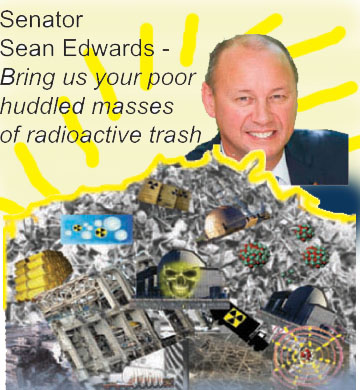
Report: The impossible dream: Free electricity sounds too good to be true. It is.
“The plan relies on technology that has never been deployed commercially – not with all the expertise in France or Germany or Japan or the United States.
“Indeed, logically, if a viable solution emerges, other countries will no longer pay Australia billions to hand over the waste.
“The plan fails to consider a basic economic principle: if Australia can generate free electricity – why wouldn’t other countries?
“Nothing in the plan explains what our great-great grandchildren are meant to do with this legacy. Indeed, the plan never mentions the leftover waste, as if it was not worth worrying about. Worse, all the money is spent in the first 50-60 years. Nothing is left to deal with the leftover waste.
“In many ways it is like a vastly complex loan. Australia will ‘borrow’ many billions of dollars, spend the lot, and leave it to future generations to pay it back. Indeed, a loan would be better, since it would not require South Australia to store tens of thousands of tonnes of radioactive material in the meantime.
“It is no wonder that Senator Edwards has been able to promise free electricity and reduced taxes. He is spending someone else’s money. Eventually, however, the piper must be paid.”
Sean Edwards proposal for nuclear pot of gold – a myth, says South Australia’s Conservation Council
Nuclear Pot of Gold is a Myth Conservation Council of South Australia, 11 Feb 16 The state’s peak environment body has welcomed today’s release of a new report that questions grandiose claims of an economic bonanza arising from the creation of a global nuclear industry in South Australia.
The report The impossible dream. Free electricity sounds too good to be true – it is was prepared by leading economic think-tank The Australia Institute. The Conservation Council of South Australia commissioned The Australia Institute to analyse the submission of Senator Sean Edwards to the SA Nuclear Royal Commission.
Conservation SA Chief Executive Craig Wilkins said the analysis presented a much-needed dose of reality.
“There’s been a lot of grandiose claims made about a nuclear waste-led economic boom for our state, including free power and the scrapping of all state taxes,” Mr Wilkins said.
“The reality is there is no magic pot of gold.
“The Edwards proposal manages to ignore basic economic laws of supply and demand while leaving tens of thousands of tonnes of highly radioactive nuclear waste for future generations to deal with.
“Either way you look at it the Edwards proposal contains high risk and fuzzy logic.
“Either South Australia solves the problem of long-term safe storage of toxic nuclear waste – a problem that no other country has yet been able to fix despite decades of research and failed proposals – in which case other countries will simply follow our lead and we quickly lose our monopoly position that underpins the economic case Senator Edwards is making, or we don’t solve it and are left with a social, economic and environmental nightmare for our state.
“This is not a legacy we should be leaving for our children.”
The Royal Commission is due to release tentative results Monday morning at 11am.
The Australia Institute Report can be found here and attached below. The Edwards submission can be found here. The Conservation SA submission to the Royal Commission can be found here. A critique of the Royal Commission can be found here.
Highly misleading to say that Lucas Heights nuclear reactor is mainly for medical uses
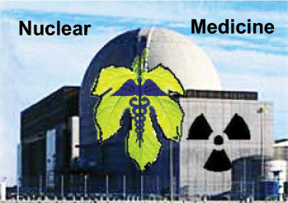 it would be highly misleading to attribute this predominantly to medical isotope production given the broad range of uses of the HIFAR and MOATA reactors over the last 60 years.
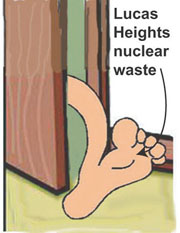 waste will be deposited in the repository? Less than 1% is medical waste (leftover radium and some disused sources). Most states and territories each only have a few cubic metres of low level medical waste.
Only a small fraction of Lucas Heights radioactive waste is of medical origin
The incessant references to nuclear medicine to ‘sell’ the proposed radioactive waste repository/store amount to nothing more than emotive propaganda
10-20% of the current stockpile would be the plausible range for medical waste − closer to 10% if measuring by radioactivity (because spent reactor fuel is such a large contributor to total radioactivity) and closer to 20% if measuring by volume.
Nuclear medicine and the proposed national radioactive waste dump http://www.foe.org.au/anti-nuclear/issues/oz/nontdump/med Jim Green National nuclear campaigner – Friends of the Earth, Australia December 2015
To download a 2-page paper addressing these issues right-click here.
“As health organisations, we are appalled that access to nuclear medical procedures is being used to justify the proposed nuclear waste dump. Most waste from these procedures break down quickly and can be safely disposed of either on site or locally.”
− Dr Bill Williams, Medical Association for the Prevention of War
“Linking the need for a centralized radioactive waste storage facility with the production of isotopes for nuclear medicine is misleading. The production of radioactive isotopes for nuclear medicine comprises a small percentage of the output of research reactors. The majority of the waste that is produced in these facilities occurs regardless of the nuclear medicine isotope production.”
− Nuclear Radiologist Dr Peter Karamoskos
Summary
Proponents of a national radioactive waste facility (a repository for lower-level wastes and a co-located store for higher-level wastes) claim or imply that nuclear medicine would be jeopardised if the facility does not proceed. There is no basis to such claims – they amount to dishonest scare-mongering.
Proponents claim that most or all of the waste that the federal government wants to dispose of or store at a national repository/store arises from medicine, specifically the production and use of medical radioisotopes. However, measured by radioactivity, the true figure is just 10-20%. Measured by volume, the figure may be within that range or it may be higher than 20% − but it takes some creative accounting to justify the claim that most or even all of the waste is medical in origin.
In any case, the fact that some waste is of medical origin doesn’t mean that a national repository/store is the best way to manage the waste.
If the plan for a national repository/store does not proceed, medical waste will continue to be stored at the Lucas Heights reactor site operated by the Australian Nuclear Science and Technology Organisation (ANSTO) and, in much smaller volumes, at hospitals. Some waste is used in hospitals and then sent back to ANSTO (e.g. molybdenum ‘cows’ that have been ‘milked’ of the daughter radionuclide, technetium-99m − by far the most commonly used medical radioisotope). That is no problem since ANSTO and hospitals continue to produce radioactive waste and thus they have an ongoing need for on-site waste stores and waste management expertise regardless of the options for periodic off-site disposal.
Nuclear medicine is not being adversely affected by the absence of a national radioactive waste repository/store. Nuclear medicine will not benefit from the creation of a national radioactive waste repository/store. Continue reading
Bill Gates on the nuclear bandwagon, Australia’s Gareth Evans on board, too.
The nuclear industry is trying to hijack the Paris Climate Summit , Independent Australia, 6 December 2015 The new Breakthrough Energy Coalition, backed by billionaires such as Bill Gates and supported by the global nuclear lobby is hijacking climate talks at COP21, writesNoel Wauchope.
At the Paris Climate Summit (COP21), the global nuclear lobby is in overdrive.
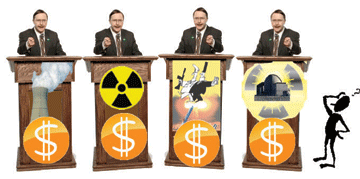
The centrepiece of today’s global nuclear lobbying is the Breakthrough Energy Coalition, led by Bill Gates, made public at the start of the conference.
Bill Gates announced the Breakthrough Energy Coalition, uniting the efforts of two dozen other billionaire philanthropists such asRichard Branson, Mark Zuckerberg and Jeff Bezos, to sponsor research into energy that doesn’t produce carbon.
Gates was present in Paris together with U.S. President Barack Obama — the White House is reported to be supportive of the initiative. Article after article in the U.S. and other media outline the purpose of this group, stressing renewable initiatives, or rather, “clean” energy initiatives. Nuclear power is not mentioned but is tacitly included in that weasel word, “clean”. …..
Eventually, I came upon Tina Casey‘s article, in Clean Technica: the very first one to notice the Breakthrough Energy Coalition’s focus on the nuclear industry and to question the inclusion of nuclear energy as “clean energy”.
She also notes the group’s co-operation with Mission Innovation, which brings tax-payer funding into the “clean” energy research programs. And Casey reminds us that Bill Gates is co-founder and chair of the innovative nuclear energy company TerraPower.
Only one university has joined the group, the University of California, which runs the Lawrence Berkeley National Laboratory — known for its nuclear energy research facilities.
Meanwhile, back in Australia, nuclear enthusiasts are on the bandwagon, too. The latest – and one of my favourites – is Gareth Evans. Evans has long been a voice for the nuclear industry, while simultaneously being Australia’s voice for nuclear disarmament. He sees no connection between nuclear reactors and nuclear weapons.
The Australian, ever a promoter of the nuclear industry, quotes Evans under the headline, ‘Nuclear waste dump a no-brainer‘.
At the South Australian Nuclear Fuel Chain Royal Commission on 3 December 2015, Evans isquoted as being almost ecstatic at the thought of Australia importing the world’s radioactive trash:
“Australia would stand very tall in the international community by repatriating waste made from exported uranium as well as storing waste for other countries. It was disconcerting that European countries had been spooked by the 2011 Fukushima nuclear power plant accident.”
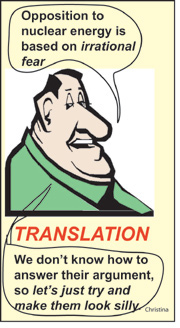 And Professor Evans used that notorious nuclear lobby argument to counter critics of nuclear power. He said:
“To me seems a triumph of emotion over reason.’……
Bill Gates himself may be something of a dreamer, with high aims and ideals, along with the commercial motive. His Breakthrough Energy Coalition sounds suspiciously like the Breakthrough Institute, which has a long history of advocating inaction on fossil fuel emissions, with the distracting promise of almost magical, new nuclear reactors that still exist only as blueprints. https://independentaustralia.net/politics/politics-display/the-nuclear-industry-is-trying-to-hijack-the-paris-climate-summit,8458
Minerals Council of Australia’s deceptive video promoting coal industry
 The campaign claims that low-emission coal-fired power plants and carbon capture and storage (CCS) technology is “now a reality” and are slashing emissions.
However, there is only one CCS-enabled plant operational in the world, in Canada. In Australia, there is just one CCS project aimed at coal emissions in the pipeline, which may arrive at some point in the 2020s.
Coal is a dangerous little black rock. Every climate scientist and almost every politician in the world knows that coal is very polluting and very dangerous. The only people who don’t get that are the Minerals Council and our government.
Green groups criticise ‘ludicrous’ Minerals Council of Australia ad which claims coal creates ‘light and jobs’ and ‘can now reduce its emissions by up to 40%’
Australia’s mining industry has launched a new ode to coal in the form of a major advertising campaign that hails the mineral’s ability to “create light and jobs”, as well as claiming that new technology will drastically slash its emissions. The campaign, called Little Black Rock , has been launched by the Minerals Council of Australia. An eye-catching TV ad shows an extreme closeup of the contours of a lump of coal, as if it were the surface of a rugged, distant planet.
A voiceover explains the “endless possibilities” of coal, Continue reading
Nuclear lobby hosts 5 Kimba officials in tour of Lucas Heights nuclear recator
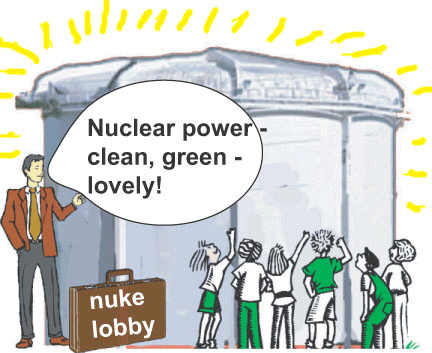
Kimba officials take nuclear fact-finding mission to Lucas Heights after toxic dump short listing, ABC Radio 20 Nov 15 The World Today By Tom Fedorowytsch Officials from Kimba, the tiny town home to two possible sites for a radioactive waste dump in South Australia, have visited Australia’s only nuclear reactor in Sydney.
Mayor Dean Johnson was among the small group of five people to be shown the reactor and waste facility at Lucas Heights, southwest of Sydney’s centre.
“We feel the tour has provided us now with a much more thorough overview and an understanding of what a repository would look like, and probably some of the keys to properly and safely handling and storing that waste,” the mayor said.
Two of the Federal Government’s six proposed sites — Pinkiwilinie and Cortlinye — fall within the Kimba council region. Other sites making up the Government’s shortlist include Barndioota in South Australia, Hale in the Northern Territory, Sallys Flat in New South Wales and Oman Ama in Queensland.
A $10 million sweetener for infrastructure and community development will be given to the local area that accepts the waste.
……..’Everyone has right to say no’: farmer While Cr Johnson and the council weigh up whether to support a nuclear waste dump, some residents of Kimba — especially farmers — are deeply opposed to the idea.
As a farmer, the perception and stigma attached to a nuclear waste dump, could have ramifications on this clean and green reputation we have in agriculture.
Farmer Peter Woolford
“To be quite frank I think it’s totally irresponsible to be putting one of these in a food producing area,” Peter Woolford, a farmer who works land next door to one of the sites, said. “We obviously have the safety issue, but you know, we have things like land values,” he said.
“Who’s going to buy a property alongside a nuclear waste dump? I think we have to be real about that.”
Mr Woolford said he would not consider taking a tour of Lucas Heights.
“Well I don’t think I need to, at the end of the day surely everyone has the right to say no, and that’s what we’re doing. This has been forced upon us,” he said. “As a farmer, the perception and stigma attached to a nuclear waste dump, could have ramifications on this clean and green reputation we have in agriculture.”
Formal consultation will ramp up in Kimba in the next few weeks, and a decision to proceed will be made next year.http://www.abc.net.au/news/2015-11-20/kimba-officials-take-nuclear-fact-finding-mission/6958734
Adelaide branch of University College London (UCL) to close (and good riddance)
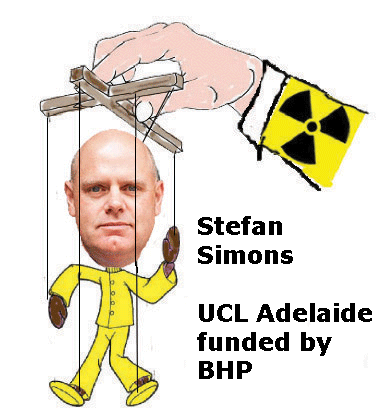
 With UK import Tim Stone, and Prof Stefaan Simons leading the charge, this UCL branch has been a useful propaganda piece for the global nuclear lobby. South Australia has enough nuclear shills without UCL. It will be good to see it gone.
UCL Australia ‘to wind down by 2017’ https://www.timeshighereducation.com/news/ucl-australia-to-wind-down-by- 2017/2018581.article#comment-5146
Future of branch campus in Adelaide under review as funds dry up and London focuses on partnerships
February 19, 2015University College London is set to close its Australia branch within two years as part of a wider review of its overseas campuses.
UCL’s Adelaide campus is likely to be wound up in 2017 on the completion of research deals with energy and mining companies Santos and BHP Billiton worth about A$20 million (£10 million).
Support from South Australia’s regional government is also due to expire that year, which led the university to carry out a review of UCL Australia’s long-term sustainability.
It is now undertaking a consultation process with its staff about a “move away from a stand-alone presence in Adelaide”, although it says this is “not a fait accompli”. Continue reading
A Non-Reactor Future for Lucas Heights
 The Australian govt continues to hype the Lucas Heights nuclear reactor, as though it were some grand asset to this nation. Well, it’s not. It’s major function is ceretainly not medical, as the government would have you believe.
Indeed, is its major function an excuse to justify the toxic nuclear fuel chain?.
Friends of The Earth, Jim Green, 1. Summary
* most of the work at ANSTO’s Lucas Heights facility does not depend on the operation of a reactor.
* a good case can be made for greater investment in non-reactor technologies/programs at Lucas Heights.
* pursuit of a non-reactor future for ANSTO offers several advantages, including a large reduction in the generation of radioactive waste……
4. Research reactors are yesterday’s technology:
“The future direction of nuclear medicine lies with cyclotron produced products and accelerators. …
Over half of all research reactors ever built have been closed and the number in operation continues to decline…. the number of cyclotrons in operation continues to increase. Some multipurpose research reactors are being replaced by reactors, but most are not being replaced or are being replaced by non-reactor technologies..
6. Alternatives to a domestic reactor for medical isotope supply:
Ongoing reliance on existing cyclotrons in Australia, plus a greater reliance on imports, is a perfectly viable alternative to a domestic reactor.. http://www.foe.org.au/anti-nuclear/issues/oz/lh
UCL Australia – key player/driver in South Australia nuclear push
“University College London’s International Energy Policy Institute (IEPI), based at its Australia campus in Adelaide, undertakes economic, regulatory and policy research on how Australia could develop a nuclear energy industry and manage its externalities, including decommissioning and waste.”
UCL Australia https://en.wikipedia.org/wiki/UCL_Australia 10 Nov 2015
UCL Australia is an international campus of the University College London, located on Victoria Square in Adelaide, South Australia.
Industry partnerships
UCL Australia has key corporate partnerships with two major resource and energy companies operating in South Australia: Santos and BHP Billiton. Santos’ South Australian interests include onshore and offshore oil and gas developments while BHP Billiton’s interest is concentrated on the expansion of the Olympic Dam mine- the world’s largest known deposit of uranium.
International Energy Policy Institute
The International Energy Policy Institute (IEPI) is housed on the Adelaide campus of University College London, Australia. In 2011, UCL signed a five-year $10 million partnership with BHP Billiton to establish the International Energy Policy Institute in Adelaide and an Institute for Sustainable Resources in London. Continue reading
Fact-checking Senator Sean Edwards’s claim on future nuclear bonanza
 FREE ENERGY – WITH NUCLEAR? http://www.factsfightback.org.au/free-energy-with-nuclear/ November 4, 2015
The claim
Senator Sean Edwards claimed that an expansion of the nuclear fuel cycle in South Australia could provide low or even no cost electricity, create a generation of high-paying jobs and do so without any subsidies from government. His plan is to take spent fuel from older nuclear power plants from around the world, and reprocess them for use in fourth generation reactors here in Australia. We could be paid to take waste which we then turn into fuel, providing free electricity.
The facts
So called fourth generation reactors are not yet commercially available but are predicted to become available sometime in the 2030s. If these reactors become commercially available they will be able to take spent fuel rods(currently treated as nuclear waste) from older nuclear reactors and use them to generate electricity. This effectively turns a waste source into a valuable commodity.
The claim that low or no cost electricity can be produced comes from the idea that other countries would pay South Australia to take their nuclear waste. This would mean that not only will South Australia pay nothing for its fuel costs but it would generate an additional revenue source from taking other countries waste and turning it into a commodity.
We will address his argument as three linked claims:
- Other countries will pay Australia to take nuclear waste for storage.
- Australia can build fourth generation reactors to use this spent fuel to generate electricity.
- This will result in free electricity, and perhaps even earn sufficient profit for the state that it will allow a reduction in taxes.
Claim 1
The expert advice to the South Australian Royal Commission into expanding the nuclear fuel cycle gave a time-frame of 25 years to complete a long term waste storage facility. The Generation IV International Forum expects fourth generation reactors – capable of using existing waste stockpiles as fuel – to be commercially deployed in 2030-2040. This means that any waste storage facility that South Australia develops is likely to be completed at about the same time as fourth generation reactors become commercially available. It is likely that South Australia’s own waste storage business would need to compete with other countries’ fourth generation reactors. Spent fuel will cease to be waste, and will become a commodity. Why would anyone pay South Australia to take a commodity?
Claim 2
The circular reasoning is clear. If fourth generation reactors work as hoped, no-one will pay South Australia to take their spent fuel. Further, if fourth generation technology proves to be expensive and difficult to maintain, South Australia would have locked itself into expensive electricity generation, having set up a waste import industry. In either case, countries with existing stockpiles of spent fuel have a clear competitive advantage over South Australia. It makes more financial sense for them to build fourth generation reactors next to existing stockpiles than it does to transport it half-way around the world. There is no good outcome for South Australia.
Claim 3
According to the US Energy Information Administration, fuel represents less than 15% of the cost of generating electricity with advanced nuclear power plants. Most of the cost is in the initial capital expense and maintenance of the reactor. Even if Australia received “free” fuel – a wildly optimistic hope – the cost of building reactors is still great. Wind and solar have no fuel costs, but no one thinks renewable electricity is free. Furthermore, the cost of setting up an international waste storage component would be extreme large. The Pangea proposal which looked at setting up a nuclear waste disposal facility in the late 1990’s included port facilities and a fleet of specialised ships. It showed that any waste facility would be very expensive.
The first ton of waste that Australia received would require a gamble of many billions of dollars.The findings
Perhaps the cheapest way to take a gamble on nuclear power might be to create temporary storage facilities now, use this brief window before fourth generation reactors are deployed commercially to get paid to take waste, and be among the first in the world to build the reactors which can use our newly acquired waste for fuel.
However, the risks are obvious. If fourth generation reactors turn out to have high costs of operation, we would be locked into expensive electricity. If they can’t be made to work commercially at all, we would have given ourselves a high-level waste problem for tens of thousands of years, a problem that may not have a solution. And if they are cheap and effective, most countries could build their own and bid for the fuel we are so generously taking for a fee. If we can plan ahead for fourth generation technology, so can everyone else.
Even at best, if everything goes just as hoped, the payoff for our gamble is paltry. A 15% reduction in energy costs from nuclear reactors, which already have a higher cost per unit of energy than new wind and solar generators, is far from “free” electricity. A waste industry, costing billions to set up, which will see its revenues killed off – in as little as ten years – by the very technologies we hope to champion, can hardly be said to provide “generations” of high-paying jobs. And we will inherit a nuclear waste storage problem that must be solved for at least hundreds, and perhaps thousands, of years.
The most risk for the least reward is not a smart business plan. Free electricity is no more than a pleasant dream.
Australia’s uranium industry looks to Paris Climate Conference to save it
Read between the lines, as BHP makes some of the right noises about climate change, in its oh so worthy portfolio analysis of climate change. BHP warns about the need for action and supports carbon pricing. It says it supports renewable energy, and does indeed support carbon capture and storage.
BHP says little about uranium – but I suspect that this is the main game.
However, it is interesting that BHP makes a quite revolutionary statement, for a nuclear company, in for the first time, publicly acknowledging that the next nuclear disaster might be a damaging blow to the industry.
Perth Now reported, Oct 1 :
“Mining giant BHP Billiton said this week it expected uranium would be the biggest winner in its portfolio, as the world comes under pressure to cut carbon emissions and limit global warming to two degrees celsius.
Australia holds the largest share of uranium resources globally. The ongoing South Australian royal commission into the nuclear fuel cycle is an important opportunity for Australia to review its contribution towards development of nuclear power, Dr Guthrie told mining industry executives in Sydney.”
- Governmental support of nuclear programs
- Successful implementation of small scale reactors
- Renewables capacity additions for power generation
- Less public acceptance following another nuclear power accident ” http://www.bhpbilliton.com/~/media/bhp/documents/investors/reports/2015/bhpbillitonclimatechangeporfolioanalysis2015.pdf
1 This month

of the week – Australians for War Powers Reform (AWPR)
To see nuclear-related stories in greater depth and intensity
 Antinuclear