The new industry of nuclear radiation denial
Plenty of funding is available. The USA’s Department of Energy funds programs worldwide, (including in Australia) to research dodgy science about the safety ‒ even alleged benefits ‒ of low level ionising radiation. Nuclear physicists and others, quite inexpert in this field, pronounce solemnly about non-hazardous nature of low dose radiation.
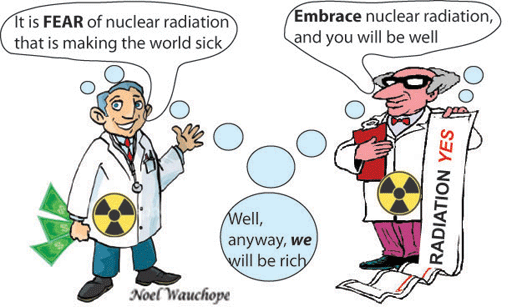
The anti-science about ionising radiation Independent Australia Some people would have you believe that low level ionising radiation is perfectly safe; this is a sinister and troubling fallacy, says Noel Wauchope. 10 Oct 13 DENIAL OF THE HEALTH EFFECTS of ionising radiation is the latest of the lies against science……….none of these motivations would get “airplay” ‒ would prevail, if it were not for the money motive, – that’s the impetus behind public relations people, consultants, journalists, commentators, TV producers, film-makers, and so on who are paid by think tanks that are fronts for polluting industries and billionaires like the Koch Brothers. And don’t let’s forget the scientists and science media who are paid by governments that are financially beholden to polluting corporations and to the military industrial complex.
There is extensive literature in books and on the Internet about the campaigns of science denial regarding asbestos, tobacco and climate change. These are global campaigns, but Australia is well represented.
The climate sceptic campaign has followed the model of the tobacco lobby…….
neither the “old” nor the “new” media are properly addressing the issue of anti-science about ionising radiation. Continue reading
Wind farmers find the industry profitable and benign – no “wind farm syndrome”
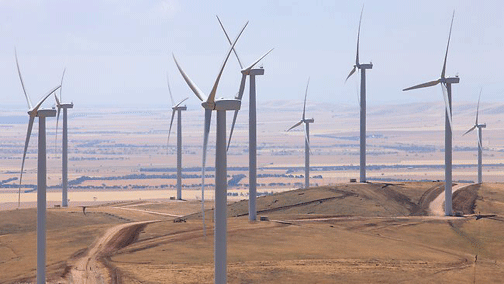 Wind turbine syndrome: farm hosts tell very different story The Conversation, Simon Chapman Professor of Public Health at University of Sydney 18 Sept 13 People who host wind turbines on their properties and derive rental income from wind energy companies have important stories to tell about living alongside turbines, but they’ve largely been absent from the debate on wind farms and health. Australian filmmaker and researcher Neil Barrett is finally giving this critical group a voice in his new short film, The way the wind blows, released today.
Turbine hosts at Waubra earn A$8,000 a year for each turbine on their land. In the bush, the expression that wind farms can “drought-proof a farm” is common: a land owner with ten turbines can wake up each morning comfortable in the thought that a tough year with poor rain or bad frosts can be ridden out, thanks to income from wind generation.
All of Barrett’s interviewees say they can hear the turbines but none say they are bothered by them or suffer from any health problems they attribute to the turbines. Continue reading
Exposing the garbage propaganda from the anti wind farm lobby
More than two-thirds of Australian wind farms including more than half of those with large turbines have never received a single complaint. Two whole states – Western Australia and Tasmania – have seen no complaints.
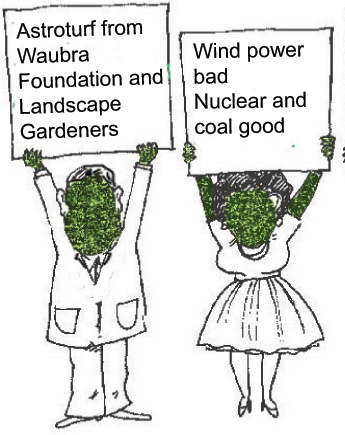 Wind turbine syndrome: farm hosts tell very different story The Conversation, Simon Chapman Professor of Public Health at University of Sydney 18 Sept 13 “………Laurie and the Waubra Foundation have done all they can to spread concern about the harms they allege are caused by living near wind farms. One former Waubra resident has been particularly prominent, speaking emotionally at anti-wind farm meetings about how wind farms have ruined his health and caused his family to move to Ballarat, at great personal expense.
In a statement that would be of immense interest to Apple, Samsung and Nokia, he recently told a meeting in Barringhup that electricity generated by wind turbines started charging his cell phone without it being plugged in:
I’ve had my … mobile phone go into charge mode in the middle of the paddock, away from everywhere.
In 2012, he wrote a public submission to a parliamentary inquiry where he revealed he had suffered a serious head injury some eight years before the wind farm opened in 2010:
I have been in brain training care and rehabilitation for about ten years because of an unfortunate, unrelated accident.
Indeed, the most common health complaints voiced by complainants are problems such as disturbed sleep, anxiety, hypertension and normal problems of ageing that are very prevalent in all communities, regardless of whether they have wind farms. Continue reading
Making coal seam gas seem clean – by changing its name
 More CSG Greenwashing? http://www.energymatters.com.au/index.php?main_page=news_article&article_id=3948 18 Sept 13, What’s been a good way in the past to distance a nasty product from its bad reputation? Simply change its name. However, the strategy isn’t so effective these days in an increasingly online world where news travels fast.
According to a report on the ABC, a briefing note from the office of Resources Minister Chris Hartcher suggests changes be made to the way the coal seam gas (CSG) industry and fuel is described within Government communications and texts. Instead of the crisp ‘CSG’ term or ‘coal seam gas’, it seems Mr. Hartcher would like to see it referred to as ‘natural gas from coal seams’ and that references to coal seam gas or CSG be removed from sentences.
‘Natural’ may work as an effective greenwashing term for some products; but the recommended change won’t fool many – it will (and has already) just further incited those dedicated to exposing the many serious issues involved with extracting the fossil fuel. In addition to the interruptions to agriculture and potential contamination of water supplies; according to Zero Emissions and other sources, coal seam gas is even more emissions intensive than coal when total lifecycle emissions are taken into account.
Research recently carried out by scientists at the University of Queensland determined that not only would a shift from coal-fired to gas-fired electricity generation in Australia fail to deliver significantly lower carbon dioxide emissions;wholesale electricity prices would be higher than with a renewable energy option.
According to Aidan Ricketts from CSG Free Northern Rivers, quoted by theNorthern Star; the attempt to relabel coal seam gas is “.. just another example of the government falling in line with industry. They’re trying to get away from the words which have become poison.”
It would seem changing how CSG is referred to is just a case of putting lipstick on a particularly filthy and greedy pig.
Book ‘Dealing in Doubt’ shows who’s behind climate denialism in Australia
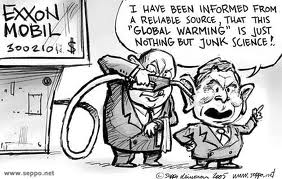 Report offers field guide to the climate change denial industry, Guardian, Graham Readfearn, 13 Sept 13, “…. There is also a potted and seldom-told history of how key figures in the United States worked to connect with like-minded people in Australia to encourage efforts Down Under to counter calls to cut emissions.
One of the first efforts came courtesy of free market promotion unit The Institute of Public Affairs, which doesn’t reveal its funders, which in 1990 sponsored a tour by veteran sceptic Fred Singer around Australia. TheIPA’s magazine reported Singer’s visit: “The greenhouse theory of global warming is contradicted by the evidence, a prominent US scientist has told the IPA.”
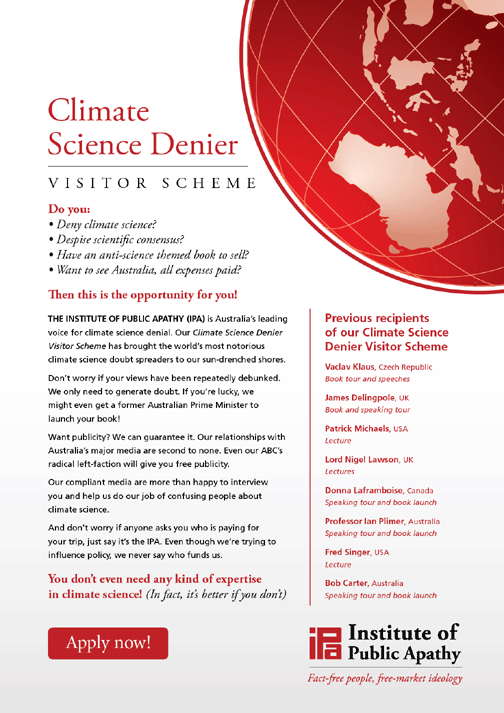
Later, Dealing in Doubt recalls planning meetings in the mid-90s with conservative think tanks in the US and Australia where strategies were developed to counter calls for action.
One of those characters, Australian businessman and former mining executive Hugh Morgan, was announced by Liberal MP Greg Hunt in 2011 as a member of the Coalition’s business advisory council on climate change………
Internal Heartland Institute documents have shown that one of the authors of the report, Australian geologist Dr Bob Carter, was to be paid $1667 a month for his work on the report (for anyone interested, Skeptical Science has a good summary of the key differences between the genuine IPCC report and the NIPCC)……. http://www.theguardian.com/environment/planet-oz/2013/sep/12/greenpeace-climate-change-denial-dealing-doubt-report
When Tony Abbott says “mandate” he means “open season” on progressive policies
Coalition’s election victory doesn’t mean a mandate to do anything it pleases PAUL SYVRET THE COURIER-MAIL SEPTEMBER 10, 2013 JUST what exactly is this thing we call a “mandate” beyond being arguably one of the most abused words in the political lexicon? Is mandate something to do with marriage equality or the electoral equivalent of a mankini (bright Speedo red, of course) except with a man and a … Actually, let’s not go there.
I ask this because to listen to some members of the incoming government, the word seems interchangeable with terms like carte blanche, or perhaps even “open season”. Certainly Australia’s Climate Change Minister-in-waiting Greg Hunt seems convinced that an election win equals a “mandate” and constitutes, ipso facto, a requirement that all in the Parliament bend over and offer blind obeisance to the new world order.
Bollocks. Polling consistently showed carbon pricing way down the list of voter concerns, making the election no more a referendum on carbon that it was on Bronwyn Bishop’s hair lacquer.
Secondly, the election result gives the new Government a mandate to introduce its policies and prosecute an argument for their passage through Parliament, nothing more. This may come as a shock to some conservative voters, but millions of Australians viewed the prospect of an Abbott government with a mixture of embarrassment and despair and voted for the other mob. In the process we non-Abbott voters gave the party of our choice a mandate to push their policy platforms on our behalf, not to sell us out.
Personally speaking, as someone who supports carbon pricing for both economic and environmental reasons, I would view a decision by Labor to acquiesce to the Coalition’s Wreck-It Ralph approach as an act of gross betrayal. I – and the aforesaid millions of others – cast my vote for a party that believes in tackling climate change via a market-based solution,……. HTTP://WWW.COURIERMAIL.COM.AU/NEWS/QUEENSLAND/OPINION-COALITION8217S-ELECTION-VICTORY-DOESN8217T-MEAN-A-MANDATE-TO-DO-ANYTHING-IT-PLEASES/STORY-FNIHSRF2-1226715384036
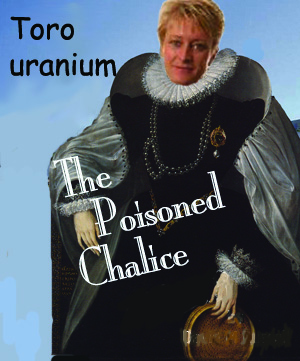
Toro’s Vanessa Guthrie optimistic in the face of uranium’s financial disaster
 INTERVIEW -Uranium miners face new hurdles as Fukushima disaster worsens Reuters, Aug 21, 2013 By James Regan
* Uranium miners face uncertainty as new Fukushima nuclear disaster unfolds
* Australia’s Toro says need for new uranium mines still stands
SYDNEY, Aug 21 (Reuters) – Revelations of more toxic leaks from Japan’s Fukushima Daiichi nuclear power plant will raise second-thoughts about Japan’s nuclear future, but won’t halt the long-term global expansion of the industry, the head of a uranium mining company said.
“It reinvigorates the heightened state of nervousness, it surely will make the Japanese government and nuclear regulatory authorities more cautious and conservative in the decisions about the restart,” said Vanessa Guthrie, managing director of Australia’s Toro Energy Ltd, which expects to start mining uranium in Australia in 2016.
Japan is set to raise the severity rating of the leak to level 3, or “serious incident”, on an international scale for radiological releases, underlining a deepening sense of crisis at the site.
The price of uranium, used mainly as fuel for nuclear reactors, plunged after the March 2011 meltdown at the Fukushima plant 240 km (150 miles) from Tokyo and has struggled to recover ever since. August uranium futures stood at $35.15 per pound on Wednesday compared with $68 per pound before the earthquake and tsunami that triggered the disaster.
However, Guthrie said contract prices between uranium miners and buyers standing at around $58-$59 a pound more accurately reflect the supply and demand balance than the spot price.
Operating costs in the industry range between $22-$25 per pound up to the high $40s, Guthrie said……
Uranium spin from David Paterson – “emotion” is good, when it’s pro nuclear
 I have often been accused by nuclear lobbyists of beong – that awful thing “emotional”. An anti-nuclear person speaking out is “emotional” (obviously not sensible). Indeed, an anti nuclear woman is “hysterical”.
So I find it almost hysterical that Australia’s uranium propagandists are now being advised to be emotional – C.M .
 Coal seam gas industry has to work harder to win over critics August 21, 2013 Business Day David Paterson
- “……..Australia’s CSG industry could learn a few lessons from the way the uranium industry worked on its image during the past three to four decades…….
in 2006, the uranium sector sought to bring a more sophisticated approach to its advocacy on public policy and in the following years there were some substantial successes…… the Australian uranium industry made a number of fundamental changes to the way it approached policy debates that helped improve its public reputation.
For today’s CSG industry, there are five important lessons that could be learned from the uranium sector’s experience.
Firstly, hearts and minds will not be won by facts alone. Good advocacy requires reliable factual information, but emotions will play a surprisingly important role in even the most technical debate. Understanding this is the first step to developing a communications strategy that will resonate with audiences.
Secondly, the CSG industry must learn that the battle is all about trust. Building trust takes many things, from showing technical ability to emotional intelligence, and company representatives will need to have both. Continue reading
Australian right wing ideas about Climate Change
 In Queensland, the state party’s rank and file members voted last year in favour of a motion to ban the teaching of climate science in schools.
Australia’s One Nation under climate science denial, The Guardian, by Graham Readfearn Friday 16 August 2013 Fringe and extremist political groups in Australia are pushing climate science denial soundbites……. One Nation appears to have gone shopping to the Climate Science Denial Mart and come back with the whole deli counter of debunked talking points.
“What’s really behind all the global warming hoopla,” One Nation’s website asks.
“Power. It’s the same old Marxist/Communist/Fascist collectivist shtick, dressed up in new clothes. Global warming is all about a power grab by a wealthy elite and their collectivist sycophants — using the (United Nations) as a cover and tool.”
Elsewhere, One Nation accuses the Bureau of Meteorology and the CSIRO of engaging in the corruption of science. Continue reading
Outrage – the favoured tactic of the anti wind energy crowd

In concert with pseudoscientific assertions, outrage and emotion seem to be integral in driving the skewed perception that wind farms are a risk to health.
A focus on rousing anger has been at the heart of the anti-wind movement for some time. New York anti-wind activist Calvin Luther Martin wrote in 2009 that wind farm opponents should “screw concerned and start getting angry and defiant.”
The same philosophy has been deployed by the anonymously run blog ‘Stop These Things’. Replete with direct vilification of individuals in the wind industry (including myself), death threats, threats of violence and comparisons to genocidal regimes, the anonymous author/s attempt to inspire anger and aggression.
Facts out, wind outrage in Climate Spectator Ketan Joshi 6 Aug 13, Recently, I relayed the tale of a man angrily questioning the health effects of wind farms, and proceeding to smoke a cigarette: two risks that he seemed to react to with odd disparity. In that piece, I explored some of the reasons why it can be quite natural for us to adopt pseudoscience, when it’s predicated on fear and uncertainty.
But that’s only part of the chain of events that has led to ‘Wind Turbine Syndrome’ consuming much of the oxygen of public discourse around wind energy. Community, control and risk perception also play a big role in the genesis of authentic health fears, based on fabricated science.
Technologies designed to meet our ravenous demand for electricity have historically spurred an undercurrent of nervousness in those that live near them………….
In late May, ABC’s ‘Background Briefing’ ran a story on the purported health impacts of wind energy, and a 200-turbine development proposed for the small community of King Island, off the coast of Tasmania. Simon Chapman, Professor in Public Health at Sydney University, states during the story that 17 evidence reviews (recently updated to 19) all reach a similar conclusion: the likelihood that wind farms have direct health impacts on human physiology, through inaudible low-frequency noise emissions, is close to nil.
Despite a conspicuous lack of supporting scientific evidence, opposition to wind farms is regularly predicated on the belief that the health risks are high. Anecdotal reports of health impacts are collated and dispersed by anti-wind groups such as the Waubra Foundation. When the CEO of the Waubra Foundation, Sarah Laurie, visited the King Island community, she informed residents that “Yes, wind turbines do cause adverse health effects” and linked wind energy to autistic behaviour.
Labelling an illusory causal link as established medical truth is not the only technique utilised by anti-wind groups to inspire opposition to wind farms. Continue reading
An Australian nuclear CONference: yes it is a real CON
Putting the Con back into Conference: No social license for nuclear power. July 25: Natalie Wasley, Beyond Nuclear Initiative and Uranium Free NSW On July 25/26 the Australian Academy of Technological Sciences and Engineering (ATSE) is holding a conference in Sydney titled ‘Nuclear Energy for Australia?’
The conference might be framed as a question but the answer is predictable given that the majority of keynote speakers are from organisations in favour of developing a nuclear power industry in Australia, including industry representative bodies and pro-nuclear think tanks.
“The idea of nuclear power in Australia has been tested and rejected many times by the Australian public,” said Beyond Nuclear Initiative coordinator Natalie Wasley. “Former Prime Minister John Howard was forced to back down from ambitious nuclear power plans when people demanded to know which postcodes would be targeted. The broad community challenge to current plans for a low and intermediate-level radioactive waste dump at Muckaty in the Northern Territory would translate to fierce opposition to plans for storage of high-level waste from nuclear power reactors.”

Advocates have tried to rebrand nuclear power as a solution to climate change concerns, but actual energy generation trends have not followed this optimistic rebranding. The World Nuclear Industry Status Report 2013 discerns that the impact of Fukushima on the global nuclear industry has become increasingly visible, noting that Global electricity generation from nuclear plants dropped by a historic 7 percent in 2012, adding to the record drop of 4 percent in 2011.
“Nuclear is costly and contaminating and our energy future is renewable, not radioactive,” said Ms Wasley.
Sakyo Noda from the Uranium Free NSW collective said “Uranium from Australia was present in Fukushima Nuclear Power Plant and the authority is still unable to control the situation – recently TEPCO admitted that contaminated water was leaking into the ocean”
“Uranium mining is the beginning of the catastrophic nuclear chain. We are trying to stop uranium exploration in NSW because we can’t risk another nuclear accident and leave contaminated soil, water and air to the next generations. The radiation health risk and impact on children affected by Fukushima has not yet been fully revealed”, Mr Noda concluded.
In August 2012 a broad coalition of trade unions, health and environment groups, the NSW ALP and NSW Greens launched the NSW Uranium Free Charter in response to the overturning of the 26 year moratorium on uranium exploration in the state.
The Charter states in part: The nuclear industry promotes nuclear power as a solution to climate change. It is not. We cannot solve one environmental and social problem by embracing another. Investment in renewable energy would create thousands of jobs, especially in regional Australia, without the health risks associated with uranium mining and nuclear energy.
Institute of Public Affairs vilifies climate scientists
 Much of the climate change scepticism in Australia can be traced back to the free-market think tank the Institute of Public Affairs (IPA), a prominent news source and intellectual role model for conservative politicians, industry magnates, religious leaders and opinion makers in the media.
The mining industry is a major IPA sponsor and occupies senior positions on its board of directors. The IPA opposes regulations on GHG emissions and rejects the scientific consensus on climate change. It vilifies climate scientists, environmentalists and the political left.
Think tank a false climate prophet, SMH June 20, 2013 – Elaine McKewon A free-market think tank has  been heavily pushing climate change scepticism. “…….What began as an almost universal acceptance of the science and the need for action has become a false debate between climate change scientists and ideologically driven climate change “sceptics”.
On one side, we have 97 per cent of climate scientists who endorse the empirically based reality that Earth has been warming since the mid-20th century, that human-induced greenhouse gas (GHG) emissions are the main cause, and that deep and rapid reductions in global emissions are necessary to avoid the worst impacts.
Then there’s the alternative reality in which there’s no scientific consensus and the idea that human-induced GHG emissions cause global warming is either a hoax, a religion or a scare tactic cooked up to justify higher taxes and restrictions on personal freedoms. This is the “reality” in which many Australians, including several of our political and religious leaders, appear to live. Continue reading
Don’t underestimate the clever tactics of the anti wind farm lobby
 Disciplined and on-message, wind farm opponents are a force to be reckoned with The Conversation, Will J Grant, 19 June 13, “…Much of the reporting of the rally has talked of it as a failure…..I’m not so sanguine……This rally showed skilled political organisation, connected directly with key on-the-ground communities. You could describe Stop These Things as an astroturf organisation guided by skilled political operators in the Institute for Public Affairs, in turn connected with a wider array of anti-environmental industries. Many others have done so, and I don’t particularly care to add to that discussion here. (Indeed, critiques like this are often used in precisely the wrong way: to damn the group in their potential supporters’ eyes, rather than change our own behaviour. The potential supporters of Stop These Things couldn’t care less about the IPA.)
What I do want to say is that those in favour of renewables should recognise groups like Stop These Things for the skilled – and dangerous – political operators they are.
In essence, the anti-wind turbine movement already has the near ineluctable force of nimbyism on its side: I don’t want them near me because they make me sick/ruin my sleep/kill birds I like/ruin my view/trample the lands of my ancestors/make me pee funny/make my neighbour rich. (Scientific friends, please note that I am making no argument about the veracity of these claims, except to say that those who believe such things certainly do believe such things). Stop These Things is now adding a layer of networking, guidance, strategic support and, potentially, funding.
You could call this nimbyism 2.0 … Or you could just call this just another strand of modern environmental political activism.
Here’s the thing: unless those in favour of wind turbines recognise and deal with this threat, networks like Stop These Things will add significantly – and perhaps ruinously – to the risk profile of every potential wind farm development….. http://theconversation.com/disciplined-and-on-message-wind-farm-opponents-are-a-force-to-be-reckoned-with-15258?utm_medium=email&utm_campaign=Latest+from+The+Conversation+for+20+June+2013&utm_content=Latest+from+The+Conversation+for+20+June+2013+CID_06ee2f136721194be78210c407225a91&utm_source=campaign_monitor&utm_term=Disciplined%20and%20on-message%20wind%20farm%20opponents%20are%20a%20force%20to%20be%20reckoned%20with
Fossil fuel and nuclear front groups rally on June 18 against wind energy industry
Windfarm industry fears consequences of Coalition turbine noise policy, Guardian UK Lenore Taylor, political editor, 12 June 13, “……The Coalition is under intense pressure from the anti-windfarm lobby and also from many of its own MPs to take much tougher action, either banning new windfarms entirely or abolishing the renewable energy target that provides the industry with an effective federal subsidy. It is promising a review of the Renewable Energy Target (RET).
The rally in Canberra on 18 June, which will be compered by radio broadcaster Alan Jones — he also hosted the rallies against the carbon tax — has the specific aim of pushing an incoming Coalition government towards a windfarm ban and scaling back of the RET.
It is the latest step in a six-year campaign against the alleged health impacts of windfarms, where concerns held by local residents have been strongly backed, organised and publicised by groups connected with the climate-sceptic Australian Environment Foundation (AEF).
In a 24 May emailed update to members, the AEF executive director, Max Rheese, reports that “over the last few months AEF has had a number of meetings with Coalition MPs at parliament with regard to windfarm health issues and the provision of renewable energy certificates to windfarms” and urges members to go to the anti-wind rally.
“AEF are assisting, but not organising the rally, however AEF members are urged to attend to join people from four states who are committed to attend,” the newsletter says, adding that “growing community and industry disquiet over the costs and effect of the mandated Renewable Energy Target is leading to calls for the revision or abolition of the RET now gaining political traction.”
AEF directors include prominent climate sceptic Bob Carter, lawyer Tom Bostock, who is also a director of the climate sceptic lobbying organisation The Lavoisier Foundation and Prof Peter Ridd, who acts as a scientific adviser to the climate sceptic Galileo Movement, has lobbied the Australian chief scientist for public funding for scientists seeking to make the case against anthropogenic global warming and has calledwarnings about the impact of climate change on the Great Barrier Reef a “swindle”.
The AEF was set up in 2005 by the Institute of Public Affairs, the free-market thinktank, and in turn, has close links with the Waubra Foundation, named after the Victorian town that hosts Australia’s largest windfarm, and which supports local activists, who call themselves “landscape guardians”, and concerned citizen groups in many places where a windfarm is proposed.
The AEF, the Waubra Foundation and the grassroots “guardian” groups have worked together on many anti-windfarm campaigns, effectively applying pressure to the proponents, local members and state governments, while often passing under the radar of the national media…….http://www.guardian.co.uk/world/2013/jun/11/windfarm-industry-coalition-turbine-noise
Liberal Coalition in the grip of front groups opposing wind energy
Windfarm industry fears consequences of Coalition turbine noise policy, Guardian UK Lenore Taylor, political editor, 12 June 13, Firms say they face crippling costs if forced to monitor in ‘real-time’ noise some blame for health problems The Coalition will impose new noise monitoring rules on windfarms that the multibillion dollar industry says will inflict crippling costs, provide no useful information and represent another victory for an anti-noise campaign by concerned citizens backed in part by the climate sceptic lobby.
The yet-to-be-released resources policy is set to require all windfarms to provide “real-time” noise monitoring, with the findings immediately publicly available, so nearby residents concerned about the alleged health impact of windfarms can compare the results with strict state government noise controls. The Coalition resources spokesman, Ian Macfarlane, will also try to introduce the measures before the election with a private members bill.
People living close to windfarms have reported symptoms including headaches, sleeplessness and nausea. Several residents experiencing the symptoms have given evidence at inquiries, but a recent study by Prof Simon Chapman of Sydney University found incidence of the sickness was far more prevalent in communities where anti-windfarm lobbyists had been active and suggested it might be a psychological phenomenon caused by the belief that turbines make people sick. “As anti-windfarm interest groups began to stress health problems in their advocacy, and to target new windfarm developments, complaints grew,” said Chapman. Continue reading
1 This month

of the week – Australians for War Powers Reform (AWPR)
To see nuclear-related stories in greater depth and intensity
 Antinuclear