Australian uranium industry’s new propaganda – rubbishing fear of radiation
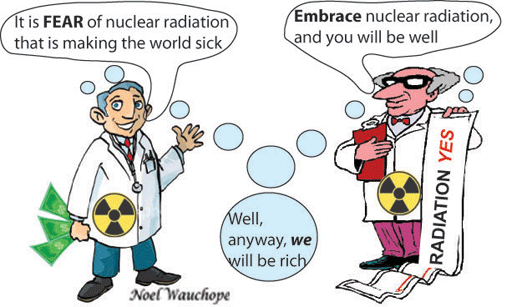 Industry leaders claim uranium mining held back by fear, Mining Australia 6 June, 2013 Vicky Validakis Addressing the fear of the uranium industry was the central theme of a uranium conference held in Adelaide last month, with industry leaders speaking out against campaigns that they say have choked the development of industry…… AUA chief executive Michael Angwin said the local industry has been politically choked by fear…… we should use that impetus to also reform the overweight regulation of and the approvals process for new uranium mines in Australia.”…..
“In short, we have entered the political end-game for uranium and any remnant political fears about the industry cannot be justified against the sector’s 40 year track record.”….
Greens nuclear policy spokesman Scott Ludlam said selling uranium to India would be ‘mistake’.
“I’m extremely concerned that Australian uranium will find itself one way or another fuelling a sub-continental arms race,” he said at the time……..http://www.miningaustralia.com.au/features/industry-leaders-claim-uranium-mining-held-back-by
From Flat Earth to Creation Science to Climate Denial to Wind Turbine Syndrome
The director of the Institute of Public Affairs’ deregulation unit, Alan Moran, will also address the rally on “the failed economics of  wind power”.
Serial ratbag, radio demagogue and leader of the rent-a-rage crowd, Alan Jones, will act as ring master at the circus.
 Wind power in the sights of climate change deniers the Australian Environment Foundation http://www.couriermail.com.au/news/opinion/wind-power-in-the-sights-of-climate-change-deniers-the-australian-environment-foundation/story-e6frerdf-1226651595470 by:Paul Syvret :The Courier-Mail May 28, 2013 DUANE Gish was an American biochemist, best known for his unshakeable belief in creationism over evolution.
When debating his detractors, he would seek to overwhelm them by spewing forth a torrent of pseudo-science, half truths and utter fancy rapidly shifting over a multitude of angles, leaving his opponents little hope of refuting the barrage of BS in any reasoned or logical fashion, and certainly not within the confines of a formal debate.
The technique has come to be known as the “Gish Gallop”, which Project Reason founder Sam Harris once described as “starting 10 fires in 10 minutes” and leaving your opponent no opportunity to douse every falsehood, no matter how brazen the untruth.
Another Made in America phenomenon in recent years has been astroturfing, where vested interests establish a (arm’s length) movement that is ostensibly independent or grassroots yet largely serves to further their own ends. This is particularly prevalent in areas of environmental debate such as climate science, and gun law reform.
A case in point here is the Australian Environment Foundation, which was spun out of the IPA back in 2005. Continue reading
No, Michael Angwin, uranium is NOT a “normal” resource like any other
 rather than being a normal Australian mineral export, uranium has all sorts of political and security ramifications, which Michael Angwin chooses to ignore.
Reader riposte: Normalisation of uranium http://www.lowyinterpreter.org/post/2013/05/27/Reader-riposte-Normalisation-of-uranium.aspx By Reader Riposte – 27 May 2013 Richard Broinowski writes:
Michael Angwin believes that the ‘normalisation’ of Australian uranium policy is almost complete, and that uranium should be dealt with like any other Australian resource. He misses the rather salient point that uranium exports can never be ‘normalised’ because unlike any other natural mineral except thorium, uranium makes nuclear weapons. Strict safeguards should attach to every shipment, and customers should be carefully vetted as to their motives in buying it. Continue reading
Busting the anti solar myths of the Energy Supply Association of Australia (ESAA)
 ESAA Attack On Solar Households ‘Riddled With Myths’ http://www.energymatters.com.au/index.php?main_page=news_article&article_id=3750 21 May 13 A discussion paper recently published by the Energy Supply Association of Australia (ESAA) has been shot down by industry commentators. Adding to the Clean Energy Council’s comment that Big Energy is ‘clutching at straws‘ in its attempts to demonise solar households; others have weighed in on the issue.
Business Spectator’s Tristan Edis has commentedthat following the ESAA’s logic; any household that implements any sort of energy efficiency strategy would be viewed in ESAA’s eyes as ‘avoiding network charges’ through lowering their electricity bill. This could include non-solar households installing LED lighting, insulation – or even turning off lights when not in a room.
Mr. Edis also points out solar is a bit player in network upgrade spending and it was the rise of the air-conditioner that was used by network businesses to justify billions of dollars of additional network infrastructure expenditure; some of which has been labeled as ‘gold-plating‘.
“The ESAA’s demonisation of solar is a bit like a guy that just ran over your dog with a semi-trailer truck, who points the finger at the bicycle following afterwards that clipped the dog’s tail before it died.”
The role of air-conditioning is also pointed out by RenewEconomy’s Giles Parkinson; who states using the ESAA’s own figures, the costs ‘avoided’ by solar households is just one eleventh of the cross-subsidy paid by households with no air conditioning for those who do – yet the ESAA has not recommended air-conditioned households be hit with higher fixed tariffs to pay for network extensions.
“What seems inevitable however is that the industry will one day soon need to change its business model or face the same decline as fixed priced telephony or printed photos. They are fast approaching their Kodak moment,” says Mr. Parkinson; who mentions the role home energy storage systems may play in the future if Big Energy continues treating solar households as second-class citizens.
The ESAA’s focus on costs and little mention of benefits solar households bring that will outweigh those costs seems to indicate Big Energy is still yet to grasp the reality that solar households play an important role in Australia’s affordable clean energy future – and that ignorance runs the risk of ultimately negatively impacting all Australian households.
Australian media silent on the dire state of the uranium industry. Media repeats the industry’s hype.
 the media hasn’t responded at all. In March 2013, Bureau of Resources and Energy Economics reduced its mid-term forecast for uranium revenue by nearly half, and the media was silent. The Australian Conservation Foundation released a detailed, factual report on April 26 exposing the uranium industry’s economic misinformation, and the media was silent.
In the mid-2000s, uranium was the ‘new black’ as The Bulletin put it and investors could take their pick in this “radioactive heaven”. The number of listed uranium juniors doubled, and doubled again … and again and again.
A company sent radioactive drill samples for assay and quickly became the most traded stock on the ASX (leading to a suspension of share trading). Residents of the small Pacific Island Niue were surprised to learn from an Australian company that they might be sitting on 10 per cent of the world’s uranium, and surprised again when the project was abandoned two months later − easy come, easy go. The uranium spot price increased ten-fold and more, peaking at $US138/lb in June 2007.
Michael Angwin, the Australian Uranium Association’s Executive Director, said in 2008 that Australia “has enough reserves to be to uranium what Saudi Arabia is to oil.” Only a pedant would note that Saudi oil generates 466 times as much revenue as Australian uranium (and that most of ‘our’ uranium revenue never comes anywhere near Australia because of the high level of foreign ownership).
Politicians from the major parties have been only too happy to regurgitate uranium industry propaganda – for example former SA politicians Mike Rann and Kevin Foley have made the comparison with Saudi oil.
The Australian Securities and Investments Commission could hold uranium miners and wannabes to account for peddling misinformation – but it doesn’t. Business journalists could hold the uranium industry to account − but they usually don’t.Claims that nuclear power growth in China, India and Russia will drive huge increases in uranium exports are routinely and uncritically regurgitated yet they don’t withstand the simplest calculations. For example it is routinely claimed that uranium sales to Russia will generate $1 billion annually − but Australia would need to supply entire Russian demand twice over to generate that amount of export revenue.
Milk and cream generate almost twice as much revenue as uranium − so where are the newspaper column-inches with pithy headlines about corporate ‘moovers and shakers’; where the ponderous weekend think-pieces about how the nation that once rode on a sheep’s back is now attached to a cow’s udder? Why isn’t milk the ‘new black’? Continue reading
May 6: antidote to uranium lobby’s lies about benefits to Aborigines
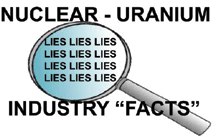 AUSTRALIA’S URANIUM EXPORT REVENUE IN PERSPECTIVE YELLOWCAKE FEVER Exposing the Uranium Industry’s Economic Myths , Australian Conservation Foundation“……..The Australian Uranium Association supports a profits-based, rather than production-linked, royalty system in the NT although such a system fails to provide a certain, secure and assured revenue platform for Indigenous communities. During the first 5 -10 years of a uranium mining operation, there is a high likelihood that little or no income would be generated under a profit-based royalty scheme, even though there would be direct environmental and social impacts from any such operations.. ” http://www.acfonline.org.au/sites/default/files/resources/ACF_Yellowcake_Fever.pdf
Now Tony Abbott is over- hyping Olympic Dam uranium mine expansion
 Tony Abbott vows the Coalition would give Olympic Dam a chance to succeed BRAD CROUCH :adelaidenow April 27, 2013 FEDERAL Opposition Leader Tony Abbott today vowed to create economic conditions to help the stalled Olympic Dam mine proceed after blaming the State and Federal governments for it being put it on hold by BHP Billiton.
However, Mineral Resources Minister Tom Koutsantonis accused Mr Abbott of “over-spruiking” by suggesting the Coalition could get Olympic Dam expanded, saying Mr Abbott would have to change international conditions.
Mr Abbott said he could not guarantee the project would proceed under the Coalition but said: “I can promise there will be no obstacles from government that will impede its progress.”
“I want to give the Olympic Dam expansion a chance,” Mr Abbott said. “It is not on hold because of the quality of the ore body, lack of dynamism in South Australia or a lack of work ethic, it is on hold essentially because State and Commonwealth Labor governments have not created a climate in which this kind of investment can go ahead.”He also repeated promises to dump the carbon and mining taxes, put the budget “back in the black” and restore border security in a speech heavy on hope but light on specifics, such as how to fund the changes.
Mr Koutsantonis responded, saying: “He needs to change business conditions internationally, not just in Australia – what will get Olympic Dam over the line is not conditions in Australia or South Australia, it is the price of copper and uranium and the development of new technology to reach one of the most difficult ore bodies in the world.
“Who is over-spruiking now?”…… http://www.theaustralian.com.au/news/tony-abbott-vows-the-coalition-would-give-olympic-dam-a-chance-to-succeed/story-e6frg6n6-1226630615659
The dirt on Australia’s uranium industry, as it holds its “Paydirt” conference
 Yellowcake Fever. Exposing the Uranium Industry’s Economic Myths Report in full at: http://www.acfonline.org.au/sites/default/files/resources/ACF_uranium_economics_Yellowcake_Fever.pdf by Dr Jim Green (FoEA) & Dave Sweeney (ACF), Australian Conservation Foundation, April 2013 (33 page PDF) Executive Summary: The Australian uranium industry involves serious and unresolved domestic and international security, environmental and inter-generational concerns and remains a contested and controversial sector that lacks a secure social license. This report examines the sectors small economic and employment contribution in relation to its significant risks and legacies and seeks to build the case for an independent cost-benefit analysis and a comprehensive and transparent assessment of the impacts and implications of Australia’s uranium trade.
Uranium is a small contributor to Australian export revenue and employment. From 2002 to 2011, uranium sales averaged $627 million annually and accounted for only 0.29% of all national export revenue. In the 2011/12 financial year, uranium revenue of $607 million was 4.4 times lower than Australia’s 20th biggest export earner, 8.7 times lower than Australia’s 10th biggest export earner and 103 times lower than the biggest earner, iron ore. Small industrial sectors can play an important economic role but the unique properties and risks of uranium mining relative to any benefits means its role requires particular scrutiny.
The industry’s contribution to employment is also underwhelming. The World Nuclear Association estimates 1,760 jobs in Australia’s uranium industry. That is the highest of all estimates yet it represents just 0.015% of all jobs in Australia. The industry’s primary promotional body, the Australian Uranium Association (AUA), claims its members are “significant employers of First Australians”
however the sector only provides around one job for every three thousand Indigenous Australians.
In the mid-2000s, there was a speculative uranium price bubble. Since this bubble burst the uranium industry has been battered by a falling commodity price, rising production costs, the Global Financial Crisis (and associated credit crisis), the failure of the global nuclear power ‘renaissance’ to materialise, the failure to develop new mines and serious production shortfalls……. Continue reading
Jim Green exposes Geoff Russell, Australia’s newest nuclear conspiracy spinner

Russell and science are at odds on the question of the cancer risks associated with low-level radiation exposure. The 2006 report of the Committee on the Biological Effects of Ionising Radiation (BEIR) of the US National Academy of Sciences states that “the risk of cancer proceeds in a linear fashion at lower doses without a threshold and … the smallest dose has the potential to cause a small increase in risk to humans.”
What nuclear conspiracy theories? Climate Spectator Jim Green 23 April 13
Conspiracy theories conjured up by nuclear advocates are mostly harmless fun. But not when they involve trivialising the suffering of victims of the Fukushima nuclear disaster.
Political demagogue Lyndon LaRouche is the most colourful of the conspiracy theorists. Here’s his take on the anti-nuclear movement:
“This utterly depraved, dionysian cult-formation found its echoed, more violent expression in late 1980s Germany, where the anti-nuclear, fascist rioting reached near to the level of outright civil war …”
Australia’s Leslie Kemeny (think Lord Monckton) agrees: “Radical green activism and global terrorism can form dangerous, even deadly, alliances. The ‘coercive utopianism’ of radical greens, their avid desire for media publicity and their hidden socio-political agendas can produce societal outcomes that are sometimes violent and ugly.”
Kemeny believes the anti-nuclear movement is “supported by immense funds from affluent right-wing interests” and is also tied to the “political left”. Go figure. With such a grab-bag of extreme − and extremely contradictory − views, Kemeny might be considered a good candidate for Bob Katter’s political party … but he’s already joined Fred Nile’s.
A recent convert to nuclear conspiracy theories is Adelaide-based nuclear advocate Geoff Russell.
Russell has no time for the euphemisms of ‘dionysian cult-formation’ or ‘coercive utopianism’. He gets straight to the point: nuclear critics are responsible for all of the death and suffering resulting from the Fukushima nuclear disaster and much else besides. Ouch.
How does he arrive at those conclusions?…….. Continue reading
Commonwealth Bank obfuscation on funding nuclear weapons manufacturers featured on F-U-Tube

 http://www.abc.net.au/tv/thecheckout/futube/default.htm?WwEQu-_c3Bw
It’s simple to upload your complaints, just make a video, put it on YouTube, go to FU tube and put in the link and your contents.
Nancy Atkin | Executive Officer
Medical Association for Prevention of War,
Australia www.mapw.org.au
The Lowy Institute’s nuclear revivalist meeting
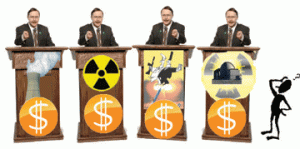 Two years after Fukushima: a tale of two symposiums, Noel Wauchope, Independent Australia 12 April 13, “….. Symposium Two: The Lowy Institute’s nuclear revivalist meeting
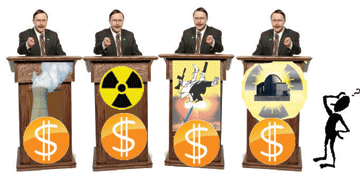
SOON AFTER Caldicott New York symposium, the Lowy Institute for International Policy put on a panel of its own to discuss nuclear power. Apparently, anything the USA can do, Australia can do better! Or perhaps worse.
The Lowy Institute’s March panel discussion topic was Asia’s nuclear future after Fukushima. The role of nuclear industry. The panel was composed of leaders of Australia’s nuclear industry — Michael Angwin, Chief Executive Officer, Australian Uranium Association, John Borshoff, CEO of Paladin Energy and Dr Selena Ng, Regional Director South East Asia and Oceanea, AREVA. The chairman was John Carlson, former Director General, Australian Safeguards and Non-Proliferation Office
I like enthusiasm and optimism, however, this panel went beyond enthusiasm. I tell you — it was like a religious revival meeting. And I think that’s just what it was. Just like a pastor exhorting a tiny remnant congregation, there seemed to be a more than a hint of underlying desperation, combined with that touching faith in the Second Coming.
There was unanimous agreement on the inevitable booming future of nuclear power, especially in South East Asia. Yet, between the lines, we heard from Michael Angwin that
“…public perceptions of nuclear industry are now less confident than before in the short term, but my expectation is that will return to confidence in the long term.”
He also admitted:
“We know that people take a negative view of nuclear industry — see it as remote from them, and as the creature of big government and big industry”…….
However, faith in the nuclear industry’s future being a given, all speakers moved on to three secondary themes, which were:
- the problem of the media
- the need for public education
- the safety of the nuclear industry…..
All said worthy things about the need for safety measures in nuclear reactors. But not a word about the cost issues involved. At the New York symposium, David Lochbaum estimated these as likely to be simply unaffordable.
Indeed, John Borshoff turned Fukusima into a positive:
“The Fukushima emergency demonstrates the resilience of nuclear technology”
The panel completely ignored the crisis in nuclear in the USA, UK and Japan over nuclear waste disposal — which has paralysed the nuclear industry there.
They demonstrated their lack of interest in, and probably complete ignorance of, radiation issues. Radiation was mentioned just once, by John Borshoff, speaking about Fukushima:
“No deaths have occurred. There were some releases of radioactivity. It is doubtful if this will be [sic] cause harm in the medium or long term.”
Angwin stressed that
“…what we know from studies done at Chernobyl — the major risk of psychological health risk [sic], caused by fear of radiation.”
The cause of the Fukushima meltdowns was ascribed to the tsunami — yet latest evidence indicates that in fact the earthquake was the initial cause, not the tsunami. But, anyway, nobody seemed particularly interested in Fukushima any more, as long as the media continues to put it on the back burner — that seems to be all that matters…. What struck me most of all was that the other speakers [except Dr Ng] showed no interest whatever in examining the after effects of Fukushima and questions about its future. I found their statements on this both puzzling and worrying…….
Dr Ng spoke of the nuclear industry’s previous attitude of complacency – now shaken up by Fukushima – towards more vigilance about safety.
Listening to Australia’s nuclear “expert panel”, it seems that complacency still reigns. What a contrast to the professionally organised, meticulously referenced symposium in New York! http://www.independentaustralia.net/2013/environment/two-years-after-fukushima-a-tale-of-two-symposiums/
Analysing the motives of anti wind power campaigners
5. Nuclear Advocates
These people may or may not believe that global warming is real, but they are invested heavily in nuclear energy as the answer to almost all of our energy needs and often have a poor understanding of grid management. They tend to be smart but ignore human dynamics of problems, and have a blind spot about the effort and time required to develop nuclear engineers and maintenance workers. Their greatest challenge to renewables campaigns is that their arguments are leveraged by others who are just against wind energy…….
If countered, the average nuclear advocate will drag out more and more factoids about nuclear energy’s value and wind power’s lack of value. They will likely reference amateur and professional studies which look good until you dig in and realize the biases. Generally a time suck, so avoid digging into their arguments in too much depth…… . Talk past them to those listening.
Examples: Willem Post (USA), James Lovelock (sadly, UK), Barry Brook (Australia)
 NOT JUST NIMBYS: UNDERSTANDING ANTI-WIND ENERGYCAMPAIGNERS Barnard on Wind, by Mike Barnard 8 April 13, NIMBY is a nice crisp acronym, but it is completely inadequate as a categorization of the various people fighting against broader penetration of renewables in energy grids world wide and their motivations…..
1. NIMBY – Not In My Back Yard Continue reading
Australian Uranium Association knows that uranium mining for Queensland is not a goer
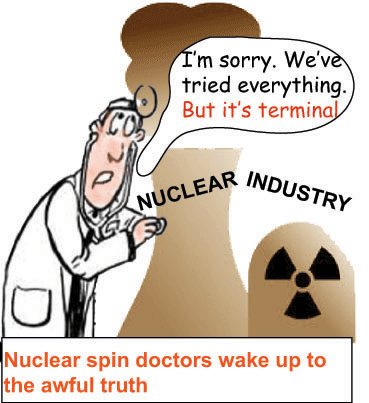 The Australian Uranium Association’s website recently published an article “Uranium Mining – an opportunity for Queensland” talking up, as one would expect, the potential for uranium mining n Queensland.
And yet, and yet –
included in this article –
“The uranium industry in Queensland will likely be a moderately sized industry developed over a lengthy period, with the potential to make a valuable contribution to the diversity and prospects of the Queensland economy and to employment, including regional employment.
Queensland’s uranium endowment is about 2% of Australia’s endowment. Queensland contains upwards of 40,000 tonnes of reasonably assured and inferred resources.”
Jim Green of Friends of the Earth, points out – That amount of uranium would fetch less than $4 billion at the current rate for Oz U sales (around $87,000 / t U3O8), and contrasts sharply with the AUA’s claim last year that the known uranium resource in Queensland, using projected prices and exchange rates, is valued at around $18 billion. The $4 billion figure is of little relevance since the uranium price is too low for any mines to be viable in Queensland
Thorium nuclear reactors – Australia’s nuclear lobby’s latest con job
the mere idea of these lovely little reactors needing plutonium or enriched uranium suggests the wisdom of Australia having uranium enrichment, nuclear power and nuclear reprocessing . And heck, why not a radioactive waste facility – to take in plutonium and other radioactive waste from other countries – as the start of another lucrative industry? Use it to facilitate the thorium reactors that will be dotted around the country. To seriously consider thorium nuclear energy in Australia means a foot in the door for the whole nuclear fuel cycle here.
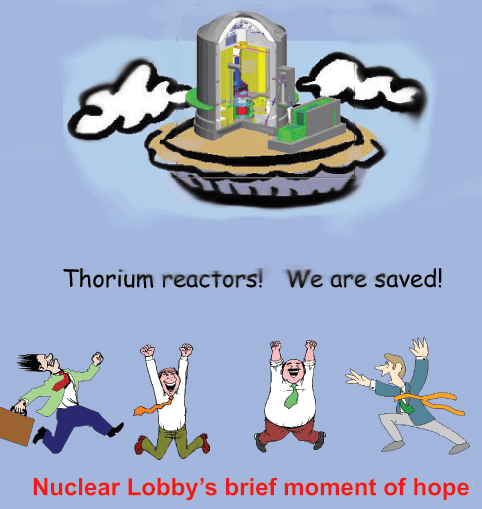
Don’t believe thorium nuclear reactor hype, Independent Austtralia 28 Jan 13, Thorium reactors are the latest big thing in nuclear spin. Noel Wauchope says: don’t believe the hype.
The explanation becomes clearer, when you consider that the nuclear industry has sunk $billions into new (uranium or plutonium fuelled) large nuclear technologies, as well as into lobbying governments and media. Would big corporations like Hitachi, EDF Westinghouse, Toshiba, Areva, Rosatom be willing, or indeed able, to withdraw from the giant international operations that they already have underway? Would they, could they, tolerate a mass uptake of the new thorium nuclear reactors — which is what would be needed, to make the thorium market economical?…. Continue reading
Old-time crusader for the nuclear lobby, Leslie Kemeny rides again
Noel Wauchope, 11 Jan 13 Make no mistake – the nuclear lobby is on the job in a big way in Australia. Leading the charge is that energetic nuclear promotion group in South Australia – Barry Brook and Ben Heard.
But they’re not alone – with many vested interests pushing the pro nuke message. For example, The Age’s recent song of praise for thorium reactors.
 Now the Canberra Times gives that tireless old warrior Leslie Kemeny yet another platform for his pro nuke spruik.
Since the 1970s Kemeny has had well over 200 opinion pieces published.
I find it quite remarkable that Kemeny gets such coverage, as he trots out pretty much the same old arguments, and denigrates opponents in the same old ways. Kemeny consistently ignores the unsolved problem of nuclear wastes, the environmental effects of radiation, the huge costs of security and of protecting the wastes for hundreds, thousands of years.
In the Canberra Times, Kemeny quotes as evidence this statement by Sir Chris Llewellyn Smith – ”The nuclear accident in Japan has not killed anybody. There may be one or two people who will die of cancer, but we are talking of very small numbers, if any.”
Here Kemeny brings in that tired old argument style from the tobacco and asbestos lobbies – . cigarettes never killed anybody – maybe one or two will get lung cancer.
Kemeny goes on at length about global warming and the necessity for nuclear power. But to make nuclear power effective against global warming it will have to produce 16,000 Mtoe of energy per year – a 25-fold increase on its current level. Today the world has 440 operational nuclear reactors, so 25 times more means 11,000 reactors. To have these in 35 years means building, on average, about one a day. Or in an exponential growth scenario, the world would need to sustain an annual increase of 8% per year in the number of operational nuclear reactors for 35 years. Many of these would need to be located in failed states and countries currently beset by internal wars
As usual – Kemeny dismisses renewable energy policies of Kevin Rudd as “merely symbolic gestures and political spin”. He has no answer to the number of scholarly studies that show that Australia could power all its electricity by renewable means.
Twenty-five years ago, Kemeny had already published dozens and dozens of newspaper articles, and they were subjected to critical analysis by Professor Brian Martin, who was then teaching in the science faculty at the Australian National University.
Martin concluded his analysis: “In quite a number of ways, Kemeny in his public advocacy of nuclear power does not fit the image of the objective, trustworthy expert: he addresses only some of the issues and seldom replies to anti-nuclear arguments; he presents large amounts of irrelevant material; he is subject to inaccuracy, and on occasion fails to acknowledge his mistakes; he continually denigrates opponents; he speaks from a position representing a potential conflict of interest; and his expertise is mostly irrelevant to the issues, or of doubtful quality.”
Nothing changes, for this retired nuclear warrior. I guess it would be like expecting a Cardinal of the Catholic Church to consider the possibility of there being no God.
1 This month

of the week – Australians for War Powers Reform (AWPR)
To see nuclear-related stories in greater depth and intensity
 Antinuclear