From Ziggy Switkowski – a new load of nuclear codswallop

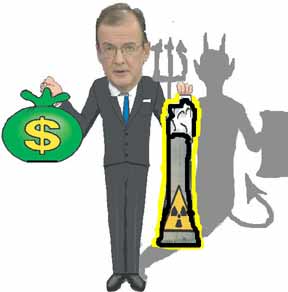 Unfortunately, I no longer have access to the full text of this. Somewhere in this article, Switkowski says that small nuclear power is
  more economic than large. Interesting that he doesn’t compare it to the cost of other energy forms – solar and wind.
He’s promoting the idea that Australia’s no-nuclear laws should be changed, – perhaps to a compromise – meaning that large nuclear reactors would still be prohibited, but small ones permitted. Good luck with that and all the perambulations involved! Only recently, Switkowski warned on risk of catastrophic failure, if Australia adopts nuclear energy. He sorta covers his back well!
Switkowski preaches for nuclear energy invoking Bill Gates, Elon Musk, AFR, Aaron Patrick, Senior Correspondent
Prominent businessman Ziggy Switkowksi urged Australians to take inspiration from two of the leading entrepreneurs of the twenty-first century, Bill Gates and Elon Musk, and support the development of a nuclear power industry.
Dr Switkowksi, a nuclear physicist, NBN board member and former Telstra chief executive, said nuclear power could become a major contributor to the electricity grid by 2040 if legalisation of the power source began now…..
With three separate inquiries into nuclear power under way, Dr Switkowksi has emerged as a leading advocate for the next generation of nuclear power plants known as small modular reactors, which supporters hope can avoid the huge costs and perceived safety risks of large-scale nuclear plants.
Dr Switkowksi, who has also briefed two separate federal parliamentary committees, told the NSW inquiry that half of NSW’s power supply could eventually be provided by nuclear power, which would compliment renewable sources after the state’s coal stations shut down. ……
Nuclear power is illegal under NSW and federal law. The NSW parliament is considering a proposed law by One Nation MP Mark Latham that would permit a nuclear industry to be developed in the state.
Many environmentalists strongly oppose the plan, including the Nature Conservation Council of NSW and the Australian Conservation Foundation, which also gave evidence to the committee on Monday.
Nuclear advocates, including Dr Switkowksi, have acknowledged that the big impediments to a nuclear industry are the cost of building reactors and the challenge of getting a wary public to support them.
Exploring for uranium is allowed in NSW, but mining is not. One first step towards developing a nuclear industry in the state could be to allow the uranium-mining industry to expand from South Australia across the border to NSW.
Officials from the Department of Planning, Industry and Environment told the inquiry that mining uranium wasn’t very different to any other mineral and that two mineral sands mines near Broken Hill bury uranium that is an inadvertent byproduct of their operations……
Inquiry chairman Taylor Martin, a Liberal MP, suggested that the federal and state laws be changed to prohibit existing forms of nuclear power technology but allow small modular reactors.
The compromise idea is designed to allow Labor MPs to support the development of a nuclear industry without appearing to give in to the demands of the mining industry, which has launched a below-the-radar campaign to legalise nuclear power.
Inquiry chairman Taylor Martin, a Liberal MP, suggested that the federal and state laws be changed to prohibit existing forms of nuclear power technology but allow small modular reactors.
The compromise idea is designed to allow Labor MPs to support the development of a nuclear industry without appearing to give in to the demands of the mining industry, which has launched a below-the-radar campaign to legalise nuclear power. …..https://www.afr.com/companies/energy/switkowski-preaches-for-nuclear-energy-invoking-bill-gates-elon-musk-20191111-p539j1
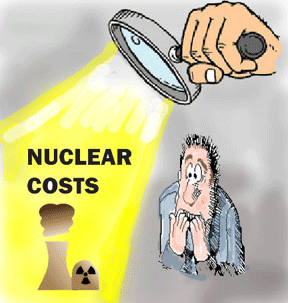
Nuclear option costs ‘six times more’ than renewables
By Marion Rae, May 18 2024, https://www.canberratimes.com.au/story/8632826/nuclear-option-costs-six-times-more-than-renewables/—
The high upfront costs and burden on consumers of adding nuclear to Australia’s energy mix have been confirmed in an independent review.
Building nuclear reactors would cost six times more than wind and solar power firmed up with batteries, according to the independent report released on Saturday by the Clean Energy Council.
“We support a clear-eyed view of the costs and time required to decarbonise Australia and right now, nuclear simply doesn’t stack up,” the industry body’s chief executive Kane Thornton said.
Taxpayers needed to understand the decades of costs if they were forced to foot the bill for building a nuclear industry from scratch, Mr Thornton warned.
The analysis prepared by construction and engineering experts Egis also found nuclear energy had poor economic viability in a grid dominated by renewable energy.
Renewable energy will provide 82 per cent of the national electricity market under current targets for 2030, which is at least a decade before any nuclear could theoretically be operational.
Further, nuclear power stations are not designed to ramp up and down to align with renewable energy generation.
Adding to the cost challenges, Australia has no nuclear energy industry because it is prohibited under commonwealth and state laws, which would all need to be changed.
Mr Thornton said the analysis confirmed that building nuclear power stations instead of renewables would cause power prices to “explode”.
The analysis was based on the CSIRO’s GenCost 2023-24 consultation draft, the Mineral Council of Australia’s Small Modular Reactors study and the industry benchmark Lazard Levelized Cost of Energy Report.
These reports did not include waste management and decommissioning of a nuclear plant in cost calculations, which meant the true cost could be even higher, Mr Thornton said.
National Party threatens to tear up wind and solar contracts as nuclear misinformation swings polls
The campaign against renewables and for nuclear has been based around misinformation, both on the cost and plans of renewables and transmission, and on the cost of nuclear power plants, which have stalled around the world because of soaring costs, huge delays, and because no small modular reactor has yet been licensed in the western world.
That campaign has been amplified by right wing “think tanks” and ginger groups, and the Murdoch media, and largely reported uncritically in other mainstream media. It appears to be having some traction.
Giles Parkinson, Apr 23, 2024, https://reneweconomy.com.au/nationals-threaten-to-tear-up-wind-and-solar-contracts-as-nuclear-misinformation-swings-polls/
National leader David Littleproud has threatened to tear up contracts for wind and solar farm developments, in the latest broadside against large scale renewable energy from the federal Coalition.
The remarks – reported by the Newcastle Herald and later verified by Renew Economy via a transcript – were made in a press conference last week in Newcastle, when Littleproud was campaigning against offshore wind projects and outlining the Coalition’s hope that it could build a nuclear power plant in the upper Hunter Valley.
The Coalition has vowed to stop the roll out of large scale renewables, and keep coal fired power plants open in the hope that they can build nuclear power plants – recognised around the world as the most expensive power technology on the planet – some time in the late 2030s and 2040s.
No one in the energy industry, nor large energy consumers for that matter, are the slightest bit interested in nuclear because of its huge costs and time it takes to build, and because it would set back Australia’s short term emissions reductions.
But the comments about contracts are the most sinister to date, and reflect the determination of a party leader who just a few years ago described renewables and storage as a “good thing”, including the huge wind and solar projects that are being built in his own electorate, to destroy the renewables industry.
The Newcastle Herald asked Littleproud if an incoming Coalition government would consider “tearing up contracts” for renewable infrastructure contracts that had already been signed.
“Well exactly,” Littleproud said. “We will look at where the existing government took contracts and at what stage they are at.
“There are some projects on land that we will have to accept, but we are not going to just let these things happen. If that means we have to pay out part of the contracts, and we will definitely look at that. You’re not going to sit here and say today that we’re stopping it and then not following through.”
The federal government this week announced the biggest ever auction of wind and solar in Australia, seeking six gigawatts of new capacity that will be underwritten by contracts written by the commonwealth.
This will see at least 2.2 GW of new wind and solar sourced in NSW, at least 300 MW in South Australia, already the country’s leader with a 75 per cent share of wind and solar in its grid, and multiple gigawatts spread over other states.
However, the Coalition’s nuclear plans are already facing delays, having pulled back from a previous commitment to deliver the nuclear policy before the May 14 federal budget. It now only promises to release the policy before the next election, with Littleproud telling Sky News on Monday that the party “would not be bullied” into an early release.
One of the many problems with its nuclear strategy will be finding sites for the proposed power plants. The Coalition has targeted the upper Hunter as one site, but AGL, the owner of the site that houses the now closed Liddell and the still operating Bayswater coal generators, has said it is not interested because it is focused on renewables and storage.
Littlepround, however, said there are other sites in the area that could be used, although the Newcastle Herald said he declined to nominate those sites. Inevitably, they would require new infrastructure.
The campaign against renewables and for nuclear has been based around misinformation, both on the cost and plans of renewables and transmission, and on the cost of nuclear power plants, which have stalled around the world because of soaring costs, huge delays, and because no small modular reactor has yet been licensed in the western world.
That campaign has been amplified by right wing “think tanks” and ginger groups, and the Murdoch media, and largely reported uncritically in other mainstream media. It appears to be having some traction.
According to an Essential Media poll published in The Guardian on Tuesday, 40 per cent of respondents ranked renewables as the most expensive form of electricity, 36 per cent said nuclear, and 24 per cent said fossil fuels.
The poll also found a majority (52%) of voters supported developing nuclear power for the generation of electricity, up two points since October 2023, and 31% opposed it, down two points.
The most recent GenCost report prepared by the CSIRO and the Australian Energy Market Operator, like other international studies, says that nuclear power costs nearly three times more than renewables, even counting the cost of storage and transmissions.
However, the Coalition – with the support of right wind media and agitators – have led relentless campaigns against the CSIRO and AEMO, even though their nuclear costs were based on the only SMR technology that has gotten close to construction, before being pulled because it was too expensive.
The push to stop renewables comes despite reports from both AEMO and the Australian Energy Regulator that highlight how the growth in renewables has lowered wholesale power prices, despite extreme weather events and the impact of the unexpected outage of Victoria’s biggest coal generator.
The only state where wholesale electricity prices actually rose were in Queensland, which has the heaviest dependency on coal, although the state has just passed laws that lock in its 75 per cent emissions reduction target and its 80 per cent renewables target by 2030.
South Australia has already reached a 75 per cent wind and solar generation share in its grid, and aims to reach “net” 100 per cent by the end of 2027. It enjoyed the biggest fall in wholesale spot prices in the last quarter, which state minister Tom Koutsantonis said should be passed on to consumers.
“SA’s prices fell the most of any state, and the black coal dependent states of Queensland and NSW had the highest prices,” Koutsantonis said.
“These proven falls in wholesale prices are encouraging signs that we are on the right track. South Australia’s high proportion of renewables – which exceeded 75 per cent of generation in 2023 – is key to South Australian prices being far lower than the black-coal states of NSW and Queensland.
“Retail prices must fall because wholesale costs to retailers are going down.”
Dutton’s plan to save Australia with nuclear comes undone when you look between the brushstrokes
Graham Readfearn, https://www.theguardian.com/environment/2024/apr/24/duttons-plan-to-save-australia-with-nuclear-comes-undone-when-you-look-between-the-brushstrokes
The dystopian picture of renewables painted by the opposition leader is full of inconsistencies, partial truths and misinformation
The Coalition leader, Peter Dutton, has been trying to paint a picture of what life in Australia will be like if it tries to power itself mostly with renewable energy and without his technology of choice: nuclear.
Towering turbines offshore will hurt whales, dolphins and the fishing industry, factories will be forced to stop working because there’s not enough electricity and the landscape will be scoured by enough new transmission cables to stretch around the entire Australian coastline.
At the same time – so his story goes – only his option to go nuclear will save Australia from falling behind the rest of the world.
But Dutton’s dystopian image, with more brushstrokes added in an interview on the ABC’s flagship Insiders program, is a picture of inconsistencies, partial truths and misinformation.
Let’s have a look between the brushstrokes.
Is it a credible plan?
The Coalition has said it wants to put nuclear reactors at the sites of coal-fired power plants, but hasn’t said where, how big the reactors will be, when it wants them built or given an estimate on cost.
The Coalition has previously said it would give more details on its plan in time for its response to the Albanese government’s budget next month, but Dutton is now saying it will come “in due course”.
Despite this, Dutton claimed in his interview with the ABC’s David Speers that: “I believe that we’re the only party with a credible pathway to net zero by 2050.”
OK then.
28,000 kilometres?
Dutton claimed the government’s plans relied on “28,000km of poles and wires being erected” to connect renewables to the grid – a distance he said was “equal to the whole coastline of Australia”.
That’s a catchy soundbite, but where does this number come from?
According to the Australian Energy Market Operator’s most recent plan for the development of Australia’s east-coast electricity market, the most likely scenarios to decarbonise the electricity grid would require about 10,000km of additional transmission lines to be built between now and 2050.
What about the extra 18,000km? That figure comes in an estimate of what would be needed if Australia chose to become a major exporter of clean hydrogen as well as decarbonising the grid.
So about two-thirds of Dutton’s 28,000km is not so much related to decarbonising the electricity grid, but rather to an export industry that may or may not happen, to an as-yet-unknown extent.
Turning off power?
Dutton claimed: “At the moment, we’re telling businesses who have huge order books to turn down their activity in an afternoon shift because the lights go out on that grid. Now, no other developed country is saying that.”
Dutton is suggesting that businesses are being routinely forced to reduce their demand for power. This is simply not true.
Dr Dylan McConnell, an energy systems analyst at UNSW, says it’s very rare for businesses to be told by the market operator they are going to have their power interrupted.
Such “load shedding” has happened only five times in the last 15 years, he said, typically occurs in extreme conditions such as storms or coal plants going offline, and only a subset of consumers are affected.
There are two main formal voluntary schemes in place across the National Electricity Market (everywhere except NT and WA) where major electricity consumers can offer to reduce their demand for electricity at certain times, but businesses are compensated for being part of those schemes. Nobody is telling any of these businesses that they have to do anything.
Neither is it true that no other country is engaging in some sort of process where demand for electricity can be managed.
Is Australia really the only developed country engaged in what’s known as demand response? No.
The International Energy Agency lists the UK, US, France, Japan and South Korea as having large markets already in place to help their electricity systems balance the supply of electricity with demand.
McConnell said: “Demand response is becoming a common and important part of modern electricity systems. This includes countries like France and the US, which have both nuclear and demand response programs.”
G20 and nuclear
Dutton said Australia was the only G20 nation “not signed up to nuclear or currently using it”.
According to information from the World Nuclear Association, Australia is one of five G20 nations with no operating nuclear power plants, alongside Indonesia, Italy, Saudi Arabia, Germany and Turkey.
But aside from Italy, Germany and Australia, the rest do have some plans to develop nuclear power in the future. Dutton’s phrase “currently using it” allows him to capture countries like Italy that import electricity from nuclear nations.
But what’s also important to note is that among the G20 countries (actually 19 countries) nuclear is mostly playing a marginal role. Nuclear provides more than 5% of its electricity in only seven of those 19 countries.
Social licence?
Projects would need a “social licence” to go ahead, Dutton said, but there was opposition in western New South Wales where “productive” land was being sold for renewables projects.
This is a variation of a previous Dutton speech, where he lamented a supposed “carpeting of Australia’s prime agricultural land with solar and windfarms”.
The renewable energy industry’s Clean Energy Council has countered claims like this, saying even if all the country’s coal plants were replaced with solar farms, the amount of space needed would be about 0.027% of agricultural land.
The Coalition leader has been to the Hunter coast more than once where offshore windfarms are being planned, telling reporters they were a “travesty” and that they would put whales, dolphins and the fishing and tourism industries “at risk”. He told Speers the turbines would rise “260 metres out of the water”.
Dutton told the ABC that Australia should be mindful of the environmental consequences of windfarms – which is, of course, true – but his past statements have sounded more like cheerleading for voices opposed to the plans than an attempt to understand the scale and legitimacy of the concerns, some of which are being stoked by misinformation.
Dutton can’t know what impact offshore windfarms will have on fishing or tourism, but is willing in any case to use labels like “travesty”.
No decisions on site for nuclear waste dump as spin doctor sought

By Karen Barlow – Canberra Times, April 15 2024 – https://www.canberratimes.com.au/story/8591149/the-nuclear-waste-dump-quest-is-waiting-for-its-spin-doctor/
The Albanese government has confirmed it is searching for, and is yet to settle on, sites for both low- and intermediate-level radioactive waste as it seeks a highly skilled PR team to manage likely “high” outrage over possible sites.
In a series of answers to questions from potential suppliers on the federal tender site, the Department of Industry, Science and Resources also advised that there may be a need to reference the future AUKUS nuclear-powered submarine program through the contract, but only in educational materials.
It comes after a major government approach to market was uncovered by The Canberra Times, revealing that a nuclear-specific crisis management team is being sought – six months after the government abandoned plans for a low-level waste dump near Kimba in remote South Australia – to bid for a two-year contract to help manage public discussion of nuclear waste in Australia.
The move has been criticised by the Greens and the Coalition as spin and “steamrolling regional communities,” but the new approach to market appears to address other criticism that nuclear waste dumps are announced and later argued as needed.
Asked by an unnamed potential supplier if the department has a list of sites or communities looking to be engaged over the two-year contract period, the answer is “no.”
“This information is unknown,” the answer reads. “The Australian Radioactive Waste Agency has started work on alternative proposals for the storage and disposal of the commonwealth’s civilian low-level and intermediate-level radioactive waste.”
So that is not just the low-level option that was being sought, but abandoned, at Napandee at the top of the Eyre Peninsula.
The answers to the questions of potential suppliers, which have to bid for the contract, offer greater insight to the process for delivering a secure storage facility, but are limited to current timelines.
“No site has been been shortlisted or selected and no benefits package has been determined, this will be a matter for government,” the department stated.
The department also advises that there are not currently “specific deliverables” that the department is looking to complete. It is also advised there may be some stakeholder engagement activities that involve a role in decision making.
The original approach to market, posted March 26, asked for assistance with “nuclear-specific” public relations and professional communications services during the early stages of a new radioactive waste management approach being identified. This is described as the first three to five years of a 100-year project.
It would involve engagement with “impacted communities”, “stringent preparation for technical and challenging questions” from the public, and support for the public’s “comprehensive understanding of the nation’s radioactive waste inventory, origins and need for safe management.”
“This is a highly specialised high-outrage area and there are times of uplift where urgent assistance is required and additional industry-relevant specialist support is needed, including upskilling staff to undertake these activities in a high outrage environment,” the document reads.
It comes as Australia, as well as AUKUS partners the United States and the United Kingdom, continues to be without a long-term solution for radioactive waste disposal.
Asked by a potential supplier if there is consideration for SSN-AUKUS (nuclear powered submarines under the AUKUS trilateral pact) or visiting nuclear-powered naval capabilities, the department said maybe, but not much.
“While information about Australia’s nuclear-powered submarine program may form a small part of ARWA educational materials, the supplier will not be required to undertake engagement work focused on AUKUS or nuclear-powered submarines,” it responded.
There appears to be no willingness to waive the requirement for baseline security clearance, even for a world-leading technical subject matter expert.
Asked if a waiver was possible for the duties which include assisting in preparing “factually correct nuclear technology and radioactive waste engagement materials”, the department responded, “Any specified personnel must be able to obtain and hold a Baseline Security Clearance.”
Asked further if people with equivalent security clearances from other five eyes nations (the US, UK, New Zealand and Canada) are able to work on the project, the response was the same: “Any specified personnel must be able to obtain and hold a Baseline Security Clearance.”
Alinta Energy boss likens nuclear pursuit to chasing ‘unicorns in the garden’
ABC News, By energy reporter Daniel Mercer 10 Apr 24
- In short: Alinta Energy boss Jeff Dimery has thrown cold water on plans to replace coal-fired plants with nuclear power.
- Mr Dimery said Alinta considering nuclear power “wouldn’t be a great use of our time” given Australia’s ban on the technology.
- What’s next: The Alinta head said consumers would ultimately pay more for power courtesy of Australia’s energy transition.
The head of one of Australia’s biggest energy companies has thrown doubt on federal opposition plans to replace coal plants with nuclear power, likening them to “looking for unicorns in the garden”.
Jeff Dimery, the boss of Alinta Energy, said while it was theoretically possible Australia could build some nuclear power in the next 10 to 15 years, legislated bans on the technology meant this would be all but impossible.
The comments came during a National Press Club address in which Mr Dimery also said consumers should brace for higher energy costs as the country transitioned away from fossil fuels……………………………………………………………………………………………………………………………………………………
Mr Dimery said it was imperative that governments and industry build the back-up or “firming” capacity that would be needed to fill in the blanks when small- and large-scale green sources were not enough.
Nuclear ‘unicorns in the garden’
Among these, he said, were “long-duration storage” facilities such as the Snowy 2.0 pumped hydro project, gas plants that could ramp up and down quickly, and consumers empowered with solar and batteries.
“Without pumped hydro, or in Victoria’s case, if the generation profile isn’t uplifted by offshore wind to something closer to base-load, then coal and rooftop solar will be locked into a negative feedback loop,” he said.
Asked about the part nuclear power could play in Australia’s energy mix, Mr Dimery was indifferent.
The question of whether Australia should build nuclear power plants looms as a key battle at the next federal election, with the Coalition set to formally announce its policy in favour of the technology.
Quoting his age as 55, Mr Dimery suggested he would be retired well before any nuclear power plant could come online.
He noted nuclear power was banned in Australia and overturning any such ban would be a “lengthy process”.
“And then there’s a lengthy process to go through the development and construction, in which time I’ll be retired,” he said.
“You could imagine our shareholder and our board wouldn’t be too impressed if the management team was sitting around contemplating building power stations that are not legal.
“It wouldn’t be a great use of our time.
“Based on what I’ve read, could you, if you started now, have nuclear in the market by 2035, 2038?
“The answer would be yes.
“But, again, no one is starting now because the legislation isn’t conducive to us even exploring that.
“So … it’s kind of like looking for unicorns in the garden.”
Mr Dimery questioned how relevant the technology was for the pressing task of replacing Australia’s ageing fleet of coal-fired power plants.
Many coal generators, including the Loy Yang B plant owned and operated by Alinta in Victoria, are due to retire in the next 10 to 15 years. https://www.abc.net.au/news/2024-04-10/alinta-boss-likens-nuclear-pursuit-to-chasing-unicorns/103683252
TODAY. Australia is EVER so grateful to the global nuclear lobby!
First of all, we Australians LOVE spending money! Not on health, education, preserving our unique biodiversity, certainly not on shelter for our growing homeless.
With our relatively small population, we are still delighted to cough up nearly $400billion to buy a second-hand American nuclear submarine and to buy all the USA and UK nuclear submarine wastes that these dear friends vouchsafe to dump on us.
And, it was interesting to read today, that the UK has spurned paying $millions to Rolls Royce as the maker for its proposed fleet of small modular nuclear reactors.
No problem to the nuclear lobby. Rolls Royce now plans to flog them off to Australia instead – Opposition leader Peter Dutton has pledged, if elected, to deliver Rolls Royce small modular reactors into the grid by the mid-2030s.
Any old or useless stuff that the nuclear industry has to get rid of – no probs – Australia will buy it!
Jim Green demolishes Rolls Royce’s claims about so-called “small” and “cheap” nuclear reactors for Australia.

Nuclear Fuel Cycle Watch Australia, Jim Green 7 Apr 24
According to reports in The Australian, Rolls-Royce claims it could build a 470-megawatt reactor in Australia for A$3.5-5 billion. That equates to A$7.4-10.6 billion / gigawatt (GW). For comparison, the cost for the two EPR reactors under construction at Hinkley Point, the only reactor construction project in the UK, is A$27.8 / GW.
So Rolls-Royce claims its cost-per-GW will be just 27-38% of the cost of Hinkley Point, for a reactor type that it has never built and doesn’t have a licence to build, anywhere in the world. Clearly Rolls-Royce’s cost claims need to be treated with scepticism.
Rolls-Royce claims it could build a reactor in Australia in just four years (once licensing and a myriad of other issues were sorted). Let’s compare that speculation with real world experience:
* Hinkley Point was supposed to be a seven-year construction project. That has blown out to 12-13 years with further slippage likely.
* The one EPR under construction project in France was meant to be completed in five years but it remains incomplete after 17 years.
* The one EPR recently completed in Finland was meant to be a four-year construction project but ultimately took 17 years to complete.
* The two AP1000 reactors in the US were meant to be completed in three years, but ultimately took 10 and 11 years to complete.
Rolls-Royce’s 470-MW design is being marketed as a small modular reactor (SMR) even though it falls well outside the <300 MW definition of SMRs. Only two SMR plants are said to be operating anywhere in the world (though there’s nothing modular about either of them). Russia’s floating ‘SMR’ was supposed to be a three-year construction project but that blew out to 12 years (and costs increased six-fold). China’s ‘SMR’ was supposed to be a four-year construction project but that blew out to nine years (and costs increased three-fold).
Clearly Rolls-Royce’s claim that it could build a reactor in just four years needs to be treated with scepticism.
A hard job for the Australian government to find credible spruikers for a nuclear waste dump
Nobody wants a nuclear waste dump, By The Canberra Times, April 2 2024, https://www.canberratimes.com.au/story/8576489/nuclear-waste-disposal-woes-in-australia/
One would think, given the Australian continent is second only to Antarctica in terms of low population density, it would be easier to develop a nuclear waste dump here than almost anywhere else.

COMMENT. Why on Earth would Australia want a nuclear waste dump? Just because it has space?
Unfortunately, due in large part to a series of hubristic decisions by former governments, that is not the case.
It is now more than two decades since plans for a nuclear waste facility at Woomera had to be abandoned. A subsequent proposal to site a national storage facility at Muckaty Station in the Northern Territory fell over 10 years later.
Then, after more than seven years of research and planning, the former Coalition government’s push to use farmland near Kimba in South Australia was derailed last July and August after traditional owners took their case to the Federal Court and won.
The court set the 2021 site declaration aside on the grounds that not only had the traditional owners not been consulted, they had been deliberately excluded from the consultation process.
According to Ian Lowe, emeritus professor of environment and science at Griffith University, the process had been doomed from the start by the government’s heavy-handed approach.
“The ‘decide and defend’ model where a government decides to put radioactive waste somewhere and then attempts to defend it against the community hasn’t worked anywhere,” he said.
Opposition to the proposal, which left Kimba bitterly divided, was fuelled by revelations that even though it had been billed as a “low level” nuclear waste dump, once up and running Kimba would be used to “temporarily” store intermediate-grade material until a suitable “permanent” disposal site could be found.
While millions of Australians have benefited from radioactive medical isotypes created at the former HIFAR reactor and its replacement, the Opal reactor, at Lucas Heights nobody wants the leftover waste in their backyard. And that’s perfectly understandable.
Unfortunately the temporary storage facility at Lucas Heights, which holds some of the 5000 cubic metres of waste Australia has accumulated at about 100 locations over more than six decades, is reportedly running out of space. It apparently won’t be able to accept some classes of material as early as 2027.
COMMENT. Confusion here between the “low level” medical wastes, mainly with short half-lives of radioactivity, stored at various locations across Australia, and the “higher level” long-lasting wastes resulting from the nuclear reactor itself.
Plenty of space at Lucas Heights for continued storage of these more dangerous reactor wastes.
This has put the Albanese government on the spot. As a result it has opted to go on the front foot in terms of damage control by seeking expressions of interest for a public relations team able to manage the “high outrage” national conversation about nuclear waste disposal.
The multi-million dollar question, given Kimba had been costed at $300 million, is what process will be followed in selecting the next site. Will Resources Minister Madeleine King revisit the six sites originally shortlisted almost a decade ago? Or will fresh expressions of interest from interested landowners be sought?
And, most importantly, what consultation process does the government intend to follow? Will it repeat the “decide and defend” mistakes of past governments or will it listen to the experts including Professor Lowe who urge the highest possible level of community engagement?
Given, as he has said, that under the AUKUS agreement Australia is to manage high-level waste from the future nuclear submarine fleet this is going to be a very hard sell. Australia has come a long way since the 1950s when the Menzies government, admittedly at the height of the Cold War, gave Britain carte blanche to test its nuclear weapons in the outback.
Whoever wins the “high outrage” PR tender is going to have a big job ahead of them.
On nuclear, Coalition prefers the optimism of misleading, decade-old, unverified claims
The Coalition is a fan of quoting the Australian Nuclear Science and Technology Organisation’s optimism on nuclear timelines compared to the CSIRO. But do the numbers add up?
JOHN QUIGGIN, MAR 22, 2024, https://johnquigginblog.substack.com/p/on-nuclear-coalition-prefers-the?utm_source=post-email-title&publication_id=806934&post_id=142847313&utm_campaign=email-post-title&isFreemail=true&r=1ise1&triedRedirect=true&utm_medium=email
To the extent that most Australians have heard of the Australian Nuclear Science and Technology Organisation (ANSTO), we know it as a supplier of radio-isotopes for use in medicine and as the operator of a small research reactor at Lucas Heights in the suburbs of Sydney.
So, it may have come as a surprise to hear shadow energy minister Ted O’Brien cite ANSTO as the source for an estimate that a small modular reactor (SMR) could be constructed in three to five years, and a large reactor in eight to 12 years.

Appearing on the ABC’s 7:30 report in mid-March, O’Brien stated “that is the advice from ANSTO. That is the advice of the Albanese government’s nuclear agency”. In view of the fact that widely publicised advice from an extensive study undertaken by CSIRO yields much less optimistic conclusions, that seems like a surprising claim.
But O’Brien is correct. ANSTO is indeed the government agency officially advising on nuclear technology, including nuclear power.
Section 5 of the ANSTO Act mandates the organisation provide advice on aspects of and the application and use of nuclear science and nuclear technology. ANSTO provides such advice to government, parliaments, ministers, departments and agencies, inquiries and investigations, members of the public, and international, multilateral and bilateral partners — in pursuit of the national interest.
In a submission to the Senate standing committee on environment and the communications inquiry into the environment and other legislation amendment (Removing Nuclear Energy Prohibitions) Bill 2022, ANSTO stated that SMRs “have the potential to reduce build costs using a variety of strategies, including reducing plant build times from six to eight years for large reactors to two and a half to four years for SMRs via the use of series-production methods“.
These numbers are even more optimistic than those cited by Ted O’Brien. But terms like “potential” can do a lot of work in claims of this kind. Nuclear fusion, for example, has the potential to meet all the energy needs of the planet, but it won’t do so any time soon.
A natural response from an interested member of the public would be to visit the ANSTO website to get more detailed information on the assessment of nuclear technology. This leads us to a webpage titled “What are small modular reactors and what makes them different?”, which leads with the claim “the USA is expected to have its first SMR operating by 2026” and includes the timeframe of three to five years for construction.
A note hastily added in the last week states: “Please note that this content was current at the time of publishing (July 2020), and the projected construction time of SMRs (three to five years) is referenced from a University of Leeds research paper. In November 2023, NuScale [the subject of the 2026 claim] announced it was discontinuing its SMR project in Idaho.”
Even in 2020, this research was out of date. The NuScale project, originally projected to be delivering power in 2023, had already pushed its target past 2026 by then. But given that the project has been abandoned, there’s no need to look too closely at this.
The University of Leeds paper is more interesting. It turns out to be a literature survey covering the period 2004-19. The three- to five-year estimate for the construction time for SMRs is taken from a non-peer-reviewed 2016 report by consulting firm Ernst and Young (which worked with one of the authors on the University of Leeds study). The information used to compile the report is even older, going back to 2014 or earlier. To put it bluntly, this is worthless.
Rather than complying with its legal obligation to keep abreast of nuclear power technology and inform the public of its findings, ANSTO has relied on decade-old, unverified claims, made by a consulting company. This sloppy treatment of an issue that should be a central focus of ANSTO analysis contrasts sharply with the careful assessment undertaken by CSIRO.
I went to ANSTO for a response but didn’t hear back.
Ted O’Brien can scarcely be blamed for taking ANSTO’s word on these matters, particularly when its claims are so convenient to his case. But ANSTO needs to retract its misleading claims as soon as possible. That would give the LNP an opportunity, if it wants it, to drop its nuclear policy and put the blame on an Albanese government agency for misleading it.
One final irony. The ban on nuclear power, which is now the subject of so much controversy, was introduced by the Howard government to secure the passage of legislation that allowed ANSTO to build a new research reactor at Lucas Heights. In light of this history, maybe ANSTO’s remit should be revised to steer the organisation clear of nuclear power once and for all.
Zion Lights and her lying, climate-denying mentor Michael Shellenberger

The only nuclear industry that is booming is nuclear decommissioning ‒ the World Nuclear Association anticipates US$111 billion (A$145 billion) worth of decommissioning projects to 2035. [written in 2017 – but nothing’s changed]
Zion Lights was sucked into nuclear advocacy by self-confessed liar, climate denier and MAGA lunatic Michael Shellenberger.
JIM GREEN, https://jimkgreen1.substack.com/p/zion-lights-and-her-lying-climate 21 Mar 24
The latest substack missive from British nuclear power advocate Zion Lights reflects the cognitive dissonance that all nuclear advocates must be experiencing. Mixed in with anger and nuttiness. In the UK, if the two Hinkley Point C reactors are ever completed (the only two reactors under construction in the UK), the cost will be at least A$44 billion per reactor and it will be at least 25 years between the announcement that new reactors will be built and grid-connection of the reactors. If we allow for the usual pattern of overruns and delays, the figures are likely to be A$50+ billion per reactor, and 30 years between announcement and grid-connection.
Since the last reactor startup in the UK (Sizewell B in 1995), 24 reactors have been permanently shut-down. If the Hinkley Point C reactors begin operating in the early- to mid-30s, it will be 35‒40 years between reactors startups in the UK, during which time there will have been 32 permanent reactor-shutdowns. Only Sizewell B is likely to be operating.
If not for the military connections (which Lights studiously ignores), Hinkley Point C would likely be abandoned and plans for more reactors would also be abandoned.
Lights was sucked into nuclear advocacy by self-confessed liar, climate denier and MAGA lunatic Michael Shellenberger. You can read more about Lights here, Shellenberger here, and you can read Extinction Rebellion’s important statement about both of them here. The Extinction Rebellion statement concludes: “Zion Lights, Michael Shellenberger, the Breakthrough Institute and their associated deniers and delayers are intentionally spreading doubt about the severity of the [climate] crisis and the action needed to respond to it.”
Presumably Lights did at least some research beforehand but still thought it a good idea to work for self-confessed liar and climate denier Shellenberger.
I mention Shellenberger because Lights’ latest substack post is nothing more than a cut-and-paste of lies and distortions that Shellenberger has been peddling for decades. Lights might at least have the decency to come up with her own lies and distortions.
That being the case, I won’t trawl through Lights’ post here. Instead, here is an article about Shellenberger which covers the same ground. “Nuclear power will solve global warming and feed all the world’s children.”
Is there a future for ‘pro-nuclear environmentalism’?
Jim Green, 30 Oct 2017, RenewEconomy. For a longer version of this article please click here.
Michael Shellenberger is visiting Australia this week. He has been a prominent environmentalist (of sorts) since he co-authored the 2004 essay, The Death of Environmentalism. These days, as the President of the California-based ‘Environmental Progress’ lobby group, he is stridently pro-nuclear, hostile towards renewable energy and hostile towards the environment movement.
Shellenberger is visiting to speak at the International Mining and Resources Conference in Melbourne. His visit was promoted by Graham Lloyd in The Australian in September. Shellenberger is “one of the world’s leading new-generation environmental thinkers” according to The Australian, and if the newspaper is any guide he is here to promote his message that wind and solar have failed, that they are doubling the cost of electricity, and that “all existing renewable technologies do is make the electricity system chaotic and provide greenwash for fossil fuels.”
Trawling through Environmental Progress literature, one of their recurring themes is the falsehood that “every time nuclear plants close they are replaced almost entirely by fossil fuels”. South Korea, for example, plans to reduce reliance on coal and nuclear under recently-elected President Moon Jae-in, and to boost reliance on gas and renewables. But Shellenberger and Environmental Progress ignore those plans and concoct their own scare-story in which coal and gas replace nuclear power, electricity prices soar, thousands die from increased air pollution, and greenhouse emissions increase.
Fake scientists and radiation quackery
Environmental Progress’ UK director John Lindberg is described as an “expert on radiation” on the lobby group’s website. In fact, he has no scientific qualifications. Likewise, a South Korean article falsely claims that Shellenberger is a scientist and that article is reposted, without correction, on the Environmental Progress website.
Shellenberger says that at a recent talk in Berlin: “Many Germans simply could not believe how few people died and will die from the Chernobyl accident (under 200) and that nobody died or will die from the meltdowns at Fukushima. How could it be that everything we were told is not only wrong, but often the opposite of the truth?”
There’s a simple reason that Germans didn’t believe Shellenberger’s claims about Chernobyl and Fukushima ‒ they are false.
Continue readingRefuting Peter Dutton’s recycled nuclear contamination
By Michelle Pini | 14 March 2024, https://independentaustralia.net/politics/politics-display/peter-duttons-recycled-nuclear-contamination,1841
Nuclear power is one hell of a way to boil water.
~ Albert Einstein
MANY AUSTRALIANS are accustomed to the Coalition’s deliberate lies and obfuscation on most issues, which is why they are no longer in power, at least for now.
The lengths to which the “friendly” media’s ongoing Right-wing public relations campaign is prepared to go in support of such obvious nonsensical blathering is, however, alarming.
In recent days, Opposition Leader Peter Dutton has been running free all over the countryside spruiking nuclear energy. Who cares? We hear you say. Well, apparently, every mainstream media platform, since they are not only publicising his outright lies, but in many cases, promoting them as credible policy.
Despite the current political state of play in Australia, in which the Labor Party has been elected federally and in every mainland state and territory, plus his “popularity” continuing to dwindle towards complete extinction, Peter Dutton appears mired to the outdated policies of generations past.
After yet another election loss, this time in the Dunkley by-election, Dutton has sprung up on every media platform, keeping the climate denial fires burning and rambling about nuclear as if it were a new idea, rather than the stale, worn-out dance with annihilation that it actually is.
According to Pete, nuclear is:
“…The only credible pathway we have to our international commitments to net zero by 2050.”
And proving yet again that facts never stood in the way of a good PR campaign, the Fourth Estate say: Facts be damned! We already had to (mostly) give up on climate denial so let’s give nuclear a good old-fashioned, vested-interests-funded, radioactive show of support!
This week, the usual suspects flooded our screens, radio waves and Google searches with headlines such as:
‘Nuclear will help Australia reduce emissions by 2050’ ~ Sky News
‘Shadow Energy Minister Ted O’Brien floats 10-year timeframe to get nuclear up and running in Australia’ ~ The West Australian
And the winner of the Most Creative Bullshit Headline award, once again, goes to that much-awarded Murdoch rag…
‘There’s no rational reason for maintaining the nuclear ban’ ~ The Australian
We may currently have a Labor Government, which has canned nuclear energy, but the media barons’ collective power to keep greenhouse gases spewing, corporate donors’ pockets overflowing and public minds contaminated should not be underestimated.
And so in answer to the Coalition and its nuclear-friendly media disciples, here are a few, by no means exhaustive, rational reasons to maintain Australia’s nuclear ban, keep nuclear energy firmly out of the energy mix and out of everyone’s backyard.
LIE #1: IT’S CHEAP
Even in the U.S., which boasts the biggest nuclear energy sector in the world, nuclear power costs have escalated. As recently as mid-2021, despite huge government subsidies, the target price for nuclear power increased by 53 per cent, to almost twice the price of utility-scale solar PV systems with battery storage.
Climate Change and Energy Minister Chris Bowen has estimated that the Coalition’s nuclear plan will carry a price tag of $387 billion – 20 times more than Labor’s current renewables investment fund – and would not be delivered before 2040. Nuclear energy, then, does not appear to be cost-effective.
LIE #2: IT’S QUICK
We (thankfully) don’t have nuclear reactors in Australia and thus there is no established nuclear reactor industry in place.
Nonetheless, back in 2023, Dutton first claimed:
“New nuclear technologies can be plugged into existing grids and work immediately.”
In their more recent ramblings, Dutton, his current Shadow Energy Minister Ted O’Brien and the unnamed “experts” to whom they refer claim Australia can have large nuclear reactors – magically – ready to go within ten years.
In the U.S., which boasts the largest nuclear industry in the world, it currently takes 19 years to achieve this.
According to Ted, the UAE produced a nuclear reactor from go to whoa in “ten years”. In reality, however, even with the UAE being an autocracy with a command economy, where communities are not permitted to object to reactors in their backyards, it actually took 13 years.
But what’s three extra years and a few more glow-in-the-dark communities between climate-denying friends?
Nuclear energy does not appear to be fast, either.
LIE #3: IT’S CLEAN AND GREEN
Even before we get to the radioactive leaks part of why nuclear power isn’t “clean”, there is the small matter of the Coalition’s stated need to maintain coal-fired power stations until all these nuclear reactors magically emerge, which even in Dutton’s plan, requires at least ten more years, but which based on the U.S. experience, we know will take more like 20.
This is, of course, at the heart of the Coalition’s nuclear push. This is the reason the Coalition gets energetic (pardon the pun) about most things. Nuclear energy generation takes a long time to develop at great cost, which would prohibit further investment in renewables and necessitate the extension of coal-fired power stations, currently set to be phased out by 2040.
According to its own Nuclear Regulatory Commission, in 2017, out of 61 operating – and self-regulating – nuclear power plant sites in the United States, 43 have had leaks or spills involving groundwater contamination above the EPA’s safe drinking water threshold.
So, nuclear energy does not appear to be “clean” or “green” or, as we indicate below, safe.
LIE #4: IT’S SAFE
There is still no answer to nuclear waste disposal or the toxic bi-products of nuclear storage. There is no safe way of “recycling” it.
There is still no answer to the “management” of radioactive leaks.
Nuclear waste, depending on its elemental composition, takes between 290 to a few hundred billion years to decompose. High-level nuclear waste consisting of spent fuel from nuclear reactors – of the type Peter Dutton and co would like to build – accounts for most radioactive waste and needs to be safely stored for up to a million years.
And then there are unplanned natural disasters, such as Fukushima.
As Dave Sweeney recently explained on IA, despite its established technical sophistication and even after 13 years, the best Japan can do with Fukushima’s ongoing radioactive waste is ‘pump and dump’ it into our oceans.
LIE #5: THE LIGHTS WILL GO OUT
According to self-styled nuclear energy mastermind Ted O’Brien, if we “prematurely” shut down coal-fired energy generators and implement nuclear reactors right now, “the lights will go out”.
Unsurprisingly, there is no factual basis for this claim. However, the lights may well go out if we do as his party is suggesting since natural disasters affecting nuclear reactors on a scale like Fukushima cannot be anticipated or prevented. Then there’s the “slight” problem of global warming, which, if we continue to accelerate by burning fossil fuels, will, indeed, result in all the lights going out.
To sum up – rationally – we repeat, nuclear power isn’t safe, it’s not cost-effective and it certainly ain’t green, unless you count glowing in the dark.
Billionaire mining magnate Andrew Forrest lampoons Coalition’s nuclear push as ‘bulldust’

A push by the Coalition to develop nuclear energy generation in Australia has been slammed by mining magnate Andrew “Twiggy” Forrest.
Jack Quail, February 26, 2024 – https://www.news.com.au/technology/environment/climate-change/billionaire-mining-magnate-andrew-forrest-lampoons-coalitions-nuclear-push-as-bulldust/news-story/048f9a45dbb31091a4ed313479922288
Billionaire mining magnate Andrew “Twiggy” Forrest has rubbished a push to develop a local nuclear energy industry, even as fresh polling showed growing voter support for the proposal.
Dr Forrest took a veiled swipe at the opposition over its soon-to-be-unveiled nuclear energy policy, saying its push was “misinformed”, would act to sustain coal and gas powered generation for another two decades, and ultimately would lead to higher power prices.
“If we swallow this new lie that we should stop the rollout of green energy and that nuclear energy will be our fairy godmother, we will be worse off again,” the chair of mining and green energy firm Fortescue told the National Press Club on Monday.
“These misinformed, unscientific, uneconomic, plucked-out-of-thin-air, bulldust nuclear policies of politicians – masquerading as leaders – help no one.”
Dr Forrest, who in 2023 ranked as Australia’s third richest person, made his billions mining iron ore but in more recent years has aggressively pursued investments in renewable energy technologies and fuel, particularly green hydrogen.
Claiming he was “agnostic” on nuclear energy, Dr Forrest said the economics of such a proposal did not stack up when compared with renewable generation.
“Who is going to pay their nuclear electricity bill when it is 4-5 times more expensive than the renewables next door, even ignoring the decade plus it takes to develop nuclear?” Dr Forrest asked.
“With wind and solar, you’re up and running, lowering electricity costs and eliminating pollution within one to three years.”
The Coalition is yet to release a costed nuclear energy policy but has committed to do so ahead of the next federal election, due by May 2025 at the latest.
A Newspoll released by The Australian on Monday revealed 55 per cent of Australians support the replacement of coal-fired power plants with small modular nuclear reactors.
However, such technology is still in development, is yet to prove commercially viable, and would not be deliverable until the mid-2030s at the earliest.
The Albanese government has similarly disparaged the Coalition’s nuclear push, and has retained a ban on nuclear power and banking.
In his address, Dr Forrest also advocated for a “renewable energy-led economy”, recommending the government establish a “climate trigger” to assess the impact of carbon pollution in granting environmental approvals, rapidly expand firmed renewable energy, and introduce a levy on carbon emissions extracted from mining or imported into Australia.
“If we make the right decisions today, it will deliver the most profound and enduring economic growth opportunities ever seen, particularly in regional Australia,” he said.
Calling out the diesel fuel rebate, which costs the federal budget billions annually, Dr Forrest said the subsidy towards mining and fossil fuel companies should be scrapped.
“Massive taxpayer-funded financial support for huge mining companies, including Fortescue, to use imported diesel is indefensible,” Dr Forrest said.
Last week, Fortescue – of which Dr Forrest and his family own a 33 per cent stake – reported a 41 per cent increase in its first-half profit, beating analysts’ estimates and bucking a growing trend of sliding profitability among other major mining firms.
Nuclear Power Advocates Accused of Spreading Misinformation
https://www.miragenews.com/nuclear-power-advocates-accused-of-spreading-1180602/ 24 Feb 24,
Opponents of cleaner, cheaper renewables have used a particularly spectacular contortion of logic to claim the recent catastrophic storms in Victoria and the resulting power outages as evidence of the folly of acting on climate change and boosting renewables.
Predictably, nuclear energy advocates seized on the Victorian events and temporary power outage to re-energise their campaign for Australia to start a nuclear energy industry.
Let’s be clear upfront. Nuclear is not being pushed as a genuine alternative to renewables. It’s being used as a distraction and a delaying tactic.
It’s also quite the feat to assert that had it been nuclear rather than renewables, a coal-fired electricity generator in Victoria wouldn’t have shut itself down as protection against surges from storm-damaged transmission. It’s an even greater leap essentially to assert that a grid under the LNP would involve no distribution – given the vast majority of outages were caused by extreme damage to the distribution network – including from the half a million lightning strikes in eight hours.
Will nuclear powered electricity be transmitted by osmosis? By Bluetooth? By a vibe? Whether your energy comes from coal, nuclear, gas or renewables, if poles and wires are down, electricity won’t get where it needs to go.
The pro-nuclear argument is two-pronged. That the world has realised the perils of renewables and is experiencing a nuclear renaissance, and Australia is missing out.
And that nuclear is much cheaper than renewable energy, once upgrading and expanding the grid is factored in.
Both these arguments collapse faster than a tree in a lightning strike when exposed to the facts.
Global investment in renewable energy sources constitutes three quarters of all power generation investment.
Take just solar, for example. Last year, the world installed 440GW of renewable capacity. This is more than the world’s entire existing nuclear capacity built up through decades of investment. By early 2025, renewable energy will surpass coal as the planet’s largest source of energy, while coal, gas and nuclear will all shrink their market share.
Nuclear and coal combined, however, account for only 16 per cent of new global power investment. In 2005, electricity companies in the US pledged to build more than 30 reactors. Only four ever commenced construction. Two were abandoned due to massive cost and time delays.
The alleged boom in Small Modular Reactors is also a mirage. China and Russia are the only two countries to have installed them. The US has now abandoned its “flagship” commercial-scale pilot SMR (promised back in 2008), wearing 70 per cent cost blowouts without having started construction on a single reactor.
We know the Russian SMRs have extraordinarily low load factors and that nuclear waste from the SMR process is disproportionate to their output. The Chinese data is more opaque, but given SMRs generate about 300MW (compared to a coal-fired power station at 2000MW), we have no reason to believe there is anything approaching a serious contribution to China’s energy demand from their two units.
My shadow minister predicted that last year’s Dubai COP would be remembered as the “nuclear COP”. Not so much. Twenty three countries have pledged to triple nuclear energy by 2050, while 124 countries pledged to triple renewable energy investment within the next six years, before the nuclear dream even gets started.
Then there is cost. Contrary to myth, GenCost does include the cost of transmission and storage, and the CSIRO-AEMO GenCost conclusions about the chasm between nuclear and renewables costs could not be clearer.
But if you don’t want to accept eminent and independent practitioners at those organisations, then you can have a look at the Bulletin of Atomic Scientists, which estimates it will cost $US15 trillion to triple nuclear capacity. Or University College London, which recently found that “new nuclear capacity is only cost effective if ambitious cost and construction times are assumed”.
And if you don’t like University College London’s research, ask the merchant bank Lazard, which shows levelised cost of nuclear to be four times higher than utilityscale solar and wind.
Then look at how many nuclear projects are falling over because of cost and time overruns. The UK’s Hinkley C nuclear plant was promised to be “cooking Christmas turkeys by 2017”. It’s yet to warm a single drumstick, with latest costings at more than $86bn. Who in Australia does the opposition energy spokesman expect will be footing those kind of bills?
Like many things in the climate debate, the push for nuclear power has taken on a singular importance in the culture wars. It’s striking that a party that once prided itself on economic rationalism could embrace a frolic so spectacularly uneconomic. This is the triumph of culture wars over climate pragmatism in the alternative government.
The LNP has been promising to reveal the details of its long nuclear fairytales soon. It can’t come soon enough.
No plan for nuclear power in Australia will survive contact with reality. The Australian people deserve more than hot air to power their homes and businesses.
This opinion piece was first published in the Australian on Saturday, 24 February 2024.
Peace Pod: an aural adventure in anti-militarist activism. With teacher resources

Get Your Armies Off Our Bodies is the inaugural series of Peace Pod.
Wage Peace is beyond proud to present our latest creation: a podcast featuring the stories, passions and insights of some of our most treasured collaborators. Tune in, subscribe and immerse yourself in the journeys of artists, activists and academics campaigning for peace on the stolen lands of this continent and further afield.
Peace Pod features some of the foremost academics, journalists and activists for peace on this continent, such as Michelle Fahey, Mujib Abid, Izzy Brown, Ned Hargreaves and Aunty Sue Coleman Haseldine, along with international luminaries such as Anthony Feinstein and Matthew Hoh.
Dr Miriam Torzillo has put together high quality teaching resources for students in years 10-12. Dr Torzillo has included a guide to curriculum placement:
- Curriculum Areas
- General Capabilities
- Australian Cross Curriculum Priorities and
- Key Concepts
The Teachers Resource sits with the Podcast here, in one easily accessible page
There is a huge resurgence in interest in the role of the weapons companies because of the genocide in Palestine. Young people are trying to make sense of militarism and peace. The podcast introduces militarism against First Nations people in both Australia and West Papua and the way STEM is being used by weapons corporations to reproduce militarism in the classroom.
1 This month

of the week – Australians for War Powers Reform (AWPR)
To see nuclear-related stories in greater depth and intensity
 Antinuclear