Submission by Australian rare earths company Lynas rejected by Malaysia on safety concerns
 Miti on Lynas plant: Safety is top priority, Free Malaysia Today Stephanie Sta Maria, | November 8, 2011, Lynas will not be allowed to operate its plant until it meets IAEA conditions. KUALA LUMPUR: The Ministry of International Trade and Industry (Miti) today clarified its stand on the controversial rare earth plant in Gebeng, saying the government would not allow Lynas Corporation Ltd to operate if it flouted the rules.
Miti secretary general Rebecca Sta Maria said safety was the ministry’s top priority.
Last week the government revealed that it had rejected Lynas’ submissions on safety requirements for the RM1.5 billion rare earth refinery. This followed reports by the Australian Associated Press that Lynas was expected to commence operations late this year and begin commercially supplying radiation-risk rare earth by next year. Continue reading
A mixed “blessing” for Australia in radiation cleanup breakthrough
 It is comforting that Queensland’s Professor Zhu tells us that radiation cleanup will still be needed, even if the world abandons nuclear power. In that case, it is good that Australia might provide other parts of the world with a technology to help in this.
On the other hand, Professor Zhu tells us “we have the technology to do the cleaning up for the world.” This is far from comforting, especially when we realise that the Australian Nuclear Science and Technology Organisation is involved. ANSTO is well known as a promoter of nuclear technology. There are some in Australia, like John White, Ron Walker and Robert Champion de Crespigny, and others – who would just love to make several $billion out of importing foreign nuclear wastes into Australia.
This new “radiation absorbent’ might be just the technology they want? – Christina Macpherson
 Breakthrough to help clean up contaminated water, Brisbane Time s, 2 Nov 11 Brisbane scientists have helped developed an intelligent absorbent, which they hope will solve the problem of how to clean up water contaminated with radioactive waste. The research team believes the technology will benefit industries rangingfrom mining to medicine, plus assist in clean-up efforts after nuclear disasters.
One gram of the absorbent can “effectively purify at least one tonne of polluted water”, according to Professor Huai-Yong Zhu from Queensland University of Technology Chemistry. The absorbent, developed in collaboration with the Australian Nuclear Science and Technology Organisation and Pennsylvania State University in the United States, effectively locks in the dangerous radioactive material and extracts it from the water.
It uses titanate nanofibre and nanotube technology. Professor Zhu said the technology would run the contaminated water through fine nanotubes and fibres, trapping radioactive ions.
The absorbent could then be safely disposed without the risk of leakage, even if the material became wet. “This saves large amounts of dangerous water needing to be stored somewhere and also prevents the risk of contaminated products leaking into the soil,” Professor Zhu said……Even if we decide that nuclear energy is not the way we want to go, we will still need to clean-up what’s been produced so far and store it safely.
“Australia is one of the largest producers of titania that are the raw materials used for fabricating the absorbents of titanate nanofibres and nanotubes. Now with the knowledge to produce the absorbents, we have the technology to do the cleaning up for the world.”
Christina Macpherson It all might be rather fanciful anyway. If you go to “comments” on this item, you will see a comment from a radiation expert, who throws cold water on the whole proposal, anyway, and wonders why, if it’s so great “why this breakthrough is not on the front page of the IAEA “?
Friends of the Earth call for transparency on proposed Whyalla In Situ Leach uranium trial
14 oct 11, Public submissions for Samphire Uranium’s application for an In Situ Leach trial mine closed yesterday. Better known as the Mullaquana project, the proposed trial site is located 20km from Whyalla, 3.6km from the Upper Spencer Gulf. Samphire Uranium is wholly owned by UraniumSA, a new entrant in the uranium mining industry.
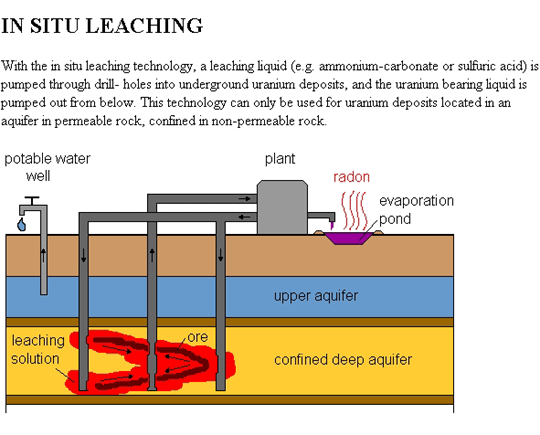
In Situ Leach mines pump highly acidic substances into an aquifer to mobilise uranium. The liquid is then pumped out of the aquifer and processed to remove the uranium. The waste liquid is then pumped back into the aquifer.
Two grassroots environmental groups, Friends of the Earth Adelaide and West Mallee Protection, stated in their joint submission that:
“Given the number of risks involved with the proposed Mullaquana trial, particularly the routine contamination of groundwater by heavy metals and radioactive materials associated with In Situ Leach mining…we strongly recommend that this proposal is rejected.”
“Using…questionable, fuzzy logic, attempts are made to argue that low soil productivity and the low quality of groundwater negate potential risks and minimise the impact of contamination…this is essentially saying that it’s okay to pollute soil and groundwater with radioactive materials and heavy metals simply because it is of a lower quality.”
Friends of the Earth Adelaide and West Mallee Protection are calling on PIRSA to reject the application.
“The In Situ Leach method of mining has left numerous sites in Eastern Europe heavily contaminated. In South Australia, there have been over 20 spills at the Beverley In Situ Leach mine. In January 2002 a pipe burst, releasing 62, 000 litres of contaminated water. UraniumSA claim that they have recruited heavily from within this sector,” said Nectaria Calan, of Friends of the Earth Adelaide.
No commercial acid leach mine in the USA has ever been given environmental approval because of the high risk of contamination.
“Given UraniumSA’s public commitment to transparency, we are calling on the company to commit to making publically available the In Situ data that will be obtained during the trial, and the models they use to obtain it,” stated Ms Calan.
Australia’s Lynas company’s problems – share price, governance, Malaysia protests
It is interesting to keep an eye on Australia’ s Lynas corporation. For one thing, that devious old propaganda merchant, Ziggy Switkowski is on Lynas’ board of directors. Wherever Ziggy is, spin will abound.
For another thing, Lynas is dedicated to make a mint out of rare earths processing in Malaysia. (nothing wrong with the idea – after, making a mint is the correct mission for a corporation – its only responsibility, unfortunately).
Still – the rare earths processing is fraught with danger. Both USA and China had to stop rare earths operations, due to very bad environmental pollution, though both are now starting again. China got away with it for ages, by putting the rare earths processing in a rural area, with an unsophisticated indigenous population. But Malaysia – that is a different situation, with a much more educated and urban population, who don’t want the pollution risk.
And now – Lynas has a couple of other problems – its plummeting share price, and some questions about corporate governance
Corporate governance guidelines outlined by the Australian Securities Exchange recommend that ”the role of chair and chief should not be exercised by the same individual”.
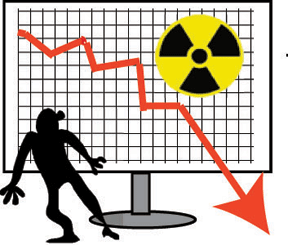 Lynas is expected to report a full-year loss before tax of $57 million today as it ramps up towards production. Shares in Lynas closed 17.5¢, or 14 per cent, lower at $1.105 – more than 60 per cent off its April high of $2.70.
Lynas shareholders demand that chairman steps down, The Age, Philip Wen, September 23, 2011 A VOCAL group of retail shareholders in rare-earths miner Lynas is seeking to remove mining entrepreneur Nick Curtis as chairman, citing concerns over ”risks to corporate governance”. Continue reading
Information about rare earths, but not much about their dangerous wastes
ABC radio conducted this informative interview on rare earths – but rather light-pedalled their radioactive waste problem – C.M.
The role of rare earths in your day to day life, ABC Radio 17 Sept 11, Philip Clark“……..the nature of some of these deposits is that they are quite complex. In essence they… as you mentioned, there’s lots of elements, particularly they’re present in small quantities. They’re in quite complex minerals, often in phosphate minerals; often they have uranium and thorium and other elements associated with them. That leads to complications in processing to some extent, but it also leads to regulatory issues, because around the world—in this country as well—there are jurisdictions that do not want or don’t allow at this stage, mining of uranium, even though that uranium might be a very, very small amount, as it generally is with these deposits.
I guess the other part of the processing—and it’s what’s really occurred I think in Malaysia recently—it is a complex… with so many elements and very complicated but manageable process route to get each of these elements out, and they’re very valuable, you do need to use sophisticated chemical processes and they need to be strictly and adequately policed……
Philip Clark: My guest is Peter Arden. He’s a scientist and resources analyst at Ord Minnett. We’re talking about rare earths. These are unusual minerals, but with big uses in electronics—television sets, mobile phones, batteries, powerful magnets, all use these materials and most of the world’s supply at the moment is controlled by China. Is there an opportunity for Australia here?
The processing of these minerals, though, is the key, isn’t it? That’s not straightforward, you need a processing plant, and extracting the actual rare earth from the mineral can be complex, can’t it?… in addition to the rare earths you generally find, as we’ve talked about, other elements—uranium and so on.
Malaysian MP disputes radiation opinion of Lynas’ Australian employee on rare earths
 Fuziah belittles radiation expert’s analysis, Free Malaysia Today, K Pragalath, September 14, 2011 The Kuantan MP replies to criticisms by Lynas-hired Nick Tsurikov. PETALING JAYA: Kuantan MP Fuziah Salleh today shot back at radiation expert Nick Tsurikov, who has disputed statements she made recently regarding the dangers posed by the rare earth project in Gebeng, near Kuantan.
She criticised his analysis as “shallow” and questioned his standing as an independent expert, noting that he was hired by Lynas Corp, the Australian mining company that is setting up the Gebeng operations……
She also said Tsurikov, who is based in Australia, was unable to understand the seriousness of the situation….
Fuziah quoted reports alleging that Lynas was using China Standards GB9133-88 as a benchmark.“I mentioned that there are no rare earth refineries in operation outside China at the moment. Thus we do not have a benchmark. Neither do we have a best practice in rare earth refining.”
Autralian govt has chosen safer airport scanners, amid claims that all scanners are ineffective
 The local Office of Transport Security has sought to calm health fears by selecting a “millimetre wave” machine (see left) that uses radio waves with an energy level claimed to be comparable to a mobile phone handset held some metres away.
Body scanners can not reliably detect home-made explosives, The Australian, Karen Dearne ,September 13, 2011 TRANSPORT Minister Anthony Albanese was warned by US security advisers that body scanners could not reliably detect home-made explosives before committing to a $28.5 million plan to X-ray international travellers.
With trials of new X-ray imaging technology just concluded at Sydney airport and currently being held in Melbourne, Continue reading
ERA scraps acid leach uranium project, but reluctant to close unprofitable Ranger mine
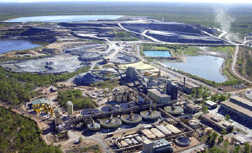 “ERA should be planning a comprehensive clean up of the mine site and beginning an ordered and managed exit from Ranger.”
Kakadu uranium miner scraps acid extraction project, but wants to go underground, Dave Sweeney, 4 August 11, Energy Resources of Australia’s decision to scrap its plan to use a controversial acid leach mining technique at the troubled Ranger uranium mine in Kakadu is an instance of belated commonsense, the Australian Conservation Foundation said today.
ERA has confirmed it will not proceed with a planned mine expansion based around acid leaching, in which sulphuric acid is injected into low grade and waste rock. Continue reading
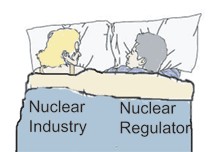
IAEA report on safety of Lynas rare earths will be slanted in favour of the company
 “How can we monitor daily? The risks of human error are too high,” she said, pointing out that the half-life of thorium was 14 billion years…..Fuziah promised that if the report from the panel, which includes members of the IAEA, was as she anticipated, she will continue to bring the issue to a higher level and exert pressure on authorities.
No confidence in Lynas safety review’, Free Malaysia Today Tashny Sukumaran, June 20, 2011, The IAEA report on the Lynas Corp is bound to be slanted and the human factor will not be taken into account, says Kuantan MP Fuziah Salleh. KUALA LUMPUR: Kuantan MP Fuziah Salleh is already second guessing the International Atomic Energy Agency’s (IAEA) report on the Lynas Corp’s rare earth refinery in Gebeng, Pahang.
She said she has no confidence in the independent panel’s safety review of the RM300 million Lynas Corp rare earth refinery . “I can imagine the outcome will contain acknowledgement of safety concerns, but also on how this refinery can be made safe,” said Fuziah. Continue reading
Australian company faces Malaysian opposition to radioactive waste dumping
 crucial questions remain unanswered especially regarding the safe disposal of radioactive waste…… officials from the nuclear watchdog would be
 pro-nuclear and therefore fail to produce a fair assessment of the Lynas plant.
Calls for local and environmental groups to be represented in the monitoring team have also gone unheeded…’Whatever their findings, our final agenda – which is our ultimate goal – is to stop Lynas.’..
Malaysia’s new rare earth plant provokes radiation fears – Monsters and Critics, By Julia Yeow May 29, 2011, Kuala Lumpur – In the quiet town of Gebeng in Malaysia’s central state of Pahang, a new rare earth plant has evoked fears of radiation contamination as residents desperately seek to stop the construction of the world’s largest such refinery. Continue reading
Australian MP calls for ban on Lynas dumping radioactive wastes in Malaysia
 “I also call upon the Transport Minister (Troy Buswell) to halt planned shipments of rare earth with radioactive Thorium 232 to Malaysia,”
Aussie MP: Don’t dump toxic by-products in Kuantan, Free Malaysia Today, G Vinod | May 18, 2011 An Australian MP has joined the chorus of calls to halt planned shipment of radioactive waste to Malaysia.
Australian company Lynas meets opposition to its rare earths plan
The Star Online, said that if Lynas claimed the residue from the plant would be safe, it should be shipped back to Australia. “Malaysia cannot afford to keep a health time bomb here and we do not know when it will explode,”
Protests threaten Lynas’s Malaysian rare-earths plant, The Australian, Sarah-Jane Tasker , April 26, 2011 RARE-EARTHS miner Lynas’s plans for a processing plant in Malaysia have been thrown into doubt as local authorities review the proposal in light of concerns about radiation pollution. Continue reading
Monash University engineer shows the way to expand Olympic Dam without uranium recovery
 The Olympic Dam Mega-Expansion Without Uranium Recovery.Dr Gavin Mudd, 2010 Peer-Reviewed Report for SA Greens MLC Mark Parnell and WA Greens Senator Scott Ludlam, Adelaide, SA, December 2010, 10 p (Download PDF – 591 kb).
“…….It is eminently reasonable to propose a process flow sheet for Olympic Dam which does not include recovery of uranium but still allows for copper, gold and silver to be produced… This report .. proposing a technically viable alternative for operating Olympic Dam in the next expansion which excludes uranium recovery….”
Electric car to go ahead, though Australia’s Green Car Fund closed
PROTOTYPE OF AUSTRALIA’S FIRST MODERN FAMILY-SIZED ELECTRIC CAR Five local companies have joined forces to build prototypes of Australia’s first modern large electric car. Supported by the Australian Government, the consortium hopes to produce a family car which could revolutionise the Australian car industry. Continue reading
Australia’s CSIRO a leader in batteries for renewable energy
Researchers at the Commonwealth Scientific and Industrial Research Organization (CSIRO), the national science agency of Australia, have developed the UltraBattery,…The UltraBattery has potential applications in hybrid electric vehicles (HEVs) and as energy storage for renewable energy systems–such as solar and wind power.

Better Batteries Coming No Jitter | By Gary Audin, Delphi, Inc. Jan 6, 2011 Batteries will be improving mobile device energy storage soon. These battery improvements will significantly increase the use of and operating life Continue reading
1 This month

of the week – Australians for War Powers Reform (AWPR)
To see nuclear-related stories in greater depth and intensity
 Antinuclear