The question of nuclear in Australia’s electricity sector

https://www.csiro.au/en/news/All/Articles/2024/December/Nuclear-explainer 9 Dec 24
In Australia’s transition to net zero emissions, the electricity sector has a major role to play. But does nuclear power have a place in our future grid?
Key points
While nuclear technologies have a long operational life, this factor provides no unique cost advantage over shorter-lived technologies.
Nuclear power does not currently provide the most cost competitive solution for low emission electricity in Australia.
Long development lead times mean nuclear won’t be able to make a significant contribution to achieving net zero emissions by 2050.
This explainer was updated on 09 December 2024 to reflect costings included in the draft GenCost 2024-25 Report.
As Australia works towards emissions reduction targets in the transition to net zero, we know the electricity sector has a major role to play. We also know it makes sense to assess a full range of technologies: some new and emerging, some established and proven.
In this context some proponents want nuclear to be considered as an option for decarbonising the electricity sector.
Despite nuclear power being a component of electricity generation for 16 per cent of the world’s countries, it does not currently represent a timely or efficient solution for meeting Australia’s net zero target.
Here’s why:
- Nuclear is not economically competitive with solar PV and wind and the total development time in Australia for large or small-scale nuclear is at least 15 years.
- Small modular reactors (SMRs) are potentially faster to build but are commercially immature at present.
- The total development lead time needed for nuclear means it cannot play a major role in electricity sector emission abatement, which is more urgent than abatement in other sectors.
Understanding GenCost calculations
GenCost is a leading economic report by CSIRO in collaboration with the Australian Energy Market Operator (AEMO) to estimate the cost of building future electricity generation and storage, as well as hydrogen production in Australia.
It is a policy and technology neutral report and the annual process involves close collaboration with electricity industry experts. There are opportunities for stakeholders to provide pre-publication feedback, ensuring the accuracy of available evidence.
Paul Graham, our Chief Energy Economist and lead author of the report, said GenCost is an open and public process.
“The report’s data is not just for AEMO planning and forecasting; it’s also used by government policymakers and electricity strategists who require a clear, simple metric to inform their decisions,” Paul said.
“To facilitate a straightforward comparison across different technologies, the GenCost report conducts a levelised cost of electricity analysis. This method calculates a dollar cost per megawatt hour (MWh) over the economic life of the asset, incorporating initial capital expenses and any ongoing fuel, operation, and maintenance costs.”
The draft GenCost 2024-25 Report released on 09 December 2024 found renewables continue to have the lowest cost range of any new build electricity generation technologies.
[Excellent table here -on original]
One of the factors that impacts the high and low cost range is the capacity factor. The capacity factor is the percentage of time on average that the technology generates to its full capacity throughout the year. Costs are lowest if technologies. such as nuclear, can operate at full capacity for as long as possible so they have more generation revenue over which to recover their capital costs.
Nuclear technology is capable of high capacity factor operation but globally its capacity factor ranges from below 60% to above 90% with an average of 80%. Australia operates a similar steam turbine based technology in coal generation for which the average capacity factor over the last decade was 59% with a maximum of 89%.
The shape of the electricity load and competition from other sources is very different between countries and so our preference is to always use Australian data where it is available. Consequently, we apply the historical coal capacity factors when considering the potential future capacity factors of Australian nuclear generation.
Capital cost assumptions
While nuclear generation is well established globally, it has never been deployed in Australia.
Applying overseas costs to large-scale nuclear projects in Australia is not straightforward due to significant variations in labour costs, workforce expertise, governance and standards. As a result, the source country for large-scale nuclear data must be carefully selected.
GenCost estimates of the cost large-scale nuclear are based on South Korea’s successful continuous nuclear building program and adjusted for differences in Australian and South Korean deployment costs by investigating the ratio of new coal generation costs in each country.
The large-scale nuclear costs it reported could only be achieved if Australia commits to a continuous building program, following the construction of an initial higher-cost unit or units. Initial units of all first-of-a-kind technologies in Australia are expected to be impacted by higher costs. A first-of-a-kind cost premium of up to 100 per cent cannot be ruled out. These assumptions remain for the draft GenCost 2024-25 Report.
Life of the investment
GenCost recognises the difference between the period over which the capital cost is recovered (the economic life) and operational life of an asset.
GenCost assumes a 30-year economic life for large-scale nuclear plants, even though they can operate for a longer period. It is standard practice in private financing that the capital recovery period for an asset is less than its full operational life, similar to a car or house loan. For power stations, warranties expire and refurbishment costs may begin to fall around the 30-year mark. As a result, we use a 30-year lifespan in our cost calculations.
After the final GenCost 23-24 Report was released in May 2024, nuclear proponents clarified they will seek to achieve longer capital recovery periods, closer to the operational life, by using public financing to realise potential cost advantages.
The draft GenCost 2024-25 Report has calculated those cost advantages for the first time (using a 60-year period), finding that there are no unique cost advantages arising from nuclear technology’s long operational life. Similar cost savings are achievable from shorter-lived technologies, even accounting for the fact that shorter lived technologies need to be built twice. This is because shorter-lived technologies such as solar PV and wind are typically available at a lower cost over time, making the second build less costly.
The lack of an economic advantage for long-lived nuclear is due to substantial nuclear refurbishment costs to achieve long operational life safely. Without new investment it cannot achieve long operational life. Also, because of the long lead time in nuclear deployment, cost reductions in the second half of their operational life are not available until around 45 years into the future, significantly reducing their value to consumers compared to other options.
Current figures for Small Modular Reactors (SMRs)
The Carbon Free Power Project was a nuclear SMR project in the United States established in 2015 and planned for full operation by 2030. It was the first project to receive design certification from the Nuclear Regulatory Commission, an essential step before construction can commence. In November 2023, the project was cancelled following a 56 per cent increase in reported costs.
Despite being cancelled, this project was the first and currently remains the only project to have provided cost estimates for a real commercial venture with detailed data. Until now, most sources were for theoretical projects only.
“The main area of uncertainty with nuclear SMR has been around capital costs,” Paul said.
“The Carbon Free Power Project provided more confidence about the capital costs of nuclear SMR and the data confirms it is currently a very high-cost technology.”
“We don’t disagree with the principle of SMRs. They attempt to speed up the building process of nuclear plants using standardised components in a modular system and may achieve cost reductions over time. However, the lack of commercial deployment has meant that these potential savings are not yet verified or realised,” Paul said.
Time is running out for the energy transition
Nuclear power has an empty development pipeline in Australia. Given the state and federal legal restrictions, this is not surprising.
But even if nuclear power was more economically feasible, its slow construction and its additional pre-construction steps, particularly around safety and security, limit its potential to play a serious role in reducing emissions within the required timeframe.
In the last five years, the global median construction time for nuclear has been 8.2 years. Furthermore, in the last ten years, no country with a similar level of democracy to Australia have been able to complete construction in less than 10 years. Overall, it will take at least 15 years before first nuclear generation could be achieved in Australia.
“The electricity sector is one of our largest sources of emissions and delaying the transition will make the cost of addressing climate change higher for all Australians,” Paul said
The electricity sector must rapidly lead the transition to net zero, so other sectors like transport, building and manufacturing can adopt electrification and cut their emissions.”
How close are we to chaos? It turns out, just one blue screen of death

Keeping cash as a backup is a smart idea in the event of a payment systems outage,
David Swan, Technology editor, 22 July 24, https://www.theage.com.au/technology/how-close-are-we-to-chaos-it-turns-out-just-one-blue-screen-of-death-20240720-p5jv6t.html
In some places, Friday’s mass tech outage resembled the beginning of an apocalyptic zombie movie. Supermarket checkouts were felled across the country and shoppers were turned away, airports became shelters for stranded passengers, and live TV and radio presenters were left scrambling to fill airtime. The iconic Windows “blue screen of death” hit millions of devices globally and rendered them effectively useless.
The ABC’s national youth station Triple J issued a call-out for anyone who could come to their Sydney studio to DJ in person. One woman was reportedly unable to open her smart fridge to access her food.
All because of a failure at CrowdStrike, a company that most of us – least of all those who were worst hit – had never heard of before.
It’s thought to be the worst tech outage in history and Australia was at its epicentre: the crisis began here, and spread to Europe and the US as the day progressed. Surgeries were cancelled in Austria, Japanese airlines cancelled flights and Indian banks were knocked offline. It was a horrifying demonstration of how interconnected global technology is, and how quickly things can fall apart.
At its peak, it reminded us of some of the most stressful periods of the pandemic, when shoppers fought each other for rolls of toilet paper and argued about whether they needed to wear masks.
Many of us lived through the Y2K panic. We avoided the worst outcomes but it was an early harbinger of how vulnerable our technology is to bugs and faults, and showed the work required to keep everything up and running. The CrowdStrike meltdown felt closer to what’s really at risk when things go wrong.
As a technology reporter, for years I’ve had warnings from industry executives of the danger of cyberattacks or mass outages. These warnings have become real.
The cause of this outage was not anything malicious. It was relatively innocuous: CrowdStrike has blamed a faulty update from its security software, which then caused millions of Windows machines to crash and enter a recovery boot loop.
Of course Australians are no strangers to mass outages, even as they become more common and more severe.
The Optus network outage that froze train networks and disrupted hospital services just over six months ago was eerily similar to the events on Friday, not least because it was also caused by what was supposed to be a routine software upgrade.
The resignation of chief executive Kelly Bayer Rosmarin did little to prevent another Optus outage a month later. If anything, Friday’s CrowdStrike outage highlights how many opportunities there are for one failure to cripple millions of devices and grind the global economy to a halt. So many of the devices that underpin our economy have hundreds of different ways that they can be knocked offline, whether through a cyberattack or human error, as was likely the case with CrowdStrike.
The incident would likely have been even worse were it a cyberattack. Experts have long warned about the vulnerability of critical infrastructure – including water supplies and electricity – to malicious hackers. Everything is now connected to the internet and is therefore at risk.
And yet the potential damage of such attacks is only growing. We are now more reliant than ever on a concentrated number of software firms, and we have repeatedly seen their products come up short when we need them to just work.
In the US, the chair of the Federal Trade Commission, Lina Khan, put it succinctly.
“All too often these days, a single glitch results in a system-wide outage, affecting industries from healthcare and airlines to banks and auto-dealers,” Khan said on Saturday.
“Millions of people and businesses pay the price.”
Khan is right. The technology we rely on is increasingly fragile, and is increasingly in the hands of just a few companies. The world’s tech giants like Microsoft and Apple now effectively run our daily lives and businesses, and an update containing a small human error can knock it all over, from Australia to India.
The heat is now on CrowdStrike, as well as the broader technology sector on which we rely so heavily, and some initial lessons are clear. Airlines have backup systems to help keep some flights operational in the case of a technological malfunction. As everyday citizens, it’s an unfortunate reality that we need to think similarly.
Keeping cash as a backup is a smart idea in the event of a payment systems outage, as is having spare battery packs for your devices. Many smart modems these days, like those from Telstra and Optus, offer 4G or 5G internet if their main connection goes down. We need more redundancies built in to the technology we use, and more alternatives in case the technology stops working altogether.
For IT executives at supermarkets, banks and hospitals, the outage makes it clear that “business as usual” will no longer cut it, and customers rightly should expect adequate backups to be in place. Before the Optus outage, a sense of complacency had permeated our IT operations rooms and our company boardrooms, and it still remains. No longer.
The “blue screen of death”, accompanied by a frowny face, was an apt metaphor for the current state of play when it comes to our overreliance on technology. Our technology companies – and us consumers, too – need to do things differently if we’re to avoid another catastrophic global IT outage. There’s too much at stake not to.
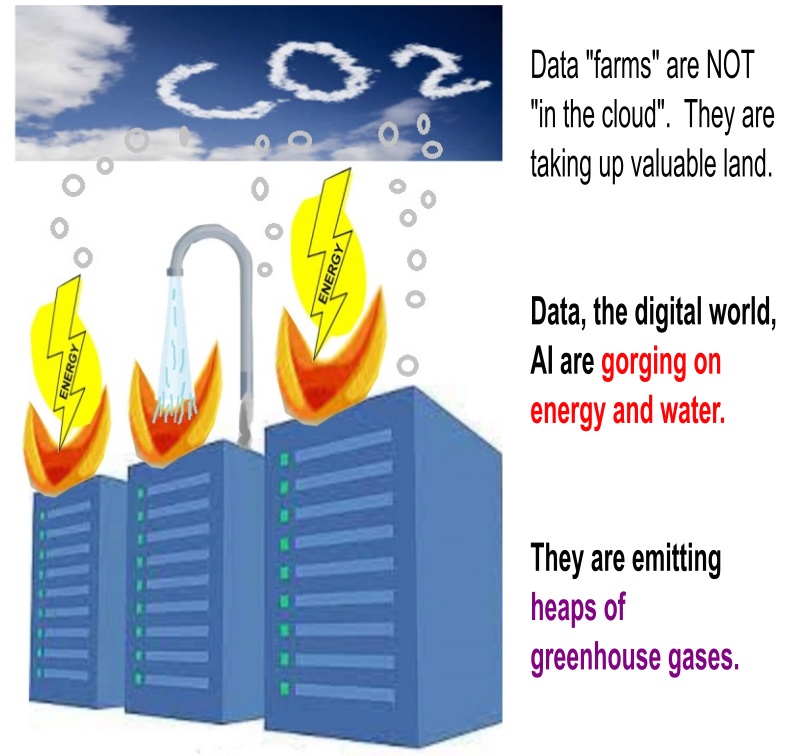
Power-hungry data centres are booming in Australia. Can the grid cope?
By Nick Toscano, July 12, 2024, https://www.theage.com.au/business/companies/power-hungry-data-centres-are-booming-in-australia-can-the-grid-cope-20240711-p5jssa.html
An explosion in the number of data centres in Australia is looming as a new test for the energy grid amid warnings they might soon require as much as electricity as two giant coal-fired power stations are capable of generating.
As cloud-based computing [nb there is no “cloud”] and artificial intelligence (AI) accelerate demand for data storage, Melbourne and Sydney have emerged as key locations for tech companies building vast industrial facilities to house their servers that send and receive data 24/7, known as data centres.
These data centres, which need huge amounts of electricity to run high-intensity computing and cooling systems, are already major power users in Australia – consuming about 5 per cent of available generation.
They are expected to drive further electricity demand growth alongside homes switching from gas to electric appliances and the growing adoption of electric cars.
However, new modelling from UBS suggests official forecasts may be underestimating the scale of the added demand that data centres could drive in the coming years.
The investment bank calculates between 3.3 gigawatts and 5 gigawatts of demand – equivalent to the combined generating potential of approximately two of Australia’s biggest coal-fired power plants – could be added to the east coast grid by 2030 on the back of growth in data centres and artificial intelligence.
At the top end of the range that could equate to up to 15 per cent of overall grid demand, which could add significant strain to supplies and push up prices unless properly managed.
The data centre boom is coming at a time of upheaval for Australia’s main grid as it transitions to cleaner energy, while the coal plants that have supplied the bulk of its power for decades increasingly bring forward their closures.
Although renewables’ share of the mix is growing, there are worries it’s not happening fast enough, with authorities fearing a shortfall of generation, storage and transmission lines to protect against the threat of price rises or blackouts once coal exits the grid.
Analysts at Morgan Stanley believe the grid will be able to accommodate extra demand from data centres’ growth, which it forecasts to rise from 5 per cent to about 8 per cent by 2030.
However, the system will face more strain next decade when the majority of the nation’s remaining coal-fired power plants are expected to have closed, they said.
“We see the power requirement for new Australian data centres as manageable for the Australian power system to 2030, but power could become a constraint in the 2030s given planned coal plant closures,” they said.
UBS said data centres may provide benefits for grid planners trying to maintain system stability, given they offer consistent minimum demand 24/7 – similar to the role of aluminium smelters. But they would add “incremental pressure” during evening peak demand periods once the sun sets and solar output recedes, Allen said.
The spread between daytime and evening wholesale prices could widen to up to 70 per cent by 2030 due to coal closures and delays to the renewable rollout, he added.
Nuclear engineer dismisses Peter Dutton’s claim that small modular reactors could be commercially viable soon

Hugh Durrant-Whyte says 2045 is a realistic timeframe, adding it was likely to be ‘more expensive than anything else you could possibly think of’
Peter Hannam, Fri 21 Jun 2024, https://www.theguardian.com/australia-news/article/2024/jun/21/peter-dutton-coalition-nuclear-policy-engineer-small-modular-reactors-no-commercially-viable
Australia would need “many decades” to develop the regulations and skills to operate a nuclear power plant, and the experience gained at the existing Lucas Heights facility won’t help much, according to New South Wales’ chief scientist and engineer.
Hugh Durrant-Whyte said he stood by comments made to a 2019 NSW upper house inquiry into uranium mining and nuclear facilities that running a plant and its fuel supply chain would require skills “built up over many decades”.
Stressing he spoke in the capacity of a trained nuclear engineer rather than as the state’s chief scientist, Durrant-Whyte said the industry demanded regulations and monitoring for all stages of fuel handling, power generation and waste management.
He told Guardian Australia that 2040 or even 2045 was the “realistic” timeframe.
“We would need people who were trained [on] how to measure radioactivity, how to measure containment vessel strengths, how to [manage] everything we do.”
The federal opposition on Wednesday revealed plans to build seven nuclear power stations in five states at existing coal plant sites, promising the first could be operating by the mid-2030s.
The government would own the plants and compulsorily acquire the sites if the owners – private companies as well as the Queensland and Western Australian governments – declined to sell them.
The shadow energy spokesperson, Ted O’Brien, has cited France and Canada as examples Australia could follow. He also offered the example of Lucas Heights, located in Sydney’s south, where a small reactor has been used for medical research for decades.
Durrant-Whyte said Canada’s nuclear industry employed about 30,000 people while France’s employed 125,000 – “not a trivial number of people”.
The UK, which operated nuclear plants for many years, has just one nuclear engineering program at an undergraduate level, limiting the supply of talent that could be imported from there.
He was also dismissive of the prospect that small modular reactors – which the opposition proposes to start its nuclear program with – were likely to be commercially viable soon.
“When I was [at Rolls-Royce] in 1979 my colleagues in the couple of desks next to me were designing SMRs,” he said. “It’s always the issue with anything big and complex. Whether it’s an aeroplane or a nuclear reactor, the first one is always the hardest.”
The capabilities learned at the Lucas Heights Ansto (Australian Nuclear Science and Technology Organisation) facility would make “little contribution” to supporting a nuclear power industry in the country, he wrote in his 2019 report.
“It must be recognised that this is a ‘zero-power’ pool reactor where the complexities of high pressure, high power, high radiation environments do not exist.”
Similarly, the capabilities needed to manage nuclear-powered submarines as part of the Aukus program also offered few transferrable skills. The pressurised water reactors on the submarines would be, in effect, SMRs of a 100-200 megawatt capacity size.
“My suspicion is we will buy the reactors in a piece of submarine and assemble that piece into submarines here,” Durrant-Whyte said. “But even then, let’s be clear, we’re not going to be doing that until the mid-2040s.”
As for safety, he said nuclear reactors were designed to be “very, very safe”. But there “have been a lot of accidents because of fuel handling and things like that” as a result of human error.
“It’s not like we haven’t had this [nuclear] conversation many times over the last 20 years in Australia,” Durrant-Whyte said. “It would be expensive, and likely more expensive than anything else you could possibly think of.”
Dutton’s plan to build nuclear plants on former coal sites not as easy as it seems
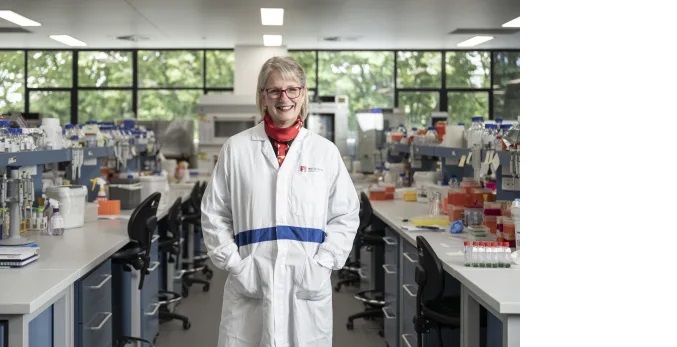
Dr Katherine Woodthorpe said it would be impractical for nuclear facilities to use existing poles and wires. CREDIT:LOUIE DOUVIS
By Bianca Hall, June 21, 2024, https://www.theage.com.au/environment/climate-change/dutton-s-plan-to-build-nuclear-plants-on-former-coal-sites-not-as-easy-as-it-seems-20240620-p5jnbo.html
Experts have cast doubt on the central pillar of Peter Dutton’s nuclear pitch to voters, saying it would take decades to fill in coal mine voids and make contaminated power station sites safe, during which time fragile and valuable transmission lines would be left to deteriorate.
Operators at several of the seven sites identified by the Coalition for nuclear plants already have well-advanced plans to transform their sites into renewable energy hubs with grid-scale batteries, hydrogen and solar once the coal runs out.
Announcing a future Coalition government would build seven nuclear power stations on the sites of existing coal-fired power stations, Dutton said nuclear facilities could be built on the sites of retired coal power plants using existing transmission poles and wires.
“Each of these locations offer important technical attributes needed for a zero-emissions nuclear plant, including cooling water capacity and transmission infrastructure,” he said.
“That is, we can use the existing poles and wires.”
Dr Katherine Woodthorpe, president of the Australian Academy of Technological Sciences and Engineering, said overseas examples like the United Kingdom’s Hinkley Point C showed it could take decades to approve and build new nuclear facilities – leaving aside the time needed to remediate dirty and geologically unstable former mine sites.
Woodthorpe said even if it only took 25 years to get a new nuclear facility up and running, that meant the existing transmission potential could lie dormant for 25 years after a coal plant closed.
“In theory it could be done, but when you look at the actual practicality of doing it they’d pretty well have to replace it all,” she said.
University of Sydney professor Glenn Platt, who specialises in energy policy, markets and grids, said there was already high demand for dormant transmission networks among renewables operators.
“The unknown bit [about the Coalition policy] is what happens to those poles and wires between now and when somebody wants to build the nuclear plant, because everybody else is trying to use those poles and wires today for wind and solar and battery projects,” he said.
“The landowners many of these sites are already deploying wind and solar or batteries on those sites. They would use up the available poles and wire infrastructure.”
AGL, which owns the Liddell Power Plant in the Hunter Valley, and Loy Yang A in the Latrobe Valley, said it was well-advanced in plans to transform the sites into industrial energy hubs with renewables, batteries and associated industries.
A spokesman referred this masthead to a statement made by chief executive Damien Nicks in March.
“AGL is already developing our coal and gas power station sites into low-emissions industrial energy hubs,” he said.
“As the owner of these sites, nuclear energy is not a part of these plans. There is no viable schedule for the regulation or development of nuclear energy in Australia, and the cost, build time and public opinion are all prohibitive.”
Many observers are looking to now-closed mine sites for clues about how Dutton’s policy could work on a practical level.
French energy giant Engie, which is rehabilitating Victoria’s closed coal mine Hazelwood, has estimated it could take up to 35 years under a worst-case scenario to finish filling the enormous mine void to a maximum depth of 116m and surface area of 1145 hectares.
Engie Australia and New Zealand manager of environment and planning Adam Moran, who has led the rehabilitation, said a nuclear facility could in theory be put on the site of a former coal power station.
“Could it be done? Yes, but if you had to choose a location, would you choose next to a mine void that’s been rehabilitated and full of water, or would you put it some distance further away?” he said.
“You would probably err on the side of caution, and move it well outside of the geological buffer zone that would exist around a rehabilitated coal mine.”
At Hazelwood, which had a 1600-megawatt transmission capacity when the coal mine operated, operators have installed a 150-megawatt-hour battery, which is now plugged into the mine’s existing transmission network.
In November, Yancoal announced plans to transform the coal mine at Stratford in the Hunter Valley, slated for closure this year, into a major 330-megawatt solar farm and pumped hydro facility capable of producing 300 megawatts in a 12-hour period.
A spokesman for EnergyAustralia, which operates the Mt Piper mine in Lithgow, said the company spoke regularly with governments and regulators.
“To date, we have not discussed the use of any EnergyAustralia sites in the context of nuclear,” he said
With its Mt Piper plant due to close in 2040, and Yallourn this decade, EnergyAustralia is increasingly looking to diversify, he said.
“We are focused on continuing to roll out existing, readily available technologies,” he said, which included gas and batteries.
“We are developing more batteries in multiple states, pumped hydro at Lake Lyell in Lithgow and working with partners to underpin further renewable energy.”
The Australian Manufacturing Workers’ Union and Climate Action Network Australia commissioned a report identifying industry and workforce opportunities presented by the renewable energy shift.
National secretary Steve Murphy said with government backing, coal workers could retrain and reap the benefits of renewable technologies.
“This is coming, so let’s get involved and get the best results for our members,” he said.
“We’re in a global race for the jobs of the future, and we spent 10 years standing still, [but] we can catch up very quickly with the natural advantages that we’ve got, provided that there is government support.”
Jim Green demolishes Rolls Royce’s claims about so-called “small” and “cheap” nuclear reactors for Australia.

Nuclear Fuel Cycle Watch Australia, Jim Green 7 Apr 24
According to reports in The Australian, Rolls-Royce claims it could build a 470-megawatt reactor in Australia for A$3.5-5 billion. That equates to A$7.4-10.6 billion / gigawatt (GW). For comparison, the cost for the two EPR reactors under construction at Hinkley Point, the only reactor construction project in the UK, is A$27.8 / GW.
So Rolls-Royce claims its cost-per-GW will be just 27-38% of the cost of Hinkley Point, for a reactor type that it has never built and doesn’t have a licence to build, anywhere in the world. Clearly Rolls-Royce’s cost claims need to be treated with scepticism.
Rolls-Royce claims it could build a reactor in Australia in just four years (once licensing and a myriad of other issues were sorted). Let’s compare that speculation with real world experience:
* Hinkley Point was supposed to be a seven-year construction project. That has blown out to 12-13 years with further slippage likely.
* The one EPR under construction project in France was meant to be completed in five years but it remains incomplete after 17 years.
* The one EPR recently completed in Finland was meant to be a four-year construction project but ultimately took 17 years to complete.
* The two AP1000 reactors in the US were meant to be completed in three years, but ultimately took 10 and 11 years to complete.
Rolls-Royce’s 470-MW design is being marketed as a small modular reactor (SMR) even though it falls well outside the <300 MW definition of SMRs. Only two SMR plants are said to be operating anywhere in the world (though there’s nothing modular about either of them). Russia’s floating ‘SMR’ was supposed to be a three-year construction project but that blew out to 12 years (and costs increased six-fold). China’s ‘SMR’ was supposed to be a four-year construction project but that blew out to nine years (and costs increased three-fold).
Clearly Rolls-Royce’s claim that it could build a reactor in just four years needs to be treated with scepticism.
Cost update blasts nuclear out of energy mix
Canberra Times, By Marion Rae, December 21 2023
A surge in the cost of small nuclear reactors has forced the national science agency to change its calculations for Australia.
The latest modelling of all energy sources, released by CSIRO on Thursday, includes data from a recently scrapped project in the United States that was showcasing nuclear small modular reactors (SMRs) as a way to fight climate change.
The draft GenCost 2023-24 report, out for consultation over summer, shows that while inflation pressures are easing there has been a recalculation on SMRs that puts them out of reach.
Real data on a high-profile six-reactor power plant in the United States has confirmed that the contentious technology costs more than any energy consumer wants to pay.
Project costs for the Utah project were estimated at $18,200 per kilowatt, but the company has since disclosed a whopping capital cost of $31,100/kW, prompting its cancellation in November.
In contrast, under existing policies the cost of new offshore wind in Australia in 2023 would be $5545/kW (fixed) and $6856/kW (floating), while rooftop solar panels are calculated at a modest $1505/kW………………………………………………………………………………………………………………..
A small but vocal group of industry backers have been calling for nuclear SMRs for some years, citing the emerging low-emission technology as being suitable for Australia’s vast and geologically stable landmass.
The coalition recently pledged to reopen the nuclear debate in Australia, where laws ban any research or use of nuclear energy despite the country having the world’s largest uranium reserves.
Regulators estimate it would be around 15 years to first production from a decision to build nuclear SMR in Australia, given the scale of legislative change required.
But even if a decision to pursue a nuclear SMR project in Australia were taken today, with political backing for new laws, it is “very unlikely” a project would be up and running as quickly as 2038, CSIRO said.
Further, CSIRO warned nuclear electricity costs put forward by proponents may be for technology that is not appropriate for Australia, or calculated from Russian and Chinese government-backed projects that don’t operate commercially. https://www.canberratimes.com.au/story/8467236/cost-update-blasts-nuclear-out-of-energy-mix/
Malaysian Govt urged to halt Australian company Lynas’ thorium extraction plan

https://www.thestar.com.my/news/nation/2023/11/24/govt-urged-to-halt-lynas-thorium-extraction-plan
SEVERAL DAP lawmakers have urged the government to review Lynas Malaysia’s license and stop the plan for thorium extraction from the waste produced at the factory of the rare earth producer.Chow Yu Hui (PH-Raub) said that he remains unconvinced that Lynas Malaysia was capable of extracting thorium.
“Let us not forget that the amount of waste from the Lynas plant was as large as five hills behind its factory. Will the new thorium extraction technology and Lynas be able to manage the radioactive waste which is expected to reach 1.2 million metric tonnes?” he asked reporters at the parliament media centre yesterday.
Oct 24, Science, Technology and Innovation Minister Chang Lih Kang announced that Lynas Malaysia would be allowed to import lanthanide concentrates until its licence expires in March 2026.
He also said that the Atomic Energy Licensing Board (AELB) decided to amend Lynas Malaysia’s license conditions after the company made a proposal to the licensing board about its thorium extraction technology.
With this, Chang said radioactive waste will not be produced after extraction and cracking and leaching activities are carried out on the lanthanide concentrate.
Khoo Poay Tiong (PH-Kota Melaka) said the Science, Technology and Innovation Ministry had announced on May 10 regarding the renewal of Lynas Malaysia’s license until Dec 31.
However, Khoo said that within a period of five months, the government, via AELB, had reviewed Lynas’ licence conditions.
“This matter has raised many concerns regarding the radioactive pollution and safety of locals,” said Khoo, who also wanted to know the parties that came up with the idea of thorium extraction.“We also want clarification from the government on what the possible market for thorium is,” he said.
Tan Hong Pin (PH-Bakri) also pointed out that thorium extraction technology was still in its initial phases, even at the international level.
“To what extent can thorium be extracted, used and commercially extracted? What are the effective measures that can be taken by the government to address the issue and ensure that Lynas will adhere to all the international standards in managing radioactive waste?” asked Tan.
On Nov 16, Chang promised that AELB will closely monitor the thorium extraction process from Lynas Malaysia’s waste material.
New nuclear medicine factory to replace ageing site at Lucas Heights reactor
SMH By Liam Mannix, September 26, 2023 —
Hundreds of millions of dollars will be spent building a new radioactive medicine factory at the Lucas Heights nuclear reactor in Sydney, replacing an ageing and accident-prone facility.
The new manufacturing centre will produce the radioactive drugs doctors use to image the heart, lungs, kidney and brain for diagnosing and tracing diseases such as cancer. The current facility has been plagued by safety breaches, including in 2017 when a worker suffered radiation burns.
The federal government has been tight-lipped on costs ahead of a competitive tender process, but equivalent facilities in other countries have often come with price tags exceeding $400 million. The factory is expected to open in the mid-2030s…………
The facility will replace Lucas Heights’ trouble-plagued Building 23, built in 1959 as a research laboratory and later repurposed to make nuclear medicine.
Building 23 recorded seven “events with safety implications” in 2017 and 2018.
The worst of these occurred in 2017, when a worker dropped a vial of radioactive Molybdenum-99, covering their hands in the liquid.
Despite wearing two pairs of gloves, the worker suffered radiation burns and blistering.
ANSTO, which operates Lucas Heights, initially estimated the worker had been exposed to a mild dose of radiation. But an investigation by the radiation safety regulator determined the dose could have been 40 times higher than the legal annual radiation exposure limit.
The Australian Radiation Protection and Nuclear Safety Agency was so concerned, it issued a direction notice to ANSTO demanding an independent review of radiation safety in 2018, noting seven separate safety incidents within two years…………..
Like the current facility, the new one will assemble and test nuclear medical products, particularly Molybdenum-99, or Mo-99.
ANSTO is a major supplier of Mo-99, a radioactive substance that naturally decays to form Technetium-99m (Tc-99m), the workhorse of nuclear medicine. The organisation supplies about 12,000 doses a week, shipping them to facilities across Australia and the region.
Tc-99m can be used as a radioactive dye. Doctors inject it, allow it to accumulate in target organs or tissues, and then image the radiation it releases using special cameras. Tc-99m is particularly useful because it exposes patients to only a low dose of radiation.
To make Mo-99, plates of uranium are inserted into the Lucas Heights nuclear reactor, known as OPAL, which stands for open-pool Australian lightwater reactor……………………………………………………..more https://www.smh.com.au/national/new-nuclear-medicine-factory-to-replace-ageing-site-at-lucas-heights-reactor-20230925-p5e7g8.html
The push for nuclear energy in Australia is driven by delay and denial, not evidence.
Adam Morton 21 Sept 23 https://www.theguardian.com/commentisfree/2023/sep/21/nuclear-energy-australia-smokescreen-climate-denialism-coalition
Unsubstantiated claims of nuclear energy’s worth distracts from the urgency to act now on climate crisis
he vague, ideological push for nuclear energy backed by the Coalition and News Corp and given legitimacy this week on the ABC’s Q+A should be treated as what it is: the latest step in a decades-long campaign of delay and denial on the climate crisis.
Nuclear energy likely has a role to play in the global shift to zero-emissions energy in places that already use it or that have few other options. As with other technology, its role may grow or recede over time as the world moves. This stuff is going to change.
But no case has been made to support claims it has a place in the rapid transition under way in Australia. The reason for this is pretty straightforward: the technology that is being spruiked – small modular reactors (SMRs) – doesn’t exist. Not meaningfully.
That alone tells you that, with few exceptions, the current wave of nuclear boosterism is at its heart an anti-renewable energy campaign.
It is based on an arrogant and – despite the reams of column inches given over to it – unsubstantiated rejection of the detailed evidence from the Australian Energy Market Operator (and plenty of others) that solar, wind, hydro, batteries and other “firming” support can provide a reliable, affordable, low-emissions electricity supply.
Coincidentally or otherwise, many prominent members of the pro-nuclear and anti-renewable energy campaign dismiss climate science. Some do it directly. Others do it indirectly by arguing there is no urgency to act.
The primary sources of this climate rejection are the federal Coalition, the Australian newspaper and the misinformation sewer of Sky News After Dark. The Australian is happy to run unquestioning news stories claiming multibillion-dollar “black holes” in renewable energy plans based on flawed analyses by former mining executives, but then devote pages to tut-tutting over an estimate by Chris Bowen’s energy department that says nuclear energy would be – shock horror – really expensive.
This is, of course, a newspaper that gives more space to contrarian campaigns by individual scientists who claim that the Great Barrier Reef is not under threat and the Bureau of Meteorology’s temperature records cannot be trusted than it does to the overwhelming weight of thousands of peer-reviewed science papers. Considered and balanced scepticism is healthy. The Australian’s coverage of these issues has the rigour of an old bloke shouting in the corner of a pub as last drinks are served.
The Coalition’s position on nuclear energy is a little more slippery. In its limited defence, we’re only 16 months on from the last election and it’s reasonable that it doesn’t yet have a developed energy policy. But the language it uses is not that of a party gently exploring an idea. Peter Dutton has asserted that Australia could build nuclear plants, which are banned here, on existing coal-fired plants.
The Coalition considered, and rejected, abolishing the nuclear ban while it was in power for nearly nine years. Then, the party stuck with its status quo on climate, including hyping a subsidised “gas-fired recovery” that never happened. Now, Dutton and Ted O’Brien, the energy and climate spokesperson, speak of nuclear as the obvious solution and mock those who back the rollout of renewable energy and transmission lines.
Bowen’s back-of-envelope claim is that it could cost $387bn to replace every Australian coal plant with nuclear SMRs – a step that, at this stage, the Coalition has not proposed. O’Brien’s response was to cite the nuclear-heavy Canadian province of Ontario as an example of a power grid that is much cleaner and cheaper than here.
This was a red herring. The Ontario system runs on old, large-scale nuclear technology that nobody is proposing for Australia. It has a different cost profile, has been heavily subsidised and a new plant has not been completed for 30 years.
A true comparison would involve looking at the cost of SMRs today and considering what it would cost to start an industry in Australia.
The CSIRO, which has looked at the evidence, concluded this is near impossible due to a lack of robust data. It says there are only two known SMRs in operation – one in Russia (on a barge) and one in China. Both suffered the cost blowouts and delays that have become common with nuclear projects.
According to the International Atomic Energy Agency, there are more than 80 other SMR designs in development, only some of which would be used for electricity generation if successful. But it says their economic competitiveness is “still to be proven in practice”.
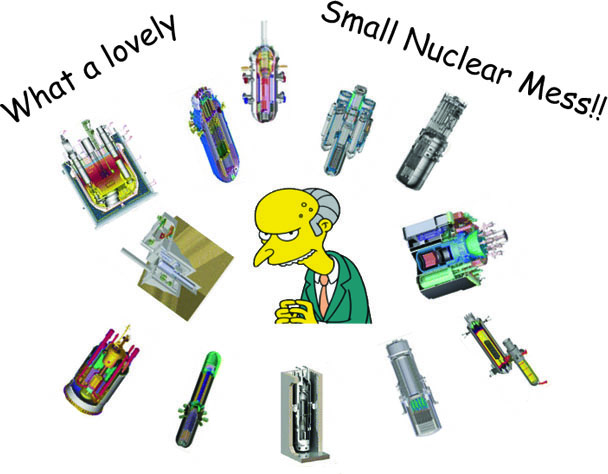
The CSIRO, which has looked at the evidence, concluded this is near impossible due to a lack of robust data. It says there are only two known SMRs in operation – one in Russia (on a barge) and one in China. Both suffered the cost blowouts and delays that have become common with nuclear projects.
According to the International Atomic Energy Agency, there are more than 80 other SMR designs in development, only some of which would be used for electricity generation if successful. But it says their economic competitiveness is “still to be proven in practice”.
But the idea Australia should wait for an unproven technology to possibly arrive when it already has extraordinary clean energy resources at its disposal defies all logic.
There is a genuine opportunity cost here. Time focused on the nuclear sideshow is playing into the delay game. I’m giving it succour just by writing this column.
Meanwhile, the world is in the grip of the hottest year on record. The fire season is under way in mid-September. Antarctic sea ice is at a record low level. Credible bodies such as the Australian Academy of Technological Sciences and Engineering now argue the country should be aiming to be net zero by 2035 – a date by which, if things go really well, just a small handful of SMRs may be in operation.
The transition away from fossil fuels is genuinely challenging. There are huge policy and social licence issues that need to be navigated so the rollout of renewable energy can accelerate. Emissions from transport, major industry and agriculture are not coming down. We barely talk about what adapting to the changes under way will mean.
But solutions are available. Imagine what might be possible if the political energy dedicated to the nuclear energy furphy went into developing those.
Nuclear fusion ambitions in Australia from a coalition of technology companies – a dodgy dream?

Tech coalition aiming to create Australian high-powered laser industry with nuclear fusion ambitions.
Proponents say lasers can be used to generate energy but others say fusion power unlikely to ‘save us from climate change’
Donna Lu, 15 Dec 22,
A coalition of technology companies intend to create a high-intensity laser industry in Australia, with potential applications including nuclear fusion.
It follows reports of an expected announcement from the National Ignition Facility at Lawrence Livermore National Laboratory in California that researchers have managed to get more energy out of a nuclear fusion reaction than they put in.
The coalition, led by the Australian laser fusion company HB11 Energy, also includes the University of Adelaide, the Institute of Laser Engineering at Osaka University, the Japanese laser fusion firm EX-Fusion, and the French engineering multinational Thales Group………..
“The same lasers can be used, for instance, for the transmutation of fission radioactive waste – essentially reducing the half-life of radioactive waste from hundreds or thousands of years to tens of years,” – Dr Warren McKenzie, founder and managing director of HB11 Energy………………….
Prof Ken Baldwin of the Australian National University described the NIF’s apparent advancement as “a truly groundbreaking achievement”, but said it was unlikely fusion power would “save us from climate change”.
All the heavy lifting for the energy transition will be done by renewable energy and nuclear fission (existing nuclear power) – with nuclear fusion at commercial scale unlikely to be available until later this century, well after the 2050 deadline needed to keep global warming below two degrees. But beyond that, fusion might provide limitless energy for centuries to come,” Baldwin said in a statement.
Mark Diesendorf, an associate professor and deputy director of the Institute of Environmental Studies at the University of New South Wales, agreed that fusion was “decades away from any possibility of commercial electricity generation”.
“There’s a huge gap between this experiment – which I really would hesitate to call a breakthrough – and what has to be done to get commercial electricity out,” he said.
“There’s an intense pulse of laser radiation for a tiny fraction of a second. Then the question is: during that tiny fraction of second, did they get more fusion energy out than they put in?” Diesendorf said. “To generate electricity, what you’ve got to do is to have thousands and thousands … perhaps millions of these pulses a day successfully getting more energy out. And then you’ve got to capture that energy.”
Diesendorf also warned of the risk of nuclear proliferation, pointing out that the Lawrence Livermore National Laboratory, where the fusion breakthrough was made, is a nuclear weapons research facility.
“Fusion produces neutrons and neutrons can be used to transmute elements – so you can get nuclear explosives such as plutonium-239 and uranium-233 and uranium-235,” Diesendorf said. “You can also produce lots of tritium … an essential component of nuclear bombs in missiles.”…………………….. https://www.theguardian.com/australia-news/2022/dec/14/tech-coalition-aiming-to-create-australian-high-powered-laser-industry-with-nuclear-fusion-ambitions
‘Next generation’ nuclear is not a credible energy response – makes no sense for Australia- The Australian Conservation Foundation

The pressing need to transition from fossil fuel energy to a low carbon future has seen renewed calls for domestic nuclear power in Australia. The Australian Conservation Foundation has recently reviewed scientific literature and industry practice from Australia and around to world to see if any developments in nuclear technology might have changed the role of this deeply contested power source.
Our findings are captured in a new report, which provides a clear pathway to a low carbon energy system. ACF is committed to effective climate action but maintains that ‘next generation’ nuclear is not a credible energy response and the pursuit of nuclear power in Australia makes no sense.
It would slow the transition to a low-carbon economy, increase electricity costs and unnecessarily introduce challenges and risks associated with high-level nuclear waste management including the potential for catastrophic accidents, with profound inter-generational economic implications for Australian taxpayers.
It is important to note that proponents of nuclear power in Australia are not calling for the deployment
of existing nuclear reactor technology. Instead, they are promoting ‘next generation’ nuclear technology which currently does not exist to scale.
Australian Conservation Foundation 5th Oct 2022
https://www.acf.org.au/our-shared-energy-future-is-renewable-not-radioactive
‘Unproven’ small nuclear reactors would raise Australia’s energy costs and delay renewable uptake, report says

Australian Conservation Foundation report finds modular reactors are expensive and introduce unnecessary challenges in managing radioactive waste
Guardian, Graham Readfearn 5 Oct 22,
The next generation of small nuclear reactors being advocated by the Coalition would raise electricity prices, slow the uptake of renewables and introduce new risks from nuclear waste, according to a report from the Australian Conservation Foundation.
But the report from the conservation group has found only two small modular reactors (SMRs) are known to be operating around the world, in Russia and China, and both have seen large cost blowouts.
Promoters of nuclear energy, the report claims, were pinning their hopes on technology that was “uncertain and unproven”.
“The good news about the renewed nuclear discussion is that it highlights that business as usual with fossil fuels is not an option,” the report found.
“The bad news is the very real risk of delay, distraction and a failure to advance a just energy transition”.
Last week during question time, the energy minister, Chris Bowen, mocked the Coalition for supporting nuclear and asked which MP would be willing to have a reactor in their electorate.
Nuclear energy has been effectively banned in Australia since the late 1990s, but some Coalition senators are pushing for those restrictions to be lifted.
The opposition leader, Peter Dutton, has tasked the shadow climate minister, Ted O’Brien, to review the status of nuclear energy.
In the report Dave Sweeney, ACF’s Nuclear Free campaigner, wrote SMRs would push up electricity costs and introduce unnecessary challenges in managing nuclear waste.
“In short, Australia’s energy future is renewable, not radioactive,” he wrote.
According to the report, Russia’s floating nuclear plant, the Akademik Lomonosov, has two small SMR units on board. Construction costs had ballooned sixfold.
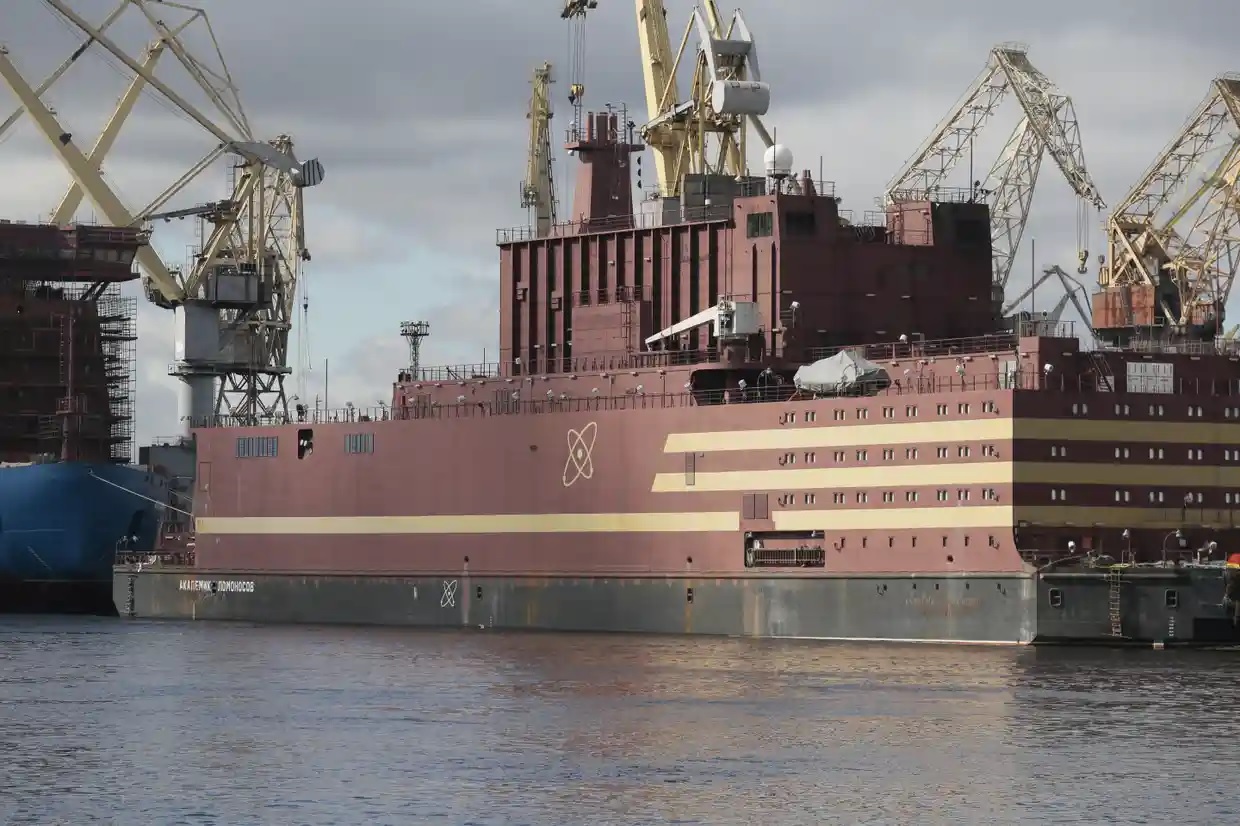
Work started in 2012 on a demonstration plant in China with two gas-cooled reactors that was completed nine years later, costing $8.8bn.
“The global SMR reality simply does not come close to matching the Australian SMR rhetoric,” the report says.
Three further SMR plants were under construction in Argentina, China and Russia but had been plagued by cost rises and delays, the report said.
In June, a study in the Proceedings of the National Academy of Sciences suggested future deployment of SMRs could increase the amount of nuclear waste by factors of two to 30, depending on the design.
……………………………………….. In June the International Energy Agency said SMRs were not yet commercially viable, but “lower cost, smaller size and reduced project risks” could improve social acceptance.
There was increased support and interest in Canada, France, UK and the US for the technology, the report said, adding: “But the successful long-term deployment of SMRs hinges on strong support from policymakers starting now, not just to mobilise investment but also to streamline and harmonise regulatory frameworks.” https://www.theguardian.com/australia-news/2022/oct/05/unproven-small-nuclear-reactors-would-raise-energy-costs-and-delay-renewable-uptake-report-says
Elon Musk’s SpaceX now leaving junk in our own backyard
Independent Australia, By Darren Crawford | 10 August 2022 After a SpaceX capsule crashed onto an Australian farm, we’re left wondering if Elon Musk will clean up his own mess, writes Darren Crawford.
ACCORDING TO the ABC, the Australian Space Agency (ASA) has confirmed that debris found in a sheep paddock in the Snowy Mountains region of New South Wales, Australia, belongs to Elon Musk’s SpaceX Dragon capsule, which was launched in November 2020.
Local authorities were alerted after nearby residents heard a loud bang earlier this year on 9 July. It is now thought the bang was the noise of the capsule re-entering the Earth’s atmosphere. New South Wales Police and the ASA visited one of the sites on Saturday 31 July and confirmed that two of the pieces are from a SpaceX mission.
According to the ABC, the ASA is continuing to engage with its counterparts in the U.S. as well as other parts of the Commonwealth and local authorities.
An ASA spokesperson said:
“The agency is operating under the Australian Government Space Re-entry Debris Plan which outlines roles and responsibilities for key Australian government agencies and committees in supporting the response to space re-entry debris.”
So who is responsible for the clean-up?
According to the ABC report, the space debris will remain in place for now. However, the pieces could eventually be returned to U.S. soil.
Australian National University’s Institute of Space deputy director Dr Cassandra Steer said there was an obligation under international space law to repatriate any debris to the country from where it originated.
Dr Steer went on to confirm that “Any space object, or part thereof, has to be repatriated” and should be sent back to the U.S. However, SpaceX has only confirmed that the debris is theirs and is yet to commit to the costs associated with returning it to the U.S.
Dr Steer added:
“We have clarity in terms of lines of responsibilities. The U.S. is liable for any damage that is caused by this space debris… and Australia could go to the U.S. and seek some form of compensation if there are any costs involved in cleaning it up.”
Elon Musk and SpaceX have a poor environmental record
As reported earlier this year, Elon Musk and fellow billionaires Richard Branson and Jeff Bezos are currently participating in a dick-swinging rocket contest to see who can get to Mars first. Suffering from massive rocket envy, these three men are speeding up the climate change process by increasing the amount of carbon dioxide and other gases in the Earth’s atmosphere with every launch.
The Guardian reports that one rocket launch alone can release up to 300 tons of carbon dioxide into the Earth’s upper atmosphere and it can stay there for years. This is in comparison to a standard long-haul flight which produces three tons of carbon dioxide per passenger/per flight, into the lower atmosphere.
These impacts do not include what happens on the ground during a launch, including the heat and noise pollution in the immediate area, or the impacts on local wildlife.
There appear to be few controls put in place to protect the planet and its inhabitants from falling space junk by Elon Musk and SpaceX. In March 2021, a SpaceX rocket blew up on launch and debris was scattered throughout the protected area. According to a local non-profit environmental group, it took three months to clean up the mess.
According to the report, launch site ditches on SpaceX land and public property in the U.S. have dumped runoff water directly into the tidal flats threatening local fish breeding grounds, and public beaches and roads have been closed for longer than the agreed times.
Finally, at an earlier launch in 2018, a jettisoned SpaceX booster rocket missed its target drone ship a few hundred kilometres out to sea and destroyed itself on impact slamming into the ocean at 500 km/hour.
So, will Elon Musk and SpaceX clean up their mess down under?
This is the great unknown, as Elon Musk’s environmental record in relation to his SpaceX program is extremely poor.
It is also clear, as can be seen by his recently abandoned Twitter purchase, that Elon Musk doesn’t care who he burns, or how hard he burns them, to get his own way.
It is apparent that Elon Musk sees the increasing amount of pollution produced by his SpaceX endeavours as little more than collateral damage and less of a threat to our civilisation. Similarly, he doesn’t care whose backyard he trashes (as long as it’s not his, obviously).
Instead of turning his immense intelligence (and wealth) to solving our current problems, Elon Musk (and his billionaire space mates) seek to exacerbate these problems by polluting the planet further.
It will be interesting to see whether he does the right thing by the Australian Government and its people and pays for the clean-up of his mess.
Update, 10 August 2022:
The ABC is reporting that SpaceX has confirmed that the space debris spread throughout an Australian sheep paddock is indeed remnants of their Dragon Capsule and is sending a team down under to investigate………………………….
What was not stated was whether any ASA or government agencies were aware of or engaged in any of SpaceX’s planning. Space Law Lecturer at UNSW Canberra, Duncan Blake, wondered if they had coordinated with Australian agencies prior to their risk assessment — “If they didn’t, then that seems somewhat arrogant to make a decision that affects Australia without consulting Australians,” he said.
There has been no mention of the cost of removal or the debris, or as to whether Elon Musk and SpaceX will be more honest and open in the future and advise all Australians about the potential damage falling SpaceX junk may cause in their country.
https://independentaustralia.net/environment/environment-display/elon-musks-spacex-now-leaving-junk-in-our-own-backyard,16650
No decision yet on choosing USA or UK nuclear submarines, but a USA Bill to train Australian submariners!

Ed. note: But Australian nuclear zealot Jonathon Mead (left) and nuclear enthusiast Peter Dutton are on the job, in lockstep with the Americans.
Booster For AUKUS: US Could Train Australian Navy On Its Nuclear Subs While Canberra Decides Between US, UK Submarines
Eurasian Times, By Sakshi Tiwari, June 18, 2022 The Australian nuclear submarine project, assisted by the US and the UK under the AUKUS agreement, has faced several controversies. Recently, the former Australian Defense Minister Peter Dutton made startling revelations about his government’s plan to buy American Virginia-class nuclear submarines.
Even though the claims enthused observers about a possible purchase by Australia, the officials have maintained that the decision has not been reached. Canberra is expected to choose between the US Virginia-class submarine or British Astute-class submarines.
In an all-new development, the US lawmakers have introduced a bill called ‘Australia-US Submarine Officer Pipeline Act’ to train Royal Australian Navy officers in the operation of nuclear submarines. The bill was moved into Congress even as doubts remain over the Virginia-class submarine purchase.
The ‘Australia-United States Submarine Officer Pipeline Act’ would allow Australian naval officers to begin training in the United States to operate and maintain nuclear-powered submarines before eventually commanding the future boats.
“The new bipartisan bill will establish a joint training pipeline between the US Navy and the Royal Australian Navy and enable the start of US-based training of Commanding Officers for Australia’s future fleet of nuclear-powered submarines under the AUKUS alliance,” the AUKUS working group said in a news release.
The bill requires the Secretary of Defense and Secretary of Energy to begin a training exchange in 2023 and continue it in subsequent years. It is the result of Congress’ AUKUS working group, formed in April to help develop the United States, United Kingdom, and Australia’s new cooperation.
In November 2021, Australia inked a nuclear submarine technology-sharing deal with the United States and the United Kingdom as part of the AUKUS defense agreement. Australia is only the second country after the United Kingdom to secure a transfer of nuclear propulsion technology from the US.
Currently, the AUKUS partners are pursuing an 18-month study period to assess the requirements of Canberra’s nuclear submarine project, as previously reported by EurAsian Times. In September 2021, it abandoned a deal with the Naval Group of France for diesel-electric submarines and signed the AUKUS pact in favor of nuclear submarines.
Training Before Manufacturing
Nuclear-powered submarines are more expensive, but they are quieter and harder to detect, and they can stay submerged longer since they don’t need to surface to refuel.
With Australia, the US plans to begin training a cadre of young officers now to be ready to command the country’s submarines when the time comes, noted Defense News.
“The AUKUS alliance is the most important national security partnership that America has entered into in decades,” Rep. Joe Courtney, D-Conn., said in a news release. “While [design] work is ongoing, it makes sense to open the US Navy’s nuclear training programs to Australia’s naval officers to acquire proficiency in the operation of nuclear submarines.”
The Chief of the Royal Australian Navy’s nuclear-powered submarine task force, Vice Admiral Jonathan Mead, previously told The Strategist that Australians co-crewing with American and British submarines are likely to be part of an interim submarine capability.
“To train personnel,” Mead said, “We could embed sailors and officers in a US or UK boat to the point where we may have a 50% UK or US crew and a 50% Australian crew.”
When the first submarine is launched in South Australia, the goal is to have the crew trained, the industrial base ready to maintain it, and the regulatory system set up. “We have exchange officers on board our submarines and ships all the time.”
Mead also toured training schools in the United Kingdom and the United States to assess their systems. Many crew members receive reactor training and study nuclear physics concepts, but they are not nuclear physicists.
“‘They’ve been given a six-month course, and then they go to sea and become competent and current on their tradecraft at sea in a submarine,’ he explained.
“So we need to set up a system supported by the US and UK to provide our people with reactor training. If you’re an engineer, you may be a nuclear physicist. If you’re working at the front end of the boat, you require some knowledge of the reactor in case there’s an emergency, but not to the same level.”
The sentiment in Australia, [i.e in Jonathon Mead] thus, seems to align with American plans to start training Australian sailors and Naval officers. However, the exact nature and specifics of the training module are not yet known……………………….
Australia does not have sufficient nuclear infrastructure or advanced industrial capacity to build nuclear submarines. The shortcomings in nuclear infrastructure have had many experts suggest purchasing subs from the two AUKUS partners or building Australian submarines overseas.
Building nuclear-powered submarines would cost Australia billions of dollars and years of infrastructure construction. However, for the project to become a reality and for Australia’s crew to operate nuclear subs perfectly, training is one of the top priorities for AUKUS.
Even though Australia sells some nuclear fuel and has a single nuclear reactor for scientific study, the country does not have a substantial civil or military nuclear program. To get a head start, Australia could first start training on American or British nuclear submarines or lease older retired American submarines until they can deploy their indigenous designs, according to a National Interest report.
The Urgency For AUKUS
Australia’s nuclear submarines are expected to be operational no sooner than the end of the next decade. Consequently, the former Defense Minister Dutton had indicated that his government wanted to purchase two US submarines “this decade” to avoid a gap in replacing the country’s outdated Collins-class submarine fleet, with another eight US submarines under development in South Australia as part of the project.
This plan, he claims, would have eliminated the need to wait until 2038 for the first submarines designed in the United States to be built in Australia. The Royal Australian Navy currently operates six diesel-electric guided-missile submarines.
……………… While a decision regarding purchasing a nuke sub from the UK or the US hangs in the balance, training to use a nuclear submarine could be an easier way forward…….. https://eurasiantimes.com/booster-for-aukus-us-to-train-australian-navy-on-its-nuclear-subs/
1 This month
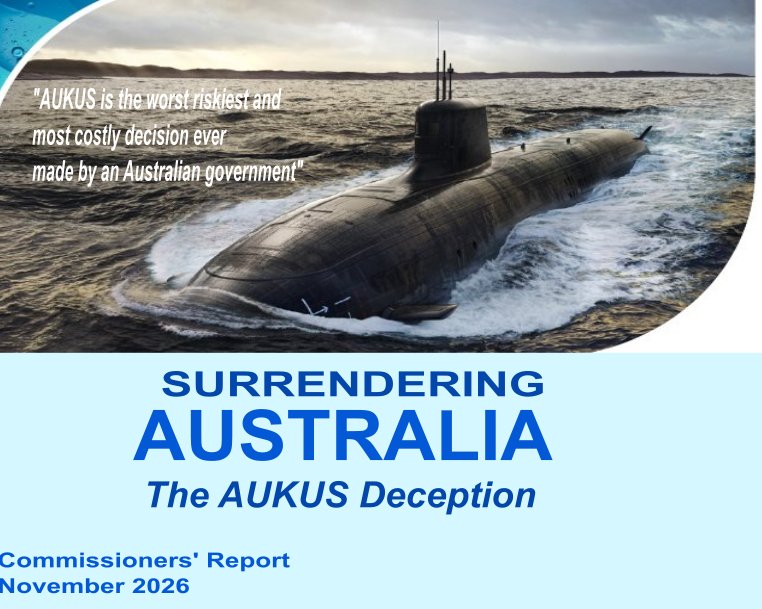
Read the Public Inquiry Report, the Commissioners’ report, Surrendering Australia: The AUKUS Deception is available to download for free at aukuspublicinquiry.com. Or just watch the replay of the National Press Club Luncheon.
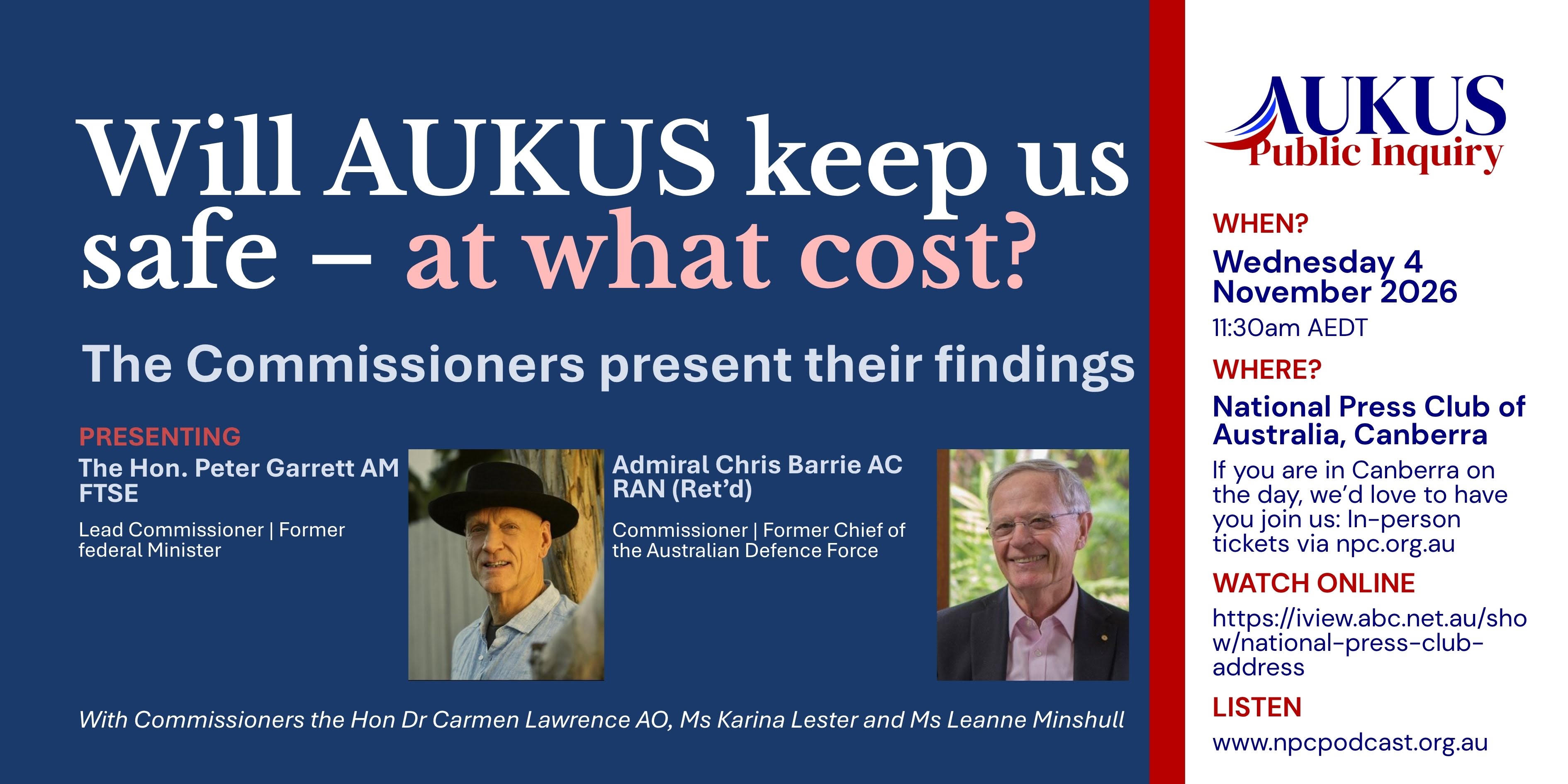
Will AUKUS keep us safe – at what cost?
the Commissioners of the AUKUS Public Inquiry presented their findings at the National Press Club of Australia in Canberra. iview.abc.net.au/show/national-press-club-address
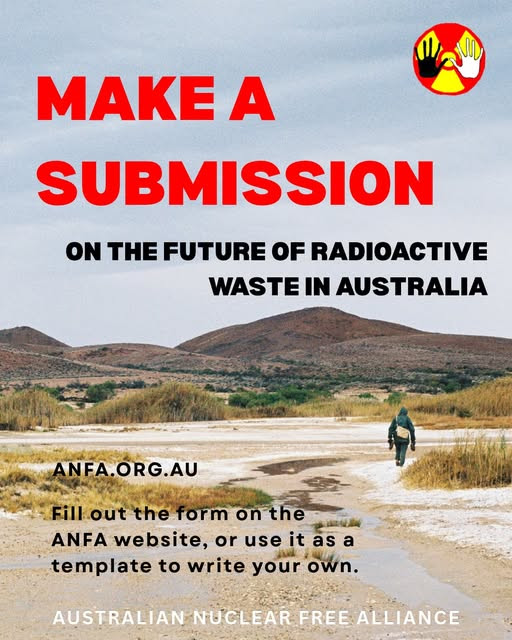
Submissions to the federal government’s new draft framework close on the 13th November 2026.
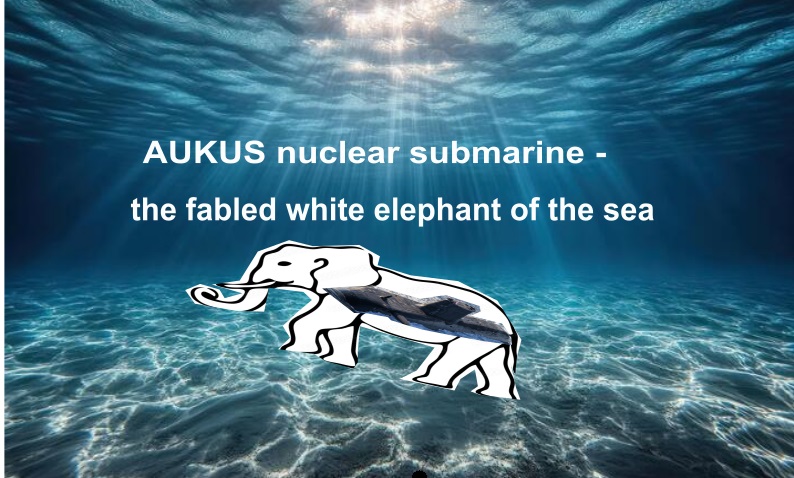
Australians deserve the truth
about
AUKUS – https://aukuspublicinquiry.com/

PETITION – To: Prime Minister Anthony Albanese and the Australian Labor Government

of the week – Australians for War Powers Reform (AWPR)
To see nuclear-related stories in greater depth and intensity

