Malaysian environmentalists and consumer groups dispute Lynas’ claims about radioactive wastes

Lynas is being unscientific, not SAM or CAP https://www.malaysiakini.com/letters/471173 SM Mohamed Idris 6 Apr 2019 Sahabat Alam Malaysia (SAM) and the Consumers Association of Penang (CAP) refer to the letter by Lynas Malaysia reported in Malaysiakini on 5 April 2019, which says that our recent statements about the plant’s wastes are “false and ignore scientific fact.”
The controversy is over the definition of wastes from the Lynas’ water leach purification (WLP) process, which contains thorium and uranium.
Lynas claims that the wastes are naturally-occurring radioactive material (called NORM), while we claim that the wastes are not naturally-occurring, but have been technologically-enhanced and should be called technologically-enhanced naturally-occurring radioactive material known as TENORM.
Citing “two eminent scientists”, Lynas states as fact that “the small amount of thorium and uranium in the WLP generated are not man-made but naturally occurring radionuclides found in soil, water and in food.”
Lynas is clearly distorting the facts.
First of all, the thorium and uranium containing wastes generated by Lynas are not found to naturally occur in the Gebeng area, where the plant is located. On the contrary, the raw material which is processed by the Lynas plant is lanthanide concentrate that contains the thorium, uranium and the rare-earth.
This raw material is processed and imported from the Mount Weld mine in Australia and is brought to Malaysia. It is then subject to further processing in Gebeng by Lynas.
Therefore, how can it be said that say that the thorium and uranium are naturally occurring in the soil, water and in food when they were not there before in the Gebeng area, if not for the Lynas operations?
Moreover, what is even more significant is that we are talking about the generation of an accumulated amount of more than 450,000 metric tonnes of radioactive wastes from the Lynas operations thus far. To call this naturally-occurring radioactive material is indeed unscientific.
Secondly, the wastes that Lynas has generated from the WLP process clearly falls within the definition of TENORM, as defined by the US Environmental Protection Agency (USEPA) as: “Naturally occurring radioactive materials that have been concentrated or exposed to the accessible environment as a result of human activities such as manufacturing, mineral extraction, or water processing.”
The USEPA also states that “technologically enhanced” means that the radiological, physical, and chemical properties of the radioactive material have been concentrated or further altered by having been processed, or beneficiated, or disturbed in a way that increases the potential for human and/or environmental exposures.”
Indeed, Lynas seems to have forgotten that its own Radiological Impact Assessment of 2010 refers to the residues from its operations as TENORM.
Moreover, in a study co-authored by, Dr. Sukiman Sarmani (the “eminent scientist” that Lynas refers to in its letter) and three others (published in 2014 on the Lynas plant residue), shows that the WLP residue has a high radioactivity of Thorium 232 compared to the natural background levels of Malaysian soils and therefore comes under the purview of the regulatory authorities.
These facts fortify our position.
Lynas in its letter also refers to us as “unqualified people.”
For the record, SAM and CAP have very deep and detailed knowledge of how rare-earth plants can impact public health and the environment, having had years of considerable experience from being involved in the Asian Rare Earth (ARE) case in Bukit Merah, Ipoh.
We assisted the people of Bukit Merah over many years countering the claims of ARE, the Atomic Energy Licensing Board, the International Atomic Energy Agency and others.
This we did by being engaged and involved with many scientists and public health experts both from Malaysia and abroad, who helped the community battle in the courts, that finally led to its closure. We have over the years documented the serious health impacts suffered by the Bukit Merah community, that continue till today, due to the impacts of low-level radiation.
Surely our rich experience and knowledge cannot simply be dismissed by the likes of Lynas. SM MOHAMED IDRIS is president of both environmental movement Sahabat Alam Malaysia (SAM) and NGO Consumers Association of Penang (CAP).
Environment Minister Melissa Price confirms Malaysia’s request for Australia to take back Lynas’ radioactive trash
 Minister confirms Malaysian request on Lynas waste, Fin Rev 2 Apr 19 Brad Thompson Environment minister Melissa Price has confirmed receiving a letter from her Malaysian counterpart requesting collaboration on the removal of low-level radioactive waste produced by Lynas Corporation.
Ms Price’s office said on Tuesday that it was premature to comment further until the request had been properly considered.
Malaysia wants Australia to accept 450,000 tonnes of waste created at the Lynas plant near Kuantan in the processing of rare earths from the company’s Mount Weld mine in Western Australia.
A spokesman for Ms Price said Australia’s Department of the Environment and Energy handled import permit applications for hazardous materials on a case-by-case basis.
Similarly, the Australian Radiation Protection and Nuclear Safety Agency handled import permit applications for radioactive material on a case-by-case basis.
It remains unclear how the Lynas waste will be classified. It is understood West Australian authorities would also have to sign off on the transport of any waste within the state, possibly all the way back out to the remote Mount Weld mine.
Lynas refuses to concede it will have to find a way to remove low-level radioactive waste from Malaysia to keep its operations going, despite increasing political pressure.
The Wesfarmers’ takeover target said on Tuesday that it continued to engage productively with the Malaysian government over the waste issue.
Lynas remains optimistic it can resolve the issue within Malaysia despite an order to remove the waste by September if it wants to continue operating its $800 million Kuantan plant.
Lynas, led by Amanda Lacaze, declined to comment on the Malaysian minister’s formal request for the Australian government to collaborate on the waste removal………
Wesfarmers is reported to have told Lynas it is willing to build a first-stage processing plant at Kwinana, south of Perth, to overcome the waste issue. Connect with Brad on Twitter.Email Brad at bradthompson@afr.com.au https://www.afr.com/business/mining/environment-minister-confirms-malaysian-request-on-lynas-waste-20190402-p51a1x?fbclid=IwAR3P_yvHRTW0Z3LAj1bBwWTkFrfdiLP0S9wmykaxQoY-QZfymcRZXtG5U5g
Malaysia wants Australia to help remove Lynas’ radioactive trash from rare earths processing
Malaysia turns up heat on Australia over Lynas waste, Brad Thompson, Fin Rev, 1 Apr 19, A senior Malaysia politician says the Australian government has been asked to collaborate on the removal of low-level radioactive waste produced by Lynas Corporation’s rare earths processing operations.
Deputy environment and climate change minister Isnaraissah Munirah Majilis said an official letter requesting collaboration had been sent to the Australian government last month, in another sign Malaysia is determined to have the waste removed despite suggestions from Lynas it is close to …… (Subscribers only) https://www.afr.com/business/mining/history-stacks-up-against-wesfarmers-and-rare-earths-plant-20190401-p519q3
Lynas considers relocating its rare earths processing to Western Australia
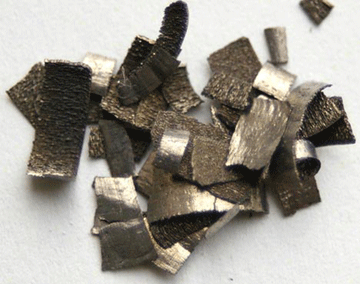 Lynas looks to WA, not Wesfarmers, for its Malay solution, WA Today, By Hamish Hastie, Colin Kruger and Darren Gray, March 27, 2019 Western Australia might hold the key to Lynas Corp’s future despite the rare earths miner rejecting a $1.5 billion takeover offer from Perth-based Wesfarmers on Wednesday.
WA’s Environmental Protection Authority (EPA) confirmed it had recently met with the company to discuss approvals in the state.
“These discussions are preliminary in nature and no formal submission for any change has been presented to the EPA,” a spokeswoman for the agency said.
The discussions could help solve the problems in Malaysia which threaten the company’s future, and made it vulnerable to what analysts and investors described as a low-ball bid from Wesfarmers on Tuesday.
Lynas faces an uncertain future after the Malaysian government imposed strict new conditions on its billion-dollar Malaysian operation which could force it to shut down in September.
This includes the permanent removal of a residue with naturally occurring radiation, Water Leached Purification Residue (WLP), from Malaysia.
According to institutional investors, Lynas discussed plans last month to relocate some of its rare earths processing back to Western Australia. All processing is currently handled in Malaysia.
Lynas chief executive Amanda Lacaze denied there was any plan to extract and retain the controversial WLP residue in WA – the state where it is mined – but did confirm it planned to expand its processing operations outside of Malaysia.
She confirmed that Western Australia was a contender.
We operate in a growth industry and we are looking at how we grow our business with the market,” Ms Lacaze said.
According to the EPA, in February 2017 the rare earths miner applied to make changes to conditions of its rare earths operation at its Mt Weld mine in Laverton, 700 kilometres north east of Perth, and “secondary processing” at Meenar in the Shire of Northam 100km north east of Perth.
Lynas received approval for the mine and Meenar processing facility in 1998, but decided to set up its processing plant in  Malaysia instead.
Anti-nuclear groups had fought the facility in both countries over concerns about rare earths radioactive by-product thorium.
On Wednesday, Ms Lacaze played down the Wesfarmers bid, saying the highly conditional nature of the approach meant there was “nothing substantive with which to engage”.
“This business is not for sale,” she told the media after the company said “it will not engage with Wesfarmers on the terms outlined in the indicative and highly conditional proposal”.
Lynas said its key assets included its position as “the only significant” rare earths miner and processor outside of China, and its Mt Weld ore body – a long life Tier 1 asset……… https://www.watoday.com.au/business/companies/lynas-looks-to-wa-not-wesfarmers-for-its-malay-solution-20190327-p5186c.html
Lynas silent on long-term effects of radioactive waste
|
Lynas silent on long-term effects of radioactive waste, says Fuziah, The Star (Malaysia) By Ong Han Sean , KUANTAN: Kuantan MP Fuziah Salleh slammed rare earth materials producer Lynas for being silent on the long life of its radioactive waste, which she claimed could have long-term effects on people’s health and the environment.”Lynas is very good with their messaging strategy that it is easy to fall for their low level radiation narrative. Lynas has always been silent on the long life, very, very long life, 14-billion-years half-life of thorium in their radioactive waste.
“Unfortunately many people in the government fell for it and were convinced by their narrative too,” said Fuziah. She added that most people found it difficult to comprehend and thought the anti-Lynas activists were politicising the issue due to Lynas’ narrative. She said this would have an effect on the villagers living around Gebeng, some of whom were still dependent on tube wells for daily water use.
“Yes, we welcome FDIs but not ones like Lynas. We welcome FDIs to the point that I am assisting them to resolve the water shortage issue that industries are facing right now. “However, industries that pollute and think they are above the law are not welcomed in Kuantan. And Pahang for that matter,” said Fuziah, who also is Deputy Minister in the Prime Minister’s Department…………… “Malaysia adopts the International Commission on Radiological Protection limits of exposures for both workers and the public and Lynas is fully compliant with these limits,” the company said in a statement signed by Lynas Malaysia managing director Datuk Mashal Ahmad and radiation safety, regulations and compliance general manager Prof Ismail Bahari. The statement added that all residue storage at Lynas Malaysia had been approved by regulators and very low level radioactive residue produced by the company was not unique in Malaysia………. “The ministry’s review committee did not suggest that any increase in the concentration of heavy metals in groundwater was due to Lynas Malaysia. “However, it recommended further research on groundwater in the Gebeng industrial area. Lynas, in collaboration with accredited laboratories, is currently carrying out its own independent investigation to rule out any contribution from our operations,” it said. https://www.thestar.com.my/news/nation/2019/03/31/lynas-silent-on-long-term-effects-of-radioactive-waste-says-fuziah/#5clQ0xKUP87uV2QR.99 |
|
|
What’s the radioactivity level of Lynas’ refinery thorium wastes?
https://m.malaysiakini.com/letters/458037, Citizens’ Health Initiative. Chan Chee Khoon, 29 Dec 2018, Lynas has repeatedly stated that the specific (radio)activity of their water leach purification (WLP) residues is low (but still above Malaysia’s regulatory limit of 1 becquerel per gm of material [the becquerel (Bq) is a measure of radioactivity, equal to the number of nuclear decays per second]:
“The WLP residue, although classified as radioactive material, has the same radioactivity level as the feedstock material (rare earth ore concentrates) used in the Lamp process (about 6 Bq/g of Th)”.
(More accurately, this should read 6Bq/g of WLP – pure Th232 has a specific activity of 4070 Bq/gm of thorium, so 1655ppm of Th232 in WLP residues would contribute 6.7 Bq/gm of WLP).
But saying that each gram of WLP contributes 6Bq of radioactivity amounts to saying that Th232 decays in a single step to a stable element which is not radioactive. Clearly, this is not the case as is evident from the decay chain for Th232 below: [on original]
In a stable equilibrium, the number of nuclear decays for each of the subsequent radioactive progenies in the Th232 decay series is equal to the number of nuclear decays of Th232.
Hence the specific activity of WLP would be 10x the Bq counts contributed solely by Th232 nuclear decays (followed by nine other nuclear decays in the decay chain of progenies in the figure above).
In line with this, p.38 of the Radiological Impact Assessment (Nuklear Malaysia, June 2010) stated that Lynas’ refinery would produce “32,000 tons per year of water leach purification residue (WLP) with radioactivity concentration of 61 Bq/g containing 1,655ppm (6.62 Bq/g) thorium-232 and 22.5ppm (0.28 Bq/g) of uranium-238”.
It is noteworthy that the RIA arrived at this estimate despite this qualification:
“All but one of the daughter products of thorium-232 is a solid. The one exception is radon-220, an isotope of radon, but commonly referred to as thoron [half-life 55 seconds]. There is a possibility of thoron being able to emanate from the concentrate, the residue or thorium bearing contaminated materials so that the entire radioactive series may not be in secular equilibrium. When in secular equilibrium the thorium-232 radioactive series has an activity ten times the activity of thorium-232”) (p.41)
Likewise, the Preliminary Environmental Impact Assessment includes a table on page 5-55 which states that the WLP contains 1655ppm of Thorium Oxide and 22.5ppm of Uranium Oxide, for a total specific (radio)activity of 62.0 Bq/g of WLP, i.e. 10 times the specific activity announced.
Lynas should explain why it is taking the boundary case (equivalent to a one-step decay of Th232 to a non-radioactive progeny), rather than in a decay chain including nine other radioactive progenies, occurring in a low-permeability clayey mass of WLP residues, which would retain much of the short-lived Thoron 220 and its decay progenies, and thus approximate a closed system tending towards secular equilibrium.
Electric cars, and the hazards of rare earths used in them
The electric-car revolution is here, but is that a good thing for the environment? ABC , By environment reporter Nick Kilvert for Life Matters 8 Dec18 “……..Rare earth metals like neodymium are often used in the batteries and magnets of electric cars, but there’s a catch, according to geologist Carl Spandler from JCU.
“There’s an association with rare earth ores with uranium and thorium, and they’re radioactive,” Associate Professor Spandler said.
Rare earth deposits are often found alongside uranium and thorium, meaning when you mine one, you get both.
In 2011, Mitsubishi spent $100 million on a quiet clean-up of a rare earth plant run by subsidiary company Mitsubishi Chemical near the villages of Ipoh and Papan in Malaysia.
From the time the plant opened in 1982, locals complained of eye-watering smoke and foul odour, and as time went on, villagers say they saw increased birth defects and leukemia.
Mitsubishi eventually removed more than 11,000 truckloads of radioactive material from the site, contaminated with thorium.
Despite the name, rare earths actually aren’t very rare at all, and there are significant deposits in Australia.
Australian company Lynas mines rare earths at its Mount Weld site in south-eastern Western Australia.
But the ore is shipped to Malaysia for processing where locals, whose limited experience with the rare-earth metals industry hasn’t been good, are in staunch opposition.
This week, Malaysia set new conditions on the Lynas plant, including that they must remove all radioactive by-products produced at the refinery, from Malaysia.
Some mining in China also has a poor environmental and social track record, according to Dr Spandler.
“They had small-scale operators just strip mining, but they’ve cut down on that quite a bit now because it was really doing a lot of damage to the environment.”
But despite the risks, radioactivity in rare earths is probably not such a big issue for Australian mines like Lynas, according to Dr Spandler.
“The mining companies are very well aware of [the radioactivity issues]. They’re obviously under strict regulations that they’ve got to control the radioactivity of their waste material and have a proper plan in place for how they deal with that waste,” he said.
“All of the [Australian] projects that are in the pipeline or up and coming now, they have fairly low levels of uranium and thorium, so they’re fairly manageable.”…… https://www.abc.net.au/news/science/2018-12-08/electric-cars-revolution-environment/10589270
Lynas contemplates importing radioactive trash into Australia
Brokers remain optimistic on Lynas despite Malaysian setbacks, SMH, By Colin Kruger, 6 December 2018 Analysts remain optimistic about the future of ASX-listed rare earths miner Lynas Corp, suggesting there may be ways around the onerous conditions put on the renewal of its operating licence in Malaysia.
Despite this, UBS has valued Lynas on a “business-as-usual basis” on the grounds that the problems are not insurmountable.
There may be grounds for appeal. The ministry is planning to implement a much stricter regime than the independent expert panel was recommending,” UBS analyst Daniel Morgan said in a research note. ….
According to UBS, Lynas may be able to economically ship the radioactive waste to another country – possibly Australia. And in a worst-case scenario, it could sell its concentrate product to China for processing while it restructured its processing.
One option is for Lynas to split out the processing stage that produces the residues that have caused problems in Malaysia.
“Lynas may be able to invest in a cracking and leaching facility in Australia, keeping the [waste] in the country.” Lynas would then ship the concentrate to Malaysia for the final stage of extraction using its existing facilities.
CLSA was also optimistic, saying the low-level radioactivity meant the waste could be shipped in regular shipping containers. And Lynas had access to rehabilitation funds to help pay the bill……..
Outside China, Lynas is the only processor of rare earths, which are crucial for elements of the new economy like mobile phone components, electric cars and batteries.
The miner’s shares shares nearly halved in value in May when Mahathir Mohamad unexpectedly defeated his former ruling party and then announced a review of the Lynas operation as promised……..
Lynas earlier this month flagged a temporary shutdown of its Malaysian processing plant, which could cost the company $16 million in lost revenue, if it doesn’t win local government approvals to lift production caps. safe…….https://www.aljazeera.com/news/2018/12/malaysia-tells-lynas-remove-rare-earths-radioactive-waste-181204085233206.html
Save Malaysia Stop Lynas (SMSL) group calls on Malaysian govt to shut down Lynas rare earth refinery
Shut down Lynas plant immediately, Harapan gov’t urged, malaysia kini 12 Nov 2018, Anti-Lynas group Save Malaysia Stop Lynas (SMSL) has called on the Pakatan Harapan government to immediately shut down the Australian-owned Lynas rare earth refinery plant in Gebeng, Kuantan.
In a statement after a public meeting held by the Lynas Review Committee in Kuantan, SMSL said that the citizens have demanded the shutdown of Lynas, which was evident by the presence of about 600 people at the meeting….
SMSL, which has been campaigning against the operation of the plant since 2011, said that several court cases have been initiated to stop the then-Najib government from issuing Lynas Corporation the licence to operate and leave massive amounts of waste contaminated with radioactive materials.
These include thorium and uranium, and hazardous substances like arsenic, cadmium, chromium and lead as well as chemicals from its refinery plant using ore concentrates from its Australian mine.
SMSL legal adviser Hon Kai Ping claimed that Lynas had breached its licensing conditions in many ways and there has been no subsequent action from the regulators. …..
SMSL said Lynas’ water leached purification residue (WLP) waste has radioactivity of close to 8Bq/g, according to a 2014 UKM research findings, eight times higher than the regulatory exemption limit.
“According to a Department of Environment document, over 450 kilo-tonne of WLP waste is now stored next to the refinery plant in dams lined only with thin HDPE (high-density polyethylene) plastic…….
It said that Lynas has proposed to turn its wastes into various commercial products – from building and road paving materials to a soil filler known as Condisoil.
It added that all of the proposed diluted products by Lynas, when released to the market, will almost certainly exceed the 1mSv/year cumulative dose limit, posing serious health and environmental risks to the whole country.
“The toxic legacy of Bukit Merah was created from monazite from our domestic tin tailing……
Pahang Department of Environment (DOE) director Rosli Zul said in his presentation that Lynas had indeed followed rules imposed by authorities since it began operations. https://www.malaysiakini.com/news/451530?fbclid=IwAR2fGT-ABGsw7Rxxv8jm3POzWdeSRKgTs_1tO30VFpd9uaph0h3Es9ohjBI
Radioactive pollution problems: Australia’s rare earths mine in Malaysia
Australian mining plant in Malaysia faces radioactive waste inquiry, As China, the world’s largest producer of rare earth metals, scales back its export operations, the future of Australia’s industry is under a cloud. https://www.sbs.com.au/news/australian-mining-plant-in-malaysia-faces-radioactive-waste-inquiry By Jarni Blakkarly 30 Oct 18, The Chinese government has announced a slashing in the production of rare earth metals, a type of metal used in a range of high-tech products from mobile phones to wind turbines and electric cars.
The country, which is the largest producer and consumer of rare earth metals, has cut its quota for the separation and smelting of rare earths by 36 percent, Reuters reported last week.
China produces roughly 80 per cent of the world’s rare earth metals and the move will likely send global prices skyrocketing. Meanwhile, the joint Australian-Malaysian rare earths operation run by Perth company Lynas, the only major production plant outside of China, is having its own problems.
Earlier this month, the Malaysian government launched a broad parliamentary inquiry into the mine and the management of its radioactive waste.
The Australian company mines rare earth metals in Western Australia before shipping them to Malaysia for processing.
Resources analyst Dylan Kelly from finance group CLSA told SBS News: “It is really critical in a strategic sense as the only real rare earth producer outside of mainland China and one that is high in quality and it is highly sought after in terms of strategic interest, not just for the Japanese, but also the US.”
But questions remain over the management of radioactive waste from the plant and what long-term solutions are in place for its management.
RMIT Professor of environmental engineering Gavin Mudd told SBS News all rare earths processing involves the generation of radioactive thorium and sometimes uranium waste.
The company’s current long-term waste management plans involve repurposing that waste into a soil fertilizer product, but Professor Mudd says not enough has been done yet to guarantee the by-product would be safe.
“Historically the rare earths industry hasn’t got a good track record in being able to demonstrate that safety case,” he said.
While the current government inquiry appears unlikely to shut the processing plant down in its entirety, Professor Mudd says more can be done in terms of increasing environmental reporting and public disclosure around the plant.
Lynas declined to comment to SBS News ahead of the inquiry, but in the past has defended its waste management practices as safe and transparent.
When the plant was approved in 2012 it set a wave of protests by thousands of concerned locals, which was largely ignored by the government.
But with the Opposition coming to power in a surprise election victory in May, the new government is taking a closer look at the plant.
Local Kuantan MP Faziah Salleh says the company needs to develop a new long-term storage plan for the radioactive waste.
“The company has to think about how they dispose of their radioactive waste, because Malaysians, especially people of [the city of] Kuantan, will not except the waste being left … dumped in our backyard, as it is right now,” she said.
The inquiry is due to report back to the government before the end of the year.
Department of Industry, Innovation and Science chief economist enthusiastic about the lithium industry
|
Lithium ‘buzz’ could be worth hundreds of billions to Australia, WA Today By Hamish Hastie, 2 October 2018 —Australia has the potential to capture more wealth and jobs from its lithium sector by moving down the battery supply chain but this would be contingent on a number of factors, one of the federal government’s top economists thinks.
In his resources and energy quarterly update Department of Industry, Innovation and Science chief economist Mark Cully said lithium and battery demand could result in billions of dollars for a country that grabbed the opportunity………https://www.watoday.com.au/business/the-economy/lithium-buzz-could-be-worth-hundreds-of-billions-to-australia-20181002-p507cb.html |
|
|
Another lithium mine opened in Western Australia
WA’s newest lithium mine plans to double down, WA Today By Hamish Hastie, 5 September 2018 Western Australia’s newest lithium mine was officially opened this morning, marking the seventh operating mine in the state.
Altura Mining’s 100 per cent-owned Pilgangoora lithium mine is located 90 kilometres south-east of Port Hedland and will support 130 ongoing jobs. The mine will produce about 220,000 tonnes per annum of lithium spodumene concentrate but the company is already considering plans to double production to tap into growing global battery demand for electric vehicles and storage.
The Pilgangoora lithium deposit currently has an ore reserve estimate of 41.1 million tonnes…..
Beyond just exporting lithium the state government’s lithium and energy materials industry taskforce is investigating the state’s ability to produce and process lithium and other energy materials.
The taskforce will present a lithium and energy materials strategy to cabinet over the next few months……https://www.watoday.com.au/business/companies/wa-s-newest-lithium-mine-plans-to-double-down-20180905-p501v3.html?crpt=index
Australia’s first lithium battery recycling plant established in Gisborne, Victoria
Australia’s first lithium battery recycling plant launched https://reneweconomy.com.au/australias-first-lithium-battery-recycling-plant-launched-19366/, By Sophie Vorrath on 27 April 2018
Australia’s first lithium battery recycling plant has been officially anointed in Victoria, in conjunction with the launch of $16.5 million state government e-waste processing plan.
The plant, established in New Gisbourne by Victorian company Envirostream Australia, is the first in the nation to recycle lithium batteries – the now ubiquitous power source for mobile phones, tablets, electric cars and home energy storage systems.
But while batteries – and in particular lithium batteries – are playing a central role in facilitating the world’s digital and clean energy revolutions, only 3 per cent of Australian batteries are currently recovered – the lowest rate in the OECD.
Envirostream’s $2 million recycling facility, which began operations last year, is trying to change that. In 2017 alone, the plant recycled 240,000 kilograms of batteries that would otherwise have gone to landfill, or been shipped to China for processing
Electronic waste – or e-waste – is defined as anything with a plug or battery that has come to the end of its useful life; including old mobile phones, computers, audio devices, refrigerators and other white goods, hair driers, TVs, heaters and air-conditioners.
The amount of e-waste generated in Victoria is projected to increase from 109,000 tonnes in 2015 to approximately 256,000 tonnes in 2035.
The plan, which is being rolled out by Sustainability Victoria, comes ahead of the impending state ban on sending e-waste to landfill, which takes effect on 1 July 2019.
It includes $15 million in grants to help Victorian councils and state government entities upgrade infrastructure to collect e-waste at more than 130 sites.
This will ensure that 98 per cent of Melburnians are within a 20-minute drive of an e-waste disposal point, and 98 per cent of regional Victorians are within a 30-minute drive of one.
It will also include a $1.5 million awareness campaign to educate Victorians on recognising e-waste, how it should be managed, and the environmental and economic benefits of reusing, donating, repairing or recycling it.
To Envirostream, Sustainability Victoria has extended a grant of $40,000 to go towards boosting the company’s recovery of valuable materials in lithium batteries.
“As one of the country’s trailblazers in reprocessing electronic waste, it’s helping to keep valuable resources out of landfills,” said Sustainability Victoria CEO Stan Krpan.
“Envirostream is showing how opportunities can be developed in Australia’s resource recovery sector, create jobs in regional communities and capture valuable chemicals, copper, steel, nickel, lithium, other metals and graphene captured so they can be sent to South Korea to be used in new batteries.”
Envirostream Director, Andrew McKenzie, said recycling batteries at New Gisborne would create five new jobs over the next year and help build Victoria’s recycling capacity.
“We have a nationally coordinated partnership to increase Australia’s low recovery rates of batteries and mobile phones and want to make sure these recoverable resources are not just thrown away or sent offshore for recycling.”
“We’re in an increasingly mobile world. Lithium batteries are now the dominant mode of energy storage for domestic and industrial uses, and like other e-waste, their use is growing fast,” he said.
Rare earths mining in Central Australia approved
EPA approves $900m rare earths mine in Central Australia despite radioactive risk, ABC News, By Ben Millington, 5 Jan 18,A proposed $900 million rare earths mine in Central Australia has been recommended for approval by the Northern Territory Environment Protection Authority (EPA), after an assessment process lasting more than two years.,
Arafura Resources’ Nolans Project at Aileron, 135 kilometres north-west of Alice Springs, would mine rare earth materials such as neodymium and praseodymium, used to manufacture strong magnets for wind turbines and electric vehicles.
The EPA identified several long-term environmental risks and impacts with the project, but found they could be managed.
“There will have to be a high level of operational management control for this project over a couple of generations, and there’ll have to be a high level of regulatory scrutiny, there’s no two ways about that,” EPA chairman Paul Vogel said.
The primary risks include the permanent storage of naturally occurring radioactive material onsite and the use of significant groundwater resources over the 35 to 55-year lifespan of the project……http://www.abc.net.au/news/2018-01-05/epa-approves-rare-earth-mine-in-central-australia/9306610
Some recycling of lithium already going on in Australia
 LITHIUM ION BATTERIES ore http://www.batteryrecycling.org.au/recycling/lithium-ion-batteries The number of lithium-ion reaching end of life is expected to increase exponentially over the next 20 years. A report from Randell Environmental Consulting and Blue Environment can be downloaded here.
A report from Anna Boyden on the environmental impacts of lithium ion batteries provides useful background material and can be downloaded here.
Lithium-ion batteries (UN No. 3480) are classified as Dangerous Goods under the Australian Code for the Transport of Dangerous Goods by Road and Rail (ADG Code).
The ADG Code requires all dangerous goods, including lithium ion batteries, to be carried in a secure, safe and environmentally controlled manner. The carrier has the right to refuse carriage if dangerous goods are not packed in accordance with the regulations. There is a special provision (377) and packaging instruction (P909) for ‘lithium ion and lithium metal cells and batteries and equipment containing such cells and batteries transported for disposal or recycling, either packed together with or packed without non-lithium batteries…’
The following ABRI members provide a collection and recycling service for used lithium-ion batteries. Contact the company or check their web site for details. Continue reading
1 This month

of the week – Australians for War Powers Reform (AWPR)
To see nuclear-related stories in greater depth and intensity
 Antinuclear