Norther Territory may be close to getting a lithium mine
NT lithium mine moves closer
THE push to build and develop the Northern Territory’s first lithium mine is gaining momentum
http://www.ntnews.com.au/business/nt-lithium-mine-moves-closer/news-story/fe9071bc2a42cbc28bbdb9fe5a741369
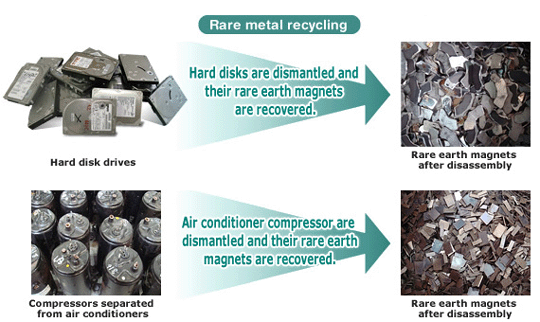
Lithium Australia – company seeks to recycle rare earths
Car industry revolution fuels Western Australia’s lithium boom, ABC News, By Kathryn Diss, 29 July 17
“……..’We can’t afford to keep throwing these things away’
Demand is also growing for other specialty minerals which go into building a battery, including graphite, cobalt, vanadium and nickel.
While the focus for most miners has been getting their lithium to market as quickly as possible, other players like Lithium Australia is targeting lower grade lithium and recycling of old batteries.
“Our focus has been developing processing technology to a large extent focusing on the materials people don’t want to process at the moment,” Lithium Australia managing director Adrian Griffin said.
“If you look at the industry, there’s more lithium that gets discharged to waste around the world than ever gets into the process supply chain.
“One of the things Australia really needs to look at is the recycling of waste battery materials.
“We can’t afford to keep throwing these things away: At the moment there’s about 8,000 tonnes a year of battery materials going to landfill and there’s only about 800 tonnes recycled.” http://www.abc.net.au/news/2017-07-29/car-industy-lithium-revolution-driving-next-mining-boom-in-wa/8748322
Western Australia’s boom in lithium mining
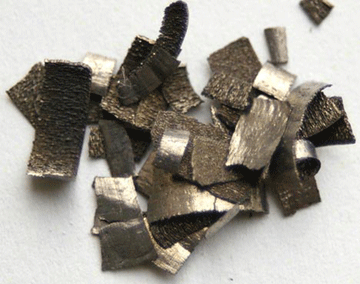 Car industry revolution fuels Western Australia’s lithium boom, ABC News, By Kathryn Diss, 29 July 17, Electric cars are driving rapid mining investment in WA, with the state supplying most of the lithium needed to manufacture batteries worldwide.
Most electric vehicles (EVs) use lithium-ion batteries, the same technology which powers smartphones, tablets and laptops.
As car makers around the globe race to meet new EV targets, demand for batteries has driven lithium exports from WA as the state now produces more than half of the world’s supply.
Global leaders have been behind the push, with new European emissions legislation forcing car markers to increase their targets and France recently announcing it wanted to end the sale of petrol and diesel cars by 2040.
It joins similar targets set by India (2030) and Norway (2025).
The British Government is also set to ban the sale of petrol and diesel cars from 2040 as part of a plan to clean up air pollution.
Growth in demand ‘surprised most analysts’
Batteries to store household solar power, which would allow consumers to disconnect from the electricity grid, are also driving demand to a lesser extent.
“The speed at which demand has grown for lithium carbonate equivalent has surprised most analysts, ourselves included,” Katana Asset Management’s Romano Sala Tenna said.
“Up until a few months ago the conventional thinking was by about 2025, we would need about 330,000 tonnes per annum of lithium carbonate, [but] based on recent announcements from larger automobile manufacturers, we are now thinking we will need at least double that — about 600,000 tonnes per annum.”
While that may sound small compared to the 800 million tonnes the state’s iron ore industry exports each year, the activity in the sector is already creating thousands of new jobs and generating millions in royalties for the cash-strapped WA Government.
The Greenbushes mine in the state’s South West, which is part owned by China’s Tianqi Lithium and America’s Albemarle, is one of the world’s largest lithium producers and is undergoing an expansion to double production.
The mine has seen both boom and bust since starting out as a tin operation in 1888, but is now on the cusp of another upswing — laying claim to what was considered the world’s highest grade lithium deposit.
“It is the longest continuously running mine in Western Australia and it’s on its third product. It just seems to keep producing new life,” Tianqi Lithium general manager Phil Thick said.
“Lithium is obviously a game changer for that mine. It’s been significant as a tin and tantalum mine, but lithium value is substantial.”
The joint venture is also building what it claims to be the biggest lithium processing plant in the world in Kwinana south of Perth. The project will cost $400 million and create 500 construction jobs.
‘More than just a mini-boom’
Growth in the sector has been rapid.
In January, the state had just one mine producing lithium — it now has four and exports have jumped six-fold.
Business observer Tim Treadgold has witnessed big changes in WA’s mining landscape during his 40 years commentating on the sector.
“This is more than just a mini-boom, this is the real McCoy, we could go from one [mine] two years ago to eight by this time next year. It really has been quite remarkable what’s going on,” he said.
Activity in the sector is attracting big names including Chilean major Sociedad Química y Minera de Chile (SQM) which has inked a deal to bankroll a new deposit in the Goldfields with Kidman Resources.
It includes plans to build a $100 million refinery at either Bunbury, Perth or Kalgoorlie.
The deal was announced just days after Kidman won a Supreme Court battle against another miner to maintain control of the mine.
“The world has beaten a path to our door. The arrival of SQM was a real wakeup call that the world wants it and it’s coming here and it’s prepared to pay for it,” Mr Treadgold said……….http://www.abc.net.au/news/2017-07-29/car-industy-lithium-revolution-driving-next-mining-boom-in-wa/8748322
Bid for rare earths mining and processing in Australia

Is there any awareness in Australia of the dangers of toxic radioactive trash from rare earths mining and processing?
Next mining boom in Australia will be driven by tech metals for renewable energy and technologies ABC Rural By Babs McHugh, 17 Apr 17 The Australian mining industry is on the verge of a new mining boom based around so-called tech metals.
And as the race cranks up across the nation to find new deposits of rare earths and other metals, industry itself is calling for the development of a value-adding component……
The tech metals complex is made up of rare earths and other minerals and metals that are used in what is referred to as the new economy. They are essential to making high technology componentry such as mobile phones, solar cells and autonomous vehicles.They are also used to make the different kinds of batteries needed to store power from renewable sources, and new types of lightweight engines to replace traditional combustion engines……..
Rare earth hunters also want local value-adding industry There are 17 rare earth elements on the periodic table, falling into the heavy rare earths or light rare earths depending on their atomic weight.
Up until recently, all rare earths were mined and exported from China, which has had a stranglehold on the industry and its pricing. Given their global importance, the race is well and truly on to find more rare earth deposits, and Australia is a favoured hunting ground.
“They’re actually quite ubiquitous in the Earth’s crust,” Arafura Resources managing director Gavin Lockyer said.”Why they’re associated with the term rare is the fact that it’s rare to find them in an economically recoverable quantity.”
Australia the perfect place for processing Arafura Resources has done that with its Nolans Bore project 135 kilometres north-west of Alice Springs in the Northern Territory.The find is considered significant, featuring a 56-million-tonne deposit with a 40-year mine life. It is full of neodymium and praseodymium, which is used to make magnets, the bulk of which are now sourced from China.
“We really think there’s much more value-add to be had by doing downstream processing, and Australia is the perfect place to do that. “We’ve got an existing regulatory environment that covers things like water usage, environmental aspects, air pollutants, transport and disposal. “There’s already a well-established regime and bureaucracy in place to regulate that, and we think it’s better to do that at the mine site where it all happens, rather than trying to do it offshore and making it somebody else’s problem……http://www.abc.net.au/news/2017-04-17/next-mining-boom-in-australia-is-tech-metals/8443172
Plans for rare earths mine in Northern Territory
$1.19bn rare earths mine’ step forward http://www.ntnews.com.au/business/119bn-rare-earths-mine-step-forward/news-story/75f63a8e5614002de0d86010ea1871f6 ASHLEY MANICAROS, NT News
Arafura plans to mine, concentrate and chemically process rare earths at the Nolans site, 135km north-northwest of Alice Springs.The project is estimated to create up to 500 jobs in the two-to-three year construction phase, and employ a peak workforce of 300 in the operation phase, which is expected to exceed 40 years.
Construction is estimated to cost $866 million at Nolans, including an estimated $145 million in the Territory and $70 million in Central Australia. It is expected to cost $188 million a year to operate.
The draft EIS and associated specialist studies were on public exhibition for eight weeks last year and attracted 21 submissions, mostly from government departments.
Arafura’s NT general manager Brian Fowler said they were hoping to complete the environmental part of the project this year.
“All matters raised in these submissions were provided to Arafura for consideration and are responded to in the EIS supplement,” he said.
“We look forward to completing the approvals process for the environmental component of the project later this year.”
Rare earths are a collection of 15 elements in the periodic table that are relatively abundant in the earth’s crust, but uncommon to find in quantities that can be recovered economically, Mr Fowler said.
“They are essential to products with significant growth potential in markets associated with the electronics and technology industries, energy efficiency and greenhouse gas reduction,” he said.
Until recently, rare earths were mostly mined, processed and refined in China and, along with Japan and the USA, China accounts for most of the world’s demand for rare earths. Continue reading
Lynas Rare Earths shares at all-time low
A tiny paragraph on page 25 of the business section of The Age (print version 29/6/15) tells that Lynas shares have plunged. Meanwhile Alkane resources, near Dubbu, NSW, is launching mining of rare earths.
What The Age didn’t tell us, in this tiny paragraph – is what is happening about the reprocessing of these rare earths, and disposal of the highly radioactive wastes. . I’m pretty sure that in the case of Alkane – thi is to be done in China. China, having learned very much the hard way, has now become a lot more careful about these wastes.
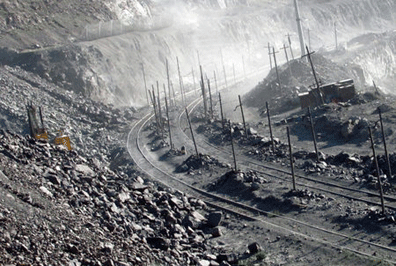
In the case of Lynas, they plan to process the rare earths in Malaysia. Lynas has been vague on what they planned to do with the radioactive wastes. No wonder the Malaysians objected – as they too have in the past, suffered a rare earth’s wastes radioactive disaster. No wonder Lynas is struggling now.
Rare earths AND URANIUM company allying with Clean Energy Council
 We do need to keep an eye on rare earth developments. In the longer term, recycling must be the major way to obtain these. In the shorty term, rare earths are needed, but require vigilant management because of their radioactive toxicity, and need for secure radioactive wastes disposal
Yellow Rock Resources has been accepted as an associate member of the Clean Energy Council of Australia.
Yellow Rock Resources (ASX:YRR) has been accepted as an associate member of the Clean Energy Council (CEC) of Australia.
The membership will allow Yellow Rock to engage with industry participants and policy makers.
Yellow Rock’s admission as a member demonstrates the company’s commitment to developing its world-class Gabanintha vanadium deposit in Western Australia specifically for emerging technology servicing the renewable energy market.
Gabanintha is a project which has the ability to support renewables as a supplier of vanadium for Vanadium Redox Battery technology.
Yellow Rock in discussions with renewable energy suppliers
Yellow Rock has initiated discussions with renewable energy suppliers SunEdison and Total Energy Australia, among others, focused on potential collaborative opportunities at Gabanintha.
Vincent Algar, chief executive, commented: “The latest excellent drilling results give us another opportunity to expand our relationships in the financial and renewable energy sectors.
“Gabanintha is a project which has the ability to support renewables as a supplier of vanadium for battery storage technology.
“In addition, Gabanintha can be supported by renewable energy generation to reduce its own operating costs, making it a unique opportunity for investors.”
About Gabanintha
The Gabanintha deposit is an intrusive layered intrusive body smaller, but displaying similar characteristics to the igneous Bushveld Complex, host to some of the world’s most significant platinum, vanadium and chromite deposits.
The project will have continued newsflow over coming weeks as more results flow through from the recent reverse circulation drilling program. commence on receipt of all assay results.
Currently 167 historical drill holes support an Inferred Resource of 125 million tonnes at 0.70% vanadium, 8.64%TiO2 and 32.6% iron.
This includes a separate high grade Indicated and Inferred Resource of 60.4 million tonnes at 0.98% vanadium, 11.4% TiO2 and 42.15% iron.
Opposition to Australian uranium/rare earths mining company in Greenland
 Uranium opponents look to other sectors for job growth Opponents of uranium mining in southern Greenland have put forward a list of proposals they believe can create jobs and in the process make a highly contested mine unnecessary The Arctic Journal, May 13, 2015 – By Kevin McGwin In the town of Narsaq, on Greenland’s southern tip, debate is coming to a head over whether residents can make do without a near-by mine that will create jobs, but which some fear will make the town unliveable.
The concerns come as Greenland Minerals and Energy, an Australia-based mining outfit, closes in on final approval to begin production rare earths, a mineral vital for use in modern technologies……
in order to extract rare earths, GME will also need to mine uranium as a by-product, and that has raised fears, particularly among farmers, sheep farmers and those making a living off tourism, that dust from the open-pit facility will taint the region’s soil and water, and in the process spoil the region’s image. Continue reading
Recycling of rare earths – an industry already under way
Recycling gives old electronics new life JAMIE DUNCAN AAP MAY 01, 2015 Herald Sun
IMAGINE a world in which billions of dollars of gold, silver, platinum and other precious metals are thrown into a pit like rubbish.
IT seems unlikely, but it’s happening now at landfills around the globe.
- A recent United Nations University report found consumers threw out 41.8 million tonnes of unwanted electronics, or e-waste, in 2014 but recycled only 6.5 million tonnes.That discarded e-waste included an estimated $US52 billion ($A65.78 billion) of precious and other metals.Rose Read, recycling manager with MobileMuster (MobileMuster), says recycling components from e-waste is good for the economy and the environment.”The benefits are massive, and not just in terms of dollar value, but also the environmental benefits of slowing the rate of mining,” Ms Read told AAP.”The amount of energy it takes to recover product materials from a mobile phone is a tenth of digging them up.”MobileMuster is a federal government-accredited product stewardship scheme funded voluntarily by a range of mobile phone manufacturers and retailers that collects unwanted mobiles to recycle components.A similar scheme operates for end-of-life televisions.Consumer thirst for the latest technology is forcing the need to recycle e-waste, Ms Read said…….
- Recycling e-waste entails significant costs, hence the need for industry-funded stewardship schemes, but Ms Read says Australia could build a new, self-sustaining e-waste industry.
- Already, a lead smelter in South Australia is considering expanding to recycle circuit boards locally rather than send them overseas, she said.”There is a whole range of opportunities to create a new industry and employment,” she said.”A lot of new jobs could come out of this. There is some innovative new technology that we can use.”
Essential to design for recycling of rare earths. – theme for April 15
The world is still in the grip of the philosophy of endless growth, endless consumption of material “goods” and energy. Along with that goes the “throwaway mentality.
The result – not just the disappearance of precious resources – water, land , biodiversity – but also the dirty pollution of the ecosphere with wastes. One of the worst is radioactive wastes. (Don’t be caught by the nuclear lobby lie about the’nuclear fuel cycle’ – which is really a chain leading to toxic wastes needing burial)
However, environmentalists must wake up to the fact that nearly all of our advanced technology requires “rare earths” – cerium, 15 lanthanoid elements and one or both of the elements yttrium and scandium. Thorium is often classed with them. Mining these elements results in highly toxic radioactive tailings.
If we’re serious about not creating radioactive wastes disasters, such as the notorious ones in Malaysia and China then the answer must be – DESIGN – designing wind turbines, cell phones, lap-tops etc – in a such a way that the rare metals can be easily retrieved and used again.
“The situation clearly calls for international policy initiatives to minimize the seemingly bizarre situation of spending large amounts of technology, time, energy and money to acquire scarce metals from the mines and then throwing them away after a single use.”
RECYCLING, DESIGN, RARE EARTHS, and the NUCLEAR CHAIN – theme for April 15
FIRST – there is NO “Nuclear Fuel Cycle” – only a toxic Nuclear Fuel Chain 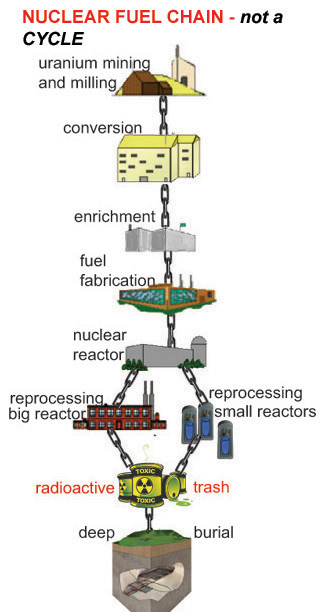
The nuclear lobby is telling one of its finest whoppers – that there really is a “nuclear fuel cycle” – that toxic radioactive wastes can be turned into lucrative nuclear fuel – for a never ending glorious “cycle”
Not true. It is truly a Nuclear Fuel Chain – that the lobby hopes to put around Australians’ necks. The new geewhiz (not yet existing) Liquid Fluoride Thorium Reactors (LFTRs) and Small Modular Nuclear Reactors (SMRs), including the Power Reactor Innovative Small Module (PRISM) – all produce highly toxic wastes that have to be buried. Reprocessing is NOT a “cycle”
SECOND – Rare Earths involve highly radioactive wastes – and require a big switch in DESIGN – so that they can be recycled.
Environmentalists must wake up to this. There must be a paradigm shift from the thinking, (so entrenched in Australia) – from “dig it up – use it – throw it away” – to DESIGN.
The modern technologies that we value – from wind turbines to mobile phones must be redesigned, so that their rare earths can be easily retrieved and re-used.
Otherwise the planet will be further plagued by radioactive wastes from rare earths.
IAEA finds Lynas rare earths plan unsatisfactory – no proper radioactive waste plan
 IAEA reports no long-term plan for Lynas waste, Malaysian Insider 17 October 2014 The International Atomic Energy Agency (IAEA) on Friday gave a passing safety grade to a controversial Malaysia rare earths plant, but raised concerns that there was no long-term plan for properly disposing of the plant’s potentially radioactive waste.
The rare earths processing plant in the state of Pahang has generated opposition from green groups who fear radioactive contamination and have accused authorities and Lynas of overriding public concern.
In a report, the IAEA said it saw little risk of contamination due to the low-level radiation involved, and that its investigators were “not able to identify any instances of non-compliance” with international standards. “Lynas needs to demonstrate that the disposal of solid waste can be carried out in a safe manner over the long-term,” the report said.
It recommended that Malaysian authorities require Lynas to come up with a plan.
“There is a lack of a plan for managing the waste from the decommissioning and dismantling of the plant at the end of its life,” it said……
However, it also appeared to underscore environmentalists’ concerns that Australian miner Lynas Corp has no long-term plan for the disposal of waste from the plant.- http://www.themalaysianinsider.com/malaysia/article/iaea-teams-says-lynas-plant-generates-low-level-radioactive-waste-bernama#sthash.JEFk1poD.dpuf
Risks of uranium mining outweigh any benefits
 Anti-uranium activists criticise NSW exploration program, Australian Mining 15 September, 2014 Vicky Validakis Anti-nuclear campaigners have criticised the NSW government for opening up the state to uranium exploration.
Last week the state government invited six companies to apply for exploration licences.
The move comes two years after NSW overturned a uranium exploration ban. Mining uranium is still restricted.
Three locations around NSW – near Broken Hill, near Cobar and south of Dubbo – have been earmarked for drilling activity.
Natalie Wasley, spokeswomen for the Beyond Nuclear Initiative, said the decision was disappointing, ABC reported.
“Uranium has very unique and dangerous properties and risks,” Wasley said. “It’s linked to the production of the world’s most toxic and long-lasting industrial waste, as well as proliferation of the world’s most destructive weapons, so it poses a risk to workers, to communities and the environment.”
Wasley said the sector will only create a small number of jobs, and claims the risks associated with uranium outweigh any economic benefits. “We know that in rural and regional areas there’s a much better opportunity for long-lasting sustainable jobs in the renewable sector.”
“We’d really encourage those local governments and the state governments to be putting money and resources into developing more creative, long-term and sustainable jobs for people.”……..
The six companies invited to apply for licenses are Australian Zirconia, Callabonna Resources, EJ Resources, Hartz Rare Earths, Iluka Resources and Marmota Energy. http://www.miningaustralia.com.au/news/anti-uranium-activists-criticise-nsw-exploration-p
Uranium mining still prohibited in New South Wales, and not considered economically viable
Uranium exploration in western NSW – but mining is still prohibited NSW Country Hour Sally Bryant and Julie Clift 15 Sept 14, The New South Wales Government has invited six mining companies to put in expressions of interest to explore for uranium, but mining will remain prohibited, until deposits prove economically viable.
However not all of the mining companies who are involved in this process are actually interested in mining for uranium.
One of six companies invited to tender for an exploration licence, Alkane Resources, is developing a rare earth project near Dubbo, in the state’s central west.

Alkane say they’re not interested in uranium, that they are merely protecting their rare earth project from other resource companies applying for an exploration licence over the top of them
Managing Director Ian Chalmers says this is an insurance policy for his company……..http://www.abc.net.au/news/2014-09-15/uranium-exploration-in-western-nsw/5743584
Rare Earths mining in Central Australia
Note: We mightn’t like mining, and it will be good when eventually product design is such that recycling of rare earths will pretty much eliminate this. Still, rare earths are needed in 21st Century technologies, especially in renewables. At least this company is not involved in the difficult and hazardous rare earths processing. I understand that processing is to be done in China, – where, after their disastrous history, they now do have the most advanced methods
Mining company Arafura Resources says plans to mine rare earth minerals in central Australia remain ‘on track’, despite uncertainty over future funding for the project, ABC Rural News 3 Sept 14, NT Country Hour By Carmen Brown
The company hopes to extract up to 20,000 tonnes of rare earth oxide per year from the Nolan’s Bore deposit, 135 kilometres north-east of Alice Springs in the Northern Territory.
A comprehensive project report released this week, indicates mining could begin at the site in 2019, six years later than previously expected. General manager of exploration and business development, Richard Brescianini, says while there has been strong interest in the project from investors, the company is yet to secure full financial backing for the mine……http://www.abc.net.au/news/2014-09-03/rare-earth-mine-on-track-for-central-australia/5715100
1 This month

of the week – Australians for War Powers Reform (AWPR)
To see nuclear-related stories in greater depth and intensity
 Antinuclear