Malaysian Govt urged to halt Australian company Lynas’ thorium extraction plan

https://www.thestar.com.my/news/nation/2023/11/24/govt-urged-to-halt-lynas-thorium-extraction-plan
SEVERAL DAP lawmakers have urged the government to review Lynas Malaysia’s license and stop the plan for thorium extraction from the waste produced at the factory of the rare earth producer.Chow Yu Hui (PH-Raub) said that he remains unconvinced that Lynas Malaysia was capable of extracting thorium.
“Let us not forget that the amount of waste from the Lynas plant was as large as five hills behind its factory. Will the new thorium extraction technology and Lynas be able to manage the radioactive waste which is expected to reach 1.2 million metric tonnes?” he asked reporters at the parliament media centre yesterday.
Oct 24, Science, Technology and Innovation Minister Chang Lih Kang announced that Lynas Malaysia would be allowed to import lanthanide concentrates until its licence expires in March 2026.
He also said that the Atomic Energy Licensing Board (AELB) decided to amend Lynas Malaysia’s license conditions after the company made a proposal to the licensing board about its thorium extraction technology.
With this, Chang said radioactive waste will not be produced after extraction and cracking and leaching activities are carried out on the lanthanide concentrate.
Khoo Poay Tiong (PH-Kota Melaka) said the Science, Technology and Innovation Ministry had announced on May 10 regarding the renewal of Lynas Malaysia’s license until Dec 31.
However, Khoo said that within a period of five months, the government, via AELB, had reviewed Lynas’ licence conditions.
“This matter has raised many concerns regarding the radioactive pollution and safety of locals,” said Khoo, who also wanted to know the parties that came up with the idea of thorium extraction.“We also want clarification from the government on what the possible market for thorium is,” he said.
Tan Hong Pin (PH-Bakri) also pointed out that thorium extraction technology was still in its initial phases, even at the international level.
“To what extent can thorium be extracted, used and commercially extracted? What are the effective measures that can be taken by the government to address the issue and ensure that Lynas will adhere to all the international standards in managing radioactive waste?” asked Tan.
On Nov 16, Chang promised that AELB will closely monitor the thorium extraction process from Lynas Malaysia’s waste material.
Scrutiny on proposal for thorium nuclear reactors for Australia
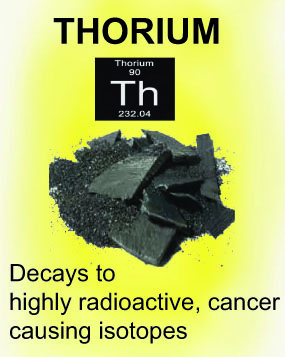
New nuclear power proposal needs public debate https://independentaustralia.net/environment/environment-display/new-nuclear-power-proposal-needs-public-discussion,13071
 By Helen Caldicott | 4 September 2019 The prospect of thorium being introduced into Australia’s energy arrangements should be subjected to significant scrutiny, writes Helen Caldicott.
AS AUSTRALIA is grappling with the notion of introducing nuclear powerinto the country, it seems imperative the general public understand the intricacies of these technologies so they can make informed decisions. Thorium reactors are amongst those being suggested at this time.
The U.S. tried for 50 years to create thorium reactors, without success. Four commercial thorium reactors were constructed, all of which failed. And because of the complexity of problems listed below, thorium reactors are far more expensive than uranium fueled reactors.
The longstanding effort to produce these reactors cost the U.S. taxpayers billions of dollars, while billions more dollars are still required to dispose of the highly toxic waste emanating from these failed trials.
The truth is, thorium is not a naturally fissionable material. It is therefore necessary to mix thorium with either enriched uranium 235 (up to 20% enrichment) or with plutonium – both of which are innately fissionable – to get the process going.
While uranium enrichment is very expensive, the reprocessing of spent nuclear fuel from uranium powered reactors is enormously expensive and very dangerous to the workers who are exposed to toxic radioactive isotopes during the process. Reprocessing spent fuel requires chopping up radioactive fuel rods by remote control, dissolving them in concentrated nitric acid from which plutonium is precipitated out by complex chemical means.
Vast quantities of highly acidic, highly radioactive liquid waste then remain to be disposed of. (Only is 6 kilograms of plutonium 239 can fuel a nuclear weapon, while each reactor makes 250 kilos of plutonium per year. One millionth of a gram of plutonium if inhaled is carcinogenic.)
So there is an extraordinarily complex, dangerous and expensive preliminary process to kick-start a fission process in a thorium reactor.
When non-fissionable thorium is mixed with either fissionable plutonium or uranium 235, it captures a neutron and converts to uranium 233, which itself is fissionable. Naturally it takes some time for enough uranium 233 to accumulate to make this particular fission process spontaneously ongoing.
Later, the radioactive fuel would be removed from the reactor and reprocessed to separate out the uranium 233 from the contaminating fission products, and the uranium 233 then will then be mixed with more thorium to be placed in another thorium reactor.
But uranium 233 is also very efficient fuel for nuclear weapons. It takes about the same amount of uranium 233 as plutonium 239 – six kilos – to fuel a nuclear weapon. The U.S. Department of Energy (DOE) has already, to its disgrace, ‘lost track’ of 96 kilograms of uranium 233.
A total of two tons of uranium 233 were manufactured in the United States. This material naturally requires similar stringent security measures used for plutonium storage for obvious reasons. It is estimated that it will take over one million dollars per kilogram to dispose of the seriously deadly material.
An Energy Department safety investigation recently found a national repository for uranium 233 in a building constructed in 1943 at the Oak Ridge National Laboratory.
It was in poor condition. Investigators reported an environmental release from many of the 1,100 containers could
‘… be expected to occur within the next five years because some of the packages are approaching 30 years of age and have not been regularly inspected.’
The DOE determined that this building had:
Deteriorated beyond cost-effective repair and significant annual costs would be incurred to satisfy both current DOE storage standards, and to provide continued protection against potential nuclear criticality accidents or theft of the material.
The DOE Office of Environmental Management now considers the disposal of this uranium 233 to be ‘an unfunded mandate’.
Thorium reactors also produce uranium 232, which decays to an extremely potent high-energy gamma emitter that can penetrate through one metre of concrete, making the handling of this spent nuclear fuel extraordinarily dangerous.
Although thorium advocates say that thorium reactors produce little radioactive waste, they simply produce a different spectrum of waste to those from uranium-235. This still includes many dangerous alpha and beta emitters, and isotopes with extremely long half-lives, including iodine 129 (half-life of 15.7 million years).
No wonder the U.S. nuclear industry gave up on thorium reactors in the 1980s. It was an unmitigated disaster, as are many other nuclear enterprises undertaken by the nuclear priesthood and the U.S. government.
1 This month

of the week – Australians for War Powers Reform (AWPR)
To see nuclear-related stories in greater depth and intensity
 Antinuclear