Australia-based Bannerman Energy join China’s CNNC for debt-free construction of its Namibian uranium project
World Nuclear News , Friday, 13 February 2026
Australia-based Bannerman Energy has signed a strategic financing and joint venture agreement with China’s CNNC Overseas Limited, paving the way for debt-free construction of its Etango uranium project in Namibia.
Under the agreement, CNNC Overseas Limited (CNOL) – a subsidiary of China National Uranium Corporation (CNUC) and part of China National Nuclear Corporation (CNNC) – and Bannerman will form an incorporated joint venture. This will be done through Bannerman’s UK subsidiary, Bannerman Energy (UK) Ltd (JVCo), by way of CNOL’s subscription for newly issued shares in JVCo, resulting in JVCo ownership of 55% by Bannerman and 45% by CNOL upon completion. JVCo holds a 95% interest in the Etango Project. CNOL will make an initial investment of USD294.5 million into JVCo upon completion.
The agreement includes a provision for additional investment by CNOL of up to USD27 million upon completion, to reimburse Bannerman for CNOL’s 45% share of project-related expenditure incurred between 1 July 2025 and completion. Bannerman and CNOL will each fund post-completion capital expenditure and operating costs of JVCo and the Etango Project pro rata to their respective 55% and 45% equity interests. The agreement also includes a life-of-mine offtake entitlement for CNOL covering 60% of actual production from Etango.
Upon completion, underlying economic ownership of the Etango project will comprise 52.25% Bannerman and 42.75% CNOL, with Namibian social welfare organisation One Economy Foundation (OEF) retaining its 5% loan-carried shareholding.
Bannerman said the agreement “enables debt-free construction of Etango mine – a financing pathway that delivers greater financial and offtake flexibility and with reduced risk”.
The transaction is targeted for completion in mid-2026, pending key conditions including filings with the relevant Chinese government authorities and foreign exchange registration, CNUC shareholder approval, clearance from the Namibian Competition Commission, amendment to the OEF funding agreement, and execution of key infrastructure supply contracts………………………………
Etango is in Namibia’s Erongo uranium mining region, which hosts the operating Rössing (in which CNUC holds a 68.62% stake), Langer Heinrich and Husab uranium mines. The proposed Etango mine received environmental approval in 2010 and the Namibian Ministry of Mines and Energy in 2017 granted Bannerman a five-year, extendable, mineral deposit retention licence over the project. Namibia’s Ministry of Mines and Energy granted Bannerman Energy a mining licence for Etango in December 2023.
https://www.world-nuclear-news.org/articles/bannerman-partners-with-cnnc-for-namibian-uranium-project
Water is under pressure in the Great Artesian Basin.
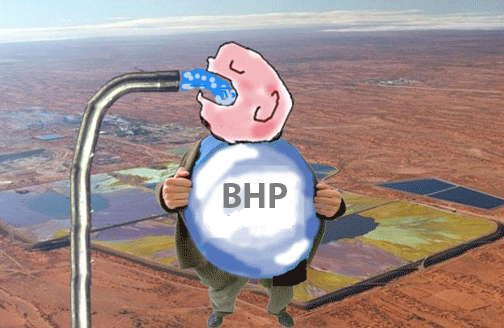
The Great Artesian Basin covers a fifth of Australia and contains water that has been there for millions of years. Now, decades of extraction are taking their toll and traditional owners are fighting a mining giant for compensation.
ABC News, Words by Leah MacLennan & images by Lincoln Rothall, 23 Nov 25
“Each spring carries a story that connects it to the traditional owners — the Arabana people. But they say the environment — and their cultural connection to it — is under threat. Some of the springs have dried up, and the health of others has deteriorated.
“The Arabana people are now fighting mining giant BHP for compensation over what they say is damage to their cultural heritage and the loss of kuta, the Arabana word for water.”
“The federal government estimates business activity in the basin — including agriculture and mining — contributed $33.2 billion to the economy last year.
“Just a few kilometres away from the springs on Arabana Country is a BHP-owned wellfield — known as Wellfield A — that, according to the company, pumps more than four million litres of water per day to its Olympic Dam mine
“The company takes another 29 million litres per day from another area — Wellfield B — further to the west.
“There’s plenty of monitoring data that shows that the extraction that BHP have engaged in supporting the Olympic Dam project has caused draw down and significant reductions in the pressure of the GAB aquifer or aquifers near their site,”
“The company says over the past 15 years it’s reduced its reliance on Wellfield A, and will stop taking from it in the mid 2030s — when there are plans for a government-built desalination plant to service the region.” https://www.abc.net.au/news/2025-11-23/water-is-under-pressure-in-the-great-artesian-basin/106002448
Danish Arbitration Court has decided against Greenland Minerals A/S case to develop uranium industry.

Energy Transition Minerals is an Australian company (formerly Greenland Minerals Limited)
On 28 October 2025, the Arbitration Court ruled on whether the case brought by Greenland Minerals A/S against Naalakkersuisut can be heard by an arbitration court. The Arbitration Court has decided that the issue of the right to exploit minerals at Kuannersuit cannot be brought before an
arbitration court and that the Danish state cannot be a party to the case.
The case was brought before the Arbitration Court by Greenland Minerals A/S on 22 March 2022. According to Greenland Minerals A/S’ claim,
Naalakkersuisut should be ordered to grant the company a permit to exploit minerals at Kuannersuit.
The case arose from the adoption of the Uranium
Act, which prohibits preliminary investigations, exploration and
exploitation of uranium. The Act prevents a permit for exploitation from
being granted in the company’s license area, as the uranium values exceed
the Uranium Act’s de minimis limit.
The Greenland Government was surprised that the company chose to bring the case before an arbitration court, as the Greenland Government’s discretionary decisions can only be brought before the courts, and the Greenland Government has maintained throughout the case that the arbitration court does not have jurisdiction to decide
the case. The arbitration court’s decision was therefore expected.
Naalakkersuisut 28th Oct 2025, https://naalakkersuisut.gl/Nyheder/2025/10/2810_voldgiftsretten
“South Australia’s Copper Strategy lacks ‘social license’ and fails contemporary public interest expectations and environmental and legislative standards”
Re: “South Australia’s Copper Strategy”, Submission To: The Department of Energy and Mining c/o DEM.engagement@sa.gov.au
“SA’s Copper Strategy lacks ‘social license’ and fails contemporary public interest expectations and environmental and legislative standards”
By: Mr David Noonan B.Sc., M.Env.St., Independent Environment Campaigner and Consultant, 12 Dec 2024
The SA Copper Strategy is potentially an important way forward for the SA Gov to instigate and require needed reform in the copper – uranium mining sector in our State.
As an individual I provide this public input and 8 x Public Interest Recommendations (p.11) toward required reform in the sector ‘as part of the development of the refreshed SA Copper Strategy’ due to be released in 2025.
The Department of Energy and Mining should provide a Public Forum on the Copper Strategy before finalisation, I request to attend and participate and offer to be a Member of a Panel Discussion. I raise part of my relevant Background at p.12.
At this stage, the SA Copper Strategy lacks ‘social licence’ and the BHP run copper sector continues to fail contemporary public interest expectations and proper environmental and legislative standards.
Further, the core related Northern Water Project lacks needed ‘social license’ as the SA Gov has to date failed to set clear public commitments to ‘shared benefits’ in protection for the Mound Springs.
It is most important for SA’s Copper Strategy and Northern Water Project realise priority protection for the unique and fragile Mound Springs of the Great Artesian Basin (GAB) with a clear commitment to replace BHP extraction of GAB waters across both Wellfields A and B.
And it is axiomatic the SA Premier can-not credibly look to spend billions of dollars of public monies on water supply and not respect, save and protect the Mound Springs of GAB. – as gems of our State.
Social license, the Gov’s political credibility and public interest standing depend on this outcome.
Please feel free to contact on any aspect of these issues.
Yours sincerely
David Noonan B.Sc., M.Env.St., Independent Environment Campaigner and Consultant, Conservation SA Representative on the Northern Water Project ‘Stakeholder Reference Group’, Seaview Downs, South Australia
‘Loophole’ in Victoria’s uranium ban allows mine to ship element to US
ABC News, By Emile Pavlich and Else Kenned, 8 Nov 24
In short:
Uranium mining is banned in Victoria, but a mine in the state’s west will be able to ship a rare earths concentrate to the US to be processed into commercial quantities of uranium.
The plan has sparked farmer protests, and Friends of the Earth is calling on the Victorian government to block the exports.
What’s next?
The mine is due to start producing and shipping the concentrate in 2026.
A mine in western Victoria is set to produce a commercial quantity of uranium for the first time in Victoria’s history, despite a state ban on uranium mining.
Astron Corporation’s Donald Rare Earth and Minerals Sands Project, about 75 kilometres north of Horsham, was approved by the Victorian government in 2008.
This year, the company received a $183-million funding injection from US uranium giant Energy Fuels, which it said would allow it to start production in 2026.
The company will produce a rare earths concentrate, which will be shipped to the US and refined by Energy Fuels in Utah to produce rare earths and uranium.
The uranium will be sold to US nuclear power plants to generate electricity, according to a memorandum of understanding signed between the two companies last year.
Friends of the Earth national anti-nuclear campaigner Jim Green said there was a “loophole” in Victorian legislation that allowed companies to mine uranium as a by-product of mining other minerals.
Dr Green said that created a “range of issues” around legality, economics and logistics.
“I’m really quite shocked by this proposal, I didn’t see it coming,” he said. “It is a concern and it could certainly lead to other similar proposals.”………………………………….
Nuclear industry banned since 1983
There are three operating uranium mines in Australia, according to Geoscience Australia.
None are in Victoria, where the activity has been banned since nuclear prohibition legislation was introduced in 1983.
Victoria banned uranium mining to “protect the health, welfare and safety of the people” and limit “deterioration of the environment” caused by radioactive substances and nuclear activities, according to the nuclear activities act.
A parliamentary inquiry report examining Victoria’s nuclear prohibition laws, tabled in 2020, found that groups or individuals who proposed changing the government policy did not present sufficient arguments to convince the committee.
“Any advantages are speculative in nature, and do not outweigh the identified and proven risks,” the report found.
If it goes ahead, Astron Corporation’s plan to sell rare earth concentrate to Energy Fuels for processing into uranium and other minerals would be the first example of an Australian rare earths mine producing a commercial quantity of uranium.
The ABC understands Australia’s two existing rare earths mines, Lynas Corporation’s Mount Weld Project and Northern Minerals’ Browns Range project, both in Western Australia, do not produce uranium.
But as the world looks to transition away from fossil fuels, more companies may take up the search, with company Australian Rare Earth announcing in September it would explore for uranium in South Australia.
Changing the fabric of a rural community
The Wimmera region of western Victoria is known as the state’s wheat belt due to its large production of grains and pulses, producing more than 800,000 tonnes on average per year.
In total, 428 square kilometres of land is under Astron Corporation’s mining license and the first phase of the mine, planned to start construction in 2025, covers 28 square kilometres. ……………………………………………………………………………..
………….Regulation concerns
Anti-nuclear campaigner Dr Green said he had concerns about the regulation of the nuclear industry.
“I’ve got safeguards and weapons proliferation concerns,” he said…………………
Dr Green said he also had serious concerns about the White Mesa Mill site in Utah where the uranium would be processed.
“It’s got a long history of controversy, it’s the subject of regular protests from the Ute Mountain Tribe — the local Indigenous people,” he said.
“They have had non-compliance notices from state and federal regulators [and] problems with underground pollution of aquifers.”
The Ute Mountain Ute Tribe and the Center for Disease Control (CDC) and Prevention in the United States are undertaking a study about the health impacts of this site, with results expected next year……….. https://www.abc.net.au/news/2024-11-08/victoria-uranium-mining-ban-loophole-mineral-sands/104473328
BHP’s untenable extraction of Great Artesian Basin waters for the Olympic Dam copper-uranium mine.
Jim Green, 26 Oct 24. BHP has had to move on Mound Springs protection issues regarding untenable extraction of GAB waters for the Olympic Dam copper-uranium mine, and an important Springs Study had now been released by SA Gov modelling reduced water extraction scenarios and affects on Springs & GAB waters.
A significant – if belated and partial – formal public commitment from BHP:
Milestone : FY2030 – cease abstraction from Wellfield A through switching to coastal desalination supply in partnership with the South Australian Government on the Northern Water Supply Project.
This partial win is a key if limited step toward proper protection for the unique and fragile Mound Springs of the GAB in SA, requiring:
is a key if limited step toward proper protection for the unique and fragile Mound Springs of the GAB in SA, requiring:
- closure of untenable BHP Wellfield A operations as soon as possible, that is warranted far sooner than by end of FY2030;
- BHP could prioritise and pay for whatever extent of water recovery at Olympic Dam to replace continued extraction from Wellfield A, which is projected to be run at 3.9 million litres a day ( Ml/d ) over next few years – about 10% of the volume BHP water take from the GAB;
- a campaign path to realise a phase out of the far larger adversely impacting Wellfield B operations that runs at 32 Ml/day, at least from when Northern Water supply becomes available at/after 2028 (this is difficult as BHP & SA Gov now think closing Wellfield A is all they have to do);
- a continued public interest campaign building on a lot of people’s roles and contributions over time…
an important Springs Study:
“Potential Impacts of Reducing Groundwater Abstraction from the Southwestern Great Artesian Basin: Modelled Aquifer Pressure and Spring Flow Response”
By Daniel Partington, Andrew Love, Daniel Wohling, Mark Keppel.
Goyder Institute for Water Research Technical Report Series No. 2024/01https://yoursay.sa.gov.au/84866/widgets/401081/documents/297652
see an extract from Goyder Institute Springs Study (at p.21 of doc & at p.31 of the pdf file, my bold below) citing the BHP commitment:
3.5 Output From the Modelled Scenarios Six experimental abstraction scenarios were proposed by Infrastructure SA to provide a spectrum of stimuli to assess the responsiveness of the aquifer to a change in abstraction volumes. The future abstraction rates from Wellfield A and B have not been confirmed, however there has been public commitment to cease abstraction from Wellfield A if water from the Northern Water project is available (see Olympic Dam Context- Based Water Targets).
Western Australia rules out uranium mining policy change amid nuclear energy push from Peter Dutton

ABC Goldfields / By Jarrod Lucas, 8 Aug 24
In short:
WA Mines Minister David Michael has ruled out any change to the Cook government’s long-standing policy on uranium mining.
There is an effective ban on mining the mineral in WA, where only one uranium mine is permitted to operate.
Peter Dutton says the ban is “ideologically based” and should be overturned.
Western Australia’s mines minister has rejected calls from federal Liberal leader Peter Dutton to overturn the state’s long-standing ban on uranium mining and insisted that future energy needs will be met by renewable sources.
The state has had an effective ban on mining the nuclear fuel since Labor was swept to power in 2017, while Mr Dutton has made nuclear power development the centrepiece of the Coalition’s energy policy.
Speaking on the sidelines of this week’s Diggers and Dealers Mining Forum in Kalgoorlie-Boulder, Mr Dutton said the WA policy should be scrapped.
But WA Mines Minister David Michael, who attended the final day of the forum, poured cold water on the idea and said the state government’s stance on uranium would not be changing anytime soon.
“WA Labor, for two elections, has committed to not approving any uranium mines and there is no intention to change that policy,” Mr Michael said……………………………………………………………………………………..
Mr Michael said he spoke with officials from Deep Yellow at Diggers and Dealers and believed renewables such as wind, solar and battery storage were a safer bet than uranium.
“I think it’s more important to focus on critical minerals in terms of the renewable future,” he said.
“We know that renewable energy is what the world moves to sooner or later.
“We know that’s what we need to tool up for in WA, and we’re doing it.”…………………………………………………………. more https://www.abc.net.au/news/2024-08-08/wa-uranium-mining-policy-to-stay-despite-nuclear-energy-push/104196130
Jabiluka uranium mine lease not renewed in decision heralded as ‘huge win’

NT government opts not to grant 10-year lease after considering wishes of Indigenous people and federal government advice
Australian Associated Press, Fri 26 Jul 2024, https://www.theguardian.com/australia-news/article/2024/jul/26/jabiluka-uranium-mine-lease-not-renewed-in-decision-heralded-as-huge-win?CMP
The lease on the Northern Territory’s Jabiluka uranium mine will not be renewed, months after its remote surrounding area was granted new protections.
Energy Resources Australia (ERA) had applied for a 10-year lease renewal on the Jabiluka uranium mine, but was knocked back on Friday.
The NT mining minister, Mark Monaghan, said the decision to not renew was based partially on advice from the federal government.
“We have gone through a thorough process to ensure that all stakeholder views have been considered in this decision,” he said.
“The federal government advice, along with the wishes of the Mirarr people, were critical to this process and outcome.”
The Northern Territory government declared special reserve status over the Jabiluka area, which is in the surrounds of Kakadu national park, in May.
This prevents any future applications for the grant of a mineral title over the Jabiluka area once the current lease ceases on 11 August.
The Australian Conservation Foundation welcomed the decision, calling it a “huge win” for traditional owners.
“This decision allows a line to be drawn under the divisive era of uranium mining in Kakadu,” a statement read.
“This is a responsible decision that ends the threat that has hovered over this very special place for four decades.”
Mirarr people have long opposed any mining in the area, holding protests in the late 1990s and early 2000s when more than 5,000 people travelled to Kakadu to prevent uranium mining at Jabiluka.
Energy Resources of Australia, a subsidiary of the Rio Tinto Group, has been contacted for comment
Jabiluka’s priceless heritage permanently protected.

“This day will go down in history.”
Gundjeihmi Aboriginal Corporation, representing the Mirarr Traditional Owners of Jabiluka, has today welcomed the decision of Northern Territory Mines Minister Mark Monaghan to refuse mining company Energy Resources of Australia’s application to extend the Jabiluka mining lease. This decision ensures that no mining will happen at Jabiluka, ending a decades-long fight by Mirarr and their supporters.
Mirarr Senior Traditional Owner Yvonne Margarula (pictured above) said:
“We have always said no to this mine, government and mining companies told us they would mine it but we stayed strong and said no. Today I feel very happy that Jabiluka will be safe forever. Protecting country is very important for my family and for me”
The Special Reservation (under the NT Mines Act) will protect Jabiluka from the threat of any mining and takes effect from August 11th when the current lease expires. The next steps for Government will be to seek inclusion in the World Heritage estate and to work with Mirarr to establish a new set of arrangements to incorporate the area into Kakadu National Park.
Gundjeihmi Aboriginal Corporation CEO Thalia van den Boogaard said:
“This news has been a long time coming. It’s a hugely significant day for the Mirarr and for all Australians. Jabiluka will never be mined and the internationally significant natural and cultural value of the site is finally being recognised and will now be protected. The Mirarr and their supporters have been steadfast in their opposition to this mining project for over four decades. Now the job starts of caring for Jabiluka as the heritage of all Australians.
“Mirarr are very concerned that ERA has been in serious financial decline for the past 18 months. Focus now needs to be put on the rehabilitation of the nearby former Ranger uranium mine. It is up to the mining company and the Commonwealth Government to ensure that site is fully rehabilitated so it can be safely returned to the Mirarr and included in the national park.”
Mirarr Traditional Owner Corben Mudjandi welcomed the news:
“This day will go down in history as the day the Mirarr finally stopped Jabiluka. It is great day for the Mirarr people, for Kakadu, the Northern Territory and for Australia. This proves that people standing strong for Country can win. We look forward to welcoming all Australians to share our cultural heritage for decades to come.”
Aboriginal supporter of right-wing racism, Warren Mundine’s interests in mining uranium -not doing too well.
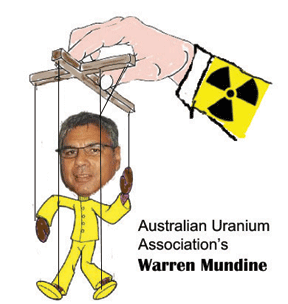
Mundine was one of the two main faces of the “No” campaign against last year’s Indigenous Voice to parliament referendum, campaigning against so-called “elites”.
The Voice “No” campaign was run by far-right lobby group Advance which ran a campaign of aggressively attacking so-called “elites” who it said were behind the Voice.
In fact, as previously reported, the No campaign was bankrolled by a handful of mega wealthy individuals, many with deep ties to the mining and fossil fuels sector.
The struggles facing Aura Energy coincide with a fierce political debate over the future of nuclear energy in Australia, with the federal Opposition calling for a nuclear rollout despite it being vastly more expensive than renewables.
Mundine uranium company shares collapse
ANTHONY KLAN, 9 July 24 https://theklaxon.com.au/mundine-uranium-company-shares-collapse/
A uranium exploration company overseen by businessman Warren Mundine has seen its share price crash after its auditor warned it was in danger of collapse.
Over $60 million has been wiped from the value of ASX-listed Aura Energy since its auditor waived the red flag — and a subsequent emergency capital raising has seen new investors left heavily in the red.
Company document show that on March 15 the auditor of Aura Energy — which states it has “major uranium projects” in “Africa and Europe” — warned there was a “material uncertainty” that it would be able to remain solvent.
Aura Energy had made losses of $9.79m in the 18 months to December 31 and had a remaining cash balance of just $5.86m.
Shares in the company — which is not covered by any analysts or stockbrokers — immediately crashed 33%, to 16.5c.
Aura Energy conducted a capital raising to help it stave off insolvency, but shares it sold under the offer only six weeks ago at 18c yesterday closed at just 13.5c.
Since January — while Australia has been engaged in a fierce debate over nuclear energy — the share price of Aura Energy has halved.
Mundine, who was appointed a director of Aura Energy in December 2021, is a major public advocate of nuclear energy was previously a director of Australian Uranium Association.
The woes facing Aura Energy follow the collapse of the planned $10m IPO of Mundine’s “minerals exploration” company Fuse Minerals in April.
That company, chaired by Mundine, was forced to scrap its plans to float on the ASX after failing to raise enough funds, despite it extending its capital raising period by more than eight-fold, from two weeks to more than four months.
Fuse Minerals had never earned a cent in revenue or conducted a single drill.
Mundine was one of the two main faces of the “No” campaign against last year’s Indigenous Voice to parliament referendum, campaigning against so-called “elites”.
He has repeatedly refused to comment when contacted by The Klaxon.
Company filings show Aura Energy entered a trading halt on March 15 and three days published its accounts for the six months to December 31.
In the six months it lost $2.99m, on the back of $6.80m in losses in the year to June 30, 2023.
In the half-year report, Aura Energy’s auditors Hall Chadwick state there is a “material uncertainty that may cast significant doubt” over the company’s “ability to continue as a going concern”.
In the report Aura Energy’s directors state the company is “dependent on further capital raises or external financing” to stay afloat.
“As the Group is in the exploration stage and does not generate operating cash inflows, the Group is dependent on further capital raises or external financing to maintain operations which results in a material uncertainty which may cast significant doubt on whether the Group can continue as a going concern,” the directors state.
On March 18 — the same day it published those half-year accounts — Aura Energy announced it had conducted a “successful placement” to raise $16.2m from “professional and sophisticated investors” by issuing 90.2m shares at 18c a share.
It would also raise $2m from the public, also at 18c a share, with those shares listed on the ASX on May 30.
Under both raisings, for every four shares bought there were also three “free” attached options, with an exercise price of 30c and a two year expiry. (Meaning they would have value if Aura Energy’s share price goes above 30c in the next two years).
In advertising the public raising, Fuse Minerals said the price of 18c a share was at an “18.2% discount” to the 22c a share they were trading at on the day the offer was announced.
Further, 18c a share was a “23.5% discount” to the average price the shares had been trading at over the five days before the offer was announced.
On the day the public offer shares were listed on the ASX, May 30, the company’s shared were trading at 16.5c.
Yesterday they closed at 13.5c.
At January 1 the company had 623m shares on issue and a share price of 26.5c, giving it a “market capitalisation” of $165.1m.
Yesterday its market capitalisation was $103m, down $62.1m.
The struggles facing Aura Energy coincide with a fierce political debate over the future of nuclear energy in Australia, with the federal Opposition calling for a nuclear rollout despite it being vastly more expensive than renewables.
Mundine and Senator Jacinta Price were the most prominent faces of the “No” campaign against the Indigenous Voice to parliament, which was voted down in October.
Two weeks later Mundine announced he was chair of Fuse Minerals — and that the company was seeking to raise up to $10m and list on the ASX.
The Klaxon subsequently revealed Fuse Minerals owned only one of the nine exploration licences listed in its prospectus — and that its own “independent expert” had warned it was in danger of collapse.
By January Fuse Minerals had raised just $1.86m, well short of the $6m-$10m sought and was legally required to refund money to investors seeking to exit.
On March 28 Fuse Minerals was forced to scrap the offer entirely.
The Voice “No” campaign was run by far-right lobby group Advance which ran a campaign of aggressively attacking so-called “elites” who it said were behind the Voice.
In fact, as previously reported, the No campaign was bankrolled by a handful of mega wealthy individuals, many with deep ties to the mining and fossil fuels sector.
Coalition nuclear policy leaves traditional owners of Kakadu uranium mine worried
ABC News, By Jane Bardon, 3 July 24
In short:
Kakadu traditional owners are worried the Coalition’s nuclear policy will drive demand for uranium mining on their land at Jabiluka.
Energy Resources of Australia (ERA) and traditional owners have asked the NT and federal governments to decide whether to extend the Jabiluka uranium mining lease.
What’s next?
ERA’s majority shareholder Rio Tinto is worried the Jabiluka lease stoush could drive up the costs of rehabilitating its closed Ranger Uranium Mine.
Mirarr traditional owner Corben Mudjandi is desperate for his spectacular land at Jabiluka to be incorporated into Kakadu National Park, which surrounds it, rather than mined for its uranium.
“Its sacred to us, and it’s a piece of human history, 65,000 years, we want Jabiluka not mined; we want to show people the beauty of nature, and what we call home,” he said.
Mr Mudjandi is worried the federal Coalition’s plan to open nuclear plants if it wins government could drive demand for Jabiluka’s uranium.
The Mirarr are also concerned that almost a year after Energy Resources of Australia (ERA) applied to extend its uranium mining lease over Jabiluka for another decade, the Northern Territory and federal governments have not yet decided whether to reject or approve it.
ERA’s current lease expires on August 11.
“The government are following process, but of course we hope they don’t support the application extension,” Mr Mudjandi said.
Senior Mirarr traditional owner Yvonne Margarula said she was worried that although ERA’s Jabiluka lease agreement enabled traditional owners to veto mining, they felt under constant pressure to change their minds.
“The mining companies might come back asking again and again, it’s annoying them asking more, enough is enough, so I hope the government is going to help us,” she said………………………………..
……………………….Professor of Archaeology at Griffith University Lynley Wallis said the Mirarr had a strong case for Jabiluka to be incorporated into Kakadu instead of mined, because of its 65,000 year-old-evidence of occupation.
“Archaeologically the escarpment that’s encapsulated within the Jabiluka mineral lease is unparalleled,” she said.
“There are hundreds of rock shelter sites, almost all of which have paintings in them, of which are incredibly well preserved, and then there are amazing objects that have been cached in those rock shelters, ceremonial wooden objects, grinding stones, spear points and scrapers.
………. the lease agreement includes a traditional owner right to veto mining……………
Lynley Wallis said the Jabiluka mining lease did not provide adequate protection.
“While a company holds a mineral lease over Jabiluka it is possible for them to apply to develop the resources in that land, and any development would pose imminent threat to the cultural sites that are within the lease,” she said.
While some of ERA’s minority shareholders want to keep the Jabiluka lease, which they estimate is worth $50 billion, its majority shareholder Rio Tinto does not.
Jabiluka is ERA’s only potentially valuable asset, but Rio Tinto estimates the rehabilitation costs would be much more than potential profits.
The cost of ERA’s rehabilitation of its neighbouring closed Ranger Uranium Mine on the Mirarr’s land has now blown out to more than $2.5 billion.
ERA is expected to run out of funds by September, and Rio Tinto has promised to fund Ranger’s rehabilitation.
But the ABC understands Rio Tinto is concerned ERA’s application to extend the Jabiluka lease is worrying Mirarr traditional owners so much, that they could delay further agreements needed on how the Ranger mine rehabilitation continues, adding to the project’s soaring costs.
Dave Sweeney, the Australian Conversation Foundation’s nuclear policy spokesman, has called on both governments to end the prospect of mining at Jabiluka.
“ERA are not making any money,” he said.
“They should be focused on getting the assured financial capacity on delivering on their legal obligations rather than appeasing minority shareholders in a fanciful push for a project that will never happen, but increases pressure on traditional owners who’ve had too much for too long.”
A spokesman for the federal Resources Minister Madeleine King said it was up to the NT government whether to renew ERA’s lease.
The spokesman said when Ms King provides her advice to NT government, she would “consider information about Jabiluka in good faith and with appropriate consultation”.
The NT Mining Minister Mark Monaghan would not explain why his government had not made a decision on the lease.
“We’re not delaying the decision, the decision is going through what is a process,” he said.
NT Opposition leader Lia Finocchiaro has backed ERA’s argument on why the lease should continue.
“Importantly that maintains the veto rights for the Mirarr people which we believe continues to be a very important right for them to have,” she said. worried
ERA applies to extend lease on Jabiluka uranium mine against traditional owners’ wishes
ABC Rural / By Daniel Fitzgerald, Thu 21 Mar 2024
- In short: Mining company ERA has applied to extend its lease on the Jabiluka uranium deposit for another 10 years.
- Mirarr traditional owners are fiercely opposed to the lease extension and any mining at Jabiluka.
- What’s next? ERA’s lease application will be assessed by the NT government and the company needs to spend at least $2.4 billion to rehabilitate the former Ranger uranium mine.
A mining company has lodged an application to renew its lease on a uranium deposit surrounded by Kakadu National Park, against the wishes of Indigenous traditional owners.
Energy Resources Australia (ERA) operated the Ranger uranium mine, 250 kilometres east of Darwin, from 1981 to 2021, and is now rehabilitating the mine, at a cost of over $2.4 billion.
Since 1991, the company has also had a the lease on the nearby Jabiluka site — which is one of the world’s largest and richest uranium deposits.
ERA had approval to mine Jabiluka but faced significant opposition from Mirarr traditional owners, which led to a blockade of the mine site by 5,000 people in 1998 and the company’s eventual decision to stop the mine’s development. …………………………………………….
Traditional owners oppose plans
Mirarr traditional owners rejected ERA’s claims that it was in their best interests for the Jabiluka lease to be extended.
Corben Mudjandi said his people were opposed to ERA renewing its lease and had no confidence in the company.
“ERA has a very big problem at Ranger, and this application isn’t helping with that,” Mr Mudjandi said.
“ERA says it wants to protect our cultural heritage at Jabiluka. The best way of doing that is to include it in the World Heritage listed Kakadu National Park where it belongs.”
In 2022, the Mirarr said they were “appalled” an independent report commissioned by ERA suggested traditional owners might reverse their opposition to mining Jabiluka.
ERA to raise funds for Ranger clean-up
Last week, ERA reported a net loss after tax of $1.38 billion in 2023, which included an increase to its rehabilitation provision for Ranger.
ERA had total cash resources of $726 million at the end of 2023 and flagged an equity raise later this year to fund further rehabilitation at Ranger.
“What guarantee is there that this company will be operating in 12 months’ time?” Mr Mudjandi said.
“[Applying to extend Jabiluka] is big talk from a company that is $2 billion short of rehabilitation at Ranger.”
Gundjeihmi Aboriginal Corporation, which represents the Mirarr, said it would seek formal protection of Jabiluka’s cultural heritage through the NT Sacred Sites Act and the Commonwealth Aboriginal and Torres Strait Islander Heritage Protection Act.
“We’ve heard very encouraging words from this company when they assured us Ranger would be cleaned up by January 2026 and look how wrong that turned out to be,” Gundjeihmi chief executive Thalia van den Boogaard said. …………. https://www.abc.net.au/news/2024-03-21/era-lodges-application-to-extend-jabiluka-uranium-lease-nt/103613966
Uranium ship sneaks into ‘nuclear free’ Fremantle port, sparking concern by wharfies over safety
The West Australian, Sat, 6 January 2024
A container ship carrying uranium ore was allowed to dock at Fremantle on Thursday, but was forced to wait for several hours whilst officials checked it was safe for it to berth.
The Maritime Union of Australia said wharfies expressed safety concerns when they became aware of the radioactive cargo.
”They’ve never had that cargo on board that anyone can remember so there was some push back from the workforce, to make sure all the safety requirements were in place,” union organiser Daniel Piccoli told The Sunday Times.
The vessel APL Mexico City was eventually allowed in on Thursday morning and the ship was due to sail on Sunday night.
The uranium stayed in 18 containers on the ship, which had left Adelaide on December 30.
Fremantle Port Authority said that while the cargo was prohibited from being handled, it was permitted for transit through the Port…………………………
Fremantle was a nuclear free zone under a long-time City of Fremantle policy.
According to the policy, “Council would object to uranium, nuclear waste or other material connected with the nuclear power industry being stored or transported in or through the municipality.“
Fremantle Greens MLC and former mayor Brad Pettitt said the transit was unusual, but it raised questions about whether the port workers were adequately informed about the dangerous cargo and were all the safety protocols adhered to.
He said protocols should be transparent as well as strong………. https://thewest.com.au/news/wa/uranium-ship-sneaks-into-nuclear-free-fremantle-port-sparking-concern-by-wharfies-over-safety-c-13132756
Uranium clean-up way over budget, running late… sounds like true nuclear power
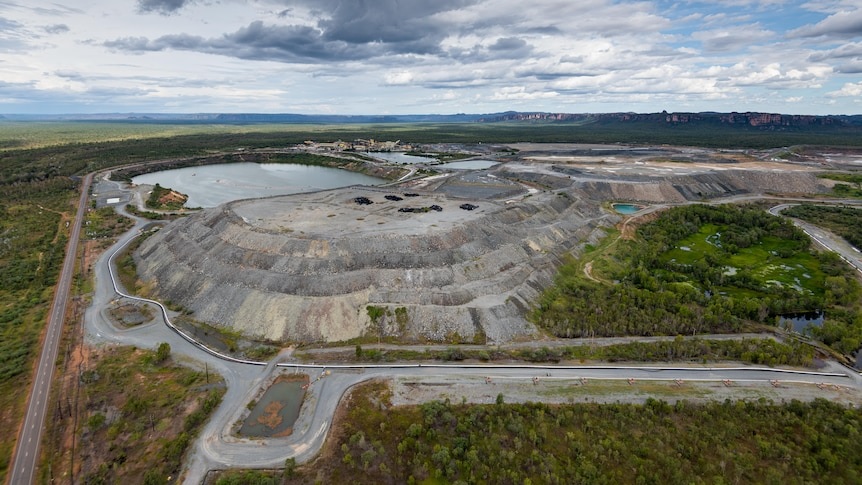
The company cleaning up the Ranger uranium mine in Kakadu says the project is running badly over budget and already late.
Crikey GLENN DYER AND BERNARD KEANE, SEP 28, 2023
Peter Dutton and the radioactive gang of nuclear spruikers in the media seem to think that if only they call for a “mature debate” long enough, small nuclear reactors (SMRs) will just pop into being.
But like any energy source, nuclear power comes with a host of practical challenges that don’t seem to feature in the op-eds and speeches about how SMRs are just around the corner.
Take, for example, the plight of Energy Resources of Australia (ERA) — the almost wholly owned subsidiary of Rio Tinto that operated the Ranger uranium mine in Kakadu in the Northern Territory from 1980 until 2021, when it was closed and rehabilitation work started………………………..(Subscribers only) more https://www.crikey.com.au/2023/09/28/uranium-mine-clean-up-over-budget-running/
Memo to Energy Resources of Australia : You have one job – clean up Kakadu uranium mess
https://www.acf.org.au/memo-to-era-you-have-one-job-clean-up-kakadu 26 Apr 23
Northern Territory and national environment groups have a clear message for Energy Resources Australia at ERA’s annual meeting in Darwin: focus on repair.
ERA is the former uranium mining company that operated the controversial Ranger uranium mine in Kakadu for 40 years, until the cessation of commercial operations in 2021.
The company, majority (86%) owned by Rio Tinto, is now responsible for delivering Australia’s costliest and most complex mine rehabilitation project.
ERA also holds the nearby Jabiluka mineral lease – the site of sustained and successful protest by the Mirarr Traditional Owners and civil society supporters from across Australia and around the world.
Despite Rio’s clear acknowledgement that any possible mining window for Jabiluka is now firmly closed, ERA continues to promote Jabiluka as an asset.
“Rio Tinto has formally accepted there is no credible business case or pathway to advance mining at Jabiluka,” said Environment Centre NT analyst Naish Gawen.
“Rio has stated it will no longer report a Mineral Resource for Jabiluka. It’s time for ERA to do the same.”
Environmentalists inside and outside the meeting will urge the ERA Board to drop the fiction of drilling at Jabiluka and address the fact of required repair at Ranger.
“Repairing the heavily impacted Ranger site is ERA’s legal responsibility,” said ACF’s nuclear policy analyst Dave Sweeney.
“ERA and Rio Tinto will be closely watched and long judged on their performance of this responsibility.”
1 This month

of the week – Australians for War Powers Reform (AWPR)
To see nuclear-related stories in greater depth and intensity
 Antinuclear